ISSN Online: 2161-7627 ISSN Print: 2161-7597
DOI: 10.4236/ojas.2019.93022 May 9, 2019 259 Open Journal of Animal Sciences
An Essential Oil Blend Decreases Methane
Emissions and Increases Milk Yield
in Dairy Cows
Kenton J. Hart
1,2, Hefin G. Jones
1, Kate E. Waddams
1, Hilary J. Worgan
1,
Beatrice Zweifel
3, C. Jamie Newbold
4*1Institute of Biological, Environmental and Rural Sciences (IBERS), Aberystwyth University, Aberystwyth, Ceredigion, UK
2Caltech Crystalyx Siloth, Cumbria, UK 3Agolin SA, Switzerland
4Scotland’s Rural College, Kings Buildings, Edinburgh, UK
Abstract
This study was conducted to investigate the effect of a commercial essential oil (EO) additive on milk production and methane (CH4) emissions from dairy cows. Early lactation Holstein-Friesian dairy cows were fed grass, whole crop wheat and corn silage total mixed ration. Cows were allocated to one of two experimental treatments: Control (no additive, CON) or 1 g/head/day of EO. Cows were housed in a free stall barn, split into two pens for the duration of the experiment. Two gas data loggers units used to measure CH4 emissions were provided per pen for the duration of the 22 week-long study. Milk yield was determined daily, and milk components were analyzed every two weeks. CH4 was recorded continuously, and daily values were tabulated. Body weight and body condition score were deter-mined at the start and bi-weekly. Results were analyzed as a randomized complete block trial. In total, 149 cows participated in the study (76 CON, 73 EO). Milk yields were greater (P < 0.05) for the test treatment (28.3 CON, 31.2 EO) with no change in milk component concentrations. Milk component concentrations were unaffected (P > 0.05) by treatment. Yields of fat, protein, lactose, and solids were higher for EO fed cows (P < 0.05). CH4 output was reduced with the EO compared to the CON treatment (411 g/day vs 438 g/day; 13.8 g/L of milk vs 17.2 g/L of milk, P < 0.05) over the duration of the trial. There were no effects of treatment on reproductive performance or the occurrence of mastitis. Feeding EO to dairy cows re-duced CH4 emissions whilst also increasing performance.
How to cite this paper: Hart, K.J., Jones, H.G., Waddams, K.E., Worgan, H.J., Zwei-fel, B., and Newbold, C.J. (2019) An Essen-tial Oil Blend Decreases Methane Emis-sions and Increases Milk Yield in Dairy Cows. Open Journal of Animal Sciences, 9, 259-267.
https://doi.org/10.4236/ojas.2019.93022
Received: April 12, 2019 Accepted: May 6, 2019 Published: May 9, 2019
Copyright © 2019 by author(s) and Scientific Research Publishing Inc. This work is licensed under the Creative Commons Attribution International License (CC BY 4.0).
DOI: 10.4236/ojas.2019.93022 260 Open Journal of Animal Sciences
Keywords
Dairy Cows, Essential Oils, Methane, Milk Yield
1. Introduction
Agriculture, forestry, and other land uses are responsible for just under a quarter of annual global greenhouse gas (GHG) emissions. Agricultural production ac-counts for approximately half of these emissions [1] with livestock production being the most important contributing factor within this sector. The largest sin-gle contributor to agricultural GHG emissions is methane (CH4) produced dur-ing enteric fermentation, which represents between 32% - 40% of the total GHG emitted from the agricultural sector [1]. Clearly, if the ruminant livestock sector is to continue to flourish and grow, then new technologies must be developed and implemented that allow it to do so while simultaneously decreasing its en-vironmental footprint and maintaining and boosting profitability [2].
Partially in response to the European Union legislation to ban antimicrobial growth promoters in animal production systems and to address concerns over transfer of antibiotic resistance from animals to humans [3] there has been an increased interest in the use of plant extracts to modify rumen fermentation, boost animal production and decrease GHG emissions [4] [5]. Essential oils (EO) are volatile compounds that can be classified as alcohol, ester or aldehyde deriva-tives of phenylpropanoids and terpenoids [6]. As an active component in many spices and preservatives, EO has been used to inhibit bacterial growth for many years [7]. Highly specific effects on rumen bacteria have been reported [8], with the spectrum of antibacterial effect dependent on the EO used [9], suggesting that they may affect rumen fermentation and potential animal productivity. However, generally trials are either conducted in vitro or of short duration with limited production data available [10].
Agolin Ruminant (Agolin SA, Bière, Switzerland) is a commercially available feed additive classified as a premixture of sensory additives within Europe [11]
and approved for use in the United States. The main active compounds within Agolin Ruminant are chemically defined, food grade, plant ingredients including coriander seed oil, geranyl acetate and eugenol. The aim of this experiment was to evaluate the effect of this EO product on the performance of dairy cattle and CH4 emissions from these cows over a longer term basis.
2. Materials and Methods
2.1. Animals and Treatments
be-DOI: 10.4236/ojas.2019.93022 261 Open Journal of Animal Sciences ing randomly allocated to one of two experimental treatments: 0 (CON) or 1 g/day per head of Agolin Ruminant Liquid Formulation (EO, Agolin SA, Bière, Switzerland). There were 69 cows at the start of the trial, and the remaining an-imals were added as they calved by week 10 of the 22-week experiment.
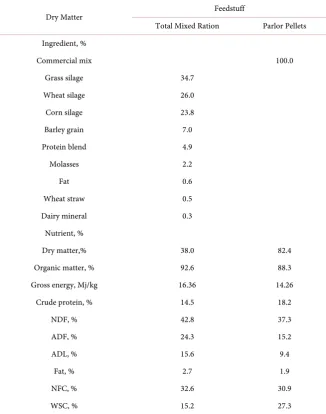
Cows were housed in a well ventilated freestall barn and split by treatment in two halves for the duration of the experiment (Trawscoed Research Farm, Ab-erystwyth, UK). Animals had free access to feed and water at all times. Cows were offered a total mixed ration (Table 1) formulated for a 620 kg cow pro-ducing 35 kg milk/day [12] and fed once daily at 9:00 AM each day. The EO was delivered by weighing the appropriate amount of EO (number of animals in treatment group × 1 g) and diluting to 400 g with water and mixing onto 25 kg of feed pellets (LambMaster, Wynnstay Group Plc., Oswestry, UK). The CON was prepared in the same way except that only 400 g of water was added. The pellets were top dressed on the freshly prepared TMR daily. Sufficient bunk space was available for all cows to access the feed simultaneously. Cows were milked twice daily through a 50-stall rotary parlor at approximately 5:30 and 17:30 during which they received 2.5 kg dry matter (DM) of a commercial parlor concentrate (Table 1) at each milking. Cows were managed for production and fertility in accordance with standard practice. Incidences of mastitis and preg-nancy diagnoses were recorded.
2.2. Data Collection
Four, large animal, CH4 monitors (GreenFeed, C-Lock Inc., Rapid City, SD, USA) were distributed within the freestall barn with each treatment group hav-ing access to two units. Units supplied dry LambMaster pellets to entice animals into the units. Cows were allocated two feeding bouts of 10 portions (50 g) dur-ing each 12 h period. Data were only recorded and used in the calculations of CH4 if animals were at the feeder for at least 2 min throughout the day. The CH4 units measured data in real time and produced 10 sec rolling averages; these were then built up over the day and used to predict daily average CH4.
Milk yields were recorded at each milking. Milk samples were taken fort-nightly at 2 consecutive milkings and analysed for fat, protein, lactose, and total solids (Delta LactoScope FTIR Advanced, PerkinElmer Inc., UK). Cows were weighed, and condition scored [13] every 2 weeks in the opposing week to milk sampling. Additionally, skin and subcutaneous fat depth were measured to the profound fascia on both sides of the animal in the area between the end of the crista sacralis and the os sacrum [14] using ultrasound (CTS-8800 PlusOrtho-pedic Ultrasound, SIUI, Guangdong, China). To ensure continuity between measurements, designated members of trained staff made condition scoring and interpretation of ultrasound images.
2.3. Chemical Analyses
DOI: 10.4236/ojas.2019.93022 262 Open Journal of Animal Sciences
Table 1. Ingredient and nutrient composition of feedstuffs.
Dry Matter Feedstuff
Total Mixed Ration Parlor Pellets Ingredient, %
Commercial mix 100.0
Grass silage 34.7
Wheat silage 26.0
Corn silage 23.8
Barley grain 7.0
Protein blend 4.9
Molasses 2.2
Fat 0.6
Wheat straw 0.5
Dairy mineral 0.3
Nutrient, %
Dry matter,% 38.0 82.4
Organic matter, % 92.6 88.3
Gross energy, Mj/kg 16.36 14.26
Crude protein, % 14.5 18.2
NDF, % 42.8 37.3
ADF, % 24.3 15.2
ADL, % 15.6 9.4
Fat, % 2.7 1.9
NFC, % 32.6 30.9
WSC, % 15.2 27.3
NDF: Neutral detegent fiber; ADF: Acid detergent fiber; ADL: Acid detergent ligin; NFC: Non fiber carbo-hydrate; WSC: Water soluble carbohydrate.
DOI: 10.4236/ojas.2019.93022 263 Open Journal of Animal Sciences
2.4. Statistical Analyses
Fat corrected (FCM) milk and energy corrected milk (ECM) were computed as described by Erdman [16]. Data were analyzed as a randomized complete block using Minitab 16 statistical software (Minitab Inc., State College. PA, USA) Feed intake was analyzed using a T-test with days used for replication. Incidences of mastitis, as well as fertility data, were analyzed using the Chi2 statistic.
3. Results and Discussions
There were 149 cows that participated in the trial. An additional 16 (7 CON and 9 EO) cows that had started the trial were removed over the course of the 22-week study for health reasons not related to treatment, largely mastitis.
Analytic results for the EO concentration of pellets indicated that the level of the additive included in diets was consistently accurate, attaining 98% to 100% of target inclusion. Pellets containing the EO treatment were consumed rapidly, and no evidence of exclusion of timid cattle was observed.
3.1. Milk Production and Composition
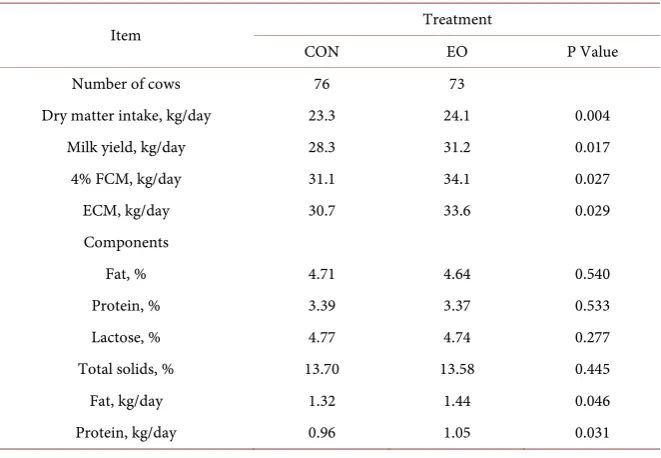
[image:5.595.208.539.498.727.2]The effects of treatment on milk yield and milk component yield are given in
Table 2. Milk yield was greater (P < 0.05) for cows receiving the EO treatment. There were no differences in components on a percentage basis, but component yields were greater for cows receiving the EO treatment. Dry matter intake was increased (P < 0.05) when received the EO treatment.
3.2. Methane Production
Although intakes were higher with the EO treatment, total methane production
Table 2. Milk production and milk composition for cows given diets without (CON) or
with the inclusion of an essential oil (EO) product for an extended period of time.
Item Treatment
CON EO P Value
Number of cows 76 73
Dry matter intake, kg/day 23.3 24.1 0.004
Milk yield, kg/day 28.3 31.2 0.017
4% FCM, kg/day 31.1 34.1 0.027
ECM, kg/day 30.7 33.6 0.029
Components
Fat, % 4.71 4.64 0.540
Protein, % 3.39 3.37 0.533
Lactose, % 4.77 4.74 0.277
Total solids, % 13.70 13.58 0.445
Fat, kg/day 1.32 1.44 0.046
DOI: 10.4236/ojas.2019.93022 264 Open Journal of Animal Sciences was reduced (P < 0.05, Table 3). This suggests that greater quantities of energy would be available both as a result of the greater quantities of feed consumed, and the reduced loss in energy as methane gas. Greater energy availability may have been a factor in greater FCM and ECM in the EO treatment relative to CON.
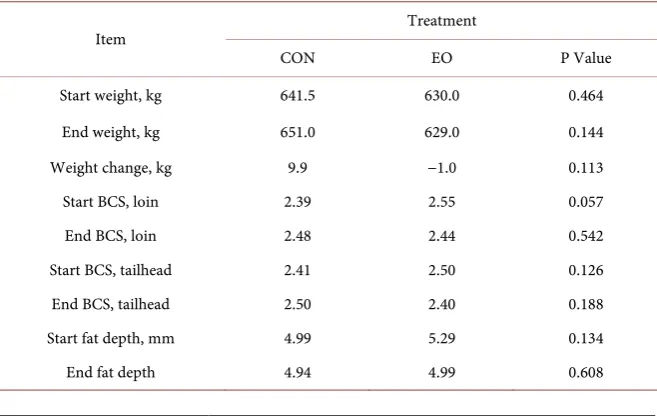
[image:6.595.208.539.373.476.2]3.3. Weight Gain, Body Condition Score (BCS) and Fat Depth
Table 4 provides data for changes in weight, BCS and fat depth as determined by ultrasound. None of the differences were statistically significant (P > 0.05).
3.4. Reproduction and Health
There were no differences in reproductive performance between the two treat-ment groups (Table 5). As well the occurrences of mastitis were similar between the two treatment groups. It would appear that treatment did not impose differ-ences with respect to these parameters.
4. Discussion
There have been two previous trials evaluating this EO blend. In a short-term
Table 3. Methane (CH4) production for cows given diets without (CON) or with the
in-clusion of an essential oil (EO) product for an extended period of time.
Item Treatment
CON EO P Value
CH4 production, g/day 438.3 411.4 0.007
CH4, g/kg milk 17.2 13.8 <0.001
CH4, g/kg FCM 15.6 12.7 <0.001
[image:6.595.209.538.530.738.2]CH4, g/kg ECM 15.8 12.9 <0.001
Table 4. Body weight, body condition score (BCS) and tailhead fat depth (FD) for cows
given diets without (CON) or with the inclusion of an essential oil (EO) product for an extended period of time.
Item Treatment
CON EO P Value
Start weight, kg 641.5 630.0 0.464
End weight, kg 651.0 629.0 0.144
Weight change, kg 9.9 −1.0 0.113
Start BCS, loin 2.39 2.55 0.057
End BCS, loin 2.48 2.44 0.542
Start BCS, tailhead 2.41 2.50 0.126
End BCS, tailhead 2.50 2.40 0.188
Start fat depth, mm 4.99 5.29 0.134
DOI: 10.4236/ojas.2019.93022 265 Open Journal of Animal Sciences crossover trial with 28 day periods, Santos, et al. [17] reported no treatment ef-fect upon milk yield, but improved milk fat yield. Methane was not measured. Castro-Montoya, et al. [18] reported reduced CH4 production for cows fed EO for a 6 week period. Reduced methane output, as well as greater milk production, was experienced for the duration of this trial. It is possible that an extended period of time is needed to discern treatment differences, and that there might be carry-over effects in trials that use a short period crossover design.
5. Conclusion
[image:7.595.208.532.344.696.2]The current trial clearly showed that methane was reduced: CH4 production was 6% less per cow per day, and 20% less per kg of milk for cows fed EO compared to CON for the duration of this trial after the initial three weeks (Figure 1). CH4 per kg of milk produced is possibly the more relevant metric given the need to reduce emissions per unit of output [19]. Likewise, it appears that the energy saved through reduced methane output can be used for productive purposes.
Table 5. Reproductive performance and incidence of mastitis for cows given diets
with-out (CON) or with the inclusion of an essential oil (EO) product for an extended period of time.
Item Treatment
CON EO P Value
Services/conception 2.4 2.4 0.900
Pregnant, % 60.5 69.9 0.468
Clinical Mastitis, number 17 21 0.531
Clinical mastitis, % 22.4 28.7 0.531
Figure 1. Mean methane per kg of milk of cows receiving EO (squares) or CON (circles).
DOI: 10.4236/ojas.2019.93022 266 Open Journal of Animal Sciences Milk yield increased by 3 kg in this study with no change in component per-centages.
Acknowledgements
This study was funded by Climate KIC as part of the project Reduced Methane Emissions from Ruminants (RuMeClean).
Conflicts of Interest
Beatrice Zweifel is employed by Agolin SA and was involved in the design but not the interpretation of the trial reported the other authors declare no conflict of interest.
References
[1] Smith, P., et al. (2014) Agriculture, Forestry and Other Land Use (AFOLU). In: Edenhofer, O., Pichs-Madruga, R., Sokona, Y., Farahani, E., Kadner, S., Seyboth, K., Adler, A., Baum, I., Brunner, S., Eickemeier, P., Kriemann, B., Savolainen, J., Schlömer, S., von Stechow, C., Zwickel, T. and Minx, J.C., Eds., Climate Change
2014: Mitigation of Climate Change, Contribution of Working Group III to the Fifth Assessment Report of the Intergovernmental Panel on Climate Change, Cam-bridge University Press, CamCam-bridge, 811-922.
[2] Scollan, N.D., Greenwood, P.L. Newbold, C.J., Yáñez, D.R., Shingfield, K.J., Wal-lace, R.J. and Hocquette, J.F. (2011) Future Research Priorities for Animal Produc-tion in a Changing World. Animal Production Science, 51, 1-5.
https://doi.org/10.1071/AN10051
[3] Cabello, F.C. and Godfrey, H.P. (2016) Even Therapeutic Antimicrobial Use in Animal Husbandry may Generate Environmental Hazards to Human Health. Envi-ronmental Microbiology,18, 311-313. https://doi.org/10.1111/1462-2920.13247
[4] Hart, K.J., Yanez-Ruiz, D.R., Duval, S.M., McEwan, N.R. and Newbold, C.J. (2008) Plant Extracts to Manipulate Rumen Fermentation. Animal Feed Science and Technology, 147, 8-35. https://doi.org/10.1016/j.anifeedsci.2007.09.007
[5] Knapp, J.R., Laur, G.L., Vadas, P.A., Weiss, W.P. and Tricarico, J.M. (2014) Invited Review: Enteric Methane in Dairy Cattle Production: Quantifying the Opportunities and Impact of Reducing Emissions. Journal of Dairy Science, 97, 3231-3261. https://doi.org/10.3168/jds.2013-7234
[6] Greathead, H. (2003) Plants and Plant Extracts for Improving Animal Productivity.
Proceedings of the Nutrition Society, 62, 279-290.
https://doi.org/10.1079/PNS2002197
[7] Hirasa, K. and Takemasa, M. (1998) Antimicrobial and Antioxidant Properties of Spices. Spice Science and Technology. Marcel Dekker, New York.
https://doi.org/10.1201/9780585367552
[8] McIntosh, F.M., Williams, P., Losa, R., Wallace, R.J., Beever, D.A. and Newbold, C.J. (2003) Effects of Essential Oils on Ruminal Microorganisms and Their Protein Metabolism. Applied and Environmental Microbiology, 69, 5011-5014.
https://doi.org/10.1128/AEM.69.8.5011-5014.2003
DOI: 10.4236/ojas.2019.93022 267 Open Journal of Animal Sciences
[10] Cobellis, G., Trabalza-Marinucci, M. and Yu, Z. (2016) Critical Evaluation of Essen-tial Oils as Rumen Modifiers in Ruminant Nutrition: A Review. Science of the Total Environment, 545, 556-568. https://doi.org/10.1016/j.scitotenv.2015.12.103
[11] European Commission (2003) Regulation (EC) No 1831/2003 of the European Par-liament and of the Council of 22 September 2003 on Additives for Use in Animal nutrition. Official Journal of the European Union, L268, 29-43.
[12] Thomas, C. (2004) Feed into Milk, a New Applied Feeding System for Dairy Cows: An Advisory Manual. Nottingham University Press, Nottingham.
[13] DEFRA (2001) Conditions of Dairy Cows.
https://www.gov.uk/government/uploads/system/uploads/attachment_data/file/693
71/pb6492-cattle-scoring-diary020130.pdf
[14] Schröder, U.J. and Staufenbiel, R. (2006) Invited Review: Methods to Determine Body Fat Reserves in the Dairy Cow with Special Regard to Ultrasonographic Mea-surement of Backfat Thickness. Journal of Dairy Science, 89, 1-14.
https://doi.org/10.3168/jds.S0022-0302(06)72064-1
[15] Belanche, A., Lee, M.R.F., Moorby, J.M. and Newbold, C.J. (2013) Comparison of Ryegrass and Red Clover on the Fermentation Pattern, Microbial Community and Efficiency of Diet Utilisation in the Rumen Simulation Technique (Rusitec). Animal Production Science, 53, 1052-1064. https://doi.org/10.1071/AN12183
[16] Erdman, R. (2011) Monitoring Feed Efficiency in Dairy Cows Using Fat-Corrected Milk per Unit of Dry Matter Intake. Proceedings of Mid-Atlantic Nutrition Confe-rence,College Park, 23-24 March 2011, Vol. 9, 69-79.
[17] Santos, M.B., Robinson, P.H., Williams, P. and Losa, R. (2010) Effects of Addition of an Essential Oil Complex to the Diet of Lactating Dairy Cows on Whole Tract Digestion of Nutrients and Productive Performance. Animal Feed Science Tech-nology, 157, 64-71. https://doi.org/10.1016/j.anifeedsci.2010.02.001
[18] Castro-Montoya, T., Peiren, N., Cone, J.W., Zweifel, B., Fievez, V. and De Camp-eneere, S. (2015) In Vivo and in Vitro Effects of a Blend of Essential Oils on Rumen Methane Mitigation. Livestock Science, 180, 134-142.
https://doi.org/10.1016/j.livsci.2015.08.010