doi:10.4236/wsn.2011.35019 Published Online May 2011 (http://www.SciRP.org/journal/wsn)
Implementation Study of a Centralized Routing Protocol
for Data Acquisition in Wireless Sensor Networks
Trung Hieu Pham1, Xue Jun Li1, Wai Yee Leong2, Peter Han Joo Chong1 1
School of Electrical and Electronic Engineering, Nanyang Technological University, Singapore City, Singapore
2
Singapore Institute of Manufacturing Technology, Singapore City, Singapore E-mail: [email protected]
Received January 17,2011; revised February 27, 2011; accepted April 6, 2011
Abstract
Wireless Sensor Networks (WSNs) attract considerable amount of research efforts from both industry and academia. With limited power and computational capability available on a sensor node, robustness and effi-ciency are major concerns when designing a routing protocol for WSNs with low complexity. There are vari-ous existing design approaches, such as data-centric approach, hierarchical approach and location-based ap-proach, which were designed for a particular application with specific requirements. In this paper, we study the design and implementation of a routing protocol for data acquisition in WSNs. The designed routing protocol is named Centralized Sensor Protocol for Information via Negotiation (CSPIN), which essentially combines the advertise-request-transfer process and a routing distribution mechanism. Implementation is realized and demonstrated with the Crossbow MicaZ hardware using nesC/TinyOS. It was our intention to provide a hand-on study of implementation of centralized routing protocol for WSNs.
Keywords:Wireless Sensor Network, Three-Way Communication, Centralized Sensor Protocols for Information Negotiation
1. Introduction
Thanks to recent advances in wireless communications [1] and electronics technologies, wireless devices with low price and high performance are now available in the market. Wireless communications can be infrastructure- based, e.g., multihop cellular networks [2], as well as infrastructureless, e.g., ad hoc networks. Recently, one type of ad hoc network, namely wireless sensor network (WSN) [3], becomes increasingly popular due to its wide applications, high flexibility and low cost. During the implementation of a WSN, adoption of small or even tiny devices is the first priority and the devices are usu-ally referred to as sensor nodes. Unlike the traditionusu-ally large-size wireless devices, sensor nodes have many constraints such as scarce memory, limited power and low computational capacity. Furthermore, these sensor nodes are more prone to failures than other wireless communication devices. In addition, WSN is normally composed of a large number of sensor nodes. Therefore, as compared to conventional cellular networks, different approaches in designing wireless networking protocols are required for a WSN [4].
Many existing sophisticated networking protocols and algorithms that generally support point-to-point commu-nications in traditional networks are not suited to the requirements of WSNs. Moreover, most of sensor nodes are usually unable to establish one-hop connections di-rectly with the base stations or fixed access points due to their limited power, which unfortunately limits their transmission range. Consequently, they have to rely on multihop transmissions in order to communicate with the desired nodes, through data forwarding with the aid of their neighbors.
for WSN [5].
In this paper, we design and implement a data-centric centralized routing protocol, namely Centralized Sensor Protocol for Information via Negotiation (CSPIN), which combines advertise-request-transfer process in SPIN [6] and the routing distribution mechanism. Two main ob-jectives are to provide centralized control to the base station and to reduce unnecessary transmissions over the network.
The rest of this paper is organized as follows. Section 2 analyzes the challenges and requirements for the de-sign of an efficient routing protocol for WSNs. Section 3 presents the design concept using a general routing model and Section 4 describes the CSPIN implementa-tion with Crossbow MicaZ hardware using nesC/TinyOS. Then the operation of CSPIN is explained in detail in Section 5. Finally, Section VI discusses and concludes about the work.
2. WSN Routing Protocol Design Challenges
This section provides the list of all the important and common challenges that are encountered by aforemen-tioned applications. With these technical challenges in mind, we can be able to focus the critical issues during the design and implementation of a routing protocol for WSNs.
2.1. Hardware Challenges
1) Node Failure: since the sizes of sensor nodes are normally small, they are more prone to failure due to lack of power, physical damages or environmental inter-ference [3]. Thus, the entire network may be suspended or interrupted because WSN relies on multihop transmis-sions from each other. As a result, an adaptive routing protocol needs to be used to ensure reliability of the network if case of these failures.
2) Node Density: since the number of sensor nodes in WSN may be in the order of hundreds or even thousands, depending on the requirement of a particular application [3], the network requires robust and flexible routing schemes to efficiently utilize a single node’s processing capacity.
3) Power Limitation: due to their limited battery ca-pacity, sensor nodes have a very short transmission range. Besides, the distance between a particular source-desti-nation pair may be very long so that multihop transmis-sion should be adopted due to out of communication range between them. In other word, the source node needs to rely on its neighboring sensor nodes to forward data towards to the destination node.
4) Computational Capability: usually a small or even
tiny sensor node needs to include all the required func-tion blocks, such as sensing block, data processing block and wireless transceiver. These requirements obviously result in many limitations on the capability of a sensor node, such as limited power, slow processing speed and scarce memory.
5) Sensing Purposes: WSNs will provide different kind of services to have different type of sensor nodes such as sound sensors and temperature sensors for acous-tic surveillance and volcanic monitoring, respectively. Consequently, communication links between different sensor nodes may not be the same type due to their par-ticular hardware platforms and abilities.
6) Autonomous Capability: WSN must have its autonomous capability such that each sensor node has to collect and process data independently without any hu-man intervention for a long period of time. Thus, it is good to have central stations to query for data or send other commands over the network because central sta-tions are usually under manual control.
2.2. Design Challenges
The design of a new protocol requires the consistency of functionalities implemented in modules and interfaces. Minimizing unnecessary coupling between modules re-sults in the reduction in effort to combine and implement new functionalities. Moreover, it is highly desirable that the protocol designed for one particular application can be reused in other applications. Since co-existing proto-cols with modules to implement overlapping functional-ities unnecessarily occupy extra resources in terms of memory and energy, the life time of resources con-strained sensor nodes can be prolonged by maximizing code reuse code portability [7].
3. Design Framework and Layout
We are enlightened by the pioneer work presented in [7], which not only provided a good starting point to imple-ment our proposed routing protocol, but also outlined general rules for us to use in this work to make sure that the result discussed in this paper is generic enough to be reused. Similarly, it is also of our interest to develop some function modules that might be useful for other researcher during their implementation of networking protocols for WSNs.
protocols for sensor networks was examined in order to identify their common parts. Fortunately, this inspection results in a possible division of the protocol into several function modules, among which certain function mod-ules can be shared by all or some of the protocol. Con-sequently, this methodology was then used to design a general layout of components that provides a frame-work for implementing the routing protocol [8]. The working mechanism of the layout is illustrated in Fig-ure 1. In particular, the layout is divided into two parts—the data plane and the control plane. Imple-menting the control plane is not surprisingly much more complicated, since it is fully responsible to accommo-date the routing protocol.
As shown in Figure 1, headers of packets coming from the lower or upper layer are examined by the Dis-patcher in order to determine the protocol to which the packet belongs, and then these packets will be passed to an appropriate protocol service, which may include a Forwarding Engine, a Routing Engine and a Topology Engine. These protocol services are revisited as follows:
1) Forwarding Engine—Forwarding Engine is not aware of the protocol format and algorithms, though it is part of a protocol service. Its function simply include: 1) before forwarding a packet, Forwarding Engine will request the Routing Engine to fill the routing header; 2) when the packet has reached its destination, Forwarding Engine will deliver the packet to the upper layer. For-warding Engine belongs to the protocol service because it may perform those tasks dependent on the protocol, such as packet aggregation or scheduling.
2) Routing Engine and Topology Engine—They are the core components of a protocol. In brief, the Routing Engine generates and processes control packets. Next, according to the data reported by the Routing Engine, the Topology Engine computes and stores the necessary in-formation about the network topology.
[image:3.595.308.539.379.693.2]3) Output Queue—It handles the packets to be sent
Figure 1. Network layer decomposition with flow of packet and control information [8].
from all the protocols running on the node, which can schedule them according to the node policy due to the fact that all packets must go through this component.
4. Design and Implementation of CSPIN
As show in Figure 2, the implementation of CSPIN was realized by a configuration component, namely CSpin-NetworkC, whose objective is to transparently send and receive data in a multihop WSN. CSpinNetworkC pro-vides the wiring illustrated in Figure 2, which should certainly include a transport protocol to transport data through multihop route because CSPIN is a routing pro-tocol. Any transport protocol using a 16-bit address can be adopted. In this paper, we refer to the transport pro-tocol as Multihopping (MH). Through CSpinNetworkC via the SubReceive interface, CSPIN can possibly inspect all the multihop data packets that flow through this node and decide where the next hop is.
[image:3.595.62.284.543.693.2]Next, the SplitControl interface initiates the network layer and SplitControl is implemented by a dedicated module, NetControlM, while the link layer is imple-mented by ActiveMessageC module. Before letting the application use the network layer, NetControlM waits for
all other components to start. After that, multihop pack-ets, including adverting, requesting and responding packets, can be then sent and received by the application and these packets may be manipulated with the MHSer-viceC component.
[image:4.595.327.513.75.247.2] [image:4.595.311.536.276.461.2]Consequently, the RouteDistributeC and MHServiceC components are responsible for all the processing and packet manipulations related to their respective protocol since they are the protocol services. In particular, each service has its own sending and receiving queue, an in-stance of AMSenderC and AMReceiverC. Although this is not depicted in Figure 2 for simplicity reasons, it does not break the single Output Queue principle and these queues rely on ActiveMessageC to exchange packets within the radio chip. ActiveMessageC actually plays the role of the Output Queue, which utilizes the parameter-ized wiring feature of nesC [9] in order to process the packets to the AMReceiverC and from the AMSenderC components. As a consequence, a Dispatcher component is not necessary. The ActiveMessageC component pro-vides the link-layer feedback by possibly request hard-ware acknowledgements for each packet sent, and thus determine if the packet has been received by a neighbor. Interactions between components are shown in Figure 3 and Figure 4 when the application sends and forwards a packet to the base station, respectively. Before sending a packet, the application must wait for a routing message to compute its routing tables. After that, it sends the packet as if it was a single-hop packet. The packet is passed to the MHServiceC component (as illustrated in Figure 5), which is aware of how to obtain a route, though it does not know how the routing protocol oper-ates. The route is obtained from the RoutingTableC,
Figure 3. Flow chart of a node sending a message.
MHServiceC
RoutngTableC forward
message a routequery
RoutngDistributeC
Route available? check available
route
AMStack send packet update
routes
Yes No ForwardingEngineM
Wait queue
Figure 4. Flow chart of a node forwarding a message.
MHSend Receive
AMSend Receive ForwardingEngineM
Subsend SubReceive AMPacket RoutingSelect
RoutingTable RoutingTableC RoutingSelect
SubReceive AMPacket AMSend
[image:4.595.80.263.489.700.2]MHServiceC
Figure 5. Modified MHService Component [8].
which is shared by both of the protocol services. There-fore, when the routing table is updated and signals to the application, MH service will be able to deliver the packet to the next hop along the route. Then, the application is signaled by the sendDone event and it may reuse the packet buffer.
Rout-ingEngineM handles the received routing packets through direct connections to the AMSend and Receive interfaces. Processing a packet may take a long time and it thus is implemented as a split-phase operation. A rout-ing packet is passed to the RoutingTableM module upon reception, which returns immediately by posting a task to read the packet. The information contained in a packet will be judged whether it is useful or not, and then de-cided if it should be propagated accordingly.
The route determined by the CSPIN protocol necessi-tates the usage of a multihop transport protocol because CSPIN services rely on it to fully function, which was unfortunately available in the TinyOS 2.0 distribution. Nevertheless, we have designed and implemented one, which allows for a directly usable multihop network layer to applications. Different from the CSPIN service, the MH service does have a Forwarding Engine.
As shown in Figure 5, the Forwarding Engine re-quests ForwardingEngineM to fill the AM fields in order to put the packet on the route toward the base station when a MH packet is received from the AM layer or sent by the application. The Forwarding Engine will not dis-card the packet if no route is immediately available be-cause of its reactive nature. Next, the Forwarding Engine was made as generic as possible and does not rely on any MH-specific interface because it does not have any func-tionality specific to the MH protocol. As a result, it may therefore be used by other protocol services.
5. CSPIN Working Mechanism
As a data-centric protocol, CSPIN explicitly stores the routing path to the base station. More precisely, routing information periodically propagates from node to node. Starting from the central node, a node will compute the shortest route towards the desired destination and update their routing tables accordingly upon receiving the rout-ing information. Since routrout-ing tables are constantly maintained, little processing is needed when a node wants to send or forward a packet, which reduces com-munication latency.
5.1. Routing Distribution Mechanism
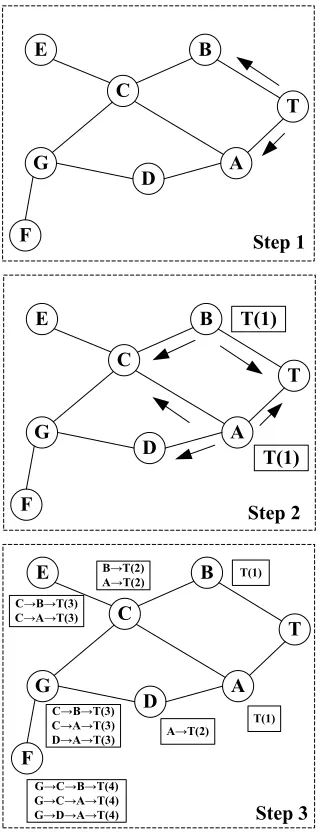
As shown in Figure6, CSPIN routing distribution makes it more centralized because the routing information is distributed from the central node [5].
Routing Advertisement: The advertisement (RouteADV) message is broadcast by base station periodically. All the nodes within its transmission range first receive the message. Then they build their routing tables based on the distributed routing information. Meanwhile, each of them will separately update the RouteADV message in
T
A B
D C E
G
F Step 2
T(1)
T(1) T
A B
D C E
G
F Step 1
T
A B
D C E
G
F
Step 3
T(1) T(1)
A→T(2) B→T(2) A→T(2) C→B→T(3) C→A→T(3)
C→B→T(3) C→A→T(3) D→A→T(3)
[image:5.595.344.502.77.495.2]G→C→B→T(4) G→C→A→T(4) G→D→A→T(4)
Figure 6. Three steps of route distribution.
order to encapsulate new routing information accord-ingly.
Routing Information Propagation: The routing infor-mation is propagated throughout the network by broad-casting the new RouteADV messages. Then, the neighbors receive, process and update it, so on and so forth.
5.2. Routing Logic Update
routing advertisement is a new distribution sent from the base station or it has a smaller route sequence number, the receiving node will definitely update its routing table without any further process. Otherwise, the received routing advertisement will be further processed with the second condition of the number of counted hops. Table 1 shows the logical steps how a node update its routing table.
During the processing, the content of the message is updated. Sensor nodes add information about themselves, which will be useful for surrounding nodes in determin-ing the routdetermin-ing path. Moreover, hop counts are incre-mented and routing information that was considered un-useful is removed from the message so that it is not propagated further.
Routing Information Updating: Nodes only update their routing tables when they receive a new RouteADV or the RouteADV which has a smaller hop count than the local value.
Practically, if a new node joins the network, it will remain silent until a RouteADV message is received. Upon completing the computation of the shortest path, it knows to which address to send or forward a packet in order to reach the base station. Moreover, instead of storing global knowledge of a full path, each routing table contains only one-hop closer addresses, which re-duces the complexity of architecture of the protocol and computational processing.
5.3. Three-Way Communication Procedure
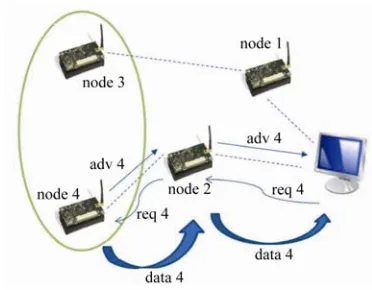
As shown in Figure 7, the three-way communication helps CSPIN reduce unnecessary transmissions in the network. It also gives more control ability to the central node over the network.
1) Adverstise: Joined nodes regularly advertise them-selves to the central node using node advertisement (nodeADV) messages. These messages include the iden-tification, number of hops and full path information; upon processing all of them will provide the global knowledge of network topology. In other words, the base station has the list of available nodes, as well as the spe-cific path to reach each of them.
[image:6.595.329.515.77.222.2]2) Request: In order to obtain the data of a particular node in a specific interested region, the base station is-sues a request (REQ) message to this node.
Table 1. Logical condition for update.
new_route = rcv_newRoute or (rcv_routeSeq > local_routeSeq) or
((local_routeSeq – rcv_ routeSeq) > MAX_SEQ/2) or ((rcv_routeSeq = local_routeSeq) and (rcv_hopCount < local_hopCount))
Figure 7. Three-way communication of data acquisition.
3) Transfer: The requested node in response starts sens-ing and sends its sensed data back to the sink. Since the data acquisition goes through three steps of advertising, requesting and responding, it is therefore called three- way process. This process ensures that only interested nodes and their corresponding regions are focused on.
6. Performance Evaluation
The proposed protocol was tested in TinyOS SIMulator (TOSSIM) [10] before hardware implementation so as to ensure its correctness and compliance with the proposed specifications. TOSSIM is a simulator provided with the TinyOS distribution, which runs codes written in nesC. It is thus possible to benefit from the advantages of a simulator without having to rewrite the application in a specific language. TOSSIM provides an interface to the execution of the TinyOS application, and the user writes a program in C, C++ or Python to control the execution of the simulation.
[image:6.595.58.287.658.720.2]Finally, energy-saving operation is a certain require-ment in the future implerequire-mentation. Nodes when operat-ing in energy-savoperat-ing are able to alternate between sleep and wake-up states. They would be in the sleep mode most of the time and wake up when it is needed. Spe-cifically, if there is no transmission or reception, each node turns off unnecessary activities to save power. When it has a message to send or there is a message coming, it turns on these activities on to carry out the process. Performance study about the effect of the pro-posed CSPIN on other system parameters, such as power dissipation, throughput, bit error rate and end-to-end de-lay, were left for future work.
TestM Component
Interface3 Interface4 Interface5
[image:7.595.58.287.78.152.2]Interface1 Interface2 Interface3 Interface4 Interface5 Interface1 Interface2
Figure 8.The generic wiring of a test program.
8. References
[1] T. S. Rappaport, “Wireless Communications: Principles and Practice,” 2nd Edition, Prentice Hall, New Jersey, 2002.
Figure 9. Four nodes topology with multihop routing.
[2] X. J. Li, B.-C. Seet and P. H. J. Chong, “Multihop Cellu-lar Networks: Technology and Economics,” Computer Networks, Vol. 52, No. 9, 2008, pp. 1825-1837.
doi:10.1016/j.comnet.2008.01.019
cal nodes. After simulation study by TOSSIM, we have implemented CSPIN into CrossBow nodes to demon-strate its functionality. Experimental results from
Cross-Bow nodes show that it works well. [3] I. F. Akyildiz, W. Su, Y. Sankarasubramaniam and E. Cayirci, “Wireless Sensor Networks: A Survey,” Com-puter Networks, Vol. 38, No. 4, 2002, pp. 393-422.
doi:10.1016/S1389-1286(01)00302-4
7. Discussions and Conclusions
[4] H. Karl and A. Willig, “Protocols and Architectures for Wireless Sensor Networks,” Wiley,New Jersey, 2005.
doi:10.1002/0470095121
The goal of this paper is to design and implement a data- centric multihop routing protocol that is suitable for data acquisition in wireless sensor networks. The results ob-tained by CSPIN in a small WSN meet the design re-quirements (centralized control and reduced redundant transmission). However, performance of the CSPIN is yet fully evaluated in terms of scalability, energy consumption and comparison with other routing protocols due to tech-nical issues. CSPIN still has much room for improvements. Currently, it is only a simple disseminated routing proto-col that supports multihop. There is no reliable communi-cation over links, which heavily impacts on the network performance when the size of the network gets bigger. As a result, providing a reliable transmission over communi-cation links is necessary. This will make sure the requests reach the requested nodes and collected data arrive at the base station without any loss.
[5] K. Akkaya and M. Younis, “A Survey on Routing Proto-cols for Wireless Sensor Networks,” Ad Hoc Networks, Vol. 3, No. 3, 2005, pp. 325-349.
doi:10.1016/j.adhoc.2003.09.010
[6] J. Kulik, W. Heinzelman and H. Balakrishnan, “Negotia-tion-Based Protocols for Disseminating Information in Wireless Sensor Networks,” Wireless Networks, Vol. 8, No. 2-3, 2002, pp. 169-185.
doi:10.1023/A:1013715909417
[7] T. E. Cheng, R. Fonseca, S. Kim, D. Moon, A. Ta-vakoli, D. Culler, S. Shenker and I. Stoica, “A Modular Network Layer for Sensornets,” Proceed-ings of ACM ODSI’06, Seattle, 6-8 November 2006, pp. 249-262.
[8] “TinyOS Documentation Wiki,”
http://docs.tinyos.net/index.php/Tymo. Next, another issue is the scalability of the WSN.
CSPIN can operate properly in small network because the number of hops is small. If the network grows larger, certain nodes have to handle more processes, which will shorten the battery life of these nodes, and subsequently cause data transmission interruptions. Furthermore, over-flow control is therefore needed to manage these situa-tions. Nodes are able to switch over limited transmis-sions to the other nodes that are idle or have light
com-utational load.
[9] D. Gay, P. Levis, R. von Behren, M. Welsh, E. Brewer and D. Culler, “The NesC Language: A Holistic Approach to Networked Embedded Systems,” Proceedings of ACM SIGPLAN’03, San Diego, 11-13 June 2003, pp. 1-11. [10] P. Levis and N. Lee, “TOSSIM: A Simulator for
TinyOS Networks,” Proceedings of the ACM SIG-PLAN 2003 Conference on Programming Language Design and Implementation, Vol. 38, No. 5, 2003, pp. 1-11. doi:10.1145/781131.781133
[image:7.595.57.287.183.288.2]![Figure 1. Network layer decomposition with flow of packet and control information [8]](https://thumb-us.123doks.com/thumbv2/123dok_us/9041852.400499/3.595.308.539.379.693/figure-network-layer-decomposition-flow-packet-control-information.webp)
![Figure 5. Modified MHService Component [8].](https://thumb-us.123doks.com/thumbv2/123dok_us/9041852.400499/4.595.80.263.489.700/figure-modified-mhservice-component.webp)