Contents lists available atScienceDirect
Operations Research Perspectives
journal homepage:www.elsevier.com/locate/orp
Advancing lean management: The missing quantitative approach
Antony Pearce
a,⁎, Dirk Pons
baUniversity of Canterbury, Christchurch, New Zealand
bDepartment of Mechanical Engineering, University of Canterbury, Private Bag 4800, Christchurch 8020
A R T I C L E I N F O
Keywords: Lean Management Review Research Quantitative
Structural equation modelling
A B S T R A C T
For 25 years, the methodologies employed to study lean management have gone relatively unchallenged. This paper reviews the development of the lean body of knowledge and reveals that the vast majority of research, being qualitative, relied heavily on researcher subjectivity. Quantitative analyses are needed to verify and strengthen existing literature and especially confirm the critical factors for lean success. Various theories re-quiring validation were identified and studies that incorporate Structural Equation Modelling were proposed. Such studies would advance industry practice, giving the tangible statistical evidence needed for educating practitioners. Practitioners are encouraged to consider the empirical basis of lean publications.
1. Introduction
Lean developed in the Japanese automobile industry as a manage-ment strategy. It focuses on continuous improvemanage-ment at creating value with the elimination of waste[1–4]. Lean management is now applied well beyond its manufacturing roots[5]and said to enhance business practice universally [3]. However, as a popularised management system, it is subject to the lifecycle of a fad; creation, development, and ultimately after time, decline[6].
Whilst being considered the industry standard for systematic pro-ductivity improvement[7,8], the success of lean in a large variety of industries is tainted by many failed implementations [9,10]with re-ports of 60–90% of improvement programs failing[11–13]. Due to this, lean has been labelled in industry as a fad and critiqued for not being applicable beyond mass production[14,15]. Earlier critiques[16–18] have been addressed as misunderstanding lean[4,19]but the question of what successful lean management is contingent or reliant on, is still being raised[20–22]. And whilst outright acceptance of the critiques would neglect the growing number of successful implementations in a wide variety of industries [14,23,24], the high failure rate and dis-parate views on its benefits and even its definition [25–28]show in-adequacies in the body of knowledge. It is not clear what in lean is just fad as opposed to what can be leveraged for truly enhancing business practice.
The purpose of this work was to reassess and recalibrate the di-rection of lean research, to identify how best to address the in-adequacies and thereby advance the body of knowledge. The objective being to identify which scientific approach and specific
research-method is best suited to achieving this goal.
Although many studies of lean management have taken place over the past 25 years, the research philosophies and methodologies used in these studies have not been challenged. This is not that the methods used are necessarily wrong, but that other research approaches could have been overlooked or some methods may not have been used to their full potential. Such approaches could strengthen weaknesses in the existing studies, providing further insight and understanding of lean and its success factors. Further research that develops a better under-standing of lean and its implementation can be stimulated by identi-fying the type of questions that need to be asked and the specific ap-proaches that needs to be taken. Ultimately, what is the fad can be separated from what provides true value to organisations.
2. Methodology
This work did not repeat the analysis of contemporary systematic reviews[29–32]but purposed to provide the next step and a definite direction for lean research. To do this, first the body of knowledge and its development were reviewed. Second, the research methods used in its development were critiqued and the core research deficiencies were identified. This critique was heavily supported by existing works in-cluding the systematic reviews by Jasti and Kodali[29,30]. Third, and based on the initial findings, an approach to address the gaps in lean research, utilising Structural Equation Modelling (SEM), was proposed. Finally, the specific lean-SEM literature was systematically reviewed and the research findings were expanded on in discussion.
The general literature searches took ‘lean’ as the primary phrase
https://doi.org/10.1016/j.orp.2019.100114
Received 21 October 2018; Received in revised form 11 May 2019; Accepted 16 May 2019 ⁎Corresponding author.
E-mail addresses:[email protected](A. Pearce),[email protected](D. Pons).
Available online 17 May 2019
2214-7160/ © 2019 The Authors. Published by Elsevier Ltd. This is an open access article under the CC BY license (http://creativecommons.org/licenses/BY/4.0/).
combined optionally with ‘implementation’, ‘success’, ‘manufacturing’, ‘production’ and ‘management’. Initially it utilised the engineering fo-cused Ei Compendex database and then Google Scholar for a more in-clusive search and citation its index[33,34]. Searches focused on lean literature, post its coining [35] and dissemination [36] with other earlier and related publications incorporated.
The literature reviews were not restricted by industry sector. The roots of lean research are in manufacturing[2,36]and understanding its application by sector is beneficial, e.g. lean service [37], in the public sector [38], in construction[39,40], in transportation[41]in food supply[42], health services[43,44], or in knowledge work[45]. However, it is argued that the lean principles, methods and challenges of change apply across industries[3,24,46,47]. Such that a most recent review of ‘lean production’[30]would incorporate articles from mul-tiple service industries.
3. The body of knowledge
In order to understand the shortcomings in lean research it is im-portant to understand how the body of knowledge developed. The lean body of knowledgedeveloped solidly in the West from the 1980s, being particularly defined in the ‘90s by the works of Womack et al.[3,36], interpreting the success of Japanese manufacturing[48]. In this cen-tury, the focus has been how to gain and sustain the advantages of a lean management system[4,49,50].
By the late 1970s Toyota had developed a uniquely Japanese pro-duction system[2]and it began to be noticed in the west[51,52], along with Japanese management in general[53]. The lean body of knowl-edge advanced further through the 1980s [1,2,54–57], with doc-umentation, research, and implementation[58]. Early implementations were strong in some places, e.g. in Connecticut due to the local con-centration of forward thinking managers[5]. However, the majority of western manufacturers still thought they had little to learn from Japan. They contributed Japanese success to cultural differences, fortune (luck), perceived lower costs, high levels of automation, as well as government orchestration and policies[48]. They were slow to realise that the Japanese had stumbled on a superior management system[19]. The first real success for lean research came from the MIT based In-ternational Motor Vehicle Program (IMVP) which finally distilled the term lean[35]and proved its supremacy through case study with clear measures. Their work was disseminated to industry with the bookThe Machine that Changed the World [36]. With further case studies, Wo-mack and Jones wrote another seminal workLean Thinking [3]as a ‘how to’ for lean, presenting five principles: defining value, mapping the value stream, creating flow and implementing pull unto perfection. From the turn of the century, there have been other good and in-depth studies of Japanese manufacturing, JIT and the Toyota Production System that incorporated empirical research and addressed im-plementation problems practitioners are facing to truly advance the lean body of knowledge [23,59–63]. The research more recently has responded to the critiques of lean, showing that lean has progressed from a stage of prescription[19]where tools and techniques have ty-pically been prescribed by consultants, to a deeper stage of under-standing specific contexts and the needs involved, especially the human aspects[49,64,65]and how the methods should be applied[24,46].
3.1. Lean research methods
To understand how to advance lean research, or where gaps in knowledge exist, it was important to understand not only the knowl-edge progression but what research methods enabled that progression.
3.1.1. Qualitative case studies prominent
The vast majority of lean research exhibits an interpretivist philo-sophy. In the best of these studies, qualitative interpretations are made from case studies. Inference from recent systematic reviews by Jasti and
Kodali[29,30] showed around 54% of articles took an entirely con-ceptual or descriptive approach, leaving only 46% with any empirical basis. Half of these empirical works were single case studies, 95% being cross sectional only. Sound quantitative assessment of lean and its success and failure factors was practically nonexistent. Notably a lack of empirical rigor is not a unique or new problem[66].
Case studies have a significant part and have been used extensively from defining lean itself by analysing the Toyota Production System [e.g. 35,36] to discovering factors for lean success[23,48]. According to Thomas[67]:
Case studies are analyses of persons, events, decisions, periods, projects, policies, institutions, or other systems that are studied holistically by one or more methods. The case… provides an ana-lytical frame—an object—within which the study is conducted and which the case illuminates and explicates.
Case studies allow a researcher to see causal relationships unfold in real scenarios and provide vivid examples that practitioners can follow [68]. The methods of gathering data are multifarious and so are the outputs. A researcher immerses themselves in a case seeking observa-tion of particular matters with which to form or confirm hypotheses [67,69]. The collected data may have no recordable value, being very much qualitative. Many variables, such as management styles and cultural considerations, may be difficult to measure quantitatively but observations can be made of their presence and apparent effects, with relevance being intuitively subscribed. Various qualitative methods have been developed and are appropriate for studying lean, including Grounded Theory and Action Research amongst others[70]. Single or repeated survey and other readily available measurement, like financial or production performance, can be incorporated into these studies[45]. The researcher may further develop their own measures as with the seminal International Motor Vehicle Program (IMVP) study[35,36,48]. Researches need access to comprehensive information concerning a case, with its internal and external factors, so that they can draw ac-curate conclusions and form appropriate mental models of what is observed. The type of case studies reported in lean research vary from personal experiences, e.g. with the conception of the TPS[1,2]and the development of specific aspects like lean accounting[71], to more ex-tensive research programs, e.g. the IMVP[35,36]amongst others[48].
3.1.2. Quantitative methods underutilised
Qualitative case studies and related methodologies [70]fit well with interpreting the complex nature of lean implementation, but ap-propriate quantitative methods are also available and should be utilised for their specific benefits. A common quantitative approach in man-agerial sciences is survey accompanied by statistical analysis [72]. From the 1980′s empirical research in operations management in-creased to improve the fields usefulness and scientific recognition. And by 2002 survey methods accounted for 60% of these empirical works [73]. This approach has been employed in lean research in limited way. Although Jasti and Kodali[29]identified a number of quantitative and survey based empirical works do exist, survey based verification of lean theory only made up 5% of the research[29]. Of these studies, we found only one particularly significant survey based study of the causality of lean success [74] along with a few related studies [10,75–77].
Various statistical methods can be used to analyse Likert type data. Pearson's rcorrelations andanalysis of variance[83,84]are common for comparing two or more variables. More advanced methods can be used to uncover key predictors, test relationships and model underlying causality. These include various data mining algorithms, exploratory factor analysis, andstructural equation modelling[85–87].
Survey methods are clearly not the only approaches to gathering or utilising quantitative data. Other forms of experimental research can leverage measured data and has in lean from early stages. For example the International Motor Vehicle Program (IMVP)[37]developed per-formance comparison measures utilising floor area, component parts and number of spot welds[49]. In that example, quantitative data was being used to support case study research. Large samples of data can also be mined for experimental purposes without surveys e.g. from ERP systems and general Big Data sources[88].
3.1.3. Comparing approaches—qualitative versus quantitative methods Qualitative methods provide researchers with a rich source of con-textual data, not readily available in quantitative works[89,90]. A case study allows the researcher to develop an understanding of the possible causality for an observed effect. However, each case study has an in-tense requirement on a researcher's time, limiting the number of cases that can be analysed and invariably resulting in small sample sizes. Over generalising from a small sample leads to bias with weakened external validity[91]. Defendants of small or selective samples argue that special cases do occur and their characteristics can be identified, i.e. research need not be so general[92]; and for some cases a sample of one may be sufficient[93]. Nonetheless, understanding case selection and possibility of bias is important[89]. For example, the research for Lean Thinking[3]followed 50 exemplary lean cases, leaving a very solid founding for their statements. However regardless of intention and ef-fort, some subjectivity would have unavoidably been present in their selection of cases.
The key advantage of quantitative survey methods is the ease of data gathering and analysis [89,90]. A large sample can easily be gathered by web based survey. Although survey distribution needs to be monitored for bias, a large sample enables a better approximation of an entire population and the ability to easily compare sub-populations. Statistical methods can test theory showing relative effect sizes and gives the confidence of statistical power. However, because of the re-moteness of the researcher to the case, these methods can miss im-portant contextual factors. A lack of detail with missing variables or inadvertently neglecting a specific analysis may cause the wrong con-clusion or generalisation to be made. Even though a statistically sig-nificant correlation is observed and reported, it may just be a secondary effect, removed from actual causality or not addressing a specific sub-section of the population or other contingent item. Thus whether the study is qualitative or quantitative, care must be taken in making causal inferences[94,95]. These factors also make it difficult to utilise mea-sures found in ERP and Big Data [88] without the help of further contextual data from survey or case study.
Besides general care in research design and execution, combining the findings from quantitative and qualitative research in various ways and phases is recommended for mitigating these methodological con-straints[96,97].
Notably other methods available in lean research include computer modelling, e.g. to analyse a process or supply chain[98,99]and various inductive reconciling and modelling techniques [100]. However the findings from computer or intuitive modelling are withdrawn from reality and not trustworthy for testing of theory[74]. True empirical validation is needed in lean research[30].
3.2. Assessment of the body of knowledge
Positively, the prominent case study approach to empirical lean research has given a rich contextual understanding. Negatively, theses
qualitative approaches necessitated the subjective interpretations of the researchers from small sample sizes. This basic weakness of the quali-tative studies prominent in lean literature highlights the need to further investigate the findings of existing research [101,102]. The related field, organisational development was criticised in the past for propa-gating and exaggerating conjecture, lacking sound research [103], forming a ‘cumulative and falsifiable body of knowledge’ growing from ‘repeated theoretical propositions’ and having ‘statements quoted with reverence but not refinement’[104]. Similar concerns were raised in general operations research[74]. The lean literature in many ways is bordering this. Many contextual experiences and cases studies have developed the body of knowledge. Some of the studies are more de-tailed and others lack empirical basis and scientific meticulousness. This review agrees with Challis, Samson and Lawson[105], although research was existing, the depth of the research was lacking, it was fragmented and without sufficient data. For example, a comprehensive study of the success and failure factors was not found, except in broader contextual terms. There is no doubt that excellent work has been done to identify many critical success factors for lean (CSFs)[4,49]. What is lacking in lean is further development of and empirical proof for con-textualised findings. Software such as NVivo [106] can be used to analyse unstructured case data, and potentially larger data sets can be mined. But, this still only identifies important factors and does not fully clarify the relative importance of factors and their relationships. To build on, provide clarity to, and confirmation of the qualitative works, a quantitative exploration of the specific factors, relationships, and un-derlying causality is needed[107,108]. A series of these studies could address the critiques of lean, shining new light on the benefits of lean along with pitfalls of its application. The tangible statistics from these kinds of studies, based on significant data sets, would also aid in edu-cating practitioners, adjusting any misunderstandings related to lean's benefits or how it should be applied[50,51].
It is clear that whilst both quantitative and qualitative approaches can be strongly argued for, for many years lean research has neglected key quantitative methods. Although quantitative methods are prone to missing key contextual factors, this is not a problem in lean as the contextual work is now well developed. Quantitative research is needed to test the qualitatively developed theory.
4. Filling the quantitative gap—verifying the qualitative theory
To advance the lean body of knowledge, by addressing the shortage of empirically validated lean theory, it is important to identify first which theories need validating and second the best methodology for this.
4.1. Theory for validation
Systematic literature reviews are needed to extract the specific factors[37,109], identify core frameworks [e.g. 32] and other com-ponents of lean theory for validation. Because the research in lean is not quantitatively verified, any of the theories from lean literature, espe-cially existing models and frameworks, could be verified in this manner. This will require multiple studies for addressing the various theories. However, some of these theories should be addressed first due to their significant import to practitioners. As covered in the introduction, the remaining unaddressed critique of lean is related to the factors lean successes are contingent on. This is reflected in the high failure rate of implementations and the struggles practitioners continue to have in sustaining lean practices[4,110].
lean iceberg model[4]. This study could survey a large sample of lean implementations to see what factors are most important, like employee involvement as compared to the various methods of lean. Such a study, if of a large sample, could also test the universality of lean [3] by moderating for business size and product variety. Other factors common to lean could be simultaneously tested, e.g. the involvement of consultants[61]and their utilisation as opposed to internal resources, or the problems of managing human resources[111]. Also the effec-tiveness of six-sigma based implementations [112], which have un-dergone critique [61], or the real relationship between lean's five principles [3] and business performance. These matters have been conceptually addressed in lean literature but findings have not yet been adequately verified.
Additional studies could investigate the effect of increased lean knowledge on how lean is understood and its competitive advantages gained. The way lean is defined and therefore understood could have profound effects on the advantages that are perceived and realised[51]. Although lean is operationalised to an extent[113]an accurate defi-nitions is hard to crystallise[25–27]. An analysis of this might require a relatively short survey that reviews participants understanding of dif-ferent components of lean and its perceived advantage.
The outcomes of the above proposed studies would both address the critiques of lean, by verifying the benefits of lean implementation and support practitioners in reaping those benefits. These works require that multiple systematic reviews of the literature be undertaken to crystallise critical success factors, including those within existing fra-meworks[32]. Cases of such research certainly exist[114]but need further development, refinement and then validation. These reviews should embody not only the lean literature but also broader literature in operations management [115,116] including change leadership with organisational development.
4.2. Method of validation—structural equation modelling
To maximise the meaningful contribution of future work[117], we specifically sought to identify the most comprehensive method for va-lidating these existing theories. A research question generally drives the choice of methodology and, whilst an exact research question is not proposed, the basis for the questions has been set. That is, the need to address the remaining major concerns and critiques of lean manage-ment by verifying the complex causality between multiple factors and lean success, verifying the benefits of lean implementation and sup-porting practitioners in reaping those benefits. With this basis, path analysis by Structural Equation Modelling (SEM) was eventually iden-tified as the best approach to further lean research.
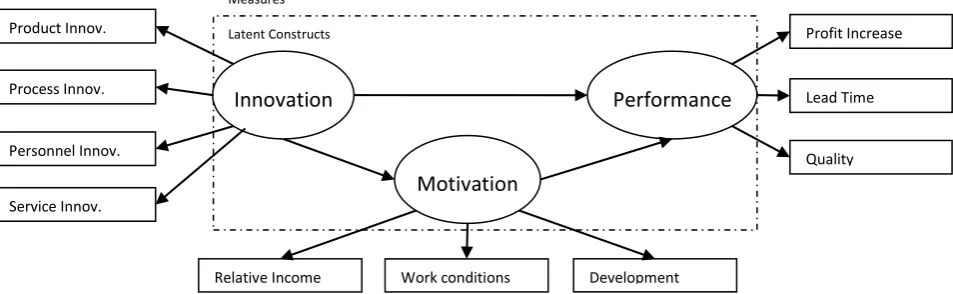
SEM is an advanced method used for confirming hypotheses (CFA) and exploring data (EA), having significant advantages over alternative techniques, being referred to as a silver bullet[118], the preeminent multivariate technique[119]. Lean theory involves complex causality of social and technical aspects[4]lending itself to multivariate ana-lysis. SEM gives the researcher the ability and flexibility to model and test such theory within a data set. It enables the researcher to‘(a) model relationships among multiple predictor and criterion variables, (b) construct unobservable LVs, (c) model errors in measurements for observed variables, and (d) statistically test a priori substantive/theoretical and measurement assumptions against empirical data’ [120]. This is its considerable ad-vantage over other multivariate statistical methods like multivariate analysis of variance[119], multiple regression, discriminant analysis, principal components analysis and factor analysis[119,120]that are commonly used [e.g. 75,76]. SEM uses measured variables, often survey data, to indicate underlying (latent) factors that are otherwise difficult to measure [121]. This is similar to the other multivariate methods, but goes further to test multiple paths (causal relationships) between the constructs[118]as illustrated inFig. 1. And now, with the advances in software, SEM models can be used to easily and flexibly test and explore complicated theories of causality [120]. In a sense, this
method even forces explicit development of the researcher's theory, requiring the specification of a models underlying structure [118]. Especially relevant to lean may be its use in longitudinal studies [122–124]. In the past, this would have required a series of detailed surveys over a number of years. Now with the extensive use of tech-nology systems, e.g. Enterprise Resources Planning, Human Resource Information Systems and Customer Relationship Management; it is possible these existing databases, whether private or public, could be leveraged for longitudinal studies. That aside, it is because of the above many advantages of Structural Equation Modelling in quantifying causal relationships, that it is seen as the most suitable method for verifying lean theory.
4.2.1. SEM lacking in lean works—systematic analysis
The need to test operations theory by SEM was suggested strongly as early as 2004 [109]. SEM has been extensively used in psychology [123]and has become an important and widely used tool in operations management research[121], but its application to lean has been very limited. A foundational literature review in 2013 uncovered one sig-nificant lean-SEM publication [75]along with 10 articles with very limited scope. Initial work operationalising lean constructs and scales had begun[113,125,126]. A systematic review of lean-SEM publication for this work did highlight a great increase in lean-SEM publications since then.
The systematic analysis of lean-SEM papers, first utilised the Scopus database. It searched for ‘lean’ within the keyword field, one of SEM and lean variants within the documents (‘structural equation model’, ‘structural equation modelling1’, ‘partial least squares’, ‘partial least square’, ‘pls’, or ‘SEM’ and ‘lean manufacturing’, ‘lean management’ or ‘lean production’), published up to December 2015 and excluded re-view papers and book sections. It is acknowledged that related works, e.g. just-in-time or kaizen based research may have relevant insight. However, this review focused on research advancing the lean body of knowledge specifically, as indicated by publication keywords and content. Of the 112 articles returned, 68 were rejected for not being SEM and two, although highly relevant for the development of scales [i.e. 113,125] were excluded for not being path analyses. This left 42 articles. To ensure a comprehensive search was achieved, the Scopus search was complemented with searches of Google Scholar. As a further effort to ensure no significant works were missed, a specific search of all operations management journals ranked three or higher by the Aca-demic Journal Guide[128]were conducted at their publishers website. The combined searches resulted in 52 articles.
Of the 52 articles found, 37 (or 67%) were published the previous three years, compared with only 15 articles the previous nine. To provide an external measure of the articles quality, they were cate-gorised by the 2015 Scientific Journal Ranking (SJR) [129], where SJR>1.3 equates to top ranked ‘3 and 4′ journals[128]. Whilst cita-tions indices and journal rankings are not full proof measures of paper quality, the outcomes of these measures do correlate well[130]. De-tailed review of all 52 articles also confirmed this as an adequate in-dicator of quality. Noteworthy articles can and did exist at lower SJR publications, i.e. the earlier identified work [131, SJR = 0.71] along with the work by Pont, Furlan and Vinelli [132], but otherwise the articles of SJR < 1.3 showed low contributions (see the full list of the lean SEM articles found in the appendix with an abbreviated descrip-tion of each study). The categorisadescrip-tion of articles (Fig. 2) showed that since 2012 the majority of them were published in lower impact pub-lications and by implication were of lower quality[130].
It was clear from initial review that this quantitative technique, SEM had now been adopted in lean research. However, this had only really happened in the past few years and further analysis (Table 1) showed
these methods still had not been utilised to their potential, specifically the potential to address the core gaps in the body of knowledge, ad-dressing the critical factors for the success and permanence of lean implementation (seeSection 4.1).
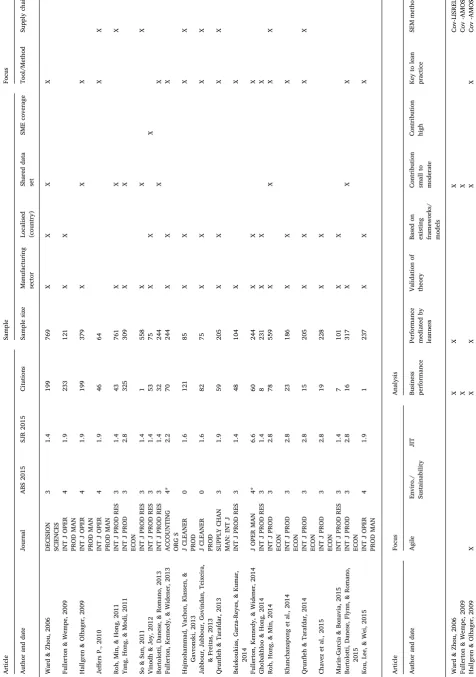
For further analysis, the 23 lean-SEM articles from journals with SJR > 1.3 were coded according to 22 categories as follows (also see Table 1). As an indicator of article quality, the coding included SJR 2015[129]and ABS[128]journal rankings along with article citations (Google Scholar). The other categories chosen were decided based on what was commonly observed in the review of the papers. Whilst a general analysis was conducted (see Appendix), the categorisation particularly focused on how the papers quantitatively addressed the major concerns and critiques of lean management: the critical success and failure factors, verifying the benefits of lean and supporting prac-titioners in achieving them. It also coded whether existing theories were being validated, as is needed [30]. The categories were divided into three main sections for Table 1; firstly ‘Sample’ for common sample characteristics, secondly ‘Focus’ for research focus and thirdly ‘Analysis’ for characteristics of the analysis. The Sample categories firstly assessed the generalisability of the studies. That is, did the paper look beyond the manufacturing roots of lean to other industries; were the studies localised to one country or global; was there a good sample size for statistical power and enabling multi-sampling; and did the study ad-dress differences by business size e.g. differentiating between larger businesses and small to medium sized businesses (SMEs). Additionally, whether or not a shared data set was used e.g. did the researcher have full control over the data. The Focus categories included whether the article presented lean as tools and methods or as a more holistic busi-ness system[4,50]and what specific fields were covered. Four major fields were identified through the review; supply chain management,
agile management, environmental sustainability and the just in time (JIT) methodology. Finally, for Analysis categories, the research was coded as to whether actual business performance was measured. It also noted whether performance was mediated through a leanness construct [113]or if alternative model paths were tested to disambiguate find-ings; whether the analysis was a validation of existing theory and/or based on existing frameworks and models; and also included an as-sessment of how much each analysis contributed to the body of knowledge, specifically to the significant problems faced by practi-tioners in implementing and sustaining lean practices in a wide variety of circumstances. The specific SEM approach was also recorded; i.e. whether the SEM was covariance (Cov) or component (Comp) based and the specific method used. Following the identification of these various categories, additional reviews of the papers were used to complete and confirm the analysis.
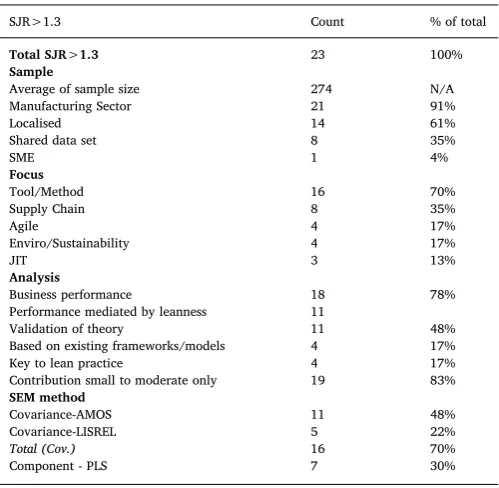
[image:5.595.61.538.62.209.2]The aggregate analysis identified clearly that the majority of these articles were limited in contribution, not addressing the core critiques of lean, the factors that lean success is contingent on. As examples, 91% addressed manufacturing only (typically high volume manufacture), 61% were localised to a specific country and only one addressed small enterprises; thus limiting generalisability and understanding of lean beyond manufacturing, geographical region and business size. Also 35% utilised a shared data set limiting the researchers control over the research design and possible contribution. Overall 70% took a tools perspective to lean, neglecting the human aspects considered critical to success with lean practices. Articles integrating agile methods with lean (17%) were more in line with the factors needed for flexibility, al-though models were small and overall contributions limited. Business performance was measured by 18 (78%) of the articles which is sig-nificant to proving the benefits of lean; but contributions were
[image:5.595.106.490.237.402.2]Fig. 1.Example layout for a Structural Equation Model showing measured and latent variables and paths (computations not shown).
Table 1 Analysis of Lean-SEM articles published in top ranked journals -SJR > 1.3 (by date). Article Sample Focus Author and date Journal ABS 2015 SJR 2015 Citations Sample size Manufacturing sector Localised (country) Shared data set SME coverage Tool/Method Supply chain Ward & Zhou, 2006 DECISION SCIENCES 3 1.4 199 769 X X X X Fullerton & Wempe, 2009 INT J OPER PROD MAN 4 1.9 233 121 X X Hallgren & Olhager, 2009 INT J OPER PROD MAN 4 1.9 199 379 X X X Jeffers P., 2010 INT J OPER PROD MAN 4 1.9 46 64 X X Roh, Min, & Hong, 2011 INT J PROD RES 3 1.4 43 761 X X X Yang, Hong, & Modi, 2011 INT J PROD ECON 3 2.8 325 309 X X So & Sun, 2011 INT J PROD RES 3 1.4 1 558 X X X Vinodh & Joy, 2012 INT J PROD RES 3 1.4 53 75 X X X Bortolotti, Danese, & Romano, 2013 INT J PROD RES 3 1.4 32 244 X X Fullerton, Kennedy, & Widener, 2013 ACCOUNTING ORG S 4* 2.2 70 244 X X X Hajmohammad, Vachon, Klassen, & Gavronski, 2013 J CLEANER PROD 0 1.6 121 85 X X X X Jabbour, Jabbour, Govindan, Teixeira, & Freitas, 2013 J CLEANER PROD 0 1.6 82 75 X X X X Qrunfleh & Tarafdar, 2013 SUPPLY CHAN MAN: INT J 3 1.9 59 205 X X X X Belekoukias, Garza-Reyes, & Kumar, 2014 INT J PROD RES 3 1.4 48 104 X X Fullerton, Kennedy, & Widener, 2014 J OPER MAN 4* 6.6 60 244 X X X Ghobakhloo & Hong, 2014 INT J PROD RES 3 1.4 8 231 X X X Roh, Hong, & Min, 2014 INT J PROD ECON 3 2.8 78 559 X X X X Khanchanapong et al., 2014 INT J PROD ECON 3 2.8 23 186 X X X Qrunfleh & Tarafdar, 2014 INT J PROD ECON 3 2.8 15 205 X X X X Chavez et al., 2015 INT J PROD ECON 3 2.8 19 228 X X Marin-Garcia & Bonavia, 2015 INT J PROD RES 3 1.4 7 101 X X Bortolotti, Danese, Flynn, & Romano, 2015 INT J PROD ECON 3 2.8 16 317 X X X Kou, Lee, & Wei, 2015 INT J OPER PROD MAN 4 1.9 1 237 X X X Article Focus Analysis Author and date Agile Enviro./ Sustainability JIT Business performance Performance mediated by leanness Validation of theory Based on
[image:6.595.67.544.64.742.2]Table 1 ( continued ) Article Focus Analysis Author and date Agile Enviro./ Sustainability JIT Business performance Performance mediated by leanness Validation of theory Based on
restricted by the above mentioned factors and that 11 (61% of these) articles moderated performance through a single “leanness” variable, operationalising lean as a single construct but obscuring the effects that the individual components of a lean system had on performance. Finally, while 11 (48%) had a theory validation component, only four papers were aligned with existing frameworks or models. As a result, 83% (19/23) were considered to contribute in only a small or at most moderate way to the body of knowledge, and only four contributed to key lean theory. The other articles did clearly contribute something to the body of knowledge, but did not address the core critiques, the un-derstanding of the critical success factors which is needed for lean practice.
The articles categorised as addressing key theory, also had sig-nificant limitations (Table 3). Of the four articles found, all were from the manufacturing sector, half localised in geography and half utilising shared data sets. In three of the four articles performance was mediated via a ‘leanness’ construct, two did focus on validation of theory but none on existing frameworks or models. And three of four had only a small or moderate contribution in their outcomes. Only one of these articles addressed the key critiques of lean, its basic success factors [133] although it addressed an arguably small sample of 75 Indian manufacturers. This was the only article that addressed SMEs, which on one hand is positive, but also limits the scope of the study itself by not being able to make comparison by business size. Other research also quantitatively addresses contingency [76,77]but again are limited in scope, not SEM (not testing integrated causal chains) and, like many of the SEM works, tend towards a leanness or production perspective [27,113]. Such operationalising has issues[134]and sets a bias towards taking lean as a mere set of production methods.
Significant lean-SEM studies are slow to emerge and the develop-ment of constructs is similarly lacking[113,125,126]. Theory in lean, especially lean implementation, is contextually mature but not verified empirically[30,133], let alone at a quantitative level[30]. The lack of developed lean-SEM theory suggests that an initial explorative ap-proach is required. Of the various SEM methods available, Partial Least Squares (PLS) SEM provides a platform for this.
4.2.2. Partial least squares versus component based SEM
PLS-SEM has been in the shadow of other SEM methods [135] Traditional SEM methods[88]are covariance-based (e.g. LISREL), PLS-SEM is a component-based technique [135,136]. The difference be-tween these has been compared to the difference bebe-tween Factor Analysis and Principal Component Analysis [137]. Previously covar-iance-based approaches were held in more regard than component-based ones; but these two should be considered as alternatives rather than competing models[135,138–140]as strongly evidenced by Hair et al. [141]. Papers that undermine the legitimacy of PLS[142,143] neglect to differentiate between cases of misuse and appropriate use [144]nor provide adequate scientific evidence[138,145].
Until recently the most common reasons given for using PLS-SEM was its ability to handle variations from normality and analyse small samples [∼50% of articles, 146], but is most suitable where research objectives relate to the original purpose of the algorithm[118]. That is, for use in exploratory research, predictive analysis, explaining variance in latent constructs, or where theory is not well developed. Specifically, although identification issues (model accuracy and problems of im-proper solutions) are concerns in alternative methods, they do not constrain SEM even if models are highly complex. Problems of PLS-SEM, and other component-based methods, are overestimation of in-dicator loadings (measurements) and underestimation of paths [135,147]. The poor estimation of indicator loadings and paths coeffi-cients can be reduced by simply increasing the number of indicators and sample size[141]. PLS-SEM can also handle both reflective and formative constructs. There are many practical guides on where and how PLS-SEM should be used[118,140,148–150].
In lean research, SEM is at the stage of explorative modelling with
the theory under development. Therefore the most appropriate ap-proach is component-based, of which PLS-SEM is not only the most common[151] but also most suited method[141]. Additionally, its ability to handle non-normal data and the flexibility to investigate smaller samples is beneficial [146,147]. Although a minimum of 100–200 samples has been recommended for covariance based methods, much smaller samples, as low asn= 20[152], have proven successful in PLS-SEM[136]. Besides meaning less investment is re-quired for data gathering; this can also allow multil-sampling; slicing existing datasets into smaller samples for moderation.
PLS-SEM has been used in 30% of the lean-SEM publications (Table 2) with the majority of lean-SEM research being covariance-based. However, PLS-SEM may be the most appropriate method for this stage of lean research. As with other fields[139], incorporating the PLS-SEM approach has great potential for advancing lean research by verifying the complex causality between multiple factors, verifying the benefits of implementation and how practitioners can reap those ben-efits.
5. Discussion and conclusions
While various methods of research are available, they are generally categorised as either quantitative or qualitative. Each of these ap-proaches have their respective pros and cons. Ultimately the researcher has to use their knowledge and intuition to build a methodology from the available techniques that will provide the best outcome for a project considering its particular constraints; whether they are time, financial, geographical, ethical, or otherwise. However, for a specific theory to be properly verified an appropriate mix of qualitative and quantitative studies is recommended. The lean body of knowledge is unbalanced in this regard. It has historically been dominated by conceptual and qualitative empirical studies, with the quantitative works needed for validating theory being practically non-existent. Lean case studies have shown the significant benefits of lean, identified many critical factors for implementation and thereby were able to respond to the critiques of lean management. The problem is that the evidence for this existing theory is somewhat weak and not convincing to practitioners and re-searchers alike, as it relies on interpretive methods without quantitative validation. The result is that practitioners are not clear what aspects of lean provide true value and what are just fad.
Lean research could be advanced to a new level by properly utilising the quantitative methods common to managerial sciences, specifically the statistical analysis of survey data. These methods firstly benefit from large sample sizes, and thereby give observed relationships a measurable correlation and statistical power (effect size and sig-nificance). Second, the strength of relationships can be compared and used to rank critical success and failure factors, showing what factors are most important and making spurious relationships more re-cognisable. Third, complex causal relationships can be tested by ad-vanced statistical techniques. Finally, this approach does not negate the qualitative studies but builds upon them to develop new insights as well as validate findings and mitigate any subjectivity present in the existing work.
Models, which are more graphical and intuitive than some other sta-tistical approaches, still need a significant level of explanation to be interpreted by those who are unfamiliar. Finally, at the early stages of lean there were insufficient numbers of lean implementations for col-lection of a worthwhile sized data set. As surveys need to be quite de-tailed to cover multiple factors, the projection of low survey responses from a small pool of available cases would have discouraged these studies, even though the importance of a high response rate may be overstated[153–155].
Now, with 25 years of lean management practiced in the West, the situation for quantitative lean research is very different. The theory of lean and its critical factors has been developed with multiple theoretical frameworks. There are many cases of lean to analyse and the ad-vancement of information technology (email, web surveys, and social media) has made data collection much more practical. Another tech-nological help is the advancement of software for statistical analysis, especially with techniques like Structural Equation Modelling (SEM) becoming more accessible with user friendly graphical interfaces. SEM was identified here as the most appropriate method to advance lean research. This is because SEM enables the clear statistical modelling of the complex theories of causality seen in lean change; effectively testing factor interactions, moderation and mediation in a way that is not possible with other methods. SEM allows and even forces the researcher
to explicitly identify the underlying structure of their theory. The systematic analysis of lean-SEM papers showed that in the re-cent years many more lean-SEM articles have been published but that these have neglected to focus on validating the core lean theory. It is believed this increased number of articles inadvertently neglects the core frameworks due to the simplicity of producing alternative statis-tical work, exchanging core theory for academically interesting but sometimes obscure topics. The current application of SEM in this field has been piecemeal and generally restricted to a few minor factors and commonly tested by simple shared data sets. They have not advanced the understanding of the real challenges being faced by practitioners, the struggles of implementation but rather other minor and secondary matters that may be viewed as novel or interesting. This was seen with other quantitative works also, e.g. quantifying the effect of industry clock speed[77]. The articles are typically tool focused and persistently operationalise lean as a selection of production methods neglecting the significance of human factors. The resultant papers have contributed to lean generally but not to the core critiques and validation of the critical theories that is needed.
SEM method needs to be used to model more of the specific caus-ality within lean, the causcaus-ality between factors as depicted in lean implementation models and frameworks, the core drivers for success and the common causes of failure. Researchers need to take full ad-vantage of the advances in technology, including the large data sets that can now be gathered through web survey, and the advances in under-standing what factors drive lean success. This work will require mul-tiple systematic reviews of the literature be undertaken to crystallise the critical success factors, including those within existing frameworks [32], in order to develop the survey instruments. Cases of such research certainly exist [114] but need further development, refinement and then validation. These systematic reviews should embody not only the lean literature but also broader literature in operations management including change leadership or organisational development.
With the lack of quantitatively validated lean theory, the field contains many theories for testing and therefore opportunities for fu-ture research. However, because of the importance to practitioners, it is especially crucial that the existing theories of lean implementation be verified first. A number of theories needing validating were extracted from the literature and discussed. These included a study of the effect of increased lean knowledge on the understanding of lean and its com-petitive advantage and also a detailed analysis of lean implementations. Many other factors also warrant investigation, e.g. the effect of relying on consultants as opposed to internal resources. These matters have been addressed conceptually or qualitatively in lean literature, but the findings have not yet been adequately verified.
Partial Least Squares SEM (PLS-SEM) is most suited to this current stage of lean research, as the theory is still under development. Once initial PLS-SEM explorative modelling is completed, more constructs for lean can be developed and other SEM techniques could be incorporated. The proposed studies would provide clear statistical evidence of the benefits of lean and the contingencies for obtaining them. It will show with more clarity where practitioners have misstepped and also address the existing critiques of lean. The quantifiable outcomes (the real numbers) will become a powerful tool for the education of practi-tioners, as opposed to the current qualitative evidence.
[image:9.595.39.289.79.323.2]It should be clear, the emphasis of this study is not merely that in the past quantitative studies were less and more are needed. Quantitative techniques like SEM are now being used in lean but this work points out that, this has only really developed in the recent years and these methods have not been utilised to address the core gaps in the body of knowledge in the way that is needed. Effort is needed to verify and develop the existing theory, especially to validate and advance the existing models and frameworks for lean change. Other literature [30,31]has identified in general terms that quantitative work is less but this work goes further in addressing how the lean literature developed and in giving a specific direction for advancing lean research. Table 2
Analysis of Lean-SEM articles published in top ranked journals - SJR > 1.3.
SJR>1.3 Count % of total
Total SJR>1.3 23 100%
Sample
Average of sample size 274 N/A
Manufacturing Sector 21 91%
Localised 14 61%
Shared data set 8 35%
SME 1 4%
Focus
Tool/Method 16 70%
Supply Chain 8 35%
Agile 4 17%
Enviro/Sustainability 4 17%
JIT 3 13%
Analysis
Business performance 18 78%
Performance mediated by leanness 11
Validation of theory 11 48%
Based on existing frameworks/models 4 17%
Key to lean practice 4 17%
Contribution small to moderate only 19 83% SEM method
Covariance-AMOS 11 48%
Covariance-LISREL 5 22%
Total (Cov.) 16 70%
[image:9.595.37.290.628.746.2]Component - PLS 7 30%
Table 3
Analysis of Lean-SEM articles with SJR > 1.3 and with a focus key to lean theory, e.g. core critiques and critical success factors.
SJR>1.3 & key lean theory Count % of total
Total 4 100%
Sample
Manufacturing Sector 4 100%
Localised 2 50%
Shared data set 2 50%
Analysis
Business performance 4 100%
Performance mediated by leanness 3 75%
Contribution small to moderate only 3 75%
Validation of theory 2 50%
For practitioners the implications of this work is that they need to understand the development of the lean body of knowledge and the difference between conceptual and empirically validated theory. Specifically they should be aware that the lean body of knowledge is not fully mature. The critical success factors and associated frameworks in lean literature require further validation and refinement by quanti-tative empirical study. Hence, mixed opinions and approaches exist in the literature and they should be taken with consideration of their empirical basis and the acknowledgement that alternate views may exist.
5.1. Limitations
The analysis of SEM articles relied on subjective classification by the authors. This work also uses the evidence found in others systematic reviews. Whilst seen unnecessary to immediately repeat the analysis of others, it is acknowledged that those reviews include subjective clas-sification outside of the control of this work.
The systematic analysis of lean-SEM articles had a relatively small sample size. That is a sample of 53 compared with 254 for other studies [31]. This was unavoidable due to the narrowness of the field under investigation but nonetheless a limitation.
Other techniques, experimentation and data may also add value to the qualitative work. A current trend is ‘Big Data’ analysis e.g. of con-sumer behaviours. Innovative use of all available data to aid research needs further exploration along with various related fields, including agile methods and general continuous improvement or kaizen, which have similar issues but were outside this review's scope.
5.2. Conclusion
The purpose was to reassess and recalibrate the direction of lean
research. Although many studies have taken place over the past 25 years, the research philosophies and general methodologies used were not challenged. This has left room for weakness in the lean body of knowledge.This review demonstrated that (1) the vast majority of re-search in this field has been conceptual or qualitative in nature relying heavily on researcher subjectivity; (2) quantitative analyses are needed to verify these past studies and strengthen the body of knowledge; (3) these studies should utilise the statistical methods common in man-agerial sciences, especially Structural Equation Modelling (SEM); (4) this quantitative work should be used to investigate the complex causality amongst the core factors needed for lean's success instead of the minor matters being addressed in existing SEM studies; and (5) this kind of analysis will provide a better understanding of the factors that affect lean implementation giving the tangible statistical evidence needed for educating practitioners and addressing the critiques. Specific theories requiring validation were identified and multiple systematic analyses of the lean and related literature are needed to identify the factors in further detail. Finally, (6) practitioners them-selves should not take any opinions of lean without the consideration of their empirical basis and the realisation that alternate views may exist. In this way, practitioners will learn to discern between what is just fad and what will truly enhance business performance and provide value to an organisation.
Disclosure statement
The authors affirm that there is no undeclared conflict of interests regarding the publication of this article.
Appendix. lean structural equation modelling articles sorted by author
Author date Article title and publication (Abbreviated) Reviewer's notes (Abbreviated)i
Agus & Hajinoor, 2012 Lean production supply chain management as driver towards enhancing
product quality and business performance. INT J QUAL RELIBILITY MANAGE 200 cases; covering understanding of the extent to which lean productionpermeates manufacturing companies in Malaysia. AL-Tahat & Jalham,
20-13 A structural equation model and a statistical investigation of lean-based qualityand productivity improvement. J INTELIGENT MAN 300 industrial organizations; 9 constructs - 8 had one or less paths to themodel; all cases Jordanian. Belekoukias,
Garza-Rey-es, & Kumar, 2014 The impact of lean methods and tools on the operational performance ofmanufacturing organisations. INT J PROD RES 140 organisations; manufacturing performance vs lean methods - JIT,autonomation, kaizen, TPM and VSM. Bortolotti, Danese, &
R-omano, 2013 Assessing the impact of just-in-time on operational performance at varyingdegrees of repetitiveness. INT J PROD RES JIT practices focused; 244 plants; impact of JIT on efficiency andresponsiveness performance and the moderating effects on these rela-tionships. Showed product customisation does not significantly moderate the impact of JIT on performance. Instead demand variability negatively moderates the relationship between JIT and responsiveness.
Bortolotti, Danese, Fly-nn, & Romano, 20-15
Leveraging fitness and lean bundles to build the cumulative performance sand
cone model. INT J PROD ECON 317 Plants; the role that external resources like suppliers can play inmastering lean.
Boyle, Scherrer-Rathje,
& Stuart, 2011 Learning to be lean: the influence of external information sources in leanimprovements. J MAN TECH MANAGE 109 Responses; Canada; manufacturing; 50 plus employees. Effect ofinformation sources on lean; correlated exposure to lean information with management commitment and in turn management commitment is linked to successful implementation.
Chavez et al., 2015 Internal lean practices and performance: The role of technological turbulence.
INT J PROD ECON 228 manufacturing companies in the Republic of Ireland;SEM and OLSregression. While lean practices can stimulate improved operational and organizational performance, this relationship is not monotonic and is timely to consider the rate of technological change at the time of implementing lean manufacturing.
Cullinane, Bosak, Flood,
& Demerouti, 2014 Job design under lean manufacturing and the quality of working life. INT JHUM RESOUR MANAGE 200 employees from one multinational pharmaceutical manufacturer. Fullerton & Wempe,
20-09 Lean manufacturing, non-financial performance measures, and financialperformance. INT J OPER PROD MAN 121 US manufacturing company executives. Lean practices; non-financialperformance measures and profit. Fullerton, Kennedy, &
Widener, 2013 Management accounting and control practices in a lean manufacturingenvironment. ACCOUNTING ORG S 244 US companies that attend a specific conference; good paper referencebut still relatively small scope; simple relationships and only assessed leanness (change) and not actual outcomes of implementation. Fullerton, Kennedy, &
Gelei, Losonci, &
Maty-usz, 2015 Lean production and leadership attributes J MAN TECH MANAGE GLOBE project data; profile of a production manager; based on Liker(2004); 89 cases; leadership styles/behaviours related to ‘leanness’. Ghobakhloo & Hong,
2-014 IT investments and business performance improvement: the mediating role oflean manufacturing implementation. INT J PROD RES 121 cases from Iranian and 110 from Malaysian auto-part manufacturers;role that the direct IT investments could play in enhancement of LMS implementation.
Gunasekharan, Elangov-an, & ParthibElangov-an, 2-014
A Comprehensive Study to Evaluate the Critical Success Factors Affecting Lean
Concept in Indian Manufacturing Industries. APPL MECH MATL Analysis of lean manufacturing factors; incorporation of SEM; Indian.
Hajmohammad, Vacho-n, KlasseVacho-n, & Gavr-onski, 2013
Lean management and supply management: their role in green practices and
performance. J CLEANER PROD Canadian manufacturing; supply management and lean methods focus onrelationship with environmental factors.
Hallgren & Olhager,
20-09 Lean and agile manufacturing: external and internal drivers and performanceoutcomes. INT J OPER PROD MAN Comparison between lean and agile drivers and outcomes. Harumi, Ken, & Dong,
2011 Structural Equation Modelling of human factors and their impact on produc-tivity of cellular manufacturing. CONF-ICPR 2011 71 students; laboratory experiment – toy robot building. Suggests thatoperators'aptitude has significant effects on cell's efficiency and the impact of operators'aptitude is largely stronger than the learning effect. Hong, Roh, & Rawski,
2012 Benchmarking sustainability practices. BENCHMARKING INT J 379 companies; sustainability practices in the context of the competitivebusiness environment; strategic driver; operational and supply chain practices.
Ismail, Razak, & Lazim,
2014 Manufacturing Technology Impact on Environmental Factors andManufacturing Performance. APPL MECH MATL Very basic SEM with limited information in this article about approach. Jabbour, Jabbour,
Frei-tas, & Teixeira, 20-13
Lean and green? Empirical evidence from the brazilian automotive industry.
GESTAO E PRODUCAO Portuguese language; 75 companies;. lean manufacturing (LM) is posi-tively associated with environmental management (EM); but the expla-nation power of LM over EM is considered weak/moderate. Jabbour, Jabbour,
Gov-indan, Teixeira, & Freitas, 2013
Environmental management and operational performance in automotive
companies in Brazil. J CLEANER PROD 75 participants; Brazil. See title.
Freitas, Jabbour,
Teixei-ra, Jabbour, 2014 Human resource management and lean manufacturing. PRODUCAO Portuguese Language; 75 Studies. Demonstrates that human resourcemanagement tends to influence the adoption of lean in a weak-moderate manner.
Jayamaha, Wagner, &
Grigg, 2014 The moderation effect of the cultural dimension. CONF-2014 IEEE Investigating how individualism/collectivism moderates the relationshipsbetween people development, process improvement and Toyota Way deployment.
Jeffers P., 2010 Embracing sustainability: Information technology and the strategic leveraging
of operations in third‐party logistics. INT J OPER PROD MAN 64 participants; mediating role of an 'operations-as-marketing' strategy inframing IT investment decisions. Khanchanapong et al.,
2014 The unique and complementary effects of manufacturing technologies and leanpractices on manufacturing operational performance. INT J PROD ECON 186 manufacturing plants in Thailand; compares manufacturing tech-nologies and lean practices; RBV; focus on tools and methods. Synergistic effects of manufacturing technologies and lean practices on cost; product quality; lead-time; and flexibility.
Kou, Lee, & Wei, 2015 The role of product lean launch in customer relationships and performance in
the high-tech manufacturing industry. INT J OPER PROD MAN Taiwan; high-tech contract manufacturers; 237 usable questionnaires.Analysis of product launch; investigated lean launch strategies from the customer relationship perspective.
Li, Nahm, Wyland, Ke, &
Yan, 2015 Reassessing the role of Chinese workers in problem solving. ASIA PAC BUS R 6 plants; manufacturing; 240 Reponses; China; outcome was powerdistance and the concern for saving face potentially hinder employees' willingness to participate in such problem solving.
Marin-Garcia &
Bonavi-a, 2015 Relationship between employee involvement and lean manufacturing and itseffect on performance in a rigid continuous process industry. INT J PROD RES 101 ceramic tile plants in Spain; employee involvement on lean manu-facturing (LM); and the effect of LM on production outcomes. Monge, Cruz, & López,
2013 Impact of lean manufacturing, sustainable manufacturing and continuousimprovement on operational efficiency and environmental responsibility in Mexico. INFORMACION TECNOLOGICA
México; Spanish Language. It relates lean manufacturing; sustainable manufacturing and continuous improvement with the operational effi-ciency and environmental responsibility in the manufacturing industry. Moori, Pescarmona, &
Kimura, 2013 Lean manufacturing and business performance in Brazilian firms. J OPERSUPPLY CHAIN MANAGE 68 Brazilian companies; positive relationship between lean manufac-turing and business performance. Results also suggest that managers lack awareness about the importance of the competitive skills to enhance business performance.
Nahm, Lauver, & Keyes,
2012 The role of workers’ trust and perceived benefits in lean implementationsuccess. INT J BUS EXCELENCE 180 production workers; Midwest US; critical role of perceived jobsecurity; trust in management and lean training in enhancing the perception of personal benefits of lean; which leads to lean implemen-tation success. The results support the notion that lean implemenimplemen-tation success depends upon conducive mind-set for lean among production workers.
Noori, 2015 The critical success factors for successful lean implementation in hospitals. INT
J PROD QUAL MANAGE Lean implementation in hospitals - strategic orientation; organisationculture; management system; implementation process and implementa-tion team; effect on success.
Nurul Fadly Habidin & Sha'ri Mohd Yusof, 2013
Critical success factors of Lean Six Sigma for the Malaysian automotive
industry. INT J LSS 252 Malaysian automotive organisations; perception based; limited in-sights available.
Pont, Furlan, & Vinelli,
2009 Interrelationships among lean bundles and their effects on operationalperformance. OPER MANAGE RES 266 manufacturing plants located in nine countries; more than 100employees each; relating bundles/scales (HRM and TQM and JIT) to performance.
Qrunfleh & Tarafdar,
2-013 Lean and agile supply chain strategies and supply chain responsiveness: therole of strategic supplier partnership and postponement. SUPPLY CHAN MAN: INT J
205 cases; supply chain only; focusing on agile/postponement.
Qrunfleh & Tarafdar,
2-014 Supply chain information systems strategy: Impacts on supply chain perfor-mance and firm performance. INT J PROD ECON 205 cases; information system versus lean/agile strategies. R.A.M. Shamah, 2013 A model for applying lean thinking to value creation. INT J LSS A model for applying lean thinking to value creation; Egyptian cases;
small scope. R.A.M. Shamah, 2013 Measuring and building lean thinking for value creation in supply chains. INT J
Ravikumar, Marimuthu, Parthiban, & Abdul Zubar, 2013
Leanness evaluation in 6 manufacturing MSME"s using AHP & SEM techniques.
INT J MECH MECHTRON ENG Relatively basic paper. See title.
Roh, Hong, & Min, 2014 Implementation of a responsive supply chain strategy in global complexity.
INT J PROD ECON International Manufacturing Strategy Survey (IMSS); 559 manufacturingcases. Supply chain aspects and pull production. Roh, Min, & Hong, 2011 A co-ordination theory approach to restructuring the supply chain. INT J PROD
RES Data from International Manufacturing Strategy Survey (IMSS) IV; 761manufacturing units of 24 countries. Supply chain restructuring and the impact of supply chain restructuring on manufacturing practices. Co-ordination theory; greater co-Co-ordination and information sharing with suppliers turned out to be a major driving force behind supply chain restructuring.
So & Sun, 2011 An extension of IDT in examining the relationship between electronic-enabled
supply chain integration and the adoption of lean production. INT J PROD RES Electronic-enabled supply chain integration and the adoption of leanproduction. 558 manufacturers around the world. Leanness measured. So & Sun, 2015 Lean thinking as organisational practice in enabling supply chain
sustain-ability. INT J ENVIROTECH MANAGE 527 manufacturing firms in 17 industrialised countries; sustainablesupply chain. Sureeratta, Napompech,
& Panjakhajo, 2014 Model of Leadership and the Effect of Lean Manufacturing Practices on FirmPerformance in Thailand's Auto Parts Industry. RES J BUS MANAGE Basic model. The latent variables were leadership, lean manufacturingpractices and firm performance. The results suggest significant relation-ships among leadership, lean manufacturing practices and firm perfor-mance.
Taggart & Kienhöfer,
2-013 The effectiveness of lean manufacturing audits in measuring operationalperformance improvements. SOUTH AFRICAN J INDU ENG 64 manufacturing sites. The findings are that lean manufacturing auditsare effective in measuring improvements in operational performance provided that the audit scope and the lean characteristics are aligned up front.
Vinodh & Joy, 2012 Structural Equation Modelling of lean manufacturing practices. INT J PROD
RES 75 small manufacturing firms; India; environmental uncertainty –> leanpractices. Vivek & Ravichandran,
2008 An empirical study on the impact of environmental uncertainty on the leanpractices of small manufacturing firms. J CONTEMP RES MANAGE 60 small manufacturing firms. Factors affecting world-class manufac-turing. Ward & Zhou, 2006 Impact of Information Technology Integration and Lean/Just-In-Time Practices
on Lead-Time Performance. DECISION SCIENCES 769 responses; supply chain; relationships between lead time andinformation technology. Covers IT integration, intrafirm IT integration, lean/JIT practices and lead-time performance.
Xia & Kamoshida, 2015 An Empirical Study of the Effect of SCM Practice on Corporate Performance.
CONF-KMO 2015 Supply chain; China focus. Se title.
Yang & Yang, 2013 An Integrated Model of the Toyota Production System with Total Quality
Management and People Factors. HUM FAC & ERGO MAN & SERV IND 153 cases; Taiwan based. The conclusion is that an integrated model (oftechnical and social) provides a much more effective “lean system”. Yang, Hong, & Modi,
2-011 Impact of lean manufacturing and environmental management on businessperformance. INT J PROD ECON 309 manufacturing firms worldwide; relationship between lean man-agement, environmental management, business outcomes and environ-mental outcomes.
Zhang & Niu, 2013 Influence mechanism of lean production to manufacturing enterprises’
com-petitiveness. CONF-ICIE 2013 SEM using SMOS17.0. Analysis result demonstrates the influence me-chanism of lean production to competitiveness clearly. The study of this paper has practical sense to lean implementation in China.
i These reviewer's comments include their own synopsis, paraphrased statements and small amounts of direct quotations from the associated paper.
References
[1] Shingo S. A study of the Toyota production system: from an industrial engineering viewpoint, rev sub. Productivity Press; 1989.
[2] Ohno T. Toyota production system: beyond large-scale production. 1st ed. Productivity Press; 1988.
[3] Womack JP, Jones DT. Lean thinking, banish waste and create wealth in your corporation. 1st ed. Productivity Press; 1996.
[4] Hines P. How to create and sustain a lean culture. Dev Learn Org 2010:24.https:// doi.org/10.1108/dlo.2010.08124fad.007.
[5] Emiliani ML. Origins of lean management in America: the role of Connecticut businesses. J Manag Hist 2006;12:167–84.https://doi.org/10.1108/ 13552520610654069.
[6] Birnbaum R. The life cycle of academic management fads. J Higher Educ 2000;71:1–16.https://doi.org/10.2307/2649279.
[7] Selko A. Strategies to help manufacturers compete successfully. IndustryWeek; 2012 http://www.industryweek.com/companies-amp-executives/strategies-help-manufacturers-compete-successfully.
[8] Seth D, Gupta V. Application of value stream mapping for lean operations and cycle time reduction: an Indian case study. Prod Plan Control 2005;16:44–59.
https://doi.org/10.1080/09537280512331325281.
[9] Schröders T, Cruz-Machado V. Sustainable lean implementation: an assessment tool. In: Xu J, Nickel S, Machado VC, Hajiyev A, editors. Proceedings of the ninth international conference on management science and engineering management. Springer; 2015. p. 1249–64 http://link.springer.com/chapter/10.1007/978-3-662-47241-5_105Accessed 23 August 2015.
[10] Bortolotti T, Boscari S, Danese P. Successful lean implementation: organizational culture and soft lean practices. Int J Prod Econ 2014.https://doi.org/10.1016/j. ijpe.2014.10.013.
[11] Bhasin S. Improving performance through lean. Int J Manag Sci Eng Manag 2011;6:23–36.https://doi.org/10.1080/17509653.2011.10671143.
[12] Goodyer J, Murti Y, Grigg NP, Shekar A. Lean: insights into SMEs ability to sustain improvement. Cambridge, United Kingdom: University of Cambridge; 2011. [13] Shin D, Kalinowski JG, Abou El-Enein G. Critical implementation issues in total
quality management. SAM Adv Manag J 1998;63:10–4.
[14] Crute V, Ward Y, Brown S, Graves A. Implementing Lean in aerospace – challen-ging the assumptions and understanding the challenges. Technovation
2003;23:917–28.https://doi.org/10.1016/S0166-4972(03)00081-6.
[15] Cooney R. Is "lean” a universal production system?: Batch production in the au-tomotive industry. Int J Oper Prod Manag 2002;22:1130–47.https://doi.org/10. 1108/01443570210446342.
[16] Garrahan P, Stewart P. The Nissan enigma: flexibility at work in a local economy. Continuum International Publishing; 1992.
[17] Williams K, Haslam C, Williams J, Adcroft A, Johal S. Against lean production. Econ Soc 1992;21:321–54.https://doi.org/10.1080/03085149200000016. [18] Delbridge R. Life on the line in contemporary manufacturing. Oxford University
Press; 1998.
[19] Hines P, Holweg M, Rich N. Learning to evolve: a review of contemporary lean thinking. Int J Oper Prod Manag 2004;24:994–1011.https://doi.org/10.1108/ 01443570410558049.
[20] Cox A, Chicksand D. The limits of lean management thinking: multiple retailers and food and farming supply chains. Eur Manag J 2005;23:648–62.https://doi. org/10.1016/j.emj.2005.10.010.
[21] Johnstone C, Pairaudeau G, Pettersson JA. Creativity, innovation and lean sigma: a controversial combination? Drug Discov Today 2011;16:50–7.https://doi.org/10. 1016/j.drudis.2010.11.005.
[22] Radnor Z, Holweg M, Waring J. Lean in healthcare: the unfilled promise? Soc Sci Medicine 2012;74:364–71.https://doi.org/10.1016/j.socscimed.2011.02.011. [23] Hines P, Found P, Griffiths G, Harrison R. Staying lean: Thriving, not just
sur-viving. Lean Enterprise Research Centre; 2008.
[24] Bateman N, Hines P, Davidson P. Wider applications for Lean: an examination of the fundamental principles within public sector organisations. Int J Prod Perform Manag 2014;63:550–68.https://doi.org/10.1108/IJPPM-04-2013-0067. [25] Arlbjørn JS, Freytag PV. Evidence of lean: a review of international peer-reviewed
journal articles. Eur Bus Rev 2013;25:174–205.https://doi.org/10.1108/ 09555341311302675.
[26] Bhasin S. Performance of organisations treating lean as an ideology. Bus Process Manag J 2011;17:986–1011.https://doi.org/10.1108/14637151111182729. [27] Bhasin S. Lean management beyond manufacturing. Cham: Springer International
Publishing; 2015http://link.springer.com/10.1007/978-3-319-17410-5
Accessed 10.
[28] Mirdad WK, Eseonu CI. A conceptual map of the lean nomenclature: comparing expert classification to the lean literature. Eng Manag J 2015;27:188–202.https:// doi.org/10.1080/10429247.2015.1082068.