Physics Base & Conceptual Views Complex of Ball
Lightning
Anton V. Pinchuk1, Vladimir A. Pinchuk2 1Scientific Technical Center “Protei”, Saint_Petersburg, Russia 2The Baltic state technical university, Saint_Petersburg, Russia
E-mail: vap@vp7550.spb.edu
Received June 23, 2010; revised August 27, 2010; accepted September 16, 2010
Abstract
The complex of conceptual views about ball lightning (BL) as containing surplus electrical charge quasi- stationary material foundation with distinctions between levels of translation temperature and exciting tem- peratures of chemical bonds and electron energy states has been offered and is substantiated in the paper. The being formed complex is grounded upon overstepping the limits of generally accepted physical base and is aimed at all-round substantiation of jointly observed in nature manifestations of BL. Within the limits of the being formed complex the possibility of localization of ball lightning in airspace is confirmed. The nature of the one’s radiate capacity is substantiated. The role of environment as source that feeds BL with energy is established. Power supply mechanisms, conditions and peculiarities of BL’s characteristics reproduction through lifetime are specified. The formations channels of energy resources of BL are turned out. Levels of BL’s energy potentialities, both permissibility proper and wide diapason of variation of the ones (multi-faces of ball lightning) as well as the capability of BL to overcome any barriers from dielectric materials by means of penetration through inanes in body of barriers and then to restore the one’s characteristic (octopus’s effect) are substantiated. Adequacy of being formulated conceptual views as a whole is confirmed.
Keywords:Ball Lightning, Natural Anomaly
1. Introduction
In 1838 year Fransuar Arago-the member of French Sci- ence Academy published the article with generalization of several views of Ball Lightning (BL). Since then and up till now the substantiation problem of BL’s nature is in the attention centre of scientists of the all world. The numerous works (Barry J., Dmitriev M. T., Elliott lo., Singer S., Silberg P., Shabanov G. D., Sokolovski B. Yu. Smirnov B. M., Stakhanov I. P., …) directed onto both the generalization of ball lightning observations and making-up of a common ideas of the ones are known.
Among important results of their joint work the portrait of Ball Lightning, having been formulated by generalization of numerous observations of BL in the nature, should be mentioned above all. The one can be presented, for example, by the next means.
The ball lightning (BL) in itself is of nature origin, being displaying with energy radiation into environment a material formation, localized in airspace as rotation ellipsoid or even in the similar to spherical shape, the
one being able to move, primary motion directions of that aren’t determined, however, by gravitation and/or air dynamic forces and lifetime of that, accordingly with observations, is at least tens of second. Characteristics of BL, being only insignificantly changed or even kept practically constant in lifetime, don’t register seemingly evident reduction of energy resources of ball lightning during time of one’s existence in connection with radia- tion energy to environment. What is more, the disap- pearance (disintegration) proper of BL is accompanied as a rule with an additional energy discharge into envi- ronment (frequently considerably exceeds quasi-stationary level of energy radiation). Multi-faces being manifested first of all by energy levels differences being discharged into environment with BLs at the disappearance period under seemingly the same characteristics of the ones’ quasi-stationary state typical to BL.
with essentially lesser sizes, concerning to dimensions of BL and then to restore (reconstruct) in essence initial shape and characteristics is peculiar to BL too.
However up to now, even after the lapse of about two century, the generally accepted conception of both nature and jointly fixed characteristics of BL on the base of universally recognized physical views is not turned out yet. What’s more the true sensation of pessimism in es- timations of principal possibilities to interpret the BL nature on this basis is felt.
It’s undoubtedly, that the being settled situation shows first of all to exceptional complexity of BL as the invest- tigation object. At the same time, it unquestionably notes too towards the principal insufficiency of resolving power of being used investigation methods formed in these cases in the framework of traditional physical re- strictions (i.e. towards imperfection of the physical basis as itself).
It is interesting to note in this connection that the sci- ence history is rich with examples when the one or other problem, occurring itself interest for investigations and being very important just as from practical so from sci- ence standpoint, within of generally adopted physical limits is kept unsolved and only going out of these limits is way to solve the one. In other words there is reason so to think that the Ball Lightning in the greatest degree is in keeping with these features.
The attempts to work out the complex substantiation of both the nature and manifestation of BL on the basis of overstepping the limits of traditional physical restrict- tions, earlier unknown Internal Energy Equilibrium Con- ditions (IEEC–between energy states with different na- ture) of material media are known too [1-13].
Admittedly, the developed views of BL so far do not obtain of due expansion and of necessary public recogni- tion (in that number owing to the being kept till now doubts about substantiations of proper IEEC) and de- mand so additional explanation and progress.
Having been formed situation and determined in es- sence expediency and purposefulness of this work. The paper is based upon materials of [1-13] and, at the same time, is aimed onto generalization and further logical progress of the ones.
2. Strategy Forming
2.1. Initial Views
On being formed of initial views of BL we will take into account only common, beyond all doubt observed of ball lightning’s characteristics.
It must be admitted so that BLs exist and are spring up under conditions of developed electro-static fields. They
are moved somewhere else and are observed as localized in the airspace material formations having form similar to sphere. The prevailing transferences directions of ball lightning in airspace are not determined by the both gravitation and/or forces of aerodynamic origin1. BL’s lifetime may achieve at least to several tens seconds.
The BL occurrence, as a rule, is accompanied by en- ergy radiation into environment (thermodynamically opened system) that is watched in the range of visible spectrum part in that number. As this takes place, char- acteristics of BL’s radiation are changed insignificantly or even are kept practically an invariable. What is more, disintegration of ball lightning often is accompanied with extra energy escape into environment. The multi-faces, revealed by considerable incompatibility of specific en- ergy resources under seemingly equal or at least compa- rable circumstances, else is peculiar to BL (see, for ex- ample, [15,16]). Octopus’s effect-capability to overcome different barriers from dielectric materials by means of penetration through inanes in the body of barrier with essentially lesser, concerning to dimensions of BL, sizes and then to restore (reconstruct) in essence the ones’ ini- tial shape and properties characteristicis characteristic of Ball Lightning at last. The enumerated common proper- ties with a great degree of trustworthiness are suited to the real manifestations of balls lightning. However, up till now the possibilities to realize the medium states with noted characteristics intake, in the context of generally accounted physics-chemistry views, are retained beyond verge of explainable ones.
2.2. Basic Assumption
In evaluating of prospects for refinements of BL’s nature in the framework of [1-13] the attention was being given first of all to the established by observations fact that the BL-medium contains surplus (uncompensated) electric charge.
As an assumption, in connection with this, it was pre- supposed that
“the observed characteristics of BL could be substan- tiated, say, by the existence of traditionally not ac- counted (earlier unknown) peculiarities of internal en- ergy equilibrium conditions (IEEC-between energy states with physical nature’s different kinds) for material for- mations with surplus electric charge (AQN- or aquasi- neutral formations) as determining, in that case by the results of inevitably being exited relaxation of AQN- formations on interacting with environment, and arising and subsequent conservation in time (reproduction) of 1The marked indicates so that BL is subjected to force influences of
medium (in the AQN-formation’s composition) with characteristics that differ from the environment and are in keeping to BL”.
The possibilities to build on this base the physics-chemic BL’s model will be estimate drawing away our attention from both the composition and the nature of BL’s forma- tion mechanisms as the subjects of specific interest as itself.
3. The Internal Energy Equilibrium
Conditions (IEEC)
3.1. Ionization Equilibrium Conditions
Let’s estimate for the first time the possibly arising, in connection with presence in medium’s composition of surplus charge to fit the being expressed assumption, the peculiarities of the medium’s inner ionization equilib- rium.
3.1.1. Small Disturbances Method
As applied to p, T = Const let us separate out now some volume of medium containing neutral (a), electron (e) and ion (i) components. Let us account that the separated so volume is bounded, for instance, by sphere of radius
bl
R and is thermodynamically opened system itself with variable particles number and description of the one conforms to three–liquid model ideas [17].
We’ll be take, as state parameters, the ionization degree
* * *
*
(0) (0) (0)
i i i
a a a
p n kT n
p n kT n
(1)
and relative content of uncompensated electron compo- nent2
* *
* * * *
* * * .
e i
e i e i
i i i
n n kT
p p n n
p n kT n
(2)
Concentrations of components in medium’s composi- tion in that case will be conform to relations
* * ( )o ;
i a
n n * *(1 ) (0);
e a
n n (1 *) (0);
a a
n n
* (0)
[1 (1 )] a . n n
Give up advantage to thermodynamic method as not leaning upon any ideas of substance atomic-molecular structure and being essentially phenomenological. As- sume that by external in relation to sphere actions an excess electric charge is inputted and at a later time is retained in the composition of separated so medium volume.
Accordingly generally adopted ideas inner equilibrium of separated system should be in conformity with the
minimum of its thermodynamic isobaric-isothermal po- tential “” and, for p T, Const, will be determined in that case by equation
_ _ _ * _ _ _ _ * _ 1 , * * 1 1 , * * 1 0. J j
j p T
j j
j j
j j p T
j j j N N N N N N
(3)Here: j chemical potential of j-'s media compo-
nent (j = a, e, i).
Draw attention to the fact that under conditions when the charge within the sphere is constant
* *
( nq ne ni Const) parameter
* * * * (0) q e i i a n n n f n n (4)
and first term of right part in equation (3) is identically equal to zero. Equation (3) is transformed so to expres- sion _ * * 1 1 0 j j j
j j j
N N
(5)and may be used for detecting of correlations between states parameters of media plasma foundations corre- sponding to inner energy equilibrium.
For the material system of examined composition the equation (5) is rewrite in
0
i Ni e Ne a Na
(6) and, with account of correlations between moles numbers
variations (0)
i i a
N n n
;
(0) (1 )
e e a
N n n
; (0)
a a a
N n n
in accordance with (1). (2), is reduced to relationship
1
0i e a
(7) For single-atom gas
3/ 2
5/ 2 30
2 ln ln
1, ,
, 0, ,
1, .
j j
j j
j j A j
g m kT
RT p
h
if j i
eZ N Z if j a
if j e (8)
Expression (7) is converted into
2Here and below with «*» the parameters of media that contains surplus
3/ 2
5/ 2 3 21, ,
exp , (1 ), ,
1, . j j c j c j j j j j m kT p g h
if j i V
e c if j e
kT
if j a
(9)and, on the neglect of 2-order infinitesimal members, corresponds to any from equations:
3/ 2 5/ 2 (1 )* *(1 )
3 2
exp ,
e
i e i
e
a a
m kT
p p g
g
p g h
V e kT (10)
3/ 2 (1 )* *(1 )
3 2
exp
e
i e i
e
a a
m kT
n n g
g
n g h
V e kT (11) or
(1 ) *(2 )(1 ) (1 )
* *
(1 )
3/ 2 5/ 2
3
1 1
1 1 1
2 exp i a e e g g P
m kT V
g e kT h (12)
Here: V –media ionization potential determined in the ordinary way;
–remote coulomb interaction potential (potentials difference stipulating electrical action onto charge). More detailed interpretation of its physical sense will be given lower.
3.1.2. Ionization Equilibrium as Reaction onto Disturbance
Assume as previously that some quantity of the same charged particles are brought in (taken out from) the considered volume owing to the system is moved up (and at a later time exists) into the state with uncompensated electric charge. It is obvious that charge introduction into a system is equivalent to a work performance under the one and causes so violation of inner energy equilibrium of the system. With account of Le Сhatelier Principle the last should being reestablished by inevitably arising in these conditions system reaction, suppose in the
AAe kind.
If a work has been done under the system by external actions is L1 e Ne1 and a change of the system’s thermodynamic potential was stipulated on the system
with external actions is i Ni e Ne a Na
then being anew settled equilibrium must corresponds to
то condition
1. i Ni e Ne a Na e Ne
(13) It is obvious that NiNe Na and (13) is presented in the kind
1.
e
i e a e
i N N
(14)
The ratio Ne1 NiNe1 Ne determines the
molar part of excess charge carriers per ion component mole and corresponds in being again settled gas medium composition to system’s state parameter according (2). The equation (14) is truly kept to the relations (9)- (12), which proves the statement.
3.2. Common Character of Inner Equilibrium
In deducing on (9)-(12) we assumed that inner equilib- rium disturbance by carrying in system’s composition of surplus charge is necessarily suppressed with reaction of AAekind. However the noted is not having one.
Indeed, “from all possible steady states of thermody- namic system being allowed with border conditions of the law of mass transfer and conservation along with 2nd law of thermodynamic the state with minimum produc- tion of entropy is realized” [18], to say, that which is priority one.
Let us assume that priority reaction formed in the sub- system as response onto disturbance in connection with carrying in medium composition of surplus charge is reaction of A B AB shape. If the work was done in the case under system by external actions is
1
1 e e
L N
that being anew-formed equilibrium will correspond to the condition
1. AB NAB A NA B NB e Ne
(15) Take into account that the relation molar contribution into a relaxation reaction of electron component
1/
e AB
N N
(that in full measure correlates with physical interpretation of parameter according to expres- sion (2)) and NAB NA NB. By this means in neglecting of 2-order infinitesimal quantities the expres- sion (15) may be written in the form
exp ,1, ,
, ,
1, , .
c j
c j act
j j
j j
j
e
p K T
kT if j AB
c if j e
if j A B
(16)(or any other one’s that in frame of specifically arising conditions in the system is priority one) being deter- mined in essence by generally accepted method.
3.3. Equilibrium Inner Peculiarities
The expressions (9)-(12), (16) determine so Inner Energy Equilibrium Conditions (IEEC) in material media com- positions in that number with account of possible pres- ence of surplus electric charge in the ones composition. From analogues of generally accepted form the lasts are distinguished essentially with only presence in exponent indexes of additional term e.
Concrete character of IEEC accordingly (9)-(12), (16) indicates so that, as applied to localized AQN-foundations temperature T as traditionally estimated parameter di-rectly determines equilibrium populations of energy states only with “mechanical” nature (translation, oscil- lating, rotatory ones).
If in the framework of traditional description and with account of (9)-(12), (18) *
exc
T -the excitation tempera- tures of chemical bonds and electron energy states of medium then their correlations with T-the excitation temperature of mechanical energy states (after referred to as translation one) to be determined by equation
* j
exc j
T T
e
(17)
Corresponding to IEEC the function of population dis- tribution of chemical bonds and electron energy states will be correspond with relation
* exp j
j e
N
kT
(18)
By IEEC, the population distribution function of chemical bonds and electron energy states in medium of AQN-foundations (directly since formation moment of the ones) is necessarily transformed (or at least is put to the deformation) to the form (18).
In other words IEEC in the form of (9)-(12), (16) really point to existence of traditionally not accounted (unknown) control channel over material media states (chargeous control channel), where electrical charge plays a role of control factor.
Draw attention that the transfer of the formed AQN- formation in new corresponding to (9)-(12), (16)-(18) state (one’s relaxation) is providedwith own energy-re- sources of AQN-formation. The AQN-formation during relaxation towards IEEC makes so some negative work. If work done by the medium of AQN-formation in this case is L q , then Sign( ) Sign q( )Sign( )
and Sign( ) 0.
The relations (9)-(12), (16) as well as (17), (18) jointly
point to reality of correlations *
exc
T T on 0e j, as well as Texc*T on e j.
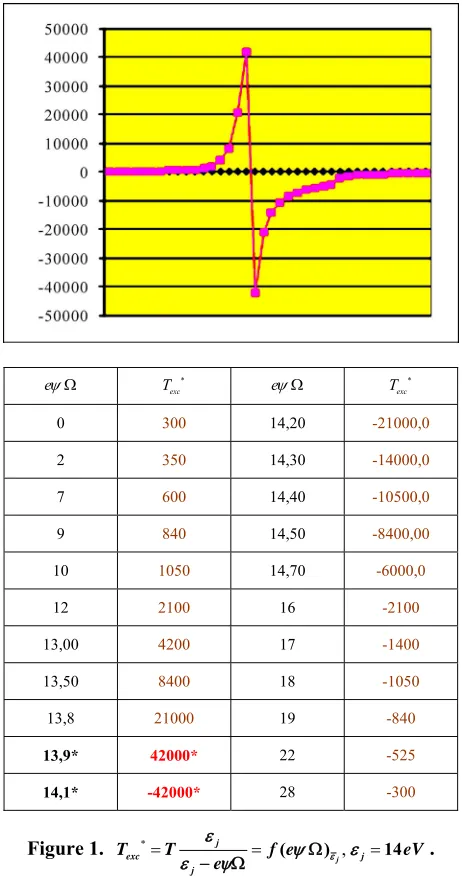
The concrete corresponding to (17) dependence
* ( ),(0 2 , 14 ,
exc j j
T f e e eV T 300 )K is presented with Figure 1.
Let us draw our attention to the fact that according to (17) and regard to being expected character of
( )
e f t during process of relaxation caused by introduction/leading-out of surplus charge into/from me- dium composition, for example, the population distribu- tion function of excitation temperatures of medium’s chemical bonds and electron energy states can be sub- jected to discontinuity of the type ( , )or
( , ). This fact among other things can be inter- preted as an indirect indication of possibility of devel- opment under these conditions of instability of medium’s
e *
exc
T e *
exc T
0 300 14,20 -21000,0
2 350 14,30 -14000,0
7 600 14,40 -10500,0
9 840 14,50 -8400,00
10 1050 14,70 -6000,0
12 2100 16 -2100
13,00 4200 17 -1400
13,50 8400 18 -1050
13,8 21000 19 -840
13,9* 42000* 22 -525
[image:5.595.308.539.281.721.2]14,1* -42000* 28 -300
Figure 1. * ( ) , 14
j
j
exc j
j
T T f e eV
e
atom-molecular structure. The instability, as it might expect, being acceptable to manifest itself, with losses of electrons steadiness on the orbit and even with absorp- tion of the ones by nuclei.
Common peculiarities of IEEC already at this stage testify to real perspectives to form on the ones’ base of conceptual views model of BL. Let us forestall however the attempt with both clarification of favourable using conditions of chargeous channel for controlling over material media states AND additional confirmation of validity of just IEEC themselves as base for the working out of supposed model of BL.
4. Temperature Limitations of IEEC
Efficiency
Verification of temperature diapason that potentially not excluding at least the ensuring possibility of significant changes with chargeous influences of medium’s charac- teristics, all other things being equal, is of special impor- tance for validity to use IEEC as base in forming of true notion of BL.
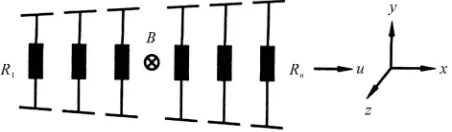
To make conditions for effective using of revealed “E-channel” more precise, quasi equilibrious plasma’s characteristics as applied to concrete parametric non- uniformity in MGD-channel with sectioned electrodes (Figure 2) were estimated versus temperature, all other things being the equal, just as by traditional (generally accepted) method, so by method with account of re- vealed IEEC.
The values next were compared relative each other. It was taken into account in this case that if a temperature corresponds to diapason where using of ECC is effective one so the differences in levels of being confronted characteristics must be necessary displayed. In doing so it was assumed that the work regime of MGD generator is stationary and realized with constant pressure.
If the Hall’s component of electrical field in the MGD
channel * *
0 0
(1 ) / ( ) /
h q i e
E uB E q e n n then * *
0
(ni ne ) (1)uB /e .
In view of (1), (2) ( * *) * * 0
i e i a
n n n n
whence 0 *
0
(1 ) / ( ).
a
n uB e But 0
a
n (see (1), (2)) complies also with expression 0
[1 *(1 )]
a
[image:6.595.306.534.87.339.2]n P kT .
Figure 2. MGD channel.
Then *
*
0
1 (1 )
(1 ) eP uB kT
what upon call-
ing 0 (1 ) eP C uB kT
is transformed into form
* 1 [ (C 1) 1]
. Potential was evaluated with
( ) (1 ) ( )
h ch ch
E L x uB L x
what is in keep-
ing with e 0 (!!!). The equation system
(1 )
*(2 )
(1 ) (1 )
* *
(1 )
3 2 5 2
3
1 1
1 1 1
2 exp ; i a e e g g P
m kT V
g e kT h 0 x eP C
E kT
; * 1 (C 1) 1
;
(1 )uB L( ch x)
under certain values of P T L x, , ch, , medium composi- tion and regime of MGD generator is closed.
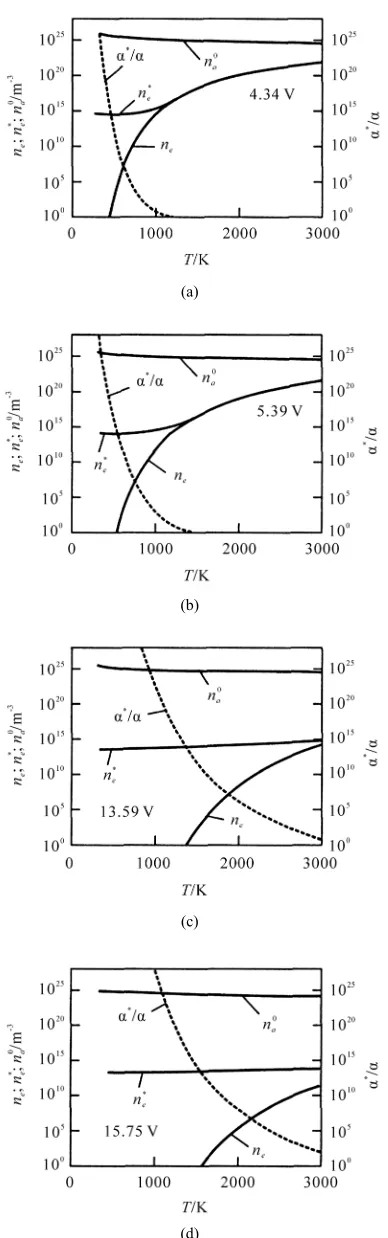
The system was used to estimate both the levels and dependences character with temperature of ionization parameters of medium that, in accordance with IEEC, correspond to quasi-equilibrium conditions in MGD channel. Related parameters of media in quasi neutral states, all other things being same, were estimated too.
The presented below with Figure 3 results (along with obtained as a whole) were being analyzed under assump- tion that using of chargeous influences for controlling of material media states will be the most effective in the temperature ranges where, all other factors being the same, just essential differences between estimations of quasi equilibrium medium’s ionization parameters are revealed depending on is accounted or no uncompen- sated electric charge in the medium composition.
The results of Figure 3 correspond to conditions: pressure P 105N m/ 2
, flow velocity u103m s/ ,
Hall parameter 2, load parameter 0 . Being conditionally taken into account here media correspond to K, Li, H, Ar (a, b, c, d correspondingly).
During investigations as a whole the following pa- rameters were being modified over ranges: a conven- tional medium composition V(3.89, 24.58)W A/ ; pressure P (10 , 10 )5 6 N m/ 2
; flow velocity
3 3
(10 . 2 10 ) /
u m s ; Hall’s parameter 1, 2, 4 ; load parameter of MGD generator 0, 0.5.
The taken into account range of temperature changes was T(300,3000 )K . It was assumed that magnetic induction B1.6T , channel length Lch 1 ,m x0 .m
[image:6.595.59.285.635.701.2](a)
(b)
(c)
[image:7.595.77.271.73.692.2](d)
Figure 3. Characteristic comparison results (conditionally– K, LI, H, Ar).
parameters are principally revealed only in field of rela- tively low temperatures.
It is elucidated that differences of medium composi- tion towards increase of ionization potential make to extension of favorable temperature diapason where using of chargeous influences might be effective for control- ling of material media’s states.
By confrontational analysis it was revealed that, even with account of wide variation of media compositions, temperature diapason, where an essential differences of the results are disclosed, is limited from the top and also envelopes by itself only oblast of relatively low tem- peratures.
Even after such seemingly optimistic generalization, let draw our attention and up to basis of the work–IEEC that was only recently pioneered by authors, till now received no of sufficiency diffusion and in itself, in one or other degree, is in need of some additional confirma- tion.
The results of Figure 3 correspond to conditions: pres- sure P 105N m/ 2
, flow velocity u103m s/ , Hall
parameter 2, load parameter 0. Being condi- tionally taken into account here media correspond to K, Li, H, Ar (a, b, c, d correspondingly).
During investigations as a whole the following pa- rameters were being modified over ranges: a conven- tional medium composition V(3.89, 24.58)W A ; pressure P (10 ,10 )5 6 N m2
; flow velocity
3 3
(10 .2 10 )
u m s; Hall’s parameter 1, 2, 4; load parameter of MGD generator 0, 0.5.
The taken into account range of temperature changes was T(300,3000 )K . It was assumed that magnetic induction B1.6T , channel length Lch 1 ,m x0 .m
It was determined in this connection that significant differences between of being so compared ionization parameters are principally revealed only in field of rela- tively low temperatures.
It is elucidated that differences of medium composi- tion towards increase of ionization potential make to extension of favorable temperature diapason where using of chargeous influences might be effective for control- ling of material media’s states.
By confrontational analysis it was revealed that, even with account of wide variation of media compositions, temperature diapason, where an essential differences of the results are disclosed, is limited from the top and also envelopes by itself only oblast of relatively low tem-peratures.
5. IEEC as Object of Investigation
5.1. Common Position
It was accounted that both character and meaningfulness of waited manifestations of relaxation process being in- evitably excited in medium composition at the forming stage of AQN-formation and at the degradation stage of the once alike are jointly conditioned by both up level of e complex and changes character of the one in the time of relaxation.
It should be waited in this connection that if
* ( )
exc
T f e function during the relaxation to (on the stage of AQN-formation forming) or even against IEEC (on the stage of one’s disintegration) undergoes discon- tinuity (that is under conditions when instability of me- dium’s atom-molecular structure becomes possible are see Figure 1) then relaxation manifestation character may be extremely complicated.
It may be suggested in particular that at this case re- gardless of the composition, inevitably excited relaxation to/against IEEC may be jointly accompanied by viola- tions of chemical bonds of medium as well as flow out of electrons from upper electron states (steadiness losses of electrons on orbits, ones’ downfalls and even absorptions by nuclei with origin of neutrons-analogue of phenomena K or ecupture), that is by very complicated mani- festations jointly not precluding in that number from reactions excitation that produce energy of intra nucleus origin. To substantiate the last (and, hence, IEEC in a whole) the experimental researches results jointly with materials of [9-13] in that number have been used. 5.2. Investigation Method and Installation
It was drawn attention to the fact, that according to
0 0
0
0
t t
а m m а
sur a i e
t
c m m c
c e i
q dq e f dt
e f dt
(19)
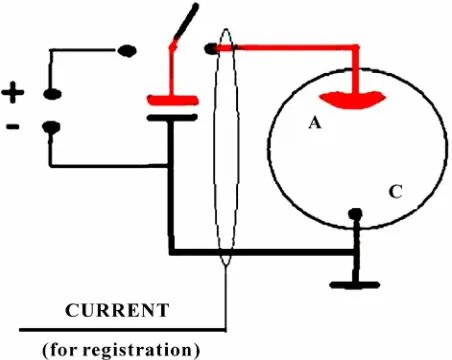
surplus charge in volume of some reactor (Figure 4) could have be done, for example, by impulse of capacitor discharge owing to differences between quantity of elec- tricity being brought in reactor during time “t” (through part of chain “positively charge cover of capacitor–elec- trode-anode in rector”) and, opposite, being brought out from reactor during the same time (through part of chain “electrode-cathode in reactor–negatively charged cover of capacitor).
In (19): j f t( ), ( j e i , )–specific flow of carriers of charge (electrons, ions) on boundaries of media division
parts of electrical chain am, cm (anode
medium, cathodemedium respectively).
By Figure 5 block-schema of experimental installa- tion is shown.
In the one’s composition: reactor 1 fitted out with electrodes “A”, “C” (basic ones), picking out reaction zone and being used for formation of controlling influ- ences onto medium in reactor and, sometimes (what isn’t necessarily), with “SE” (subsidiary one) for any infor- mation leading-out from reactor; system 2 of medium storage and preparation of one’s wanted composition; systems 3 of injection/ejection, additional preparation, ensuring and regulation of barometric characteristics of medium in reactor; power supply system 4; system 5 of registration and measurements of optical, electromag- netic and neutron radiation.
[image:8.595.311.537.307.487.2]As reactor a vessel done from quartz glass was used (see Figure 6).
[image:8.595.308.539.527.703.2]Figure 4. Schema of set for forming and registration of sur- plus charge.
Figure 6. Some reactor variants.
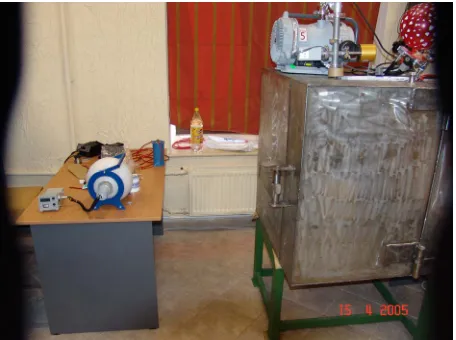
On examinations the reactor was placed in capsule from non-rusting stale (Figure 7) with hollow walls of the one the reactor compartment was picked out.
[image:9.595.57.285.535.705.2]For providing of controlling influences to medium with energy 2.0-2.5 mF capacitor was used. The poten- tial differences on the capacitor covers in diapason of 0,8-2,5 kV was varied. Measuring of neutron flow on examinations was foreseen. As measure of neutron flow power on examinations a number of events fixed per discharge impulse was accounted.
Figure 7. Some sets of installation.
5.3. Common Results
Figure 8 illustrates typical experimental oscillograms of tension and current between basic reactor electrodes on examinations. Current–below curve, 227 A/div, tension– upper curve, 500 V/div.
As applied to concrete conditions of receiving of curves Figure 8, both the electrical field laying onto dis- charge interval of the reactor and switching on of oscil- lograph were carried at the same time with help of spe- cial electron key being brought in feeding chain of dis- charge zone of reactor.
As material of electrodes Mo, W and/ or Kovar (Fe, Ni, Co)3 were used. Any dependence of results from elec- trodes material was not revealed.
As applied to concrete conditions of the oscillograms receiving the application of electrical field to the anode- cathode gap and triggering of the oscillograph were being at the same time with the help of electronic key, being introduced into the feeding chain of the reactor.
The initial level of voltages on the capacitor’s plates was supported in the frame of being took out diapason and practically was not varied beyond the medium com- position from number of being used ones (hydrogen, helium, nitrogen, air, nitrogen-hydrogen mixture with molar relation ~1:1).
Under conditions being typical ones for Figure 8, from 100 to 200 events per discharge impulse were fixed at distance 0,5 meter from reactor (in general neutron radiation was able to be fixed up to 10 meter from reac- tor). The trustworthiness of conclusion that being Regis- tered radiation is really neutron one has been confirmed with additional investigations [9,11-13].
For verification of radiation nature and exception so of possibilities to distort results, in connection with influ- ence to detector of one or other strays pick-up, the ex- perimental tests have been done. So the additional analo-gous block but with distant scintillating target was taken up position side by side with detection block. This addi-tional block detected no events during discharge. More-over, the hollow walls of operating compartment with hollow’s thickness ~250 mm were filled up with saturated water-solution of boron acid and were used as a special absorbent of neutrons. An introduction of this absorber between reactor and detector was accompanied by sharp weakening (by one order) of having been before registered, all other being equal, neutron flow. In carry- ing out of control experiments, when the hollow intra- walls was empty or even filled up with distilled water, a weakening of neutron flow was not observed. We can state so with full assurance that fixed radiation is really neutron one.
3Change of material at that case was determined in essence only with
(a)
[image:10.595.57.285.67.444.2](b)
Figure 8. Typical discharge on pressure: 0.5-1.5 Torr (H2,
He), 1.0-2.0 Torr (N2, air, N2 + H2, molar ratio ~ 1/1).
Scan-ning: (а) 1 ms/div; (b) 4 ms/div.
Let us note also that registration of neutron radiation safely testifies to exciting under these conditions of en- ergy producing reactions of intra nuclear origin too.
The pressure diapason corresponding to fixed neutron radiation is set with experiment. To substantiate impor- tance of arising so in reality of search stage in common cycle of the work let us note that under the pressure above 20 Torr, all other things being equal, discharge of the capacitor takes of the classical shape (Figure 9). Neutron radiation under such conditions is not found.
[image:10.595.317.524.78.264.2]Let us draw an attention that by oscillograms of Figure 8 the overloading of capacitor’s covers with electrical charge of opposite sign is fixed. The last testify to that owing to chargeous influences to medium in that case an untraditional source of energy in the reactor is formed. The last shows so to principal possibilities to accompany the chargeous influences onto medium with leading-out of energy from reactor. Notice that presented with Figure 10 data testify to such conclusion.
Figure 9. Discharge characteristics under Р = 25 Torr (1-current; 2–tension on capacitor covers).
(a)
(b)
Figure 10. The installation schema (a) and experimental data; (b) 1-tension: 2-current on/from E-electrode, 0.022 V/A.
[image:10.595.319.525.307.610.2]as of attempts to form, on the ones’ base, model physics views about BL received so experimental confirmation too. By received results so not only the validity of waited manifestations of chargeous influences to medium but and additionally, on this time just with experimental way, truth and fundamental character of IEEC itself as basis of this work were confirmed too.
Let us further in consecutive order consider key prob- lems of BL.
6. BL Model Views Forming
6.1. SphericityThe sphericity substantiation of BL (as a foundation with higher, in respect to the environment, temperature) is traditionally considered as extremely complicated one for solution (if not being defied explanation by ordinary means at all [19]).
In the framework of the developed point of view (i.e.. when it is possible to assume that Tbl-translation tem-
perature of BL and Tenv-a temperature of environment
are close to each other) the existence possibilities verify- cation of material AQN-formations (after referred to as BL-formations or BLs) localized in the space is taking however some new tinge.
With the availability in medium of dipole molecules with moment d and at a concentration nd n
bl
P kT
( -the relative dipoles concentration) the surface tension forces energy will be determined by value
2 2
5 30 4
st sf d bl
d Q U r rS n R n
(20)
If needed expenditures to retain the electric charge in BL composition to be estimated by means of energy ac-cumulated by the BL sphere being under consideration as spherical condenser (Tbl Tenv)
2 2
0 8
c
bl
q q
Q
C R
(21)
then the greatest surplus charge being kept in the sphere of BL may be determined with
5 63 2
4 2 ,
1, ;
1, .
j bl
j
q Z dR n
if j i Z
if j e
(22)
The excess electron concentration in BL medium complying with q
5 63 2 3 2
.
j q
bl bl
Z d n q
n
eV eR
(23)
Both physical meaning and level of potential
would be determined in that case by the greatest negative work has been made by BL-medium itself when carrying in of the surplus charge into BL sphere. So if the work has been done with BL medium is L q C q2/
then electrical potential will be determined as
5 61 2
0 2
. 2
j bl
Z dR n
q C
(24)
For a case when the sphere radius of BL-formation 0,075
bl
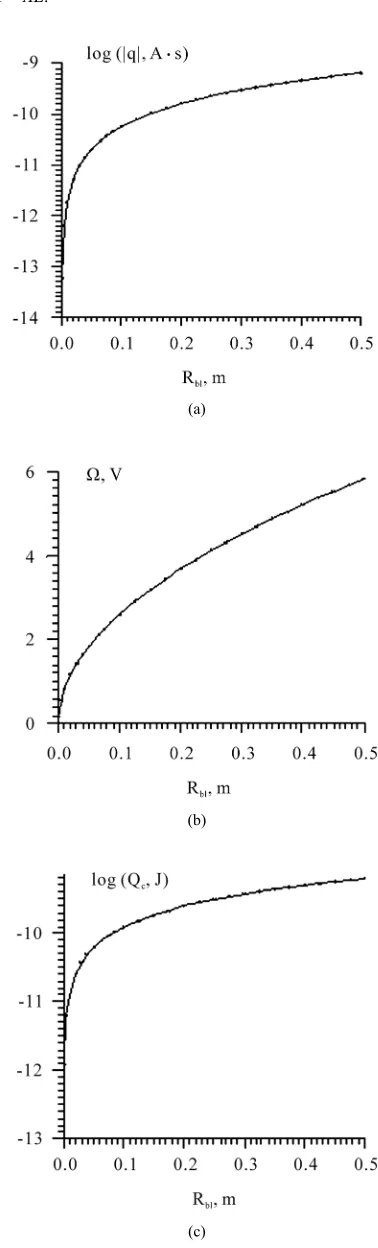
R m the absolute level of charge q held in BL-medium (a), electric potential (b) and energy ac- cumulated by the BL sphere as a capacitor (c) versus relative dipoles keeping are shown at the Figure 11.
The analogous characteristics, but versus BL’s sphere radius and for case when relative dipoles keeping
0,01
, are presented at the Figure 12.
Thus the possibilities for energy ensuring of BLs’ sphericity even in a case when relative dipoles keeping in a medium corresponds to relatively low are confirmed by presented results.
6.2. Energy Problem
6.2.1. Common Remark
BL origin in form of material formations with uncom- pensated electric charge is made possible by only in connection with manifestations of external disturbances with one or another nature onto medium (the ones not considered by us within this work). Similarly, the exis- tence proper of BL itself likewise is realized under BL- environment interactions.
In other words, the ball lightning presents by itself, first of all, thermodynamically opened system the prop- erties of the one are typical for significantly upset me- dium formations and are necessary supported by especial processes aggregate (complex) of heat and mass transfer as between energy states of different physical nature of BL medium, so between BL as a whole and environment.
(a)
(b)
[image:12.595.325.514.64.688.2](c)
Figure 11. The holdable charge’s characteristics log
q ,, log
Qc f
.(a)
(b)
(c)
[image:12.595.82.512.66.671.2]6.2.2. RadiateAbility Problem
Within the formed ideas of BL as of material formation with uncompensated electric charge the radiation capac- ity is substantiated first of all by typical for aquasineutral formations of excesses of chemical bonds and electron energy states excitation temperatures ( *
exc
T ) over transla- tion one (Tbl) (in that number and especially on the dis- tant approaches to the equilibrium conditions, see (6.2.1) and (17), (18))
[image:13.595.324.517.63.677.2]In support of practical significance of the waited re- flections in reference to the conditions that are similar to
Figures 11, 12 a quantitative estimations of
quasi-equilibrium parameters of different composition media has been received.
The estimation was being conducted on the base of system including both ionization parameters bonds equa- tions of plasma medium within of three liquid model [17] and expressions having been received in the work. Spe- cifically the system was included following equilibriums:
(0) 1 * 1
a bl
n P kT ; nP
kTbl
;
5 6 3 24 2 j bl
q ZdR n ; ndn; ni**na(0);
5 6 3 23 2
;
j d
q
bl
Z d n n
eR
*;
q i
n n
5 6 1 20
2
; 2
j bl d
Z dR n
* j
exc j
T T
e
(1 ) *(2 )
(1 ) (1 )
* *
(1 ) 3 2 5 2
3
1 1
1 1 1
2
exp ;
i
a
e e
g
P g
m kT V
g e
h kT
Among unknowns in solution of the system ten following parameters are accounted: (0), , *, , , , , , ,*
a d q i
n n n n n q
*.
exc
T The parameters ,R V Zbl, , j were being varied. It was assumed that P1.01325105 Pa, T300K, d1D.
The system so was being closed.
The revealed so ionization degrees * of different
composition media (a) in common with the both excite temperatures of electron energy states *
exc
T (b) and levels corrections of ionization potentials being stipulated by presence in media composition of surplus charge
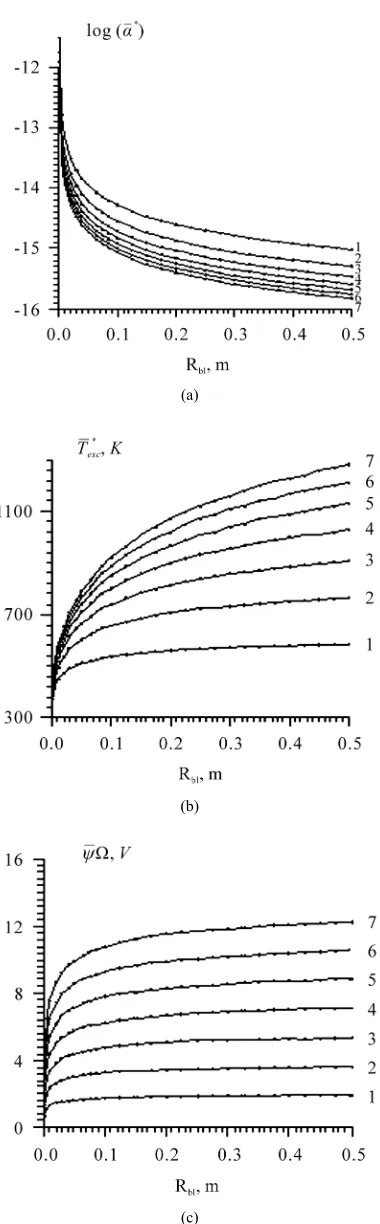
(c) delivering the ionization degree versus relative dipole keeping in media composition of BL with Rbl0.075m are presented at Figure 13.
The curves 1-6 conform to conventional media com- position with V 6,8,10,12,14,16W A/ (curves 1-6 ac- cordingly). Plots of Figure 14 present the dependences
(a)
(b)
[image:13.595.73.267.311.493.2](c)
Figure 13. The quasi-equilibrium characteristics log(_*),
_ _
, (log )
exc
T f .
4In so doing will bear in mind that, under generally accepted views,
“any negative temperature * exc
(a)
(b)
[image:14.595.77.267.71.683.2](c)
Figure 14. The quasi-equilibrium characteristics log(_*), _ _
, ( )
exc bl
T f R
of the same parameters but versus radius of BL founda- tion sphere.
The plots conform to conventional media composition with V 4,6,8,10,12,14,16W A/ (curves 1-7 accord- ingly). Being taken into account the relative dipole keeping in a composition of BL medium is 1%
(0,01).
Let us note that, as applied to no equilibrium aquasi- neutral foundations state, reflecting best of specific character of ones’ relaxation under conditions of energy interchange with environment, the absolute values of present-day parameter _ and levels * _*.
exc
T T In other words, the obtained upper results indicate convincingly as a whole that the natural air foundations with uncompensated charge keeping in ones’ composi- tion (BL) not only can exist themselves but also are really able to radiate energy even under conditions, when translation temperature of the foundations is correlated with (or even less than) the environment temperature
(Tbl Tenv).
Let us bring into consideration an effective radiation temperature Trad as parameter determining, on a basis
of the generally accepted propositions, radiating power of BL into environment
42 0
4 100
rad bl rad bl g rad
Q S q R C T (25) To concretize conditions for numerous estimations of
rad
Q will be assumed that Trad accordingly (25) at the same time correlates with excitation temperature of chemical bonds and electron energy states of some char- acteristic for BL (within of the ideas about common fea- tures along with a typical reactions relaxation composi- tion and energy feeding mechanism) energy level *
j
5, to say
*
*
j
rad bl
j
T T
e
(26)
In other words, the temperature Trad will be consid-
ered as a parameter determining, in traditional mind, the radiating power of BL and, at the same time, as a factor being functionally stipulated by peculiarities of excita- tion temperature distribution of chemical bonds and electron energy states peculiar to BL media.
It is possible so within of taken into account with (26) bonds the degree of darkness g to be estimated by the
ionization degree of a media with *
j
eV as deter- mining, in that case, the settlement density of energy states with radiation transitions of electrons from one
5Admittedly, the accounted so character of bonds between
rad
T and
orbit to another in composition of BL media
q bl
g
n kT P
(27)
Here nq- surplus concentration of particles-charge carriers.
6.3. Octopus’s Effect
The being noted by eyewitnesses capability of BL to overcome different barriers from dielectric materials (window-frame for example) by means of penetration through inanes in the body of barrier (hollows, cracks, splits) being essentially lesser, concerning to BL, sizes and then to restore (reconstruct) in essence the ones’ ini- tial shape and characteristic is substantiated too. The one is substantiated, first of all, with susceptibleness of sur- plus charge in composition of BL’s medium to influ- ences of external electric fields and hence with one’s obvious capability not only to overcome through barrier (wall) from dielectric material along the channels in bar- rier’s body in hollows (cracks, splits) form, but and then, after penetration through channels, to form (to restore) behind barrier in environment a new AQN-formation with initially corresponding to BL characteristics.
6.4. The Energy Feeding Source
The way of attack untwisted in this work opens else real prospects to solve the problem of nature substantiating of the energy source for feeding of BL.
Indeed, as it has been readily apparent from observa- tions, the keeping up (continuous reproduction) of quasi-stationary states in process of BLs existence is realized in that number (unless not always) under condi- tions when the ones radiate energy into environment.
This seemingly that the radiation of energy into envi- ronment must be accompanied by reduction of settlement levels of energy states (relative to stationary settlement level of the ones) with radiation transitions of electrons from one orbit to another and so bring towards lowering of radiating capacity of BL. As applied to stationary state of BL the last however is practically kept constant one. In the framework of the formed method of attack the noted comes to be explicable.
Indeed, it is obviously that the settlements lowering of chemical bonds and electron energy states, in connection with radiation all other things being equal, to be neces- sary accompanied by (stipulates) an additional excitation (overheating) of “mechanical” energy states of BL me- dium (Tbl) in relation to the being reduced so excitation levels of the “no mechanical” energy states (Texc*).
The growth of misbalance in energy distribution over
states in connection with radiation is suppressed so by the energy flow from mechanical energy states towards the ones but being no mechanical nature. Let us draw attention to the fact that the flow of energy from me-chanical energy states leads to drop of BL’s translation temperature (Tbl) even to the levels below environment
temperature (Tenv) and, in turn, stipulates origin of
en-ergy flow from environment to BL.
In other words the both existence and nature of source to feed BL with energy is really substantiated. This source feeding with energy of BL is so environment.
By this means in the framework of the formed model a quasi-stationary state of BL is necessary consistent with conditions when Tbl Tenv . Just that relation’s range
between the noted temperatures provides of BL with heat absorption from environment as clearly indemnifies for ball lightning’s energy escape by radiation and essen- tially makes possible existing of BL in nature as itself. The common picture of exchange energy-mass processes in these conditions in full measure corresponds to both Le Сhatelier Principle and the common character of ma- terial systems reactions onto disturbances.
6.5. Energy Feeding Mechanisms
There can be no doubt that the feeding of BL with energy from environment on a stationary existence stage is real- ized by traditional mechanisms of energy-mass-exchange. Both convective heat input and input of energy inside BL in connection with mass-exchange between ball lightning and environment are naturally enough to account in components number of the energy supplying (energy feeding) mechanism.
6.6. Energy Resource Components
Channels as and sources to form energy-resources of BL along with needed conditions for supplying of the one’s quasi-stationary characteristics are also substantiated within the formed ideas model of BL as about localized in the space containing uncompensated electric charge material foundation with differences between transla- tional temperature and excitation temperatures of both chemical bonds and electron energy states.
In account with the revealed appropriateness in equi- libriums and common conditions to localize material foundatio9ns in the space, the common level of BL’s energy resources is advantageous to estimate in that case with discrete blocks. These are radiation flow energy
rad
Q , energy saved up by sphere of BL as capacitor Qc,
BL-media towards equilibrium conditions accounting of availability of uncompensated electric charge in one’s compositions.
6.7. The Multi-Faces Problem
Making longer discussion in the framework of the being formed BL model let us attention draw to the fact that the energy absorbed by BL from environment at the same time can be used up at least in two directions. Firstly, it is the one for indemnity of energy losses in connection with radiation. For secondly, it is the one for putting down settlings levels diminution of excited chemical bonds and electron energy states (continuous reproduce- tion of radiation capacity) stipulated by mass-exchange processes between BL and environment.
It can be assumed that distribution character of feeding energy flow between the noted directions determines the total level of ball lightning’s energy resources and, in its turn, is determined by common as well as being specifi- cally established, as the existence conditions of BL re- quire, peculiarities of energy feeding mechanism.
If this the case, the relative contribution of each from energy feeding mechanism’s components (convective heat exchange or/and mass transfer) must show essential influence over quasi-stationary characteristics of BL. The dependence of BL foundation’s energy resources upon of concrete realized, at each single of occasion, energy feeding mechanism can be considered so as the most probable reason, from assumed ones, of being noted with observations so called multi-faces of ball lightning.
By way of the first step for following consideration let us more concrete formulate ideas upon waited, at each separate case in connection with the noted, common pe- culiarities of quasi-stationary states of balls lightning. For better visualization of these peculiarities, the needed consideration should be carry out with the supposition of limit contribution into the BL’s energy feeding mecha- nism either of one or another its component from the accounted ones (only of convective heat exchange or, on contrary, only of energy input inside BL from environ- ment in mutual mass-exchange connection with).
Even not accounting of cognitive advisability, allow- ance of the last is substantiated, among other factors, by possible variations of real environment characteristics and consequently of BL’s existence conditions.
6.7.1. Convective Heat Exchange
Overpowering contribution of convective heat exchange into energy feeding mechanism of balls lightning with stationary characteristics corresponds to conditions, when BL-environment mass-exchange for the most part has been put down. The quasi-stationary states of BL being
existed in the conditions must be characterized first of all by constancy with time of both the radiation characteris- tics and the settlements of chemical bonds and electron energy states. The energy being supplied to BL from environment must be expended in these conditions only to compensate energy loses of ball lightning with radia- tion (ideal case).
It should be emphasized that BL-media conforming to quasi-stationarity conditions (and being exceptional so with invariability of energy states and depression of mass-exchange) must be characterized in the case by essential deformation of distribution function of chemical bonds and electron energy states towards internal energy equilibrium with account of surplus electric charge in the media composition.
Let us note that specificity of the being established so distributions points to existence (and possibilities of ef- fective displays) of nontraditional, in the framework of generally accepted physical views, energy resources formation channel of BL. Of the channel being substan- tiated with obvious capacity of media with surplus elec- tric charge to absorb energy of one or other source to supply the deformation of media’s energy states settle- ments and functioning, in principle, at any stage of ball lighting’s vital cycle.
It is safe to assume also that the radiate characteristics of BL in quasi-stationary state under energy feeding by convective heat input (and hence when mass-exchange is depressed) likewise are must be stood out with some typical features.
By significant deformation of energy states settle- ments, the BL’s radiation, in this case, must be mainly realized by transitions in the diapason energy states hav- ing been drawn (essentially!) to the internal equilibrium conditions accounting presence of surplus charge in me- dia composition
6.7.2. Mass-Exchange Energy Feeding
Contrary to the previous case the power supply of BL by mass-exchange mechanisms necessary assumes that the energy flow from environment to feed with energy of quasi-stationary states of ball lightning is being neces- sary expended at least towards two ways:
Firstly, to supply radiation;
To ensure with energy the continuous reproduction of energy states settlements that determine the ra- diate capacity of BL, secondly.
undergo a rupture of ( , ) kind). But the BL’s en- ergy resources component conditioned by settlements distribution function deformation of chemical bonds and electron energy states with relaxation most likely in the case is kept only partly filled up.
6.8. Preliminary Result
The preliminary examination materials testify that account of revealed [1-13], earlier unknown peculiarities of inner energy equilibrium conditions of media with surplus (uncompensated) electric charge opens truly up new prospects for adequate ideas model substantiation of BL. The last however requires for addition confirmation rather by numerous estimations.
7. BL’s Quasi-Stationary States
7.1. Common PositionsWill be considered that the BL quasi-stationary state is manifested first of all with immutability in time of its radiate characteristics.
Common conceptions about BL in this conditions will be presided in connection with this by equations complex jointly substantiating just as both the existence reality and energy resources of the ball lightning in form of lo- calized in space material foundation with uncompensated electric charge so others characteristic parameters of the BL versus media compositions and common specificity of feeding energy mechanisms of its quasi-stationary state.
With account of existence of differences channels for keeping/radiation by BL from/into environment the en- ergy resource of BL in quasi-stationary state will be es- timated with separate components. Will be taken into account specifically:
radiation flow Qrad;
energy Qchaving been accumulated by sphere of
BL as electric capasitor;
energy Q having been accumulated under set- tlements distribution function deformation of chemical bonds and electron energy states of BL medium when relaxing the one towards new equi- librium conditions6.
7.2. Convective Energy Input
When convective heat input to be considered as the
mechanism feeding of quasi-stationary state of ball lightning with energy that equation determining the waited power input to BL from environment versus tem- peratures as titled above is
2
4 .
conv
hi bl conv bl conv env bl
Q S q R T T (28) Here: conv-heat transfer coefficient.
By the conditions of one-to-another equilibrium in value of introducing (to BL from environment) and radi- ated contrary (to environment from BL) energy flows will be determined in that case the demands to supply power mechanism feeding. In substantiated limitations so (mass-exchange between the ball lightning and environ- ment is depressed) through correlation of (25) and (28) the conditions of BL’s quasi-stationary states supplying with energy (of characteristics invariability) will be de- termined as
4 0
*
100
conv g rad conv env bl
conv
C T
T T T
(29)
As applied to a case of convective heat input the nu- merous estimations of energy resources of balls lightning under quasi-stationary states as well as feasibility of the lasts by themselves were being conducted within equilib- rium approximation (see 5.6.1).
As this take place, with account (26) the effective ra- diate temperatures were taken equal to quasi-equilibrium excitation temperatures Texc of electron energy states
conforming to ionization energy
conv
rad exc bl
V
T T T
V
(30)
As for relative blackness degrees g, the ones, all other factors being the same, were set equal to quasi- equilibrium ionization degree * (estimations of * along with of Texc were presented above by Figures 13,
14). The equation
3 4 3
conv
bl bl
P
Q R e
kT
(31)
was being used to estimate the energy resources compo- nent Qconv
of ball lightning in that case.
The evaluations of both the radiate power conv rad
Q (“a”) according to (25) and the differences *
conv
T
between the ball lightning’s translation temperatures and envi- ronment temperature (“b”) as well as of the BL’s energy resources component Qconv
(“c”) versus the relative
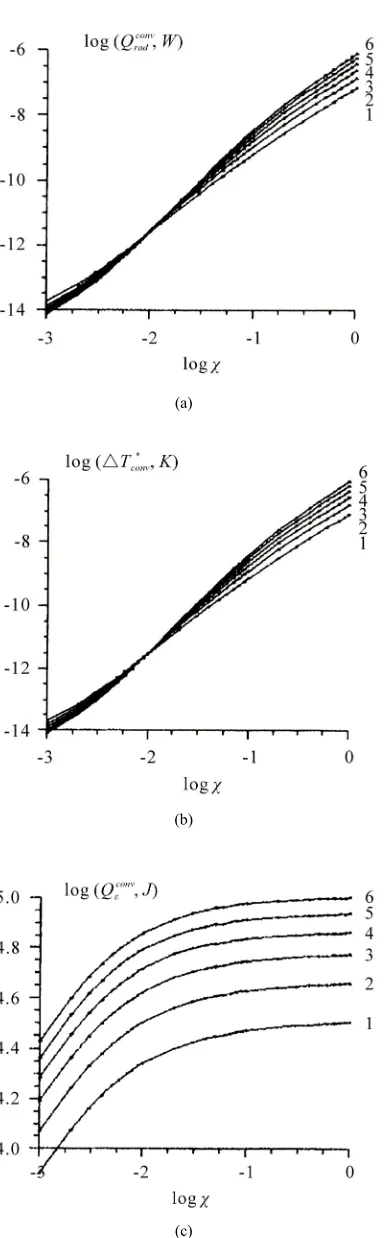
dipoles content in BL’s media composition are represent in Figure 15.
In during the estimations it was assumed that BL’s sphere radius Rbl 0.075m. The plots 1-6 correspond to conventional media composition with
6,8,10,12,14,16 /
V W A respectively. As for the rest
6Existence of the energy resources’ component Q