doi: 10.1093/nar/gku308
Cas6 specificity and CRISPR RNA loading in a
complex CRISPR-Cas system
Richard D. Sokolowski, Shirley Graham and Malcolm F. White
*Biomedical Sciences Research Complex, School of Biology, University of St Andrews, North Haugh, St Andrews, Fife KY16 9ST, UK
Received March 7, 2014; Revised March 28, 2014; Accepted March 28, 2014
ABSTRACT
CRISPR-Cas is an adaptive prokaryotic immune system, providing protection against viruses and other mobile genetic elements. In type I and type III CRISPR-Cas systems, CRISPR RNA (crRNA) is generated by cleavage of a primary transcript by the Cas6 endonuclease and loaded into
multi-subunit surveillance/effector complexes, allowing
homology-directed detection and cleavage of invad-ing elements. Highly studied CRISPR-Cas systems
such as those inEscherichia coliandPseudomonas
aeruginosahave a single Cas6 enzyme that is an inte-gral subunit of the surveillance complex. By contrast, Sulfolobus solfataricus has a complex CRISPR-Cas system with three types of surveillance complexes
(Cascade/type I-A, CSM/type III-A and CMR/type
III-B), five Cas6 paralogues and two different CRISPR-repeat families (AB and CD). Here, we investigate the kinetic properties of two different Cas6 paralogues fromS. solfataricus. The Cas6-1 subtype is specific for CD-family CRISPR repeats, generating crRNA by multiple turnover catalysis whilst Cas6-3 has a broader specificity and also processes a non-coding RNA with a CRISPR repeat-related sequence. Deep sequencing of crRNA in surveillance complexes re-veals a biased distribution of spacers derived from AB and CD loci, suggesting functional coupling be-tween Cas6 paralogues and their downstream effec-tor complexes.
INTRODUCTION
CRISPR-Cas (clustered regularly interspaced palindromic repeats––CRISPR associated) is a prokaryotic adaptive im-mune system found in many bacteria and almost all ar-chaea. Small fragments of DNA (known as ‘spacers’) from invading genetic elements are captured in a poorly under-stood acquisition process and incorporated into the host genome, flanked by short tandem repeats, in a CRISPR
lo-cus. An upstream leader sequence harbouring a strong pro-moter ensures that the CRISPR locus is transcribed, gener-ating pre-CRISPR RNA (pre-crRNA) that is in turn pro-cessed to generate mature crRNA by the Cas6 endonucle-ase (in type I and type III CRISPR-Cas systems) or host ribonucleases (in the type II system). Cleavage by Cas6 at two adjacent repeats generates a mature crRNA consist-ing of a sconsist-ingle unique spacer flanked by repeat-derived se-quences known as the 5- and 3-handles. crRNAs are in-corporated into large multisubunit ribonucleoprotein plexes (known as effector, surveillance or interference com-plexes) and used to detect homologous sequences in non-self DNA or RNA, initiating a series of events that leads to the degradation of the invading genetic entity and therefore host immunity. Host DNA is rarely taken up (or actively dis-criminated against) by the CRISPR-Cas system, and the ge-nomic CRISPR locus is protected against cleavage by effec-tor complexes due to detection of a perfect match between the genomic locus and the CRISPR sequence flanking the spacer in the crRNA.
CRISPR effector complexes are classified into three main types (1). Class I, also known as Cascade, includes the sig-nature subunit Cas3 and a crRNA-binding backbone com-posed of Cas7 subunits (2–4). The class III complexes share the Cas7-backbone with class I and have the signature sub-unit Cas10. Class III complexes can cleave either DNA (type III-A) or RNA (type III-B) targets and their cleav-age mechanism is not yet well understood (5–8). By con-trast, the class II complexes are comprised of a single large subunit known as Cas9 and generate crRNA using host ri-bonucleases and a unique genomically-encoded small RNA known as tracrRNA (9,10). Recently, the simplicity of the Cas9 system has led to its application in numerous exper-imental systems ranging from bacteria to human cells for the targeted cleavage of specific genomic regions, facilitat-ing specific recombination or gene disruption (11).
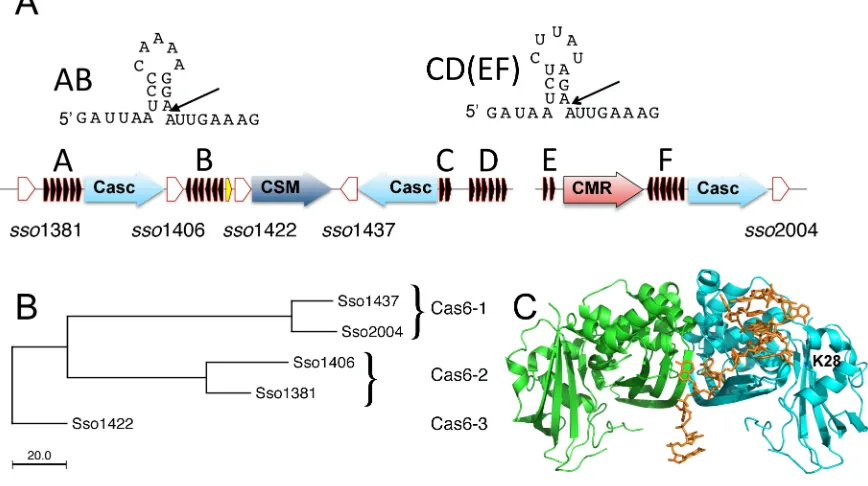
CRISPR-Cas systems are particularly well represented in the archaea. The model organismSulfolobus solfataricus en-codes over 50casgenes and six CRISPR loci (A–F) encom-passing over 400 unique spacers (12,13) (Figure1A). These repeats group into two different families (AB and CD) with distinct hairpin structures. Figure1A shows the sequences
*To whom correspondence should be addressed. Tel: +44 1334 463432; Fax: +44-1334 462595; Email: [email protected]
C
The Author(s) 2014. Published by Oxford University Press on behalf of Nucleic Acids Research.
This is an Open Access article distributed under the terms of the Creative Commons Attribution License (http://creativecommons.org/licenses/by/3.0/), which permits unrestricted reuse, distribution, and reproduction in any medium, provided the original work is properly cited.
at St Andrews University Library on April 22, 2014
http://nar.oxfordjournals.org/
Figure 1. The CRISPR-Cas system ofSulfolobus solfataricus. (A) Schematic diagram showing CRISPR-Cas organization in theS. solfataricusP2 genome. Six repeat loci (small black arrows) comprising two distinct families (AB and CD) are present. Five Cas6 paralogues (white arrows) and five operons encoding effector complexes are indicated. The AB and CD families CRISPR repeats are shown in the hairpin conformation identified in the complex with Cas6-1 (15). The gene corresponding to ncRNA60 is shown next tosso1422. The CRISPR loci and cas genes are not generally contiguous and intervening genes are not indicated. (B) Midpoint-rooted neighbour joining phylogram ofS. solfataricusCas6 paralogues, which can be categorized into three families. (C) Structure of the Cas6-1 repeat RNA complex. The active site residue lysine 28 (K28) is indicated, positioning the active site at the base of the RNA hairpin.
of the AB and CD repeats in a hairpin conformation. Re-peats E and F differ from the CD sequence by one and two nucleotide changes, respectively, but form the same hairpin stem and appear to be processed with similar kinetics by Cas6. Henceforth, they will be grouped under the CD fam-ily for simplicity.Sulfolobus solfataricusencodes three sep-arate type I-A (Cascade) complexes, one type III-A (CSM complex) and at least one type III-B system (CMR com-plex). In addition, there are five clear Cas6 paralogues in the genome. Sso1437 and Sso2004 are 90% identical at the amino acid level and are hereafter referred to as the Cas6-1 family. This group has around 28% identity with the Cas6-2 family comprising Sso1381 and Sso1406. The Cas6-3 family has a single member, Sso1422, which shares∼25% identity with Cas6-2 and 21% sequence identity with Cas6-1 (Figure
1B).Sulfolobus solfataricusCas6-1 is a dimeric enzyme and lacks the canonical catalytic histidine sidechain found in the active site of most Cas6 orthologues (14). The structure of Cas6-1 bound to a CD-family repeat substrate revealed spe-cific recognition of a short hairpin sequence in the repeat (Figure1C), with cleavage at the base of the hairpin (15) as is seen in bacterial Cas6 enzymes (16,17). These hairpin structures are not expected to be highly populated for free pre-crRNA but appear important for substrate recognition by Cas6-1. By contrast, Cas6 fromPyrococcus furiosusis thought to wrap CRISPR RNA around the outside of the monomeric enzyme in a largely unstructured fashion (18). InS. solfataricusCas6 enzymes have been shown not to co-purify with the CSM or CMR complexes (19,20), and to associate only weakly with the Cascade complex (21),
sug-gesting that Cas6 is not an integral subunit of any of these systems.
In this study, we demonstrate that Cas6-1 from S. sol-fataricus has a strong preference for cleavage of the CD-repeat family and is capable of robust multiple turnover ki-netics consistent with a role in generation of crRNA for multiple effector complexes. By contrast, the Sso1422 (here-after Cas6-3) enzyme is less specific than Cas6-1 and is also responsible for the cleavage of a non-coding RNA (ncRNA60) precursor with a repeat-related sequence that is found in high levels in the CSM complex. Functional cou-pling of Cas6 enzymes and effector complexes inS. solfatar-icusis suggested by the biased distribution of crRNA found in the downstream effector complexes by next-generation sequencing.
MATERIALS AND METHODS
Cloning, gene expression and protein purification
Cas6-1 (Sso1437) was expressed and purified as described previously (14). The gene for Cas6-3 (sso1422) was am-plified by PCR and cloned using NcoI and EcoRI sites into a derivative of the vector pEHisTEV (22), allowing ex-pression with an N-terminal polyhistidine-tagged maltose binding protein (MBP) fusion. The K47A variant was con-structed by site directed mutagenesis using the Quikchange protocol (Stratagene). The sequences of the PCR and muta-genesis oligonucleotides are available from the correspond-ing author on request. MBP-Cas6-3 protein was expressed inEscherichia coliC43 cells by induction at an O.D.600of
at St Andrews University Library on April 22, 2014
http://nar.oxfordjournals.org/
0.8 with 0.4 mM isopropyl -D-1 thiogalactopyranoside (IPTG) and overnight incubation at 25◦C with shak-ing. Cells were harvested by centrifugation, resuspended in buffer A (50 mM Tris–HCl pH 7.5, 500 mM NaCl, 30 mM imidazole, 10% glycerol), disrupted by sonication, cen-trifuged at 30 000×g for 20 min and the supernatant filtered through a 0.2M filter. The cleared lysate was subjected to immobilized metal affinity chromatography on a 5 ml His-Trap FF column equilibrated with buffer A and eluted with a gradient of 30–500 mM imidazole in buffer A. Fractions containing MBP-Cas6-3 were pooled and applied to a Su-perdex 200 10/300 column equilibrated with buffer B (20 mM Tris–HCl pH 7.5, 300 mM NaCl, 10% glycerol) and eluted by isocratic flow in the same buffer. The final pro-tein eluted in roughly equimolar quantities with theE. coli chaperone GroEL, suggesting problems with correct pro-tein folding. The solubility of the propro-tein was dependent on the presence of the MBP tag. These limitations meant that the MBP-Cas6-3 protein was only suitable for simple qual-itative activity assays.
Sequence and preparation of RNA substrates
RNA was purchased from IDT. The CRISPR repeats cor-responding toS. solfataricusP2 CRISPR repeats of the C and D (CD) and A and B (AB) loci were synthesized in both fluorescently labelled (5-fluorescein (FAM)) and un-labelled formats. An extra uracil nucleotide was added to the 5end of the repeat oligonucleotides to prevent fluores-cence quenching by the guanine nucleotide that is the first bona fidenucleotide of both the AB and CD-repeat fam-ilies. As a mimic of the Cas6 cleavage product, a fluores-cently labelled CD sequence lacking the final eight 3 nu-cleotides (CDproduct) was synthesized with a 3-phosphate. The predicted Cas6 substrate leading to the generation of ncRNA60 was synthesized in an unlabelled format. The non-fluorescent oligonucleotides were end-labelled with␥
-32P-ATP and polynucleotide kinase and purified as
de-scribed previously (23)
AB: 5-GAUUAAUCCCAAAAGGAAUUGAAAG CD: 5-GAUAAUCUCUUAUAGAAUUGAAAG ncRNA60: 5-UAAUGUGCCCCAAAAUGAAUUG AUAU
AB: 5-[FAM]-UGAUUAAUCCCAAAAGGAAUU GAAAG
CD: 5-[FAM]-UGAUAAUCUCUUAUAGAAUUG AAAG
CDproduct: 5’-[FAM]-UGAUAAUCUCUUAUAGA-P
Single-turnover assays
Two micromolars purified recombinant Cas6 was incu-bated with 1–5 nM [␥-32P] ATP-labelled RNA (CD, AB or ncRNA60) at 60◦C in nuclease reaction (NR) buffer (20 mM NaH2PO4/Na2HPO4 pH 7.5, 100 mM NaCl, 5
mM EDTA, 0.5 mM dithiothreitol). This buffer supported a higher Cas6 activity than that reported previously (14). To stop the reaction, aliquots of 10 l were quenched by addition to 30 l acid phenol/chloroform (Ambion), vor-texed briefly and centrifuged at 15 000×g for 1 min. Five microlitres of the upper aqueous phase was removed and
mixed 1:1 with formamide. Samples were heated at 95◦C for 2 min and loaded onto a pre-run 20% denaturing poly-acrylamide gel (20% poly-acrylamide, 8 M urea, 1× Tris-borate-EDTA (TBE)) then electrophoresed at 80 W for 90 min in 1×TBE running buffer. Following electrophoresis, gels were scanned by phosphorimaging and analysed using Fuji Imagegauge software as described previously (24).
Multiple-turnover assays
Cas6-1 (4–80 nM) was incubated with a large excess (4M) CD RNA in NR-buffer additionally supplemented with 2 M bovine serum albumin (BSA). All other details were as described above.
Electrophoretic mobility shift assay
A dilution series of Cas6-1 was prepared from 5M to 0.5 nM (monomer concentration) in NR buffer supplemented with 2 M BSA, to which 0.5 nM [␥-32P] ATP-labelled
RNA was introduced. After 15 min incubation at 20◦C, re-actions were gently mixed 1:1 with ficoll and 10l loaded under voltage (30 V) onto a non-denaturing 6% polyacry-lamide, 1×TBE gel. Electrophoresis was completed at 120 V for 120 min in 1×TBE running buffer. Gels were phos-phorimaged, quantified to determine the fraction of RNA bound and plotted using Kaleidagraph as detailed previ-ously (23).
Fluorescence quenching
Fluorescence quenching experiments utilized a Varian Cary Eclipse fluorimeter (λexcitation=480 nm) under temperature control at 25◦C. In a 150l starting volume, changes to flu-orescence intensity were recorded on addition of aliquots of Cas6-1 to 1 nM CD or CDproduct oligonucleotide with a 5 fluorescein label. The emission data collected in the wavelength range 500–560 nm (1 nm data intervals) were summed, adjusted for dilution factor and normalized for baseline fluorescence. Assays were conducted in NR buffer supplemented with 2M BSA.
Determination of Cas6 activity in size-fractionated lysates of S. solfataricus
Five grams S. solfataricus was grown, pelleted and lysed as described previously (19), resuspended in GF buffer (20 mM NaH2PO4/Na2HPO4 pH 7.5, 250 mM NaCl, 5 mM
ethylenediaminetetracetic acid (EDTA), 0.5 mM dithio-threitol (DTT), filtered through a 0.2m filter and applied to a Superdex 200 gel filtration column (GE Healthcare) equilibrated in GF buffer. Protein was eluted isocratically and 2 ml fractions were collected. Cas6 activity was deter-mined as described above for single turnover conditions us-ing a sus-ingle time point of 60 min at 60◦C. Aliquots were also analysed by western blotting using a polyclonal sheep anti-bodies raised against the Cas5–Cas7 (Sso1441–1442) com-plex ofS. solfataricusCascade, the Cmr7 (Sso1986) subunit of CMR and the Cas6-1 protein (SNBTS, Penicuik, Mid-lothian), using standard methods. In a separate experiment, recombinant Cas6-1 was passed through the same column under the same conditions in GF buffer.
at St Andrews University Library on April 22, 2014
http://nar.oxfordjournals.org/
RESULTS
S. solfataricusCas6 paralogues have differing specificities for particular CRISPR-repeat sequences
The co-existence of two families of CRISPR-repeat se-quences and three families of Cas6 enzymes in theS. solfa-taricusgenome raised the possibility that CRISPR repeats andcas6genes could have co-evolved. To test this possibil-ity, we assayed the Cas6-1 enzyme against synthetic RNAs corresponding to the AB or CD family repeat sequences under single turnover kinetic conditions. The CD-repeat substrate was cleaved by Cas6-1 at a rate of 3.69 min−1,
which is similar to the rate constants observed for other Cas6 enzymes (25). By contrast, the AB-repeat sequence was cleaved much (>50-fold) more slowly and did not show exponential single turnover kinetics (Figure2A). In order to investigate the other Cas6 families we attempted heterolo-gous expression of Sso1381, Sso1406 (Cas6-2) and Sso1422 (Cas6-3) inE. coli. We were unable to obtain soluble protein for Sso1381 or Sso1406 despite extensive attempts. Sso1422 (Cas6-3) could be obtained in soluble form when expressed as a fusion with MBP. We also generated and purified a K47A variant of Sso1422 that was designed to knock out a lysine residue predicted from sequence comparisons to be important for catalysis.
The MBP-Sso1422 fusion protein was obtained in suffi-cient amounts to allow initial investigation of its substrate specificity (Figure2B). Cleavage of both the AB- and CD-family repeat sequences was observed under single turnover conditions with broadly similar rates. The K47A variant had no activity against either repeat, confirming that the ac-tivity observed for the wild-type enzyme was due to Cas6-3. These data suggest the Cas6-3 family is not biased towards one repeat sequence, unlike the Cas6-1 family. The site of cleavage could be mapped to the base of the short 3 bp hair-pin stem of the AB-repeat (Figure1), as expected for the generation of crRNA with an 8 nt 5-handle.
Cas6-1 binds the CD-repeat preferentially
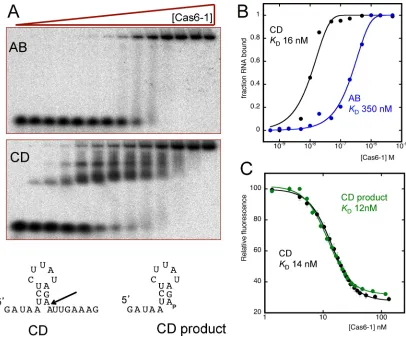
An electrophoretic mobility shift assay (EMSA) was used to estimate the binding affinity of Cas6-1 for the CD and AB families repeats. The CD-repeat was bound with an appar-ent dissociation constant around 16 nM (Figure3). This is
>100-fold weaker than that observed for the Csy4 enzyme which has aKDof 50 pM for its cognate substrate (25).
In-termediate retarded species were observed, which may cor-respond to mixtures of one or two repeats binding to the dimeric Cas6 protein and potentially to cleaved repeats. In contrast, for the AB-repeat, the binding affinity was con-siderably lower (apparentKD=350 nM) (Figure3) and no
intermediate bands were observed. These experiments were carried out at 20◦C, a temperature that minimizes cleavage of the RNA substrate by Cas6-1 as the enzyme has an opti-mal temperature for activity at 70◦C or above (14).
To investigate the binding affinity in more detail, Cas6-1 was titrated against a fixed concentration of the CD-repeat sequence with a 5-fluorescein label at 25◦C. This experi-ment was also carried out using an RNA corresponding to the CD cleavage product of Cas6-1, with a 3-phosphate at the point of cleavage mimicking the cyclic phosphate
gen-erated by Cas6. For both RNA species, progressive fluores-cence quenching on titration of Cas6-1 was observed which could be fitted using a binding equation incorporating the Hill coefficient to take into account apparent cooperativ-ity. Both the CD substrate and CDproduct were bound by Cas6-1 with an apparent dissociation constant around 14 nM, in good agreement with the value obtained from the EMSA experiment. Whilst we cannot rule out partial cleav-age of the CD-repeat under these conditions, the most im-portant conclusion arising from these experiments is the Cas6-1 binds its cleaved crRNA with a dissociation con-stant about 2.5 orders of magnitude higher than the other Cas6 enzymes that have been studied.
Cas6-1 can operate under multiple turnover conditions to gen-erate free crRNAs for effector complexes
All Cas6 enzymes studied to date have been analysed un-der single turnover conditions where the enzyme is present in large excess compared with the RNA substrate. Several Cas6 enzymes from different sources have been shown to catalyse only a single turnover, remaining bound tightly to the cleaved crRNA product. Biologically, this makes sense where a Cas6 enzyme is dedicated to the generation of cr-RNA for one effector complex, particularly where Cas6 is an integral component of the complex. However, the sit-uation in S. solfataricusis more complex, with five Cas6 paralogues and at least five surveillance complexes. Accord-ingly, we investigated the ability of Cas6-1 to catalyse mul-tiple turnover kinetics, a reaction cycle that requires the re-lease of crRNA product after cleavage. When 10 nM Cas6-1 was incubated with a 400-fold excess (4M) of CRISPR-repeat substrate, multiple turnover was observed, with over 35 turnovers in 30 min (Figure4A). The multiple turnover reaction rate varied linearly with enzyme concentration over a broad range of Cas6 concentrations (Figure 4B). The rate constant for this reaction was estimated as 1.75 min−1, which may be close to theVmaxof the enzyme because
sub-strate concentrations were much higher than the dissocia-tion constant of∼15 nM. Compared with a single turnover rate constant of 3.7 min−1under equivalent conditions, this
suggests that the overall reaction rate may be partially lim-ited by substrate binding or product dissociation rather than the rate for the chemical step of catalysis, but the differ-ence in rates was not large. Thus, it appears Cas6-1 is capa-ble of generating free crRNA products in multiple turnover mode for incorporation into multiple distinct surveillance complexes.
Cas6-1 activity inS. solfataricusextracts
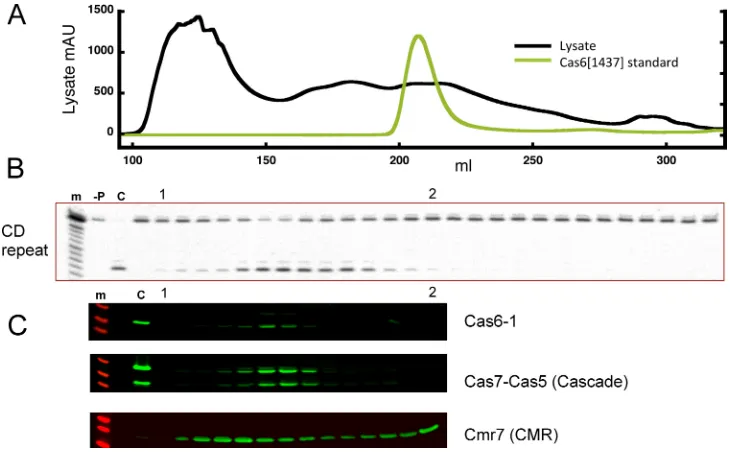
To investigate Cas6 activity in S. solfataricusextracts, we lysed 5 gS. solfataricusbiomass and passed it over a gel filtration column to fractionate proteins by size. Fractions were then assayed for Cas6 activity and analysed by west-ern blotting with polyclonal antibodies raised against Cas6-1, the Cmr7 subunit of the CMR complex and the Cas5– Cas7 complex that forms the core of Cascade. The UV-absorbance trace showed proteins and other UV-absorbing material eluting in a complex pattern at retention volumes between 100 and 300 ml (Figure5A). Recombinant dimeric
at St Andrews University Library on April 22, 2014
http://nar.oxfordjournals.org/
Figure 2. CRISPR-repeat specificity of Cas6-1 and Cas6-3. (A) Single turnover kinetic analysis of cleavage of the CD and AB families repeats by Cas6-1. The CD-repeat is cleaved with exponential kinetics and a rate constant of 3.69 min−1. The AB-repeat is cleaved much more slowly. Data points are
the means of triplicate measurements and error bars showing the standard error are plotted although these are typically too small to see in the plot. (B) Denaturing gel electrophoresis monitoring cleavage of the AB and CD families repeats by the Cas6-3 endonuclease (MBP-Sso1422). Cleavage rates were roughly equivalent to one another and an active site variant protein (K47A) was inactive. Numbers show the time of incubation (in minutes). The control lacking protein is indicated as ‘−P’ and an alkaline hydrolysis ladder of the AB-repeat RNA is shown in lane ‘m’. Cleavage by Cas6-1 for 15 min for both these repeats is shown in the right hand lanes.
Cas6-1, which has a native molecular weight of 65 kDa, elutes from the column in a single peak with a retention time centred on 210 ml. CD-repeat cleavage activity corre-sponding to Cas6-1 was detected in one peak eluting with retention volumes between 150 and 180 ml (Figure5B). This activity eluted with a considerably smaller retention volume than recombinant Cas6-1, suggesting that the Cas6 activity is part of a larger complex. This was confirmed by west-ern blotting using antibodies raised against Cas6-1, which showed that the protein eluted in one peak at the position corresponding to the peak of activity against the CD-repeat (Figure5C). This is consistent with the hypothesis that the Cas6-1 enzymes are responsible for cleavage of the majority of CD-repeat sequencesin vivo. Duplicate membranes were probed using antibodies raised against the heteromeric pro-tein Sso1441–1442 (Cas7–Cas5, representing the core of the archaeal Cascade complex (21)). Cas6-1 clearly elutes co-incidently with Cascade, suggesting that they may form a complex in cell extracts, as suggested previously (21). We cannot rule out the possibility that co-incident elution is due to the interaction of Cas6-1 with other factors such as pre-crRNA or with other CRISPR-Cas complexes in cell extracts. A stable interaction with Cas6 was not observed in studies of theThermoproteus tenaxtype I-A Cascade com-plex (26). However, antibodies raised against the Cmr7 sub-unit of the CMR complex show a peak eluting before Cas-cade (consistent with the large size of the CMR complex) and another peak corresponding to the dimeric Cmr7 pro-tein (Figure5C). These data suggest that Cas6-1 is not co-eluting with the CMR complex, consistent with earlier ob-servations (19).
A non-CRISPR RNA is abundant in the CSM complex and is processed by Cas6-3in vitro
Evidence supporting the functional coupling of Cas6-3 and CSM comes from the identification of a non-crRNA present in nearly 1.5% of the total sequence reads in the CSM complex as judged by next generation sequencing (20). By contrast, this species constitutes only 0.07% of the total RNA isolated from the CMR complex (19). The RNA, previously annotated as ncRNA60 by Soreket al.(27), has no known function and is found adjacent to the sso1421 gene (and therefore very close to thesso1422gene encod-ing Cas6-3) (Figure1). Inspection of the RNA sequence re-veals a repeat-like sequence with significant similarity (nu-cleotides in grey) to the AB-repeat family upstream of the mature 5-end of ncRNA60 (Figure6). A synthetic version of the ncRNA60 precursor is cleaved by Cas6-3 with simi-lar efficiency to that observed for repeats of the AB or CD families (Figure6), generating mature ncRNA60 with a 5 sequence that closely resembles the 5-handle of crRNAs. This suggests that the ncRNA60 precursor is cleaved by Cas6-3 and loaded into the CSM complex. The processed ncRNA60 sequence is predicted by mfold (28) to form a hairpin structure with an 8 bp helical stem. The functional significance of these observations are unclear at present. It is likely that this sequence does not direct cleavage of the cognate genomic locus as, like the CRISPR loci themselves, there will be no mismatch present at the junction of the 5 -handle and the spacer sequence.
at St Andrews University Library on April 22, 2014
http://nar.oxfordjournals.org/
Figure 3. Repeat binding by Cas6-1. (A) Gel electrophoretic mobility shift assay showing Cas6-1 binding to 1 nM radioactively labelled AB- or CD-repeat at 20◦C. (B) Quantification of the fraction of RNA bound for data in panel (A), fitted to a standard binding isotherm. (C) Cas6-1 binding to the CD and CD product RNA species monitored by fluorescence quenching of a 5-fluorescein moiety at 25◦C. Data points are means of triplicate measurements with SD. Standard error of the means (SEMs) shown. The data were fitted using a modified binding equation with a variable Hill coefficient to take apparent cooperativity into account (25).
Figure 4. Multiple turnover cleavage of CRISPR repeats by Cas6-1. (A) 10 nM Cas6-1 was incubated with 4M32P-labelled CD-repeat under multiple
turnover conditions (see ‘Materials and Methods’ section). Over 35 turnovers were observed in the 30 min assay. (B) Secondary plot showing that, under multiple turnover conditions, the rate of product formation was linearly dependent on the enzyme concentration with a rate constant of 1.75 min−1. Error
bars represent the standard errors of the rates obtained from linear curve fits as shown in (A).
at St Andrews University Library on April 22, 2014
http://nar.oxfordjournals.org/
[image:6.595.109.474.497.683.2]Figure 5. Cas6-1 activity inSulfolobus solfataricus.(A) UV absorbance traces showing total protein elution following application of anS. solfataricus
cell lysate to a gel filtration column (black), and the elution profile of purified dimeric Cas6-1 (pale). (B) Nuclease activity against the CD-repeat in the cell extract. The gels are aligned with the UV traces shown in (A). Lane m: alkaline hydrolysis ladder;−P: no protein control; C: RNA digested with recombinant Cas6-1. (C) Western blots showing the coincident elution positions of Cas6-1 and the Cascade core subunits Cas7–Cas5. The elution position of Cmr7, a subunit of the CMR complex, is also shown. Lane m: protein markers; C: recombinant proteins; labels 1 and 2 serve to indicate identical fractions in panels (B) and (C).
Figure 6. A non-CRISPR-repeat substrate for Cas6-3. ncRNA60 precur-sor is cut by Cas6-3 at a similar rate and site to the AB-repeat, but not by Cas6-1. The active site variant of Cas6-3 (K47A) was inactive. Lane−P indicates a no-protein control incubated for 60 min. Sequences and poten-tial structures of the AB-repeat and ncRNA60 precursor RNAs are shown on the right. Arrows show the positions cleaved by Cas6-3. For ncRNA60, the residues in grey match corresponding residues in the AB-repeat. Note the lack of potential to form a base paired hairpin stem.
DISCUSSION
Co-evolution of Cas6 enzymes with effector complexes and CRISPR repeats
A recent bioinformatics analysis of archaeal CRISPR-Cas systems has revealed that many species encode more than one effector complex, often with only a single cas6 gene (29). TheS. solfataricusCRISPR-Cas system is one of the most complex characterized to date. The genome encodes at least five different surveillance complexes of three sub-types, two CRISPR-repeat families and five Cas6 paralogues (12). In situations where multiple CRISPR-repeat families and Cas6 paralogues co-exist, one possibility is that pre-crRNA from any repeat family is processed in a promiscuous man-ner by the first Cas6 to encounter them. This appears to be
the situation in the archaeonMethanosarcina mazeiwhere there are two effector complexes (of subtypes I-B and III-B), two Cas6 paralogues and two different repeat sequences, as no differential specificity was observed for either Cas6 with respect to the two repeat sequences (30). Similarly, the two Cas6 paralogues inThermus thermophilus appear to have similar CRISPR RNA cleavage specificities, even though there are distinct modes of RNA recognition (31). The alter-native is a tight co-evolution of a Cas6 enzyme specific for its cognate CRISPR-repeat. This appears to be the case in the cyanobacteriumSynechocystissp. PCC6803, which has three spacer loci, each associated with genes encoding an ef-fector complex (one type I-D and two type III). Two of these loci have an associatedcas6paralogue and genetic analysis suggests each Cas6 is specific for its cognate CRISPR-repeat sequence (32), suggesting co-evolution of each Cas6 with its cognate repeat sequence, although it should be emphasized that biochemical data in support of this finding is not yet available.
Our data suggest a more subtle situation exists inS. solfa-taricus. Two CRISPR-repeat families have been described, both capable of forming a 3-bp hairpin stem that is known to provide an important recognition motif for the Cas6-1 family (15) and both generating an identical eight nu-cleotide 5-handle sequence upon cleavage by Cas6. The main difference between the AB and CD families occurs in the hairpin loop sequence where three nucleotides out of five vary. This could provide opportunities for differen-tial recognition on binding by different Cas6 paralogues. Cas6-1 is clearly highly specific for the CD family repeat se-quence, probably due to the specific recognition of the hair-pin loop sequence observed in the co-crystal structure (15). In contrast, the Cas6-3 enzyme has a more relaxed
at St Andrews University Library on April 22, 2014
http://nar.oxfordjournals.org/
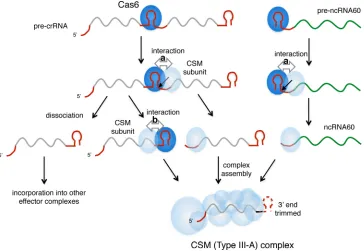
[image:7.595.51.289.369.463.2]Figure 7. Model for biased uptake of AB-family crRNAs into the CSM complex. Cas6 binding to pre-crRNA creates two possibilities for interactions between bound Cas6 and CSM subunits: (a) 3of the cleavage site at the nascent 5-handle sequence, or (b) 5of the cleavage site, either before or after cleavage by Cas6. Either alternative could explain the enrichment of AB family crRNAs in the CSM complex due to an interaction between a CSM subunit and Cas6-3. A third possibility is the dissociation of Cas6 leaving free crRNA to initiate assembly of effector complexes. A similar mechanism could account for biased uptake of ncRNA60 into the CSM complex via interaction a) only (shown on right). Spacer sequence is shown in grey and repeat-derived sequences in a darker shade.
ficity, at least in vitro, cleaving all repeat sequences with similar kinetics. The difference in specificities is exemplified by the finding that an abundant non-coding RNA species in S. solfataricus, ncRNA60, is generated from a precur-sor molecule by cleavage mediated by Cas6-3 but is not a substrate for Cas6-1. Closer inspection of the RNA precur-sor reveals extensive sequence identity with the AB-family CRISPR-repeat sequence (Figure6C) including all five nu-cleotides of the hairpin loop and the sequence flanking the Cas6-3 cleavage site. However, tellingly, the ncRNA60 pre-cursor lacks the ability to form a hairpin stem structure, with only one out of three base pairs possible. This raises the possibility that the Cas6-3 family, for which there is no structural information, utilize a fundamentally differ-ent mechanism for repeat recognition that does not rely on cleavage at the base of a hairpin. Although hairpin loops are a recurring feature in Cas6:repeat complexes the structure ofP. furiosusCas6 bound to a repeat RNA suggests an al-ternative ‘wrap around’ recognition mechanism is possible (18). Further studies are required to explore this possibility.
Coupling Cas6 to effector complexes
The established paradigm for Cas6 enzymes is that they catalyse only a single turnover, remaining tightly bound to the crRNA cleavage product with picomolar affinities (25,31,33). This is logical where Cas6 is an integral subunit of the type I Cascade complex or where a dedicated Cas6 is present for each effector complex, a situation that is possi-ble, at least in theory, inS. solfataricus. Alternatively, there could be a complete disconnect between Cas6 and the
ef-fector complexes, with crRNAs dissociating from Cas6 en-zymes following cleavage, leaving them free to associate with effector complexes stochastically. The reality appears to lie somewhere between these extreme scenarios.
On the one hand, Cas6-1 is unique amongst currently characterized Cas6 enzymes in its ability to sustain multi-ple turnover catalysis––acting as a true enzyme and gen-erating free crRNA productin vitro. The kinetic constants suggest that product release does not significantly limit the overall rate of reaction, unlike other Cas6 enzymes studied in detail (25,31). This may be largely due to weaker binding of substrates and products by Cas6-1, where dissociation constants are about 15 nM rather than the picomolarKD’s
observed for other enzymes. In this scenario,crRNAs pro-cessed by Cas6 could be released to act as a focal point for the assembly of effector complexes of types IA, III-A and III-B inS. solfataricus. This is consistent with the obser-vation that no Cas6 paralogue is found in association with purified type III complexes inS. solfataricusorP. furiosus (19,20,34). Furthermore, in the related speciesS. islandicus REY15A, one Cas6 appears to service the crRNA require-ments of three different effector complexes (one type I-A and two type III-B) (35).
On the other hand, there is clearly a biased uptake of crRNAs in the CSM complex, with 88% derived from the A and B loci (20). Coupled with the observation that the ncRNA60 species is also present at high levels in CSM, this suggests a functional link between Cas6-3 (and/or Cas6-2, which has not yet been characterized) and the CSM com-plex. In the CMR complex, the situation is reversed with a
at St Andrews University Library on April 22, 2014
http://nar.oxfordjournals.org/
biased uptake of crRNA from loci C and D (19). It should be borne in mind that mature crRNAs from the AB and CD loci are indistinguishable from one another at the 5-end where the 5-handle sequences are identical. This suggests some type of handover between Cas6 and the downstream effector complexes may be operating. It is possible that Cas6 binding to repeat sequences facilitates the initiation of CSM complex assembly with crRNA via protein:protein inter-actions. These crRNA binding events could occur either 5 or 3 of the bound Cas6 (Figure 7). Transient interac-tions between Cas6 proteins and the type III complexes could be lost when crRNA product dissociates from Cas6 or when the remaining repeat-derived RNA of the 3-handle is trimmed away––a feature of type III systems (5,19,20,36). It should be noted that the ncRNA60 precursor has only a single ‘repeat-like’ motif and any interaction between CSM subunits and Cas6-3 on this RNA species would have to oc-cur near the 5-end prior to cleavage by Cas6-3. This inter-action raises the possibility that different effector complexes might target different types of mobile element, depending on the origins of spacers found in the different CRISPR loci.
CONCLUSION
In conclusion, we have studied crRNA processing and load-ing into effector complexes in the highly complex S. sol-fataricus CRISPR-Cas system. Two families of Cas6 pro-teins have been investigated, revealing differing specificities for the CRISPR-repeat sequences present and the possibil-ity of multiple turnover catalysis to generate free crRNA. Biased incorporation of AB family repeats into the CSM complex may be explained by transient interactions with Cas6:crRNA product complexes. We have also shown that Cas6 enzymes can process non-crRNAin vivo, suggesting alternative potential functions for these enzymes beyond the CRISPR-Cas system.
ACKNOWLEDGEMENT
We are grateful to Stuart MacNeill, Christophe Rouillon, Jing Zhang and Huanting Liu for helpful discussions.
FUNDING
Biotechnology and Biological Sciences Research Council [BB/K000314/1 to M.F.W.]; Medical Research Council-funded studentship [to R.S.]. Funding for open access charge: Department for Business, Innovation and Skills award to the University of St Andrews.
Conflict of interest.None declared.
REFERENCES
1. Makarova,K.S., Haft,D.H., Barrangou,R., Brouns,S.J., Charpentier,E., Horvath,P., Moineau,S., Mojica,F.J., Wolf,Y.I., Yakunin,A.F.et al.(2011) Evolution and classification of the CRISPR-Cas systems.Nat. Rev.. Microbiol.,9, 467–477.
2. Brouns,S.J., Jore,M.M., Lundgren,M., Westra,E.R., Slijkhuis,R.J., Snijders,A.P., Dickman,M.J., Makarova,K.S., Koonin,E.V. and van der Oost,J. (2008) Small CRISPR RNAs guide antiviral defense in prokaryotes.Science,321, 960–964.
3. Westra,E.R., van Erp,P.B., Kunne,T., Wong,S.P., Staals,R.H., Seegers,C.L., Bollen,S., Jore,M.M., Semenova,E., Severinov,K.et al.
(2012) CRISPR immunity relies on the consecutive binding and degradation of negatively supercoiled invader DNA by Cascade and Cas3.Mol. Cell,46, 595–605.
4. Sinkunas,T., Gasiunas,G., Waghmare,S.P., Dickman,M.J., Barrangou,R., Horvath,P. and Siksnys,V. (2013) In vitro reconstitution of Cascade-mediated CRISPR immunity in Streptococcus thermophilus.EMBO J.,32, 385–394. 5. Hale,C.R., Majumdar,S., Elmore,J., Pfister,N., Compton,M.,
Olson,S., Resch,A.M., Glover,C.V. 3rd, Graveley,B.R., Terns,R.M.
et al.(2012) Essential features and rational design of CRISPR RNAs that function with the Cas RAMP module complex to cleave RNAs.
Mol. Cell,45, 292–302.
6. Spilman,M., Cocozaki,A., Hale,C., Shao,Y., Ramia,N., Terns,R., Terns,M., Li,H. and Stagg,S. (2013) Structure of an RNA silencing complex of the CRISPR-Cas immune system.Mol. Cell,52, 146–152. 7. Hatoum-Aslan,A., Maniv,I., Samai,P. and Marraffini,L.A. (2013)
Genetic characterization of anti-plasmid immunity by a Type III-A CRISPR-Cas system.J. Bacteriol.,196, 310–317.
8. Marraffini,L.A. and Sontheimer,E.J. (2008) CRISPR interference limits horizontal gene transfer in staphylococci by targeting DNA.
Science,322, 1843–1845.
9. Deltcheva,E., Chylinski,K., Sharma,C.M., Gonzales,K., Chao,Y., Pirzada,Z.A., Eckert,M.R., Vogel,J. and Charpentier,E. (2011) CRISPR RNA maturation by trans-encoded small RNA and host factor RNase III.Nature,471, 602–607.
10. Jinek,M., Chylinski,K., Fonfara,I., Hauer,M., Doudna,J.A. and Charpentier,E. (2012) A programmable dual-RNA-guided DNA endonuclease in adaptive bacterial immunity.Science,337, 816–821. 11. Mali,P., Esvelt,K.M. and Church,G.M. (2013) Cas9 as a versatile tool
for engineering biology.Nat. Methods,10, 957–963.
12. Zhang,J. and White,M.F. (2013) Hot and crispy: CRISPR-Cas systems in the hyperthermophile Sulfolobus solfataricus.Biochem. Soc. Trans.,41, 1422–1426.
13. Lillestol,R.K., Shah,S.A., Brugger,K., Redder,P., Phan,H., Christiansen,J. and Garrett,R.A. (2009) CRISPR families of the crenarchaeal genus Sulfolobus: bidirectional transcription and dynamic properties.Mol. Microbiol.,72, 259–272.
14. Reeks,J., Sokolowski,R.D., Graham,S., Liu,H., Naismith,J.H. and White,M.F. (2013) Structure of a dimeric crenarchaeal Cas6 enzyme with an atypical active site for CRISPR RNA processing.Biochem J.,
452, 223–230.
15. Shao,Y. and Li,H. (2013) Recognition and cleavage of a nonstructured CRISPR RNA by its processing endoribonuclease Cas6.Structure,21, 385–393.
16. Haurwitz,R.E., Jinek,M., Wiedenheft,B., Zhou,K. and Doudna,J.A. (2010) Sequence- and structure-specific RNA processing by a CRISPR endonuclease.Science,329, 1355–1358.
17. Gesner,E.M., Schellenberg,M.J., Garside,E.L., George,M.M. and Macmillan,A.M. (2011) Recognition and maturation of effector RNAs in a CRISPR interference pathway.Nat. Struct. Mol. Biol.,18, 688–692.
18. Wang,R., Preamplume,G., Terns,M.P., Terns,R.M. and Li,H. (2011) Interaction of the Cas6 riboendonuclease with CRISPR RNAs: recognition and cleavage.Structure,19, 257–264.
19. Zhang,J., Rouillon,C., Kerou,M., Reeks,J., Brugger,K., Graham,S., Reimann,J., Cannone,G., Liu,H., Albers,S.V.et al.(2012) Structure and mechanism of the CMR complex for CRISPR-mediated antiviral immunity.Mol. Cell,45, 303–313.
20. Rouillon,C., Zhou,M., Zhang,J., Politis,A., Beilsten-Edmands,V., Cannone,G., Graham,S., Robinson,C.V., Spagnolo,L. and White,M.F. (2013) Structure of the CRISPR interference complex CSM reveals key similarities with cascade.Mol. Cell,52, 124–134. 21. Lintner,N.G., Kerou,M., Brumfield,S.K., Graham,S., Liu,H.,
Naismith,J.H., Sdano,M., Peng,N., She,Q., Copie,V.et al.(2011) Structural and functional characterization of an archaeal clustered regularly interspaced short palindromic repeat (CRISPR)-associated complex for antiviral defense (CASCADE).J. Biol. Chem.,286, 21643–21656.
22. Liu,H. and Naismith,J.H. (2009) A simple and efficient expression and purification system using two newly constructed vectors.Protein Expr. Purif.,63, 102–111.
at St Andrews University Library on April 22, 2014
http://nar.oxfordjournals.org/
23. Kvaratskhelia,M. and White,M.F. (2000) An archaeal Holliday junction resolving enzyme with unique properties.J. Mol. Biol.,295, 193–202.
24. Richard,D.J., Bell,S.D. and White,M.F. (2004) Physical and functional interaction of the archaeal single-stranded DNA binding protein SSB with RNA polymerase.Nucleic Acids Res.,32, 1065–1074.
25. Sternberg,S.H., Haurwitz,R.E. and Doudna,J.A. (2012) Mechanism of substrate selection by a highly specific CRISPR endoribonuclease.
RNA,18, 661–672.
26. Plagens,A., Tripp,V., Daume,M., Sharma,K., Klingl,A., Hrle,A., Conti,E., Urlaub,H. and Randau,L. (2014) In vitro assembly and activity of an archaeal CRISPR-Cas type I-A Cascade interference complex.Nucleic Acids Res., in press.
27. Wurtzel,O., Sapra,R., Chen,F., Zhu,Y., Simmons,B.A. and Sorek,R. (2010) A single-base resolution map of an archaeal transcriptome.
Genome Res.,20, 133–141.
28. Zuker,M. (2003) Mfold web server for nucleic acid folding and hybridization prediction.Nucleic Acids Res.,31, 3406–3415. 29. Vestergaard,G., Garrett,R.A. and Shah,S.A. (2014) CRISPR
adaptive immune systems of archaea.RNA Biol.,11, 156–167. 30. Nickel,L., Weidenbach,K., Jager,D., Backofen,R., Lange,S.J.,
Heidrich,N. and Schmitz,R.A. (2013) Two CRISPR-Cas systems in Methanosarcina mazei strain Go1 display common processing
features despite belonging to different types I and III.RNA Biol.,10, 779–791.
31. Niewoehner,O., Jinek,M. and Doudna,J.A. (2014) Evolution of CRISPR RNA recognition and processing by Cas6 endonucleases.
Nucleic Acids Res.,42, 1341–1353.
32. Scholz,I., Lange,S.J., Hein,S., Hess,W.R. and Backofen,R. (2013) CRISPR-Cas systems in the cyanobacterium Synechocystis sp. PCC6803 exhibit distinct processing pathways involving at least two Cas6 and a Cmr2 protein.PLoS One,8, e56470.
33. Sashital,D.G., Jinek,M. and Doudna,J.A. (2011) An RNA-induced conformational change required for CRISPR RNA cleavage by the endoribonuclease Cse3.Nat. Struct. Mol. Biol.,18, 680–687. 34. Hale,C.R., Zhao,P., Olson,S., Duff,M.O., Graveley,B.R., Wells,L.,
Terns,R.M. and Terns,M.P. (2009) RNA-guided RNA cleavage by a CRISPR RNA-Cas protein complex.Cell,139, 945–956.
35. Deng,L., Garrett,R.A., Shah,S.A., Peng,X. and She,Q. (2013) A novel interference mechanism by a type IIIB CRISPR-Cmr module in Sulfolobus.Mol. Microbiol.,87, 1088–1099.
36. Hatoum-Aslan,A., Maniv,I. and Marraffini,L.A. (2011) Mature clustered, regularly interspaced, short palindromic repeats RNA (crRNA) length is measured by a ruler mechanism anchored at the precursor processing site.Proc. Natl. Acad. Sci. U.S.A.,108, 21218–21222.
at St Andrews University Library on April 22, 2014
http://nar.oxfordjournals.org/