Psychological Science 1 –7
© The Author(s) 2015 Reprints and permissions:
sagepub.com/journalsPermissions.nav DOI: 10.1177/0956797614561799 pss.sagepub.com
Research Article
Switching between different tasks is a common cognitive challenge. In the laboratory, task switching is usually examined by asking participants to switch frequently between trials associated with different tasks; on some trials, the task will change (switch trials), whereas on oth-ers it will not (stay or repeat trials). People are commonly slower and more error-prone on switch than on stay trials (Monsell, 2003). A central question in the task-switching literature relates to the identity and nature of the pro-cesses responsible for the costs involved in switching.
There are two main accounts of switch costs (for reviews, see Kiesel et al., 2010; Vandierendonck, Liefooghe, & Verbruggen, 2010). Central to both is the notion of task set, which is a collection of cognitive processes needed to perform the task. According to the task-set-reconfiguration explanation (Monsell, Yeung, & Azuma, 2000; Rogers & Monsell, 1995), the increase in reaction time (RT) on switch trials in comparison with stay trials reflects the time needed to engage control processes to reconfigure the cognitive system for a new task. An alternative account, task-set inertia, posits that the switch cost indexes the interference arising from the completion of a different task. Critically, this view emphasizes the difficulty in
switching away from a task set, rather than in the time to prepare for an impending one. Allport and colleagues (Allport, Styles, & Hsieh, 1994; Wylie & Allport, 2000) argue that when individuals switch tasks, they still have activation persisting from the previous task set, and this can interfere with performance on the task at hand. The switch cost reflects the time needed to overcome this interference.
Empirical support for task-set inertia has been obtained from a variety of behavioral studies, in which persisting task set is inferred from the pattern of switch costs (see Kiesel et al., 2010). An alternative is to use techniques that arguably provide more direct insights into the processing of task-irrelevant information, such as eye movements and measures of neural activity. Longman, Lavric, and Monsell (2013) measured eye fixations in participants who were cued on every trial to identify a face or letters superim-posed on it. On switch trials, participants fixated on the
Corresponding Author:
Lisa H. Evans, Cardiff University, School of Psychology, Tower Building, Park Place, Cardiff, CF10 3AT, United Kingdom E-mail: [email protected]
Direct Real-Time Neural Evidence for
Task-Set Inertia
Lisa H. Evans, Jane E. Herron, and Edward L. Wilding
Brain Research Imaging Centre, School of Psychology, Cardiff University
Abstract
One influential explanation for the costs incurred when switching between tasks is that they reflect interference arising from completing the previous task—known as task-set inertia. We report a novel approach for assessing task-set inertia in a memory experiment using event-related potentials (ERPs). After a study phase, participants completed a test block in which they switched between a memory task (retrieving information from the study phase) and a perceptual task. These tasks alternated every two trials. An ERP index of the retrieval of study information was evident in the memory task. It was also present on the first trial of the perceptual task but was markedly attenuated on the second. Moreover, this task-irrelevant ERP activity was positively correlated with a behavioral cost associated with switching between tasks. This real-time measure of neural activity thus provides direct evidence of task-set inertia, its duration, and the functional role it plays in switch costs.
Keywords
task switching, episodic memory, task-set inertia, ERPs, recollection
previously relevant feature to a greater extent than on stay trials. Moreover, there was a relationship between this attentional misorienting and switch costs. In functional MRI experiments, two different teams of researchers capi-talized on the fact that distinct brain regions are engaged during the processing of certain stimuli (faces and words; Yeung, Nystrom, Aronson, & Cohen, 2006) or stimulus attributes (color and motion; Wylie, Javitt, & Foxe, 2006). Both teams reported increased activation of task-irrelevant information immediately following a task switch, and they also observed that the magnitude of this activation corre-lated with RT switch costs.
In the experiment reported here, we adopted the same approach as Longman et al. (2013) and Wylie et al. (2006) and cued our participants on a trial-by-trial basis so that we could determine more precisely the duration of task-irrelevant neural activity. There were also two important differences. First, one of our tasks did not rely on an assessment of perceptual characteristics of stimuli; instead, it required a memory judgment. This is an important departure, because in the three studies described previ-ously, all switches were between perceptual elements (e.g., words or letters superimposed on faces); hence, con-clusions about persisting activations encompassed only visible elements of a stimulus array (which are either task irrelevant or task relevant). Second, we employed event-related potentials (ERPs). In the context of a task requiring a memory judgment, ERPs offer opportunities to infer the engagement of specific processes on switch and stay trials because the functional significance of specific ERP modu-lations has been explored extensively.
Of particular relevance here is the fact that recollec-tion—the recovery of specific details of episodes—has a distinct signature in the electrical record called the left-parietal ERP old/new effect. This effect consists of a rela-tively greater positivity for ERPs elicited by old rather than by new test stimuli attracting correct judgments. It is largest at left parietal scalp locations between 500 and 800 ms after stimulus presentation. The evidence linking this effect to recollection is substantial (for reviews, see Friedman & Johnson, 2000; Wilding & Sharpe, 2003), and the effect has been used in several studies as a marker of the extent to which recollection has occurred in the absence of converging behavioral evidence (Bergstrom, Velmans, de Fockert, & Richardson-Klavehn, 2007; Evans, Wilding, Hibbs, & Herron, 2010; Herron & Rugg, 2003; Mecklinger, Parra, & Waldhauser, 2009).
In the present experiment, participants completed an initial study phase followed by a test phase, during which ERPs were acquired. In the test phase, participants switched between an episodic memory task and a per-ceptual task; these alternated every two trials (Rogers & Monsell, 1995). If there was interference between tasks, the task set should carry over from the episodic memory
task when participants complete the perceptual task. Evidence for this would be the presence of a left-parietal old/new effect, the neural index of recollection, in the perceptual task. Moreover, larger old/new effects on switch than on stay trials would provide information about the time course of this persistence. Finally, if task-set inertia plays a functional role in the switch cost, there should be a correlation between the degree of task-irrel-evant activity and behavioral switch costs.
Method
Participants
Because of the novelty of this study, effect sizes could not be calculated straightforwardly to estimate sample size. Previous studies have demonstrated that robust left-pari-etal effects in memory tasks can be found with 16 partici-pants (e.g., Wilding, Doyle, & Rugg, 1995; Wilding & Rugg, 1997). Anticipating somewhat smaller effects in the perceptual task here, as well as an assessment of changes in effects across switch and stay trials, we planned to include data from 32 participants.
Forty-eight right-handed native English speakers ages 18 to 30 years (35 females, 13 males) participated in the study for payment after giving informed consent. Sixteen were excluded: 11 failed to contribute sufficient artifact-free trials in the conditions of interest (i.e., ≥ 16), and 5 fell below the threshold for behavioral performance (pro-portion of correct location judgments given an “old” response < .6). Rules for the selection of participants were set a priori following standards adopted in our pre-vious work (e.g., Evans et al., 2010). Of the 32 partici-pants included, 24 were female, and 8 were male.
Stimuli and design
location. Each of these words was preceded by one of two preparatory cues that indicated which task participants were to complete, and these were denoted by the capital letters “O” and “X.” The mapping of these letters to task was counterbalanced across participants. Each test-cue type was always presented for two consecutive trials.
The old/new status of words and the designation of words to the episodic or perceptual task were fully coun-terbalanced. At study, participants responded with their index and middle fingers, counterbalanced across left and right hand. Left-side location judgments were always asso-ciated with the leftmost of the two fingers. During the test phase, participants responded using the same fingers as at study, with the addition of the index finger of the other hand to indicate new words or words below fixation.
Procedure
Each study-test block started with a message on screen indicating the number of the block participants were about to complete. At study, participants were asked to indicate whether a word appeared on the right or left side of the screen. A central fixation asterisk was pre-sented for 1,000 ms, then a word was prepre-sented for 300 ms. The monitor then went blank until a response was made, after which the monitor remained blank for a fur-ther 500 ms before the start of the next study trial. Responses were made by pressing a key.
Each trial during the test phase started with a cue indicat-ing which of two tasks participants should prepare to com-plete. In the episodic task, participants had to decide whether the word was new (i.e., not shown at study) or had appeared on the left or right side of the screen. In the per-ceptual task, participants had to indicate whether the test word had just appeared toward the top, middle, or bottom of the monitor. Each task required one of three responses: The episodic task required a “left,” “right,” or “new” response, and the perceptual task required a “top,” “middle,” or “bot-tom” response. The preparatory cue stayed on screen for 300 ms, followed by a central fixation asterisk for 2,000 ms, then the test word for 300 ms. The monitor then went blank until participants made a response, and it remained blank for a further 500 ms before the next preparatory cue was shown. Participants were asked to pay attention to the pre-paratory cue in order to identify the retrieval requirements and to respond accordingly. They were encouraged to bal-ance speed and accuracy equally.
Electroencephalogram (EEG)
acquisition
EEG data were recorded during the test phase from 25 silver/silver-chloride electrodes embedded in an elastic cap and from two electrodes placed on the left and right
mastoids. Recording locations were based on the interna-tional 10-20 system (Jasper, 1958, appendix) and included midline (Fz, Cz, Pz), fronto-polar (Fp1/Fp2), frontal (F7/ F8, F5/F6, F3/F4), central (C7/C8, C5/C6, C3/C4), poste-rior (P7/P8, P5/P6, P3/P4), and occipital (O1/O2) sites. Vertical and horizontal eye movements were recorded from additional electrode pairs. EEG data were recorded at 167 Hz and referenced off-line to the average of the signal at the two mastoids. EEG and electrooculogram (EOG) data were recorded with a bandwidth from 0.03 to 40 Hz (−3 dB). Trials containing large EOG artifacts were rejected, as were trials containing analog-to-digital satu-ration or baseline drift exceeding ±80 µV. Other EOG blink artifacts were corrected using a linear regression estimate (Semlitsch, Anderer, Schuster, & Presslich, 1986). The researcher was blind to trial identity when process-ing EEG data. Procedures for the rejection of trials were set a priori and were based on standards we have adopted in previous work (e.g., Evans et al., 2010). Less than 5% of all trials were rejected because of EEG artifacts. The total epoch length was 1,536 ms with a 102-ms prestimu-lus baseline, relative to which all mean amplitude mea-sures were taken. A seven-point binomially weighted smoothing filter (~22 Hz) was applied prior to analysis.
Results
All analyses included the Greenhouse-Geisser correction for nonsphericity when necessary. Epsilon-corrected degrees of freedom are reported. A significance level of .05 was adopted for all analyses. The mean number of trials included in the averaged ERPs for each response category was as follows. For the episodic task, ERPs asso-ciated with correct location judgments to old words had a mean of 22 for switch trials (range = 16–29) and 21 for stay trials (range = 16–28); in addition, ERPs associated with new items that were correctly classified had a mean of 26 for switch trials (range = 19–30) and 26 for stay tri-als (range = 16–30). For the perceptual task, ERPs associ-ated with correct location judgments for new words had a mean of 27 for switch trials (range = 16–30) and 29 for stay trials (range = 25–38), whereas for correct location judgments for old words, the mean was 28 for switch tri-als (range = 21–33) and 27 for stay tritri-als (range = 19–30).1
Behavioral data
Cohen’s dzs > 6.99, Hedges’s gavs > 9.95 (Lakens, 2013). The probability of “old” responses to old words was .93 for both switch trials (95% confidence interval, or CI = [.91, .95]), and stay trials (95% CI = [.90, .96]), and the probability of correct responses to new words was .91 for both trial types (95% CI = [.88, .94]). The mean accuracy of location judgments was .79 (95% CI = [.75, .83]), and .78 (95% CI = [.74, .82]), for switch and stay trials, respec-tively, which was reliably above chance, ts(31) > 13.49, ps < .001, Cohen’s dzs > 2.39, Hedges’s gavs > 4.71. Accuracy in the perceptual task was close to ceiling: The mean proportion of correct responses for all trial types ranged from .95 to .98 (95% CI = [0.93, 0.99]).
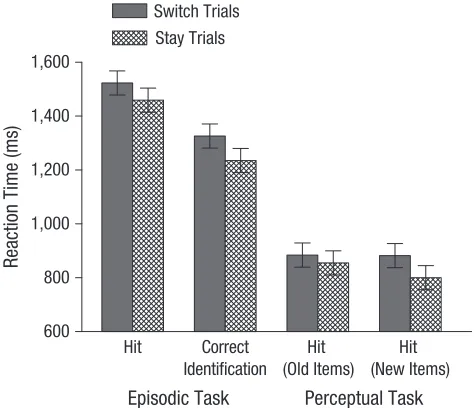
An analysis of variance (ANOVA) on RT data was con-ducted with the factors task (episodic, perceptual), trial type (switch, stay), and word status (old, new). RTs were slower on switch than on stay trials, F(1, 31) = 17.96, p < .001, ωp2 = 0.35. In addition, the Task × Word Status inter-action was significant: RTs were faster in the perceptual task than in the episodic task, F(1, 31) = 148.74, p < .001, ωp2 = 0.82, and faster for new than for old words, F(1, 31) = 19.13, p < .001, ωp2 = 0.36, with the difference in RTs for word status being larger in the episodic than in the perceptual task, F(1, 31) = 18.09, p < .001, ωp2 = 0.35. These data are presented in Figure 1.
ERP analyses
The neural index of recollection was measured between 500 and 800 ms after stimulus presentation. We ran a
series of ANOVAs on the electrophysiological data, using the factors anterior-posterior dimension (anterior, central, and posterior), hemisphere (left, right), and site (inferior, midlateral, and superior) alongside factors of trial type (switch, stay) and word status (in the perceptual task: old, new; in the episodic task: correct location judgment, correct identification of new word).
First, analyses were conducted for the ERPs elicited in the perceptual task. At issue was how ERPs diverged on switch and stay trials when they were separated accord-ing to the task-irrelevant old/new stimulus dimension. The second set of analyses was conducted on ERPs elic-ited in the episodic task, in which the old/new dimen-sion was relevant. In the following sections, only reliable effects involving word status are described. Finally, a cor-relation was computed between task-irrelevant activity on the perceptual task (i.e., the left-parietal ERP old/new effect) and the behavioral switch cost.
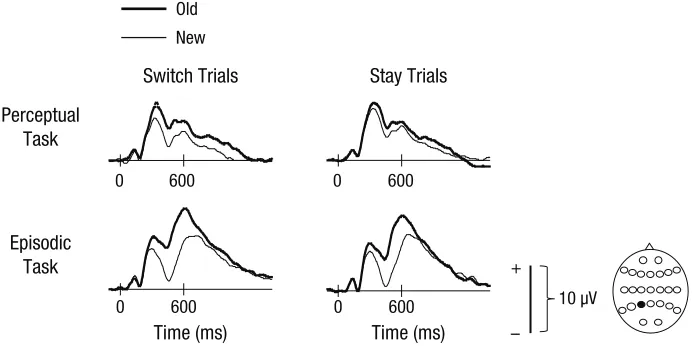
Perceptual task. For the perceptual task, the scalp maps in Figure 2 show that the differences between activities in response to old and new words were somewhat left-later-alized, larger at posterior than at anterior scalp locations, and larger on switch than on stay trials. Statistical analyses revealed a Trial Type × Word Status × Anterior-Posterior Dimension × Hemisphere interaction, F(1.6, 48.3) = 3.79, p < .05, consistent with data shown in Figure 2.
We followed up on this interaction by assessing switch and stay trials separately. There were no significant differ-ences between ERPs elicited by old and new words on stay trials.2 On switch trials, there was a four-way 600
800 1,000 1,200 1,400 1,600
Perceptual Task Episodic Task
Reaction Time (ms)
Switch Trials Stay Trials
Hit Correct
Identification Hit (Old Items)
[image:4.603.319.547.69.257.2]Hit (New Items)
Fig. 1. Mean reaction time as a function of task and trial type. For the episodic task, results are shown separately for correct location judg-ments (hits) and for correct identifications of new test items. For the perceptual task, results are shown for correct location judgments for previously studied words (old items) and for unstudied words (new items). Error bars indicate within-subjects confidence intervals (Loftus & Masson, 1994).
Switch Trials
Perceptual Task
Episodic Task
Stay Trials
0.0 µV
1.5 µV
4.0 µV
[image:4.603.52.289.439.643.2]0.5 µV
interaction between word status, anterior-posterior dimension, hemisphere, and site, F(3.4, 104.6) = 3.32, p < .05, as well as two lower-order effects: a Word Status × Site interaction, F(1.1, 35.0) = 5.18, p < .05, and a main effect of word status, F(1, 31) = 6.21, p < .05. Examining ERPs elicited by switch trials at left posterior sites, where effects were largest, we found a main effect of word sta-tus, F(1, 31) = 12.13, p < .01, and an interaction with site, F(1.6, 49.0) = 9.77, p < .01. These results indicate that waveforms were more positive-going for old words than for new words at left posterior sites, particularly at sites closest to the midline (see Fig. 3).
For switch trials at one left posterior superior site (P3), there was a mean amplitude difference between responses to old words and responses to new words of 1.65 µV, t(31) = 3.72, p < .001, Cohen’s dz = 0.66, Hedges’s gav = 0.37. For comparative purposes, these same analy-ses were also conducted for stay trials, in which the mar-ginal effect seen in Figures 2 and 3 was also largest at the P3 site. Here, the mean difference between ERPs in responses to old and new words was 0.85 µV, t(31) = 1.65, p > .1, Cohen’s dz = 0.29, Hedges’s gav = 0.17.
Episodic task. Figure 2 shows that the distributions of old/new effects in the episodic task were somewhat com-parable on both trial types, but it appears that the magni-tude was larger on switch than on stay trials. However, statistical analyses did not reveal reliable interactions involving the switch-versus-stay manipulation. There were interactions involving word status, anterior-posterior dimension, and site, F(2.4, 73.0) = 4.75, p < .01, and word status, anterior-posterior dimension, and hemisphere,
F(1.2, 38.0) = 10.68, p < .01, as well as lower-level interac-tions involving these factors. Examining left posterior scalp locations revealed a main effect of word status, F(1, 31) = 58.35, p < .001. These results reflect the greater relative positivity for correct location judgments compared with correctly classified new test items at left posterior scalp locations. These can be seen clearly in Figures 2 and 3.
Task-set inertia and the switch cost. For each partici-pant, the magnitude of the left-parietal old/new ERP effect (i.e., old items – new items) in the perceptual task was calculated for switch and stay trials separately. These data were taken from P3, where the effect was largest (see results for the episodic task). To calculate the degree to which this effect was reduced on switch trials relative to stay trials, we divided the magnitude of the effect on switch trials by the magnitude of the effect on stay trials. This ratio was then correlated with the behavioral RT switch cost observed in the perceptual task (indexed by dividing the RT on switch trials by the RT on stay trials).3 There was a significant positive correlation between the ERP and behavioral ratios, r(30) = .45, p < .02: Larger switch costs arose when there was a bigger reduction in the size of the old/new effect from switch to stay trials.
Discussion
We used a novel approach to examine the presence of task-set inertia in a memory-task-switching experiment. We capitalized on the finding that there is an ERP index of the successful recovery of contextual information—the left-parietal old/new effect. This neural index was
Episodic Task
Stay Trials
Perceptual Task
Switch Trials
0 600 0 600
+
10 μV Old
New
0 600 0 600
[image:5.603.129.475.69.242.2]Time (ms) Time (ms) –
present in responses during our perceptual task, even though the study history of words was irrelevant for com-pletion of this task. Notably, the left-parietal old/new effect was larger on trials in which participants had just switched from the episodic memory task than on trials in which participants had previously completed the percep-tual task. Moreover, the pattern of neural activity differen-tiating responses to old and new words on switch trials in the perceptual task was similar to that found on switch as well as stay trials in the episodic task. This outcome is consistent with the view that processes engaged on the preceding task carried over and remained active on at least the first trial of the subsequent task. In a further analysis, we found that the magnitude of the left-parietal old/new effect in the perceptual task was related to the behavioral switch cost. This indicates that a reduction in the degree of task-irrelevant activity between switch and stay trials is associated with quicker RTs on stay than on switch trials. This finding is important because it demon-strates that the recovery of task-irrelevant information, which is presumably a consequence of task-set inertia, has a functional role in the switch cost. It is not the case that recollective activity runs in parallel to perceptual processing without influencing performance on the per-ceptual task.
It is clear that processes relevant to the episodic task were active during the perceptual task. Because of the timing and scalp topography of the effect seen in the perceptual task, together with the similarities to the effect observed in the episodic task, it seems reasonable to sug-gest that what is being carried over is the recollection of contextual information. Moreover, it seems likely that this information is the location of the word on the screen from the preceding study phase. As noted in the intro-duction, ERP studies of memory retrieval are now suffi-ciently advanced that the left-parietal old/new effect has been employed as a marker of recollection in the absence of behavioral data. For example, in a study by Bergstrom et al. (2007), participants initially learned a list of weakly associated word pairs. In the test phase, they saw the first word from the pair and were asked either to recall the associated word or to prevent the associated word from entering consciousness. On the basis of the magnitude of the left-parietal old/new effect, the authors were able to draw conclusions about the ability of participants to suc-cessfully avoid recollection.
Our study replicates Wylie et al.’s (2006) and Yeung et al.’s (2006) findings that task-irrelevant indices of neu-ral activity are evident on switch trials and that there is a relationship between this persistence and behavioral switch costs. However, our study extends these findings in three important ways. First, the carryover effects reported here were not restricted to different elements or attributes of a visual stimulus. Second, they develop the
important link between cognitive control and episodic memory (see Richter & Yeung, 2014). Third, they permit inferences about carryover at the level of a specific mem-ory process. The findings also complement a recent behavioral study by Richter and Yeung (2012) examining the relationship between task switching and memory. In that study, participants saw words superimposed on pic-tures and were cued on each trial to attend to one or the other. Their memory was then tested for the words and the pictures. Task switching improved memory for task-irrelevant information: Participants remembered more about the unattended elements when they had been pre-sented on switch rather than stay trials. This study and the current one illustrate that there is interdependence between task switching and episodic memory, which is rarely studied, but could potentially help to elucidate the mechanisms involved in each.
A notable element of the findings reported here was the absence of marked differences between the magni-tudes of old/new ERP effects in the episodic task on switch and on stay trials. It might be anticipated that task-set inertia would affect the processing of both tasks, whereas this was only true for the perceptual task. One factor that was likely important in this respect is differ-ences in task difficulty. Previous work has demonstrated that carryover effects are affected by the relative difficulty of the two tasks (Allport et al., 1994; Monsell et al., 2000; Yeung & Monsell, 2003). Switch costs are usually higher for the easier, more dominant task, as the increased con-trol required to perform the hard task has more carryover than the control required for the easy task. This seems to fit with the pattern of ERP findings reported here. The lack of a difference in the magnitude of the left-parietal old/new effect between switch and stay trials in the epi-sodic task may simply be due to the fact that the percep-tual task had limited carryover, as it was substantially easier than the memory task.
In conclusion, strong evidence for task-set inertia was found only on the first trial after a cue to switch tasks. There was also compelling evidence that this carryover plays a functional role in the switch cost, as participants who recovered more task-irrelevant material exhibited larger behavioral switch costs. This insight was made possible by using an approach that is novel in the task-switching domain. We believe this paradigm and tech-nique can be developed further to address new and fruitful questions in the areas of cognitive control as well as episodic memory.
Author Contributions
authors approved the final version of the manuscript for submission.
Declaration of Conflicting Interests
The authors declared that they had no conflicts of interest with respect to their authorship or the publication of this article.
Funding
This research was supported by the United Kingdom Biotechnology and Biological Sciences Research Council (BB/E009921/1) and the BIAL Foundation (91/12).
Notes
1. All participants received the same number of old and new items in the perceptual task; however, for 3 participants, these items were distributed slightly unequally between switch and stay trials. 2. The interaction between word status, anterior-posterior dimension, and site was just outside of the significance level adopted, F(2.9, 90.3) = 2.74, p = .05.
3. The correlation was also significant if a subtraction measure was used to calculate the behavioral switch cost, r(30) = .37,
p < .05.
References
Allport, A., Styles, E. A., & Hsieh, S. (1994). Shifting intentional set: Exploring the dynamic control of tasks. In C. Umilta & M. Moscovitch (Eds.), Attention and performance XV (pp. 421–452). Cambridge, MA: MIT Press.
Bergstrom, Z. M., Velmans, M., de Fockert, J., & Richardson-Klavehn, A. (2007). ERP evidence for successful voluntary avoidance of conscious recollection. Brain Research, 1151, 119–133.
Coltheart, M. (1981). The MRC Psycholinguistic Database.
Quart-erly Journal of Experimental Psychology, 33A, 497–505.
Evans, L. H., Wilding, E. L., Hibbs, C. S., & Herron, J. E. (2010). An electrophysiological study of boundary conditions for control of recollection in the exclusion task. Brain
Research, 1324, 43–53.
Friedman, D., & Johnson, R. (2000). Event-related potential (ERP) studies of memory encoding and retrieval: A selec-tive review. Microscopy Research & Techniques, 51, 6–28. Herron, J. E., & Rugg, M. D. (2003). Strategic influences on
recollection in the exclusion task: Electrophysiological evi-dence. Psychonomic Bulletin & Review, 10, 703–710. Jasper, H. H. (1958). Report of the Committee on Methods of
Clinical Examination in Electroencephalography.
Electroence-phalography and Clinical Neurophysiology, 10, 370–375.
Kiesel, A., Steinhauser, M., Wendt, M., Falkenstein, M., Jost, K., Philipp, A. M., & Koch, I. (2010). Control and interference in task switching—a review. Psychological Bulletin, 136, 849–874.
Lakens, D. (2013). Calculating and reporting effect sizes to facilitate cumulative science: A practical primer for t-tests and ANOVAs.
Frontiers in Psychology, 4, Article 863. Retrieved from http://
journal.frontiersin.org/Journal/10.3389/fpsyg.2013.00863/full
Loftus, G. R., & Masson, M. E. J. (1994). Using confidence inter-vals in within-subjects designs. Psychonomic Bulletin &
Review, 1, 476–490.
Longman, C. S., Lavric, A., & Monsell, S. (2013). More atten-tion to attenatten-tion? An eye-tracking investigaatten-tion of selec-tion of perceptual attributes during a task switch. Journal of Experimental Psychology: Learning, Memory, and
Cognition, 39, 1142–1151.
Mecklinger, A., Parra, M., & Waldhauser, G. T. (2009). ERP correlates of intentional forgetting. Brain Research, 1255, 132–147.
Monsell, S. (2003). Task switching. Trends in Cognitive Sciences,
7, 134–140.
Monsell, S., Yeung, N., & Azuma, R. (2000). Reconfiguration of task-set: Is it easier to switch to the weaker task?
Psychological Research, 63, 250–264.
Richter, F. R., & Yeung, N. (2012). Memory and cognitive con-trol in task switching. Psychological Science, 23, 1256–1263. Richter, F. R., & Yeung, N. (2014). Neuroimaging studies of task
switching. In J. Grange & G. Houghton (Eds.), Task
switch-ing and cognitive control (pp. 237–271). Oxford, England:
Oxford University Press.
Rogers, R. D., & Monsell, S. (1995). Costs of a predictable switch between simple cognitive tasks. Journal of Experimental
Psychology: General, 124, 207–231.
Semlitsch, H. V., Anderer, P., Schuster, P., & Presslich, O. (1986). A solution for reliable and valid reduction of ocular artifacts, applied to the P300 ERP. Psychophysiology, 23, 695–703.
Vandierendonck, A., Liefooghe, B., & Verbruggen, F. (2010). Task switching: Interplay of reconfiguration and interfer-ence control. Psychological Bulletin, 136, 601–626.
Wilding, E. L., Doyle, M. C., & Rugg, M. D. (1995). Recognition memory with and without retrieval of context: An event-related potential study. Neuropsychologia, 33, 743–767. Wilding, E. L., & Rugg, M. D. (1997). An event-related
poten-tial study of memory for words spoken aloud or heard.
Neuropsychologia, 35, 1185–1195.
Wilding, E. L., & Sharpe, H. (2003). Episodic memory encoding and retrieval: Recent insights from event-related potentials. In A. Zani & A. Mado Proverbio (Eds.), The cognitive
elec-trophysiology of mind and brain (pp. 169–196). San Diego,
CA: Academic Press.
Wylie, G., & Allport, A. (2000). Task switching and the mea-surement of “switch costs.” Psychological Research, 63, 212–233.
Wylie, G. R., Javitt, D. C., & Foxe, J. J. (2006). Jumping the gun: Is effective preparation contingent upon anticipatory activation in task-relevant neural circuitry? Cerebral Cortex,
16, 394–404.
Yeung, N., & Monsell, S. (2003). Switching between tasks of unequal familiarity: The role of stimulus-attribute and response-set selection. Journal of Experimental Psychology:
Human Perception and Performance, 29, 455–469.