Printed in Great Britain © The Company ofBiobgists Limited 1985
TEMPERATURE AND MUSCLE
BY ALBERT F. BENNETT
School of Biological Sciences, University of California, Irvine, California 92717, U.SA.
SUMMARY
Rates of force development, contraction and relaxation of vertebrate skeletal muscle are temperature dependent with Qi0 values of approxi-mately 2. Maximal forces developed have a low or negative thermal depen-dence. The functional basis of these patterns is poorly understood. Muscle performance generally does not acclimate. There appears to have been some evolutionary adaptation among species and classes to different thermal regimes, such that muscles from cold-adapted species maintain better mechanical performance at low temperatures than do those from warm-adapted animals. However, rate processes remain strongly ther-mally dependent even in animals with low or variable body temperatures. This thermal dependence of muscle in vitro is reflected in behavioural performance: maximal force generation in vivo is temperature indepen-dent and time-depenindepen-dent activities are more rapid at higher muscle tem-peratures.
INTRODUCTION
Mechanical performance of muscle is greatly influenced by temperature, as are most biological processes. Maximal forces developed by muscles and their rates of force generation, contraction, relaxation and power output are all altered when body temperature varies. As these muscular forces and rate processes underlie behavioural capacities, these may also be thermally dependent. Such factors as maximal locomotor speed and reaction rates may change with temperature and be so slow in the cold that effective escape or pursuit by an animal is curtailed. In animals that are subjected to varying or low body temperatures, we might expect to find adaptations which minimize the thermal dependence of muscle perform-ance.
The influence of temperature on the mechanical performance of vertebrate skeletal muscle is reviewed in this paper, first for one species of lizard and then for vertebrates more generally. Adaptations of muscle performance to temperature are examined, underlying mechanisms of thermal dependence are reviewed and implications for behaviour are discussed.
TEMPERATURE AND MECHANICAL PERFORMANCE
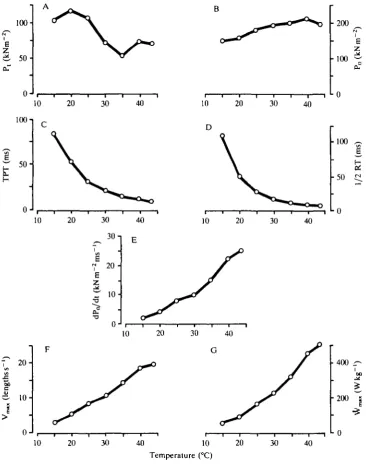
First, we will examine the influence of temperature on the contractile performance of muscle from a lizard. Lizards are a particularly useful group of animals for such studies as they may naturally experience a wide range of body temperatures daily. Many species also have very high thermal tolerance. Data are presented here (Fig. 1) on the influence of temperature on several aspects of force generation and contraction of skeletal muscle of the lizard Dipsosaurus dorsalis (Marsh & Bennett, 1985).
Dipsosaurus inhabits the hot desert regions of California and regulates field body
temperatures at approximately 40°C. However, it must maintain the capacity to react and move even when its body temperature is far below these diurnal levels. The reported data were measured on the white portion of the iliofibularis muscle of the hind limb. This preparation is composed almost exclusively of fast glycolytic fibres (Gleeson, Putnam & Bennett, 1980), which constitute the large majority of fibres in all the locomotory muscles of this species (Putnam, Gleeson & Bennett,
1980).
All contractile rate processes in this muscle, both isometric and isotonic, are greatly accelerated by increasing temperature, even up to 44°C. In isometric twitch, the rates of both tension development (measured as the inverse of time-to-peak tension, TPT) and relaxation (measured as the inverse of time to return to 50 % of maximal twitch tension, 1/2 RT) have Q)0 values of 2-36 and 2-82, respectively, between 20 and 30°C. Maximal rate of isometric tetanic tension development (dP0/dt) has a Qio of 2-22 over this range. The maximal velocity of shortening (Vm,,*) and maximal power output (Wmax) during isotonic contractions are similarly thermally dependent with Qio values of 1 -95 and 2-42, respectively. All these rates have a thermal dependence similar to those of most other biological processes (i.e. Qio = 2-3, Precht, Christophersen, Hensel & Larcher, 1973; Prosser, 1973).
In contrast, the temperature dependence of force exerted during isometric contraction is substantially different from that of contractile rate processes. Tetanic tension (Po) has a significant but very low thermal dependence: its thermal ratio (Rio, the ratio of two quantities measured over a 10°C interval, Bennett, 1984) is 1-2 between 20 and 30°C. Maximal Po is attained at 40°C. Twitch tension (Pt) is maximal at 15°C, declining at higher temperatures (Rio = 0-62 between 20 and 30°C).
How representative is the thermal dependence of muscle function in Dipsosaurus ? Qio and R]0 values measured approximately between 20 and 30°C from all other studies available on vertebrate skeletal muscle are given in Fig. 2. Most of these
100
i
E Z
50--200
i
E
z
-100
10 20 40 10 20
Temperature (°C)
[image:3.451.44.411.117.584.2]30 40
observations were made on amphibian and mammalian muscle. Although the variance in the data is high, due to such factors as the diversity of animals examined, differing fibre type composition of the muscles and different measurement techniques, the pattern is clear. As in the lizard muscle, rate processes in general are thermally dependent with Qi0 values of approximately 2, tetanic tension has a very low thermal dependence and twitch tension often decreases over this temperature range.
ADAPTATIONS TO TEMPERATURE
This general pattern of high thermal dependence of rate processes might be expected to pose problems for poikilothermic organisms. As muscle temperature changes, so do contractile speeds and possibly reaction rates or locomotor ability. Poikilotherms with low body temperatures might not attain maximal performance of which their muscles are capable due to an extrinsic factor, temperature, rather than an intrinsic structural or biochemical limitation. For example, the lizard Getrhonotus
multicarinatus has field active body temperatures of about 25 °C, but maximal rates of
muscle contraction and burst escape speed at 35-4O°C (Bennett, 1980; Putnam & Bennett, 1982), body temperatures far in excess of those encountered under any
Force Rate
40 n
3 0
-a
1 0
P,
(44)
P., (49)
TPT 1/2 RT dPo/dt
[image:4.451.81.368.310.592.2](40) (22) (13) (10) (7)
Temperature and muscle 337
natural conditions. Such a pattern of thermal dependence does not appear particularly adaptive. To what extent has there been adjustment to minimize the thermal perturbation of contractile rate processes in animals with low and/or variable body temperatures? Few data on this topic exist, so no confident generalizations are possible, but the studies available suggest some interesting adaptive patterns.
Acclimation
When an individual animal is exposed to a new thermal regime, it often shows compensatory changes in its physiological reactions (acclimation). Biological rate processes are initially altered in accordance with their QIQ upon acute temperature exposure. Over several days or weeks, these rates often return partially or completely to their original levels, even while the new thermal regime is maintained (Prechtef al. 1973; Prosser, 1973). Several comprehensive studies on the effect of long-term temperature exposure have been done on the mechanical performance of skeletal muscles of anuran amphibians. As illustrated for twitch kinetics (Fig. 3), no acclimation of either force generation (Pt, Po) or contractile rate (TPT, 1/2RT, dPo/dt, Vmax, WmM) has been demonstrated (Renaud & Stevens, 1981a,fe; Rome, 1983). The initial depression of contraction rates by cold exposure is maintained indefinitely. A similar lack of acclimation occurs in locomotor capacity of these animals (Putnam & Bennett, 1981). In fish, myofibrillar ATPase activity, which should be reflected in Vmax (Bdr&ny, 1967), has been shown to acclimate in goldfish (Johnston, 1979) but not in killifish (Sidell, Johnston, Moerland & Goldspink, 1983).
200 T
160-
1208 0
-
400
-TPT 1/2 RT
o •o
D
•o
15 25 5
Experimental temperature (°C)
15 25
The lack of acclimation of muscle function is a very puzzling result in view of its obvious importance to behavioural capacity and may reflect a constraint on adaptation.
Interspecific comparisons
Studies comparing species naturally exposed to different thermal regimes show a different pattern of adjustment of muscle function over evolutionary time. In lizards, species with lower activity temperatures have lower Q10 values for TPT, 1/2 RT and dP0/dt and faster twitch responses measured at any common temperature (Putnam & Bennett, 1982). Maximization of Pt at preferred thermal levels previously reported (Licht, 1964) has not been confirmed (Putnam & Bennett, 1982). The range of temperatures over which lizard muscles can function is clearly affected by their thermal regimes (Ushakov, 1964; Licht, 1964; Putnam & Bennett, 1982): muscles from more thermophilic species lose contractile ability and undergo irreversible heat damage at substantially higher temperatures than do those of more cryophilic animals. In fish, actomyosin ATPases of species from cold environments have both lower QIQ values and greater activities at any common temperature than those from warm-adapted fish (Fig. 4) (Johnston, Walesby, Davison & Goldspink, 1977; Johnston & Walesby, 1977, 1979). In both fish and lizards, evolutionary adaptation to tem-perature has evidently proceeded with both a shift (translation) and rotation of the rate-temperature curve.
100 n
10-2> S
2. E
1
-0-1 -I
10 20 Temperature (°C)
[image:6.451.53.366.354.583.2]30
Fig. 4. Activity of Mg2"1", Ca2+-activated actomyosin ATPase from teleost fish adapted to different thermal regimes. Cold-adapted species: Salvelinus alpinus, arctic (open squares); Champsocephalui gunnari, antarctic (open circles); Cottus bubalis, North Sea (open triangles). Warm-adapted species: Dascyllus aruanus (filled circles) and Pomatocentrus pulcherrimus (filled squares), both tropical.
Temperature and muscle 339
It should be emphasized, however, that these interspecific differences are only relative. In absolute terms, rate processes are still very thermally dependent even in cold-adapted species.
Comparison of muscle fmm homeotherms and poikilotherms
Are there major differences in the thermal dependence of muscle function in homeotherms and poikilotherms? One might anticipate that the latter would show adaptations to minimize thermal dependence and the former would optimize function over a narrow range of high temperatures. It should be noted, however, that even muscles from homeotherms may undergo major temperature changes depending on ambient conditions and work intensity (e.g. Saltin, Gagge & Stolwijk, 1968).
Some functional differences are apparent between muscle from anuran amphibians and mammals (Bennett, 1984). Anuran muscle develops maximal Pt at 0°C; mammalian peak Pt usually occurs at 20°C. Maximal Po is maintained at lower temperatures in anurans: Po of anuran muscle declines below approximately 15°C, that of mammalian muscle always decreases below 25 °C (Fig. 5). The time course of a muscle twitch, both TPT and 1/2 RT, has a lower Qi0 in anurans than in mammals. Anuran muscle is thus capable of producing maximal tension at lower temperatures than is mammalian muscle and its rate processes are less temperature sensitive, at least in regard to twitch kinetics. However, the distinction between the thermal dependence of saurian and mammalian muscle function is much less clear (Bennett, 1984). Although maximal Pt is developed at lower temperatures in lizard than in mammalian muscle, the thermal dependencies of Po and contractile rate processes are almost identical in these groups. The anuran-mammalian differences probably reflect
100 n
8 0
-O.
S 60 J
| loo n
80-60
Mammalian
Amphibian
10 20
Temperature (°C)
[image:7.451.50.403.401.609.2]30 40
adaptation to very different thermal regimes rather than a dichotomy in the functional capacity of muscle from poikilotherms and homeotherms.
It is apparent from the foregoing that some adjustments of vertebrate skeletal muscle function have evolved with respect to temperature. These adaptations in rate processes, however, have not been substantial. Muscle from poikilotherms still has a marked thermal dependence and rate processes are often faster at temperatures above those normally encountered. Lack of acclimation of these properties in individual animals further points to a lack of plasticity in these systems in regard to temperature adjustment. In view of the small number of studies, it should be evident that more comparative work is required to substantiate or alter these conclusions.
FUNCTIONAL BASIS OF THERMAL DEPENDENCE
The biochemical and functional properties that underlie these patterns of thermal dependence are not well understood. The pronounced thermal dependence of contractile rate processes are expected, as several of the steps underlying contraction and relaxation are enzymatically catalysed and have rates with Q10 values of 2-0 or more. For instance, strong thermal dependencies have been demonstrated for the rate of Ca2+ release (Blinks, Rudel & Taylor, 1978; Rail, 1979), the activity of actomyosin ATPase (Bendall, 1964; Hartshorne, Barns, Parker & Fuchs, 1972) and Ca2+ uptake by sarcoplasmic reticulum (Yamamoto & Tonomura, 1967; Blinks et al. 1978). However, the correspondence between the thermal dependence of contractile events and isolated enzyme systems associated with them is often poor. For example, although actomyosin ATPase is thought to be an important determinant of V ^ , the thermal dependence of the former is much greater than that of the latter (Bdrdny, 1967). An attempt to determine limiting factors of contractile events by comparisons of thermal dependencies would probably be no more successful than previous attempts to elucidate controlling reactions of biochemical pathways by measurement of Arrhenius activation energies.
Temperature and muscle 341
by the sarcoplasmic reticulum (Josephson, 1981). These processes evidently have different thermal dependencies, with the latter being more temperature sensitive; the Qio of 1/2 RT is generally greater than that of TPT measured on the same muscle (Hill, 1951; Walker, 1960; Bennett, 1984). Thus at low temperatures, greater force can be attained by the contractile proteins, even though their intrinsic contractile velocity is also slowed, before deactivation processes become effective. This explanation of the thermal dependence of Pt, while attractive, has not been critically tested.
Tetanic tension generally has a low but significant thermal dependence below 15-25 °C, depending on species (Fig. 5). As the muscle is supposedly completely activated by repetitive stimuli, one might expect Po to be thermally independent over the entire temperature range. One explanation for lower Po at low temperatures is a smaller number of cross-bridge attachments at those temperatures. However, measurements of instantaneous stiffness, which is dependent upon the number of cross-bridges attached, do not support this hypothesis (Ford, Huxley & Simmons, 1977; Kuhn et al. 1979; Bressler, 1981). Instantaneous stiffness is either thermally independent or has a different thermal dependence from that of Po. Consequently, the number of cross-bridges attached or a thermally-dependent bridge cycling does not appear to account for the observed pattern. Bressler (1981) suggests that increasing temperature may increase the tension per cross-bridge during tetanus.
It should be clear that further work is required to explain the bases of the thermal dependence of muscle function. Investigations exploiting thermal dependence may well lead to further hypotheses and insights into the nature of the contractile process itself (e.g. Mittenthal, 1975, on the distance of cross-bridge movement). Muscle from animals and/or animal groups with very different thermal histories could be particularly useful in these studies. For example, the different response of Po to temperature in anuran and mammalian muscle (Fig. 5) may be helpful to understanding patterns of cross-bridge tension generation and cycling during tetany. Or, the differing thermal dependencies of myofibrillar ATPase from animals adapted to different temperatures (e.g. Fig. 4) may help elucidate their role in determining intrinsic shortening velocities.
THERMAL DEPENDENCE OF MUSCLE PERFORMANCE IS VIVO
Is the thermal dependence of muscle function reflected in animal behavioural capacities? On the basis of experiments on isolated muscle, one would expect performance capacity for behaviour involving rates of contraction (e.g. running speed) to improve with increasing temperature. One would also expect performance involving maximal force generation by an animal to be relatively temperature independent.
greater maximal speeds (Webb, 1978; Bennett, 1980; Putnam & Bennett, 1981). However, the thermal dependence of this performance is distinctly lower than that of rate processes in isolated muscle. For example, in the lizard Dipsosaurus, maximal running velocity and limb cycling frequency have Qio values of 1-3-1-4 from 25 to 40 °C, while Vmai and W ^ , have Qio values of 1-7 and 2-0, respectively (Fig. 6) (Marsh & Bennett, 1985). Similarly low Qi0 values of 1-0—1-6 have been reported in other studies on rate-dependent performance cited above. This lower thermal dependence of behavioural performance compared to that of isolated muscle function could be attributable to several factors, including storage of energy in elastic structures of low thermal sensitivity (Marsh & Bennett, 1985). However, its basis is unknown at present.
Maximal force generation by muscles in vivo is almost independent of muscle temperature from 25 to 40°C (Binkhorst et al. 1977; Bergh & Ekblom, 1979; Petrofsky, Burse & Lind, 1981). This pattern accords very well with the observed thermal independence of Po over this temperature range. Endurance, measured as the time of maintenance of constant force, is maximal at approximately 30°C in both in
100 1
80-2.
60-a
'x
CO
* 4 0
-
20-0J
15 25 35 45
Temperature (°C)
Temperature and muscle 343
vivo performance (Clarke, Hellon & Lind, 1958; Petrofsky & Lind, 1969; Edwardset al. 1972) and in isolated muscle (Petrofsky & Lind, 1981; Segal & Faulkner, 1982).Endurance declines at both higher and lower temperatures.
As the foregoing data indicate, behavioural performance involving both speed and force generation reflects the underlying patterns of thermal dependence of muscle function. Higher muscle temperatures may be expected to result in improved rate performance in vivo, although maximal force application may be little affected and endurance may decline.
Financial support for this work was provided by NSF Grant PCM 81-02331. I thank Roger Seymour for his helpful comments on the manuscript.
R E F E R E N C E S
ASMUSSEN, E. k BfHE, O. (1945). Body temperature and capacity for work. Actaphysiol. tcand. 10, 1-22. BARANY, M. (1967). ATPase activity of myosin correlated with speed of muscle shortening. J. gen. Physiol. 50,
197-218.
BENDALL, J. R. (1964). The myofibnllar ATPase activity of various animals in relation to ionic strength and temperature. In Biochemistry ofMuscle Contraction, (ed. J. Gergely), pp. 448—452. Boston: Little, Brown & Co.
BENNETT, A. F. (1980). The thermal dependence of lizard behaviour. Amm. Behav. 28, 752-762.
BENNETT, A. F. (1984). The thermal dependence of muscle function. Am. J. Pkysiol. 247 {Reg. Integ. comp. Physiol. 16), R217-R229.
BEROH, U. & EKBLOM, B. (1979). Influence of muscle temperature on maximal muscle strength and power output in human skeletal muscle. Acta physiol. scand. 107, 33—37.
BlNKHORST, R. A., HOOFD, L. & VlSSERS, A. C. A. (1977). Temperature and force-velocity relationship of human muscles. J. appl. Physiol. 42, 471-475.
BUNKS, J. R., RODEL, R. & TAYLOR, S. R. (1978). Calcium transients in isolated amphibian skeletal muscle fibres: detection with aequorin.J- Physiol., Land. 277, 291-323.
BRESSLER, B. H. (1981). Isometric contractile properties and instantaneous stiffness of amphibian skeletal muscle in the temperature range of 0 to 20°C. Can.J. Physiol. Pharmacol. 59, 548-554.
CLARKE, R. S. J., HELLON, R. F. & LIND, A. R. (1958). The duration of sustained contractions in the human forearm at different muscle temperatures. J. Physiol., Land. 143, 454-473.
EDWARDS, R. H. T . , HARRIS, R. C , HULTMAN, E., KAUSER, L., K O H , D . &NORDESJO, L.-O. (1972). Effect of temperature on muscle energy metabolism and endurance during successive isometric contractions sustained to fatigue, of the quadriceps muscle in man. J . Physiol., Land. 220, 335-352.
FORD, L. E., HUXLEY, A. F. & SIMMONS, R. M. (1977). Tension responses to sudden length changes in stimulated frog muscle fibres near slack length.,7. Physiol., Land. 269, 441—515.
GLEESON, T . T . , PUTNAM, R. W. & BENNETT, A. F. (1980). Histochemical, enzymatic, and contractile properties of skeletal muscle fibres in the lizard Dipsosaurus dorsalii.J. exp. Zool. 214, 293-302.
HARTSHORNE, D. J., BARNS, E. M., PARKER, L. & F U C H S , F. (1972). The effect of temperature on actomyosin. Biochim. biophys. Acta 267, 190-202.
HILL, A. V. (1951). The influence of temperature on the tension developed in an isometric twitch. Proc. R. Soc. B
138, 349-354.
HOMSHER, E., MOMMAERTS, W. F. H. M., RICCHTUTI, N. V. & WALLNER, A. (1972). Activation heat, activation metabolism and tension-related heat in frog semitendinosus muscles. J. Physiol., Land. 220, 601—625. JOHNSTON, I. A. (1979). Calcium regulatory proteins and temperature acclimation of actomyosin ATPase from a
eurythermal teleost (Carassius auratus L.).J. comp. Physiol. 129, 163-167.
JOHNSTON, I. A. &WALESBY, N. J. (1977). Molecular mechanisms of temperature adaptation in fish myofibnllar adenosine triphosphatase. J. comp. Physiol. 119, 195—206.
JOHNSTON, I. A. & WALESBY, N. J. (1979). Evolutionary temperature adaptation and the calcium regulation of fish actomyosin ATPases.jr. comp. Physiol. 129, 169-177.
JOHNSTON, I. A., WALESBY, N. J., DAVISON, W. JCGOLDSPTNK, G. (1977). Further studies on the adaptation of fish myofibnllar ATPases to different cell temperatures. Pflugen Arch. ges. Physiol. 371, 257-262. JOSEPHSON, R. K. (1981). Temperature and the mechanical performance of insect muscle. In Insect
K U H N , H. J., G O T H , K . , DREXLER, B., BERBERICH, W. &ROEGG, J. C. (1979). Investigation of the temperature dependence of the cross-bridge parameters for attachment, force generation and detachment as deduced from mechano-chemica] studies in glycerinated single fibers from the dorsal longitudinal muscle of Lethoctrus maxemus. Biopkys. Struct. Mech. 6, 1-29.
LICHT, P. (1964). A comparative study of the thermal dependence of contractility in saurian skeletal muscle. Camp. Biochem. Physiol. 13, 27-34.
MARSH, R. L. & BENNETT, A. F. (1985). Thermal properties of isotonic contractile properties of skeletal muscle and sprint performance of the lizard Dipsosaurus dorsalis. J. comp. Physiol. (in press).
MnTENTHAL, J. E. (1975). A sliding filament model for skeletal muscle: dependence of isometric dynamics on temperature and sarcomere length. J. theor. Biol. 52, 1-16.
PETROFSKY, J. S., BURSE, R. L. & LIND, A. R. (1981). The effect of deep muscle temperature on the cardiovascular responses of man to static effort. Eur.J. appl. Phytiol. 47, 7-16.
PETROFSKY, J. S. & LIND, A. R. (1969). Insulative power of body fat on deep muscle temperatures and isometric endurance. J. appl. Physiol. 39, 629-642.
PETROFSKY, J. S. <ND, A. R. (1981). The influence of temperature on the isometric characteristics of fast and slow muscle of the cat. Pflugers Arch, ges. Physiol. 389, 149-154.
PRECHT, H., CHRISTOPHERSEN, J., HENSEL, H. & LARCHER, W. (1973). Temperature and Life. Berlin: Springer- Verlag.
PROSSER, C. L. (1973). Comparative Animal Physiology, 3rd edn. Philadelphia: W. B. Saunders Co. PUTNAM, R. W. & BENNETT, A. F . (1981). Thermal dependence of behavioural performance of anuran
amphibians. Anim. Behav. 29, 502-509.
PUTNAM, R. W. & BENNETT, A. F. (1982). Thermal dependence of isometric contractile properties of lizard muscle. J . comp. Physiol. 147, 11-20.
PUTNAM, R. W., GLEESON, T . T. & BENNETT, A. F. (1980). Histochemical determination of the fiber composition of locomotory muscles in a lizard, Dipsosaurus dorsalis. jf. exp. Zool. 214, 303-309.
RALL, J. R. (1979). Effects of temperature on tension, tension-dependent heat, and activation heat in twitches of frog skeletal muscle. J. Physiol., Land. 291, 265-275.
RANATUNGA, K. W. (1977). Influence of temperature on the characteristics of summation of isometric mechanical responses of mammalian skeletal muscle. Expl Neurol. 54, 513-532.
RENAUD, J. M. & STEVENS, E. D. (1981a). Effect of acclimation temperature and pH on contraction of frog sartonus muscle. Am. J. Physiol. 240 (Reg. Integ. comp. Physiol. 9), R301-R309.
RENAUD, J. M. & STEVENS, E. D. (19816). The interactive effects of temperature and pH on the isometric contraction of toad sartorius muscle. J. comp. Physiol. 145, 67-71.
ROME, L. C. (1983). The effect of long-term exposure to different temperatures on the mechanical performance of frog muscle. Physiol. Zool 56, 33-40.
SALTIN, B., GAGGE, A. P. &STOLWUK, J. A. J. (1968). Muscle temperature during submaximal exercise in man. J. appl. Physiol. 25, 679-688.
SEGAL, S. S. & FAULKNER, J. A. (1982). Static endurance of rat skeletal muscles at different temperatures in vitro. Med. Sci. Sports Exer. 14, 106.
SIDELL, B. D., JOHNSTON, I. A., MOERLAND, T . S. & GOLDSPINK, G. (1983). The eurythermal myofibrillar protein complex of the mummichog (Fundultu hetemclitus): adaptation to a fluctuating thermal environment. J. comp. Physiol. 153, 167-173.
USHAKOV, B. (1964). Thermostability of cells and proteins of poikilotherms and its significance in speciation. Physiol. Rev. 44, 518-560.
WALKER, S. M. (1960). The relation of stretch and of temperature to contraction of skeletal muscle. Am. J.phys. Med. 39, 234-258.
WEBB, P. W. (1978). Temperature effects on acceleration of rainbow trout, Sabno gairdneri. J'. Fish. Res. Bd Can. 35, 1417-1422.