Olfactory Neuroblastoma: MR Evaluation
Cheng Li,1
•2·3 David M. Yousem,1•2•3 Richard E. Hayden,2 and Richard L. Doti·2
PURPOSE: To evaluate MR in the diagnosis and staging of olfactory neuroblastoma. METHODS: Five patients with histologically proved olfactory neuroblastomas were studied by MR. Four also
had CT scans. RESULTS: The extent of disease delineated by MR agreed with surgical findings
and surgical staging of the tumor in all five patients. All cases of olfactory neuroblastomas originated in the nasal cavity and involved the ethmoid sinuses. In three of the five cases, the
tumors extended to the anterior skull base. In one case MR correctly suggested skull base involvement missed on CT. Lesions were isointense to hyperintense with muscle on T1-weighted scans. Compared with fat on T2-weighted scans, olfactory neuroblastomas were variable in signal intensity. Enhancement was minimal to moderate in all cases. CONCLUSION: In the evaluation
of olfactory neuroblastoma, MR is most useful in delineating the extent of the tumor and may be
more accurate than CT. However, the signal intensity characteristics of olfactory neuroblastomas
may overlap other tumors.
Index terms: Neuroblastoma; Esthesioneuroblastoma; Nose, neoplasms; Nose, magnetic resonance
AJNR 14:1167-1171, Sep/Oct 1993
Olfactory neuroblastoma (ON), also called es-thesioneuroblastoma, is an uncommon intranasal tumor originating from the olfactory neuroepithe-lium lining the roof of the nasal vault and in close proximity to the cribriform plate. ONs occur in
all age groups with a peak incidence in the age groups of 11 to 20 years and 51 to 60 years (1). There is a slightly greater incidence of the tumor in women. The common clinical symptoms are nasal obstruction, recurrent epistaxis, hyposmia, rhinorrhea, headaches, and visual disturbances
(1-4). Computed tomography (CT) has been shown to be extremely useful in staging and treatment planning of this tumor (2, 5). However, magnetic resonance (MR) imaging has shown
tremendous promise in surpassing CT for the mapping of neoplasms of the nasal cavity and paranasal sinuses (6-9). The authors have en-countered five patients with histologically proved
Received June 22, 1992; revision requested August 31, received September 24, and accepted November 10.
Supported in part by NIDCD grant POl DC 00161 (to RLD). 1
Smell and Taste Center, 2
Department of Otorhinolaryngology and Head and Neck Surgery, and 3
Department of Radiology, Hospital of the University of Pennsylvania, 3400 Spruce St, Philadelphia, PA 19104. Address reprint requests to David M. Yousem, MD.
AJNR 14:1167-1171, Sep/Oct 1993 0195-6108/93/1405-1167 © American Society of Neuroradiology
ON during the past 5 years who had MR studies. This entity has not been well described in the MR literature, and it remains to be seen whether ONs have stereotypical MR imaging features that can distinguish ON from other lesions.
Materials and Methods
Five patients with histologically verified ONs were
ex-amined by MR (n
=
5) and CT (n=
4). There were threewomen and two men with ages ranging from 17 to 76
years (mean 49.4 years) (see Table 1).
MR imaging was performed on a General Electric
(Mil-waukee, WI) 1.5-T Signa scanner using the quadrature head coil and a Medical Advances (Milwaukee, WI)
anterior-posterior volume neck coil. T1-Weighted images were
performed in the axial, coronal, and/or sagittal plane,
600-800/11-30/1-2 (repetition time/echo time/excitations).
Double-echo long-TR scans (2500-3500/18-25) were per
-formed in the axial plane. In three of the five cases,
gadopentetate dimeglumine (Berlex Industries, Wayne, NJ) was administered at a dose of 0.1 mmol/kg. T1-weighted scans (with the identical parameters above) were performed
immediately after administration of the gadolinium in the
axial and coronal planes. Fat-suppression techniques for the postcontrast scans were variably employed. All MR scans used a 256 X 192 matrix, 5-mm-thick sections, and
inferior saturation pulses. Intersection gaps of 2 to 2.5 mm
were standard for long-TR scans; the short-TR scans had
no intersection gaps.
1168 Ll
TABLE 1: Clinical information in five patients with olfactory neuroblastoma
Age, Presenting Primary Tumor Tumor Case
Sex Symptoms Location Staging
76, F Nasal obstruction, Right upper nasal c decreased smell, cavity
headache
2 65, F Epistaxis, nasal Left upper nasal B obstruction cavity
3 44, M Decreased smell and Left upper nasa- c vision on left pharynx
4 17, F Nasal congestion, Right sinonasal B right> left cavity
5 45, M Epistaxis Left upper nasal c
cavity
CT was performed on a GE 9800 scanner. Three- to 10-mm-thick sections were obtained in both the axial and
coronal planes, after administration of intravenous contrast
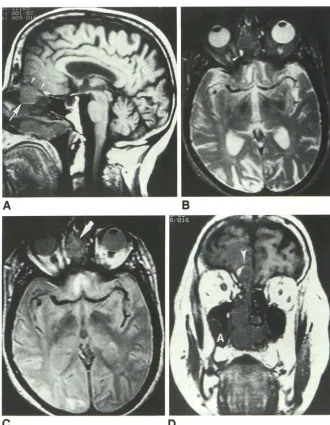
Fig. 1. Case 1. Seventy-six-year-old
woman with reported hyposmia and
patho-logically confirmed olfactory neuroblastoma.
A, Sagittal (600/20) MR scan through the midline demonstrates a soft-tissue mass
(ar-row) which breaches the cribriform plate and
demonstrates extraaxial intracranial tumor
(arrowheads).
B, Axial (3000/90) MR scan through the
same level demonstrates persistent low sig-nal intensity of the mass. Note the high signal intensity (arrowhead) of obstructed
secretions in the posterior ethmoid air cell
behind the lesion.
C, Axial (3000/35) MR scan through the
level of the superior orbits demonstrates a
low-intensity mass (arrow) within the right
nasal cavity and ethmoid air cells with ex -tension across midline to the left ethmoid air
cells.
A
D, Coronal (600/20) MR scan through the anterior nasal cavity demonstrates the intracranial extension of the mass
(arrow-head) through the cribriform plate invading the region of the olfactory lobe on the right
side. Postobstructive secretions are present
within the maxillary antrum (A).
c
AJNR: 14, September/October 1993
material. Supplementary 5-mm scans were made through
regions of special interest.
Both the MR and CT scans were carefully evaluated for the tumor's original location, extension, bony structure changes, anterior skull base invasion, and some associated
changes, including postobstructed secretions, hemorrhage, and edema. ONs were staged from A to C according to the classification system developed by Kadish et al (2). In stage
A, the tumor is limited to the nasal cavity. In stage B, the
tumor is confined to the nasal cavity and paranasal sinuses, and in stage C, the tumor extends beyond the nasal cavity and paranasal sinuses.
The scans were retrospectively reviewed by two radiol -ogists in concert without knowledge of surgical findings. The CT and MR scans were viewed separately but one after the other in a random order. The CT and MR scans were performed within 1 to 13 days of each other with no intervening therapy. The imaging findings were compared with surgical findings.
B
[image:2.614.56.300.106.251.2] [image:2.614.231.561.315.739.2]AJNR: 14, September/October 1993
A
B
c
D
Results
Clinical data on the patients with ON are sum-marized in Table 1.
On T1-weighted (short-TR, short-TE) MR ex-aminations, all ONs were hypointense to fat, but the intensity compared with muscle and inflam-matory mucosal disease was variable. On T2-weighted (long-TR, long-TE) sequences, the
tu-mors were always hyperintense to muscle and hypointense to inflamed mucosa, but had variable
intensity compared with fat. On proton density-weighted (long-TR, short-TE) scans the five ONs were hypointense to fat, hyperintense to muscle,
and hypointense to mucosal disease.
Gadopentetate dimeglumine was administered
to three patients. Tumor enhancement was
het-erogeneous in the three cases. In these three
cases, the solid tumor enhancement was readily
discernible from the peripheral (rim)
enhance-ment of obstructed sinonasal secretions.
Menin-OLFACTORY NEUROBLASTOMA 1169
Fig. 2. Case 2. Sixty-five-year-old woman with persistent epistaxis. Biopsy
proved olfactory neuroblastoma.
A, Axial CT scan through the nasal cavity
after biopsy reveals a mass in the mid to posterior left nasal cavity (arrow), which is well defined on this image. The lower density
anterior to the mass is caused by packing after the biopsy.
B, Coronal (3500/90) MR scan demon
-strates the lower signal intensity of the nasal
cavity and medial left ethmoid sinus neo -plasm, which is differentiated from the high
signal intensity of the lateral left ethmoid sinus obstructed secretions and the ob-structed secretions in the left maxillary
an-trum.
C, Coronal CT scan fails to demonstrate a good differentiation between neoplasm and
postobstructed secretions, pointing up one of the weaknesses of CT in the evaluation
of neoplastic processes in the paranasal si-nuses.
D, Axial postcontrast 750/26 MR scan through the lesion demonstrates the
nonen-hancing packing in the anterior portion of
the left nasal cavity and the enhancing tumor posterior to it (t). MR with gadolinium may be useful in differentiating inflammatory from neoplastic conditions, because inflam
-mation enhances in a peripheral fashion,
whereas enhancement in neoplasms tends
to be solid.
geal invasion, or the lack thereof, was well dem-onstrated after gadolinium.
Two tumors demonstrated speckled
calcifica-tions on CT scans; the calcified portion of the
mass was not detected, even in retrospect, on MR scans.
The extent of disease delineated by MR agreed with surgical findings in all five patients. Four
cases of ON originated in the high nasal cavity and involved the ethmoid sinus (Figs 1 and 2). In three of the five cases, tumors extended to the anterior skull base. One tumor invaded the brain and produced white matter edema (Fig 1).
An-other case was unusual in that it involved the maxillary antrum more than the nasal cavity (Fig 3).
[image:3.612.54.380.76.465.2]1170 Ll AJNR: 14, September/October 1993
A
B
c
Fig. 3. Case 4. Seventeen-year-old girl with nasal stuffiness and pathologically proved olfactory neuroblastoma.
A, Sagittal (600/20) MR scan to the right of midline demonstrates a soft-tissue mass that completely opacifies the right nasal cavity. Note the heterogeneity of the signal intensity within the mass with the anterior portion more hyperintense than the intermediate posterior portion. The bony margin of the cribriform plate (arrowheads) is intact, as surgically confirmed.
B, Axial (600/20) MR scan through the maxillary antrum demonstrates complete opacification of the maxillary antrum by the neoplastic process ( T). Whenever one confronts an isolated maxillary sinus opacification, one should consider neoplasm rather than an inflammatory condition. The bony margin of the maxillary antrum is breached medially, as invasion into the nasal cavity is evident.
C, Coronal (2500/80) scan further anterior to C demonstrates the low intensity of the mass, again isointense with gray matter. Although there is high signal intensity caused by postobstructive secretions in the frontal-ethmoidal recess on the right side, no tumor is seen to invade the cribriform plate or extend intracranially. MR is exquisitely useful for differentiating neoplasm from postobstructed secretions because of the difference in the signal intensity, as noted in this example.
seen on CT was unclear but probably related to
the very minimal destruction of the cribriform
plate. The tumor may have traveled through the sieve-like openings through the cribriform plate
rather than aggressively destroying bone. None-theless, because of concomitant orbital
involve-ment, this ON was preoperatively labeled as stage
C by both CT and MR. Therefore, although the
staging was identical, the MR more accurately
mapped the tumor, as was confirmed at surgery.
Discussion
ONs are rare, slow-growing malignant tumors
of the sino nasal cavity. The incidence of ON has
been estimated to range between 2% to 3% of
all malignant intranasal neoplasms (4). Most of
the cases of ON arise from the olfactory
neuro-epithelium lining the cribriform plate, upper
one-third of the nasal septum, superior turbinates,
and anterior ethmoid air cells. Symptoms
asso-ciated with early ON include: 1) gradually de-creasing sense of smell; 2) some degree of
unilat-eral nasal obstruction; and 3) episodic epistaxis.
These early clinical symptoms are nonspecific but, in combination, should lead one to consider the diagnosis of ON.
The tumors tend to grow slowly, spread sub-mucosally, and eventually extend into adjacent structures, especially the sinuses, palate, orbit, and brain. Remote metastases may occur in
ad-vanced cases.
The preoperative assessment of a patient with ON requires medical imaging, and herein lies
some controversy. Although CT is superior to
MR in the evaluation of bony structures, soft-tissue boundaries between tumor, retained secre-tions, and muscle are more accurately delineated with MR (9). Which study should be ordered?
In this short report, we found that MR was more accurate than CT in delineating ON extent. Because the staging system is so general, the
improved accuracy of MR in delineating the tu-mor is not demonstrated just by stage classifica-tion. Extension to the orbit on one CT study led to a stage C classification. The concomitant in-tracranial extension noted by MR was not seen on CT. Although this is not reflected by differ-ences in the staging classification (stage C in-cludes both orbital and intracranial extension),
the finding on MR made a difference in the surgical approach. A craniofacial
(neurosurgical-otorhinolaryngologic) combined-team approach
AJNR: 14, September/October 1993
ability to detect intracranial spread by MR in a study of inverted papillomas (10). It would seem that intracranial spread need not require
cribri-form plate destruction detectable by CT. Perhaps
a tumor can cross the fenestrations of the plate without destroying it to a degree detectable by CT.
The ability of MR to differentiate tumors from obstructed secretions in the paranasal sinuses was evident in this study also and has been previously described with other sinonasal tumors (7). Obstructed secretions are generally (but not exclusively) high intensity on T2-weighted scans
and show peripheral enhancement; tumors are
usually (but not exclusively) intermediate in inten-sity on T2-weighted scans and enhance in a solid fashion. Gadolinium enhancement is therefore very helpful in the mapping of sinonasal neo-plasms. Its utility in determining meningeal and extradural extrameningeal spread is widely known; it also can be helpful, in other settings, to detect perineural spread of sinonasal neo-plasms.
It should be noted that the signal-intensity characteristics of ONs in this limited study pop-ulation overlap those of other neoplasms in the sinonasal cavity (11). One of the distinguishing features of this tumor is its propensity for calci-fication, although inverted papillomas and chon-droid tumors can calcify as well. Spin-echo MR is less sensitive for the detection of calcification than CT is. In this regard, CT findings may
sug-OLFACTORY NEUROBLASTOMA 1171
gest the specific histology of ON when there is a calcified superior nasal mass. However, by virtue of the lesion's location high in the nasal vault, the diagnosis of ON usually will be also suggested by MR. In any event, a biopsy is required for histo-pathologic confirmation. At that point, the supe-rior mapping ability of MR is of paramount im
-portance.
References
1. Elkon D, Hightower 51, Lim ML, et al. Esthesioneuroblastoma. Cancer
1979;44: 1087-1094
2. Kadish S, Goodman M, Wang CC. Olfactory neuroblastoma. A clinical analysis of 17 cases. Cancer 1976;37:1571-1576
3. O'Connor TA, McLean P, Juilland GJF, et al. Olfactory neuro-blastoma. Cancer 1989;63:2426-2428
4. Anavi Y, Bahar M, Ben-Bassat M. Olfactory neuroblastoma: report of
a case and review of the literature. J Oral Maxillofac Surg
1989;47:514-517
5. Hurst RW, Erickson S, Cail WS, et al. Computed tomographic features
of esthesioneuroblastoma. Neuroradiology 1989;31 :253-257
6. Woodhead P, Lloyd GA. Olfactory neuroblastoma: imaging by m
ag-netic resonance, CT and conventional techniques. Clin Otolaryngol 1988;13:387-394
7. Shapiro MD, Sam PM. MRI of the paranasal sinuses and nasal cavity.
Radio/ Clin North Am 1989;27:447-475
8. Tassel PV, Lee Y. Gd-DTPA enhanced MR for detecting intracranial
extension of sinonasal malignancies. J Comput Assist Tomogr
1991 ;15:387-392
9. Paling MR, Block WC, Levine PA, et al. Tumor invasion of the anterior
skull base: a comparison of MR and CT studies. J Comput Assist Tomogr 1987;11 :824-830
10. Yousem DM, Fellows DW, Kennedy DW, et al. Inverted papilloma: MR evaluation. Radiology 1992;185:501-506
11. Som PM, Shapiro MD, Biller HF, Sasaki C, Lawson W. Sinonasal tumors and inflammatory tissues: differentiation with MR imaging.