T
HALES
S
OCIAL RESPONSIBLE BUYING AT
T
HALES
:
Improvement of purchasing performance and prepared for future changes.
Client: Thales Hengelo
1nd supervisor Thales Hengelo: Dhr. M. Bos 2st supervisor Thales Hengelo: Dhr. J. van Putten
1st supervisor Twente University: Dhr. J.I.H. Buter 2nd supervisor Twente University: Dr. J.M.G. Heerkens
Tim Hoogstrate Student number: 0143790 E-mail address: [email protected]
Industrial Engineering and Management Twente University, Enschede
Abstract
To be socially responsible these days is of growing importance to businesses around the globe including Thales. To come so far, purchasing as a business function can play an important role. In this report the role of purchasing is defined as social responsible buying. In order to be able to buy socially responsible, purchasing has to have certain capabilities. These capabilities are described in
purchasing maturity models. In this report we have a look towards the maturity purchasing
organizations should have to be able to buy socially responsible. Then we apply the knowledge to Thales and formulate recommendations for improvements.
Management summary
Introduction and scope:
The defense industry used to have a conservative nature. Nowadays, however, social responsibility seems to increase in importance in the defense industry.
For us CSR means that a company not only takes care of economic issues but also handles environmental and social issues (people, planet, and profit). This has two reasons, first for the motivations of being good, and second, to increase business results.
The Thales group expects that they can increase their business results by taking social and environmental issues into account.
Since Thales’ buying volume increased, responsibilities resulting from social issues shifted towards purchasing. Thus, purchasing as a business function can help organizations improve their social performance.
We defined the role of purchasing within social responsibility as Social Responsible Buying (SRB).
This thesis focuses on the elements in purchasing that are essential for Thales to buy socially responsible.
Research questions:
The following research question was formulated, which had been divided into sub questions 1, 2, and 3:
Does Thales have the capabilities to buy social responsible?
1. What are the key drivers and barriers of CSR and
how do these relate to Thales?
2. How do we distinguish different strategies towards
CSR and what are key processes for purchasing?
3. What competencies are required in different
CSR-attitudes and how does this relate to Monzcka’s model?
Research approach:
Figure 1 gives the schematic view of the different research activities.
Definition of variables
Limiting the domain
Relationship (model
building) Support
Figure 1 The stepwise procedure for theory combining is: definition of variables, limiting the domain, relationship (model building), and finally theory practicing (support).
Step 1 and 2 are bodied by a literature review, and theory is combined in step 3, so that a model could be formulated which gives insight in the relation between purchasing maturity and SRB.
To answer the main research question a large number of respondents could be used within Thales. (Formal and informal) Interviews with these respondents were used as a primary source of data collection.
Literature review:
Organizations can follow different strategies towards SRB. In this report these different strategies are defined as CSR-orientations. These differences are shown on a line from reactive towards proactive. Reactive companies typically add minimal effort in SRB, so that they for example hardly comply with regulations. On the other hand, proactive companies will voluntary take initiative to reduce their social impact.
For organizations the ability to execute a CSR-orientation seems to be dependent on its maturity as shown in the following figure:
Competences Maturity
Absorptive capacity Possible CSR orientation
Financial performance
Best practices
To define the maturity of purchasing in this thesis the Michigan State University (MSU) model is used. This model states 10 different stages of maturity for 8 strategic processes. We chose the MSU model from several other models because:
• It is empirically tested with financial performance, • It is well known and used throughout the world,
• It handles the five main elements that describe maturity, • It handles integrity,
• It is the most exhaustive,
• It is not a model, which forces the user to one unique solution,
• Finally, it needs information from many different departments and a broad scope of department’s increases validity.
[image:6.595.74.520.516.579.2]To determine a preferred CSR-orientation we used a 5 step procedure which is based on the 5 principles of Maignan et al. (2002): analyse of stakeholder pressure, estimation of potential benefits and costs, purchasing policy, choosing, and implementing a CSR-orientation. This process is shown in Figure 2.
analyse of stakeholder
pressure
estimation of potential
benefits and costs Purchasing policy choosing
implementing a CSR-orientation
Figure 2 The 5 step approach to help organizations determine the preferred CSR-orientation (based on Maignan et al. (2002)
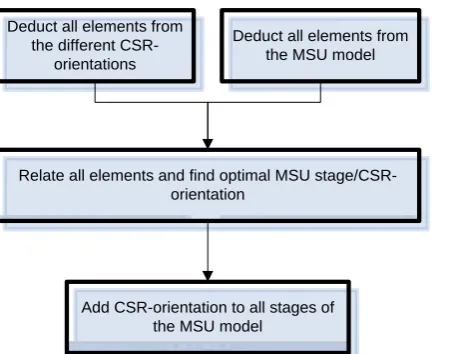
Combining theory:
Deduct all elements from the different
CSR-orientations
Deduct all elements from the MSU model
Relate all elements and find optimal MSU stage/CSR-orientation
Add CSR-orientation to all stages of the MSU model
This procedure results in an integration of the different CSR-orientations in the MSU model.
Theory practicing:
We applied the result of the combination to Thales. And used semi structured interviews with data triangulation as a basis for analysis of the current purchasing elements at Thales. We used 6 respondents from several disciplines for interviews.
Conclusions:
The conclusion is that:
Based on the analysis a reactive CSR-orientation is preferred for Thales.
[image:7.595.76.310.69.246.2]Furthermore, the following SRB elements are not sufficiently present at Thales:
Table 1: insufficient SRB elements
Element At Thales
The level of planning horizon for CSR objectives
The purchasing involvement in product and process planning differs between projects and products. Project with early and late (none) involvements are known. CSR objectives are not or ad hoc planned.
Benchmarking and market research Both benchmarking and market research happens basically only on price, and barely on other factors. Sometimes Thales analyse suppliers on different certificates. But this is not an order winner or loser. Collaboration that is commonly used in
order to deal with social responsible objectives
Use supply chains for innovative solutions, but social issues are not a goal itself.
Supplier selection happens by: first, look to suppliers already in the database; another supplier must have substantial advantages before they are switched. Two, new suppliers fill in a questionnaire and thereby environmental subjects and ISO certificates are tested. Purchasing is responsible for supplier selection. However, it is not that they always have the product knowledge to actively debate product specifications with suppliers.
A systematic supplier evaluation process Supplier evaluation happens on logistical issues, quality, and financial situations on a three months basis. A new tool QLTC in now introduced where hard and soft issues are continuously evaluated. Selective visits at suppliers. Normal audits for itself and its vendors (to expose and identify poor CSR performers within the supply base).
A systematic procedure for supplier development
8 strategic processes Stage
In sourcing and outsourcing 0 1 2 3 4 5 6 7 8 9 10
Commodity Strategy Development 0 1 2 3 4 5 6 7 8 9 10
Establish and leverage a world class supply 0 1 2 3 4 5 6 7 8 9 10
Development and manage supplier relationship 0 1 2 3 4 5 6 7 8 9 10
Supplier involvement in new product/process development 0 1 2 3 4 5 6 7 8 9 10
Supplier involvement in order realization process 0 1 2 3 4 5 6 7 8 9 10
Supplier development and quality management 0 1 2 3 4 5 6 7 8 9 10
Strategic costs 0 1 2 3 4 5 6 7 8 9 10
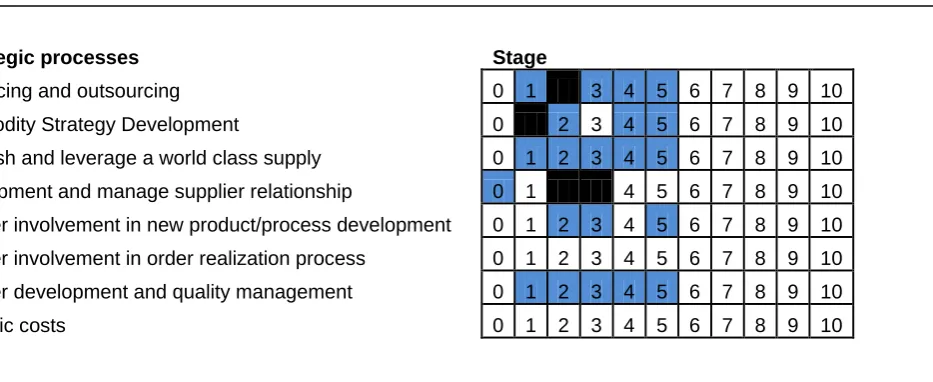
We have indicated that a reactive level seems to fit best to Thales’ situation. Therefore, Thales also needs fill in the gaps (black spots) so that they have enough absorptive capacity, and therefore are able to buy socially responsible, which Figure 3 shows.
[image:8.595.76.543.111.302.2]
Figure 3 Shows the black spots where MSU elements are missing.
In short, Thales should focus on getting the elements from Figure 3 so that they have sufficient absorptive capacity towards SRB, and are able to buy socially responsible, and should, if they follow a reactive CSR-orientation, give SRB shape with the missing and pointed SRB elements from Table 1. Resulting from the conclusion the recommendations could be formulated.
Recommendations:
To come to a reactive CSR-orientation, the following recommendations were formulated:
• Create a process to indentify suppliers that are performing below the level that the Thales Group has stated. Formulate supplier improvement programs and evaluate suppliers based on these processes and programs.
• Include SRB criteria in market research, benchmarks, and contracts.
• Product lifecycles within Thales are long and changing products is expensive. Therefore including social statements early in the planning process is recommended. Changing products in the early part of the lifecycle could be cheaper.
• Use the supply chain for innovative solutions, and move as much as possible towards standardization. Standardized products are easily interchangeable. Therefore, if for example a less energy consuming product enters the market it’s effortlessly implementable.
• Demand suppliers to help listing harmful materials, if there are any of them. Some entities (for example firefighters) also need this information for safety reasons.
• Communicate with other business functions (e.g. technical managers) and personnel the facts and opportunities SRB can have, so they become more familiar with the opportunities it creates.
• Make courses mandatory.
• Include SRB policies within purchasing policies as stated by the organizational policies and check ethical subjects on performance.
Acknowledgements
Table of content
Management summary ___________________________________________________________ 5
Chapter 1 Introduction to the research problem ______________________________________ 15 1.1 Thales ___________________________________________________________________ 16 1.1.2 Purchasing at Thales Hengelo _______________________________________________ 16 1.2 Research area and scope ____________________________________________________ 16 1.2.1 Subjects of the report ____________________________________________________ 17 1.2.2 Defense, Thales, and socially responsible ____________________________________ 17 1.2.3 Scope ________________________________________________________________ 17 1.2.1 Previous research on CSR and purchasing maturity ____________________________ 18 1.2.2 Gap in literature ________________________________________________________ 18 1.3 Research question __________________________________________________________ 18 1.4 Research approach _________________________________________________________ 18
1.4.1 Collecting data _________________________________________________________ 19 1.4.2 Combining theory _______________________________________________________ 19 1.4 Structure of the report _______________________________________________________ 19 Concluding remarks ____________________________________________________________ 20
Chapter 2 Literature review _______________________________________________________ 21 2.1 Corporate social responsibility _________________________________________________ 22 2.1.1 Definitions corporate social responsibility _____________________________________ 22 2.1.2 Reasons for CSR _______________________________________________________ 22 2.1.3 CSR-orientation and its different characteristics ________________________________ 23 2.2 Social responsible buying ____________________________________________________ 25 2.2.1 Definitions of social responsible buying ______________________________________ 25 2.2.2 Drivers and barriers of social responsible buying _______________________________ 25
2.2.2.1 Drivers towards SRB _________________________________________________ 26 2.2.2.2 Barriers towards SRB ________________________________________________ 27 2.2.3 Expected effects of social responsible buying _________________________________ 29 2.3 Purchasing maturity related to SRB _____________________________________________ 29
2.3.1 Effects of maturity on performance __________________________________________ 29 2.3.2 Effects of maturity on absorptive capacity ____________________________________ 30 2.3.3 Maturity models ________________________________________________________ 31 2.3.4 Michigan State University model ___________________________________________ 32 Concluding remarks ____________________________________________________________ 33
Chapter 3 Design of MSU model applicable to SRB ___________________________________ 35 3.1 Relation between SRB and level of maturity ______________________________________ 36 3.2 Preconditions (procedure to determine preferred CSR-orientation) _____________________ 36 3.3 Coupling purchasing elements with SRB _________________________________________ 37 3.4 Applying SRB to MSU _______________________________________________________ 39 Concluding remarks ____________________________________________________________ 40
Chapter 4 Preparations and pilot study _____________________________________________ 41 4.1 The research setting ________________________________________________________ 42 4.1.1 Interview framework _____________________________________________________ 42 4.2 Pilot study ________________________________________________________________ 42 4.3 Analysis of pilot study _______________________________________________________ 43
4.3.1 Important elements to buy socially responsible ________________________________ 43 4.3.2 Drivers and barriers for Thales _____________________________________________ 43 4.3.3 Thales purchasing policy _________________________________________________ 44 4.3.4 Thales competences and maturity levels _____________________________________ 44 4.3.5 Conclusion of the pilot study _______________________________________________ 44 4.4 Validation of the interview framework and methods _________________________________ 44 Concluding remarks ____________________________________________________________ 44
5.3 Determination of the preferred CSR-orientation at Thales ____________________________ 47 5.3.1 Analysis of Thales stakeholders ____________________________________________ 47 5.3.2 Drivers and barriers for Thales _____________________________________________ 47 5.3.3 Thales purchasing policy _________________________________________________ 49 5.4 Thales SRB elements and maturity levels ________________________________________ 49 Concluding remarks ____________________________________________________________ 51
Chapter 6 Conclusion, recommendations, and directions for further research. ____________ 53 6.1 Conclusion: Answers to the sub questions _______________________________________ 54 6.1.1 The key drivers and barriers of CSR within Thales _____________________________ 54 6.1.2 Key processes and strategies towards SRB ___________________________________ 55 6.1.3 Relationship between SRB elements and the MSU model ________________________ 55 6.2 Conclusion: Answer to the main question ________________________________________ 56 6.3 Recommendations __________________________________________________________ 57 6.3.1 Align purchasing policies with organizational policies ___________________________ 57 6.3.2 Improving supplier development and relationship, and other elements ______________ 58 6.3.3 Improve purchasing performance by using the MSU model _______________________ 58 6.3.4 Learn personnel how to deal with social responsibility and show the benefits _________ 58 6.4 Discussion ________________________________________________________________ 58
6.4.1 Limitations of this Thesis _________________________________________________ 59 6.4.2 Directions for future research in the academic field of SRB maturity ________________ 59 6.4.3 Directions for future research at Thales ______________________________________ 59 6.5 Final statement ____________________________________________________________ 59
Chapter 1 Introduction to the research problem
Research environment
In this section we discuss the main elements of this thesis including: Thales, scope, goal, methodology, and the structure of the report.
1.1 Thales
This section provides background information about Thales and its purchasing department.
Thales Netherlands is part of a global player: the Thales group. This group operates 50 countries with its headquarters in France. Thales has a workforce of 68,000 with 25,000 high-level researchers and engineers. Of their revenues 18% (2.2 billion) is invested in R&D. Furthermore, Thales has 30 cooperation agreements with universities and research centres. Each year they produce around 300 innovations and 15,000 patents. Thales is a global technology leader in mission critical systems and is active in the aerospace, space, defense, security, and transportation markets.
Thales Netherlands is active at 4 different locations. Thales Hengelo, which houses the Dutch headquarters, accommodates the Naval and Air systems, and Security solutions & services. With 2,100 employees it’s by far the biggest defense organization in the Netherlands.
The Naval division develops and produces naval missile control systems, naval sensors, radars and infrared systems designed to defend a naval ship against air threats. Air Systems produces various types of ground-based systems that provide ground forces with the surveillance capabilities. Security Solutions & Services provides integrated support to customers using Thales Nederland’s products. Furthermore, they offer ground transportation solutions, critical infrastructure security systems, and simulation solutions. (Thales, 2008a; Thales corporate website; Thales purchasing intranet page)
In the continuation of this report when speaking of Thales, we refer to Thales Hengelo.
1.1.2 Purchasing at Thales Hengelo
The purchasing department Hengelo ensures supply for surface radar (Netherlands), which is a subdivision of air systems. This division is active in both the Netherlands and France, and therefore the purchasing departments in these countries collaborate closely.
Purchasing is separated in primary process procurement (direct) and general expenses (indirect). In this report we focus only on direct procurement. Direct procurement provides goods and services for surface radar. Furthermore, it indirectly supplies the business units Above Water systems, Naval Services, and Industrial services. The business unit Above Water Systems handles its own primary subcontracting, but uses consoles and sensors for command and control systems that the Purchasing department of Surface Radar provides. Naval Services and Industrial Services handle the procurement of the products that they sell directly to the customers. For their assembly activities they use printed circuit boards that are produced by Surface Radar.
Concluding, Thales uses a combination of centralized and decentralized purchasing. The underlying argumentation is that the division Naval uses the production facilities of the division Air Systems, because it is too expensive to maintain two production departments for the same parts. (Thales, 2008a; Thales corporate website; Thales purchasing intranet page)
1.2 Research area and scope
Note: Little knowledge is available about social responsibility in the defence industry, so we have decided to first focus on social responsible buying in general and then zoom into Thales itself.
1.2.1 Subjects of the report
In this section we introduce the main subjects of this report: purchasing and to be socially responsible.
Purchasing: The emerge of supply chain management (SCM) led to the recognition of the strategic role of purchasing which resulted in a evolution from pure “buying” to “procurement” or “supply management”. (Paulraj et al., 2006; Ellram and Carr, 1994) “The principles of SCM have also induced the recent restructuring of procurement departments’ role in managing the buyer–supplier relationships (…)”. (Anderson and Rask, 2003 p. 83) In order to realize that, purchasing needed to move forward, by (1) position itself different in an organization and (2) gain different capabilities.
Purchasing capabilities: The main focus of this thesis will be on (2), which describes the level of evolution measured in maturity. Maturity is a sum of elements (e.g. formulation of a purchasing policy and an in-/outsourcing policy) that indicates the level of competences (e.g. capability of making legitimate outsourcing decisions). Scholars and researches proposed models to quantify and measure the maturity. In this thesis the different models are reviewed.
Socially responsible: As described, a topic of increased interest is Corporate Social Responsibility (CSR). Thales Hengelo, however, is primarily operating in the defense industry, which seems to have little drivers towards social responsibility due to (1) the relative “inflexible” industrial specific standards (2) the role of defense in conflicts (3) a B2B or better a business to government environment with relative small competition (the Dutch government owns a small part of Thales Netherlands and it is the primary customer).
The first point is explained by a small example.
Example of point one: When leadless soldering is used, tin whispers could form. Tin whispers are nano crystals that eventually could create a short circuit that activates the missile. In short, a missile requires such a high level of quality that errors in systems lead to unsafe situations. This could result in devastating effects. To overcome this problem, Thales is still using lead.
1.2.2 Defense, Thales, and socially responsible
Primarily due to the 1ste and 3rd reasons in section 1.2.1, defense is excluded in the environmental buying criteria of the Dutch government (senternovem). Thus, regarding to regulations and industrial standards, Thales experiences little drivers towards social responsibility. On the other hand, products for civil applications and dual use are not excluded.
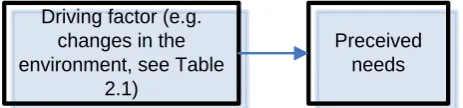
Nevertheless, the Thales Group itself, as a market leader, pays attention to the subject. Two changes may influence the importance of social responsibility to Hengelo: (1) In a centralized CSR policy the corporate policy will be pushed towards Hengelo (the Thales group can be seen as the policy developer) (2) Different (future/local/international) regulations and industrial standards (Thales has responsibilities as a market leader) may be expected. Hence, in Figure 1.1 it is shown why Thales Hengelo expects that social responsibility will eventually become more important.
Driving factor (e.g. changes in the environment, see Table
2.1)
[image:17.595.72.304.635.689.2]Preceived needs
Figure 1.1 How changes ask for perceived needs
1.2.3 Scope
This thesis focuses on the elements in purchasing that are essential to buy socially responsible.
What level of maturity does the purchasing function of Thales need in order to successfully apply CSR practises related to purchasing?
1.2.1 Previous research on CSR and purchasing maturity
CSR is a widely described topic in scholarly literature. Information about: drivers/enablers and barriers of CSR as well as “CSR-orientation” are described in literature. However, drivers and barriers differ between industries and nations. Consequently, we need to gain more knowledge about these at Thales Hengelo.
In the past, Goldsby and Stank (2000) performed an empirical research on 306 senior logistic employees and found a significant relation between the quality of logistics and environmentally responsible logistics practices. Nevertheless, as far as concerned, no research has been performed to test the (cor)relation between the quality of purchasing and CSR practices. Moreover, no conditions under which purchasing is able to buy social responsible given a certain CSR-orientation, are stated. What is of more concern is that none of the studies applied looked to the (relatively) odd and closed defense industry.
We use a maturity model that is focussed on purchasing to determine what elements a mature purchasing organization should have. A number of researchers proposed models to determine maturity profiles of the purchasing function and the purchasing organization (e.g. Schiele, 2008). Some of these models are already positively empirically tested in connection with (financial) firm performance (e.g. purchasing excellence program1).
For this study we chose the Michigan State University (MSU) model of Monczka. In section 2.3.3 this choice is explained.
1.2.2 Gap in literature
Concluding from section 1.2.1, there is no minimal maturity level known in literature to be able to introduce CSR successfully in an organization. Therefore, this qualitative study aims at finding a “minimal maturity level” required so that CSR activities in the realm of purchasing can be successfully implemented.
1.3 Research question
The following research question is formulated, which has been divided into sub questions:
Does Thales have the capabilities to buy social responsible?
1. What are the key drivers and barriers of CSR and
how do these relate to Thales?
2. How do we distinguish different strategies towards
CSR and what are key processes for purchasing?
3. What competencies are required in different
CSR-attitudes and how does this relate to Monzcka’s model?
1.4.1 Collecting data
During informal interviews the scope of the research became clear. We focussed on Thales to find out what the current situation was. A large number of respondents could be used within Thales. (Formal and informal) Interviews with these respondents were recognized as a primary source of data collection. To increase validity of the interviews a number of measures were taken. It was decided to (1) interview multiple respondents (from different disciplines) and compare data between respondents (identifying confirming and conflicting statements). (2) go for semi-structured interviews (giving respondents the opportunity to give own inputs) (3) use data triangulation (second sources of information to check the statements of the respondents).
According to Eisenhardt (1989) cases can be added until results are achieved. He however does not take a time limit into account. For this study due to time limitations this approach is infeasible. Therefore it was decided to use six formal respondents. With the notion that the first respondent was used as a pilot. This pilot study is used to evaluate the collected data for usability. A pilot study does not infect the study and can even be used in data analysis (Yin, 2003).
1.4.2 Combining theory
After analysing the data, research questions are answered. So a model is formulated which gives insight in the relation between purchasing maturity and social responsibility. By applying this model we provide insights whether Thales needs improvements to buy socially responsible. Figure 1.2 gives the schematic view of the different research activities.
Definition of variables
Limiting the domain
Relationship (model
building) Support
Figure 1.2 The stepwise procedure for theory combining is: definition of variables, limiting the domain, relationship (model building), and finally theory practicing (support).
1.4 Structure of the report
This thesis is organized in the region of the objectives: purchasing maturity and social responsibility. Furthermore, each chapter of this report deals with one objective. This is depicted in Figure 1.3.
Chapter 2 Reviews the current literature on purchasing and social responsibility. In order to do that, characteristics and information about social responsibility is provided. Therefore, CSR-orientation is introduced. Furthermore, different maturity models and levels of purchasing development are discussed and a maturity model has been chosen to work with.
Chapter 3 describes research that links CSR-orientation and the elements from chapter 2. This will be extensively discussed, and based on the previous chapters, we will formulate what is needed to further explore the conditions for this link will be formulated.
Chapter 4 handles the pilot study to validate the research methodology. The details of this chapter are provided by chapter 2, 3 and completed with the information provided by second sources.
[image:19.595.85.403.343.377.2](Chapter 2) Litrature review on
CSR and Purchasing
maturity
(Chapter 3) Model building
(Chapter 4) Pilot study at
Thales
(Chapter 5) Study at Thales
(Chapter 6) Conclusions
Definition of variables
Limiting the domain
Relationship (model building)
Support
Figure 1.3 Structure of the report based on the stepwise procedure for theory combining (Figure 1.2)
Concluding remarks
Chapter 2 Literature review
This chapter examines the first body of knowledge that is required to answer the question: “What are the elements required by purchasing to buy socially responsible, given a certain CSR-orientation.”
It starts with a literature review on Corporate Social Responsibility (CSR) followed by the role of purchasing within CSR (SRB). Then, we look to the elements that purchasing should have so that it can buy social responsible (purchasing activities related to SRB). Furthermore, we have a look on the drivers and barriers of SRB. The aim of this chapter is to provide input for theory combining in chapter 3.
(Chapter 2) Litrature review on CSR and purchasing maturity
(Chapter 3) Model building
(Chapter 4) Pilot study at
Thales
(Chapter 5) Study results at
Thales
(Chapter 6) Conclusions
Corporate social reponsibility Social responsible buying Purchasing maturity related to SRB
(Chapter 3) Model building
(Chapter 4) Pilot study at
Thales
(Chapter 5) Study results at
Thales
2.1 Corporate social responsibility
This section describes the definitions regarding corporate social responsibility and the orientation companies can have towards corporate social responsibility.
2.1.1 Definitions corporate social responsibility
What is corporate social responsibility? From Carroll (1979) we know that the idea of social responsibility found its roots during the 1930’s. Although there is still a lack of a generally accepted definition today, there are numerous interpretations on CSR known in literature. McWilliams and Siegel (2001 p.117) define CSR as “actions that appear to further some social good, beyond the interests of the firm and that which is required by law” and that this goes “beyond obeying the law”. Most literature describes certain activities and ideas that are included in CSR:
• “The basic idea of corporate social responsibility is that business and society are interwoven
• “It must
rather than distinct entities“. (Wood, 1991 p.295)
embody economic, legal, ethical, and discretionary
• (Carroll, 1979 p. 497) quotes [Joseph McGuire] “The idea of social responsibilities supposes that the corporation has not only economic and legal obligations, but also certain responsibilities to society which extend
categories of business performance” (Carroll, 1979 . p. 499)
beyond these obligations
• “CSR means that an organization strives to improve profit, environment and the broad” (MVO Nederland, 2009)
“.
For us CSR means that a company not only takes care of economic issues but also handles environmental and social issues (people, planet, and profit). In the next section we introduce two reasons for CSR.
2.1.2 Reasons for CSR
CSR could have two reasons (1) for the motivation to be “good”, Figure 2.1 shows that social environmental and profit have to be balanced for the organizational performance. Or (2) strive for a better corporate performance. Figure 2.2 shows that social and environmental factors support profit. It can be argued that in the end it is always self interested to act socially responsible.
Organizational performance
Social performane Environmental performance
Child labour Waste
management
Corruption Energy
consumption
….. ...
[image:22.595.73.519.443.590.2]Profit
Organizational performance
Profit
Social Environmental
Child labour Waste
management
Corruption Energy
consumption
[image:23.595.76.520.86.250.2]….. ...
Figure 2.2 social and environmental responsibilities are used to improve the organizational performance, which is profit
Furthermore, researchers argue that CSR can be executed through different attitudes, so-called CSR-orientations. This will be explained in the next section.
2.1.3 CSR-orientation and its different characteristics
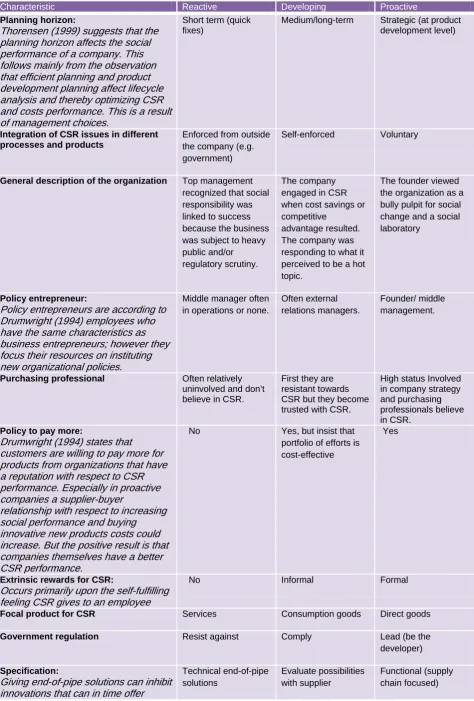
In addition to section 2.1.2 researchers distinguish CSR-orientation between two extreme positions, ranging from reactive towards a proactive approach. Reactive companies typically add minimal effort in CSR, so that they for example hardly comply with regulations. On the other hand, proactive companies will voluntary take measures to reduce their social impact. Some researchers’ segmented the range from reactive to proactive in 4 or 5 steps. Still most describe three steps. We also chose these three steps. We call these three steps reactive, developing, and proactive. Literature describes the characteristics of reactive to proactive companies. In the next part of this section a small summary is provided which will be used to combine theory in chapter 3.
CSR-orientation
Reactive (lower bound) Developing Proactive
Figure 2.3 CSR-orientation
Looking at Figure 2.3 makes it possible to determine differences between organizations. For example, companies that are more committed to listen to the needs of society can be considered to have a stronger CSR-orientation than companies that do not listen to the needs of society.
Table 2.1 Different characteristics of different “ CSR-orientation”
Characteristic Reactive Developing Proactive
Planning horizon:
Thorensen (1999) suggests that the planning horizon affects the social performance of a company. This follows mainly from the observation that efficient planning and product development planning affect lifecycle analysis and thereby optimizing CSR and costs performance. This is a result of management choices.
Short term (quick fixes)
Medium/long-term Strategic (at product development level)
Integration of CSR issues in different processes and products
Enforced from outside the company (e.g. government)
Self-enforced Voluntary
General description of the organization Top management recognized that social responsibility was linked to success because the business was subject to heavy public and/or regulatory scrutiny.
The company engaged in CSR when cost savings or competitive
advantage resulted. The company was responding to what it perceived to be a hot topic.
The founder viewed the organization as a bully pulpit for social change and a social laboratory
Policy entrepreneur:
Policy entrepreneurs are according to Drumwright (1994) employees who have the same characteristics as business entrepreneurs; however they focus their resources on instituting new organizational policies.
Middle manager often in operations or none.
Often external relations managers.
Founder/ middle management.
Purchasing professional Often relatively
uninvolved and don’t believe in CSR.
First they are resistant towards CSR but they become trusted with CSR.
High status Involved in company strategy and purchasing professionals believe in CSR.
Policy to pay more:
Drumwright (1994) states that customers are willing to pay more for products from organizations that have a reputation with respect to CSR performance. Especially in proactive companies a supplier-buyer
relationship with respect to increasing social performance and buying innovative new products costs could increase. But the positive result is that companies themselves have a better CSR performance.
No Yes, but insist that
portfolio of efforts is cost-effective
better performance. By giving
functional specifications, suppliers are stimulated to come up with new products, which they have more knowledge or skills about.
Valuation of CSR issues Denial Ignorance/familiarity Expertise
Stakeholders issues Denying the
relevance of any stakeholder issue to the organization. Implicitly acknowledge the existence of stakeholder issues, but avoiding addressing these issues. Systematically anticipating, and addressing stakeholder demands and involve
stakeholders in the monitoring process. Proactive companies try to get
stakeholders’ evaluation of their progress in specific issues.
Source: (adapted from Thorensen (1999), Tulder et al (2008), Carrol (1979), Wilson (1974), Mc Adam (1973), Davis and Blomstrom (1975), Porter and v.d. Linde (1995), Maignan et al. (2002), Hunt and Auster (1990), Kopicki et al. (1993), Handfield et al (1997), and Drumwright (1994))
2.2 Social responsible buying
Before the 80’s, purchasing was primarily focussed on costs and little else. Recently policy makers have realized that purchasing can also improve a firm’s environmental and social performance (Handfield et al., 2002). Purchasing is considered to be a critical component in CSR-orientations. The decisions of purchasing managers can affect the success of CSR strategies at each stage of the supply chain. In fact purchasers are the eyes and ears of a company on the supplier side, and therefore can attain important knowledge about the CSR capabilities of suppliers. Given that purchasing plays a major role in innovation, market research, supplier selection, and supplier development, choices in the purchasing process are therefore related to idealistic and ethical issues. Together with economic values they form the “triple bottom line” of Elkington (1997).
In literature the role of purchasing in CSR is described under the denominator; Social Responsible Buying (SRB). This section describes the definition, drivers and barriers, and effects SRB can have within companies.
2.2.1 Definitions of social responsible buying
SRB has the characteristics of CSR (Carter and Jannings, 2004), and like CSR there is no clear definition for social responsible buying. “Green” purchasing is sometimes separated and overall more popular in literature compared to social factors within purchasing. We however do not make a clear distinction between “green” and social factors in SRB. Names that are frequently used for SRB are:
• Purchasing social responsibility (Carter and Jannings, 2004)
• Corporate social responsibility in the supply chain (Maloni and Brown, 2006) • Socially-responsible buying (Maignan, Hillebrand et al., 2002)
• Responsible procurement (Allen, 2006)
• Socially responsible purchasing and disposal (Webb, Mohr et al., 2008), and • Ethical purchasing (Wells, 2004).
In the continuation of this report we use the following definition of SRB:
Social responsible buying is the task of purchasing within CSR. This task is performed next to “the regular” economical also social and environmental criteria in different buying decisions and processes.
2.2.2 Drivers and barriers of social responsible buying
We know that the triple bottom line as described by Elkington (1997) includes environmental, social, and economical factors. Furthermore, Carter and Dresner (2001), and Maignan and Ralston (2000) show us through case studies that there is a difference between the drivers and barriers between different countries and industries (e.g. government regulation is different between countries (Hall, 2000)). Sometimes a change in the environment can result in a driver but also in a barrier. An example is a change in management commitment. If management commits itself to SRB then this forms a driver, however, when there is a lack of management commitment this forms a barrier towards SRB.
Section 2.2.2.1 describes drivers towards SRB and 2.2.2.2 describes the barriers towards SRB.
2.2.2.1 Drivers towards SRB
Literature describes several drivers towards SRB, we describe these drivers below.
Management commitment: According to a lot of literature, management commitment is in fact a driver for a company to implement SRB practices. New et al., (2000) for example states that personal commitment of individuals (founder and owner) is positively related to “green” supply chain practices. Top management commitment and leadership are key drivers of organizational change and the implementation of new activities and programs in this case buying from minority business enterprises (MDE). Carter et al. (1999) and Carter and Jennings (2004) suggest that this does indeed have a direct effect on whether purchasing managers implement SRB. “Top managers can influence SRB by initiating, requiring, and supporting SRB programs; corporate leaders can also strongly impact SRB by influencing organizational culture through their own examples” (Carter and Jennings, 2004 p. 168). Drumright (1994) found out that “policy entrepreneurs” are a driver for SRB. These entrepreneurs do not necessarily have to be at top management level but could also be employees that are personally affected to SRB practices. However, just addressing these human recourses only are not enough (Handfield et al., 1997). Top management support is needed to pursue a success.
Employees: Literature describes that there is no clear relation between employee values and the implementation of SRB, Carter and Jennings (2004) therefore state that SRB programs can be established regardless of employees’ values. However, there is a positive relation between employees and values when employees are chosen to manage or develop SRB efforts (Hanna et al., 2000). In line with Drumright (1994) they claim that managers should identify values of employees to point managers who spreadsheet SRB activities. Therefore we conclude that employees in some companies could be seen as drivers.
Regulation: A lot of research suggests that legislation and regulation is a driver for companies to be socially responsible (Handfield et al., 1997; Carter and Jennings, 2004; and Walker, 2008). Especially when the regulation resulted from a national disaster (Hall, 2000). On the other hand Carter and Carter (1998) suggest that government regulations are not a significant driver for organizations to apply socially responsible practices. One of the main barriers of government regulation, which is also the case in the Netherlands (Senternovem) is that those regulations often employs “end-of-pipe”, reactive solutions to prevent pollution (e.g. buy a hybrid car) instead of proactive form that focuses on outcomes and stimulates innovation to archive those outcomes (e.g. transportation should reduce pollution with 10%) (Porter and v. d. Linde, 1995; and Carter and Dresner, 2001). Reactive regulations don’t fit all businesses and can be expensive or unusable while proactive companies seem to have more “success” in green supply projects (Carter and Dresner, 2001). The Lack of legislation and legal uncertainty are also seen as barriers (Mont and Leire, 2009). Handfield et al. (1997) suggests that firms themselves must be proactive toward environmental regulations. When a company could see upcoming regulation it can be a driver to be proactive ahead of regulations. This does not mean that regulation is not good. Regulation is an effective driver for legal component rather than a discretionary component.
Reputation: An important driver is the reputation of the company (or marketing/public opinion reasons) (Roberts, 2003; Maignan et al, 2002; and Elkington, 1994). The reputation of companies is build up over a lot of years so avoiding negative publicity and thereby maintaining the reputation are seen as an important driver for SRB. In the recent years a lot of examples showed us that the power of the media newer should be underestimated, therefore this could be seen as a driver (Mont and Leire, 2009). Organizations are in a growing trend accountable for errors in ethics of suppliers and other practices, and therefore forced to include non-economic buying criteria into their purchasing process. Furthermore, Drumwright (1994) suggests that customers purchasing decisions are dependent on the environmental reputation of a company.
Customers: Carter and Dresner (2001) add to this that customers can be both a successful and an unsuccessful driver. The first applies when customers looked to the broader aspects of supply chain environmental improvements while the latter focussed on short-term fixes of the customer without taking the broader system into concern.
Competition: Competition has been recognized as a driver for innovation towards SRB practices. (Walker, 2008) Competitors who have high environmental standards may be able to set industry standards and therefore have an advantage. SRB practices therefore may not be undertaken in a desire to “save the world” rather than to improve a competitive advantage with a result of improving a firm’s financial performance (Drumwright, 1994; and Porter and van de Linde, 1995).
Suppliers: It is not proven whether suppliers are drivers of SRB, or not. (Walker et al., 2008)
The problems, job loss, negative publicity, and high costs of switching suppliers also occur when SRB is implemented in a company. This is caused by the lack of knowledge about the consequences of switching suppliers.
2.2.2.2 Barriers towards SRB
Next to drivers, literature also describes several barriers towards SRB.
Management commitment: According to Mont and Leire (2009) a lack of top management commitment is fatal towards the implementation of CSR into supply chains. Mainly because they provide the resources needed by purchasing managers and decide to what extend socially responsibility is implemented, and how proactive these managers need to be. This is in line with Lantos (2001) who states that the top management is one of the most important shapers on organizational culture, which is an influence of SRB within a company. (Lamming and Hampson, 1996)
Value-driven: An important barrier to bring social factors into the supply chain process are additional costs (Walker et al., 2008), especially in the short run arise costs. (Mont and Laire, 2009)
Regulation: as been described before, Porter and van de Linde (1995) see regulation as a barrier, because it can inhibit innovation.
performance resulting in reduced costs. There are problems with checking performance beyond the first tier suppliers. Not that those companies don’t know how to do this, it’s more that they don’t have enough resources to do it. Auditing is recognized as barriers, because it consumes resources from the companies and external auditing companies are cheap but there is a lack of quality. One technique to overcome this problem is to reduce the number of suppliers, and build more long term cooperative relationships with the suppliers who you keep aiming at meeting SRB criteria, but this leaves small companies with no chance. (Mont and Laire, 2009)
As suggested before, we can say that being social responsible often results from value or (firm) performance improvements, rather than being motivated by purely being “good”. A conclusion from section 2.2.2.1 and 2.2.2.2 is that the drivers and barriers fall under the umbrella of economic motives. Automatically it’s interesting to see what the consequences of CSR can be for a firm as has been investigated by Weber (2008).
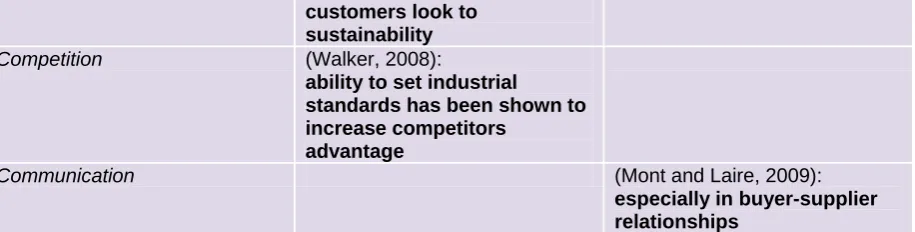
[image:28.595.65.540.280.793.2]Table 2.2 summarizes the drivers and barriers from literature.
Table 2.2 Literature review on the drivers and barriers of SRB
Change in environment Driver/enables Barrier
Management commitment (New et al., 2000): positive commitment of former and owner
(Carter et al., 1999; and Carter and Jennings, 2004):
top management commitment and leadership
(Handfield et al., 1997)
(Mont and Leire, 2009; and Lantos, 2001)
a lack of top management commitment
Employees (Hanna et al., 2000):
manage SRB
(Drumright, 1994):
but with support of managers
Value (Carter and Dresner, 2001); and (Handfield, 1997):
reduction of costs
(Mont and Leire, 2009);and (Walker, 2008):
investors interests
(Handfield et al., 1997; porter and van de Linde, 1995; and Young, 2000):
reduction of residuals
(Walker et al., 2008):
additional costs
(Mont and Laire, 2009):
especially in the short run arise costs
Performance (Handfield et al., 1997): focus on performance (quality) improvements
Regulation (Handfield et al., 1997; Carter and Jennings, 2004; and Walker, 2008):
especially when it resulted
(Porter and van der Linde, 1995; and Carter and Dresner, 2001):
customers look to sustainability
Competition (Walker, 2008):
ability to set industrial
standards has been shown to increase competitors
advantage
Communication (Mont and Laire, 2009):
especially in buyer-supplier relationships
2.2.3 Expected effects of social responsible buying
[image:29.595.73.531.72.188.2]Now that we have a better look on the definitions, drivers, barriers of SRB, this section describes the effects SRB can have for a company. In line with the effects described in Figure 2.1 and 2.2, Weber (2008) introduced the SRB impact model, which is shown in Figure 2.3, where monetary and non-monetary benefits are stated, resulted from an empirical study. In the continuation of this report this model is only used as a source of information.
Figure 2.3 SRB impact model of Weber (2008)
Monetary benefits include direct financial effects as well as benefits that do not directly lead to cash flows but can nevertheless be measured in monetary terms. Non-monetary benefits refer to benefits that are not directly measured in monetary terms but nevertheless influence company competitiveness and the financial success of a company. Companies can assess non-monetary benefits using quantitative indicators e.g., changes in repurchase rates or qualitative indicators e.g., evaluating customer attitudes. Non-monetary benefits can thus further be systematized with regard to the nature of indicators to measure the respective benefits, which can be quantitative or qualitative.
2.3 Purchasing maturity related to SRB
Thus far we introduce corporate social responsibility and different orientation levels towards CSR. We described the role of purchasing within CSR as SRB. We also described drivers and barriers towards SRB; management commitment, regulation, industrial standards, customers, suppliers, and reputation. Furthermore, we described the monetary and non-monetary effects of buying social responsible. This section describes which model literature describes to measure the maturity levels of a purchasing function.
2.3.1 Effects of maturity on performance
Measuring the competences of purchasing organization within literature is known as purchasing maturity. All the competences of a purchasing function together form a maturity profile (Schiele, 2007). In the past decades, increased complexity of products resulted in an increased purchased volume and therefore, using suppliers as an extension of the organization increased the importance of the purchasing function. Therefore, the strategic role of purchasing changed (Anderson and Rask, 2003; Ellram and Carr, 1994).
According to Schiele (2008), a better performing purchasing function can result in a better performing firm. This is based on a 14-company case study where “more mature organizations” had a significant positive correlation with cost savings (with an average of 7%).
Improved acces to capital Risk reduction Reveneu increases Cost decreases Increased brand value Secure licence to
In Figure 2.4 we can see that an organization with more competencies has a higher maturity. Through this maturity, it’s expected to be able to absorb activities “better”. Lane et al. (1990) defines this as absorptive capacity.
Ellram et al. (2002), concludes that because of the absorptive capacity, best practices in purchasing are better absorbed in above average organizations, compared to below average organizations. It is expected that this also counts for best practices in SRB.
Options are open that a common cause will be responsible for the absorptive power resulting from higher capabilities. For example, a company that had a better director, and therefore is better led could have better capabilities and can learn more, resulting from the director. This has not been discussed by these authors and considering the small time span for this thesis; common causes are out of the scope of this report.
Competences Maturity
Absorptive capacity Possible CSR orientation
Financial performance
Best practices
Figure 2.4 Relation between maturity, absorptive capacity, and possible CSR-orientation
2.3.2 Effects of maturity on absorptive capacity
[image:30.595.78.464.224.308.2]According to Schiele (2008) the absorptive capacity perception indicates that there is a “minimum maturity point” an organisation needs to have achieved in order to benefit from the introduction of best practices. This research aims at finding a minimal maturity level, for which SRB can be achieved. The maturity level at which firms are able to profit from new knowledge is the “minimum maturity point” (Figure 2.5).
With low maturity, the basics have to be established first. This might mean defining processes or hiring trained personnel. Highly mature organisations can try to absorb best-practice knowledge immediately since they have sufficient absorptive capacity. Failing to consider the point of minimum maturity and attempting to “leapfrog” development could result in the situation described by Ellram et al. (1994). They found that firms with poor financial results were introducing the largest number of best practices but were apparently not profiting sufficiently from them. Understanding the minimum maturity point of an organisation, below which there is no financial benefit from introducing best practices, is an important managerial task. To end, organizations should absorb best practices that require the maturity level of the organization, otherwise, the costs of absorbing are higher than the benefits.
Benefits
Performance improvement trough learning
We now define the maturity model that we are going to use in this research. From this model we are going to subtract the competencies required by purchasing to be “mature”.
2.3.3 Maturity models
A maturity model determines maturity scores for different processes. Together these scores form a maturity profile (e.g. a radar diagram). A maturity profile approach enables organizations to ensure that: (1) conditions under which a certain level is reached are predetermined (2) a maturity profile shows other entities in a glance the results and therefore are easy communicable, consequently it (3) shows actions for improvement (Schiele, 2008).
Purchasing has adopted these models in a variety of forms, but all these approaches differentiate maturity in among stages, where an organization moves from one stage to a higher stage in order to develop towards greater superiority (Van Weele and Rietveld, 2000). Furthermore, Reck and Long (1988) argue that skipping stages is associated with great difficulties and therefore it is an evolutionary process. However, it can happen that an organization already fulfils the needs of higher maturity levels but not yet of a lower level, and therefore, with improving this lower level it can happen that the company raises multiple levels at once. In addition, it is not necessary for every organization to score maximum points on each discipline.
Since 1989 different models to determine purchasing maturity are available. Table 2.3 shows a number of purchasing maturity models available in the literature. A few of these models are empirically tested to financial performance. Excluded in the table are the models that focus on one single purchasing task. From this shortlist we determine the model that we will use.
Table 2.3 Purchasing maturity models No empirically maturity-performance tested
Empirical maturity-performance tested
Bhote (1989),
Freeman and Cavinato (1990), Chadwick and Rajagopal (1995) Reck and Long (1988),
Cammish and Keough (1991), Keough (1993),
Burt and Doyle (1994), Barry et al. (1996)
MSU (Monszka, 1993), Schiele (2008),
Cousins et al. (2006), Paulraj et al. (2006)
Source: (adapted from Schiele, 2008)
In Table 2.4 only empirically tested models are further considered. This table handles the comparison which is based on the 5 main elements that describe maturity, additionally we also considered its relation towards social responsibility. These elements are:
• Procurement planning: This concerns the planning of procurement activities. Often the first steps in purchasing process (e.g. material specification, market research).
• Organizational structure of purchasing: (hierarchical) Position of purchasing, organizational visibility, ideal organizational forms (e.g. commodity teams).
• Process organisation: defining a sourcing strategy, supplier management systems, supplier evaluation/development systems.
• Human resources and leadership: Skill level, purchasing involvement in development teams • Purchasing controlling: Performance measurements, methods and tools.
Table 2.4 Maturity model comparison
Paulraj et al. (2006) Cousins et al. (2006) Schiele (2008)
MSU model Monczka (1993)
Scope General purchasing General purchasing General purchasing General purchasing
No. of stages 3 4 4 10
No. of items for
assessment 42 24 111 140
Planning x x
Structural organisation x x
Process organisation x x
Human resources x
Controlling
Connection to SRB None None None Integrity
Collaborative supply
relation x
Source: (adapted from Schiele, 2007)
2.3.4 Michigan State University model
A frequently used model to determine the maturity is the Michigan State University (MSU) model (Purchasing excellence, 2004). Since it is commonly used (e.g. purchasing excellence benchmark program) the maturity scores of several companies in the Netherlands are already determined. This model has the following advantage over other models (Faber, Lammers, and Peters, 2007).
• The MSU model is a set of checklists, which have to tag off before getting to a final conclusion. It is not a model, which forces the user to one unique solution. It stimulates thought and creativity. And therefore, it is adjustable to social responsibility.
• Monczka needs information from many different departments and this will ensure that more people than just the purchaser will support the outcome. Some other models could tempt users to jump to conclusions and rely on partial information. And purchasing especially in relation to social responsibility should be cooperative towards other parts of the organization. Additionally, by using a broad scope of department’s validity increases.
Thus far, we described why we chose to use the MSU model, these motivations are now summarized: • It is empirically tested with financial performance,
• It is well known and used throughout the world,
• It handles the five main elements that describe maturity, • It handles integrity,
• It is the most exhaustive,
• It is not a model, which forces the user to one unique solution,
• Finally, it needs information from many different departments and a broad scope of department’s increases validity.
Monzcka states 8 strategic and 6 enabler processes to create a maturity profile. Every process of the model contains ten different stages. Ranging from 0 (the lowest, as if it does not occur in the organization) to 10 (as if, best in class). If a score of 10 has been given, the competences for this
8 strategic processes Stage In sourcing and outsourcing 0 1 2 3 4 5 6 7 8 9 10 Commodity Strategy Development 0 1 2 3 4 5 6 7 8 9 10 Establish and leverage a world class supply 0 1 2 3 4 5 6 7 8 9 10 Development and manage supplier relationship 0 1 2 3 4 5 6 7 8 9 10 Supplier involvement in new product/process development 0 1 2 3 4 5 6 7 8 9 10 Supplier involvement in order realization process 0 1 2 3 4 5 6 7 8 9 10 Supplier development and quality management 0 1 2 3 4 5 6 7 8 9 10
Strategic costs 0 1 2 3 4 5 6 7 8 9 10
6 Enabler processes
Establish globally integrated and customized strategies and plans 0 1 2 3 4 5 6 7 8 9 10 Develop organization and teaming strategies 0 1 2 3 4 5 6 7 8 9 10
Globalisation 0 1 2 3 4 5 6 7 8 9 10
[image:33.595.65.521.92.351.2]Develop a purchasing and Supply Chain Measurement 0 1 2 3 4 5 6 7 8 9 10 Develop and implement enabling IS/IT Systems 0 1 2 3 4 5 6 7 8 9 10 Human resource development and training 0 1 2 3 4 5 6 7 8 9 10
Table 2.5 The 8 strategic and 6 enabler processes of the MSU model (purchasing excellence, 2004)
In the continuation of this report we use the MSU model of Monzcka to determine purchasing elements and maturity levels.
Concluding remarks
Chapter 3 Design of MSU model applicable to SRB
This section couples the information that has been gathered in the literature review. So now we can determine what level of maturity is required, given a certain CSR-orientation.
Although the level of purchasing maturity and SRB can be seen as two separate subjects, we believe that maturity has influence on SRB abilities. As shown in chapter 2, Monzcka’s model describes competencies that should be present within (high) mature organizations. An organization that feels needs to buy social
responsible should also possess certain characteristics before they will ever be able to do it (chapter 2). Therefore, this chapter links these two subjects to each other and provides further knowledge needed to answer the research question: “What level of purchasing maturity is required in order to be able to adopt CSR practices within purchasing?” Therefore it states the relations that we can expect from the literature.
Additionally, pieces that are missing will be added (e.g. important processes to buy social responsible). We hope that eventually researchers and practitioners can benefit from coupling these areas.
Social responsible buying Qualitative study Level of maturity (Chapter 2) Litrature
review on CSR and purchasing maturity
(Chapter 3) Model building
(Chapter 4) Pilot study at
Thales
(Chapter 5) Study results at
Thales
3.1 Relation between SRB and level of maturity
This section describes the relation between purchasing maturity and elements that we can expect by combining the two subjects from the previous chapter.
Figure 3.1 again shows the proposition that resulting from the capabilities an organization carries; it is able to buy social responsible. So if an organization wants to buy socially responsible on a higher level, it should carry more capabilities and therefore posses a higher maturity.
But an organization not always knows what level of CSR-orientation suits the organization best, furthermore, some organizations never thought about SRB.
Therefore, certain preconditions (steps to take) are defined and will be discussed in section 3.2. These preconditions help an organization think about social responsibility and helps determining what level of CSR-orientation should be possessed (other than it is able to posses). These preconditions are graphically shown in Figure 3.1.
Competences Maturity
Absorptive capacity
Possible CSR orientation Financial performance
Best practices
Preconditions Determine preferred CSR
[image:36.595.98.422.261.413.2]orientation CSR orientation
Figure 3.1 Relation between purchasing maturity and SRB
3.2 Preconditions (procedure to determine preferred CSR-orientation)
The preferred CSR-orientation follows from the corporate strategy. However, this section describes a procedure to help organizations determine their preferred CSR-orientation. Which is based on the 5 principles of Maignan et al. (2002): analyse of stakeholder pressure, estimation of potential benefits and costs, purchasing policy, choosing, and implementing a CSR-orientation. This process is shown in Figure 3.2.
analyse of stakeholder
pressure
estimation of potential
benefits and costs Purchasing policy choosing
implementing a CSR-orientation
Figure 3.2 The 5 step approach to help organizations determine the preferred CSR-orientation (based on Maignan et al. (2002)
[image:36.595.72.519.520.585.2]Estimate potential benefits and costs: In this step different benefits and costs of SRB at the organization (as a stakeholder) are estimated. This can be done by analyzing the drivers and barriers, and estimating the expected benefits. As shown in section 2.2.2 and 2.2.3.
Now we know the benefits of SRB for our stakeholders and organization.
Purchasing policies: Furthermore, purchasing policies should follow from organizational values. Purchasing, however, should think about some SRB topics which are related to purchasing policies.
[image:37.595.66.550.220.507.2]Typically Table 3.2 states topics where purchasing should think of and how organizations with different CSR-orientations did it in practice.
Table 3.2 Topics where purchasing should think of
Question Reactive Developing Proactive
Is there a policy to pay more for a social responsible product?
Don't pay more for a social responsible product
Pay more, but insist that portfolio of efforts is cost-effective
Willing to pay more for social responsible product, even if the product has relatively same quality
What is the degree of integration of social issues in different processes?
Enforced Self-enforced Voluntary
Who is responsible for organizing social issues? Policy entrepreneur:
None or Middle manager often in operations
Often external relations managers Founder/ top management/ middle management What social responsible objectives are described in contracts?
Only regular objectives with little effort towards SRB objectives towards strategic suppliers
Regular objectives and SRB objectives
SRB objectives are prime objectives
On what products is social responsibility focussed?
Services Consumption goods Direct goods
How are employee developed in social responsible practices?
No training for employees related to SRB
Employee-SRB training Employee-SRB training with target setting and evaluation
Source: (adapted from Thorensen (1999), Tulder et al (2008), Carrol (1979), Wilson (1974), Mc Adam (1973), Davis and Blomstrom (1975), Porter and v.d. Linde (1995), Maignan et al. (2002), Hunt and Auster (1990), Kopicki et al. (1993), Handfield et al (1997), and Drumwright (1994))
Choosing a CSR-orientation: As stated before, this question is primarily a management choice based on the SRB elements above.
Implementing the CSR-orientation: In order to implement the CSR-orientation, we should focus on the maturity levels that should be reached to enable the CSR-orientation. A model to do this will be discussed in the following of this chapter.
Recommendations for improvements follow from the difference on the maturity levels now and required for the CSR-orientation.
3.3 Coupling purchasing elements with SRB
Section 3.1 states the expected relation between purchasing maturity and SRB. Furthermore, in section 3.2, the preconditions in order to buy socially responsible are stated. In this section we formulate the important purchasing elements in SRB, so that they can be related to the MSU model. Elements are explained in this research by characteristics, competencies, and processes.