UNIVERSITY OF TWENTE.
E n h a n c e d I C o N o s M a t u r i t y M o d e l
Author: Faiza Allah Bukhsh (s0203041) Examination Committee: Dr Maya Daneva
Dr Roberto G. Santana Tapia Dr Chintan Amrit
UNIVERSITY OF TWENTE.
E
NHANCED
IC
O
NO
S
M
ATURITY
M
ODEL
A master thesis submitted to the Information System Group,
Department Of Computer Science, Faculty of Electrical Engineering,
Computer Science and Mathematics for obtaining the degree of Master
of Sciences in Computer Science
By
Faiza Allah Bukhsh
Page i
M
ANAGEMENT
S
UMMARY
Organization’s concerns as controlling costs, improving quality, increasing effectiveness, and managing risk have become increasingly important. Business-IT alignment (B-Business-ITa) is a known solution for such concerns. Maturity Models (MM) came into being for considering improvement actions in B-ITa. MM describe the evolution of an entity over time. We can find considerable literature on MM for B-ITa in single organizations. However, to the best of our knowledge at the time of writing this thesis, IT-Enabled Collaborative Network organizations (ICoNOs) MM is the one that specifically addresses the processes needed for achieving B-ITa in networked organizations. The ICoNOs MM provides improvement routes in four domains for achieving B-ITa in CNOs. These basic domains are Process Architecture, Information System Architecture, Partnering Structure and Coordination.
The author of ICoNOs MM evaluated the ICoNOs MM design elements in six case studies (with the help of documentation and interviews with professionals) in specific regions (in Europe and Nord-America). Specific-region-based evaluation of ICoNOs MM motivated us to evaluate it in a setting in a different region that has not been previously studied. We have evaluated the presence/absence of ICoNOs MM domains and processes in an Asian CNO. We have selected the National Database and Registration Authority (NADRA) of Pakistan as our case study. Results not only validate the existence of the four domains of ICoNOs MM but also compel to introduce a new domain named as “Cost Management”. Introduction of this new domain is the reason for the title “Enhanced ICoNOs MM”.
While preparing for the interview-based evaluation of ICoNOs MM in an Asian case study, we faced a great deal of difficulty in arranging the appointments with professionals. This difficulty provides the basis for reflection on how difficult it could be to carry out an interview-based maturity assessment and also for thinking of evaluating B-ITa in an alternative – and independent, way i.e. without interviewing professionals. The idea of an independent evaluation motivated us to collect B-ITa information from publically available information e.g. downloadable documentation or websites. For evaluating B-ITa in ICoNOs MM it is necessary to interpret and understand publically available information (website & documentation) correctly. We have developed interpretation rules in order to avoid the misinterpretation of information available on website.
Page ii
Page iii
A
CKNOWLEDGEMENT
This thesis is the result of the final assessment of my master study in University of Twente. Two years ago I started my master study with a great excitement of studying abroad, in the Netherlands. I owe to a number of people who helped me in successfully carrying out my studies in general and project in particular. It is my honor and pleasure to mention some of them who always proved helpful, cooperative and spared their valuable time for me.
My heartiest gratitude goes to my supervisor Dr. Maya Daneva who very kindly gave me challenging opportunity to do a research in information system engineering. I have really benefited from her experience and vast knowledge. She welcomed me every time and spared her valuable time for me, as I need her help. She is extra kind in extending all possible help in the cause of this thesis and it was due to her guidance, moral support, encouragement and lot of time contribution that I am able to complete this thesis work in time.
I am grateful to my co-supervisor Dr. Roberto G. Santana Tapia, for sparing his time from his busy schedule for me. He not only helped me to correct my thesis but also help me to look in other dimensions of the problem.
I owe my deep gratitude to all of my teachers, who have taught me. Their wonderful teaching methods enhanced my knowledge of the respective subject and enabled me to complete my studies in time.
With the support of professionals from NADRA, who have spared their valuable time for us, this project cannot be completed. I am very grateful to them for their support and time in conducting interview.
Many thanks for Higher Education Commission of Pakistan for providing funds to finance my stay and studies in the Netherlands. I also like to extend my sincere thanks to the staff of international office. Without support from international office it is not possible for me to come here and complete my studies.
The years pass quickly, though the time is long. So, last but not the least, I would like to express my gratitude to my family, husband and friends who encouraged me not only during this project but also during all my studies. Without their love, time, guidance I would not be able to make all this possible.
Page iv
T
ABLE OF
C
ONTENTS
MANAGEMENT SUMMARY ... I ACKNOWLEDGEMENT ... III TABLE OF CONTENTS ... IV LIST OF FIGURES ... VI LIST OF TABLES ... VII LIST OF ABBREVIATIONS/ACRONYMS ... VIII
1 INTRODUCTION ... 1
1.1 PROBLEM BACKGROUND ... 1
1.2 PROBLEM STATEMENT ... 1
1.3 RESEARCH GOAL... 2
1.4 RESEARCH MODEL ... 2
1.5 RESEARCH QUESTIONS ... 3
1.6 RESEARCH PLAN ... 5
1.7 RESEARCH APPROACH ... 6
1.8 RESEARCH SCOPE AND RELEVANCE ... 7
1.9 THESIS STRUCTURE ... 7
2 LITERATURE REVIEW ... 9
2.1 SYSTEMATIC REVIEW ... 9
2.2 PLANNING THE REVIEW ... 9
2.3 CONDUCTING THE REVIEW ... 10
2.4 SUMMARY OF THE RESULTS ... 10
2.4.1 The Adaptive Infrastructure MM ... 10
2.4.1 The Forrester MM ... 12
2.4.2 The E-Business MM 2.0 ... 12
2.4.3 The Web Analytic MM ... 13
2.4.4 A four stage model for developing fully functional E-government ... 14
2.4.5 A two-stage model of E-government growth ... 15
2.4.6 Stages of growth in e-government: An Architectural Approach ... 16
2.5 COMPARISON OF THE SIX MODELS AND ICONOS ... 17
2.6 SUMMARY ... 18
3 ICoNOs MM VALIDATION IN AN ASIAN GOVERNMENT ORGANIZATION ... 19
3.1 BACKGROUND ... 19
3.2 CASE STUDY RESEARCH PLAN ... 21
3.2.1 Decide the Model and Interviewees ... 21
3.2.2 Present the Model to Interviewees ... 22
3.2.3 Conduct the Interviews ... 22
3.2.4 Analyze the Study Findings ... 24
3.2.5 Conclude the results ... 26
3.3 EVALUATION OF VALIDITY THREATS IN THE CASE STUDY... 26
3.4 SUMMARY ... 28
4 ENHANCED ICoNOs MM ... 30
4.1 BRIEF INTRODUCTION TO MMS... 30
4.1.1 ICoNO’s Levels ... 30
4.1.2 ICoNO’s Domains ... 30
4.2 IMPLICATION OF RESULTS FROM NADRA: INTRODUCTION OF THE COST DOMAIN ... 31
4.3 B-ITA PROCESSES FOR ENHANCED ICONOS MM ... 33
Page v
4.3.2 Enhanced ICoNOs MM: Cost Management Domain ... 38
4.5 SUMMARY ... 40
5 INTERPRETATION RULES/GUIDELINES ... 42
5.1 BACKGROUND ... 42
5.2 TERMINOLOGY USED ... 43
5.3 PROPOSED INTERPRETATION RULES/GUIDELINES ... 43
5.3.1 Step-1: Snapshot Development ... 44
5.3.2 Step-2: Research for Web-Analytic ... 45
5.3.3 Step-3: B-ITa Processes ... 47
5.4 SUMMARY ... 48
6 VALIDATION OF ENHANCED ICoNOs MM ... 49
6.1 CASE STUDY 1: FACEBOOK ... 49
6.1.1 Step-1: Snapshot Development ... 49
6.1.2 Step-2: Based on Web analytic ... 52
6.1.3 Step-3: B-ITa Processes ... 53
6.1.4 Discussion on the case study results ... 59
6.2 CASE STUDY 2: AMAZON ... 60
6.2.1 Step-1: Snapshot Development ... 60
6.2.2 Step-2: Based on Web analytics... 63
6.2.3 Step-3: B-ITa Processes ... 65
6.2.4 Discussion on the case study results ... 70
6.3 CROSS-CASE ANALYSIS... 70
6.4 SUMMARY ... 73
7 CONCLUSION ... 74
7.1 REVIEWING THE RESEARCH QUESTIONS ... 74
7.2 OUR CONTRIBUTION ... 76
7.3 FUTURE WORK ... 77
8 REFERENCES ... 78
APPENDICES ... 82
APPENDIX A: PRESENTATION ABOUT ICONOS MM ... 82
Page vi
List of Figures
FIGURE 1.1 : RESEARCH MODEL ... 3
FIGURE 1.2: ICONOS MM RESEARCH DIRECTIONS ... 4
FIGURE 1.3: RESEARCH PLAN OF STUDY ... 6
FIGURE 1.4: THESIS STRUCTURE ... 8
FIGURE 2.1:RESULTS AT A GLANCE ... 11
FIGURE 2.2: ADAPTIVE INFRASTRUCTURE MM ... 11
FIGURE 2.3:LEVELS OF E-BUSINESS MM2.0 ... 12
FIGURE 2.4: FACTORS EFFECTING ON E-BUSINESS MM 2.0 ... 13
FIGURE 2.5: WEB ANALYTIC MM WORKSHEET ... 14
FIGURE 2.6: FOUR STAGE MODEL ... 15
FIGURE 2.7: STAGES OF E-GOVERNMENT ... 16
FIGURE 3.1:MULTIPLE CASE STUDY APPROACH ... 19
FIGURE 3.2: RESEARCH CYCLE ... 21
FIGURE 3.3: COST MANAGEMENT ... 29
FIGURE 4.1RELATIONSHIP OF COST MANAGEMENT WITH OTHER DOMAINS ... 32
FIGURE 4.2: MAP MODELING THEORIES APPLICABLE TO B-ITA DOMAINS ... 34
FIGURE 4.3MAP MODELING THEORIES APPLICABLE TO ENHANCED ICONOS MM DOMAINS ... 39
FIGURE 5.1: DOMAIN FOR WEB-ANALYTIC ... 45
FIGURE 5.2:HIGH-LEVEL VIEW OF INTERPRETATION RULES/GUIDELINES ... 48
FIGURE 6.1: FACEBOOK HOME PAGE ... 50
FIGURE 6.2: FARMVILLE ... 51
FIGURE 6.3: AMAZON HOME PAGE ... 61
FIGURE 6.4: FEDEX INTERFACE ... 63
Page vii
List of Tables
TABLE 3.1: LOCAL CLIENTS ... 20
TABLE 3.2: CORPORATE CLIENTS ... 20
TABLE 3.3: INTERNATIONAL CLIENTS ... 20
TABLE 3.4: EXAMPLES OF DIFFERENT NAMES PEOPLE USE FOR CONCEPTS WITH THE SAME MEANING. ... 26
TABLE 4.1:PARTNERING STRUCTURE PROCESSES ... 35
TABLE 4.2: IS ARCHITECTURE PROCESSES ... 36
TABLE 4.3:PROCESS ARCHITECTURE PROCESSES ... 37
TABLE 4.4: COORDINATION PROCESSES... 38
TABLE 4.5: COST MANAGEMENT PROCESSES... 40
TABLE 5.1: MATURITY LEVEL DESCRIPTION ... 46
TABLE 6.1 : PARTNERING STRUCTURE PROCESSES FOR FACEBOOK ... 55
TABLE 6.2:ISARCHITECTURE PROCESSES FOR FACEBOOK ... 56
TABLE 6.3 : PROCESS ARCHITECTURE PROCESSES FOR FACEBOOK ... 57
TABLE 6.4 : COORDINATION PROCESSES FOR FACEBOOK ... 58
TABLE 6.5:COST MANAGEMENT PROCESSES FOR FACEBOOK ... 59
TABLE 6.6 : PARTNERING STRUCTURE PROCESSES FOR AMAZON ... 66
TABLE 6.7:ISARCHITECTU RE PROCESSES FOR AMAZON ... 67
TABLE 6.8 : PROCESS ARCHITECTURE PROCESSES FOR AMAZON ... 68
TABLE 6.9:COORDINATION PROCESSES FOR AMAZON ... 69
TABLE 6.10 : COST MANAGEMENT PROCESSES FOR AMAZON ... 70
Page viii
List of Abbreviations/Acronyms
AIMM Adaptive Infrastructure Maturity Model
ATF IS architecture target formulation
AVV IS architecture verification and validation
B-ITa Business-IT Alignment
BAD Baseline IS architecture description
BMD Business model definition
BPD Baseline process architecture description
CAR Causal analysis and resolution
CeRA Cost effective risk analysis
CM Cost Management
CMM Capability maturity model
CNOs/CNO Collaborative Network Organizations
CO Coordination
COC Communication-oriented coordination
CRM Customer relationship management
CRD Centre for Reviews and Dissemination
University of York
CSlA Cost based service level agreements
DTS Direct supervision
E2A Extended enterprise architecture
EBMM 2.0 e-business maturity model 2.0
EFC Event logs formal consistency
EIMM Enterprise interoperability maturity model
ERRA Earthquake Reconstruction & Rehabilitation Authority
G2C Government to Citizen
G2B Government to Business
G2G Government to Citizen
GSC Governance structure and compliance
HP Hewlett Packard
ICoNOs IT-Enabled Collaborative Networked Organizations
ICMA International City/County Management Association
IESCO Islamabad Electric Supply Company
InCA Informal communication adjustment
IoPD Inter-organizational policies definition
IoPO Inter-organizational process optimization
IR Investment reason analysis
IS Information System
ISA IS Architecture
IsCD IS capabilities definition
IsPM IS portfolio management
IsRM IS requirements management
IT Information Technology
MM Maturity Models
MRE Metric-based exploration of roles
Page ix
NIC National Identity Card
NOs/NO Networked Organizations
OPP Organizational process performance
OSD Organizational structure definition
PFA Profitability Analysis
PA Process Architecture
PAD Process architecture definition
PAF Process architecture target formulation
PFP Organizational process focus planning
PO Process optimization
PPM Process portfolio management
PS Partnering Structure
PTCL Pakistan Telecommunication Limited
QPM Quantitative IS portfolio management
QRA Quantitative coordination analysis
RAM Risk analysis and mitigation
ROI SMF ROI strategy and management formulation
RRS Roles and responsibilities specification
SaaS Software-as-a-service
SLA Service level agreements definition
SCM Supply chain management
SMB Small and mid size business
SNGPL Sui Northern Gas Pipe lines
SPD Standards and principles definition
Introduction
Page 1
1
Introduction
This chapter provides an overview of the work presented in this thesis. It explains what the problem is, how it comes up, and what techniques were used to tackle the problem. It also formulates the research questions and specifies the scope of this master thesis.
1.1 Problem Background
With the development in business, it is believed that a business organization is not a stand-alone entity; it has to communicate and collaborate with other businesses. In the recent years the development of Information Technology (IT) resulted in inventing a variety of collaboration and coordination models based entirely on inter-organizational systems. For communications and collaboration, to add value to the business, businesses need to align its business and IT sides. Organizations that work together are termed as networked organizations (NOs/NO). A NO is precisely defined as: “A network organization is a situation that come up when independent people and groups, linked across boundaries, work together for achieving a common goal” [1] [2]. Different network organizations behave differently for achieving their goals based on their collaboration. Thus the relationship of network organizations when studied in perspective of business-IT alignment (B-ITa) gives rise to the question of how to measure the maturity of the relationship. Maturity models (MM) are newly emerging measurement strategies for businesses/organizations that can help to measure the maturity of the relationship.
To assess the maturity of NOs there exist a number of MMs [3], [4], [5]. Considering which one is the best and which one provides us an efficient way to conclude how B-ITa in NOs/collaborative network organizations (CNOs) work is a demanding task. In this master thesis, we will start with the most recently developed MM: the IT-Enabled Collaborative Networked Organizations Maturity Model (ICoNOs MM) [6].
1.2 Problem Statement
Page 2
model for both government and non-government NOs. The author [6] deemed any follow-up evaluation studies necessary and important to build up a body of evidence that helps practitioners and fellow researchers assess for themselves whether or not the model could possibly be used as a B-ITa maturity assessment instrument in their organizations. This thesis takes on the challenge to evaluate the suitability of ICoNOs in a variety of settings, to derive lessons learnt from each evaluation study, and to use the learning to enhance the ICoNOs model so that its applicability to organizations is extended.
1.3 Research Goal
Our goal is to evaluate the ICoNOs MM by using two qualitative approaches. The first involves subject experts (e.g. interviews). The second is a documentation-based approach. The first approach is considered as a ‘traditional’ way of evaluating ICoNOs, while the second one is a ‘non-traditional’ approach where subject experts are not involved for gathering data (in this non-traditional approach, we use only websites or publically available documentation as data sources). Santana Tapia [6] produced the ICoNOs MM and evaluated the design elements of the model by interviewing people (i.e a ‘traditional’ approach). Our goal is to continue validating the ICoNOs MM while using both ‘traditional’ and ‘non-traditional’ approaches. In this master project, we use the ICoNOs model to assess the B-ITa of government agencies located in Asia. We enhanced the model and used ‘non-traditional’ approaches to evaluate its suitability in two international settings.
1.4 Research Model
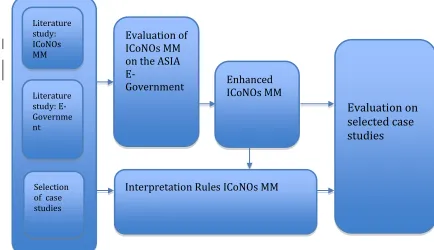
Figure 1.1presents the research model used in this thesis. First, we will conduct a literature review for analyzing the existing maturity models, and then we will particularly study the ICoNOs maturity model in detail. Literature study of e-government will provide us with the understanding of the concepts that are specific to B-ITa in government settings. After that, we will need to select some case studies which will later help us to evaluate the model and our understanding of the concepts.
As shown in the Figure 1.1, after the literature study, ICoNOs MM will be evaluated on the Asian government organization’s case. The qualitative approach of interviewing the people and studying the documentation will lead us to learn about the validity of ICoNOs MM in Asian government organization. These results may lead to some modifications in the ICoNOs MM.
Introduction
Page 3
[image:14.595.79.513.219.469.2]will be evaluated on the selected websites. The literature review, the observations of websites and the possible interviews with experts will be employed as mile stones towards the enhancement in ICoNOs MM. We can move back and forth between interpretation rule formation and evaluation step. This iterative process will continue until we are able to judge about the maturity of CNOs by using interpretation rules.
Figure 1.1 : Research Model
1.5 Research Questions
Our main goal is to evaluate the ICoNOs MM by using two types of qualitative research techniques: traditional and non-traditional, on both government and non-government websites. To achieve this goal, we have formulated our research question which is given below:
What is the suitability of the ICoNOs MM to contexts of government NOs/CNOs in developing countries for assessing their B-ITa? And if experts are not available for interview-based evaluation of B-ITa maturity, in which way can we use information from websites and publicly available documentation for the purpose of evaluation of B-ITa by means of the ICoNOs Maturity?
This research question is an abstract question, i.e., it contains many details. Before continuing decomposing the question into sub-questions, we need to understand the scope of the ICoNOs MM.
Literature study: E-Governme nt
Evaluation of ICoNOs MM on the ASIA
E-Government Enhanced ICoNOs MM
Interpretation Rules ICoNOs MM Literature
study: ICoNOs MM
MMMM
Selection of case studies
Page 4
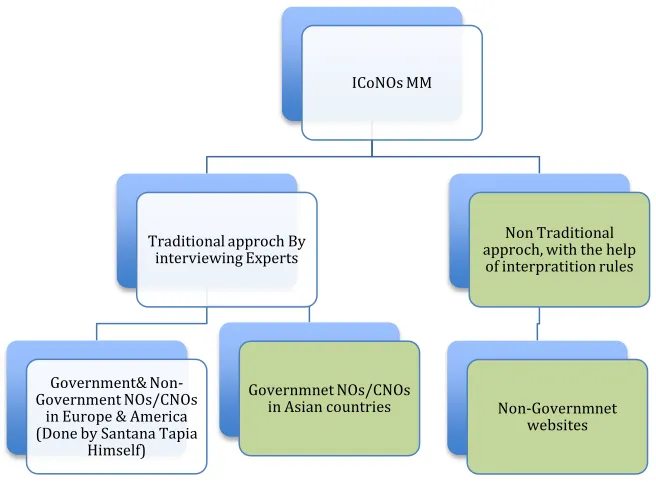
In Figure 1.2 gray color boxes show the areas where our main research question is focused. There are several aspects of the research question that can be redefined in sub-questions to create simpler, more concrete questions. Research question is divided according to the various parts of the research that need to be explained or elaborated.
[image:15.595.125.453.252.493.2]Question#1: Is the ICoNOs MM suitable for NOs/CNOs contexts in developing countries, especially in Asian e-government NOs/CNOs, by using the traditional approach?
Figure 1.2: ICoNOs MM Research Directions
The purpose of this question is to analyze the B-ITa of e-government NOs/CNOs of developing countries (especially of Asian countries), and try to figure out that the MM developed by Santana Tapia [6] is suitable for Asia too.
Question#2: Does the evaluation of the ICoNOs MM bring into focus the new aspects of MMs?
We will consider each and every domain, necessity of its existence (and non- existence) then finally we will conclude about the ICoNOs MM’s domain.
Question#3: How to interpret what you have seen on a website in the light of the constructs of the ICoNOs MM when publically available information in websites is the only possible source of information in the evaluation of B-ITa maturity of CNOs?
ICoNOs MM
Traditional approch By interviewing Experts
Government& Non-Government NOs/CNOs
in Europe & America (Done by Santana Tapia
Himself)
Governmnet NOs/CNOs in Asian countries
Non Traditional approch, with the help
of interpratition rules
Introduction
Page 5
In the previous case studies conducted to validate the ICoNOs MM [6] a questionnaire has been used when interviewing people. But if experts are not available, or if they do not have enough time, to explain each and every aspect of the business, then how to collect maximum basic information concerning B-ITa. This question will help us to build our interpretation rules.
Question#4: Is there any difference of results while evaluating the ICoNOs MM on a website with the help of interpretation rules instead of interviewing people?
This question is a follows up on Question#3. We will evaluate the interpretation rules developed in the previous question. With the help if interpretation rules we will deduce B-ITa related information from publically available non-government websites.
1.6 Research Plan
For planning this research we draw on Wiring’s problem analysis and solution design approach [7]. We chose this research approach because of its broad use in master and PhD projects at the University of Twente and also because of its suitability to the problem we are investigating. Applying this approach, we are using the distinction between two types of questions: design research questions and knowledge research questions [7]. Once we are able to identify the question type, it will be straightforward to follow the research method based on the research question types. Based on the paper by Wieringa and Heerkens [7] a design research question is a “How-to-do” question which asks us a way to get a desired output from the given set of inputs. The other type of research questions is called as “knowledge research question”. This type of questions can be explained in one sentence as “what-is-the-case” and “why-is-it-the-case”. A knowledge research question tells us what we want to know about the world based on what we already know about the world. Conceptual modeling questions make the foundation for the knowledge research questions.
Page 6
Figure 1.3: Research Plan of Study
1.7 Research Approach
This research focuses on evaluation of the ICoNOs MM. While the overall research process has been presented in Figure 1.1, in this section we describe in more detail those specific research techniques that will be used for the specific tasks included in this projects. These techniques are the following:
Literature Review: Purpose of this literature review is twofold; one is to find the most recent MMs and to study the aspects these new MMs have discussed. Research Plan
Legend:
D: Design Question K: Knowledge Question
C: Conceptual Modeling Question A: Action
“What is the suitability of the ICoNOs MM to contexts of government NOs/CNOs in developing countries for assessing their B-ITa? And if experts are not available for interview-based evaluation of B-ITa maturity, in which way can we use information from websites and publicly available documentation for the purpose of evaluation B-ITa by means of the ICoNOs Maturity”?
Q1: Is the ICoNOs MM suitable for NOs/CNOs contexts in developing countries, especially in Asian e-government NOs/CNOs, by using the traditional approach?
K: Selection of Asian e-governance NOs/CNOs A: Interview the experts
A: Evaluate the ICoNOs MM on Selected NOs/CNOs A: Conclude the results
Q2: Does the evaluation of ICoNOs MM bring into focus the new aspects of MMs?
K: Evaluate the B-ITa on the basis of results obtain in Q1 A: Conclude the results
Q3: How to interpret what you have seen on a website in the light of the constructs of the ICoNOs MM when publically available information in websites is the only possible source of information in the evaluation of B-ITa maturity of CNOs?
C: Produce interpretation rules
K: Selection of Non government NOs/CNOs
A: Apply the rules on the selected websites.
Q4: Is there any difference of results while evaluating the ICoNOs MM on a website with the help of interpretation rules instead of interviewing the people?
Introduction
Page 7
The second purpose of this literature review is to create a base for developing the interpretation rules.
Case study: There are two scenarios for which we have to choose case studies. One for the evaluation of the ICoNOs MM on developing country CNOs/NOs, and other one for the evaluation of the interpretation rules and some possible modification of ICoNOs MM(in case we came across during the evaluation process).
Interviews: For evaluating the ICoNOs MM we need to conduct interviews. We have planned that we will conduct structured interviews [8]. The reason for selecting structured interviews is to save time, because this evaluation will be conduct in Pakistan and we will have limited time over there. Also structured interviews let us get more information in efficient way.
Interpretation methods: So far the ICoNOs MM has been evaluated by interviewing experts and studying documentation. We will evaluate the ICoNOs MM using websites; so, we will follow web analytics techniques [9].
1.8 Research Scope and Relevance
This research is relevant for the further development of MMs to assess B-ITa. Evaluation studies are deemed important in that they provide a body of evidence that confirms or disconfirms claims published in previously carried out research. This is necessary because Santana Tapia [6] (see p. 230) discuss many open issues like:
How ICoNOs MM will behave if it is not a cross organization framework.
There is a need to evaluate the ICoNOs MM on other case studies too.
ICoNOs MM discusses four domains based on the case studied but new domains may arise with new case studies.
A need for a model assessment tool is also there.
Such broad perspectives are difficult to achieve in such limited time and scope of master thesis, therefore we have selected only some parts of that.
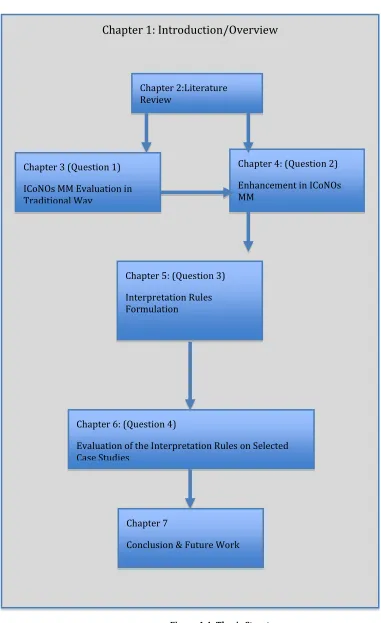
1.9 Thesis Structure
Page 8
Figure 1.4: Thesis Structure
Chapter 1: Introduction/Overview
Chapter 2:Literature Review
Chapter 3 (Question 1) ICoNOs MM Evaluation in Traditional Way
Chapter 4: (Question 2) Enhancement in ICoNOs MM
Chapter 5: (Question 3) Interpretation Rules Formulation
Chapter 6: (Question 4)
Evaluation of the Interpretation Rules on Selected Case Studies
Chapter 7
Literature Review
Page 9
2
Literature Review
As discussed in the Chapter 1, this thesis is based on the ICoNOs MM proposed by Santana Tapia [6] . Because the literature sources on B-ITa MMs,that have already been reviewed by Santana Tapia [6], are dated up to 2006, we considered it worthwhile to complement his literature review with a new one that aims to uncover and analyze more recent literature sources published between 2006 and 2009. The purpose of our complementary review is twofold: (i) to extend the Santana Tapia’s review by including MMs specific to e-government and (ii) to identify MMs for B-ITa at CNOs dated 2006-2010.
2.1 Systematic Review
Systematic review synthesizes the related work on a research topic in a fair way. Kitchenham [10] provides a detailed procedure for the systematic review process. In Information System (IS) community, Webster and Watson [11] gave set of detailed steps for “writing the analysis of the past in order to prepare for future”. In this thesis we will consider Webster and Watson’s guidelines and Kitchenham’s systematic review phases. The description of our review explicitly follow the Kitchenham’s systematic review phases, a review consist of three phases,
Planning the review
Conducting the review
Reporting the review
In the following sections we present these steps.
2.2 Planning the Review
CRD Report [12] suggest in its checklist that if we understand the objective of research then we can identify the need of review. In this thesis we are going to evaluate the ICoNOs MM on Asian government CNOs. Because a literature review on MMs has already been used to inform the design of the ICoNOs MM, we are not going to execute a full scope literature review on MMs in this thesis. Instead, it makes sense to search, identify and analyze recent MMs that have been published after the ICoNOs MM’s publication date and then, to compare these models with ICoNOs MM.
Page 10
Moreover, later in this thesis, we plan to develop some interpretation rules for understanding B-ITa maturity aspects based on information available from the websites of CNOs. Our literature review finds some MMs, which are in some ways based on web-analytics [9].
Our review plan included searching in (i) ACM digital library, (ii) IEEE Xplore, (iii) Scopus, (iv) Springer Link, and (v) Goolge Scholar. We used the combination of the following key words: ‘maturity models’, ‘e-government’, ‘e-business’, ‘web analytics’, ‘B-ITa’, ‘online government’. We chose these terms because we deemed them to be important for describing both the topic of B-ITa in CNOs in the government sector and the matter that we are interested in using a web-analytics-based approach. The choice of key words was finalized in multiple iteration process and discussed on regular basis with the first supervisor who also did a search in digital libraries to judge the results that these key words brought. We considered the following inclusion criteria: (1) the paper is about a MM that explicitly addresses some B-ITa aspects and (2) the paper is published after 2006 and is not included in the literature reference list in Santana Tapia’s dissertation[6].
2.3 Conducting the Review
We have performed search between 1st September 2009 and 1st October 2009
by applying the search query individually to each of the five databases. After applying our inclusion criteria, we identified six MMs that met these criteria. We present each one in the next section. After that, we compare them with respect to ICoNOs MM. Our comparison is of qualitative nature and is presented in 2.4 .
2.4 Summary of the results
We identified six models that were published between 2006 and 2009, that are related to this master project. Figure 2.1 depicts the models that we found in our review. We provide a brief description of each of them is given in Figure 2.1.
2.4.1 The Adaptive Infrastructure MM [13]
Literature Review
Page 11
[image:22.595.96.495.86.369.2] [image:22.595.100.488.398.630.2]
Figure 2.1: Results at a glance
Figure 2.2: Adaptive infrastructure MM [13]
processes.
The HP AIMM helps to manage evolution. HP AIMM have recommendations that can help to identify the types of initiatives that should be consider for driving the current state of maturity to a desired state. These recommendations and stages of maturity vary from organization to organization depending on the current state of IT, business itself, business constraints and priorities. For example an
Adaptively Source Infrastructure
Automated Service Oriented
Optimized
Standardized
Com Parameterized
Specific IT domain areas that drive maturity IT domains
Cu ltu re & IT St aff Ma na ge m ent too ls & P roce ss es T ech no logy & a rch itectu re D em and , Su pp ly & IT Go ve rn an ce St age s of m atu rit y
Four Stage Model (2.3.6) Adaptive Infrastructure MM
Santana Tapia’s Literature review Forrester MM , E-business MM 2.0
Web Analytic MM
Stage Model
Two Stage Model
Maturity Model E-Government
Page 12
organization which has compartmentalize and legacy IT environment. This environment can indicate that it is on a least mature stage or it may want to move to a more standardize environment, technologies and tools. Error! eference source not found. shows a brief study of the stages involved in the AIMM.
2.4.1 The Forrester MM [14]
This model addresses the software-as-a-service (SaaS) context, an important trend in customer relationship management (CRM) in particular and in the small and mid size business (SMB) market in general. Forrester's SaaS MM provides an assessment of the SaaS solutions that CNOs can adopt to streamline their collaboration. This model provides the guidance to software vendors and services providers for realistic strategy transformation. Forrester implies that the SaaS vendor is a central partner in a CNO relying on SaaS. It’s interesting also to note that Forrester explicitly states that targeting the highest maturity level by such a CNO is not necessarily the best fit for every vendor.
2.4.2 The E-Business MM 2.0 [15]
This model is emerged in 2001 and is based on the concept of organizing for e-future. It can be said safely that the world of e-business is changing dramatically since 2001 so there is a need to manage and understand e-business with respect to current state. In order to meet the requirement for current e-business, in 2008 e-business maturity model 2.0(EBMM 2.0) is introduced.
The main purpose for the development of EBMM 2.0 is to help organizations understand their current status and future goal. This model also helps to understand the factor that influence their way to their desired state. These factors are (i) Processes, (ii) Infrastructure, (iii) Management & Organization (iv) People & Culture. EBMM 2.0 consists of five levels and four factors shown in Figure 2.3 respectively. It is based on the well-known capability maturity model (CMM).
.
Figure 2.3: Levels of E-business MM 2.0 [15]
Initial
Repeatable
Defined
Managed
Literature Review
[image:24.595.180.416.95.324.2]Page 13
Figure 2.4: Factors effecting on E-business MM 2.0 [15]
In 2008, a quantitative research was performed by the Atos Consulting Trends Institute. Its aim is to validate the EBMM 2.0 across sectors, establishing sector benchmarks
2.4.3 The Web Analytic MM [16]
A web analytic model is the analysis of the web developed in 2009. Jim Sterne, founder of the Web Analytics Association revealed that “it was a mistake to call it web analytics, it is business analysis”. So the aim of web analytics is to “arrive at an optimal or realistic decision based on existing data”. In turn, analysis is “the process of breaking a complex topic or substance into smaller parts to gain a better understanding of it”. The Web Analytics MM provides the processes needed by CNOs to carry out web analysis. . This model let the analyst to speak the language of stakeholder and to see the existing and previous business dimensions. This model can be used by CNOs to optimize online marketing activities, which is ultimately based on the analysis of business and process optimization at each of the partner organizations participating in a CNO. Figure
2.5 outlines of the model along with the short description of its maturity levels.
The Web Analytics MM is deemed to be able to help for the advancement of the field by making an easy communication and change management framework.
Performance Management & Oraganization
Infrastrucure
Page 14
Figure 2.5: Web Analytic MM Worksheet [16]
2.4.4 A four stage model for developing fully functional E-government [17]
E-government is a challenge at different levels of public administration. For public administrators think about e-government and their organizations, ‘stages of growth’. This model describes different stages of e-government development. These stages give an overview of the multi-perspective transformation within government structures and functions as they make transitions to e-government through each stage.
For each stage this model describes technological and organizational challenge. This model tells how the e-government becomes amalgamated with traditional public administrative structure. In addition these stages identify the citizen as the user of the government services. A four stage model is shown in the Figure
Literature Review
[image:26.595.108.462.95.465.2]Page 15
Figure 2.6: Four stage Model [17]
2.4.5 A two-stage model of E-government growth [18]
This model is based on a four-stage model presented in the previous section but it examines current stages of development of e-government growth in American cities. A two-stage model is an evolution of the four-stage model. This two-stage model is applied on the municipalities for e-government growth.
Stage I is the cataloging of information online
Stage II is transactions being completed online
Page 16
procurement of equipment and office supplies was done by Internet among half of the surveyed cities. So it is concluded that e-government growth is more pronounced in some areas than others.
Figure 2.7: Stages of e-government [18]
2.4.6 Stages of growth in e-government: An Architectural Approach [19]
This model acknowledges that there is gradual evolution in all the organization, including evolution in governmental agencies. All over the world government organizations are migrating from traditional systems architectures to more horizontally and vertically integrated architectures. This model presents the development of information architectures for local government. By analyzing discontinuities in the architectures and coordinating back and front office applications, five stages are derived. The five-stage model consists of
i. No integration,
ii. One-to-one messaging,
iii. Warehouse,
iv. Broker
v. Orchestrated broker architecture.
Literature Review
Page 17 2.5 Comparison of the six models and ICoNOs
While Santana Tapia’s review is based on the models especially designed for the B-ITa, in this review we explicitly included e-government and e-business models in which B-ITa is one of the key components (but not the only one). While in Santana Tapia’s review, the author found that his surveyed MMs mostly relate to B-ITa in a single enterprise and few with B-ITa in CNOs. In case of CNOs the main focus is on processes and integration levels (such as page 81 EIMM[20], SCM MM [21] , E2AMM [22]), relationship (such as IT outsourcing MM [23] ), IT sharing and information (such as in extended CMM [24] ).
We must note that the six models, we have reported, are all geared to the networked settings. When comparing ICoNOs and any of the six models, we observe that mappings can be found between the ICoNOs design elements and the design elements of the models in our review. For example, the Four Stage Model [17] (see Figure 2.6), the HP AIMM model [13] and the Forrester model [14] suggest a strong emphasis on processes and integration levels, on relationships, on information sharing, as ICoNOs does. We are however able to point out to areas that fall beyond the scope of ICoNOs. These are: culture, cost management, quality assurance. We trace the inclusion of these areas back to the objectives with which the six models were created. For the purpose of our research project and our research model (see Figure 1.1), we also think that those areas that are beyond the ICoNOs MM’s scope, can be considered as candidates for inclusion in ICoNOs MM, if one considers investigating the possible ways to extend the ICoNOs MM. We make a note of this because it is well possible that replicated evaluations of ICoNOs MM suggest needs for extending it. If this happens, then a researcher would not only use his/her observations coming out of his/her evaluation of ICoNOs MM, but also the observations that are provided through this literature review. Indeed, in the rest of this thesis (for the overall thesis structure see Figure 1.4), we will see how we identified the need for one specific enhancement to the original ICoNOs MM model and how we responded to this need.
Page 18 2.6 Summary
ICoNOs MM Validation in an Asian Government Organization
Page 19
3
ICoNOs MM Validation in an Asian Government
Organization
This chapter presents a case study for evaluating the domains of ICoNOs MM on Asian CNOs. This evaluation process is done by using a case of National Database and Registration Authority, (NADRA) Pakistan[25]. In what follows, we will introduce the case study research approach for this validation process.
3.1 Background
[image:30.595.131.464.368.684.2]The ICoNOs MM is designed on the basis of B-ITa processes organized in the so-called domains. ICoNOs consists of four most common domains and five levels of maturity. Santana Tapia validated his proposed model on different case studies [26], [27]. He concluded that his proposed MM [6] works very well with the case studies shown in the Figure 3.1.
Figure 3.1:Multiple Case Study Approach [28]
Page 20
coordination are the basic building stones than any other domain”. The author has validated this claim in his PhD dissertation and in his publications to which we refer interested readers for more details [6] [26] [29]. In this chapter, we go a
step further and extend the evaluation efforts by including a case that describes an Asian CNO. The case study organization is the NADRA, Pakistan. It is a system integrator for global identification sector in developing country. NADRA designs, implements and provide operating solutions for corporate and public sector clients. NADRA offers customizable solutions for identification, e-governance and secure documents to its clients. NADRA has implemented the Multi-Biometric National Identity Card (NIC) & Multi-Biometric e-Passport in Pakistan[25].
Local Clients Projects
Ministry of Interior National Identity Card System
Directorate General of
Immigration and Passports Multi-Biometric Card System National Highway Authority E-Toll System
Benazir Income Support Program
MNA/MPA/Senator
Forms Processing Project
Emergency Relief (ER) for IDPs Project Smart Card Project
World Bank Scorecard Survey Project Earthquake Reconstruction
& Rehabilitation Authority ERRA
UNHCR Pakistan Registration of Afghan Refugees
Table 3.1: Local Clients [25]
Sector Companies
Telecom Mobilink, Ufone, Telenor…
Financial Institutions Barclays, Royal Bank of Scotland, Standard Chartered…
Utility Bill Companies PTCL, IESCO, SNGPL, SSGPL…
Table 3.2: Corporate Clients [25]
Clients Projects
Government of Sudan Civil Registration Project
Government of Kenya Passport Issuing System
Government of
Bangladesh High Security Driver’s License
ICoNOs MM Validation in an Asian Government Organization
Page 21
NADRA purchased its solution with the help of its strategic partners. Which includes Terawatt, ORACLE, Safe ID solutions[25]. With the help of these partners NADRA is in its current state of development. NADRA have its local, international and corporate clients.
Detailed client information about NADRA is given in Table 3.1, Table 3.2 and Table 3.3.
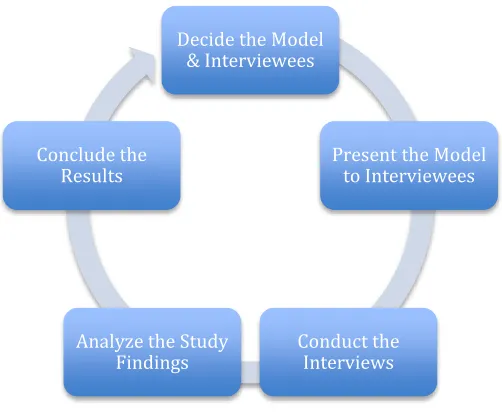
3.2 Case Study Research Plan
[image:32.595.173.424.375.581.2]We have planned to apply traditional approach (namely the interview-based approach) for evaluation of ICoNOs MM on NADRA. We started by conducting the interviews and concluded that as NADRA is originally developed by its strategic partners, so the administration don’t know the details of technical terminologies evolved behind it. The overall case study plan was inspired by Yin [30] and other researchers [31] [32]. We devised the following research cycle [31] [32](see Figure 3.2). In the following sections we will go through the research cycle step by step.
Figure 3.2: Research Cycle
3.2.1 Decide the Model and Interviewees
As shown in the section 3.1, we have selected NADRA, Pakistan as a case study to evaluate ICoNOs MM. The targeted interviewee groups are the professionals from NADRA and from its government and corporate clients. We have included five professionals from NADRA,
Two are senior IT experts working with NADRA for more than ten years. Decide the Model
& Interviewees
Present the Model to Interviewees
Conduct the Interviews Analyze the Study
Findings Conclude the
Page 22
Two are NADRA system specialists who are working with NADRA for four
years; their responsibility is to manage the servers of NADRA.
One person is from the “National Passport Authority” which is a client of NADRA.
3.2.2 Present the Model to Interviewees
This step means educating the interviewee about the technical terminologies and details included in the case study that would be carried out. Most of the professionals we had to interview are those who were not directly involved in the development of NADRA. Instead they are the users and administrative staff of NADRA and its clients. So they needed to learn few terms and basics about ICoNOs MM. For this purpose, we organized an information-and-orientation meeting with all participants where we have given a presentation for the purpose of bringing all participants to a common level of understanding of the ICoNOs MM and its maturity assessment procedure. See Appendix A for presentation details.
3.2.3 Conduct the Interviews
We carried out semi-structured interviews based on the interviewing practices recommended in [8]. For the interviews, we used the questionnaire presented in Appendix B. There in, our questions are adapted from Santana Tapia’s thesis [6], (see Appendix D). We got an opportunity to meet five professionals. Four of them were from NADRA and one was from its local client. For the better understanding and convenience of the professionals, most of the interviews were conducted in Urdu (Pakistan’s National Language). In this thesis, instead of writing a detailed question-answer-session of each professional, we are dividing the interviews into three parts based on our three broad questions. Below, each question, the views of each interviewee are presented.
Question 1: How NADRA judges the strengths and weaknesses of the relationship with its partner organizations (namely, its clients)?
1st Interviewee: “As NADRA is the Pakistan’s largest database for the citizen, from the start of partnership all the clients change themselves according to NADRA. NADRA is not flexible enough to the adoption with respect to clients. So if there is some platform incompatibility then it is obligatory for client to adjust with NADRA”.
ICoNOs MM Validation in an Asian Government Organization
Page 23
3rd Interviewee: “NADRA consider its strong and weak clients by considering the level of coordination that they have among them”.
4th Interviewee: “Capability of data exchange is the basis for the strong and weak relationship with its clients. For data exchange basic infrastructure need to be the same. For example in case of NADRA and Pakistan Passport Authority”.
5th Interviewee: “The requirement document provided by NADRA to its client is in fact the base of the judgment, for seeing the existing and future possibility of alignment between them”.
Question 2: What are the aspects needed, for NADRA to work successfully with its clients?
1st Interviewee: “The coordination on the ‘architectural information’ is required data”.
2nd Interviewee: “Cost considerations and quality control is the building stone of the successful relationship. As there exist no competitors for NADRA therefore NADRA demand whatever it wants”.
3rd Interviewee: “Coordination and communication among the clients and the NADRA is one of the major considerable aspects. Because lack of communication produce different outcome then expected or required”.
4th Interviewee: “Process architecture and business rules and data flows are the considerable aspect for NADRA’s success”.
5th Interviewee: “There exist many aspects but the most important among them are cost management and coordination”.
Question 3: Does these recommendations (ICoNOs MM Domains) suits to NADRA?
We make the note that the names of the ICoNOs MM domains were not provided in the orientation presentation (Appendix A) explicitly, because we wanted the interviewees to give us the necessary domain names from NADRA themselves. We wanted to see whether the domain names and the meanings that would come up in the minds of the professionals, when thinking about B-ITa, would converge with or diverge from the original names and meanings used in the ICoNOs MM.
Page 24
important. So we can say among ICoNOs MM domain coordination and partnership structure (partnering structure in ICoNOs terminology) are basic recommendations”.
2nd Interviewee: “To measure the maturity of the NADRA with its clients all the recommendations are important but there should also be some cost consideration”.
3rd Interviewee: “Still there was no way by which NADRA can consider maturity aspect and these recommendations provide very practical and convenient framework”.
4th Interviewee: “Yes, they suits to NADRA”.
5th Interviewee: “Not only these recommendations suits to NADRA but these are also helpful for the clients. Because in this way client can also find out about themselves, that at which level of maturity are they with NADRA or with any other organization”.
3.2.4 Analyze the Study Findings
NADRA provides us with great deal of information for evaluating ICoNOs MM. The terminologies used by NADRA and by ICoNOs MM are different but have same meanings. For example the terms “Partnership, Partnership Structure and Partnering Structure” have same meanings. We note that the first two terms are from NADRA and last one is an original ICoNOs MM domain name.
In this section we will analyze the information gathered from interviews and documentation while keeping in view the ICoNOs MM domains. We will consider two important, inter-dependent projects of NADRA: one is NIC system and the other is Multi-Biometric Card System, for discussing the ICoNOs MM domains.
Partnering Structure: NADRA is a semi-government organization. So it has a hierarchy of authority and always has new government projects with new demands. The client companies handle these new projects. The contract among these companies and NADRA provide a detail partnering structure. For the NIC system, NADRA have a partnering structure or workflow structure that describes the constraints which IS architecture and process architecture need to fulfill.
Identify the person with its finger prints
Identify the person with family hierarchy
According to Pakistan’s customs change in social status (Single, Married, Divorce, Dependent) change the family hierarchy.
NIC system has:
ICoNOs MM Validation in an Asian Government Organization
Page 25
(ii)An established governance structure
Although they have assigned responsibilities to the individual actors collaborating in the network, Multi-Biometric Card System is dependent on the NIC system so they also have the same partnering structure provided by NADRA.
IS architecture: Most of the interviewees have demonstrated that detailed documentation, briefing and training are necessary for IS architecture. Only IS architecture is not enough for project success, it needs detailed infrastructure and technical information that can be termed as IT infrastructure architecture. As in case of NIC system NADRA provide the system for data entry but additional hardware is required for that data entry because each person is being identified by his fingerprints and NIC system needs a fingerprint input device. It can be a finger-print scanner, or a simple scanner which can read ink based fingerprints from the paper. For NADRA, this architecture was necessary to align the new systems. For immigration, passports are needed and a system known as Multi-Biometric Card System exists for this purpose. Data collected by the NIC system is being utilized for the passport processing by Multi-Biometric Card System. This is an example of data collaboration among the organizations based on IS architecture.
Process Architecture: Another important domain but none of the interviewee discussed about it directly, is Process Architecture. They used different terminologies as Process Rules, Business Architecture but all of them were indicating toward a single aspect termed by ICoNOs MM as Process Architecture. All interviewees agreed on that if there is cross-organizational collaboration then process architecture is a basic building stone for such collaborative network organizations. As in case of NIC system, the process architecture domain was identified in the context of the organization delivering the Multi-Biometric Card System. The Multi-Biometric Card System organization need the details of the citizen, if data is not being provided and the process architecture is not same then it can happen that a person will have its passport first then he will get his NIC. Which indicates a miscommunication in the ‘process architecture’ of the system? This also indicates contradiction of the saying that “Multi-Biometric Card System is dependent on NIC system”.
Coordination: Almost all of the interviewees discussed about coordination in one way or other way around. Some of them called it as “Communication among collaborative network organizations”. Our interviewees converged on the use of the following mechanisms:
Page 26
(ii) Coordination enabled through agreements specifications, (iii) Definition and communication of mutual expectations.
Preceding the example we have considered in the previous paragraphs, for NIC and Multi-Biometric Card System if no coordination exist then the information can be duplicate or can be erroneous. As there exist that basic information of a person can be provided by the NIC system, Multi-Biometric Card System can only re-check the credential given by NIC system and add extra details like purpose to going abroad, latest photograph etc.
3.2.5 Conclude the results
In our case study research, we came across with following important findings,
Coordination is fundamental among all the dimensions; we found that any other dimension like Partnering Structure, IS architecture or Process architecture are related to the Coordination. We can say that all the other three domains lie under the cover of Coordination.
IS architecture and process architecture are being used but at NADRA, both architectures didn’t have any distinct boundaries, in-fact they have overlapping boundaries in NADRA.
There exist different terms but have same meaning. Examples are shown
in the Table 3.4.
Terms by ICoNOs MM Equivalent Terms used in
NADRA
1 Partnering Structure Partnership Structure , Partnership
2 Coordination Coordination and/or Communication 3 Collaborative Network
Organizations
Network Organizations, Partnering Organizations
Table 3.4: Examples of different names people use for concepts with the same meaning.
3.3 Evaluation of Validity Threats in the Case Study
We have validated the ICoNOs MM on one of the government organization in Pakistan and found that the ICoNOs MM is equally suitable to Asian government organizations too. There can be chances to challenge our conclusions by asking a number of questions, which are as follows:
Was the organization (NADRA, Pakistan) very much developed
government organization and, thus, a typical for Asian countries?
ICoNOs MM Validation in an Asian Government Organization
Page 27
If we apply ICoNOs MM on other government organizations, will the results be same?
Below, we address these questions in more detail.
First, NADRA is a large provider of government solutions serving many Asian countries and its solution delivery processes are developed and elaborated in a way similar to a solution provider organization in the Western countries (e.g. US or the European countries). This might pose a threat to the generalizabiity of our results in the sense that they might be specific to large Asian CNOs where one much developed partner (in terms of organizational design) instills its discipline, processes and cooperation rules over its collaborators (in this case, its clients). We however think that the impact of this threat is minimal as NADRA seems to be a typical organization in the Asian market of government system delivery. We did a search for evidence on the characteristics (in terms of collaboration) of Asian e-government projects as available in web sites of market research firms in Asia (e.g. Gartner Asia, eGovAsia - www.egovasia.com), the United Nations [33] and the Economist magazine. Specifically, we looked into what kinds of partners are included in Asian vendor and partnership ecosystems. We found that in a number of Asian countries, e-government is built-up with the participation of large solution providers collaborating with country-specific government authorities. We also acknowledge the Asian countries have similar e-government demands [33] and, as it is the case of NADRA, it is well possible for a solution provider to have as clients the governments of several countries. We, therefore, think that we could possibly expect results similar to ours if we carry out a maturity evaluation in e-government contexts that are similar to ours. If we, for example, asses the maturity of the NADRA CNO formed with the Earthquake Reconstruction & Rehabilitation Authority and the Registration of Afghan Refugees, then we could expect to get results similar to those presented in this chapter.
Second, we can say that we have selected NADRA for convenience (in a way randomly) and without any prior analysis. The author of this thesis had a previous work relationship with NADRA and was employed in an internship in a Pakistani government organization. The author was, thus, familiar with the government processes in the country and in the business areas for which NADRA delivers IT solutions. We acknowledge that other researchers might choose other country’s organizations for the reasons similar to ours. We, however, think that this choice is reasonable in the light of the deadline constraints imposed in a master project.
Page 28
this thesis). Two senior researchers participated in planning the case study, but because they were not familiar with Urdu, there was no way for them to get actively involved in the data analysis. This poses a threat to the accuracy of the data collected and the analysis as the interpretation of the author could have been different from what the interviewees actually wanted to say. This threat was mitigated by a checking step in which the first supervisor of the author asked questions and attempted to triangulate the data with the information from official documents partly available in English from the web sites of NADRA and its clients. This triangulation step strengthened the feeling that the level of bias of the first author is reduced.
3.4 Summary
In this chapter, we have presented the NADRA case study that we have conducted to empirically validate the B-ITa domains by means of interviews with a group of professionals. We have followed the research plan presented in the section 3.2. Based on our learning we confirm the presence of same four key domains proposed by Santana Tapia[34]:
Partnering structure,
IS architecture,
Process architecture and
Coordination.
CNOs involved in B-ITa projects consider these domains to have an insight and to strive for B-ITa maturity. During the interviews we found one additional domains that is “Cost Management”. But the most important are the four discussed by the ICoNOs MM. We came across another important aspect that cost management is effected by the type of organization. If it is a non-government organization then cost of B-ITa is very important factor to consider. On the other hand if it is government organization then cost will be managed by government. B-ITa of CNOs (Government) will not have much concern with cost management domain.
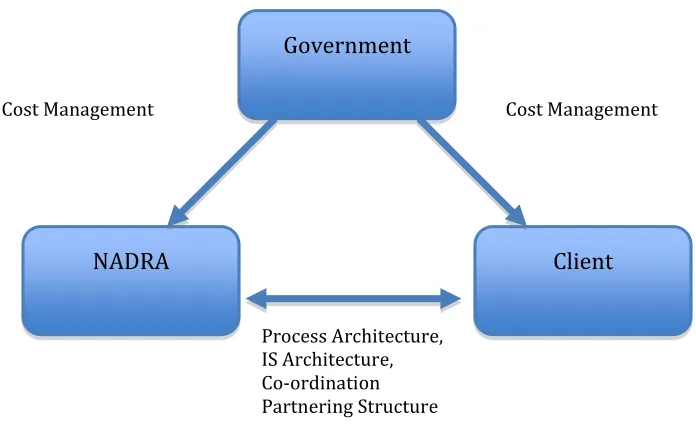
We explain this point by considering the Figure 3.3 for NADRA:
ICoNOs MM Validation in an Asian Government Organization
[image:40.595.97.445.85.297.2]Page 29
Figure 3.3: Cost Management
As shown in the Figure 3.3, government is responsible for managing cost in both the client organizations (these are government authorities) and NADRA. NADRA and clients have to deal with process architecture, IS architecture, coordination and partnering structure (ICoNOs MM Domains). So we can say in government level CNOs sharing of revenue, profit and loss are not much concerned but in non-government sector they are a big deal to think about. Therefore we can conclude that in non-government CNOs cost management need to be considered as an independent domain.
Government
NADRA Client
Cost Management Cost Management
Process Architecture, IS Architecture, Co-ordination
Page 30
4
Enhanced ICoNOs MM
This chapter focuses on an enhancement in the ICoNOs MM [34]. In the previous chapter, ICoNOs MM is evaluated on NADRA [25] case study. For this purpose we have conducted interviews and studied some documentation. We have reported the results obtained and we indicated that there is a need to enhance the ICoNOs MM.
4.1 Brief Introduction to MMs
MMs describe evolution of an entity (Organization/ NOs/ CNOs etc). These models are designed for the purpose of assessment and prediction of some attributes for an entity. With the help of these models, entities become aware of the current state of different areas. MMs are usually level based approaches. Domains and levels characterize each MM. Domains define the specific area or direction and levels define the improvement path. Each MM has tried to answer some specific questions. Question like “How maturity of CNOs can be measured” is answered by ICoNOs MM. It helps CNOs to access the maturity of B-ITa activity to identify lack of efficiency that can have negative impact [34]. Like other MMs, it is a two dimensional framework and consists of domains and levels. In the following sections, we will summaries ICoNOs MM domains and levels.
4.1.1 ICoNO’s Levels[27]
ICoNOs MM consist of five levels, which are used to describe the improvement path for CNOs to achieve B-ITa. These levels are,
Level 1: Incomplete. At this level processes for a B-ITa domain are not performed or partially performed.
Level 2: Isolated. Processes for particular B-ITa domain are planned and executed at initial levels. But these processes are isolated not managed form CNOs perspective.
Level 3: Standardized. Processes are heading for standardization of a particular B-ITa domain from a CNOs perspective.
Level 4: Quantitative Managed. Processes about a particular B-ITa domain use statistical and other quantitative techniques for quality measurement.
Level 5: Optimized. Processes are improved for B-ITa based on common causes and interests.
4.1.2 ICoNO’s Domains [27]
Enhanced ICoNOs MM
Page 31
Partnering Structure: Defines where the work will be done and who will be involved. For CNOs it describes organization structure, work division, roles and responsibilities.
IS Architecture: It is about information management function their relationship to each other and the environment. It also describes the principles, guiding the design, and evolution of CNOs.
Process Architecture: Describe about all the individual and collaborative processes needed to reach a shared goal of CNOs.
Coordination: It is about managing the interaction and work among the CNOs while considering the dependencies among the processes.
4.2 Implication of results from NADRA: Introduction of the Cost Domain
The recommendation obtained by interviewing people from NADRA suggests that cost is an important factor to consider. Indeed, when searching the literature on the role of cost consideration in B-ITa. One can deduce that many theories and models [16], [35], [36], [37], [38], [39], [40], [41] are cost based. The literature survey done in the chapter 2 of this thesis and the literature survey done by Santana Tapia [6] (Chapter 4 ) provide the bases for introducing the cost domain.
Our goal of introducing this domain is to improve the completeness and performance of ICoNOs MM. For the purpose of introducing this domain, we have to answer following questions:
What will be the name of the new domain?
From NADRA we have concluded that B-ITa is affected by cost. Among many terms used by NADRA (Financial Constraint, Cost effects, Cost management, Financial regulations) we have selected “Cost Management” as the name of this new domain [42]. We think that this choice is justified because we found it was intuitive not only to our NADRA case study participants but also it converged with the terminology used in the B-ITa literature.
Will the name of the ICoNOs MM be changed after introduction of new domain?
Yes it will change; we will name it as Enhanced ICoNOs MM.
How to define this domain?
Page 32
Why is it necessary to introduce it?
Cost constraints always affect the progress of an organization. Despite the fact that all the other domains help us to understand the B-ITa, if financial constraints/standards of the partnering organization are not comparable (w.r.t organization’s size, type, financial state. etc) then the ICoNOs MM domain may not be enough to make the right decisions.
Will the ICoNOs MM domains be affected by the introduction of a new domain?
We think that they will be affected partially. Coordination is the heart of the B-ITa, without it two CNOs can never be aligned. If two CNOs have different cost considerations then how the coordination is possible at equal level? For example, the domain of partnering structure incorporates
![Figure 2.2: Adaptive infrastructure MM [13] ](https://thumb-us.123doks.com/thumbv2/123dok_us/1204622.643974/22.595.96.495.86.369/figure-adaptive-infrastructure-mm.webp)
![Figure 2.4: Factors effecting on E-business MM 2.0 [15] ](https://thumb-us.123doks.com/thumbv2/123dok_us/1204622.643974/24.595.180.416.95.324/figure-factors-effecting-e-business-mm.webp)
![Figure 2.5: Web Analytic MM Worksheet [16] ](https://thumb-us.123doks.com/thumbv2/123dok_us/1204622.643974/25.595.111.509.93.410/figure-web-analytic-mm-worksheet.webp)
![Figure 2.6: Four stage Model [17] ](https://thumb-us.123doks.com/thumbv2/123dok_us/1204622.643974/26.595.108.462.95.465/figure-four-stage-model.webp)
![Figure 3.1:Multiple Case Study Approach [28] ](https://thumb-us.123doks.com/thumbv2/123dok_us/1204622.643974/30.595.131.464.368.684/figure-multiple-case-study-approach.webp)