J. Exp. Biol. (1973), 59, 491-521 4 9 1 With 10 text-figures
Printed in Great Britain
CENTRAL CONTROL OF POSTURAL ORIENTATION
IN FLATFISH
I. POSTURAL CHANGE DEPENDENCE ON CENTRAL NEURAL CHANGES BY CHRISTOPHER PLATT
Neurobiology Unit, Scripps Institution of Oceanography,
University of California, San Diego, La JoUa, California, 92037, U.S.A.
• (Received 23 March 1973)
INTRODUCTION
Postural orientation is an integrative action in which the nervous system produces a co-ordinated, directed muscular output in response to diverse peripheral sensory input from many modalities, including gravistatic sense, vision and touch. Even a single modality, such as gravistatic sense, may involve more than one receptor organ. Integration of input thus depends on the physiological capabilities of receptors as well as central mechanisms involving the weighted values of the afferent activities.
Flatfish, such as flounders, provide an interesting case for comparison of the peri-pheral and the central contributions to postural responses. These fish metamorphose from a larval form which swims like a standard fish with the dorsal fin upright to an adult which lies on one side; during this time one eye migrates across the head so that both eyes are on the upper side. This permanent change in body orientation relative to gravity and relative to the eyes requires permanent changes in the mechan-isms determining posture. Central changes must correct for any lack of peripheral changes. The problem therefore can be approached by examining the capabilities of the peripheral systems involved in the adult's postural regulation.
Specialized gravistatic receptors were developed first in coelenterates (Hyman, 1940), but reach their highest complexity in cepbalopod molluscs (Vinnikov et al. 1968) and vertebrates. Structure and function of the vertebrate vestibular system have been periodically reviewed. Notable reviews are Lowenstein's (1936, 1950, 1957, 1967, 1971), Pfeiffer's (1964) on much of the German behavioural literature, and Trincker's (1962) on fine structure and biophysics.
A few principles of static function in vertebrates are clear, chiefly from work on elasmobranch and teleost fishes which have three bilaterally symmetrical pairs of otolith organs. Each utriculus contains an otolith lying horizontally when the head is in the normal upright position; each sacculus and lagena contains an otolith lying on edge, vertically. The utriculus is almost exclusively responsible for the gravistatic component of postural orientation, despite the physiological sensory capability of the other otolith organs for responding to tilt (Lowenstein, 1957).
in the adult, so in the adult posture they have been rotated functionally by 900 relative to gravity (Retzius, 1881; Jacob, 1928). Schone (1964) obtained data sup-porting Jacob's (1928) observations, showing that the flatfish sacculus, rather than utriculus, is responsible for much of the behavioural response to tilt. The roles of vision, touch and other senses have not been explored. Reports on the physiological properties of primary afferents from otolith organs in other vertebrates (Ross (1936) and Gualtierotti & Alltucker (1967) on the frog; Lowenstein & Roberts (1949) on the ray; Giesen & Klinke (1969) on the guinea pig; Rupert, Moushegian & Galambos (1962), Beerens (1969) and Vidal et al. (1971) on the cat) allow comparisons with afferent activity in flatfish to determine whether a change in peripheral function can be eliminated as an alternative to central change for postural alteration.
Flatfish, then, provide a unique example of postural integrative function. The basic question posed here is whether their postural change results from peripheral changes in receptor functions or central changes in connexions. Either alternative could suggest mechanisms of plasticity in the phylogenetic or ontogenetic development of the ancient behaviour of gravistatic responses.
MATERIALS AND METHODS
(1) Flatfish used in these experiments were primarily of two species: Citharichthys
stigmaeus Jordan & Gilbert (speckled sand-dab) of the left-eyed Family Bothidae and Hypsopsetta guttulata (Girard) (diamond turbot) of the right-eyed Pleuronectidae.
Some individuals of other species were used for comparisons, including the bothid
Paralichtkys californicus (Ayres) (California halibut), the pleuronectid Pleuromchthys coenosus Girard (C-0 turbot), and a local standard fish, the girellid Girella nigricans
(Ayres) (opaleye). Adults of these species were caught locally by using SCUBA and hand nets at depths of 5-30 m. Fish were identified using the key in Roedel (1953) and comparison with specimens in the collection of Scripps Institution of Oceano-graphy. Only a few flatfish larvae were ever caught in tows with a i m plankton net of 500 ^m mesh, despite their relative abundance (Ahlstrom, 1959); these few never survived more than a few hours in the laboratory and showed obvious distress and disorientation. Although several dozen larvae were hatched from collected eggs, none survived to metamorphosis, as is often the problem in flatfish rearing (Shelbourne, 1964).
(2) Anatomical data on otolith orientation was obtained by two techniques. Clearing followed the basic method of Ahrens (1950) rendering a specimen transparent except for the otoliths so that their planes of inclination can be measured. Stained transverse sections (10 /on) of whole heads complemented these data by allowing microscopic study of the orientations of the sensory epithelia.
Postural orientation in flatfish. I
493
[image:3.451.25.378.50.302.2]K'O.
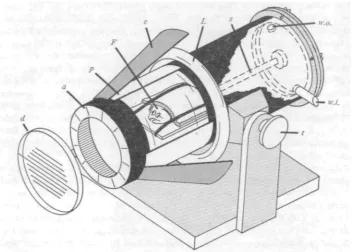
Fig. i. Tank for testing ocular compensation to lateral tilt. Flatfish (F) with eye pointers is held down on tilting platform, rotated on shaft (s) through a removable back plate. Circular fluorescent lamp (Z.) provides illumination reflected into clear section of tank by cone (c), diffused by translucent paper cylinder (p). Angles read to i° by aligning scribed acetate disc (d) with degree markings on annulus (a) fixed to front of tank. Tank can be clamped horizontally or vertically around transverse axle (t). Water inlet (to.J.) and outlet (to.o.) allow circulation.
loop inside the mouth and foam rubber pads over the body held by rubber bands, leaving the eyed-side of the head completely exposed, allowing unhindered eye move-ments and respiration. After small pointers had been glued on the eyes with Eastman 910 adhesive, fresh sea water was given to the fish for 15 min or until its respiration rate was normal and vigorous, indicating complete washing out of anaesthetic. Observations were made through the front end of the filled tank with the fish on the platform inside. A revolving acetate disc with a set of scribed parallel lines could be aligned with the platform or each eye pointer, and the angle could be read off a circumferential annulus marked in degrees.
The fish was usually rotated clockwise, by hand, through 3600 in 300 steps; the rate of rotation for each 300 step was roughly io°/sec. After 2 min at each tilt position two measurements were made on the angle of each eye in a left-right-left-right sequence; these measurements usually agreed within 2-30. Total time for a run through the full 3600 rotation was roughly 35 min.
with its sensory macula was then removed using jeweller's forceps, and the trailing nerve was cut with iridectomy scissors. Warm saline agar (i-8% agar) was then injected into the hole with a 22 g needle and syringe; the plug congealed on contact and was retained several days. Total time from the end of a control run to the start of the post-operative run was from 1 to 2 h. Occasionally a pointer came off during the operation, but position of the pointers relative to the eyes was always noted at the start of each run, so data could be standardized for new pointers relative to the old. Means and standard deviations for the ocular compensation angle a, described below, were calculated from the raw data. Since the distribution of data for a at 900 for 18 fish of similar size showed approximate normality (plotted on normal probability paper, the cumulative distribution was nearly a straight line), 95 % confidence limits for the means were calculated for several experiments using t values (Dixon & Massey, 1969).
(4) Electrical activity of single neurones was recorded by suction electrodes on peripheral branches of the eighth nerve while the fish was held on a table which could be hand-tilted 3600 around the long axis of the fish. The table was rigidly mounted by vertical braces to a heavy steel plate. A potentiometer was mounted so that its shaft rotated with the table; amplitude change in a sine-wave input gave an output which was calibrated with tilt angle. Right-eyed flatfish up to 30 cm long were positioned on a respiration tube (gravity fed) and held by a cork pad by stiff tapes, tacked down, with a yoke holding down the mouth.
Suction electrodes in the form of fire-polished glass micropipettes with a tip dia-meter of 10-20/im (100-300 kQ resistance) gave the best single-unit approach and isolation, without clogging. The recording lead was a chloridized silver wire inside the suction electrode; the indifferent lead was a length of chloridized wire on nearby tissue; the ground lead was soldered to shielding around the suction tube. The tilting table carried the suction system, electrode micromanipulator, and pre-amplifier. Signals from the recording electrode and pre-amplifier went through a 60 Hz filter to one channel of a dual-beam oscilliscope and a tape-recorder for later analysis; the second channel monitored stimuli such as tilt.
Postural orientation in flatfish. I
495
(c)
270° 30 -i Blind, carbon
>--»~a./ B l i n d j caps
Tilt
(b) 30 -I
a* 0-«
- 3 0 J
360
[image:5.451.52.405.46.331.2]Time (min) Fig. a. Properties of ocular compensation indicating otolith organ mediation.
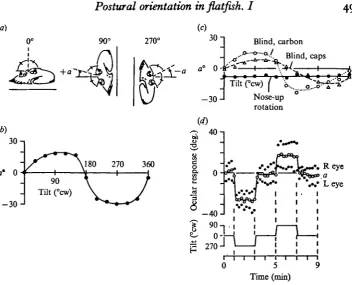
(a) Measurement of ocular compensation angle, a. The bisector of the angle between the eye pointers varies from the perpendicular by the angle a as the eyes deviate from lateral gaze.
(6) The response, a, is a function of tilt which approximates to the sinusoidal variation in gravitational shear on a plane as it is tilted from the horizontal. Rotation is clockwise; positive
a is counterclockwise, negative is clockwise from the perpendicular to the platform, relative to
the fish.
(c) Response is not a function of vision or rotation alone. Blinding with carbon black or vinyl caps does not abolish the response. Longitudinal rotation in the nose-up position does not elicit the response.
(d) For a given tilt, a is tonically maintained. Measurements from photos at 15 sec intervals
show plateau in response occurs within 30 sec of a fast 900 tilt and is maintained for 2 min.
RESULTS
1. The otoliths are necessary
Before ascribing the major role in the maintenance of normal posture of adult flat-fish to the otolith organs, the possible mediation by tactile cues, or the eyes, or the semicircular canals must be considered. Measurement of ocular compensation to lateral tilt, using a modified version of Schone's (1964) technique, allows elimination of these alternatives as of any considerable importance.
counterclockwise and positive; Fig. 2 (b) shows responses for a full clockwise rotatio^ of a fish, with maximum deviations near 900 and 2700.
Tactile cues for tilt responses would include the presence of a solid substrate on the underside of the fish, shearing force on the underside, or even gravitational stimulation of some internal stretch receptors. Adult flatfish have no swimbladder, and their specific gravity was calculated to be approximately i-6, giving such tactile cues low sensitivity. It is immediately evident that because the fish is held snugly to the pad during the tilt test, tactile stimuli to the skin are distributed nearly equally over both upper and lower surfaces, there is no shear, and suspensory play is mini-mized by compression of such a thin fish. The response is obvious in spite of these factors, and we can conclude that the flatfish probably has not developed any special tactile or proprioceptive mechanisms for detecting tilt.
One way for a flatfish to keep upright on the bottom would be to use visual cues to keep the eyes uppermost. However, vision does not appear to be necessary for ocular compensation, though vision may contribute to the response. Fig. z{c) shows that vinyl caps glued over the eyes or carbon black applied directly on the eyes lessened but did not abolish the response. An unblinded fish showed no compensation when rotated in the nose-up position (Fig. 2 c), implying that visual cues alone are probably not of major importance.
The semicircular canals may be capable of acting as an ' accelerometer with a memory' for swimming orientation (Kleerekoper et al. 1969). Three results from flatfish suggest this mechanism is not used for postural responses. First, the time course for ocular compensation to lateral tilt shows a fast rise to a plateau which is then maintain^ for more than 2 min (Fig. 2 d), a time period during which Kleerekoper et al. noticed substantial decrement. Secondly, the response is constant whether each tilt is preceded by a very fast twist clockwise or counterclockwise. If this rapid twist saturated the accelerometer mechanism briefly, acceleration would not be integrated properly to position, leaving an opposite bias for the two cases; but no such bias is evident. Thirdly, the response was already shown to be abolished during rotation while in the nose-up position, although the acceleration sensitivity of the canals would not be expected to change, unless there were some interaction between transverse tilt and rotation. These results suggest that the canals are not likely to function as ' accelerometers with a memory' to mediate gravistatic responses. The results are consistent with the simpler explanation that a tonic position-dependent mechanism regulates posture.
Postural orientation in flatfish. I 497
2. Otolith orientation is unchanged
The adoption of the adult posture is accompanied by the migration of one eye across the skull to maintain a functionally lateral gaze. One alternative for maintenance of posture is for the otolith organs also to retain their individual functions, relative to gravity, by changing their morphological orientation in the skull. However, cleared or sectioned heads of flatfish adults show that the morphological orientations of the three pairs of otoliths correspond well with that observed in standard fishes, in agree-ment with Jacob (1928). Four specimens of Citharichthys, three of Hypsopsetta and one of Girella (the standard fish) were cleared and the angles between the flattened axis of the otoliths and the dorsoventral axis of the fish were measured. In the flatfish the utricular otolith (lapillus) on each side is perpendicular, and the lagenar otolith (astericus) is parallel, to the dorso-ventral axis just as in the standard fish. Since the dorso-ventral axis of the flatfish is normally horizontal relative to gravity, the lapillus is vertical and the astericus horizontal. The flatfish saccular otolith (sagitta) on both sides lies at roughly 45 ° to the dorso-ventral axis, the two otoliths thus at 900 to each other, forming a V diverging dorsally; the sagittae of the standard fish are less diver-gent. Gross dissection of the other two flatfish species shows similar structure. In no case is there any obvious asymmetry in size or orientation between eyed-side and blind-side. Sectioning of heads shows the sensory epithelia underlying the otoliths to be slightly curved; although some curvature may result from shrinkage during fixation, it must be stressed that these estimated angles need not represent a single plane of shear for all hair cells in a given otolith organ.
The morphology of the adult form suggests that little anatomical change occurs between the larva which swims like a standard fish with its dorsal fin upright and the adult which swims on one side with its dorsal fin horizontal. I have examined trans-verse sections of both larva and adult in only one species, Paralichthys caUfornicus (Fig. 3). In the larva, as in the adult and in the standard fish, the utricular epithelium is roughly perpendicular, and the lagenar epithelium parallel, to the dorso-ventral axis. In the larva the saccular epithelium is parallel to the dorso-ventral axis; in the adult, allowing for shrinkage, the sacculi may form a slight V as seen in the cleared specimens. This material confirms that in this species there is no morphological rotation of the otolith organs to compensate functionally for the 900 change in orienta-tion of the fish after metamorphosis. There is still bilateral symmetry of the otolith organs, despite the asymmetrical adult posture.
3. The utriculus has only a minor role
Larva
Utriculus
Sacculus
Lagena
250 ftm 250/mi
Fig. 3. Unchanged otolith-organ anatomy of flatfish. Sketches of stained transverse sections show orientation of sensory epithelia in larva and adult of Paralichthys calif ormcus. All sketches anterior views with dorsal fin upward; normal posture for this adult would be with dorsal fin horizontal to its right. Note morphological similarity of larva and adult, and bilateral sym-metry. (Shrinkage has distorted one utriculus of adult.)
Postural orientation in flatfish. I
499
30-i c oi
oi
—30 -I Utricular shearOjO
Standard fish Left Normal 270° Left-eyed flatfish Nonnal Upside-down i i I I o o 90° Upside-down I A Normal Right-eyed flatfish Normal 270°i
90° I I I o Normal i I I I - A —I I
• • A
Upside-down 270° Normal
Fig. 4. Phase shift of postural response and utricular function in adult flatfish relative to standard fish. Tilt is clockwise. Solid line, standard fish (Girella), normal position with dorsal fin upward; dashed line, left-eyed flatfish (Citharichtkyt), normal with dorsal fin to its right; dotted line, right-eyed flatfish (Hyptoptetta), normal with dorsal fin to its left. Gravitational shear direction on utricular epithelium schematically shown for four quadrants (a-d) of a full rotation; R, Right edge, L, left edge of epithelium. Tilt across normal causes change in shear direction only for standard fiah (a and d), not for left-eyed (a and b) or right-eyed (c and d) flatfish utriculus.
Direct evidence for the secondary role came from extirpation experiments. Bilateral utricular removal in two Citharichthys had no effect on ocular compensation. Compared to the control of a normal second run, the post-operative curves show no reduction in amplitude and no phase shift, only a doubtful change in crossing zero that puts the crossover closer to 1800.
As seen in Fig. 4, the crossover point of a for both species of flatfish is not exactly at the inversion point of 1800, but to one side or the other, depending on whether the fish is right-eyed or left-eyed. This is not an effect of hysteresis, as in the standard fish tested. The effect of hysteresis on the same individual of Citharichthys was tested by averaging three runs made on different days, each run from 0° to 3600 clockwise and returning counterclockwise, in io° steps. Here it is clear that hysteresis effects do not push the crossover point from one side of 1800 to the other; the crossover is consistently counterclockwise from 1800 (Fig. 5 a). The difference curve (Fig. 5 A) from the responses in either direction shows a sharp peak of difference near the point ^of crossover of a. This difference might have greatest ampUtude in the middle of the
curve simply because of mechanical'play' in the system, or might result from neura| mechanisms which enhance the difference between normal and inversion and so increase the accuracy of responses near the normal. These alternatives were tested by performing the same type of clockwise and counterclockwise rotations, again with the same individual used above, but starting and ending upside-down, at 1800, putting the normal position, o°, in the middle of the curve (Fig. 5 c). Hysteresis here is not nearly as evident as in Fig. 5 (a) and the difference curve (Fig. 5 d) is nearly flat at zero. The end-points of the curve, unlike the end-points of Fig. 5 (a), are separated from each other by several degrees. These results, repeated with other individuals, indicate that the accuracy and reproducibility of the response during approach to normal from either side are greater than during approach to the upside-down position. Since it is difficult to imagine how mechanical play could be reduced at only one point during a full rotation, rather than at two points 1800 apart, the neural enhancement alternative is favoured. This enhancement could result from specialization of utricular receptors for responding only near the normal, as is the case in the normally vertical lagena of the ray (Lowenstein & Roberts, 1949).
4. The sacculus is necessary
Removal of the utriculus demonstrated that the remaining otoliths are sufficient to mediate the ocular compensation response. The following experiment on Citharichthys tested whether the sacculus and lagena are necessary as well as sufficient. Un-fortunately it proved impossible to separate the sacculus from the lagena surgically without obvious damage to both; in these experiments the sacculus-lagena is con-sidered a single organ.
To avoid effects of central adjustments with time to unilateral impairments, bilateral removal of the sacculus-lagena was carried out in a single period of anaes-thesia. This is a severe operation, and only one of four fish used appeared in good condition during and after the test. Bilateral removal of the sacculus-lagena has very different effects from bilateral removal of the utriculus in a fish of similar size (Fig. 6). The utricular operation, despite the substantial local interference near neighbouring otolith organs, hardly changed the response curve (Fig. 66), so the extreme changes following the sacculus-lagena removal (Fig. 6 a) are not operative artifacts. Bilateral loss of sacculus-lagena changes the ocular compensation curve by drastically reducing amplitude and shifting clockwise both the normal null and upside-down null. The post-operative curve shows minimum slopes at o° and 1800; it is not clear whether this curve approximates to a cosine curve, corresponding to the gravitational shear change on the normally vertical utriculi, which remained.
Postural orientation in flatfish. I
Hysteresis 40 -\ ^ = i 360°
°o <H
(6) Difference
0° ^ = ^ 3 6 0 ° 40
0
-- 2 0 J
180 270 360
(c) Hysteresis 40 -| 180° ^ = ^ 1 8 0 °
Tilt (°cw) 1
270
- 4 0
! 5
j
5«J* /
h
(d) Difference 40 -]
180° = i 180°
270
_2 0
360 90 180
Tilt (deg.)
Fig. 5. Hysteresis, and accuracy of normal null position. Means and 95 % confidence intervals,
N = 3; all data from one individual (Citharichthyt). {a) Full rotation, normal to normal
position. • , Clockwise rotation; O, counterclockwise. (4) Differences in a, clockwise minus counterclockwise, from paired values. Note significant difference near upside-down position, (c) Full rotation, upside-down to upside-down position. 0 , Clockwise rotation; O, counter-clockwise, (d) Differences in a, clockwise minus countercounter-clockwise, from paired values. Note insignificant difference throughout rotation.
•in
(a) Sacculus-lagena \ bilateral loss
a" 0
Control
1-01
a
8
3 o
o OO
f i i
< « M
(ft) Utriculus bilateral los?
- 3 0
10-l
! 11
Fig. 6. Necessity for the sacculus-lagena. Each curve from one fish (Citharichtkys). Pre-operative (—) and post-Pre-operative (—) ratios of post- to pre-Pre-operative peak-to-peak amplitude, slope at o°, and slope at 1800. (a) Sacculus-lagena bilateral loss; ratios show drastic reduction, (ft) Utriculus bilateral loss; ratios show no reduction.lagena. In terms of directional sensitivity, phase and amplitude, then, the sacculus-lagena is both necessary and sufficient for ocular compensation responses to lateral tilt; it can be considered the dominant postural organ, and the utriculus secondary.
5. Saccuhs function is bilaterally symmetrical
In a standard bilaterally symmetrical vertebrate the otoliths of the two sides exert an effect which is arithmetically summed in producing postural responses to tilt (von Hoist, 1950). The desired posture is that of equal stimulation to both sides in the normal position. Since a flatfish lies on one side, asymmetrically, the otoliths of the two sides lie one under the other, stimulated asymetrically by gravity in the normal position; this asymmetry might be expected to correlate with asymmetrical contribution of the bilateral otolith organs to lateral tilt responses. The following experiments on Citharichthys tested whether the eyed-side otoliths (sacculus-lagena) make a substantially different contribution from those of the blind-side on the amplitude and phase of the ocular compensation curve. Five fish, 9-12 cm long, were used for each operation.
Eyedside loss 30
-o° 0
- 3 0J
Blind-side loss 30 -i
<f 0 *
Postural orientation in flatfish. I
Control
Control
503
1-0-1
8 o o
h 2
5 .2 C/5 C/3
1-0-1
a
8
I
II
.2
[image:13.451.38.418.40.353.2]C/3
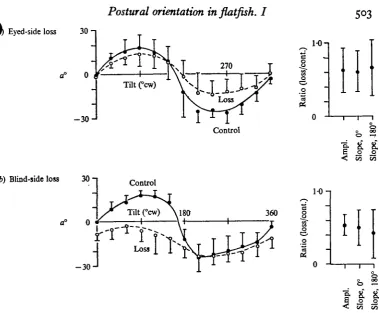
Fig. 7. Bilaterally symmetrical contribution of sacculi to a. Means and 95 % confidence inter-vals, N = s (Citharichthyi) for each curve. Pre-operative (—) and post-operative (—) ratios of post- to pre-operative peak-to-peak amplitude, slope at o", and slope at 180° from paired values for each fiah. (a) Left (eyed) side loss; curve offset counterclockwise, ratios reduced approximately by half. (b) Right (blind) side loss; curve offset clockwise, ratios reduced approximately by half.
on either side the total amplitude is roughly halved, as are the slopes measured across both the normal and upside-down position. There is a clear clockwise bias for the null points of the curve after the blind-side operation; a bias is not so evident after the eyed-side operation. However, using the values of a at the upside-down position as an index, a is shifted io° counterclockwise after the eyed-side operation and shifted 6° clockwise after the blind-side operation. Since the eyed-side is counter-clockwise to the dorsoventral axis of a left-eyed flatfish, these results indicate a bias toward the side of the lesion, as in other vertebrates (Lowenstein, 1971).
5°4
(a) Left and right contribution
Left-side otolith loss
30-Right-side otolith loss 3 0 - |
- 3 0 J
(A) Change after loss
Left-side otolith loss
30-- 3 0
30-Aa°,
Right-side otolith loss
- 3 0
Fig. 8. Bilaterally symmetrical contribution of individual eyes and sacculi to total response. Means and 95 % confidence intervals, N = 5 (Citharichtkys) for each curve. Pre-operative (—) and post-operative (—) differences from paired values for each fish. Deviation of eye from lateral gaze given by a^, left eye; aB, right eye; positive is counterclockwise, (a) Left and right contribution of otoliths and eyes. Compensation of left eye and right eye are both affected by loss of either left-side or right-side otoliths; response curves parallel those seen for total ocular compensation (a) in Fig. 7. (6) Change in compensation after otolith loss shows left eye differences (A^L) after left-side loss mirror right eye differences (A<*B) after right-side loss.
post-operative curve show clockwise bias to those normally counterclockwise re-sponses, and the converse applies to the left-side operation.
Postural orientation in flatfish. I 505
^receive equal influence from the organs of both sides, the contribution of a given side to the movements of the two eyes is bilaterally symmetrical to the contribution of the opposite side.6. Each sacculus has a null point at non-zero shear
The curves of Fig. 7 show that unilateral removal of the sacculus-lagena produced no phase change; the amplitude peaks remained near 900 and 2700. If the flatfish determined the null position by cancellation of equal but opposite shear stimuli to the bilateral saccular epithelia, then elimination of one side should have produced a phase shift of 45°, the normal angle of each sacculus with the horizontal. The new null would occur only with zero shear on the remaining epithelium, which would require the 450 tilt to level it. Since no phase shift occurs after either eyed-side or blind-side operations, the flatfish must have a ' set point1 for each sacculus for the null, and this set point is not the position of zero shear.
7. Primary afferent types are similar to those in other vertebrates
The alteration of posture from larval to adult flatfish could involve peripheral or central changes in the nervous system. If there were a change in peripheral function, which during development altered the response properties of primary afferent neurons, then a central process would not be necessary. Conversely, if no peripheral change occurred, a central change would be required. Recordings of gravistatic responses of single neurons in the vestibular nerve made it possible to investigate these alternatives. Responses of primary vestibular gravistatic neurones have been described for only a few vertebrates, but some generalizations can be made and simple criteria used for classification. Fibres from the utriculus are in the anterior branch of the peripheral nerve, fibres from the sacculus-lagena in the posterior branch. Usually a spontaneous discharge rate is modulated in frequency by tilt, and the rate at a given tilt may depend on the history of recent activity. Two basic dichotomies involve tonic or phasic and regular or irregular properties. Further division can be based on directional sensitivity; one unit may increase rate when tilted in one direction, another may decrease rate when tilted in that direction, and another may change rate symmetrically when tilted to either side (see Fujita, Rosenberg & Segundo, 1968).
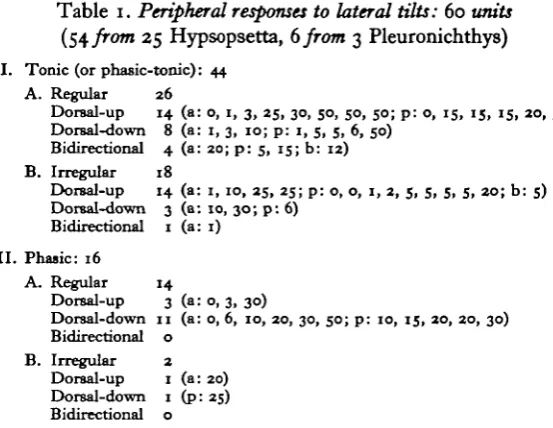
After eliminating all responses in which amplitude changed by more than a factor of two (because apparent responses to tilt in those cases might be spurious effects of pressure) and similarly eliminating units which showed a steady decline with time (suggesting possible injury), the responses of 60 single units in the peripheral branches of nerve VIII of adult pleuronectid flatfish were classified by the above criteria as shown in Table 1. Examples of the three basic classes of directional responses listed in the table are shown in Fig. 9.
Table i. Peripheral responses to lateral tilts: 60 units (54 from 25 Hypsopsetta, 6 from 3 Pleuronichthys)
I. Tonic (or phasic-tonic) A. Regular 26
Dorsal-up 14 (a Dorsal-down 8 (a Bidirectional 4 (a B. Irregular 18
Dorsal-up 14 (a Dorsal-down 3 (a Bidirectional 1 (a II. Phasic: 16
44
o» 1. 3. 25. 3°. S°. SO, 5°; p: o, 15, 15, 15, 20, 50) 1, 3, 10; p: 1, 5, 5. 6, 50)
20; p : s. i s ; b: 12)
i, 10, 25, 25; p: o, o, 1, 2, 5, s, 5, 5, 20; b: 5) io, 30; p : 6)
1)
A. Regular 14
Dorsal-up 3 (a: o, 3, 30)
Dorsal-down 11 (a: o, 6, 10, 20, 30, 50; p: 10, 15, 20, 20, 30)
Bidirectional o B. Irregular 2
Dorsal-up 1 (a: 20) Dorsal-down 1 (p: 25) Bidirectional o
Tonic units maintained a new discharge rate for more than 1 min after change in tilt. Regular units showed interspike interval variation of less than 50%. Dorsal-up, dorsal-down and bidirectional refer to sense of tilt required to cause increase in rate of unit. Nerve branch given by anterior (a), posterior (p) and base (b). Discharge rate (spikes/sec) in the normal position is given for all units after notation of their location. Number of observed units in each major category includes all those of lower categories.
initial rates in the normal position indicates there is no obvious correlation of func-tional types with rate of discharge. Similarly, the possibility of funcfunc-tional division of individual end-organs into exclusive response types is eliminated by the lack of obvious correlation between the branch recorded from (anterior or posterior) and the type of response. In summary, the basic properties of spontaneous discharge and 'multi-valuedness', as well as the overlap of functional types of response in the different otolith organs, are similar in flatfish and other vertebrates.
While the gravistatic function is generally associated with maintained discharges which differ when held at different tilts, purely phasic units have been reported in the ray (Lowenstein & Roberts, 1949). Table 1 shows that roughly 25% of the flatfish units analysed show phasic tilt responses, and some evidence argues against these being semicircular canal responses or vibration artifacts during acceleration. First, the integrity of the canals was destroyed during the surgery; secondly, at least a few of these units are also sensitive to vibration, unlike the canal units, and the phasic response during tilt is unlike the 'bursty' vibration responses. These phasic units differ from those in the ray in that these do not decrease activity on any direction of tilt to a new position, but are directionally dependent for increase and decrease. This type of phasic activity is similar to that sometimes seen in association with tonic activity in a single unit (Vidal et al. 1971).
Postural orientation in flatfish. I
5°7
(a) Dorsal-down unit
6 0T
Dorsal-up unit 30 T
(c) Bidirectional unit
20 -r
1 0 - •
60
Tilt (deg.),
dorsal-up-0 Tilt (deg.)
60
Fig. o.. Three basic tilt dependencies of peripheral afferent single units in the vestibular nerve of flatfish (Hyptopsetta). Rate in average spikes per second for 5 sec epochs after 1 min in position. Starting-rate indicated by open circle, arrows indicate order of following points.
(a) Dorsal-down unit, decreases rate when dorsal fin is tilted toward vertical. (6) Dorsal-up
unit, increases rate with dorsal-up tiltB. (<;) Bidirectional unit, increases rate when tilted to either side of normal. Note wide range of activity rates, and multivalued rate for a given tilt in (a) and (b).
less than 2/1. Such directional preference is common in other vertebrates also (Fujita
et al. 1968). Comparison of the tonic with the phasic units shows another interesting
difference in the ratio of dorsal-up to dorsal-down increase; for the tonic units it is 28/11, or almost 3/1, while for the phasic it is 4/12 or 1/3. Finally, some of the tonic units, but none of the phasic units, are bidirectional, changing rate symmetrically across the normal.
There results show some differences from those reported for other vertebrates, but these differences seem slight relative to the basic similarities; no activity seen suggests a peripheral adjustment for establishment of the new normal adult position of flatfish.
8. ' Set point' peripheral units are not found
degrees to either side; in the frog these responded only when tilted from a non-leve| position into the normal level position.
Since the activity of such units is characteristic near the normal, one hypothesis for changing of posture in flatfish is that similar units might set the new reference point, with peak rates only in the new normal adult position. The expected location for such units in the flatfish would be the vertical accessory otolith, the utriculus, since in the ray they occur in the vertical accessory otolith, the lagena. The hypothesis of the occurrence of such peripheral units was considered testable since of ioo analysed units in the ray, 34, all from the lagena, were of the ' into-level' type. If a similar proportion were found in the flatfish, concentrated in the utriculus, a strong case could be made for the peripheral change in function.
The data in Table 1, on the contrary, serve to reject this possibility. Of the 60 units, only five show bidirectional symmetry across the normal. These units, in addition, are clearly not of the 'into-level' type, but instead have a normal resting rate which increases only slightly on tilt to either side (see Fig. gc); this activity is very different from the steep rise from silence on approach to normal in the ray and frog units. None of these 60 units, phasic or tonic, from any branch of the nerve shows the type of distinctive activity which might characterize 'into-leveP receptors. The conclusion from these data is that flatfish do not have a peripheral mechanism for adjusting a null reference, as a 'set point' for calibration of the multivalued and double-valued directionally sensitive units. If such units are present, they must be either finer fibre types than those units found or else they must be unusually distributed in the branches of the nerve.
9. Brainstem units have the same properties as peripheral units
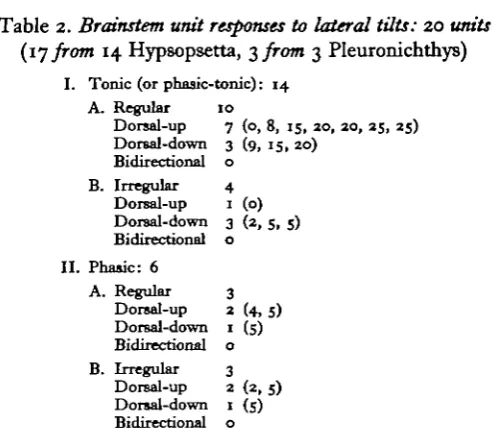
Since no distinctive peripheral units are present to account for the re-setting of adult postural reflexes, the next step centrally where such change might occur is at the level of the vestibular nuclei, the second-order sensory neurones in the pathway. A simple adjustment of the electrode mount allowed use of extracellular recording by sharpened steel needle electrodes (electrolytically sharpened insect pins, insulated to the tip with Insl-X polymer). The approach to the brainstem was also from 450 laterally, penetrating in a region at the level of the eighth nerve and just dorsal to its entry below the cerebellum. No histological examination was made to establish recording sites, but the clear large single-unit spikes contrasted greatly with the 'hashy' recordings of these rather-low-resistance (100-500 kfl) electrodes when in fibre tracts of the brainstem. This property suggests that the recorded tilt responses were from the large neurones of the vestibular nuclei and not from the primary afferent fibres. Possible artificial responses were eliminated as for the primary records; 20 remaining units are classified in Table 2.
Postural orientation in flatfish. I 509
Table 2. Brainstem unit responses to lateral tilts: 20 units (17 from 14 Hypsopsetta, ^from 3 Pleuronichthys)
I. Tonic (or phasic-tonic): A. B. Regular Dorsal-up Dorsal-down Bidirectional Irregular Dorsal-up Dorsal-down Bidirectional
[I. Phasic: 6 A. B. Regular Dorsal-up Dorsal-down Bidirectional Irregular Dorsal-up Dorsal-down Bidirectional IO 7 3 o 4 i 3 o 3 2 I O 3 2 I O (o, (9, (o) ( 2 ,
(4, (5)
( 2 , (5)
' 4
8, is, 20, 20, 25, 25) 15, 20)
5 , 5 )
5)
5)
Notation as in Table I, except for location. Discharge rate (spikes/sec) instead follows number of units in a given category.
regular and increase rate on dorsal-up tilts. As before, no novel units are present and distinctive 'set point* activity is missing.
The conclusion is that the tilt responses of neurones in the medulla of flatfish are similar to those of the peripheral primary afferents. The combined data from both populations suggest that neither novel signalling mechanisms nor conventional' into-level' specialized receptors are used by flatfish in establishing the new normal position. io. The sacculus has a different 'weighted' value from the utriculus
Single otolith organs frequently are physiologically capable of responding to tilts in many directions, and theoretically, acting alone, could account for all the postural responses (see Lowenstein, 1971). Since there are many reports that removal of certain otoliths results in extreme postural impairments while removal of others has little effect, postural inputs from the different otolith organs must be evaluated centrally by a mechanism which attaches 'weighted' importance to the signals from some end-organs different from the signals from others. In flatfish, again, the alter-native of a peripheral mechanism must be excluded before a central mechanism is determined to be necessary.
Two lines of evidence point to central weighting in flatfish. First, as described earlier in the ocular compensation experiments, the sacculus-lagena is necessary and nearly sufficient to mediate the response to lateral tilt, and thus has a greater be-havioural importance than the utriculus. Since the unit activity shows that afferents from both organs signal changes of tilt equally well, this difference in importance does not result from differing peripheral capabilities, but must have a central cause in which input from the sacculus-lagena has greater significance than the similar input from the utriculus.
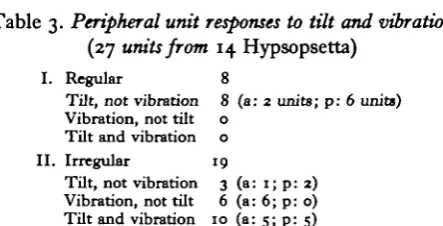
Table 3. Peripheral unit responses to tilt and vibration (27 units from 14 Hypsopsetta)
I. Regular
Tilt, not vibration Vibration, not tilt Tilt and vibration II. Irregular
Tilt, not vibration Vibration, not tilt Tilt and vibration
8
8
o o
19
3
6 1 0
(a: 2
(a: 1 (a: 6 (a: 5
units; p: 6 units)
;p:z) ; p : o )
; p : s )
Vibration stimulus a light tap to the cork pad. Regularity given as in Table i. Nerve branch indicated as in Table i, followed by number of units of given property found in that branch.
mechanism, dependent on the volume of input from each organ. Naturally, the more an organ is specialized for one type of response, the fewer neurones remain for other responses. In many fishes, for example, certain otolith organs are specialized for vibration alone, or share both vibration and tilt sensitivity, separated in different regions of the sensory macula (Lowenstein, 1971). Flatfish similarly might have receptors in some maculae specialized for perception of vibration rather than tilt, decreasing the central representation for tilt from those organs.
In the flatfish (Hypsopsetta) 27 peripheral units were tested for responses to both tilt and vibration. If the observed distribution of responses in the anterior and posterior branches were nearly equal, then a simple summating central process would require a greatly different total neuronal population in the two branches to account for the great difference in value between utriculus and sacculus. If one branch showed a markedly greater vibration-sensitive population than the other, specialization of that organ for vibration would be suggested, with concomitant reduction in its central representation for tilt response. Table 3 shows the division of regular and irregular units into those responding to one, or the other, or both modalities of tilt and vibra-tion. Responses to tilt alone are found in both branches and are from all of the regular units tested, but from only a few of the irregular units. Responses to both tilt and vibration are found in both branches, and are from a majority of the irregular units. Responses to vibration alone are found only in the anterior branch, from irregular units. The sample here is obviously too small to make any broad generalizations, and electrode limitations made statistical analysis unwarranted. It seems that the anterior branch, from the utriculus, might contain relatively more units exclusively sensitive to vibration, while the posterior branch from the sacculus-lagena might contain relatively more units exclusively sensitive to tilt. It is more apparent that the division of tilt and vibration sensitivity parallels the division of regular and irregular rate, respectively.
Postural orientation in flatfish. I
(a) Year-class I 30
a0 0
360
. fUt (°cw)
(6) Year-class U
- 3 0
"-30
a" 0
180. 360
1-6'
1-4
Tilt
l>i-*^
•3
(c) Year-class i n
1-2
o° 0
-30 u
i/i II/I m/i
Year-class
[image:21.451.43.404.42.329.2](d) Relative change
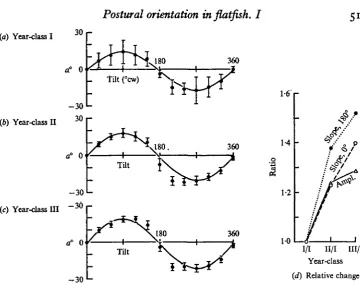
Fig. 10. Change in ocular compensation with age. Means and 95 % confidence intervals for curves from Citharichtkys of three year-classes, with each run on a different individual; (a) N = 4, (b) N = 18, (c) N = 18. Solid line is a sine curve of same peak-to-peak amplitude and offset as means for that group. Ratios of peak-to-peak amplitude, slope at o°, and slope at 1800 are for each year-class relative to year-class I. (a) Year-class I; no significant difference from sine curve. (4) Year-class II; significantly increased amplitude from 1800 to 270° clock-wise, (c) Year-class III; significantly increased amplitude on both aides of 180°. (d) Ratios; increase of slopes at o° and 1800 with increasing age is relatively greater than increase in peak-to-peak amplitudes, indicating change in the shapes of the curves.
11. Changes in postural response also occur in adult life
Central plasticity which allows long-term changes in postural orientation may be kept throughout life. Braemer & Braemer (1958) noted a difference between older and younger fish in the resting attitude of the freshwater tailstander, Poecilobrycon
eques, although the otolith orientation was unchanged, suggesting a central process.
The presence of such long-term changes in the flatfish adult, without change in otolith orientation, would provide evidence for a central rather than peripheral mechanism for change in posture.
amplitude. Similarly the increased clockwise peak magnitude probably results fromf the greater freedom of the forehead eye to look down (clockwise) over the edge of the body, rather than the more limited downward (counterclockwise) freedom of the cheek eye.
While these factors might change both magnitude and midpoint of the compensa-tion curves, inspeccompensa-tion shows that the three curves are progressively worse in fit to a sine curve of the same amplitude and offset as each. In the first-year fish (a) the observed means for tilts between 900 and 2700 are greater in amplitude than the values for the sine curve; by the second year (b) this difference is statistically sig-nificant for tilts from 180 to 2700, and by the third year (c) is significant on both sides of 1800. The increasing difference from the sine curve suggests that the curves change relative to each other as well.
For a family of curves of a function, changing values of the constants changes both amplitude and slope in direct proportion. If the ocular compensation curves for each age-group represent the same function varying only in amplitude, then simple changes in proportionality should make them congruent. However, Fig. io(d) shows that the proportional increase in mean slopes, particularly at 1800, is much greater than the proportional increase in mean amplitudes. The increase in slopes without equal increase in amplitude implies a widening of the peaks, forming a plateau with steep slopes at each side, as visually evident in Fig. 10 (a-c). Although the differences in the ratios are not statistically significant enough (P > 0-05) to reject the hypothesis that the curves represent the same function, both the sign and progression of the changes are consistent with formation of a plateau.
The mean values of the compensation curves for the three year-classes thus suggest that the curves change shape with age. In addition to an amplitude increase, a plateau of nearly peak amplitude forms on each side of the upside-down position.
DISCUSSION
1. Posture is primarily regulated by the otolith organs
Flatfish seem unusually well suited to take advantage of alternatives to gravistatic sensory mechanisms for postural orientation; these alternatives include tactile, visual, and dynamic rotational senses. The adults have no swimbladder (Norman, 1934) and are frequently in contact with the bottom. The migration of the eye during meta-morphosis provides a visual means by which the eyed-side could be kept uppermost using light direction alone. The semicircular canals theoretically work equally well at all tilts, being dependent on rotational acceleration; the metamorphic postural change, which alters the plane of function of the otoliths by 900, should not affect the functional capabilities of the canals. It might be expected that flatfish would exploit these alternatives and relegate the static function of the otoliths to a secondary role.
Postural orientation in flatfish. I 513
view, seems to be based on results without adequate controls for semicircular canal capabilities. Tactile cues are apparently of no importance; the canals elicit only the expected phasic component; and at least certain light stimuli, while not ruled out as useful during the period of eye migration, are clearly neither necessary nor sufficient for the maintenance of adult posture. Postural orientation in flatfish thus involves the phylogenetically ancient gravistatic receptor mechanism. As with many swimming and flying animals, the force of gravity provides an orientation cue which is always present, while directional light or substrate may be lacking. Gravistatic sense is apparently so valuable to the flatfish that the adult, despite the changes required for determining the new posture, has not transferred postural control to other sensory systems.
2. OtoUth orientation determines otolith function
The sensory receptor mechanism of the otolith organs gives prime importance to the orientation of the epithelium with respect to the force acting on it. Deflexion of the cilia of the sensory receptors by tangential movement of the overlying otolith mass causes either depolarization or hyperpolarization of the sensory cell, depending on whether the deflection is toward or away from the kinocilium (Flock & Wersall, 1963; Lowenstein, Osborne & Wersall, 1964). This property provides a mechanism for the earlier behavioural and anatomical demonstrations that shear force, not pressure, is the naturally occurring adequate stimulus for the receptors (von Hoist, 1950; de Vries, 1950; Trincker, 1961). Since shear on the cilia of the individual cells is important, the orientation of populations of these cells is important. One of the peripheral solutions to problems arising from the alteration of posture during meta-morphosis would be for the otolith organs to rotate within the skull, as the eyes do, to retain their individual functional orientation relative to gravity. The observations given here and in the literature enable us to rule out this possibility for seven species from three major flatfish families. Since the functional orientation of the organs changes, the neural activity in the new normal will be different from that in the larval normal, unless other neural changes occur.
The necessity for the sacculus, rather than utriculus, in flatfish suggests the adaptive value of a non-vertical organ as the dominant postural determiner. The general text-book view is that the vertebrate sacculus is not primarily used in static orientation responses (Gernandt, 1959; Ruch et al. 1965); in most vertebrates the horizontal utriculus has this role. The necessity for compensatory responses to tilt requires a directionally dependent sensory system, and the cilia bent by the weight of the otolith provide this directional dependence. Unless factors other than tangential shear on the hair cells are effective, a vertical epithelium does not have the capability of dis-tinguishing tilt to one side of the vertical from tilt to the other, since only magnitude of the downward shear would change but not direction. In contrast, a uniformly horizontal epithelium is subject to a 1800 change in shear direction between even very small tilts to one side or the other, providing the necessary directional stimulus. The closer the epithelium is to horizontal in the normal position of the animal, the closer the shear stimulus to that epithelium will reflect the gravitational force vector pulling the whole animal off the normal equilibrium position.
1971), the success of von Hoist's (1950) analysis with the assumption of the utricula4 macula as a level plane suggests that any effects of curvature are centrally corrected. Naturally the less the curvature over the whole macula, the more uniform will be the shear to all the sensory cells at a given tilt. Directionally dependent tonic units are present in the utricular branch of the nerve in flatfish, but many of these reach a minimum or maximum within several degrees of the normal. This activity shows that the utricular macula is either curved or is not vertical in the normal position, but it is not far off the vertical. The clear behavioural requirement for the sacculus implies that the utricular directional sensitivity is far lower than the directional sensitivity of a more horizontal organ.
In the case of adult flatfish, then, the general vertebrate dependence on the utriculus appears to have been abandoned in favour of the sacculus. This change provides the common denominator of physiologically uniform dependence on an otolith with non-vertical normal orientation.
3. Null response in flatfish depends on a central 'set point'
Each individual sacculus, although lying at non-zero shear in the normal position, has the capability of producing the null response, since the unilaterally operated fish show no phase-shift in the response curve. This unusual property of determining the normal position with non-zero shear to the responsible otolith organs is shared only by certain freshwater 'headstander' fish (Braemer & Braemer, 1958), which utilize non-level utriculi to determine normal position around the transverse axis. The flatfish instead utilizes non-level sacculi to determine normal position around the longitudinal axis. However, in the 'headstander' the utriculi are parallel to each other, and subject to bilaterally equal non-zero shear; in the flatfish the sacculi are divergent and subject to opposite shear directions with the fish in the normal position.
Postural orientation in flatfish. I 515
f A second hypothesis for peripheral mechanism to determine the flatfish normal
involves the specialization of certain neural types to produce a distinctive signal only in or near the normal position, which thus serve as references against which more gradually changing units could be calibrated centrally. Such peripheral units have been found in the ray (Lowenstein & Roberts, 1949) and the frog (Ross, 1936). These 'into-level' receptors seem to be associated with the vertical lagena, which has been shown behaviourally to have a stabilizing role in tilt responses near the normal position in the frog (MacNaughtan & McNally, 1946). The flatfish hysteresis curves suggest that they have some mechanism for improving the accuracy of responses near the normal; and while the flatfish lagena has been reported to have a negligible postural function based on extirpation studies (Schone, 1964), my behavioural data suggest that the utriculus might affect responses only near the normal and upside-down positions. Although directionally dependent responses are not expected from a ver-tical epithelium because shear direction does not change, bidirectional responses can be advantageous on signalling approach to the normal from either side. If the flatfish utriculus utilizes this property of the lagena in other vertebrates, just as the sacculus has replaced the function of the utriculus because of orientational change, then again the phylogenetic continuity would have been broken by physiological require-ments.
It is surprising that the physiological recordings showed no units of the 'into-level' type in either branch of the nerve. In addition to the reports on the peripheral fibres of the ray and the frog, in which such units were a large proportion of all those sampled, similar types of activity also have been reported from neurones in the vestibular nuclei of other teleosts (Schoen, 1957). In flatfish none of the 60 peripheral and 20 central units showed such a response. Their absence in the peripheral sample could have resulted from electrode characteristics, since a 20 /tm suction electrode might record only from larger fibres. (One count from serial sections of a Pleuronichthys brain gave only 97 fibres of more than 5 /tm diameter in the vestibular nerve at its entry to the medulla, and there were obviously many times that number of finer fibres.) However, the types found are similar to the types and diversity reported by these other authors. Unless one rather limited size class of vestibular fibres has a remarkably wide range of functions, it seems improbable that my records would selectively miss the ' into-level' types if they were present. One other possible expla-nation for the lack of these units is that they function only in the former larval normal position with the dorsal fin upward, as in other fishes; in the flatfish adult, detecting this functional property would require tilting the fish by 900. Since none of the units examined showed similarities to 'into-level' types even around the dorsal-up position, this alternative is also doubtful.
As stated in the results, the conclusion based on these data must be that there are no peripheral neuronal properties which provide a reference set point for the new adult normal posture of flatfish. The hypothesis that the utriculus can act by the same physiological mechanism as the lagena of other vertebrates must be rejected, although it may have the same behavioural function of stabilizing the normal position. It seems unusual that such a potentially useful neural mechanism would be lost, but it may be that the restriction of these units to the lagena in other vertebrates, coupled with the change in lagenar functional orientation, has precluded the usefulness of such units
in flatfish. Mammals have no lagena, but still have well-developed vestibular function! Some reports on mammals list bidirectionally increasing or decreasing units which may be of the' into-level' type, although recorded in the vestibular nuclei (Duensing & Schaefer, 1959; Peterson, 1967); instead, recordings from primary neurones have consistently shown a dominant directional and not a bidirectional response (Adrian, 1943; Beerens, 1969; Giesen & Klinke, 1969; Vidal et al. 1971). Such 'into-level' peripheral receptors would not be necessary if a central 'pattern recognition' were used. As pointed out by Cohen (i960) for crustaceans and Wolff (1970) for gastropods, a multiplicity of inputs, either tonic or phasic, all with a different angle for peak response can lead to a highly accurate determination of a given tilt angle precisely because of the unique combination of inputs at a given tilt. In flatfish the angled orientation of the sacculi allows shear stimuli to be different between upside-down and rightside-up, unlike the double-valued stimulus on parallel otolith epithelia. This property also would contribute to the unique bilateral input pattern for all tilts.
4. Postural alteration involves central mechanisms
In contrast to the evidence against a peripheral change in flatfish otolith-organ function, certain results suggest central alternatives which could determine adult posture. These include the recognition of input pattern just discussed, a weighted central importance for different otolith organs and some central plasticity shown by increased ocular compensation with age.
The behavioural results showed the nearly complete dependence on the sacculus-lagena, but the physiological results showed neuronal responses which were capable of signalling maintained tilt in both branches of the nerve. This capability of all otolith organs to respond physiologically to tilt is well known, as discussed above. In other vertebrates the postural role of the utriculus and the semicircular canals has provided physiological justification for functionally distinguishing the anatomical pars superior (utriculus and canals) from the pars inferior (sacculus and lagena) which are often used for vibration detection (Lowenstein, 1971). The results on flatfish weaken that justification and demonstrate the remarkable capability which the func-tional overlap provides. The difference between the physiological and behavioural capability of the different end-organs means there must be a difference in the central value of the information received from them. Furthermore, since there was little change in the physiological capability between peripheral units of flatfish and standard fish, the change in otolith dominance must be central.
Postural orientation in flatfish. I 517
Jment of changing connexions from sensory inputs to the relevant compensatory outputs.
A change in these central connexions would be a more complex process. Neural development often involves increasing the ramifications and connexions of neurones, so it is plausible to consider the replacement, during metamorphosis, of many of the central connexions of utricular neurones by saccular neurones. The supporting evi-dence for this possibility is the marked similarity of several details of the saccular dependence in flatfish compared to the utricular dependence of standard vertebrates. The unequal but symmetrical influence on the eyes, the deviation of the apparent vertical toward the side of a unilateral lesion, and the basic shape of the curve for a 3600 roll are all properties expected from utricular mediation in standard fish (von Hoist, 1950). Though the central connexions of the vestibular system in mammals have been extensively investigated physiologically and anatomically (Carpenter, 1967) there is little knowledge of the comparable pathways in fishes. To demon-strate or eliminate a possible synaptic reorganization of the vestibular nuclei in flatfish would require a detailed anatomical study of both larvae and adults, and a comparative study with standard fish. From a developmental standpoint such a study might provide useful results on the specificity of neural connexions (see Gaze et al. 1970).
The concept of central plasticity can include more subtle changes such as those involved in learning. The metamorphic period for a flatfish is usually a few weeks long, but the period from the time the eyes are still on opposite sides of the dorsal ridge until the eye migration is completed and buttom life begins can be as short as three days (Williams, 1902). This change from vertical to horizontal posture is reminiscent of other rapid neural developments, such as development of visual capa-bilities, which have a critical period for the proper functional connexions to be made (Jacobson, 1970). However, the critical period in vision involves a change from a non-specified to a restricted distribution of connexions, and not a change from one equivalent state to another, as implied by postural alteration. Vestibular function is usually well developed at birth, and usually not considered to have a plastic capability for such a drastic readjustment of posture. Even flatfish adults of different ages show an apparent change in the shape of the compensation curve. Although this minor change is not as great as the central compensation to unilateral loss (von Hoist, 1950; Kolb, 1955; McCabe & Ryu, 1969), it appears naturally and not as a result of a lesion. It is interesting that the oldest individuals have the same kind of plateau on each side of the upside-down position as seen in standard fish (see the Girella curve of Fig. 4; also Benjamins, 1918), while the young adults do not. These plateaus, increasing the slope of the response at the upside-down position relative to the slope at normal, can be interpreted as increasing the perceived difference between upside-down and normal. A few degrees tilt from upside-down elicits a much greater compensation than a few degrees tilt from normal, suggesting the upside-down null is more ' unstable' than the normal null point. Whether this development is related to experi-ence is an open question.
One further level of central determination of posture, that of direct central control over sensory input, will be reported in a following paper. As mentioned earlier, vision often has an important role in postural orientation. In some flatfish the
tion of eye migration is not solely dependent on the monomorphic nature of the optic| chiasma (Hubbs & Hubbs, 1944), so visual stimuli may be important during metamorphosis.
Flatfish thus demonstrate that the vestibular system, while conservative in an evolutionary sense, does undergo both phylogenetic and developmental adaptation to alter the specific functions of the otolith organs. The adaptability seems to depend in part on the diverse capabilities of the individual organs, so that even without a change in peripheral function there can be a change in central function, shown by the change in behavioural responses. The critical experiments to clarify the nature of this central change will have to be carried out during the metamorphic period when the change actually occurs.
SUMMARY
1. Flatfish metamorphose from a larval form that swims upright like a standard fish to an adult that lies on one side, with both eyes on the upper side, having rotated posture 900 relative to gravity and the former normal posture. Adult Citharichthys
stigmaeus and Hypsopsetta guttulata were used in behavioural and physiological
experiments to determine whether the postural change is a peripheral or central phenomenon.
2. Cleared and sectioned specimens verify that the otolith organs, unlike the eyes, do not rotate within the skull, and so do not maintain the normal vertebrate orientation with respect to gravity.
3. Ocular compensation to lateral tilt shows that tactile cues, vision, and the semi-circular canals are inadequate to produce tut responses, but elimination of otolith function abolishes tilt responses. The major postural role of the otolith organs is not lost.
4. Selective removal of otoliths demonstrates that the flatfish utriculus has only a minor role in tilt responses, and that the sacculus-lagena is required, unlike the situation in other vertebrates. The details of the ocular compensation responses are similar to those of standard fishes. Each sacculus lies at an angle of up to 45 ° when in the normal position, but unilateral loss does not change the phase of the response curve, indicating that the null response is set for a non-zero value of gravitational shear, unlike the null at zero shear to the utriculus in other vertebrates.
5. Hysteresis effects suggest a differential sensitivity between tilts near the normal and the upside-down null positions. The narrowness of the effect argues against mechanical restrictions. Possibly the vertical utriculus is useful only near the normal, as an accessory organ, like the vertical lagena in other vertebrates.
6. Neural units recorded from both eighth nerve and medulla show the expected activity properties of regular and irregular rate, tonic and phasic responses to tilt, directional dependence and 'multi-valuedness', as in other vertebrates. No novel response types are found, nor any distinctive 'into-level' types described for some vertebrates. Vibration sensitivity is associated with irregular rate, and exclusively vibration-sensitive units are apparent only in the utriculus. The shift in functional relations of the otolith organs relative to gravity is not apparently compensated for by any major change in peripheral afferent gravistatic unit properties.
Postural orientation in flatfish. I 519
^ shown by limited data on ocular compensation in three year-classes of flatfish. A central change in vestibular function is suggested that might be dependent on experi-ence, as is gradual compensation to a vestibular lesion.
8. Since peripheral changes are not responsible for the postural change, alternative central mechanisms are proposed, including central weighting of input, recognition of a complex input pattern, and plasticity of connexions, all of which have received some supporting evidence from these results.
I am indebted to Professor T. H. Bullock for guidance during this work, which was done in his laboratory. I also thank Professors S. Hagiwara, H. T. Hammel, R. B. Livingston, R. H. Rosenblatt and H. O. Schwassmann for their advice and criticism. I thank D. Flaming, W. Reetz, W. Bloodworth and G. Kennedy for technical assistance; R. Kiwala for obtaining animals; and C. Platt for typing. This work was supported by an NSF Graduate Fellowship, and NSF and NIH grants to Professor Bullock.
REFERENCES
ADRIAN, E. D. (1943). Discharges from vestibular receptors in the cat. J. Pkysiol., Lond. 101, 389-407. AHLSTROM, E. H. (1939)- Vertical distribution of pelagic fish eggs and larvae off California and Baja
California. Fishery Bull. Fish Wildl. Serv. U.S. 161, 6o, 107-46.
AHBENS, W. (1950). Uber die Brauchbarkeit der Aufhellungsmethoden bei morphologischen und physiologischen Untersuchungen liber das Fischlabyrinth. Z. vergl. Pkysiol. 33, 49-59.
BEERENS, A. J. J. (1969). Recording from primary afferents in the utricular nerve in the cat. Practica
oto-rkmo-lar. 31, 122-5.
BENJAMINS, C. E. (1918). Contribution a la connaissance des reflexes toniques des muscles de l'oeil.
Archs nierl. Pkysiol. 3, 536-44.
BRAEMER, W. & BRAEMER, H. (1958). Orientation of fish to gravity. Limnol. Oceanogr. 3, 362-72. CARPENTER, M. B. (1967). Central connections of the vestibular system. Arcks Otolar. 85, 517-20. COHEN, M. J. (i960). The response patterns of single receptors in the crustacean statocyst. Proc. R.
Soc. Lond. B 153, 30-49.
DDCON, W. J. & MASSEY, F. J. Jr. (1969). Introduction to Statistical Analysis, 3rd ed. New York: McGraw-Hill.
DUENSINQ, F. & SCHAEFER, K. P. (1959). Uber die Konvergenz verschiedener labyrinthlrer Afferenzen auf einzelne Neurone des Vestibulariskerngebietes. Arch. PsycMat. NervKrankh. 199, 345-71. ENGER, P. S. (1968). Hearing in fish. In Hearing Mechanisms in Vertebrates (ed. A. V. S. de Reuck and
J. Knight), 4—17. London: Churchill.
FLOCK, A. (1964). Structure of the macula utriculi with special reference to directional interplay of sensory responses as revealed by .morphological polarization. J. Cell Biol. 33, 413-31.
FLOCK, A. & WERSALL, J. (1963). Morphological polarization and orientation of the hair cells in the labyrinth and the lateral line organ. J. Ultrastruct. Res. 8, 193-4.
FORD, R. F. (1965). Distribution, population dynamics and behavior of a Bothid flatfish, Citharichtkys
stigmaeus. Ph.D. Dissertation, University of California, San Diego.
FUJITA, Y., ROSENBERG, J. & SEGUNDO, J. P. (1968). Activity of cells in the lateral vestibular nucleus as a function of head position. J. Pkysiol., Lond. 196, 1-18.
GAZE, R. M., KEATING, M. J., SZEKELEY, G. & BEAZLEY, L. (1970). Binocular interaction in the for-mation of specific intertectal neuronal connexions. Proc. R. Soc. Lond. B 175, 107-47.
GERNANDT, B. E. (1959). Vestibular mechanisms. In Neurophysiology; vol. I, Sect. 1 of Handbook of
Physiology (ed. J. Field, H. W. Magoun and V. E. Hall), 549-64. Washington: American
Physio-logical Society.
GIESEN, M. & KLINKE, R. (1969). Die Richtcharakteristik primarer Afferenzen des Otolithenorgans bei intakter efferenter Innervation. Ada oto-lar. 67, 49-56.
GUALTIEROTTT, T. & ALLTUCKER, D. S. (1967). Prolonged recording from single vestibular units in the frog during plane and space flight, its significance and technique. Aerospace Med. 38, 513-17. HAMA, K. (1969). A study on the fine structure of the saccular macula of the gold fish. Z. Zellforsch.
mikrosk. Anat. 94, 155-71.