Text Mining in Archaeology: Extracting Information from Archaeological Reports
Julian D Richards Department of Archaeology
University of York The King’s Manor Exhibition Square
York YO1 7EP, UK [email protected]
Douglas Tudhope Hypermedia Research Unit
Faculty of Computing, Engineering and Science University of South Wales
Pontypridd CF37 1DL, Wales, UK [email protected]
Andreas Vlachidis Hypermedia Research Unit
Faculty of Computing, Engineering and Science University of South Wales
Pontypridd CF37 1DL, Wales, UK [email protected]
Introduction
Archaeologists generate large quantities of text, ranging from unpublished technical fieldwork reports (the ‘grey literature’) to synthetic journal articles. However, the indexing and analysis of these documents can be time consuming and lacks consistency when done by hand. It is also rarely integrated with the wider
archaeological information domain, with bibliographic searches having to be undertaken independently of database queries, for example. Text mining offers a means of extracting information from large volumes of text, providing researchers with an easy way of locating relevant texts and also of identifying patterns in the literature. In recent years techniques of Natural Language Processing (NLP) and its subfield, Information Extraction (IE), have been adopted to allow researchers to find, compare and analyse relevant documents, and to link them to other types of data. This chapter introduces the underpinning mathematics and provides a short presentation of the algorithms and distance measures used, from the point of view of artificial
intelligence and computational logic. It describes the different NLP schools of thought and compares the pros and cons of rule-based vs machine learning approaches to information extraction. The role of ontologies and named entity recognition will be discussed and the chapter demonstrates how IE can provide the basis for semantic annotation and how it contributes to the construction of a semantic web for archaeology. The authors have worked on a number of projects that have employed techniques from NLP and IE in
Archaeology, including Archaeotools, STAR and STELLAR. The chapter describes the archaeological user needs requirement, drawing examples from several countries, and the authors present examples drawn from their own projects, and previous work by others, of how NLP and IE can contribute to addressing this need. The problems and challenges of employing text mining in the archaeological domain are discussed, as well as the potential benefits.
Background
of fieldwork in other European countries, varying only according to the extent of the legal requirement for intervention prior to development, and whether it is undertaken as a state-led operation (as in France, Germany, Greece and Italy) or commercial enterprise (as in the UK and Netherlands). In the US, between $650M and $1B is spent annually on Cultural Resource Management, of which a large proportion is devoted to archaeology. Nearly all of this work is performed to comply with laws that require government agencies to take into account the effect of their actions on archaeological and historical resources. In the US, in the order of 50,000 field projects a year are carried out by federal agencies under these mandates, with another 50,000 federal undertakings requiring record searches or other inquiries that do not result in fieldwork. However, there is no legal requirement to publish the outcome of all this activity, either in the USA or Europe.
On both sides of the Atlantic, therefore, this activity generates vast numbers of reports that together constitute the unpublished ‘grey literature’ whose inaccessibility has long been an issue of major concern. With so much work being performed and so much data being generated, it is not surprising that
archaeologists working in the same region do not know of each others’ work, let alone archaeologists working in different continents. Decisions about whether to preserve particular sites, how many sites of specific types to excavate, and how much more work needs to be done are frequently made in an
informational vacuum. Furthermore new data is not fed into the research cycle and academic researchers may be dealing with information which is at least 10 years out-of-date. Nonetheless, the fact that such reports are not fully published should not be taken to suggest that the value of the archaeological data or
interpretation is not significant enough for publication (Falkingham 2005).
In recent years the detrimental effect of inaccessibility and difficulty of discovery of the large amounts of archaeological information represented by this material has begun to be recognised by the academic community. Bradley (2006) has questioned why it is not more widely available, and several research projects have been undertaken specifically to attempt to synthesise the outcomes of development control archaeology from the grey literature (Fulford and Holbrook 2011). Digital collection and online delivery of both newly created (i.e. ‘born digital’) and legacy material could provide a solution to addressing these access issues. However, good access is predicated on good discovery mechanisms and these rely, amongst other things, on good data about data, or metadata.
In the UK the Archaeology Data Service (ADS) actively gathers digital versions of grey literature fieldwork reports as part of the OASIS project <http://www.oasis.ac.uk/> (Hardman and Richards 2003; Richards and Hardman 2008). The ADS grey literature library currently (as of December 2013) comprises over 23,000 reports although it is increasing at the rate of 50-100 per month. In the Netherlands the Dutch e-depot for Archaeology, managed by DANS, also holds over 20,000 reports. In the UK all reports can be downloaded free of charge and there is a high level of usage. In collaboration with the British Library and Datacite each report is assigned a Digital Object Identifier, ensuring a permanent means of citation. Each of the reports also has manually generated resource discovery metadata covering such attributes as author, publisher, and temporal and geospatial coverage, adhering to the Dublin Core metadata standard <http://dublincore.org/>. Generating metadata this way may be feasible, if time-consuming, where it is created simultaneously with the report’s deposit with the ADS. It would not be a feasible means of dealing with the tens of thousands of legacy reports known to exist. For any attempt to digitise these disparate and distributed sets of records to facilitate broader access, the key in terms of both cost and time would be automated metadata generation.
Within the ADS digital library there are also electronic versions of more conventional journals and reports, including for example, all Council for British Archaeology Research Reports 1-100 <
match searches are also susceptible to large numbers of false positives, recovering ‘Barrow’ as a place name, or barrow as a wheelbarrow for instance. Several research projects are now undertaking text mining on large quantities of published text in order to identify intellectual trends (Michel et al. 2011). Furthermore, in archaeology, there is the potential to provide joined-up access to published and unpublished literature within a single interface, allowing users to cross-search both types of resource. However, indexing of journal back-runs rarely goes beyond author and title. This is generally inadequate for the scholar wishing to investigate previous research on a particular site or artefact class. Furthermore, whilst modern fieldwork reports generally provide Ordnance Survey grid references for site locations, antiquarian reports use a variety of non-standard and historic place names, making it impossible to integrate this sort of information in modern geospatial interfaces. Ideally a methodology to automatically generate metadata for grey literature should be flexible enough to be applicable to this additional dataset with the minimum of reworking.
Mathematical methods of Natural Language Processing
Statistical Information Retrieval
Information Retrieval (IR) is the activity of finding relevant information resources to satisfy specific user queries originating from generic information needs. Typical IR systems obtain relevant information resources from a collection through matching user queries to particular document abstractions, such as metadata or full-text index terms. The automatic definition of representative document abstractions
(metadata or index terms) and ranking of search results is used by many different retrieval models that have been introduced in the last decades, including the Boolean model, vector space models and probabilistic models (Baeza-Yates and Ribeiro-Neto 1999).
The Boolean model enables users to seek for information using precise semantics that are joined by the Boolean operators AND, OR, NOT. The model considers that index terms are either present or absent in the document and in this way the document is predicted to be relevant or not to the query expression. Considering a vector K ={k1...kn} as the set of all index terms and a weight wi,j>0 associated with each index term ki and document dj then an index term vector Dj is associated with the document dj by Dj = (w1,j, 2,j , .... n,j). For the Boolean model the index term weights are all binary i.e. wi,j ∈{0,1} depending if index terms are present or absent.
The vector model acknowledges the fact that binary weights are limited and does not provide a means for partial matching of user queries (Moens 2006). To overcome this, the vector model calculates the degree of similarity between document and query vector. Both document and query index terms are weighted and associated with the document and query vector respectively. The similarity between the query vector Q = (w1,q, w2,q , .... wn,q) and the document vector Dj = (w1,j, 2,j , .... n,j is based on the quantification of the cosine of the angle between those two vectors. Since wi,j≥ 0 and wi,q≥ 0 then sim(q,dj) varies from 0 to +1. An established threshold could dictate the retrieved matches based on the degree of similarity between query and document which might be equal or over a given cut-off point. In this way partial match retrieval is achieved and results can be presented in a ranked order.
The probabilistic IR model is based upon the assumption that there is an ‘ideal answer set’ which contains exactly the relevant documents for a given user query. Knowing the description and attributes of an ‘ideal answer set’ will lead us to successful retrieval results. Because these attributes are not known initially, and all that is known are index terms bearing some semantic meaning, an initial guess must be made for an initial ‘ideal answer’ to invoke the first set of results which are presented in a ranked order of probability relevance. During iterations the ‘ideal answer’ is improved and comes closer to the real description of the answer set. The probabilistic model defines a query q as a subset of index terms and R the set of documents known (or initially guessed) to be relevant. If ~R is the compliment of R and the set of non-relevant
documents, then the probability P of the document Dj being relevant to the query q is defined as P(R|Dj) (Baeza-Yates and Ribeiro-Neto 1999).
The query probability also can be expressed as a set of individual term probabilities P(q1...qn|Dj). It is very likely that the initial guess of relevant documents tends to yield zero probability and leads to no retrieved documents. The probabilistic model allows smoothing of the probabilities in order to avoid zero probability and to enable retrieval of documents that contain the query terms. Two simple assumptions enable probability smoothing by assuming that the probability of an index term Kj found within R relevant collection is a constant for all index terms typically P(kj|R) = 0.5 and that the distribution of index terms among the non-relevant documents can be approximated by the distribution of index terms among all documents in collection P(kj|~R) = ni|N. An initial guess based on the above two assumptions yields ranked results which can then be improved through an iterative process based on the assumption that the probability P(kj|R) is approximated by the distribution of this index term among retrieved documents and also considering that all non-retrieved documents are non-relevant documents.
A number of variations to these IR models aim to improve and enhance their performance. The above models operate on the assumption that index terms are mutually independent and none of them acknowledge dependencies between index terms. This may result in poor retrieval performance since relevant documents not indexed by any of the query terms are not retrieved and irrelevant documents indexed with the query terms are retrieved (Smeaton 1997). The Latent Semantic Indexing model proposes a solution to this problem by enhancing the vector based model and matching each document and query vector to a lower dimensional space of concepts enabling concept based matching.
Information Extraction
Information Extraction (IE) is a specific NLP technique defined as a text analysis task which extracts
targeted information from context (Cowie and Lehnert 1996; Gaizauskas and Wilks 1998; Moens 2006). It is a process whereby a textual input is analysed to form a textual output capable of further manipulation. Such data manipulation may then be used for automatic database population, machine translation tasks, term indexing analysis, text summary algorithms, and so on.
Information extraction systems fall into two distinct categories; Rule-Based (hand-crafted) and Machine Learning systems (Feldman et al. 2002). During the seven Machine Understanding Conferences (MUC), the involvement of rule-based information extraction systems has been influential. The issue of information systems portability quickly gained attention and during MUC-4 the Machine Learning
applications introduced a semi-automatic technique for defining information extraction patterns as a way of improving a system’s portability to new domains and scenarios (Soderland et al. 1997).
Rule-based Information Extraction Systems
Rule-based systems consist of cascaded finite state traducers that process input in successive stages. Dictated by a pattern matching mechanism, such systems are targeted at building abstractions that correspond to specific IE scenarios. Hand-crafted rules make use of domain knowledge and domain-independent linguistic syntax, in order to negotiate semantics and pragmatics in context and to extract information for a defined problem. It is reported that rule-based systems can achieve high levels of precision of between 80%-90% when identifying general purpose entities such as ‘Person’, ‘Location’, and ‘Organisation’ from financial news documents (Feldman et al. 2002; Lin 1995).
good understanding of the IE problem. For this reason rule-based systems have been criticised by some as being costly and inflexible, having limited portability and adaptability to new IE scenarios (Feldman et al. 2002). However, developers of rule-based systems claim that, depending on the IE task, the linguistic complexity can be bypassed and a small number of rules can be used to extract large sets of variant
information (Hobbs et al. 1993). An advantage of rule-based systems is that there is no need for any training set (or annotation corpus) of previously annotated documents.
Machine Learning Information Extraction Systems
The use of machine learning has been envisaged to provide a solution capable of overcoming the potential domain-dependencies of rule-based IE systems (Moens 2006; Ciravegna and Lavelli 2004). Machine Learning developed out of Artificial Intelligence research, by which algorithms are designed that enable computers to ‘adapt’ to external conditions. The term ‘learning’ obviously does not have precisely the same meaning as learning in the context of human intelligence. Learning in the Artificial Intelligence context describes the condition where a computer programme is able to alter its ‘behaviour’, that is, to alter structure, data or algorithmic behaviour in response to an input or to external information (Nilsson 2005).
Machine learning strategies can support supervised and unsupervised learning activities. The supervised learning process is based upon the provision of a training data set which is used by the machine learning process in order to deliver generalisations of the extraction rules, which are then able to perform a large scale exercise over a large corpus. The general idea of using supervised machine learning in IE systems is to use human experts to annotate a desired set of information fragments in an exercise involving a small corpus of training documents. The training set of documents is then utilised in a machine learning process for generalisation of the extraction rules, which are able to perform a large scale exercise on a large corpus. Some argue that it is easier to annotate a small corpus of training documents than to create hand-crafted extraction rules, since the latter requires programming expertise and domain knowledge (Moens 2006). On the other hand, the size of the training set may depend on the range and complexity of the desired
annotations and the characteristic language use in the domain.
During unsupervised learning, human intervention is not present and the output of the training data set is not characterised by any desired label. Instead a probabilistic clustering technique is employed to partition the training data set and to describe the output result, which the generalisation of a larger collection could expand upon (Nilsson 2005). Unsupervised IE is very challenging and so far such systems have been unable to perform at an operational level (Uren et al. 2006; Wilks and Brewster 2009).
Information Extraction Evaluation
The evaluation of IE systems was established by the Machine Understanding Conference, MUC 2. Two primary measurements adopted by the conference, Precision and Recall, originated from the domain of Information Retrieval but were adjusted for the task of IE (template filling). According to the MUC definition, when the answer key is Nkey and the system delivers Ncorrect responses correctly and Nincorrect
incorrectly then key correct
N
N
=
Recall
andincorrect correct correct
N
+
N
N
=
Precision
.The formulas examine a system’s response in terms of correct or incorrect matches. This binary approach does not provide enough flexibility to address partially correct answers. A slightly scalar approach can be adopted to incorporate the partial matches. In this case, the above formulas can be defined as
key correct
N
matches
Partial
+
N
=
Recall
(
0.5
*
_
)
,incorrect correct correct
N
+
N
matches
Partial
+
N
=
Precision
(
0.5
*
_
)
.Partial matches are weighted as ‘half’ matches. The value of the weight can change if partial matches seem more or less important.
The weighted average of Precision and Recall is reflected by a third metric, the F-measure score. When both Precision and Recall are deemed equally important then we can use the equation:
Recall
+
Precision
Recall
Precision
=
High scoring of F1 is desirable since the measure can be used to test the overall accuracy of the system (Maynard et al. 2006).
Gold Standard Measures
The Gold Standard (GS) is a test set of human annotated documents describing the desirable system outcome. Typically, a GS set is used to compare and benchmark the system results. Therefore, definition of an explicit and unambiguous GS is critical for the delivery of summative evaluation results that describe the overall system’s achievement. An erroneous GS definition could distort the results of the evaluation and lead to false conclusions.
Problematic and erroneous GS definition is addressed by enabling multiple annotations per document. The technique allows more than one person to annotate the same text in order to address
discrepancies between different annotators. To calculate the agreement level between individual annotators the technique employs the Inter Annotator Agreement (IAA) metric (Maynard et al. 2006). The metric shows the level of agreement between different manual annotation sets, either for particular entities or overall. The best IAA score is 1 or 100% which shows a total agreement between different annotators and the worst is 0 where there is absolutely no agreement.
In the MUC and ACE conferences, the GS definition was prepared by a committee. However, it is not always certain that experts fully agree on GS definitions, especially when such definitions carry fine ontological distinctions or are influenced by domain and language specific ambiguities. Manual annotation of archaeological documents is influenced by domain characteristics and embedded language ambiguities that challenge IAA scores. Such ambiguities concern the definition of domain entities; for example, the fine distinction between physical object and material entities, application of annotation boundaries and inclusion of lexical moderators. Typical IAA scores in an archaeological context range from between 60% and 80% (Byrne 2007; Vlachidis and Tudhope 2012; Zhang et al. 2010). In the case of a low IAA score a final and explicit GS set is proposed by a human ‘Super Annotator’ who acts as a referee between individual annotation sets, reviewing the cases of disagreement and choosing the correct annotation (Savary et al. 2010). Normally the Super Annotator is a field expert with the experience and knowledge to reconcile individual annotation discrepancies, although it must be remembered that there may be underlying variation in language use and terminology within a domain.
Previous work
Archaeology has excellent potential for the deployment of text mining because, despite its humanities focus, it has a relatively well-controlled vocabulary. Significant effort has been put into the development of
controlled word lists or thesauri, including the UK MIDAS data standard (English Heritage 2007; Newman and Gilman 2007). However the nature of archaeological vocabulary poses some challenges in that, unlike highly specialised scientific domains with a unique vocabulary (e.g. biological or medical terms), much archaeological terminology consists of common words in an everyday sense, for example ‘pit’, ‘well’. There is also the distinction between descriptions of the present and the archaeological past (for example, the term ‘road’ has much more significance if it is a ‘roman road’).
Within the last ten years a number of projects have attempted to deploy text mining on
archaeological texts, with a specific focus on the grey literature. Amrani et al. (2008) reported on a pilot application in a relatively specialised area of archaeology; the OpenBoek project experimented with Memory Based Learning in extracting chronological and geographical terms from Dutch archaeological texts
(Paijmans and Wubben 2008) and Byrne has also explored the application of NLP to extract event
information from archaeological texts (Byrne and Klein 2010). In the United States, Giles and his colleagues have developed Archseer, an adaptation of their successful CiteSeer system to archaeology
The Archaeotools Project
In the UK, the Archaeotools project, a collaboration between the ADS and the University of Sheffield Computer Science OAK group, funded by the AHRC-EPSRC-JISC eScience programme, provided a major opportunity to deploy text mining in Archaeology (Jeffrey et al. 2009; Richards et al. 2011).
The first objective of Archaeotools was to extract several types of information from a corpus of over 1000 unstructured archaeological grey literature reports, such that this corpus could be indexed and searched by a number of attributes, including subject, location, and period. These support the standard ‘What’, ‘Where’ and ‘When’queries that underlie a broad range of archaeological research questions. The project employed a combination of a rule-based (KE) and an Automatic Training (AT) approach. The rule-based approach was applied to information that matched simple patterns, or occurred in regular contexts, such as national grid references and bibliographies. In order to deploy the AT approach the ADS staff, all of whom are
archaeologically trained, carried out extensive annotation exercises on a subset (c.150 reports) of the grey literature corpus. The AT approach was applied to information that occurred in irregular contexts and could not be captured by simple rules, such as place names, temporal information, event dates, and subjects. In addition, both approaches were combined to identify report title, creator, publisher, publication dates and publisher contacts.
Text Mining applied to grey literature
Relatively high levels of success were achieved when the above techniques were applied to the sample of 1000 semi-structured grey literature reports. Removing files which could not be converted to machine readable documents due to file formatting issues, this left a working sample of 906 reports.
The greatest problem encountered was that of distinguishing between ‘actual’ and ‘reference’ terms. As well as the ‘actual’ place name referring to the location of the archaeological intervention, most grey literature reports also refer to comparative information from other sites, here called ‘reference’ terms. The IE software returned all place names in the document, masking the place name for the actual site amongst large numbers of other names. However this was solved by adopting the simple rule that the primary place name would appear within the ‘summary’ section of the report. If it was not possible to identify a summary then the first ten percent of the document was used instead.
Out of 1000 reports, this left 162 documents where it was not possible to identify a place name in the summary or first ten percent of the report.
No data
What 159 17.5%
Where 162 17.9%
When 263 29.0%
Table 1 ‘Actual’ identifications for 1000 grey literature reports.
However, for the documents as a whole there were only 17 where it was not possible according to the ‘What’ facet, 20 with no ‘Where’ information, and 40 where it was impossible to identify a ‘When’ term.
No data
What 17 1.9%
Where 20 2.2%
[image:7.595.51.246.654.710.2]When 40 4.4%
Table 2 ‘Reference’ identifications for 1000 grey literature reports
Text Mining applied to historic literature
Another strand of the Archaeotools project was to focus the NLP automated metadata extraction on the almost entirely unstructured digitised version of the PSAS. Going back to 1851, these extremely valuable journals are archived and disseminated by the ADS in digital form as PDF files. Despite the highly
unstructured nature of the text and the antiquated use of language we were surprised to find that once trained on the grey literature reports the IE software achieved comparable levels of success with the antiquarian literature. Problems were encountered with more synthetic papers and other types of document, but where the primary subject of the article was a fieldwork report then it was possible to identify the key ‘What’ ‘When’ and ‘Where’ index terms using the same approach as adopted with the grey literature.
After discounting prefatory papers, such as financial accounts, or election reports, the PSAS corpus was reduced to 3991 papers referring to archaeological discoveries. By applying the rule that the actual What, Where and When would appear in the first ten percent of the paper it was possible to identify a subject term for all but 277 of the papers, although there was less success with a geospatial location (627 papers with no location), and least success with period terms (2056 papers with no When term).
No data
What 277 6.9%
Where 627 15.7%
When 2056 51.5%
Table 3 ‘Actual’ identifications for 3991 PSAS papers
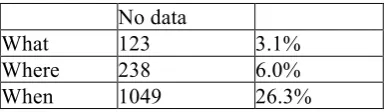
However, these results could be improved somewhat by looking at the ‘Reference’ terms; although less certain to provide the primary identification of the key What, Where and When for each paper these left far fewer papers unclassified:
No data
What 123 3.1%
Where 238 6.0%
[image:8.595.51.246.425.481.2]When 1049 26.3%
Table 4 ‘Reference’ identifications for 3991 PSAS papers
Determining place names within the County-District-Parish (CDP) place name thesaurus proved a challenge, particularly given the number of historic names used in older accounts, but the geo-gazetteer web service hosted by EDINA at the University of Edinburgh was used to resolve many of the outstanding names. Extracted place names were sent directly to this service and the GeoXwalk automatically returned NGRs for the place name (centred) or in the case of some urban areas an actual polygon definition. This allowed the relevant place name from PSAS to be mapped in the Archaeotools geo-spatial interface and therefore made them as discoverable and searchable as standard monument inventory datasets.
Of the total of 3991 PSAS papers, it was initially impossible to find an Ordnance Survey grid
reference for 3388 (85%), compared to a figure of just 185 (20%) for the grey literature. This reflects the fact that older reports did not tend to use precise geospatial references to refer to site or find locations. However, by using the GeoXwalk service it was possible to resolve a place name into a grid reference for all but 268 reports (6.7%) – for which there was no ‘Where’ term for 238 reports, leaving just 30 for which a place name had been identified that could not be geo-referenced by the EDINA web service. Manual checking revealed that the majority of these were instances where a county name was the most precise spatial location that had been used in the published paper.
article in the entire run of the PSAS available from the ADS. These represent the actual frequency of place names, period and monument types within these journals year on year, from 1851 to 1999. A superficial examination of these counts made it apparent that they detailed, metrically, what, when and where was being written about in each year and therefore, via the editorial process, what was considered significant at that time. It was clear that this could offer significant potential in the longitudinal consideration of changes in archaeological practice and thought. By looking at the changes in terms used and their relative frequencies Bateman and Jeffrey (2011) were able give a more concrete basis to the presumed biases in subject and area believed to exist in the literature. For example, the usage of period terms varies in a non-random fashion both in the actual periods used and the number of different period terms themselves. The Roman period term was shown to dominate early articles and it is not until the 1970s that what we would recognise as the broad modern range of terms reflected in the MIDAS Heritage data standard came into use.
OPTIMA
By contrast, OPTIMA is an example of a rule-based semantic annotation system that performs the Natural Language Processing (NLP) tasks of Named Entity Recognition, Relation Extraction, Negation Detection and Word Sense disambiguation using hand-crafted rules and terminological resources (Vlachidis 2012). Semantic Annotation refers to specific metadata which are usually generated with respect to a given ontology and are aimed to automate identification of concepts and their relationships in documents. The system associates contextual abstractions from grey literature documents with classes of the ISO Standard (ISO 21127:2006) CIDOC Conceptual Reference Model (CRM) for cultural heritage and its archaeological extension, CRM-EH. The CIDOC-CRM entities Physical Object, Place, Time Appellation and Material are in the core of the system’s semantic annotation process and form the basis of the system’s acronym. The system is described as pipeline due its cascading arrangement of NLP modules and it is capable of delivering, in addition to the four main CIDOC-CRM entities, a range of CRM-EH archaeology specific entities and relationships, which are expressed as annotations of ‘rich’ contextual phases connecting two or more individual entities. The hand-crafted rules of the system are expressed as JAPE grammars which are responsible for the delivery of the semantic annotations in context. JAPE (Java Annotation Pattern Engine) is a finite state transducer, which uses regular expressions for handling pattern-matching rules (Cunningham et al. 2000). The rules are developed and deployed within the NLP framework GATE (Cunningham and Scott 2004) and enable a cascading mechanism of matching conditions.
OPTIMA contributed to the Semantic Technologies for Archaeological Research (STAR) project (Vlachidis et al. 2010; Tudhope et al. 2011), which explored the potential of semantic technologies in cross search and integration of archaeological digital resources. STAR and the follow-on STELLAR projects were collaborations between the Hypermedia Research Unit at the University of South Wales (then the University of Glamorgan) with English Heritage and the ADS, funded by the UK Arts and Humanities Research Council (AHRC). STAR developed new methods for linking digital archive databases, vocabularies and associated unpublished on-line documents originating from OASIS (see above). The project supported the efforts of English Heritage in trying to integrate data from various archaeological projects, exploiting the potential of semantic technologies and NLP techniques to enable complex and semantically defined queries of archaeological digital resources. STAR developed a CRM-EH based search demonstrator which cross searches over five different excavation datasets, together with a subset of archaeological reports from the OASIS grey literature library (examples can be seen in Tudhope et al. 2011). The Demonstrator made use of the rich metadata for some forms of semantic search, building on CRM and SKOS unique identifiers. It also delivered a set of web services for accessing the SKOS terminological references and relationships of the domain thesauri and glossaries employed by the project.
Named Entity Recognition
The term Named Entity Recognition (NER), also sometimes referred to as Named Entity Recognition and Classification (NERC), is a particular IE subtask aimed at the recognition and classification of units of information within predefined categories, such as names of person, location, organisation, expressions of time, money, percentage etc. (Nadeau and Sekine 2007). The Rule-based approach of OPTIMA NER was based on the definition of hand-crafted rules, using a range of lexical and syntactical attributes for the identification of the extraction results. The NER phase employed glossaries and thesauri to support
equip the NER task with supportive vocabulary. This vocabulary was utilised by hand-crafted rules which support the NLP tasks of word-sense disambiguation and negation detection.
The NER phase introduces a novel approach of Semantic Expansion of the terminology-based resources contributing to the task. The novelty of the mechanism resides in its capability to invoke a controlled semantic expansion technique, which exploits synonym and hierarchical relationships of terminological resources for assigning distinct terminological and ontological definitions to the extracted results. The mechanism is capable of selective exploitation of gazetteer listings via synonyms, narrower and broader concepts relationships. Hence, the system can be configured to a range of different modes of
semantic expansion depending on the aims of an IE task, i.e. being lenient and applying a generous semantic expansion or being strict and applying a limited semantic expansion.
A word-sense disambiguation module is invoked by the NER phase in order to resolve ambiguity between physical object and material terms by assigning appropriate terminological (SKOS) references (Isaac and Summers 2009). For example, when the term ‘brick’ is disambiguated as a material, a
terminological reference from the Material thesaurus is assigned to the annotation. When the same term is resolved as a physical object, a terminological reference from the Object Type thesaurus is assigned instead.
The OPTIMA NER phase also implements a negation detection mechanism targeted at matching phrases which negate any of the four CRM entities (Place, Physical Object, Material and Time Appellation) (Vlachidis and Tudhope 2013). The implemented mechanism enhances the NegEx algorithm (Chapman et al. 2001) addressing known limitations and domain related issues. The vocabulary is enhanced with additional archaeology related terms while the algorithm is modified to enable negation detection within the context of archaeology reports. The primary aim of the negation module is to strengthen precision by discarding negated matches that could reduce the validity of results (e.g. delivering a match on ‘Roman settlement’ when it originates from the negated phrase ‘No evidence of Roman settlement’). In addition to the primary goal, the negation module can also provide semantic annotations of negated entities that are stand-alone and may still carry a significant value in archaeological research.
Named Entity Recognition Results
The NER system’s performance was conducted on summary extracts of archaeological fieldwork reports, originating from a range of different commercial archaeology units. The summaries present some significant advantages over other document sections as they are brief and contain rich discussion which reflects the main findings. Hence, such sections can support the end-user focus of the evaluation due to their density and richness.
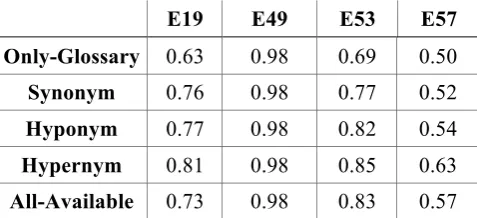
The manual annotation task for the purposes of Gold Standard definition was conducted at the ADS by 12 staff and post-graduate students. Table 5 presents the full set of results. The Hypernym mode of semantic expansion, which exploits narrower terms of the vocabulary, delivers the best F-measure rates. However, there is a difference in the system performance between the different entity types.
E19 E49 E53 E57
[image:10.595.179.418.601.710.2]Only-Glossary 0.63 0.98 0.69 0.50 Synonym 0.76 0.98 0.77 0.52 Hyponym 0.77 0.98 0.82 0.54 Hypernym 0.81 0.98 0.85 0.63 All-Available 0.73 0.98 0.83 0.57
Table 5: F-measure score of four CRM entities (E19.Physical Object, E49.Time Appellation, E53.Place and E57.Material ) for the five modes of semantic expansion
The NER task does not rely on a particular glossary for the identification of Time Appellations; instead, it uses All-Available concepts of the EH Timeline thesaurus. The very good performance is based on the completeness of the Timeline thesaurus with its non-ambiguous terms. The Timeline thesaurus is the only terminological resource which contributes to the NER that does not have any overlapping terms with other terminological resources.
The results of Physical Object (E19) and Place (E53) entities range from 63% to 85% depending on the semantic expansion mode. Places include archaeological contexts and larger groupings of contexts (but not locations which are not the focus of the semantic annotation). The highest score for both entities is delivered by the Hypernym expansion mode reaching 81% and 85% for the Physical Object and the Place entity respectively.
The system delivers the lowest F-measure score (50%) in the recognition of Material (E57), which can be ambiguous. For example the same concept (‘iron’, ‘pottery’, etc.) could be treated by archaeologists as a find (i.e. physical object) or as the material of an object. Although disambiguation is performed, it can still be challenging to identify. Whether the distinction is worth making might depend on the use cases for the information extraction.
Relation Extraction
Extraction of semantic relations between entities is a significant step towards the development of
sophisticated NLP applications that explore the potential of natural language understanding. The OPTIMA pipeline can be configured to detect ‘rich’ textual phrases that connect CRM entity types in a meaningful way. The aim of the pipeline is to detect and to annotate such phrases as CRM-EH event or property entities. The pipeline uses hand-crafted rules that employ syntactical structures for the detection of ‘rich’ textual phrases. The extraction method follows a shallow parsing strategy based on the input of part of speech tags, entity types and domain dictionaries. Other projects have also found shallow parsing useful for tackling the task of relation extraction (Zelenko at al. 2003).
The pair of entities that participate in an event phrase are the arguments of the event. For example the phrase ‘[ditch contains {pottery] of the Roman period}’ delivers two CRM-EH events. One event connects ‘ditch’ and ‘pottery’ and another event connects the same ‘pottery’ with the ‘Roman period’, both events having ‘pottery’ as a common argument. The first event can be modelled in CRM-EH terms as a deposition event (EHE1004.ContextFindDepositionEvent) while the second event can be modelled as a production event (EHE1002.ContextFindProductionEvent).
The pipeline detects contextual binary relationships, for example “pit dates to Prehistoric period”, “pottery dates to Prehistoric period”, “ditch contains pottery” and “sherds of pottery”, assigning the CRM-EH ontological annotations CRM-EHE1001.ContextEvent, CRM-EHE1002.ContextFindProductionEvent,
EHE1004.ContextFindDepositionEvent and P45.consists_of, respectively (Vlachidis 2012). Thus the resulting information extraction carries the semantic relationship between the different entities when there is a valid connection between them.
Conclusions and Future Work
This chapter has described the underpinning algorithms and has provided an overview of the techniques employed, highlighting their strengths and weaknesses. It has highlighted two projects: Archaeotools, and OPTIMA (which underpins STAR and STELLAR). Machine Learning and Rule based techniques are sometimes seen as competing NLP paradigms with different strengths and weaknesses. Which works best often depends on the specifics of the entities to be extracted and the language style of the text. It may also depend on the future use cases for the information extraction outputs and the applications that will consume the output.
However, the two methods can be combined, either in a complementary fashion, or sequentially in a pipeline. Archaeotools combined the two methods for different types of entities; OPTIMA employed rule-based techniques for very specific annotations involving ‘rich phrases’ that combined different types of entities in a meaningful way, while retaining the semantics of each entity in the ontological output. Thus the more specific OPTIMA annotations can be seen as complementary to the broader Archaeotools
classifications of the main focus of the documents in question. Each can be seen as tending to serve a different use case; thus perhaps Archaeotools in classification for browsing; OPTIMA in providing more detailed annotations for semantic searching.
Looking to the future, as part of the EU-funded ARIADNE research e-infrastructure project
(Niccolucci and Richards 2012) the authors are collaborating to explore the possibilities for combining rule-based approaches and machine learning sequentially as stages in a pipeline, as well as investigating the generalisation of OPTIMA rule based techniques to other European language grey literature. With the current interest in Big Data it seems that the potential of text mining to address archaeological research questions and some of the grand challenges of our domain (Kintigh at al. 2014) is only just beginning to be explored.
Acknowlegements
The STAR and STELLAR projects were supported by the Arts and Humanities Research Council [grant numbers AH/D001528/1, AH/H037357/1]. Archaeotools was funded under the AHRC/EPSRC/JISC eScience programme [grant numberAH/E006175/1]. Julian Richards would like to thank Professor Fabio Ciravegna, Sam Chapman and Ziqi Zhang of the Sheffield Organisations, Information and Knowledge (OAK) group for their input to that project. Thanks are also due to Stuart Jeffrey and Lei Xia at the Archaeology Data Service, Phil Carlisle (English Heritage) for providing domain thesauri and for helpful input from Renato Souza (Visiting Fellow at Glamorgan).
References
Amrani, A., V. Abajian, Y. Kodratoff and O. Matte-Tailliez. 2008. A chain of text-mining to extract information in Archaeology. Information and Communication Technologies: From Theory to Applications, 2008. ICTTA 2008. 3rd International Conference, 1-5.
Baeza-Yates, R. and B. Ribeiro-Neto. 1999. Modern Information Retrieval. Boston, Addison-Wesley Longman Publishing Co., Inc.
Bateman, J. and S. Jeffrey 2011. What Matters about the Monument: reconstructing historical classification. Internet Archaeology 29. http://dx.doi.org/10.11141/ia.29.6
Binding C., D. Tudhope and K. May 2008. Semantic Interoperability in Archaeological Datasets: Data Mapping and Extraction via the CIDOC CRM. Proceedings (ECDL 2008) 12th European Conference on Research and Advanced Technology for Digital Libraries, Aarhus, 280–290.
Bradley, R. 2006. Bridging the two cultures. Commercial archaeology and the study of prehistoric Britain. Antiquaries Journal 86: 1-13.
Frischer, J. W. Crawford, and D. Koller, (eds.). Making History Interactive. Proceedings of the 37th Computer Application in Archaeology Conference, Williamsburg 2009. Archaeopress, Oxford.
Chapman W.W., W. Bridewell. P. Hanbury, G.F. Cooper and B.G. Buchanan.2001. A Simple Algorithm for Identifying Negated Findings and Diseases in Discharge Summaries. Journal of Biomedical
Informatics 34(5): 301–310.
Ciravegna, F. and A. Lavelli. 2004. Learning Pinocchio: adaptive information extraction for real world applications. Natural Language Engineering 10(02): 145–165.
Cowie, J., and W. Lehnert. 1996.Information extraction. Communications ACM 39(1): 80–91.
Cunningham, H., D. Maynard and V. Tablan. 2000. JAPE a Java Annotation Patterns Engine (Second Edition). [online] Technical report CS--00--10, University of Sheffield, Department of Computer Science. Available at http://www.dcs.shef.ac.uk/intranet/research/resmes/CS0010.pdf
Cunningham, H. and D. Scott. 2004. Software Architecture for Language Engineering. Natural Language Engineering 10(3-4): 205–209.
English Heritage 2007. MIDAS Heritage – The UK Historic Environment Data Standard. (Best practice guidelines)
http://www.english-heritage.org.uk/publications/midas-heritage/midasheritagepartone.pdf
Falkingham, G. 2005. A Whiter Shade of Grey: a new approach to archaeological grey literature using the XML version of the TEI Guidelines. Internet Archaeology 17. http://dx.doi.org/10.11141/ia.17.5
Feldman, R., Y. Aumann, M. Finkelstein-Landau, E. Hurvitz, Y. Regev and A. Yaroshevich. 2002. A Comparative Study of Information Extraction Strategies. Proceedings (CICLing-2002) Third
International Conference on Intelligent Text Processing and Computational Linguistics, Mexico city, Mexico, 17-23 February.
Fulford, M. and N. Holbrook. 2011. Assessing the contribution of commercial archaeology to the study of the Roman period in England, 1990-2004. Antiquaries Journal 91: 323-345.
Gaizauskas R. and Y. Wilks. 1998. Information extraction: beyond document retrieval. Journal of Documentation 54(1): 70–105.
Grover C., S. Givon, R. Tobin and J. Ball. 2008. Named entity recognition for digitised historical texts. In Proceedings (LREC 2008) 6th International Conference on Language Resources and Evaluation, Marrakech, Morocco, 28-30 May.
Hardman, C. and J.D. Richards. 2003. OASIS: dealing with the digital revolution. In CAA2002: The Digital Heritage of Archaeology. Computer Applications and Quantitative Methods in Archaeology 2002, (ed. M. Doerr and A. Sarris), 325-328. Archive of Monuments and Publications Hellenic Ministry of Culture.
Hobbs, J. R., D. Appelt, J. Bear, D. Israel, M. Kameyama, M. Stickel and M. Tyson. 1993. ‘FASTUS: A Cascaded Finite-State Transducer for Extracting Information from Natural-Language Text’, In Proceedings (IJCAI 1993) 13th International Joint Conference on Artificial Intelligence, Chambery, France, 28 August – 3 September
Isaac A. and E. Summers. 2009. SKOS Simple Knowledge Organization System Primer. [Online]. Available at: http://www.w3.org/TR/skos-primer (Accessed: 12 June 2012)
Special Themed Issue of the Philosophical Transactions of the Royal Society A, 367, 2507-19.
Kintigh, K., J. Altschul, M. Beaudry, R. Drennan, A. Kinzig, T. Kohler, W.F. Limp, H. Maschner, W. Michener, T. Pauketat, P. Peregrine, J. Sabloff, T. Wilkinson, H. Wright and M. Zeder. 2014. Grand Challenges for Archaeology. American Antiquity 79, 5–24.
Lin, D. 1995. University of Manitoba: description of the PIE system used for MUC-6. In Proceedings (MUC 6) 6th Message Understanding Conference, Columbia, Maryland, 6-8 November.
Michel, J-B, Y.K. Shen, A.P. Aiden, A.Veres, M.K. Gray, The Google Books Team, J.P. Pickett, D. Hoiberg, D. Clancy, P. Norvig, J. Orwant, S. Pinker, M.A. Nowak and E. Lieberman Aiden. 2011. Quantitative analysis of culture using millions of digitized books. Science 331, 176.
doi:10.1126/science.1199644.
Moens, M.F. 2006. Information Extraction Algorithms and Prospects in a Retrieval Context. Dordrecht, Springer
Nadeau D. and S. Sekine. 2007. A survey of named entity recognition and classification. Lingvisticae Investigationes 30(1): 3–26.
Newman, M and P. Gilman. 2007. Informing the Future of the Past: Guidelines for Historic Environment Records (2nd edition). ADS, ALGAO UK, English Heritage, Historic Scotland, RCAHMS and RCAHMW.
Niccolucci, F. and J.D. Richards. 2013. ARIADNE: Advanced Research Infrastructures for Archaeological Dataset Networking in Europe. International Journal of Humanities and Arts Computing 7.1-2, 70– 88.
Nilsson, N. 2005. Introduction to Machine Learning. [Online]. Nils J Nilson publications. Available at: http://robotics.stanford.edu/people/nilsson/mlbook.html
Paijmans, H. and S. Wubben. 2008. Preparing archaeological reports for intelligent retrieval, in Layers of Perception. Proceedings of the 35th International Conference on Computer Applications and
Quantitative Methods in Archaeology (CAA) Berlin, Germany, April 2-6, 2007, (ed. A. Posluschny, K. Lambers and I. Herzog), 212-217, Kolloquien zur Vor- und Frühgeschichte Band 10, Bonn.
Richards, J.D. and C. Hardman. 2008. Stepping back from the trench edge. An archaeological perspective on the development of standards for recording and publication. pp101-112. In: M. Greengrass and L. Hughes (eds.). The Virtual Representation of the Past. Ashgate, London.
Richards, J.D., S. Jeffrey, S. Waller, F. Ciravegna, S. Chapman and Z. Zhang. 2011. The Archaeology Data Service and the Archaeotools project: faceted classification and natural language processing. pp.31-56. In: S. Whitcher Kansa, E.C. Kansa and E. Watrall (eds.). Archaeology 2.0 and Beyond: New Tools for Collaboration and Communication. Cotsen Institute of Archaeology Press, Los Angeles.
Savary, A., J. Waszczuk, and A. Przepiórkowski. 2010. Towards the Annotation of Named Entities in the National Corpus of Polish. In Proceedings (LREC'10) Fourth International Conference on Language Resources and Evaluation, Valletta, Malta, 13-17 May.
Smeaton A.F., 1997. Using NLP and NLP resources for Information Retrieval Tasks. In: T. Strzalkowski (ed.). Natural Language Information Retrieval, Kluwer Academic Publishers.
Soderland, S., D. Fisher, and W. Lehnert, (1997) ‘Automatically Learned vs. Hand-crafted Text Analysis Rules’, CIIR Technical Report T44, University of Massachusetts, Amherst.
Uren, V., P. Cimiano, J. Iria, S. Handschuh, M. Vargas-Vera, E. Motta and F. Ciravegna. 2006. Semantic annotation for knowledge management: Requirements and a survey of the state of the art. Web Semantics: Science, Services and Agents on the World Wide Web 4(1), 14–28.
Vlachidis, A., C. Binding, C., K. May and D. Tudhope. 2010. Excavating grey literature: a case study on the rich indexing of archaeological documents via Natural Language Processing techniques and
knowledge based resources. ASLIB Proceedings 62 (4&5), 466–475.
Vlachidis A, and D. Tudhope. 2012. A pilot investigation of information extraction in the semantic annotation of archaeological reports. International Journal of Metadata, Semantics and Ontologies 7(3), 222-235. Inderscience.
Vlachidis A. 2012. Semantic Indexing via Knowledge Organization Systems: Applying the CIDOC-CRM to Archaeological Grey Literature. Unpublished PhD Thesis, University of South Wales (USW).
Vlachidis A, and D. Tudhope. 2013. The Semantics of Negation Detection in Archaeological Grey Literature. pp188-200. In: E. Garoufallou and J. Greenberg (eds.). Metadata and Semantics Research. Communications in Computer and Information Science 390.