ARE WATER SECTOR PROFESSIONALS WORRIED ABOUT CLIMATE CHANGE?
EXAMINING RISK PERCEPTIONS OF WATER SECTOR PROFESSIONALS THROUGH A SYSTEMATIC LITERATURE REVIEW AND SURVEY
Katherine G. Connolly
A technical report submitted to the faculty of the University of North Carolina at Chapel Hill in partial fulfillment of the requirements for the degree of Masters of Science in Public Health in
the Department of Environmental Science and Engineering in the Gillings School of Global Public Health.
Chapel Hill 2017
Approved by:
Dr. Jamie Bartram Dr. Pete Kolsky
Dr. Jackie MacDonald-Gibson
©2017
Katherine G. Connolly
ALL RIGHTS RESERVED
ABSTRACT
Katherine G. Connolly: Are water sector professionals worried about climate change? Examining the risk perceptions of water sector professionals through a systematic literature review and
survey.
(Under the direction of Jamie Bartram)
For water and wastewater utilities to adapt to climate change, water sector professionals must perceive risk from the associated impacts. In order to better understand water sector
professionals’ risk perceptions, a systematic literature review was conducted, which revealed that risk perceptions toward climate change have increased over time and are linked to behavior and decision-making in the water sector. No identified papers in the peer-reviewed literature have studied professionals from sub-Saharan Africa, therefore, a survey was implementedtd to examine the perceptions of professionals in this region. We surveyed 90 participants at the African Water Association’s Congress in Nairobi, Kenya, and found that water sector
professionals are concerned about climate change impacts on utilities, but are also worried about
non-climate risks facing utilities. These findings highlight the multiple, competing risks utilities
face and the need for adaptation strategies that simultaneously address climate and non-climate
concerns of utilities.
ACKNOWLEDGEMENTS
Jamie Bartram, PhD, Don and Jennifer Holzworth Distinguished Professor of Environmental Science and Engineering, Dept. of Environmental Sciences and Engineering, Gillings School of Global Public Health.
Pete Kolsky, PhD, Professor of the Practice Environmental Science and Engineering, Dept. of Environmental Sciences and Engineering, Gillings School of Global Public Health.
Jackie McDonald Gibson, PhD, Associate Professor of Environmental Science and Engineering, Dept. of Environmental Sciences and Engineering, Gillings School of Global Public Health.
Jill Stewart, PhD, Associate Professor of Environmental Science and Engineering, Dept. of Environmental Sciences and Engineering, Gillings School of Global Public Health.
David Fuente, Program Coordinator at The Water Institute, Gillings School of Global Public Health.
Jeanne Luh, Program Coordinator at The Water Institute, Gillings School of Global Public Health.
Jane Kabubo-Mariara, PhD, Professor of Economics, University of Nairobi.
African Water Association
Nairobi Water and Sewerage Company Environmental for Development
Zahra Al Hamdani, Allison Fetcher, Lisa Fleming, Lauren Joca, Abhishek Komandur, Sarah
Long, and Claire Tipton, Dept. of Environmental Sciences and Engineering, Gillings School of
Global Public Health.
TABLE OF CONTENTS
ABSTRACT...iiiiii
ACKNOWLEDGEMENTS...iviv
TABLE OF CONTENTS...vv
LIST OF FIGURES...vivi
LIST OF TABLES...vivi
Section 1: Introduction...11
Climate change and water resources in sub-Saharan Africa...22
Risk Perceptions Research...44
Section 2: Systematic Literature Review...77
Systematic Literature Review Research Questions...77
Systematic Literature Review Methods...77
Systematic Literature Review Results...1010
Summary of Systematic Literature Review...2323
Section 3: Survey of water sector professionals in sub-saharan africa...2525
Rationale...2525
Survey Research questions...2626
Survey Methods...2727
Survey Results...3131
Discussion...3838
Limitations...4242
Conclusion...4343
Appendix 1: Studies excluded after Full text review...4646
Appendix 2: Systematic literature review extraction table...5050
Appendix 3: Survey materials...5555
References...7070
LIST OF FIGURES
Figure Figure Caption Page
Figure 1 Figure 2
Literature search flow diagram
Mean risk perception of water sector professionals toward climate and weather events disrupting utility service
9
34 Figure 3 Mean risk perception of water sector professionals toward non-
climate factors disrupting utility service
35
Figure 4 Comparison of water sector professionals’ risk perceptions
toward climate/weather events and non-climate factors 36 Figure 5 Mean risk perception toward climate and weather events among
utility and non-utility professionals. 37
LIST OF TABLES Table
Number
Table Caption Page
Table 1 Main findings on climate-related risk perceptions from included
studies 14
Table 2 Survey questions used to create measures for analysis 27 Table 3
Table 4
Risk factors assessed in survey Survey respondent characteristics
30
31
SECTION 1: INTRODUCTION
Climate change will very likely affect water quality and availability worldwide (Cisneros Jimenez et al., 2014). The impacts of climate change on water resources will be more severe in the regions that already face water scarcity and other climate-related challenges (Cisneros Jimenez et al., 2014; Niang et al., 2014). Sub-Saharan Africa is one such region (Niang et al., 2014). Given the projected impacts of climate change in sub-Saharan Africa, as well as existing non-climate issues facing water and wastewater management in the region (rapidly growing demand, insufficient revenues etc.), it is vital for water sector professionals to be planning for future variability and working to minimize the negative effects of climate change on their systems through adaptation
1strategies. But, for utility professionals to be adequately adapting to current and predicted climate changes, they must first be aware of and perceive risk from its impacts (Arnell & Delaney, 2006; Brettle, Berry, Paterson & Yasvinski, 2015; Moser & Luers, 2009).
However, the literature on utility and water sector professionals’ perceptions toward climate change relatively is sparse. Furthermore, no studies have been identified that assess the perceptions of professionals in sub-Saharan Africa. Therefore, a systematic literature review was conducted to assess the state of knowledge on water sector professionals’ perceptions, globally, and a survey was implemented in sub-Saharan Africa to examine the perceptions of water sector professionals in this region. This report presents the results of the systematic literature review and survey in order to answer the following research questions:
1
Within the context of climate change, mitigation actions are those that seek to minimize emissions of greenhouse gases (e.g., through use of alternative energy sources). Adaptation actions are those taken to help adjust the to the current or expected impacts of climate change in order to minimize the consequences/damage (e.g., installing flood1. How do water sector professionals perceive of climate change risks facing water/wastewater management and utilities?
2. How does risk from climate change compare to other risks facing water/wastewater management and utilities?
This section provides a brief overview of projected climate change impacts in sub-Saharan Africa and an introduction to the field of risk perception research to contextualize the findings of the systematic literature review and survey, which will be presented in the following sections.
Climate change and water resources in sub-Saharan Africa
With respect to climate change, water and wastewater utilities face a number of potential water-related hazards, including: droughts, flooding, and water quality concerns (Danilenko, Dickson, and Jacobsen 2010). While it is difficult to project how the impacts of these different climate/weather events will vary across sub-Saharan Africa over the 21
stcentury, global climate models and historical data provide a general picture of past and predicted future change.
Data show that most of southern Africa experienced warming over the past century and this trend is expected to continue into the future (Niang et al., 2014; Serdeczny et al., 2016). Rising
temperatures may impact water availability for water utilities, as water demand and
evapotranspiration rates typically increase with temperature. Warmer temperatures can also create water quality concerns, thereby making water treatment more difficult and expensive (Danilenko et al., 2010).
Estimates show that southern Africa is “very likely” to see an overall decrease in
precipitation over the next century, which may bring more frequent and severe drought (Niang et
al., 2014, p. 1210; Serdeczny et al. 2016). If global average temperatures increase by 4° Celsius,
this could lead to a 30% decrease in precipitation in southern Africa and significant reductions in
groundwater recharge (50-75%) in the south and west of sub-Saharan Africa (World Bank, 2013).
Decreases in precipitation and more frequent drought would make it more difficult for water utilities to provide an adequate supply of water to rapidly expanding populations. Furthermore, reduced flows make water and wastewater more difficult to treat given a higher concentration of pollutants and nutrients (Miller & Yates, 2006).
In contrast, eastern Africa may experience an increase in precipitation (Niang et al., 2014;
Serdeczny et al. 2016). And precipitation is expected to occur increasingly in concentrated extreme precipitation events, which may lead to flooding (World Bank, 2013). Floods can cause a number of problems for utilities, including:from infrastructure damagdamage, e to power outages, increased water tuurbidityrbidity, and overflow or backflow of sewage (Loftus, 2011; EPA, 2015). Wastewater treatment works are particularly vulnerable to flooding because they are often built at low points to decrease pumping costs. In coastal areas, flooding may be exacerbated by sea level rise, which can lead to more powerful storm surges and greater infrastructure damage for utilities (Serdeczny et al., 2016). Additionally, sea level rise can create water quality challenges for water utilities from saltwater intrusion into aquifers (EPA, 2015).
Overall, climate models point to an increase in variability of temperature, precipitation and
extreme weather events for sub-Saharan Africa (Niang et al., 2014). Consequently, this could
mean that the same region experiences more consecutive dry days and an increase in annual
average rainfall. This variability is likely to be compounded by El Niño and La Niña cycles,
which have been linked to precipitation changes throughout Africa (Niang et al., 2014). The
predicted increase in variability of precipitation caused by climate change will make long-term
planning for water and wastewater utilities in sub-Saharan Africa all the more difficult.
Furthermore, many utilities in the region already face non-climate related issues, from rapidly growing water demand, insufficient revenues to cover operations and maintenance for the utility, and non-revenue water (water that is supplied by the utility, but it not paid for by a customer), all of which may be exacerbated by climate change. Given the broad range of challenges utilities face, it is important to know how individuals making decisions with respect to water and
wastewater management perceive of these various risks because these perceptions will influence how they are managed.
Risk Perceptions Research
The term risk carries many different connotations. However, for this paper, risk refers to
“the probability that exposure to a hazard will lead to negative consequences” (Ropeik & Gray, 2002, p. 4). Risk perception is how an individual perceives and judges a risk, which makes it an inherently subjective and personal construct (Slovic & Weber, 2002).
Over the past 20 years, there have been an increasing number of studies focused on climate change risk perception. This is likely due to the fact that perceiving risk is considered an
important antecedent to adaptive behavior change (Brettle et al., 2015; Moser & Luers, 2009). For example, Kettle and Dow (2014) found that higher risk perceptions toward climate change
impacts were linked to greater support for adaptation strategies among coastal managers in the United States. O’Connor, Board and Fisher (1999a), and Semenza et al. (2008) showed that climate change risk perceptions are associated with climate change mitigation/voting behavioral intentions and behavior change, respectively, in the U.S.
In terms of the factors that may contribute to perceived risk toward climate change, there
are a number of internal and external influences, both at the individual and societal scale, which
may play a role. For instance, demographic characteristics such as gender, age, and education may
all impact risk perception (O’Connor et al., 1999a; van der Linden 2015). Geographic location, or other factors related to where an individual lives (cultural, socioeconomic, etc.), can influence risk perceptions as well.
Research conducted in the U.S. has found that individuals often recognize climate change as a threat and are concerned about the risks it poses, but assign it relatively low priority in relation to other concerns (Leiserowitz, 2006). With respect to utilities, water sector professionals may exhibit concern regarding climate risks, but these risks could be less concerning compared to the broader portfolio of risks that a utility must address. This may especially be the case given that climate change is often perceived as a psychologically distant risk. Psychological distance refers to “the subjective experience that something is close or far away from the self, here, and now” (Trope & Liberman, 2010, p. 440). Previous research has found that climate change is often perceived as a risk that is far off in time (e.g., impacts being more concerning for future
generations) and/or location, with impacts perceived as being more severe for people in other countries, especially developing countries (Leiserowitz, 2006; McDonald, Yi, & Newell, 2015).
Perceiving climate change to be a temporally and/or spatially close risk has been linked to having higher risk perceptions (Spence et al., 2012).
Another relevant factor linked to risk perception is the controllability of the risk, which refers to an individual’s perception of the extent to which they have control over a risk (Slovic, 1987). Higher perceived control over a risk is associated with lower risk perception. In the context of perceptions of risks that face utilities, those who work for utilities may believe they have greater control over the impacts of climate change on the utility, compared to others in the water sector, which could contribute to lower perceived risk in utilities workers. Additionally,
individuals who work for utilities may have different professional and educational backgrounds
than others in the water sector (e.g., a greater proportion of engineers). Each professional field comes with its own perspective, which likely influences risk perceptions, and the water sector employs professionals from many different fields (Dobbie & Brown, 2014).
While this section does not contain an exhaustive list of factors previously found to be
related to climate change risk perceptions, those outlined here are deemed to be the most relevant
to water sector professionals in sub-Saharan Africa. The next section will present the results of
the systematic literature review.
SECTION 2: SYSTEMATIC LITERATURE REVIEW
Systematic Literature Review Research Questions
A systematic literature review was conducted to answer the following questions:
What factors influence climate/weather related risk perceptions of water sector professionals?
How do water sector professionals perceive of climate change risks facing water/wastewater management?
What non-climate related factors do water sector professionals perceive as posing a risk to water/wastewater management?
Is there evidence to support the influence of risk perception on behavior/decision-making amongst water sector professionals?
Systematic Literature Review Methods
Published literature was searched in March and April of 2017 using Web of Science and Academic Search Premier
2databases. The following search string was used:
Climate change OR global warming OR natural hazard OR climate extreme OR weather extreme AND risk perception OR perceived risk OR worry OR concern AND water utility OR wastewater utility OR water system OR wastewater system OR water manager OR water management OR wastewater manager OR wastewater management
2 Academic Search Premier also included a search within the following databases: EconLit, Environment Complete, Family & Society Studies Worldwide, Global Health, Global Health Archive, GreenFILE, PsycARTICLES
Only articles with the abstract and full text available in English were considered. Papers were included in the review if they assessed risk perceptions (included perceived likelihood or perceived severity of impacts) or general concern regarding climate change or extreme weather events amongst water sector professionals. Only original researcher papers involving quantitative and/or qualitative data collection on the perceptions of water sector professionals were
considered. ‘Water sector professional’ was defined to include water/wastewater utility
professionals, storm water managers, or others who make decisions regarding the management of water or wastewater resources as part of their job. Farmers and other water users were not
included in this category, nor was the general public. The citations of all included papers were scanned for additional references in order to capture any studies not identified through the database search. Three studies that were not published in academic journals are included in the review, but grey literature was not systematically searched.
For each identified paper, the following data was extracted: study location and population, method and year of data collection, purpose of study or research questions, variable or question used to assess risk perceptions/concern and relevant findings (Appendix 2). The relevant findings were categorized under four main themes: factors that impact risk perceptions, risk
perception/concern over climate or weather events/impacts, non-climate risks facing utilities, and
the influence of risk perceptions on behavior.
Figure 1: Literature search flow diagram. N indicates the the number of studies included at each stage in the review process.
Additional records identified through other sources
(n = 27) Records identified through
database searching (n = 3720) Identification IncludedScreening Eligibility
Records excluded (n = 2596)
Full-text articles assessed for eligibility
(n = 55)
Full-text articles excluded, with reasons
(n = 37) Records screened
(n = 2651)
Records after duplicates removed (n = 2651)
Studies included in qualitative synthesis
(n = 18)
Systematic Literature Review Results Search Results
The search yielded 2,651 unique articles (3,747 articles total, 1,096 of which were
duplicates). After screening titles and abstracts, 2,596 papers were excluded (2,354 based on title and 242 based on abstract). Fifty-five papers were reviewed in full, 18 of which were deemed relevant for inclusion (Appendices 1 and 2). Papers were excluded following a full text review because they did not assess risk perceptions, did not focus on water sector professionals, and/or did not collect qualitative or quantitative data (see Appendix 1 for a list of all papers reviewed inexcluded after a full text review and reasons for exclusion).
Study Characteristics
Of the eighteen papers included in this review, only one (O’Connor et al., 1999) was published before 2000 and the majority (56%) wwasas published in 2010 or later. Two-thirds (n=12) of the included studies focus exclusively on water sector professionals in the United States and only two studies (Economist Intelligence Unit, 2012; Kirchoff, Lemos, & Engle 2014) include perspectives of professionals from low- or middle- income countries. Neither of these two studies includes professionals from sub-Saharan Africa in their samples. Surveys were used to collect data in 13 of the studies and five of the studies base their analyses on information gathered from qualitative interviews. Sample sizes range from less than 30 respondents to over 650, although not all authors reported their total sample size (see Appendix 2 for details).
Factors influencing risk perceptions
Several of the identified studies examine factors that influence climate- and weather-
related risk perceptions of water sector professionals. For instance, a number of studies found that
managers of water systems that rely on surface water as a source for their drinking water supply
are more concerned about climate change and/or perceive their systems to be more vulnerable compared to groundwater systems (Bolson, Martinez, Breuer, Srivastava, & Knox, 2013; Dow, O’Connor, Yarnal, Carbone, & Jocoy 2007). Additionally, Ekstrom, Bedsworth and Fencl (2017) found that reliance on surface water amongst drinking water utilities in California was linked to taking adaptation actions, which may have been motivated by greater perceived vulnerability.
Furthermore, a survey of water managers in Arizona found that managers of water systems that rely upon more than one source of water perceive themselves to be less vulnerable to drought (Carter & Morehouse, 2003).
Past (or current) problems related to climate and weather events also appear to impact perceived likelihood of events occurring in the future (Dow et al., 2007), risk perceptions (Lowrey, Ray, & Webb 2009) and adaptation actions taken (Ekstrom et al., 2017). Interestingly, Dow et al. (2007) found that size of a utility is not a significant predictor of climate/weather- related problems that utilities expect to face. However, in a survey of water and wastewater utilities in Canada, smaller utilities were more likely to claim that they have not been impacted by climate change or that they do not know if they had been impacted (Brettle et al., 2015). This unclear relationship between utility size and perceptions is contrary to the expectation that smaller utilities would perceive themselves as being more vulnerable to climate change due to having fewer resources available for adaptation (Dow et al., 2007). But, smaller utilities being less likely to know if they have already been impacted by climate change may be a reflection of lesser capacity within these smaller utilities or greater volatility within these systems, in general, making it more difficult to detect changes in averages.
A survey of storm water managers in the Baltimore-Washington Metropolitan area of the
United States looked more at individual-level factors that may influence climate change
perceptions (Wernstedt & Carlet, 2014). It found that higher concern over climate change-related impacts on storm water management was associated with several factors: greater familiarity with climate change, the perception that scientists understand climate change, a greater number of years of work experience, high population growth rate and a greater proportion of impervious surfaces in the area where the individual works, and working with climate change issues as part of one’s job (Wernstedt & Carlet, 2014). Belief that scientists understand climate change well and working on climate change issues as part of one’s job both had a large, positive correlation with the belief that climate change will negatively affect storm water management in the respondent's jurisdiction (Wernstedt and Carlet, 2014). It seems likely that these two contributing factors are related to one’s degree of knowledge about climate change. Lowrey et al. (2009) also found that exposure to scientists and climate information may increase climate-related risk perceptions, which lends further support to the importance of knowledge.
As these studies demonstrate, there are a number of different factors that may be related to climate change risk perceptions of water sector professionals. Consistent with the larger body of literature on climate change risk perceptions, perceptions of water sector professionals seem to be influenced by both internal and external factors
3. And while exposure to climate/weather events and climate science seem to increase risk perceptions, these factors alone may not spark concern over climate change risks facing utilities.
Climate-related risk perceptions of water sector professionals
Within the identified studies, there was a large degree of heterogeneity in terms of specific variables measured with respect to risk perceptions (Appendix 2), which makes comparisons between studies somewhat difficult. However, there are several interesting themes that emerge
3
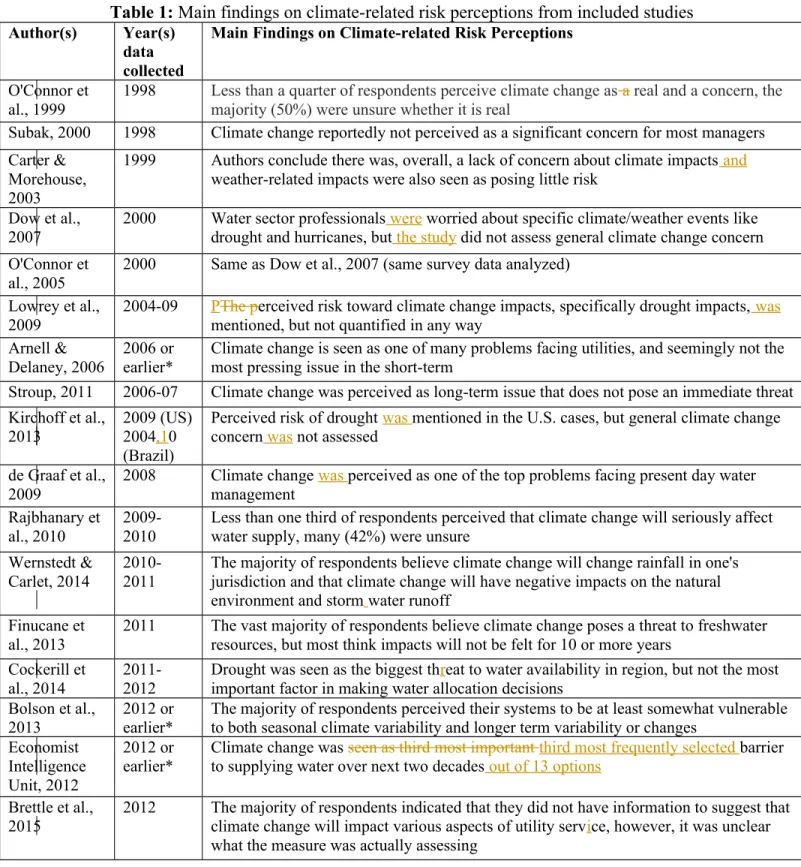
Internal factors are personal, individual-level factors such as personal values or beliefs and knowledge; externalfrom the 18 studies, taken as a whole. For instance, there seems to be a general trend of water sector professionals increasingly perceiving climate change as a risk to water/wastewater management over time (Table 1). The earliest included study found that only 22% of managers surveyed believed that climate change was real and a threat to their system, whereas the majority (50%) of respondents did not know if climate change was real (O’Connor et al., 1999b).
Similarly, Subak (2000), and Carter and Morehouse (2003), found that water utility managers in England/Wales and Arizona, respectively, were not particularly concerned about climate change.
In the Carter and Morehouse (2003) study, water providers in Arizona expressed concern over shorter-terms weather factors, such as electrical storms and high winds, as opposed to longer-term events like drought. However, it is not particularly surprising that these earlier studies found a general lack of climate change concern amongst water sector professionals given the state of climate change knowledge at the time the data for these studies were collected.
Looking at the studies conducted in the early 2000s (2000-2010), many of the researchers
avoided asking water sector professionals directly about climate change. For instance, in the Dow
et al. (2007) and O’Connor, Yarnal, Dow, Jocoy and Carbone et al. (2005) studies, studies which
used the same survey data, in their analyses, water system managers were asked to rank the
perceived likelihood and severity of various climate/weather events disrupting utility service over
the next ten years. Managers in both South Carolina and Pennsylvania perceived drought to be a
severe problem and those in South Carolina were particularly concerned about hurricanes (Dow et
al., 2007). However, it is not clear from the results whether the managers perceived these events
as changing in frequency or severity as a result of climate change. Both Lowrey et al. (2009) and
Kirchoff et al. (2013) discuss perceived risk of drought, particularly as it pertains to use of climate
forecasts/information, but neither quantify perceived risk with respect to drought or climate change in general.
Table 1: Main findings on climate-related risk perceptions from included studies
Author(s) Year(s)data collected
Main Findings on Climate-related Risk Perceptions
O'Connor et al., 1999
1998 Less than a quarter of respondents perceive climate change as a real and a concern, the majority (50%) were unsure whether it is real
Subak, 2000 1998 Climate change reportedly not perceived as a significant concern for most managers Carter &
Morehouse, 2003
1999 Authors conclude there was, overall, a lack of concern about climate impacts and weather-related impacts were also seen as posing little risk
Dow et al., 2007
2000 Water sector professionals were worried about specific climate/weather events like drought and hurricanes, but the study did not assess general climate change concern O'Connor et
al., 2005
2000 Same as Dow et al., 2007 (same survey data analyzed) Lowrey et al.,
2009
2004-09 PThe perceived risk toward climate change impacts, specifically drought impacts, was mentioned, but not quantified in any way
Arnell &
Delaney, 2006
2006 or earlier*
Climate change is seen as one of many problems facing utilities, and seemingly not the most pressing issue in the short-term
Stroup, 2011 2006-07 Climate change was perceived as long-term issue that does not pose an immediate threat Kirchoff et al.,
2013
2009 (US) 2004,10 (Brazil)
Perceived risk of drought was mentioned in the U.S. cases, but general climate change concern was not assessed
de Graaf et al., 2009
2008 Climate change was perceived as one of the top problems facing present day water management
Rajbhanary et al., 2010
2009- 2010
Less than one third of respondents perceived that climate change will seriously affect water supply, many (42%) were unsure
Wernstedt &
Carlet, 2014
2010- 2011
The majority of respondents believe climate change will change rainfall in one's jurisdiction and that climate change will have negative impacts on the natural environment and storm water runoff
Finucane et al., 2013
2011 The vast majority of respondents believe climate change poses a threat to freshwater resources, but most think impacts will not be felt for 10 or more years
Cockerill et al., 2014
2011- 2012
Drought was seen as the biggest threat to water availability in region, but not the most important factor in making water allocation decisions
Bolson et al., 2013
2012 or earlier*
The majority of respondents perceived their systems to be at least somewhat vulnerable to both seasonal climate variability and longer term variability or changes
Economist Intelligence Unit, 2012
2012 or earlier*
Climate change was seen as third most important third most frequently selected barrier to supplying water over next two decades out of 13 options
Brettle et al., 2015
2012 The majority of respondents indicated that they did not have information to suggest that climate change will impact various aspects of utility service, however, it was unclear what the measure was actually assessing
Ekstrom et al., 2017
2015 The majority of respondents believe that the climate is changing locally and that is poses a threat to local water quality
*Date of data collection not specified, year of publication or earlier
Amongst studies in the early 2000s that did specifically assess climate change risks, water professionals seemed either unsure about climate change or perceived it as a temporally distance threat. For instance, Rajbhanary, Borisova, Adams, Haynes, and Boyer (2010) found that 42% of water utility professionals surveyed in Florida were not sure whether long-term changes in climate or weather would significantly impact their water supply, while 28% believed it would.
Additionally, based off of interviews with water utility managers in England and Wales, Arnell and Delaney (2006) concluded, “climate change is generally seen as one amongst several pressures, and not necessarily the most important in the short term” (p. 252). Similarly, water professionals across four basins in the U.S. generally perceived climate change to be a long-term problem that did not pose a serious threat in the near future (Stroup, 2011). This is not to say that these perceptions are incorrect, because in reality climate change is a long-term and gradual issue, but climate change may also have short-term implications for water resource management and this fact does not seem to be reflected in the perceptions of professionals in these studies.
A clear outlier amongst the pre-2010 studies is the survey of urban water professionals in the Netherlands (de Graaf et al., 2009). In this study, respondents were asked to select what they believed were the two most important problems facing water management in their area and climate change was one of the most frequently selected options. However, the Dutch are particularly vulnerable to climate change and have been especially innovative in addressing it, which may account for this finding.
Looking at studies in which data were collected in 2010 or later, there seems to be an
uptick in professionals who perceive climate change as posing a threat to water or wastewater
management. For instance, the majority of storm water managers surveyed in the Baltimore- Washington area reported they believe climate change will negatively impact rainfall and the natural environment in their area (Wernstedt & Carlet, 2014). Additionally, the majority of water professionals in the Oahu watershed of Hawaii believed that sea level rise, droughts, saltwater intrusion into aquifers, hurricanes and storms, and water shortages were very or extremely likely to occur over the next 50 years due to climate change (Finucane et al., 2013). Furthermore, 98%
of respondents in this same study believed that there would be ‘dangerous’ impacts on freshwater resources caused by climate change. However, only 14% reported that these impacts were
happening now, whereas 84% believed that these dangerous impacts would not be felt for ten or more years (Finucane et al., 2013). While it is likely that the impacts of climate change will become more severe over time, this finding may point to climate change being perceived as temporally distant.
A survey of individuals responsible for making water resource decisions in western North Carolina revealed that drought is perceived as posing the largest threat to future water availability in the region (Cockerill, Badurek, and Hale, 2014). However, these results do not indicate
whether respondents perceive drought as being related to climate change. But, the majority of water resource managers surveyed in three U.S. states perceived their systems to be at least somewhat vulnerable to both seasonal climate variability and longer-term variability or changes (Bolson et al., et al., 2012).
Furthermore, amongst water utility executives surveyed in ten countries (the US, Canada,
the UK, Spain, France, Australia, Brazil, Russia, India and China) climate change seemed to be
perceived as a serious risk (Economist Intelligence Unit, 2012). For instance, respondents were
asked to select the top three barriers to ensuring a sufficient supply of clean water through the
year 2030 out of a list of thirteen options and reduced water supplies due to climate change was the third-most selected barrier (34% of respondents selected it in their ‘top 3’), after wasteful consumer behavior (45%) and insufficient resources for capital investment (35%). Additionally, drought was perceived as the most likely and severe risk to impact utilities and pollution and failed infrastructure were perceived as the second and third most severe risks, respectively.
Floods, pollution, competition from other water suppliers, and insufficient capital to build future capacity were all tied for second most likely risks to occur (EIU, 2012).
The second most recently conducted study, by Brettle et al. (2015), seems to contradict the trend of increasing climate change risk perceptions of water sector professionals over time.
However, a closer examination of the results reveals that this is not necessarily the case. In their survey, Brettle et al. (2015) asked respondents if they had “information that suggests that [water supply, [water infrastructure, wastewater infrastructure, etc.] will be impacted by climate
change?” (p. 139). The majority of respondents reported that they did not possess such information with respect to: water supply, drinking water treatment, source water quality,
drinking water infrastructure, wastewater treatment, or wastewater treatment infrastructure. Based
off of these responses, the authors conclude that climate change awareness is low and that “many
water utility officials do not perceive that their utilities will be impacted in the future by climate
change” (Brettle et al., 2015 p. 131). However, this conclusion may not be warranted based on the
measure used in this survey. Given the phrasing of the questions assessing perceptions, it is
somewhat difficult to determine whether utility respondents believe that they will not be impacted
by climate change, which one could infer to mean that climate change is perceived as low risk, or
if they simply do not have the relevant information. The latter could be a result of the utility
lacking climate simulations for its region, rather than lack of perceived risk with respect to climate change.
The most recently conducted study included in this review is a survey of drinking water utility managers throughout California. The survey revealed that the majority (53%) believes climate change will impact water quality locally (Ekstrom et al., 2017). This recognition of climate change as a local threat indicates that there is concern about climate change amongst these managers; however, more respondents (65%) perceive that water quality will be impacted
globally, which may mean that climate change is perceived as a more spatially distant risk.
Overall, these findings seem to show that water sector professionals perceive climate change to be more of a risk to water and/or wastewater management now, compared to managers in thethe late 1990s, when the earliest identified studies were conducted. Yet, there is also
evidence to suggest that climate change is perceived as a psychologically distant risk that does not pose an immediately threat to utilities. A closer look at the non-climate/weather risks facing utilities may help shed further light on these perceptions.
Risk Perceptions of Non-Climate Risks
A common theme that emerged from the literature is that water and wastewater managers have to juggle a number of competing problems, both on a daily basis and in the long-term. While many managers may be aware of and concerned about climate change, it is far from the only threat they face and may not be the most immediately pressing one. For instance, water
professionals in a number of studies expressed that population growth and increased demand will make it more difficult to provide adequate water supply service (Arnell & Delaney, 2006; Carter
& Morehouse, 2003; Economist Intelligence Unit, 2012; Rajbhanary et al., 2010; Stroup, 2011;
Subak, 2000). And, in fact, these demand-side factors were often perceived as posing a larger
threat to water availability than climate-related factors, such as drought. For example, the majority (54.8%) of water utility professionals in Florida believed that water customers’ inefficient use of water would impact future ability to meet demands, whereas less than one-third (28%) thought climate change would negatively impact water supply (Rajbhanary et al., 2010). Similarly, although climate change was perceived as a barrier to supplying water amongst utility executives surveyed by the Economist Intelligence Unit (2012), wasteful consumer behavior was selected as a top barrier by 11% more of respondents. This perception of wasteful or inefficient consumer behavior as a serious threat to water sustainability may reflect utility professionals’ inability, perceived or actual, to influence (limit) customer water usage.
Financial or infrastructure limitations were also mentioned as a threat in several studies.
Water providers in Arizona were concerned that infrastructure could not expand quickly enough to meet demand and water managers in four U.S. basins also cited infrastructure-related concerns as interacting with climate change risks (Carter & Morehouse, 2003; Stroup, 2011). In addition to concerns over wasteful consumer behavior, water utility executives in the Economist Intelligence Unit survey also reported that insufficient capital for investment (selected by 35% of respondents as a barrier), tariffs being too low to allow for investment (33%), funds not covering operations (27%), and inadequate infrastructure (19%) were barriers to supplying future water.
Regulatory and/or political challenges were also brought up incited in several studies.
Some of the related challenges/factors mentioned include: the need to upgrade treatment
infrastructure to meet regulatory requirements (Brettle et al., 2015), decisions made by state
agencies or town councils affecting management (Carter & Morehouse, 2003), state/federal
regulations limiting water access (Cockerill et al., 2014), regulatory/political barriers preventing
investments (Economist Intelligence Unit, 2012) and increasing costs from regulatory
requirements (Rajbhanary et al., 2010). Similar to climate/weather events, many of these factors are things that water professionals themselves may have little control over, but can significantly impact management and adaptation behavior.
While the non-climate factors included here are by no means an exhaustive list of all risks water professionals must contend with outside of climate/weather challenges, it does illustrate the number of competing and complex problems facing water and wastewater resource management.
Therefore, it should not be surprising that other priorities may take precedent over climate change management; therefore, water professionals reported that they require adaptation actions that can
“buffer the effects of climate change while serving another purpose” (Stroup, 2011, p.417).
Impacts of risk perceptions on behavior
Many of the studies included in this review were concerned with whether water sector professionals perceived risk from climate change, and also how these perceptions impact behavior. Ekstrom et al. (2017) found that drinking water utility managers with higher risk perception toward local impacts of climate cchange on water quality and drought were more likely to have taken adaptive action. Lowrey et al. (2009) also reported that higher perceived risk of potential future water shortage, as induced by a severe drought in 2002, led water managers in Colorado to look for and use climate information to a greater extent; this finding was also
mentioned by Stroup (2011). Additionally, O’Connor et al., (2005) found that risk perception, measured as both perceived likelihood and perceived severity of various climate/weather
extremes impacting the utility, was a statistically significant predictor of forecast use among water
managers in Pennsylvania and South Carolina. According the results, 73% of managers who
anticipate problems for their system as a result of both drought and increasing temperatures use
climate and/or weather forecasts to inform public water conservation campaigns, compared to
36% of managers who are not concerned about either (O’Connor et al., 2005). Interestingly, perceived reliability of forecasts was not significant predictor of forecast use, which demonstrates the relative importance of risk perceptions (O’Connor et al., 2005).
In Arizona, perceived risk of drought helped initiate/motivate use of climate information among water managers and this led to a long-term, fruitful relationship with a climate research organization (Kirchoff et al., 2013). This same study also found that, in Georgia, water managers reportedly started to incorporate limited climate information into decision making in response to a severe drought lasting from 2006 to 2008. However, this use of climate information waned when the drought ended and Georgia water managers began to question whether they needed to be planning for climate change (Kirchoff et al., 2013). The authors note that the Georgia state government is both skeptical of climate change and heavily involved in water resource management throughout the state, which may contribute to lower risk perceptions and use of climate information in Georgia compared to Arizona. Based off these case studies, the authors concluded, “overwhelmingly, individual water manager behavior (e.g., information seeking) and risk perception spur consideration of climate information in planning and decision-making”
(Krichhoff et al., p. 6). The Arizona and Georgia cases provide insight into how risk perceptions may influence decision-making within utilities and illustrate how context-specific risk perceptions are; risk perceptions are inconsistent across states in the same country.
However, not all studies included in this review found evidence for a relationship between risk perceptions and behavior; storm water managers in the Baltimore-Washington area reported that their concern over climate change did not motivate their adaptation efforts (Wernstedt &
Carlet, 2014). Rather, the impetus for developing climate change adaptation plans was usually
citizen concern, economic interest, or political pressure (Wernstedt and Carlet, 2014), although, perceived risk may have subconsciously impacted adaptation efforts, or lack thereof.
While the majority of the studies that examined whether or how risk perceptions impact behavior did find an association, it is worth pointing out these studies have only examined the impact of risk perceptions on a limited number of behaviors, with the majority (two-thirds) looking at climate information/forecast use. Therefore, it is difficult to say whether risk perceptions would be equally influential when it comes to more significant decisions, such as infrastructure investment or developing new water supply optionss.
Furthermore, many of these studies avoid using causal language; climate/weather-related risk perceptions may be correlated/associated with behavior, but it is not clear that it causes behavior change. Cockerill et al. (2014), who noted in their study that water resource decision makers who were more worried about drought were also more likely to have a conservation program where they work, summarize this point well:
“What is not entirely clear is if, how, and when the decision-maker perceptions are influencing policy and program development rather than the presence of a policy or program influencing decision-maker perceptions about water management issues” (p.
100).
Establishing such causal links between perceptions and behavior and determining the direction of
such relationships is extremely difficult. The existing body of research seems to indicate that risk
perceptions do influence behavior to some extent. However, climate change is one of many
challenges that water professionals face and these other, non-climate factors may be equally or
more influential when it comes to decision-making and behavior in the water sector.
Summary of Systematic Literature Review
Overall, the available literature on climate-related risk perceptions of water sector
professionals is sparse and inconsistent in terms of findings and variables assessed. The majority of studies focus on the U.S. and no identified studies examine perceptions of individuals water sector professionals in sub-Saharan Africa.
Based on the 18 papers identified as part of the systematic literature review, risk
perceptions of water sector professionals seem to be influenced by external and internal factors.
Examining what influences perceptions can help us better understand why water sector
professionals do or do not perceive climate change as a risk. While there was little consistency in how climate-related risk perceptions are measured across studies, the body of literature indicates that perceptions of water sector professionals have evolved over time. This evolution is likely due, at least in part, to society’s the scientific community’s evolving understanding of climate change and its impacts on the hydrological cycle.
The earliest identified studies found that water professionals were not particularly
concerned about climate change and/or did not know if it was real. However, more recently,
studies have generally found that the most (or many) water sector professionals are at least
somewhat worried about climate change, though it may still be perceived as a psychologically
distant risk. But, in many cases, water professionals have a number of competing risks to manage
and some of these may pose a more immediately concerning risk than climate change. Therefore,
climate and weather-related risks need to be examined within the context of the larger portfolio of
risks facing the water sector. This will be especially useful in identifying ‘no regrets’ strategies that offer near-term benefits to utilities, while also increasing resilience to future changes.
Finally, the literature mostly provides some evidence for a link between climate change
risk perceptions and adaptation behavior among water sector professionals. However, there are
several limitations to these findings, including the inability to establish a causal link between risk
perceptions and behavior. Nevertheless, the findings of this systematic literature review provide a
justification for the need to better understand risk perceptions of water sector professionals,
especially in regions where they have not yet been examined.
SECTION 3: SURVEY OF WATER SECTOR PROFESSIONALS IN SUB-SAHARAN AFRICA
Rationale
Based on climatological projections for sub-Saharan Africa (Section 1), it is highly
probably that water and wastewater utilities throughout the region will be impacted by climate
change. The increased variability in the hydrologic cycle caused by climate change makes long-
term planning all the more difficult for utilities and adaptation all the more necessary. As
described throughout the previous section, being aware of and concerned about climate change
risk is seen as a necessary precursor to adaptation action. Therefore, understanding the risk
perceptions of water sector professionals can lend valuable insight into the climate change
adaptation process in utilities. However, we detected no studies that have looked at the risk
perceptions of water sector professionals in sub-Saharan Africa. The present study aims to
address this notable gap in the existing literature on climate change risk perceptions.
Survey Research questions
In this study, we examine the risk perceptions of water sector (both utility and non-utility) professionals (both utility and non-utility) in sub-Saharan Africa toward climate and non-climate risks facing water and wastewater utilities. We conducted an online survey at the bi-annual congress of the African Water Association (AfWA), a professional organization composed of water sector professionals from all over Africa
4, including utility workers (AfWA, 2015). The survey assessed perceptions of likelihood and severity of various factors that have the potential to disrupt utility water and/or wastewater service in order to answer the following questions:
How do water sector professionals’ perceptions of climate change risks compare to their perceptions toward other non-climate risks facing utilities?
How do the risk perceptions of utility professionals compare to those of other professionals in the broader water sector?
This paper presents the results of the survey in order to answer these questions and discusses possible implications for the climate change adaptation process among utilities in Sub-Saharan Africa.
4
AfWA is open to water sector professionals in any African country, however, the vast majority of survey respondents were from sub-Saharan Africa (SSA) and less than 3% reported working in an African country not in SSA (Table 4). Therefore, this report is framed around the water sector and climate change impacts in this region, asSurvey Methods Measures
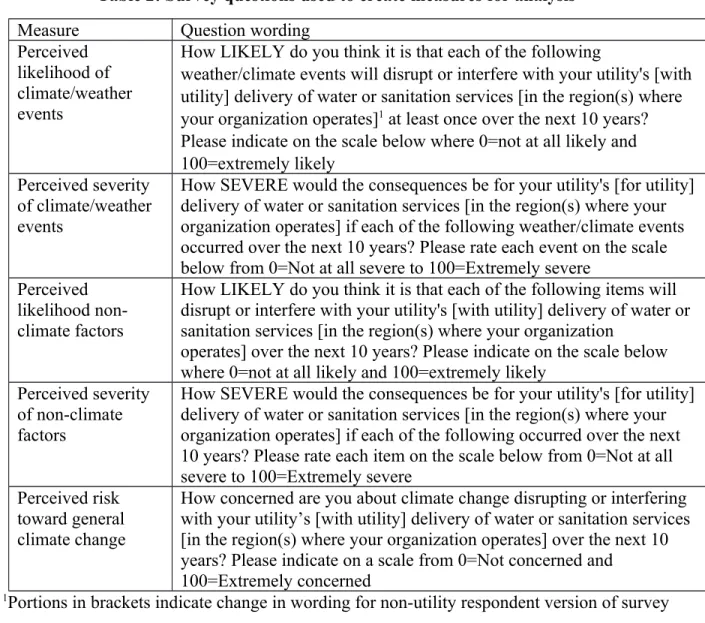
Table 2: Survey questions used to create measures for analysis
Measure Question wording
Perceived likelihood of climate/weather events
How LIKELY do you think it is that each of the following
weather/climate events will disrupt or interfere with your utility's [with utility] delivery of water or sanitation services [in the region(s) where your organization operates]
1at least once over the next 10 years?
Please indicate on the scale below where 0=not at all likely and 100=extremely likely
Perceived severity of climate/weather events
How SEVERE would the consequences be for your utility's [for utility]
delivery of water or sanitation services [in the region(s) where your organization operates] if each of the following weather/climate events occurred over the next 10 years? Please rate each event on the scale below from 0=Not at all severe to 100=Extremely severe
Perceived likelihood non- climate factors
How LIKELY do you think it is that each of the following items will disrupt or interfere with your utility's [with utility] delivery of water or sanitation services [in the region(s) where your organization
operates] over the next 10 years? Please indicate on the scale below where 0=not at all likely and 100=extremely likely
Perceived severity of non-climate factors
How SEVERE would the consequences be for your utility's [for utility]
delivery of water or sanitation services [in the region(s) where your organization operates] if each of the following occurred over the next 10 years? Please rate each item on the scale below from 0=Not at all severe to 100=Extremely severe
Perceived risk toward general climate change
How concerned are you about climate change disrupting or interfering with your utility’s [with utility] delivery of water or sanitation services [in the region(s) where your organization operates] over the next 10 years? Please indicate on a scale from 0=Not concerned and
100=Extremely concerned
1
Portions in brackets indicate change in wording for non-utility respondent version of survey Organization type
In order to compare the perceptions of utility and non-utility respondents, two different
versions of the survey were used: one for individuals who identified their organization type as a
water and/or wastewater utility and another for all others (non-utility professionals). The main
difference between the two survey versions was question wording; utility respondents were asked
about their perceptions of risk regarding the utility they work for, whereas non-utility respondents
were asked about their perceptions of risk regarding the utility or utilities in the region(s) where their organization operates (see Table 2 for question wording).
Respondents were asked to select the response that most accurately describes their organization from 13 options (including “Other” and “I prefer not to answer”). Respondents who selected an option other than water or wastewater utility were collapsed into one group of non- utility respondents. All utility and non-utility respondents answered questions regarding type and location of the organization they worked for, their position within their organization, perceived likelihood and perceived severity of various climate and non-climate factors, and overall climate change concern.
Risk Perception
Within the context of this study, risk is defined as, “the probability that exposure to a hazard will lead to negative consequences” (Ropeik & Gray 2002, p.4). The way in which an individual perceives and judges a risk is referred to as risk perception (Slovic & Weber, 2002).
Similar to Dow et al. (2007), our survey assessed both perceptions of the likelihood of a given event disrupting utility service over a ten-year planning window and the severity of the consequences if the event occurred. Perceived likelihood and severity were measured as continuous variables on a scale from 0=not at all likely/severe to 100=extremely likely/severe.
Measuring perceived likelihood and severity on the same scale allowed for these two dimensions of risk to be combined as a measure of risk perception. Risk perception toward event/factor C was calculated as follows:
[Equation 1]
Perceived likelihood of C disruptingutility service × Perceived severity of co sequences if C occurred
100
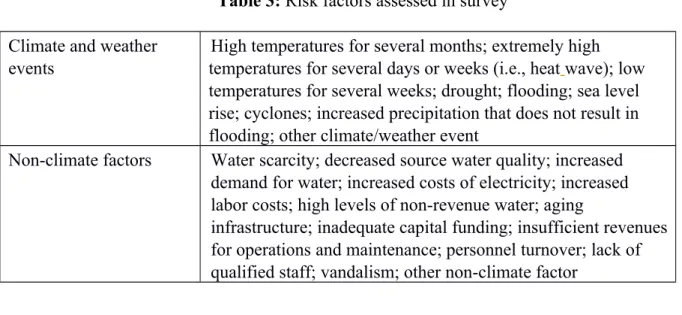
Risk perception toward each individual climate and weather event (Table 3) was calculated as shown in Equation 1 and then all the items were averaged to calculate overall risk perception toward weather and climate events. The climate and weather events included in the survey were identified through the systematic literature review (Section 2) and using climate projections for the region (Section 1). The items used to calculate overall risk perception were tested and found to have a scale reliability coefficient (Cronbach’s alpha value) of 0.914.
In order to compare risk perception toward specific climate/weather events to overall climate change concern, respondents were asked how concerned they are about climate change disrupting utility service over the next ten years (from 0=not concerned to 100=extremely
concerned). This second measure is referred to as general climate change concern throughout the paper.
Non-climate risk factors were included in the survey in order to understand the scope of
risks facing utilities and how they compare to climate risks. Risk perception was calculated for
each of the 13 non-climate factors (Table 3) as shown in Equation 1 and overall risk perception
toward non-climate factors is the average of the 13 risk perceptions (Cronbach’s alpha=0.93). The
non-climate factors included in the survey were identified during the systematic literature review
(Section 2). In order to capture risk factors not identified in the literature review, respondents
were given the option to provide their own “other” climate/weather event and/or non-climate
factor that they thought posed a risk to utility service. All data analysis was completed using Stata
statistical software (StataCorp, 2015).
Table 3: Risk factors assessed in survey
Climate and weather events
High temperatures for several months; extremely high temperatures for several days or weeks (i.e., heat wave); low temperatures for several weeks; drought; flooding; sea level rise; cyclones; increased precipitation that does not result in flooding; other climate/weather event
Non-climate factors Water scarcity; decreased source water quality; increased demand for water; increased costs of electricity; increased labor costs; high levels of non-revenue water; aging
infrastructure; inadequate capital funding; insufficient revenues for operations and maintenance; personnel turnover; lack of qualified staff; vandalism; other non-climate factor
Survey sample
During the February 2016 AfWA Congress in Nairobi, Kenya, the survey was emailed
(via Qualtrics) to all attendees who provided an email address when registering for the congress
(n=807). The survey was also advertised in congress sessions and on fliers distributed at the
congress to encourage completion. Respondents had the option to take the survey in either
English or French. Congress attendees were initially contacted at the beginning of the congress
and those who had not completed the survey received four reminder emails. Late registrants
(n=228) were initially emailed on the second day of the congress and received two reminder
emails. The University of North Carolina’s Internal Review Board approved the research prior to
implementation of the survey (study #16-0389) and each respondent was required to provide
informed consent.
Survey Results
Responses were collected February 22
ndthrough March 5
th, 20167. We had an overall response rate of 18% (n=149) and the 90 fully completed surveys are included in this analysis.
Water sector professionals are most concerned about the impacts of drought on utilities, followed by increased water demand and water scarcity. Overall, average risk perception toward climate and weather events is lower than average risk perception across the 13 non-climate factors.
However, respondents tended to rate their general concern over climate change impacts on utilities closer to ‘extremely’ concerned than not at all concerned. Finally, non-utility
professionals perceive greater risk from the impacts of climate and weather events on utilities than do utility professionals.
Table 4: Survey Respondent Characteristics Respondent Characteristic Number of respondents (%) Utility professional
Type of utility:
Water Wastewater Both
43 (48) 14 (33) 0 29 (67) Non-utility respondents
Type of organization:
Government agency University/think tank
Non-governmental organization International donor organization Consulting firm
Regulatory agency Other
47 (52) 9 (10) 7 (8) 6 (7) 6 (7) 5 (5) 4 (4) 11 (10) Location where respondent works
Sub-Saharan Africa Kenya Other region Unspecified
67 (74)
50 (56)
8 (9)
15 (17)
Respondent Characteristics
The proportion of respondents that work for a utility (48%) and for an organization other than a utility (52%) is nearly equal (Table 4). The majority of utility respondents (67%) work for a utility that provides both water and wastewater services. Most respondents (74%) work in one or more countries in Sub-Saharan Africa and more than half of all respondents (56%) work in Kenya, where the African Water Congress was held.
Comparison of Climate and Non-climate Risk Perceptions
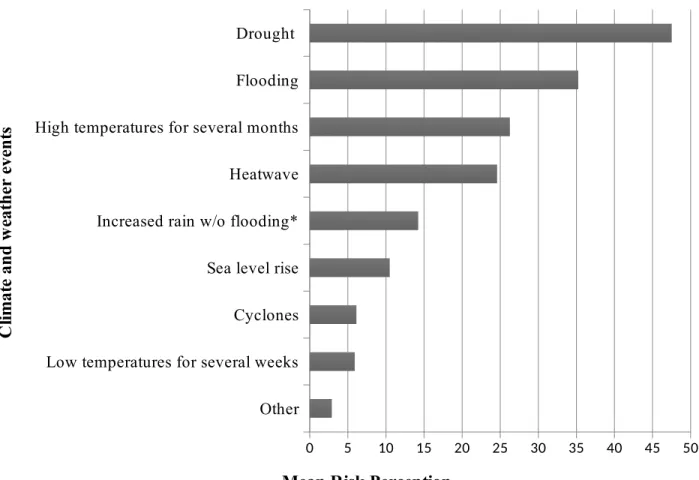
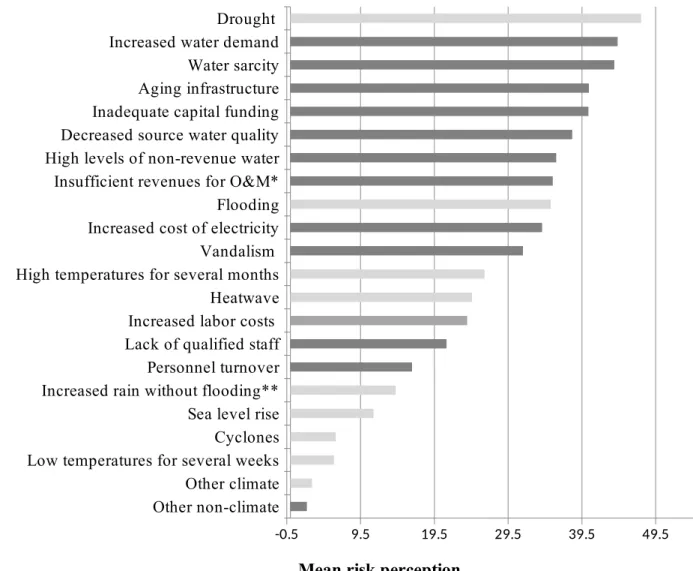
Water sector professionals had the highest average risk perception toward drought (μ=47.5, σ=36) and flooding (μ=35.3, σ=34.1) out of all the climate and weather events (Fig. 2).
Of the included climate and weather events, respondents were least concerned about low
temperatures (μ=5.9, σ=15.8). Average risk perception across all climate/weather events was 19.3 (σ=17.5) out of a maximum possible 100 points. The average value for concern over general climate change impacts on utilities was 75.7 (σ=23.4) out of 100, meaning that respondents were more likely to be extremely concerned about climate change, as opposed to not at all concerned.
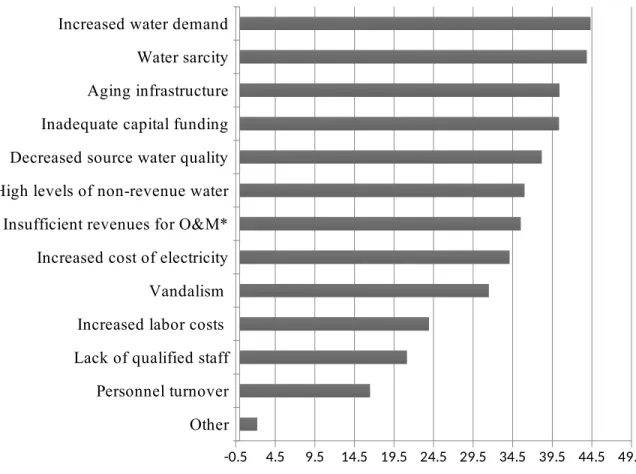
Given that utilities face risks extending beyond climate and weather events, risk perceptions of water sector professionals toward twelve different non-climate factors that may disrupt utility service were measured. Water sector professionals had the highest perceived risk toward increased water demand (μ=44.3, σ=34.8), closely followed by water scarcity (μ=43.9, σ=36.6) out of all the non-climate factors (Fig. 3). Of the non-climate factors included in the survey, respondents had the lowest perceived risk toward personnel turnover (μ=16.5, σ=24.8).
Average risk perception toward all non-climate factors was 31.4 (σ=24.3) out of a possible 100
points.
To better understand how risk perceptions toward climate and weather events compare to perceptions of non-climate risks across all respondents, all risk factors (20 in total plus ‘other’
climate and non-climate) were ranked according to level of risk perception (Fig. 4). Average risk perception toward non-climate factors was significantly higher than average risk perception toward climate and weather events (31.4 vs. 19.3, t(178)=3.84, p<0.001). Of the ten factors with the highest risk perception scores, only two (drought and flooding) were climate/weather events.
In contrast, four of the five factors with the lowest risk perception scores were climate and weather events. Drought was the most concerning factor overall, followed by increased water demand and water scarcity, indicating high perceptions of risk toward issues related to water quantity and availability.
Comparison of utility and non-utility risk perceptions
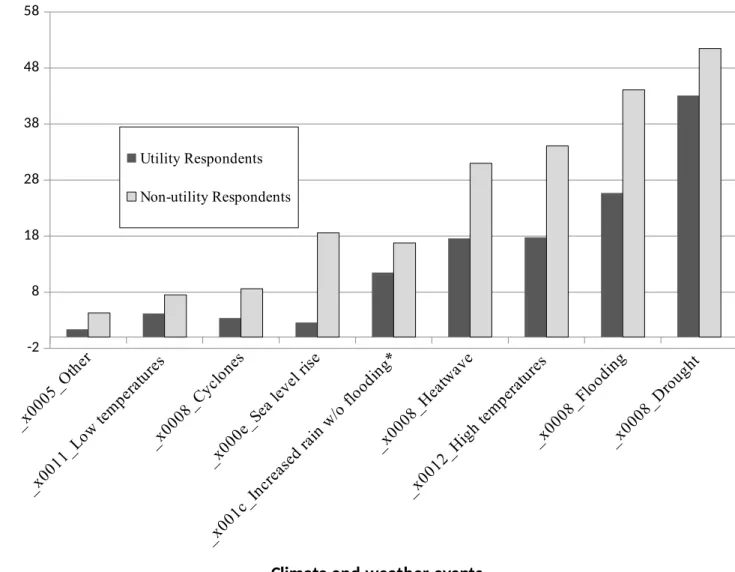
To establish whether risk perceptions of respondents who work for a water/wastewater utility differ from those of other (non-utility) water professionals, the responses of the two groups were separated. Non-utility respondents reported higher perceptions of risk toward each climate and weather event than the utility respondents (Fig. 5). Additionally, average risk perception toward climate/weather events was significantly higher among non-utility respondents than utility respondents (24 vs. 14.1, t(88)=2.75, p<0.01). This same pattern was also observed in the
question assessing general climate change concern; average non-utility concern over general
climate change impact on utilities (μ=80.3, σ=19.3) was greater than that of utility respondents
(μ=70.6, σ=26.6; t(88)=2, p<0.05). There was a statistically significant ten-point difference
between utility and non-utility averages for both general climate change concern and average
climate/weather event risk perception.
Other Low temperatures for several weeks Cyclones Sea level rise Increased rain w/o flooding*
Heatwave High temperatures for several months Flooding Drought
0 5 10 15 20 25 30 35 40 45 50
Mean Risk Perception
C lim at e an d w ea th er e ve n ts
Figure 2: Mean risk perception of water sector professionals toward climate and weather events disrupting utility service (n=90). Risk perception measured on a scale from 0 to 100 and
calculated as: (mean perceived likelihood of climate event x mean perceived severity of climate event)/100. Overall risk perception toward weather and climate events is 19.3/100 (σ=17.5). The lines on each bar represent the 95% confidence interval.
*Increased precipitation that does not result in flooding
Other Personnel turnover Lack of qualified staff Increased labor costs Vandalism Increased cost of electricity Insufficient revenues for O&M*
High levels of non-revenue water Decreased source water quality Inadequate capital funding Aging infrastructure Water sarcity Increased water demand
-0.5 4.5 9.5 14.5 19.5 24.5 29.5 34.5 39.5 44.5 49.5