Understanding attitudes to priorities at side road junctions
Jonathan Flower
*, John Parkin
University of the West of England (UWE Bristol), Frenchay Campus, Coldharbour Lane, Bristol BS16 1QY, United Kingdom
a r t i c l e i n f o
Article history:
Received 19 November 2018 Accepted 10 January 2019
a b s t r a c t
Junctions are places of interaction and hence conflict for all road users. Two thirds of all collisions in built up areas occur at junctions, with pedestrians and cyclists being most at risk.
The aim of the research is to investigate the attitudes to change, and likely behaviour at junctions, of all types of road users, were a general and unambiguous duty to ‘give way on turning’ to be introduced in the UK context. Q-methodology was used because it is good at capturing and describing divergent views and also consensus.
Q-mode factor analysis was used and revealed five groups with common perspectives, as follows: optimistic experienced drivers, pessimistic regular cyclists, realistic multi-modals, altruistic pedestrians and the pragmatic sustainably mobile. Differences between groups centred on which road user types should be the prime focus of junction improvements, the relative importance of safety and time saving, and the amount of effort required to implement change. There was a strong consensus between the groups that no level of injury and death at road junctions is acceptable, and that regulation changes should be made. Funding for awareness raising, and supporting any regulation change with concomi-tant design changes to the physical layout of junctions is also imporconcomi-tant.
There is a consistency of opinion across all groups of road users that the lack of alignment between design and regulation, and lack of compliance with the regulations are not accept-able. Each grouping of respondents thought that it is appropriate to make junctions safe for all, and more attractive and convenient for those that are currently the most at risk. There are practical changes that policy makers and practitioners could and should make. Change in regulations could be undertaken, but it would need to be supported by the following: public awareness raising campaigns; infrastructure design changes; funding; and enforcement.
Ó2019 The Authors. Published by Elsevier Ltd. This is an open access article under the CC BY license (http://creativecommons.org/licenses/by/4.0/).
1. Introduction
Walking and cycling, which may be combined with the use of public transport (Gerike et al., 2016), not only support pub-lic health objectives, but can also improve the overall quality of life due to their minimal consumption of transport infras-tructure space and energy, and minimal production of air pollution and noise. Walking and cycling need to be safe, convenient and practical ways to move around.
The public realm may provide separated space for different road users (e.g. a footway for pedestrians to use, or a cycle track for cyclists to use). However, there are points at which users need to cross each other. Whatever design solutions are employed, all modes have to interact in some way at road junctions. Interactions are a primary source of risk, with
https://doi.org/10.1016/j.trf.2019.01.005
1369-8478/Ó2019 The Authors. Published by Elsevier Ltd.
This is an open access article under the CC BY license (http://creativecommons.org/licenses/by/4.0/). * Corresponding author.
E-mail addresses:[email protected](J. Flower),[email protected](J. Parkin). Contents lists available atScienceDirect
Transportation Research Part F
pedestrians and cyclists being among the most exposed road users. Even if designers understand their own intent in relation to a junction layout, road users may not. Where there are different design approaches adopted for circumstances that are not dissimilar to each other, road users may become confused by seemingly contradictory requirements about how they might behave.
There has been significant development in standards, guidance and statutory instruments in relation to highway design for walking and cycling in the last few years in the UK and indeed in Northern Europe and North America (Transport for London, 2014;Highways England, 2016; Welsh Assembly Government, 2014; National Association of City Transportation Officials, 2013; CROW, 2016). These developments inevitably create new and different designs which may not be familiar to users.
In the UK, the rules relating to junctions have not changed significantly for decades. There are fourteen rules in the High-way Code (rules 170–183,Department of Transport, 2015) that relate to junctions. There is ambiguity, however, in relation to how drivers are meant to treat cyclists crossing the mouth of a side road when the cyclist is on a shared use footway or cycle track adjacent to the carriageway. Also leading to ambiguity is the different strength of requirement as manifest in the way the rules are expressed (‘should’, ‘must’, ‘watch out’ and ‘take care’). There appears to be a lesser requirement to give way to pedestrians and cyclists (‘‘you should watch out for cyclists/pedestrians”) as compared with the obligation to avoid colliding with other vehicles (‘‘you MUST [capitals in original] give way to traffic on the main road”). These ambiguities may result in road user behaviour that largely knows and follows the ‘obligations’ (must), but generally ignores or is unaware of the ‘sug-gestions’ (should). Similar ambiguity exists in other countries (Figliozzi & Tipagornwong, 2016) and this is a UK case study of an international problem.
Importantly, much junction design fails to support the rules in the Highway Code (pp. 50–51,Jones, 2016). An example is a wide mouthed side road with generous kerb radii which do not encourage lower speeds. Drivers may be encouraged to turn at speed, and consequentially be less likely to follow the rules that they should give way to pedestrians or cyclists crossing the side road (Rules 170 and 183,Department of Transport, 2015).
Behaviour in the public realm, including at junctions, is influenced by the law and regulation (Björklund, Åberg, Dalarna, & Utbildning, 2005; Friedman, 2016), and by the design of infrastructure and the wider environment (Bassani, Dalmazzo, Marinelli, & Cirillo, 2014; Gehl, 2011). In the long run, the way that regulation is developed is, in turn, influenced by beha-viour (Bjørnskau, 2017), and the environment. Also, in the long run, the way the environment is built for road users is influ-enced by behaviour and its regulation. While individual linkages have been the subject of research, the complete set of inter-relations is an under-researched area. This research focuses on these inter-inter-relations at side road junctions from the perspec-tive of all road users at junctions.
There is an immediate interest in understanding these inter-relationships as a result of a proposal for a universal duty to give way when turning into or out of a side road (Jones, 2016, 2017). The point of these changes is to enhance safety while not compromising expeditious use of the junction.
People think they look before making a manoeuvre such as crossing a side road, but they often only look in response to hearing an approaching vehicle, and when nothing is heard there can be a tendency to cross without looking (Stelling-Kon´czak, Hagenzieker, Commandeur, Agterberg, & van Wee, 2016). The rise of electric vehicles and e-bikes could create addi-tional risks in relation to priority junctions in the future.
The aim of the research is to investigate the attitudes to change, and likely behaviour at junctions, of all road users, whether turning or proceeding straight on, were a general and unambiguous duty to ‘give way on turning’ to be introduced. The aim is supported by the following research questions:
(1) Are there different typologies of road user in relation to their assessments of safety and expediency behaviours at side road junctions?
(2) How do road users assess safety and expediency behaviours at side road junctions under current regulations compared with a general duty to give way on turning?
(3) What road user behaviour issues may need to be addressed should the general duty be brought into effect? (4) How can the concerns of specific road user groups, such as disabled people, be addressed?
Section 2describes the methodology.Section 3presents the results andSection 4discusses the results. Conclusions are drawn inSection 5.
2. Methodology
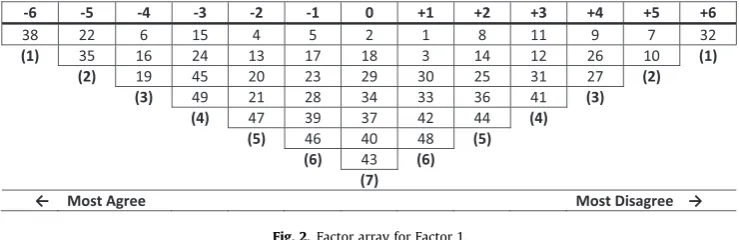
Statements are ranked within a predefined grid (the Q-grid) in one of thirteen categories from most agree to most dis-agree (the Q-sort). The central neutral category takes seven statements, with six statements in the adjoining categories, and then one less in each subsequent category until only one statement is allowed to be placed in the most extreme cate-gories.Fig. 1shows a participant selecting statements to place in the predefined grid.
The 49 statements covered: current behaviour of drivers, cyclists and pedestrians at junctions; potential changes to junc-tion regulajunc-tions; and possible changes in behaviour based on a change in juncjunc-tion regulajunc-tion.
The statements (the Q-set) were drawn primarily from a variety of road user specific discussion forums relating to the subject area of road user interactions (Cycling, 2017; Motoring.co.uk, 2017; Open Democracy, 2017; Road.cc, 2017). Six experts drawn from academia and practice were asked to review the statements to ensure they were reasonably self-explanatory, and to check that they covered the range of possible views.
Q-studies only require sufficient respondents to determine the existence of common groupings (Brown, 1980), and they do not establish the proportion of the population that belongs to a particular grouping. Therefore, a purposeful sample of forty-one respondents was recruited that ensured a suitable gender split (nineteen female), age profile (range 18 to 82, mean 52), and range of ability (including wheelchair users, pushchair users, people walking with children, and visually impaired people). So far as road user types is concerned, thirty-seven walked (eleven daily), thirty-two cycled (thirteen daily), and thirty-two used the bus (one daily). Thirty-four were car drivers, but three had stopped due to impairment. There were two motor-cycle licence holders. The mean number of years since passing the driving test was thirty-three years, with the range being six weeks to fifty-seven years.
The survey took place between the 2nd and 23rd July 2018. The concept of giving way on turning at junctions was intro-duced to respondents via a slide presentation and video clips to explain the current regulations in the UK, design options, and examples from countries with different (and often stronger) give way on turning regulations (the Netherlands, Austria, Ire-land, Germany and California, USA).
Measures were taken to ensure that visually impaired respondents could access the materials. Physical accessibility was addressed for those with mobility impairments and toys were provided for participants attending with children. Participants attended up to three at a time for the presentation, but statement sorting was completed individually, and respondents were asked initially to divide the forty-nine statements, printed on A4 sheets of paper, into three piles (agree, neutral, disagree). They were asked then to transfer statements onto the Q-grid.
Following the Q-sort, each participant was interviewed to elicit reasons behind their ranking, and to ask about driving experience and frequency of use of other modes for local journeys. All participants were asked whether or not they walked with children or used pushchairs.
3. Results
Q-mode factor analysis is the process of reducing a set of Q-sorts to a smaller number of composite sorts, called factors. These factors are created from groups of similar sorts, which hence represent the views of individuals who ranked the Q-statements in similar ways. The first step is to identify sorts that are closely associated with each other. The second step is to create the factors from these closely associated, or defining, sorts. The factor loading is defined as the correlation coefficient between the individual sort and the composite sort.
[image:3.544.171.377.484.673.2]The reduction to factors should maintain the maximum amount of variance contained in the original sorts. It should also create a number of factors which are useful in representing the attitudes of the respondents. Ideally a solution will include
the maximum number of individual sorts, and also have few sorts which confound (that is, significantly correlate to more than one factor).
Factor-analysis was undertaken using PQMethod software (Schmolck, 2015). Seven factors were initially extracted and 36 of the sorts loaded significantly (at the p < 0.01 level), four respondents’ sorts were dismissed due to confounding with other factors and one respondent’s sort failed to load significantly with any of the factors, as it bore no obvious correlation to any of them. This initial solution, which accounted for 48% of the total study variance, would ordinarily be considered a sound solu-tion as a result of accounting for more than 35–40% of the variance (Kline, 1994). However, with 35 of the sorts loading sig-nificantly for one factor, the solution goes a long way to helping to understand the shared views of many of the participants, but it does little to tease out the nuances of any potential differences between the respondents. Further, one factor had only one defining sort, whereas in Q-methodology it is considered good practice only to consider factors with two or more defin-ing sorts (Brown, 1980).
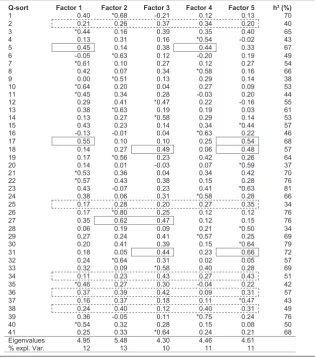
For these reasons and to explore the differences in greater detail, it is possible to adopt a statistical technique called vari-max rotation (Dilbeck, 2017). Varivari-max rotation is a technique that vari-maximises the variance between the factors.Table 1 shows the results of the factor analysis using varimax rotation.
The h2(%) is the percentage of the variance in each Q-sort that is accounted for by the five factors and is calculated as the
sum of the squares of the factor loadings for a particular Q-sort. The eigenvalue is the sum of the squares of the loadings of each of the Q-sorts on that factor (the values in each column). It can then be used to calculate the percentage of study vari-ance explained by each factor.
[image:4.544.112.428.316.676.2]A confounded Q-sort is one that loaded significantly for more than one factor. To reduce the number of confounded sorts, a cut-off correlation of 0.44 rather than 0.37 (the significant factor loading, p < 0.01) was adopted.
Table 1
Factor loadings using Varimax rotation.
*
Factor 1 has eight defining sorts, Factor 2 seven, Factor 3 four, Factor 4 six and Factor 5 six. Each factor defines between 10 and 13% of the study variance respectively and 58% in total. The defining sorts are merged using weighted averaging to form a factor array, or composite Q-sort (higher loading sorts are given more weight since they better exemplify the factor). The resulting factor array for Factor 1 is shown inFig. 2.
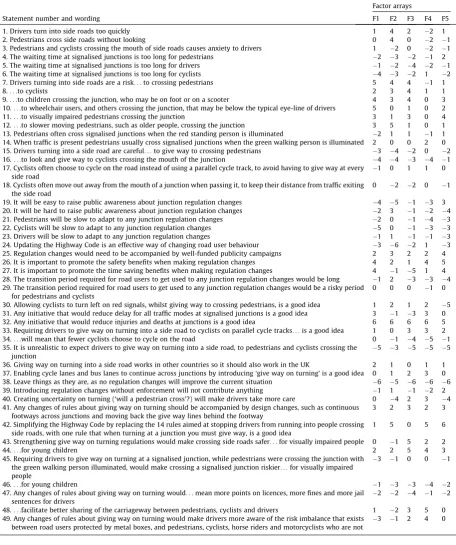
The factor arrays for all five factors and the 49 statements are shown inTable 2.
3.1. Factor Interpretations
The five resulting groupings from the factor analysis and their defining sorts have been analysed. They are presented in Table 3with demographic summaries of the participants.
Appendix Aprovides greater detail in the form of the rankings for the factors and also the comments made by participants which help interpret the reasons for their choices. We summarise the groupings as follows, under appropriate headings for each grouping.
3.1.1. Factor 1 – optimistic
This group have an optimistic outlook. They are sure that road users will be quick to adapt to changes and that the UK can learn from other countries with stronger give way on turning rules. The participants that made up the defining sorts for Fac-tor 1 are experienced drivers that make some local journeys on foot.
3.1.2. Factor 2 – pessimistic
This group have the most pessimistic outlook. They view the issues mainly from a cyclist’s perspective. They feel that rais-ing public awareness about changes will be difficult. They are all cyclists, predominantly regular cyclists, who also drive.
3.1.3. Factor 3 – realistic
This group are realistic that, in time, change could happen and that drivers could and would adapt. They are the most multi-modal, using a mode other than a car daily, mixing modes (car, bike, foot and bus) day to day, and are the most likely to walk with children.
3.1.4. Factor 4 – altruistic
This group are altruistic. They are optimistic that positive change will happen and seek the well-being of all, not just themselves. They walk for local journeys. They are the only group that included a motorcyclist.
3.1.5. Factor 5 – pragmatic
This group are pragmatic. They think that although change could be fast, it needs funding and enforcement. They orien-tate towards using more sustainable forms of mobility, are the youngest group and the least likely to drive.
3.2. Consensus
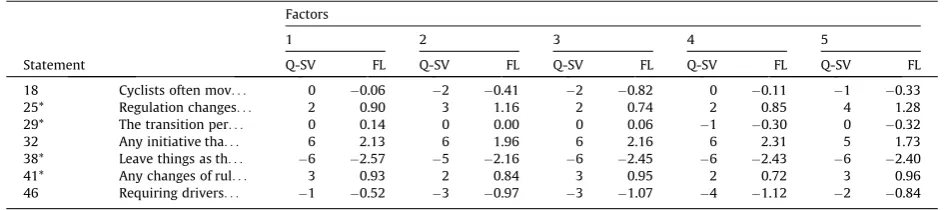
Although each of the factors illustrates a distinct perspective there is some clear consensus between them as shown in Table 4.
All participants, to varying extents were in agreement about the following statements:
Any initiative that would reduce injuries and deaths at junctions is a good idea very (very strong agree: +6, except Factor 5, +5)
Leave things as they are, as no regulation changes will improve the current situation (very strong disagree: 6, except Factor 2, 5)
Regulation changes would need to be accompanied by well-funded publicity campaigns (strong agree: +4/+3/+2)
-6 -5 -4 -3 -2 -1 0 +1 +2 +3 +4 +5 +6
38 22 6 15 4 5 2 1 8 11 9 7 32
(1) 35 16 24 13 17 18 3 14 12 26 10 (1)
(2) 19 45 20 23 29 30 25 31 27 (2)
(3) 49 21 28 34 33 36 41 (3)
(4) 47 39 37 42 44 (4)
(5) 46 40 48 (5)
(6) 43 (6)
(7)
[image:5.544.89.459.54.174.2]← Most Agree Most Disagree →
Any changes of rules about giving way on turning should be accompanied by design changes, such as continuous foot-ways across junctions and moving back the give way lines behind the footway (agree: +3/+2)
Requiring drivers to give way on turning at a signalised junction, while pedestrians were crossing the junction with the green walking person illuminated, would make crossing a signalised junction riskier for young children (disagree:
1/ 2/ 3/ 4)
[image:6.544.43.500.73.619.2]The transition period required for road users to get used to any junction regulation changes would be a risky period for pedestrians and cyclists (ambivalent: 0/ 1).
Table 2
Composition of factor arrays for five study factors.
Factor arrays
Statement number and wording F1 F2 F3 F4 F5
1. Drivers turn into side roads too quickly 1 4 2 2 1
2. Pedestrians cross side roads without looking 0 4 0 2 1
3. Pedestrians and cyclists crossing the mouth of side roads causes anxiety to drivers 1 2 0 2 1 4. The waiting time at signalised junctions is too long for pedestrians 2 3 2 1 2
5. The waiting time at signalised junctions is too long for drivers 1 2 4 2 1
6. The waiting time at signalised junctions is too long for cyclists 4 3 2 1 2
7. Drivers turning into side roads are a risk. . .to crossing pedestrians 5 4 4 1 1
8.. . .to cyclists 2 3 4 1 1
9.. . .to children crossing the junction, who may be on foot or on a scooter 4 3 4 0 3
10.. . .to wheelchair users, and others crossing the junction, that may be below the typical eye-line of drivers 5 0 1 0 2
11.. . .to visually impaired pedestrians crossing the junction 3 1 3 0 4
12.. . .to slower moving pedestrians, such as older people, crossing the junction 3 5 1 0 1
13. Pedestrians often cross signalised junctions when the red standing person is illuminated 2 1 1 1 1 14. When traffic is present pedestrians usually cross signalised junctions when the green walking person is illuminated 2 0 0 2 0 15. Drivers turning into a side road are careful. . .to give way to crossing pedestrians 3 4 2 0 2
16.. . .to look and give way to cyclists crossing the mouth of the junction 4 4 3 4 1
17. Cyclists often choose to cycle on the road instead of using a parallel cycle track, to avoid having to give way at every side road
1 0 1 1 0
18. Cyclists often move out away from the mouth of a junction when passing it, to keep their distance from traffic exiting the side road
0 2 2 0 1
19. It will be easy to raise public awareness about junction regulation changes 4 5 1 3 3 20. It will be hard to raise public awareness about junction regulation changes 2 3 1 2 4 21. Pedestrians will be slow to adapt to any junction regulation changes 2 0 1 4 3
22. Cyclists will be slow to adapt to any junction regulation changes 5 0 1 3 3
23. Drivers will be slow to adapt to any junction regulation changes 1 1 1 1 3
24. Updating the Highway Code is an effective way of changing road user behaviour 3 6 2 1 3 25. Regulation changes would need to be accompanied by well-funded publicity campaigns 2 3 2 2 4 26. It is important to promote the safety benefits when making regulation changes 4 2 1 4 5 27. It is important to promote the time saving benefits when making regulation changes 4 1 5 1 4 28. The transition period required for road users to get used to any junction regulation changes would be long 1 2 3 3 4 29. The transition period required for road users to get used to any junction regulation changes would be a risky period
for pedestrians and cyclists
0 0 0 1 0
30. Allowing cyclists to turn left on red signals, whilst giving way to crossing pedestrians, is a good idea 1 2 1 2 5 31. Any initiative that would reduce delay for all traffic modes at signalised junctions is a good idea 3 1 3 3 0 32. Any initiative that would reduce injuries and deaths at junctions is a good idea 6 6 6 6 5 33. Requiring drivers to give way on turning into a side road to cyclists on parallel cycle tracks. . .is a good idea 1 0 3 3 2
34.. . .will mean that fewer cyclists choose to cycle on the road 0 1 4 5 1
35. It is unrealistic to expect drivers to give way on turning into a side road, to pedestrians and cyclists crossing the junction
5 3 5 5 5
36. Giving way on turning into a side road works in other countries so it should also work in the UK 2 1 0 1 1 37. Enabling cycle lanes and bus lanes to continue across junctions by introducing ‘give way on turning’ is a good idea 0 1 2 3 0 38. Leave things as they are, as no regulation changes will improve the current situation 6 5 6 6 6 39. Introducing regulation changes without enforcement will not contribute anything 1 1 1 2 2 40. Creating uncertainty on turning (‘will a pedestrian cross’?) will make drivers take more care 0 4 2 3 4 41. Any changes of rules about giving way on turning should be accompanied by design changes, such as continuous
footways across junctions and moving back the give way lines behind the footway
3 2 3 2 3
42. Simplifying the Highway Code by replacing the 14 rules aimed at stopping drivers from running into people crossing side roads, with one rule that when turning at a junction you must give way, is a good idea
1 5 0 5 6
43. Strengthening give way on turning regulations would make crossing side roads safer. . .for visually impaired people 0 1 5 2 2
44.. . .for young children 2 2 5 4 3
45. Requiring drivers to give way on turning at a signalised junction, while pedestrians were crossing the junction with the green walking person illuminated, would make crossing a signalised junction riskier. . .for visually impaired people
3 1 0 0 1
46.. . .for young children 1 3 3 4 2
47. Any changes of rules about giving way on turning would. . .mean more points on licences, more fines and more jail sentences for drivers
2 2 4 1 2
48.. . .facilitate better sharing of the carriageway between pedestrians, cyclists and drivers 1 2 3 5 0
49. Any changes of rules about giving way on turning would make drivers more aware of the risk imbalance that exists between road users protected by metal boxes, and pedestrians, cyclists, horse riders and motorcyclists who are not
It is clear that there is very considerable consensus between the participants across the five factors that no level of injury and death at road junctions is acceptable and that regulation changes should be made. They also agree that a good level of funding for awareness raising about regulation changes is required and that supporting this with design changes is quite Table 3
Factors 1–5 compared.
Factor Description Eigenvalue & study
variance Demographics Factor 1 Optimistic Experienced drivers
Group with most driving experience (mean 38 years, from 9 to 57). These drivers also all walk for local journeys
4.95 explains 12%
n = 8,
3 Female/5 Male av. age: 58 years (26–76) People in group 1 think. . .that no collisions at junctions that cause injury or death are acceptable. Changes must be made, & drivers & cyclists will
adapt in a relatively short period of time. The UK can learn from the example of other countries that have stronger give way on turning regulations. Concerned about the vulnerability of pedestrians & other vulnerable users of the footways including those in wheelchairs & want to see safety improvements. More concerned about seeing improvements for pedestrians than cyclists
Factor 2 Pessimistic Regular cyclists
Group most dedicated to cycling & least likely to make local journeys on foot or bus due to bike’s convenience & speed
5.48 explains 13%
n = 7
5 female/2 male av. age: 52 years (30–68) People in group 2 think. . .that no collisions at junctions that cause injury or death are acceptable & simplifying the Highway Code’s rules on
junctions would be a good starting point. Changes must be made, but while they acknowledge that raising public awareness will be very difficult, they are ambivalent as to how much time it will take to change road user behaviour. Highway Code changes alone will not change behaviour. They see both the current situation & possible future changes principally from a cyclist’s perspective, including the risks that drivers pose to cyclists & pedestrians, & the hazard that pedestrians may cause for other road users
Factor 3 Realistic Multi modals
All use modes other than the car daily & are the group most likely to walk with children 4.30 explains 10%
n = 4
1 female/3 male av. age 56 years (22–72) People in group 3 think. . .that no collisions at junctions that cause injury or death are acceptable. They put a strong emphasis on safety, with a
particular concern for improving safety for children, visually impaired people & cyclists. Time saving benefits are not important. Regulation changes must be made, & the prospect of change is realistic. Drivers could & would adapt without significant detrimental effects to themselves
Factor 4 Altruistic Pedestrians
All walk for local journeys even if it is not their main mode. Two walk daily. Only group with someone that rides a motorcycle
4.46 explains 11%
n = 6
3 female/3 male av. age 46 years (20–71) People in group 4 think. . .that no collisions at junctions that cause injury or death are acceptable. Simplifying the Highway Code’s rules on junctions
would be a good starting point. Regulation changes must be made, & they are optimistic not only that change is possible, but that it will help create better & safer streets for all, with different road users behaving in a more socially responsible way. There would be better sharing of the streets by different road users, & road users would become more considerate & more understanding of the needs of others. Generally, see the best in others & are happy to see improvements that would benefit others & not just themselves
Factor 5 The Pragmatic Sustainably mobile
Youngest group are the least likely to drive & tend towards more sustainable transport. All walk & bus for local journeys
4.61 explains 11%
n = 6
3 female/3 male av. age 45 years (18–62)
People in group 5 think. . .that simplifying the Highway Code’s rules on junctions is a priority. They place high importance on safety. No level of injury & death on the roads is acceptable. The welfare of the most vulnerable road users, especially visually impaired people is of high importance. Regulation changes must be made, & they are optimistic not only that change is possible, but also that public awareness of changes can be achieved relatively quickly. This should be well funded & accompanied by enforcement. The safety benefits of changes need to be promoted. It is not appropriate to change rules so that cyclists are permitted to turn left on red signals.
Table 4
Q-sort values and factor loadings of consensus statements that do not distinguish between any pair of factors.
Factors
1 2 3 4 5
Statement Q-SV FL Q-SV FL Q-SV FL Q-SV FL Q-SV FL
18 Cyclists often mov. . . 0 0.06 2 0.41 2 0.82 0 0.11 1 0.33
25* Regulation changes. . . 2 0.90 3 1.16 2 0.74 2 0.85 4 1.28
29* The transition per. . . 0 0.14 0 0.00 0 0.06 1 0.30 0 0.32
32 Any initiative tha. . . 6 2.13 6 1.96 6 2.16 6 2.31 5 1.73
38* Leave things as th. . . 6 2.57 5 2.16 6 2.45 6 2.43 6 2.40
41* Any changes of rul. . . 3 0.93 2 0.84 3 0.95 2 0.72 3 0.96
46 Requiring drivers. . . 1 0.52 3 0.97 3 1.07 4 1.12 2 0.84
[image:7.544.38.511.520.625.2]important. They are ambivalent about the idea that the transition period would be a risky time for pedestrians and cyclists. They feel that regulation changes at signalised junctions would not create additional risks for young children.
4. Discussion
We have identified five distinct factors, each representing a multifaceted construct of road-user experiences at junctions. Hence, we have answered our first research question: there are different typologies of road user in relation to their assess-ments of safety and expediency behaviours at side road junctions.
In terms of the relation between safety and efficiency (research question 2), safety was almost always prioritised over time savings and efficiency. This runs counter to current regulations, junction designs and motor-normativity (Walker, Tapp, & Davis, forthcoming) in modern culture which in practice allow for an acceptable level of casualties in exchange for speed and the convenience of those who use private motorised vehicles. One participant expressed it as follows:
‘‘For me it is all about safety, waiting times are not important. Hitting and killing people is completely unacceptable. Over the last 50 years we have become a car dominated culture, with cars seen as a way for people to have freedom. It needs to be reined in a bit. I am not seeking to punish motorists, but we should seek improved quality of life for everyone. This will mean that motorists have to take a hit.”
There was also evidence of annoyance with road users who undertake actions which could be detrimental to safety. Another participant said: ‘‘I get annoyed when pedestrians have things in their ears as it is bad for cyclists and drivers.” While this might mean that pedestrians fail to hear bicycle bells or approaching cars, this might suggest another reason for changing regulations at junctions. It is perhaps unreasonable to expect all pedestrians and cyclists to be able to hear and some vehicles including bicycles and electric cars can approach almost silently.
Road user behaviour issues that need to be addressed (research question 3) revolve around the relations between differ-ent types of road users. Some participants made it clear that there can be a great deal of antipathy between differdiffer-ent groups of road users. This seems to particularly frequently involve cyclists. There were driver and pedestrian participants who explicitly expressed their animosity towards cyclists. There were also cyclist participants who expressed their hostility towards drivers. Most people use a variety of modes, but at the time of their comments the participants were identifying themselves with a particular mode. Additionally, the two motorcyclists complained that cyclists get too much attention in terms of funding and infrastructure while motorcyclists are the most vulnerable in terms of casualty rates. In order to overcome this mutual antipathy, one way forward would be to introduce and promote changes at junctions by introducing measures targeted primarily at pedestrians.
Putting the focus of change on pedestrians would bring the greatest benefit and potentially support, as almost all use junc-tions in this capacity. Simultaneously, improved junction designs and regulajunc-tions could also bring benefit to other road users including different impairment groups, cyclists, motorcyclists and, particularly at four-way signalised junctions, drivers.
In terms of the views of disabled people (research question 4), there was no obviously distinct view of visually impaired participants or wheelchair users who contributed defining sorts to all five factors. Some of these people drew on experiences from times when they were able to drive or cycle independently. The viewpoints of the five groupings did not easily relate to a particular road user group, age, gender or experience.
There is a clear discrepancy between the behaviour that the 14 junction rules in the Highway Code (Rules 170–183, Department of Transport, 2015) is framing, the behaviour that infrastructure design is prompting and the practice of road users. Not all street infrastructure design encourages behaviour that is compliant with current regulations, and some regulations are not generally known or clear to road-users, or not fit for purpose. There can therefore be a misalignment between what is the intention of the law and what is practised by road users at junctions. One participant expressed frustration as follows:
‘‘The thing that gets me are the wide mouths of junctions. In the snow recently, I saw how narrow the used road could be. Made me think of how we could give far more space to pedestrians.”
Street design nudges road users to go fast or slow, to stop or give way, and to look out for, or to ignore, other road users. It would be reasonable to expect infrastructure to promote compliance with laws and regulations, but sometimes it does the opposite. Another participant noted the following:
‘‘If design and regulations are addressed and they get it right, then the rest will follow. I believe that the behaviour of all road users would be influenced by this and they would change their behaviour.”
Ideally, infrastructure will encourage behaviour compliant with regulations, and those regulations will be widely known and adhered to. Many international contexts could benefit from better alignment between highway regulations and infras-tructure design.
5. Conclusion
This study has identified five different types of road user in relation to the introduction of a general duty to give way on turning. These groupings were as follows: optimistic experienced drivers; pessimistic regular cyclists; realistic users of all modes; altruistic pedestrians; and pragmatic road users who are sustainably mobile.
There is a consistency of opinion across all groups of road users that the lack of alignment between design and regulation, and lack of compliance with the regulations are not acceptable. The sample of respondents was small and purposeful and designed to span the full range of possible opinion. It is interesting to note however, that each grouping of respondents thought that it is appropriate to make junctions safe for all, and more attractive and convenient for those that are currently the most at risk.
It is concluded that there are practical changes that policy makers and practitioners could and should make. Change in regulations could be undertaken, but it would need to be supported by the following: public awareness raising campaigns; infrastructure design changes; funding; and enforcement. It would be beneficial to explore the three-way relationship between the law, infrastructure design and road-user behaviour more fully. This is part of on-going research that will develop a socio ecological model of road user behaviour.
Acknowledgements
The authors would like to thank Phil Jones (PJA), the author of the Turning the Corner report, which served as a launching point for this study, colleagues at UWE, Bristol that provided feedback on the Q-sort statements, all of those that have given freely of their time and participated in this study and Alistair Ledger (MSc Transport Planning student, UWE) who assisted with the participant trials, particularly on the days when we had numerous participants simultaneously, some of whom were visually impaired.
This research did not receive any specific grant from funding agencies in the public, commercial, or not-for-profit sectors.
Appendix A
[image:9.544.40.508.438.623.2]Defining statements by factor SeeTables 5–9.
Table 5
Factor 1 defining statements.
Optimistic, Experienced Drivers, Factor 1 statements (SeeTable 2for full list of statements)
Statements ranked at + 6/+5 (+6 = ‘most agree’): Statements ranked at 6/ 5 ( 6 = ‘most disagree’):
32/ Any initiative that would reduce injuries and deaths at junctions is a good idea (+6)
10/ Drivers turning. . .are a risk to wheelchair users 7/ Drivers turning into side roads are a risk to crossing pedestrians
38/ Leave things as they are, as no regulation changes will improve current situation ( 6)
35/ It is unrealistic to expect drivers to give way on turning into a side road. . .
22/ Cyclists will be slow to adapt to any junction regulation changes
Statements ranked higher by F1 than other factors: Statements ranked lower by F1 than other factors:
10/ Drivers turning. . .are a risk to wheelchair. . .s (+5) 7/ Drivers turning into side roads are a risk to crossing pedestrians (+5)
36/ Giving way on turning into a side road works in other countries so it should also work in the UK (+2)
22/ Cyclists will be slow to adapt to any junction regulation changes ( 5) 6/ The waiting time at signalised junctions is too long for cyclists ( 4) 45/ Requiring drivers to give way on turning at a signalised junction. . .would make crossing. . .riskier for visually impaired people ( 3)
49/ Any changes. . .would make drivers more aware of the risk imbalance that exists between road users. . .( 3)
13/ Pedestrians often cross signalised junctions when the red standing person is illuminated ( 2)
17/ Cyclists. . .choose to cycle on the road instead of. . .a parallel cycle track, to avoid. . .give way. . .( 1)
Factor 1, quotes from the defining sorts:
‘‘I think that time saving is less important, and that safety has to be the ultimate goal.”
‘‘Children absolutely excluded from doing anything. It is so unfair that children are shoved into cars to go half a mile. Roads are so unsafe. It is a tall order to get every child and young person on foot or on scooter to look out at every junction and driveway for traffic.”
‘‘Change is possible. You can do it; the example of previous drink and drive campaigns shows that something that was once acceptable has changed to something that we now accept you just don’t do. That is not just because you will be caught. There are multiple factors. People see that it makes good sense. People are willing to do things if they make good sense.”
Table 6
Factor 2 defining statements.
Pessimistic, Regular Cyclists, Factor 2 (SeeTable 2for full list of statements)
Statements ranked at + 6/+5 (+6 = ‘most agree’): Statements ranked at 6/ 5 ( 6 = ‘most disagree’):
32/ Any initiative that would reduce injuries and deaths at junctions is a good idea (+6)
42/ Simplifying the Highway Code by replacing the 14 rules. . .with one rule. . .
12/ Drivers turning into side roads are a risk to slower moving pedestrians. . .
24/ Updating the Highway Code is an effective way of changing road user behaviour ( 6)
38/ Leave things as they are, as no regulation changes will improve current situation
19/ It will be easy to raise public awareness about junction regulation changes
Statements ranked higher by F2 than other factors: Statements ranked lower by F2 than other factors:
12/ Drivers turning into side roads are a risk to. . .(+5) 1/ Drivers turn into side roads too quickly (+4) 2/ Pedestrians cross side roads without looking (+4) 20/ It will be hard to raise public awareness. . .(+3) 28/ The transition period. . .would be long (+2) 23/ Drivers will be slow to adapt. . .(+1) 21/ Pedestrians will be slow to adapt. . .(0) 22/ Cyclists will be slow to adapt. . .(0)
24/ Updating the Highway Code is an effective. . .( 6) 19/ It will be easy to raise public awareness. . .( 5) 15/. . .careful to give way to crossing pedestrians ( 4) 4/ The waiting time. . .is too long for pedestrians ( 3)
48/. . .changes. . .would facilitate better sharing of the carriageway. . .( 2) 43/ Strengthening. . .regulations would make crossing. . .safer for visually impaired people ( 1)
Factor 2, quotes from the defining sorts:
‘‘I was thinking about my kids and my husband who is a regular cyclist. I considered my personal experience of incidents that I have had with my kids with drivers when crossing side roads. I am also aware of my lack of knowledge of the Highway Code.”
‘‘My answers came a lot from my driving years before I was visually impaired, rather than my current experiences as a visually impaired rear tandem rider (I didn’t cycle when sighted).”
‘‘Mostly looking from a cyclist point of view. General experience of Bristol roads. Safety was important to me, not time saving. There are a lot of impatient people out there. The lack of people’s knowledge of the Highway Code came into play. You read it to pass your test and never pick it up again.” ‘‘I am a driver, a cyclist and now I have a daughter who is visually impaired, but I based most of my responses on being a cyclist.”
Table 7
Factor 3 defining statements.
Realistic, Multi-modals, Factor 3 (SeeTable 2for full list of statements)
Statements ranked at + 6/+5 (+6 = ‘most agree’): Statements ranked at 6/ 5 ( 6 = ‘most disagree’):
32/ Any initiative that would reduce injuries and deaths at junctions is a good idea (+6)
43/ Strengthening give way on turning. . .safer for visually impaired people
44/ Strengthening give way on turning. . .safer for young children
38/ Leave things as they are, as no regulation changes will improve current situation ( 6)
35/ It is unrealistic to expect drivers to give way on turning into a side road. . .. 27/ It is important to promote time saving benefits when making regulation changes
Statements ranked higher by F3 than other factors: Statements ranked lower by F3 than other factors:
43/ Strengthening give way on turning regulations would make crossing side roads safer for visually impaired people (+5) 44/ Strengthening give way on turning regulations would make crossing side roads safer for young children (+5)
8/ Drivers turning into side roads are a risk to cyclists (+4)
27/ It is important to promote time saving benefits when making regulation changes ( 5)
5/ The waiting time at signalised junctions is too long for drivers ( 4) 47/ Any changes of rules about giving way on turning would mean more points on licences, more fines and more jail sentences for drivers ( 4)
31/ Any initiative that would reduce delay for all traffic modes at signalised junctions is a good idea ( 3)
Factor 3, quotes from the defining sorts:
‘‘I tried to not think of the prejudices of my friends and colleagues who speak out against cyclists and older people – they tend to think that they are king of the road.”
‘‘Lived previously in Denmark and saw how good the walking infrastructure and culture was. I was au pairing and so walked and cycled (and drove) with children.”
‘‘I think it is all a bit of a mess. The junctions, the paint work. All a bit of a mess. Sometimes a little bit confusing. Feel sorry for cyclists – cycle lanes disappearing. Major change needed. Needs to be funded properly.”
‘‘(The exercise) made me think about other users – disabled, old, young and infirm and that brought it out for me. Drivers don’t always think of them. Made me think again.”
‘‘Put safety above throughput and efficiency. I would be opposed to solutions that were more efficient but less safe.”
[image:10.544.34.501.406.564.2]Table 8
Factor 4 defining statements.
Altruistic, Pedestrians, Factor 4 (SeeTable 2for full list of statements)
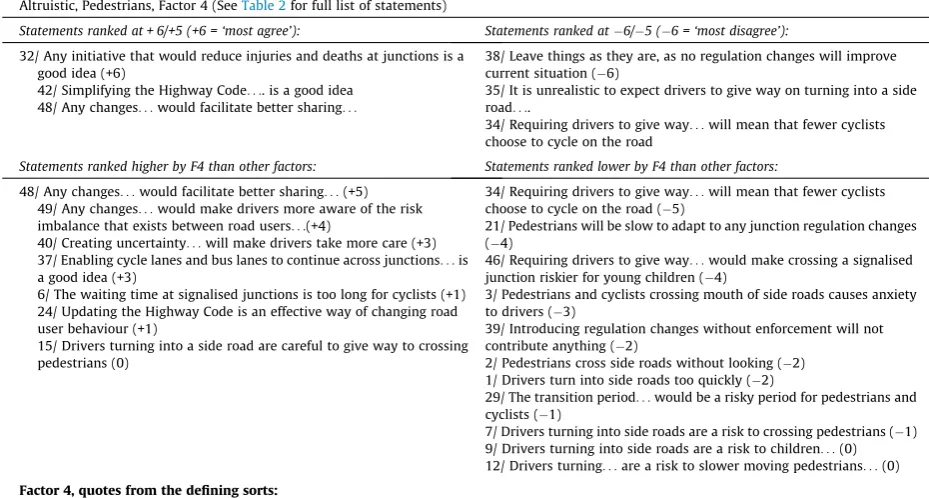
Statements ranked at + 6/+5 (+6 = ‘most agree’): Statements ranked at 6/ 5 ( 6 = ‘most disagree’):
32/ Any initiative that would reduce injuries and deaths at junctions is a good idea (+6)
42/ Simplifying the Highway Code. . .. is a good idea 48/ Any changes. . .would facilitate better sharing. . .
38/ Leave things as they are, as no regulation changes will improve current situation ( 6)
35/ It is unrealistic to expect drivers to give way on turning into a side road. . ..
34/ Requiring drivers to give way. . .will mean that fewer cyclists choose to cycle on the road
Statements ranked higher by F4 than other factors: Statements ranked lower by F4 than other factors:
48/ Any changes. . .would facilitate better sharing. . .(+5) 49/ Any changes. . .would make drivers more aware of the risk imbalance that exists between road users. . .(+4)
40/ Creating uncertainty. . .will make drivers take more care (+3) 37/ Enabling cycle lanes and bus lanes to continue across junctions. . .is a good idea (+3)
6/ The waiting time at signalised junctions is too long for cyclists (+1) 24/ Updating the Highway Code is an effective way of changing road user behaviour (+1)
15/ Drivers turning into a side road are careful to give way to crossing pedestrians (0)
34/ Requiring drivers to give way. . .will mean that fewer cyclists choose to cycle on the road ( 5)
21/ Pedestrians will be slow to adapt to any junction regulation changes ( 4)
46/ Requiring drivers to give way. . .would make crossing a signalised junction riskier for young children ( 4)
3/ Pedestrians and cyclists crossing mouth of side roads causes anxiety to drivers ( 3)
39/ Introducing regulation changes without enforcement will not contribute anything ( 2)
2/ Pedestrians cross side roads without looking ( 2) 1/ Drivers turn into side roads too quickly ( 2)
29/ The transition period. . .would be a risky period for pedestrians and cyclists ( 1)
7/ Drivers turning into side roads are a risk to crossing pedestrians ( 1) 9/ Drivers turning into side roads are a risk to children. . .(0) 12/ Drivers turning. . .are a risk to slower moving pedestrians. . .(0)
Factor 4, quotes from the defining sorts:
‘‘I’ve driven 500,000 miles and not hit anyone or been hit. Society requires a level of trust between road users. The variety in current road designs and regulations is very difficult for users. There needs to be consistency. We need to trial new ideas. The current situation is complicated. We need something simpler than the status quo. However, I realise that there is not going to be a quick fix. I’m not too critical of drivers. Some look out for bikes using their wing mirrors. Drivers do slow down for junctions and giving way. However, there are exceptions: white vans, taxis, some young people, and self-righteous drivers who see all pedestrians and cyclists as second class.”
‘‘Junctions are key for cyclists and motorcyclists – more injuries happen here. Sometimes bugs me that with 300 motorcycle deaths and 70 cyclist deaths a year that all improvements are for cyclists and none for motorcycles. Anything that makes things safer has got to be a good thing.”
‘‘Any ambiguity/vagueness in the current situation which results in death is an outrage.”
‘‘I want to see things improved for pedestrians and cyclists as a whole and less priority given to drivers. I believe that we don’t need lots of rules, because if you put the infrastructure there, drivers, perhaps reluctantly, will slow down.”
‘‘I prioritised children; drivers were less in my priority as you are more vulnerable if you are not in a car.”
Table 9
Factor 5 defining statements.
Pragmatic, Sustainably Mobile, Factor 5 (SeeTable 2for full list of statements)
Statements ranked at + 6/+5 (+6 = ‘most agree’): Statements ranked at 6/ 5 ( 6 = ‘most disagree’):
42/ Simplifying the Highway Code. . .. is a good idea (+6) 26/ It is important to promote the safety benefits when making regulation changes
32/ Any initiative that would reduce injuries and deaths at junctions is a good idea
38/ Leave things as they are, as no regulation changes will improve current situation ( 6)
35/ It is unrealistic to expect drivers to give way on turning into a side road. . .
30/ Allowing cyclists to turn left on red signals, whilst giving way to crossing pedestrians, is a good idea
Statements ranked higher by F5 than other factors: Statements ranked lower by F5 than other factors:
42/ Simplifying the H. Code. . .is a good idea (+6)
26/ It is important to promote the safety benefits when making regulation changes (+5)
11/ Drivers turning. . .are a risk to visually impaired pedestrians crossing the junction (+4)
25/ Regulation changes would need to be accompanied by well-funded publicity campaigns (+4)
19/ It will be easy to raise public awareness about junction regulation changes (+3)
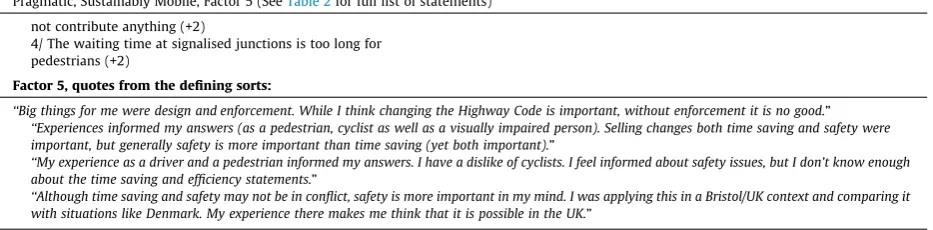
39/ Introducing regulation changes without enforcement will
30/ Allowing cyclists to turn left on red signals, whilst giving way to crossing pedestrians, is a good idea ( 5)
20/ It will be hard to raise public awareness about junction regulation changes ( 4)
28/ The transition period required for road users to get used to any junction regulation changes would be long ( 4)
[image:11.544.39.504.471.652.2]References
Baker, R. M. (2006). Economic rationality and health and lifestyle choices for people with diabetes.Social Science and Medicine, 63(9), 2341–2353. Bassani, M., Dalmazzo, D., Marinelli, G., & Cirillo, C. (2014). The effects of road geometrics and traffic regulations on driver-preferred speeds in northern Italy.
An exploratory analysis.Transportation Research Part F: Psychology and Behaviour, 25, 10–26.
Björklund, G.M., Åberg, L., Högskolan Dalarna, Akademin Utbildning, h.o.s., Psykologi (2005) Driver behaviour in intersections: Formal and informal traffic rules. Transportation Research Part F: Psychology and Behaviour 8 (3), pp. 239–253.
Bjørnskau, T. (2017). The Zebra Crossing Game – Using game theory to explain a discrepancy between road user behaviour and traffic rules.Safety Science [online], 92, 298–301.
Bronfenbrenner, U. (1974). Developmental research, public policy, and the ecology of childhood.Child Development, 45(1), 1–5. Brown, S. R. (1980).Political Subjectivity: Applications of Q Methodology in Political Science [online]. New Haven, CT: Yale University Press. CROW (2016).Design manual for bicycle traffic. Ede, The Netherlands: CROW.
Cycling UK (2017) Cycling UK Discussion Forum. Available from:https://forum.cyclinguk.org/viewtopic.php?t=115515[accessed 14.08.18]. Department of Transport (2015).The highway code(Rev. ed). London: TSO.
Dilbeck, K. (2017). Factor analysis: Varimax rotation. In M. Allen (Ed.),The sage encyclopedia of communication research methods. Thousand Oaks, CA: SAGE Publications [accessed 10/11/18].
Highways England (2016) Interim Advice Note 195/16 Cycle Traffic and the Strategic Road Network. Available from:http://www.standardsforhighways.co. uk/ha/standards/ians/index.htm[Accessed 26.08.18].
Figliozzi, M. A., & Tipagornwong, C. (2016). Pedestrian Crosswalk Law: A study of traffic and trajectory factors that affect non-compliance and stopping distance.Accident Analysis and Prevention, 96, 169–179.
Friedman, L. (2016).Impact: How law affects behavior. Cambridge, Massachusetts: Havard University Press. Gehl, J. (2011).Life between buildings: Using public space. London; Washington, D.C: Island.
Gerike, R., de Nazelle, A., Nieuwenhuijsen, M., Panis, L.I., Anaya, E., Avila-Palencia, I.,. . .PASTA Consortium and on behalf of the PASTA consortium (2016) Physical Activity through Sustainable Transport Approaches (PASTA): a study protocol for a multicentre project. BMJ Open 6 (1), pp.e009924. Jones, P. (2017).Technical note, turning the corner: Give way on turning at traffic signals. Birmingham: British Cycling.
Jones, P. (2016) Turning the Corner: Priority Changes at Junctions to Improve Safety and Comfort for People Cycling and Walking. Report number: 1468. Birmingham: British Cycling.
Kline, P. (1994).An easy guide to factor analysis. London: Routledge.
Motoring.co.uk (2017) Motoring Discussion Forum. Available from: https://www.motoring.co.uk/car-news/go-danish-to-save-lives-urge-motoring-and-cycling-organisations_68612?utm_source=newsletter&utm_medium=email&utm_campaign=motoring-131216&utm_content=newsletter&profile= 686379&code=0f9ebca2a824ab8d65816b2d83a77d2a[Accessed 14.08.18].
National Association of City Transportation Officials (2013) Urban Street Design Guide [online].
Open Democracy (2017) Open Democracy Discussion Forum. Available from: https://www.opendemocracy.net/https%3A/%252Fopendemocracy.net/ openjustice/road-safety-london-uk[accessed 14.08.18].
Road.cc (2017) Road CC Discussion Forum. Available from: http://road.cc/content/news/225057-british-cycling-say-highway-code-rule-change-could-cut-traffic-queues-almost[Accessed 14.08.18].
Schmolck, P. (2015) PQMethod Manual. Available from:http://schmolck.org/qmethod/pqmanual.htm[accessed 26.07.18].
Stelling-Kon´czak, A., Hagenzieker, M., Commandeur, J. J. F., Agterberg, M. J. H., & van Wee, B. (2016). Auditory localisation of conventional and electric cars: Laboratory results and implications for cycling safety.Transportation Research Part F: Psychology and Behaviour, 41(August), 227–242.
Stephenson, W. (1935). Technique of factor analysis.Nature, 136(3434), 297.
Transport for London (2014) London Cycle Design Standards. Available from: https://tfl.gov.uk/corporate/publications-and-reports/streets-toolkit#on-this-page-2[accessed 26.08.18].
Walker, I., Tapp, A., Davis, A. (forthcoming) Motonormativity: How Social Norms Hide a Major Public Health Hazard. In preparation.
[image:12.544.39.506.72.187.2]Welsh Assembly Government (2014) Design Guidance Active Travel (Wales) Act 2013. Available from: http://gov.wales/docs/det/publications/141209-active-travel-design-guidance-en.pdf[accessed 26.08.18].
Table 9(continued)
Pragmatic, Sustainably Mobile, Factor 5 (SeeTable 2for full list of statements)
not contribute anything (+2)
4/ The waiting time at signalised junctions is too long for pedestrians (+2)
Factor 5, quotes from the defining sorts:
‘‘Big things for me were design and enforcement. While I think changing the Highway Code is important, without enforcement it is no good.” ‘‘Experiences informed my answers (as a pedestrian, cyclist as well as a visually impaired person). Selling changes both time saving and safety were important, but generally safety is more important than time saving (yet both important).”
‘‘My experience as a driver and a pedestrian informed my answers. I have a dislike of cyclists. I feel informed about safety issues, but I don’t know enough about the time saving and efficiency statements.”