Who should be searching? Differences in personality can affect visual search accuracy
RUNNING HEAD: Personality and Visual Search
Abstract (200 / 250)
Visual search is an everyday task conducted in a wide variety of contexts. Some searches are mundane, such as finding a beverage in the refrigerator, and some have life-or-death
consequences, such as finding improvised explosives at a security checkpoint or within a combat zone. Prior work has shown numerous influences on search, including “bottom-up” (physical stimulus attributes) and “top-down” factors (task-relevant or goal-driven aspects). Recent work has begun to focus on “observer-specific” factors, examining how searchers’ attributes might influence search performance. A logical extension involves exploring whether some individuals are better suited to conduct visual searches than other individuals. The current study examined whether certain personality characteristics relate to visual search performance in a large sample of professional searchers employed by the U.S. Transportation Security Administration. Of the “big five” personality traits (neuroticism, extroversion, openness, agreeableness, and
conscientiousness), only conscientiousness significantly correlated with visual search accuracy. Both early-career and experienced professional searchers demonstrated a significant relationship between conscientiousness scores and accuracy on a simple visual search task. These findings validate the notion that searchers’ attributes impact their visual search performance and suggest that personality assessments might prove useful for hiring and selection decisions regarding professional tasks that incorporate visual search.
1.1. Introduction
Visual search—the act of finding targets amongst distractors—is a commonplace activity with people conducting visual searches in everyday situations, such as finding a beverage in the refrigerator, and in highly dangerous scenarios, such as finding improvised explosive devices (IEDs) in combat zones. Visual search is nearly a ubiquitous activity, which makes it an
interesting and important topic to study. Given the impact of visual search upon many aspects of everyday life, and some life-or-death situations, it is vital to identify which factors might
influence performance. There have been decades of research into the nature of visual search (Eckstein, 2011 & Nakayama & Martini, 2011), and the work has expanded cognitive theories and informed real-world search performance.
Top-down influences generally represent goal-directed or strategy-level influences on search performance. These influences can include factors such as the relationship between target-defining properties and distractors most likely to capture attention (Folk & Anderson, 2010; Folk & Remington, 2008; Gibson & Kelsey, 1998). The primary idea is that goal-relevant
characteristics determine what aspects of a visual display will receive the most attention. The evidence for top-down influences is varied; for example, data show attentional priorities can be altered based upon which targets yield the greatest reward (Anderson & Yantis, 2013; Anderson, Laurent, & Yantis, 2011a; 2011b) and by sufficient experience with a specific task (Cunningham & Egeth, 2016; Cosman & Vecera, 2014; Hout & Goldinger, 2010; Leber & Egeth, 2006a; 2006b; Vatterott & Vecera, 2012). A change in the task can then alter what an individual prioritizes during visual search, such as how changing the high reward target color from red to green will have searchers shift their priorities from finding red targets to finding green targets. In short, the specific search task and its associated goals allow for assessment of many different parameters that affect how visual search is conducted under a specific set of circumstances.
1.2. Moving beyond the Bottom-up and Top-down dichotomy
stimuli involved. For example, experienced professional visual searchers were shown to be more consistent in using their search strategies, and consistency explained a significant portion of the variance in search accuracy for professional searchers (Biggs, Cain, Clark, Darking, & Mitroff, 2013; Biggs & Mitroff, 2014). This instance potentially demonstrates how individual differences in search strategy might impact key elements of visual search performance.
One understudied potential individual difference aspect is that some individuals might simply be better suited to conducting visual searches. For example, it has been suggested that individuals with autism (or high on autism traits) might have enhanced visual search abilities (O’Riordan, Plaisted, Driver, & Baron-Cohen, 2001). Another possibility is that some
personality types might be more compatible with the demands and nuances of visual search tasks. For example, introverts may be better at visual search than extroverts (Sen & Goel, 1981). However, this remains an open question as other work has suggested that introverts perform equally well in visual search (Newton, Slade, Butler, & Murphy, 1992), and that introverts might simply perform better on any sustained attention task (Koelega, 1992). This possibility represents a factor relevant to the individual conducting the search, yet it is not an influence due to specific stimuli, the specific task, or the relationship between the searcher and a particular stimulus. It is also a factor that could be highly impactful and relevant to search accuracy from the moment the individual begins conducting searches (i.e., hiring and selection). As such, personality
Personality factors could also be highly important in personnel selection for other duties where visual search plays an important, but perhaps less conspicuous role. For example,
personality differences can serve as early indicators of talent in piloting remote aircraft (Rose, Barron, Carretta, Arnold, & Howse, 2014). Remotely piloting an aircraft, and a slew of other aviation tasks, requires visual search or scanning to complete the task, and so it could be insightful to determine if specific personality traits relate to visual search, per se. Personnel selection for these duties, and more, could be improved by identifying individuals well suited to the task through the relationship between personality and task-based performance. Furthermore, this relationship could provide additional theoretical insight into visual search by exploring an understudied top-down factor in search behaviors.
The current study sought to reveal possible relationships between personality factors and visual search performance. Professional visual searchers from the U.S. Transportation Security Administration (TSA) completed a validated and established self-report survey about their personality characteristics (the Big Five Inventory; John & Srivastava, 1999) and also completed a standard computer-based visual search task. The primary questions at hand are whether one or more personality traits relate to search performance, and whether personality traits account for search accuracy above and beyond other factors.
2. Method 2.1. Participants
First, TSA Officers could choose to participate in the study or review training materials during the allotted time. Second, all TSA officials were unaware which individuals participated and which individuals reviewed training materials. Third, TSA Officers were asked whether they would allow their data to be used only for TSA purposes or both university research and TSA purposes (10 participants declined and 3 did not explicitly consent; data from these 13
individuals were excluded). Data presented here comes only from participants who completed the personality survey, completed the visual search experiment, and consented to have their data used for research purposes (N=213 from the larger study).
Data were further limited based upon several criteria. First, data were limited to those who regularly conducted X-ray searches as part of their primary duties (N=58 did not regularly perform searches). Second, data were limited to individuals under 65 years of age (N=6 were over 65 years). Third, data were limited to participants whose search task accuracy was within three standard deviations of the group mean (N=4 were below three standard deviations of the group mean in accuracy). Finally, personality subscale analyses were limited to participants who completed all questions of that subscale. For example, the conscientiousness subscale has 9 questions, and data from any participant who answered 8 or fewer questions were excluded for analyses involving that particular subscale. These restrictions left the following counts for participants who met all criteria listed above and completed the personality metric: N=127 for neuroticism, N=126 for extraversion, N=130 for openness, N=127 for agreeableness, and N=122 for conscientiousness.
response given for two participants). For some analyses, TSA Officers were divided into groups based upon experience: individuals with 3 or fewer years of TSA employment were classified as “early-career” TSA Officers (N=40), and individuals with 6 or more years of TSA employment were classified as “experienced” TSA Officers (N=54).
2.2. Design
Data reported here come from a larger initiative, which took place from October 2011 through June 2013. Participants completed one to four experimental sessions with each session containing different procedures. The hypotheses here are concerned with a simple visual search task and personality assessment administered during the first and fourth sessions, respectively. The personality survey was the Big Five Inventory (BFI; Benet-Martinez & John, 1998; John & Srivastava, 1999; John, Donahue, & Kentle, 1991; John, Naumann, & Soto, 2008), which includes 44 questions addressing five primary personality factors (neuroticism, extraversion, openness, agreeableness, conscientiousness). Thorough psychometric validation of this scale is widely cited and available (Benet-Martinez & John, 1998; John & Srivastava, 1999), which developed more through classic test theory than advanced item response theory (cf., Lange, Irwin, & Houran, 2000). The BFI is easily available, not overly long, and it has been used in hundreds of studies. Taken together, these factors made it an ideal personality assessment for the current study.
were performed using Matlab software (The MathWorks, Natick, MA) and Psychophysics Toolbox version 3.0.8 (Brainard, 1997; Pelli, 1997; Kleiner, Brainard, & Pelli, 2007).
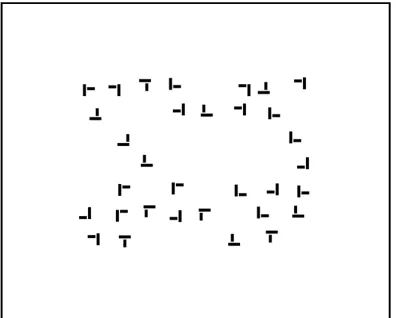
2.2.2. Stimuli. Search displays presented multiple pseudo-“L”s as distractors with 50% of displays containing one target “T.” Individual display items were comprised of two
perpendicular black lines (subtending 1.3°x1.3°, width=0.3°). The crossbar aligned perfectly with the other line segment to form target “T”s, whereas the crossbar slid off-center for distractor pseudo-“L”s (see Figure 1). All display items were randomly placed onto an invisible 8x7 grid subtending 25.4°x19.1° at an approximate viewing distance of 60cm. Individual grid cells did not overlap, all items were presented against white backgrounds, and random spatial jitter was applied to individual cell items. Display items were randomly rotated (0°,90°,180°, and 270°). Set size varied with four possible options: 8, 16, 24, and 32.
2.2.3. Search Procedure. Trials began with a fixation cross for 100ms. The search array then appeared and remained on-screen until response or until 30 seconds elapsed. Participants responded with target presence or target absence judgments by pressing one of two keys (“z” and “/”, counterbalanced across participants). The full experiment included practice (16 trials)
followed by experimental trials (256 trials). Practice and experimental trials included an equal mix of target present and target absent trials equally divided among the four set sizes.
Participants received accuracy feedback for practice trials, but no feedback for experimental trials. Search displays disappeared after response and the program proceeded automatically to the next trial. Breaks were provided every 25 experimental trials.
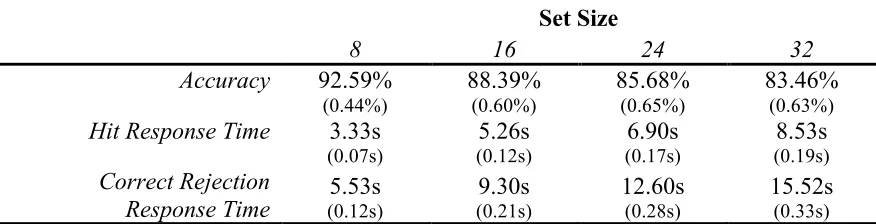
3.1. Descriptive Statistics. See Table 1 for visual search metrics divided by set size. Participants averaged reasonably high search accuracy with a range of values (Mean=87.53%, SD=6.13%, Minimum=72.66%, Maximum=98.44%). Misses were the predominant error source (Mean=29.36 missed targets, SD=14.89 missed targets, Minimum=2, Maximum=69), whereas false alarms accounted for only a small portion of errors (Mean=1.81 false alarms, SD=3.21 false alarms, Minimum=0, Maximum=20). Notably, many participants did not have any false alarms (61 of 145 participants had 0 false alarms). Given that misses were the primary source of error, personality measures were compared to the number of missed targets to represent the accuracy variable from visual search.
Age and gender are potential predictor variables for search performance; however, neither age (F(3,141)=1.87, p=.14) nor gender (t(141)=1.85, p=.07) emerged as significant predictors of search accuracy. Age also had no impact on speed as a 4 (age groups: 18-25, 26-34, 35-49, 50-64) x 4 (set sizes: 8, 16, 24, 32) ANOVA revealed no significant effects of age on hits (p’s>.15) or correct rejections (p’s>.50). The previous study (Biggs et al., 2013) did find minor age-related effects with slower responses from older participants, although several possibilities could explain the difference. First, the previous study demonstrated only a small effect, and this study analyzed a smaller sample size. Another possibility is that the age groups were not
sensitive enough, especially as these age groups were selected to provide some demographic information while also ensuring participant anonymity. For the purposes of the further analyses, neither age nor gender significantly influenced accuracy on the visual search task, and so they are not further considered here as predictors of visual search accuracy.
Mean=4.09, SD=0.63; Conscientiousness: Mean=4.23, SD=0.55). Note that these values generally fall within one standard deviation or less for values attained from previous studies involving these age ranges (John & Srivastava, 1999).
None of these visual search or personality metrics had a skewness or kurtosis value greater than one or less than negative one. These values satisfy the statistical requirement of between negative two and positive two to support a normal, univariate distribution (George, 2003). The single exception involved false alarm values, which had a skewness of 2.06 and a kurtosis of 4.97. This non-normal distribution further supported the decision to focus on misses as the dependent variable for accuracy when comparing search performance to personality measures.
3.2. Visual Search Metrics and Personality Measures. The primary question was whether any personality factors related to search accuracy. Only one personality factor was significantly correlated with accuracy in the visual search task: conscientiousness, r(120)=-.25, p<.01, BF10=4.53. Participants were more likely to miss targets as their conscientiousness score decreased. No other factors were related to search accuracy (Neuroticism: r(125)=.06, p=.47, BF10=0.14; Extraversion: r(124)=-.05, p=.61, BF10=0.13; Openness: r(128)=.07, p=.41,
BF10=0.15) with only agreeableness even approaching significance (Agreeableness: r(125)=-.15,
p=.08, BF10=0.50). The relationship between number of misses and conscientiousness was also evident at both the smallest and largest set sizes; conscientiousness was significantly correlated to number of misses at set size 8, r(120)=-.21, p=.02, BF10=1.64, and at set size 32, r(120)=-.25,
With regard to response times, increased time to find the target as display set size increased (i.e., hit-slope) was significantly related to conscientiousness, r(120)=.18, p=.04, BF10=0.84, although the increase in time to correctly identify target absence as display set size increased (i.e., correct rejection slope, CR-slope) was not related to conscientiousness,
r(120)=.13, p=.16, BF10=0.30. Agreeableness was also marginally related to hit-slope,
r(125)=.17, p=.06, BF10=0.61, but not CR-slope, r(125)=.13 p=.20, BF10=0.30. No other
relationship between personality factors (neuroticism, extraversion, and openness) approached a significant relationship with either hit-slope or CR-slope (all ps>.20).
Visual search accuracy can also be explained, in part, by response time metrics. So, it is reasonable to question whether hit-slope could be a latent variable that explains part of the relationship between number of misses and conscientiousness. However, the relationship between number of misses and conscientiousness remained significant even when conducting a partial correlation and controlling for the influence of hit-slope, r(119)=-.18, p=.04.
with these other factors, conscientiousness may not have a uniform impact on visual search accuracy for both early-career professional searchers and highly experienced professional searchers.
The previous evidence (Biggs et al., 2013) establishes a practical reason to include both CR-slope and search consistency into regression models to predict search accuracy. Additionally, large CR-slopes indicate that a search takes additional time to find targets, which increases accuracy at the cost of speed. CR-slope thus allows for an empirical investigation into any speed/accuracy trade-offs in the data. The regression models here account for this possibility by including CR-slope in the calculations. Finally, without clear theoretical reasons how
conscientiousness might interact with CR-slope or consistency, the regression models will be standard multiple regressions. To compare the influence of conscientiousness among groups with differing levels of professional experience, professional searchers were divided into those
individuals with the least experience (i.e., 3 years or less professional experience, N=40, “early-career”) and those individuals with the most experience (i.e., 6 years or more professional experience, N=54, “experienced”).
For early-career professionals, there was a significant relationship between number of misses and conscientiousness, r(38)=-.39, p=.01, BF10=3.82. A regression analysis was
conducted to simultaneously assess contributions of three known predictors of search accuracy— CR-slope, consistency, and conscientiousness. The regression analysis predicted a significant amount of variance in misses, Adj. R2=.46. F(3,36)=12.24, p<.001 (CR-slope: β=-.61,
t(39)=5.00, p<.001, BF10=2,941.40, sr2=0.34; consistency: β=-.01, t(39)=0.09, p=.93, BF10=0.37,
For experienced professionals, there was a significant relationship between number of misses and conscientiousness, r(52)=-.29, p=.04, BF10=1.45. A regression analysis was
conducted to simultaneously assess contributions of three known predictors of search accuracy— CR-slope, consistency, and conscientiousness. The regression analysis predicted a significant amount of variance in misses, Adj. R2=.61. F(3,50)=28.70, p<.001 (CR-slope: β=-.59,
t(53)=6.62, p<.001, BF10=322,347.78, sr2=0.32; consistency: β=.41, t(53)=4.69, p<.001,
BF10=197.51, sr2=0.16; conscientiousness: β=-.13, t(53)=1.46, p=.15, BF10=1.80, sr2=0.02). CR-slope was again the largest predictor of search accuracy, followed by consistency.
4. General Discussion
The current study investigated whether personality differences could predict variability in performance on a visual search task. Personality was assessed via the Big Five Inventory (John et al., 1991; John & Srivastava, 1999), which is an established survey that delineates five
personality traits: neuroticism, extraversion, openness, agreeableness, and conscientiousness. Of these “big five” personality factors, only conscientiousness significantly predicted performance in an established visual search task. Taking a step back, it is not necessarily surprising to find a significant relationship between conscientiousness and search performance, especially in the context of visual monitoring or surveillance tasks that require sustained effort throughout a long performance period.
or vigilance (Peltier & Becker, 2017). This difference could be attributable, in part, to the population samples—whereas most studies used undergraduate participants, the current study focused on a professional search population. Visual search could have a significant impact on many different careers. Although the connection is evident with security screening (e.g., Biggs & Mitroff, 2015) or radiology (Krupinski, 2015), other professions from first responders to insect exterminators may depends upon visual search abilities. These various search tasks may be so different though that not all predictors are equally effective across all scenarios. In turn, multiple studies may be necessary to identify particular predictors within a given professional
environment. Nevertheless, conscientiousness could be a powerful factor to include when making hiring and selection decisions.
Personality differences also address an understudied impact on the bottom-up versus top-down dichotomy in attention research. Most studies focus upon bottom-up differences as
top-down dichotomy or even continuum in visual search and towards visual attention models that incorporate additional factors (e.g., Awh et al., 2012).
An important limitation for the present study is that it only included a single type of visual search task. In this experiment, participants performed a difficult variant of a classic “Ts and Ls” search, where the primary errors involved missed targets. Although this error is
particularly important in professional situations such as at security checkpoints—where missed targets could be explosive devices, there are additional task-relevant factors that could also affect the relationship between personality and search accuracy. For example, search accuracy declines if targets rarely appear during a search task (e.g., Wolfe, Horowitz, & Kenner, 2005), search accuracy is very low for specific targets which rarely appear (Biggs, Adamo, & Mitroff, 2014; Mitroff & Biggs, 2014), search becomes increasingly difficult as multiple target types are added (e.g., Cunningham & Wolfe, 2012; 2014; Drew & Wolfe, 2014; Godwin, Menneer, Cave, & Donnelly, 2010; Wolfe, 2012), and the simultaneous presence of multiple different targets dramatically affects search behaviors (e.g., Wolfe, 2013). All these examples represent
significantly different visual search tasks, and conscientiousness may or may not play an equal role in influencing visual search under each unique set of parameters. Nevertheless, the current evidence does suggest that future research should consider conscientiousness assessments if analyzing the role of personality in these various alternative search tasks.
In conclusion, personality represents another potent factor in visual search. The evidence here suggests that conscientiousness is the predominant personality influence, although
5. References
Anderson, B.A., & Yantis, S. (2013). Persistence of value-driven attentional capture. Journal of Experimental Psychology: Human Perception and Performance, 39, 6-9.
Anderson, B.A., Laurent, P.A., & Yantis, S. (2011a). Value-driven attentional
capture. Proceedings of the National Academy of Sciences, 108, 10367-10371.
Anderson, B.A., Laurent, P.A., & Yantis, S. (2011b). Learned value magnifies salience-based attentional capture. PLoS One, 6, e27926.
Awh, E., Belopolsky, A.V., & Theeuwes, J. (2012). Top-down versus bottom-up attentional control: A failed theoretical dichotomy. Trends in Cognitive Sciences, 16, 437-443. Benet-Martinez, V., & John, O.P. (1998). Los Cinco Grandes across cultures and ethnic groups:
Multitrait multimethod analyses of the Big Five in Spanish and English. Journal of Personality and Social Psychology, 75, 729-750.
Biggs, A.T., Adamo, S.H., & Mitroff, S.R. (2014). Rare, but obviously there: Effects of target frequency and salience on visual search accuracy. Acta Psychologica, 152, 158-165. Biggs, A.T., Cain, M.S., Clark, K., Darling, E.F., Mitroff, S.R. (2013). Assessing visual search
performance differences between Transportation Security Administration Officers and nonprofessional searchers. Visual Cognition, 21, 330-352.
Biggs, A.T., & Mitroff, S.R. (2014). Different predictors of multiple-target search accuracy between professional and non-professional visual searchers. Quarterly Journal of Experimental Psychology, 67, 1335-1348.
Biggs, A.T., & Mitroff, S.R. (2015). Improving the efficacy of security screening tasks: A review of visual search challenges and ways to mitigate their adverse effects. Applied Cognitive Psychology, 29, 142-148.
Brainard, D.H. (1997). The psychophysics toolbox. Spatial Vision, 10, 433-436.
Cosman, J.D., & Vecera, S.P. (2014). Establishment of an attentional set via statistical learning.
Journal of Experimental Psychology: Human Perception and Performance, 40, 1-6. Cunningham, C.A., & Egeth, H.E. (2016). Taming the white bear: initial costs and eventual
benefits of distractor inhibition. Psychological Science.
Cunningham, C.A., & Wolfe, J.M. (2012). Lions or tigers or bears: Oh my! Hybrid visual and memory search for categorical targets. Visual Cognition, 20, 1024-1027.
Cunningham, C.A., & Wolfe, J.M. (2014). The role of object categories in hybrid visual and memory search. Journal of Experimental Psychology: General, 143, 1585.
Drew, T., & Wolfe, J.M. (2014). Hybrid search in the temporal domain: Evidence for rapid, serial logarithmic search through memory. Attention, Perception, & Psychophysics, 76, 296-303.
George, D. (2003). SPSS for windows step by step: A simple study guide and reference, 17.0 update, 10/e. Pearson Education India.
Folk, C.L., & Remington, R.W. (2008). Bottom-up priming of top-down attentional control settings. Visual Cognition, 16, 215-231.
Gibson, B.S., & Kelsey, E.M. (1998). Stimulus-driven attentional capture is contingent on attentional set for displaywide visual features. Journal of Experimental Psychology: Human Perception and Performance, 24, 699-706.
Godwin, H.J., Menneer, T., Cave, K.R., & Donnelly, N. (2010). Dual-target search for high and low prevalence X-ray threat targets. Visual Cognition, 18, 1439-1463.
Hout, M.C., & Goldinger, S.D. (2010). Learning in repeated visual search. Attention, Perception, & Psychophysics, 72, 1267-1282.
Itti, L., Koch, C., & Niebur, E. (1998). A model of saliency-based visual attention for rapid scene analysis. Pattern Analysis and Machine Intelligence, IEEE Transactions on, 20, 1254-1259.
John, O.P., & Srivastava, S. (1999). The Big Five trait taxonomy: History, measurement, and theoretical perspectives. Handbook of personality: Theory and research, 2, 102-138. John, O.P., Donahue, E.M., & Kentle, R.L. (1991). The Big Five Inventory--Versions 4a and 54.
Berkeley, CA: University of California, Berkeley, Institute of Personality and Social Research.
John, O.P., Naumann, L.P., & Soto, C.J. (2008). Paradigm shift to the integrative big-five trait taxonomy: History, measurement, and conceptual issues. In O.P. John, R. W. Robins, & L.A. Pervin (Eds.), Handbook of personality: Theory and research (pp. 114-158). New York, NY: Guilford Press.
Koelega, H.S. (1992). Extraversion and vigilance performance: 30 years of inconsistencies.
Lange, R., Irwin, H.J., & Houran, J. (2000). Top-down purification of Tobacyk’s revised paranormal belief scale. Personality and Individual Differences, 29, 131-156.
Leber, A.B., & Egeth, H.E. (2006a). It’s under control: Top-down search strategies can override attentional capture. Psychonomic Bulletin & Review, 13, 132-138.
Leber, A.B., & Egeth, H.E. (2006b). Attention on autopilot: Past experience and attentional set.
Visual Cognition, 14, 565-583.
Kleiner, M., Brainard, D.H., & Pelli, D.G. (2007). What’s new in Psychtoolbox-3? Perception, 36, ECVP Abstract Supplement.
Krupinski, E.A. (2010). Current perspectives in medical image perception. Attention, Perception, & Psychophysics, 72, 1205-1217.
Krupinski, E.A. (2015). Improving patient care through medical image perception research.
Policy Insights from the Behavioral and Brain Sciences, doi: 10.1177/2372732215600451.
Mitroff, S.R., & Biggs, A.T. (2014). The Ultra-rare item effect: Exceedingly rare items are highly susceptible to search errors. Psychological Science, 25, 284-289.
Mitroff, S.R., Biggs, A.T., & Cain, M.S. (2015). Multiple-target visual search errors: Overview and implications for airport security. Policy Insights from the Behavioral and Brain Sciences, 2, 121-128.
Newton, T., Slade, P., Butler, N., & Murphy, P. (1992). Personality and performance on a simple visual search task. Personality and Individual Differences, 13(3), 381-382.
O'Riordan, M. A., Plaisted, K. C., Driver, J., & Baron-Cohen, S. (2001). Superior visual search in autism. Journal of Experimental Psychology: Human Perception and Performance,
27(3), 719-730.
Pelli, D.G. (1997). The VideoToolbox software for visual psychophysics: Transforming numbers into movies. Spatial Vision, 10, 437-442.
Peltier, C., & Becker, M.W. (2017). Individual differences predict low prevalence visual search performance. Cognitive Research: Principles and Implications, 2, 5.
Rose, M.R., Barron, L.G., Carretta, T.R., Arnold, R.D., & Howse, W.R. (2014). Early
identification of unmanned aircraft pilots using measures of personality and aptitude. The International Journal of Aviation Psychology, 24, 36-52.
Sen, A., & Goel, N. (1981). Functional relation between personality types and some impirically derived TSD parameters in a visual searching task. Psychological Studies, 26, 23-27. Theeuwes, J. (2010). Top-down and bottom-up control of visual selection. Acta Psychologica,
135, 77-99.
Treisman, A., & Gormican, S. (1988). Feature analysis in early vision: Evidence from search asymmetries. Psychological Review, 95, 15-48.
Vatterott, D.B., & Vecera, S.P. (2012). Experience-dependent attentional tuning of distractor rejection. Psychonomic Bulletin & Review, 19, 871-878.
Wolfe, J.M. (2012). Saved by a log how do humans perform hybrid visual and memory search?
Psychological Science, 23, 698-703.
Wolfe, J.M., Horowitz, T.S., & Kenner, N.M. (2005). Rare items often missed in visual searches.
Table 1. Average accuracy and response times by set size (with standard errors in parentheses).
Set Size
8 16 24 32
Accuracy 92.59%
(0.44%)
88.39%
(0.60%)
85.68%
(0.65%)
83.46%
(0.63%)
Hit Response Time 3.33s
(0.07s)
5.26s
(0.12s)
6.90s
(0.17s)
8.53s
(0.19s)
Correct Rejection