2,2-Bis(3-chloromethyl-4-ethoxyphenyl)-propane
Nejmeddine Jaballah,* Taha Guerfel and Mustapha Majdoub
De´partement de Chimie, Faculte´ des Sciences, 5019 Monastir, Tunisia Correspondence e-mail: [email protected]
Received 11 June 2008; accepted 20 June 2008
Key indicators: single-crystal X-ray study;T= 293 K; mean(C–C) = 0.003 A˚;
Rfactor = 0.036;wRfactor = 0.118; data-to-parameter ratio = 11.8.
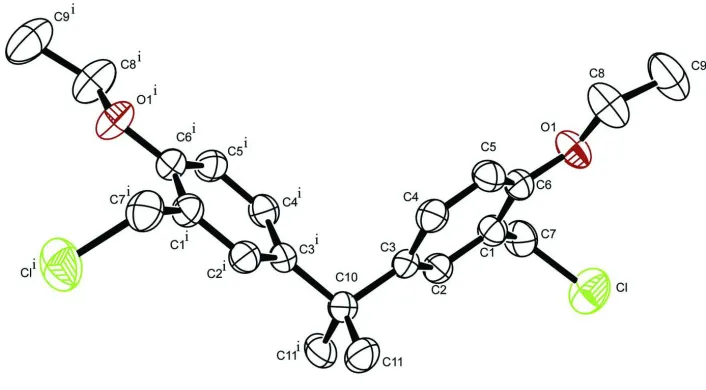
The title compound, C21H26Cl2O2, a bis-chloromethyl deriva-tive of O-ethylated bisphenol A, exhibits C2 molecular symmetry. It shows a bent conformation with the two benzene rings nearly perpendicular [dihedral angle = 87.17 (6)].
Related literature
For more information on the synthesis, see: Miyazawa et al. (1999). For background to the investigation of new conjugated polymers derived from bisphenols as potential organic semi-conducting materials, see: Jaballahet al.(2006). For the use of bis-chloromethyl bisphenol A ethers for the control of fungal and bacterial organisms, see: Priddy & Hennis (1970).
Experimental
Crystal data
C21H26Cl2O2 Mr= 381.32
Monoclinic,C2=c a= 13.856 (5) A˚
b= 15.185 (6) A˚
c= 10.999 (4) A˚
= 118.82 (3)
V= 2027.7 (13) A˚3
Z= 4
MoKradiation
= 0.33 mm 1
T= 293 (2) K 0.420.330.21 mm
Data collection
Enraf–Nonius TurboCAD-4 diffractometer
Absorption correction: none 2374 measured reflections 1960 independent reflections
1173 reflections withI> 2(I)
Rint= 0.022
2 standard reflections frequency: 120 min intensity decay: 2%
Refinement
R[F2> 2(F2)] = 0.035
wR(F2) = 0.118
S= 1.02 1960 reflections 166 parameters
H atoms treated by a mixture of independent and constrained refinement
max= 0.25 e A˚ 3
min= 0.21 e A˚ 3
Data collection: CAD-4 EXPRESS (Enraf–Nonius, 1994); cell refinement:CAD-4 EXPRESS; data reduction:XCAD4(Harms & Wocadlo, 1995); program(s) used to solve structure: SHELXS97
(Sheldrick, 2008); program(s) used to refine structure:SHELXL97
(Sheldrick, 2008); molecular graphics: ORTEP-3 for Windows
(Farrugia, 1997); software used to prepare material for publication:
WinGX(Farrugia, 1999).
The authors gratefully acknowledge financial support from the Ministry of Higher Education, Scientific Research and Technology of Tunisia.
Supplementary data and figures for this paper are available from the IUCr electronic archives (Reference: KP2175).
References
Enraf–Nonius (1994).CAD-4 EXPRESS Software. Enraf–Nonius, Delft, The Netherlands.
Farrugia, L. J. (1997).J. Appl. Cryst.30, 565. Farrugia, L. J. (1999).J. Appl. Cryst.32, 837–838.
Harms, K. & Wocadlo, S. (1995).XCAD4. University of Marburg, Germany. Jaballah, N., Trad, H., Majdoub, M., Jouini, M., Roussel, J. & Fave, J. L. (2006).
J. Appl. Polym. Sci.99, 2997–3004.
Miyazawa, A., Suzuki, Y., Sawada, T., Mataka, S. & Tashiro, M. (1999).J. Chem. Res. Synop.7, 426–427.
Priddy, D. B. & Hennis, H. E. (1970). US Patent 3 546 299. Sheldrick, G. M. (2008).Acta Cryst.A64, 112–122. Acta Crystallographica Section E
Structure Reports Online
supporting information
Acta Cryst. (2008). E64, o1360 [doi:10.1107/S1600536808018783]
2,2-Bis(3-chloromethyl-4-ethoxyphenyl)propane
Nejmeddine Jaballah, Taha Guerfel and Mustapha Majdoub
S1. Comment
BPAEtCl was synthesized as part of an ongoing program on the investigation of new conjugated polymers derived from
bisphenols as potential organic semi-conducting materials (Jaballah et al., 2006). This intermediate is of value in
synthetic work inasmuch as the CH2C1 group can be converted to other groups such as CH2CN, CH2OH and CHO.
Particularly, the bend-like structure of bisphenol A (BPA) nucleus offers a special interest in metacyclophanes synthesis
(Miyazawa et al., 1999). Bis-chloromethyl bisphenol A ethers are also useful as microbicides for control of fungal and
bacterial organisms (Priddy & Hennis, 1970). The molecular structure of BPAEtCl is shown in Fig. 1. The two benzene
rings are nearly perpendicular, forming a dihedral angle of 87.17 (6)°. The ethoxy group plan [O1—C8—C9] is almost
parallel with the benzene ring with the dihedral angle of 6.82 (37)° whereas chloromethyl group plan [C1—C7—Cl] is
close to be perpendicular [82.62 (13)°].
S2. Experimental
BPAEtCl was synthesized in two steps from 4,4′-isopropylidenediphenol [Bisphenol A, BPA]. To a stirred mixture of
BPA (10 mmoles) and K2CO3 (40 mmoles) in 20 mL of dimethylformamide, was added dropwise bromoethane (30
mmoles). After stirring for 5 h at room temperature, the reaction mixture was poured into distilled water and extracted
with diethyl ether. The extract was washed with distilled water, dried over anhydrous MgSO4, and then evaporated. The
resultant crude product was purified by recrystallization from ethanol/water (3/1) to afford the
2,2-bis-(4-ethoxyphenyl)-propane [BPAEt] as needle-like white crystals. A mixture of BPAEt (10 mmoles), paraformaldehyde (2.5 g), and 37%
aqueous HCl (8.5 mL) in acetic acid (30 mL) was heated at 328 K for 5 h. The resulting mixture was then poured into
distilled water and extracted with diethyl ether. The organic layer was washed several times with distilled water and dried
over anhydrous MgSO4. After solvent removal and two recrystallizations from hexane, we obtained BPAEtCl as
colourless crystals. Yield: 75%; mp: 352–354 K.
S3. Refinement
Figure 1
The molecular structure of BPAEtCl, showing the atom-labelling scheme. Displacement ellipsoids are drawn at the 50%
probability level. H atoms have been omitted. Symmetry code: (i) -x + 1, y, -z + 5/2.
2,2-Bis(3-chloromethyl-4-ethoxyphenyl)propane
Crystal data C21H26Cl2O2 Mr = 381.32
Monoclinic, C2/c Hall symbol: -C 2yc a = 13.856 (5) Å b = 15.185 (6) Å c = 10.999 (4) Å β = 118.82 (3)° V = 2027.7 (13) Å3 Z = 4
F(000) = 808 Dx = 1.249 Mg m−3
Mo Kα radiation, λ = 0.71073 Å Cell parameters from 25 reflections θ = 11.6–15.7°
µ = 0.33 mm−1 T = 293 K Prism, colourless 0.42 × 0.33 × 0.21 mm
Data collection
Enraf–Nonius TurboCAD-4 diffractometer
Radiation source: fine-focus sealed tube Graphite monochromator
non–profiled ω scans 2374 measured reflections 1960 independent reflections 1173 reflections with I > 2σ(I)
Rint = 0.022
θmax = 26.0°, θmin = 2.2° h = −17→17
k = −6→18 l = −1→13
2 standard reflections every 120 min intensity decay: 2%
Refinement Refinement on F2 Least-squares matrix: full R[F2 > 2σ(F2)] = 0.036 wR(F2) = 0.118 S = 1.03 1960 reflections 166 parameters 0 restraints
H atoms treated by a mixture of independent and constrained refinement
w = 1/[σ2(Fo2) + (0.052P)2 + 0.7485P] where P = (Fo2 + 2Fc2)/3
Special details
Geometry. All e.s.d.'s (except the e.s.d. in the dihedral angle between two l.s. planes) are estimated using the full covariance matrix. The cell e.s.d.'s are taken into account individually in the estimation of e.s.d.'s in distances, angles and torsion angles; correlations between e.s.d.'s in cell parameters are only used when they are defined by crystal symmetry. An approximate (isotropic) treatment of cell e.s.d.'s is used for estimating e.s.d.'s involving l.s. planes.
Refinement. Refinement of F2 against ALL reflections. The weighted R-factor wR and goodness of fit S are based on F2, conventional R-factors R are based on F, with F set to zero for negative F2. The threshold expression of F2 > σ(F2) is used only for calculating R-factors(gt) etc. and is not relevant to the choice of reflections for refinement. R-factors based on F2 are statistically about twice as large as those based on F, and R- factors based on ALL data will be even larger.
Fractional atomic coordinates and isotropic or equivalent isotropic displacement parameters (Å2)
x y z Uiso*/Ueq
HC2 0.2827 (17) 0.0620 (14) 1.052 (2) 0.046 (6)*
HC4 0.5740 (19) 0.1686 (14) 1.147 (2) 0.050 (6)*
H111 0.641 (2) 0.0223 (19) 1.220 (3) 0.085 (9)*
H211 0.6149 (19) −0.0548 (15) 1.306 (3) 0.052 (6)*
H1C7 0.124 (2) 0.1193 (16) 0.880 (3) 0.064 (8)*
HC5 0.4965 (18) 0.2588 (15) 0.961 (2) 0.051 (6)*
H311 0.5386 (19) −0.0493 (15) 1.142 (3) 0.056 (6)*
H2C7 0.126 (2) 0.2044 (18) 0.786 (3) 0.077 (8)*
H2C8 0.403 (3) 0.278 (2) 0.719 (3) 0.102 (11)*
H1C9 0.318 (3) 0.390 (2) 0.568 (4) 0.109 (13)*
H2C9 0.217 (3) 0.403 (3) 0.598 (4) 0.128 (14)*
H3C9 0.224 (4) 0.315 (3) 0.524 (5) 0.152 (17)*
H1C8 0.392 (3) 0.362 (2) 0.807 (4) 0.107 (12)*
Cl 0.11729 (5) 0.08024 (5) 0.67435 (7) 0.0780 (3)
C10 0.5 0.04410 (18) 1.25 0.0424 (7)
O1 0.28391 (12) 0.26525 (10) 0.77132 (17) 0.0557 (5)
C3 0.43999 (15) 0.10349 (12) 1.1219 (2) 0.0360 (5)
C1 0.27565 (15) 0.15480 (13) 0.9159 (2) 0.0395 (5)
C5 0.45100 (18) 0.21933 (13) 0.9770 (2) 0.0436 (5)
C2 0.32750 (16) 0.10062 (13) 1.0324 (2) 0.0386 (5)
C4 0.49939 (17) 0.16456 (13) 1.0907 (2) 0.0420 (5)
C6 0.33857 (16) 0.21428 (12) 0.8875 (2) 0.0408 (5)
C7 0.15422 (18) 0.14840 (18) 0.8252 (3) 0.0522 (6)
C11 0.5796 (2) −0.01497 (17) 1.2272 (3) 0.0600 (8)
C8 0.3483 (3) 0.3195 (2) 0.7315 (4) 0.0752 (9)
C9 0.2741 (4) 0.3638 (3) 0.5969 (4) 0.0863 (11)
Atomic displacement parameters (Å2)
U11 U22 U33 U12 U13 U23
Cl 0.0520 (4) 0.0956 (5) 0.0591 (5) 0.0027 (3) 0.0050 (3) −0.0129 (4)
C10 0.0475 (15) 0.0365 (14) 0.0313 (17) 0 0.0095 (13) 0
C2 0.0382 (10) 0.0382 (10) 0.0367 (13) −0.0020 (8) 0.0159 (9) −0.0001 (9) C4 0.0358 (10) 0.0433 (11) 0.0363 (13) −0.0055 (8) 0.0090 (9) −0.0046 (9) C6 0.0450 (11) 0.0383 (10) 0.0344 (13) 0.0055 (8) 0.0154 (9) 0.0030 (9) C7 0.0400 (11) 0.0592 (14) 0.0478 (16) 0.0077 (10) 0.0135 (10) 0.0061 (12) C11 0.0727 (17) 0.0472 (13) 0.0393 (16) 0.0191 (12) 0.0104 (13) −0.0055 (12) C8 0.0762 (19) 0.078 (2) 0.071 (2) 0.0090 (16) 0.0357 (17) 0.0314 (17)
C9 0.102 (3) 0.087 (2) 0.080 (3) 0.027 (2) 0.052 (2) 0.042 (2)
Geometric parameters (Å, º)
Cl—C7 1.808 (3) C5—HC5 0.95 (2)
C10—C11i 1.533 (3) C2—HC2 0.95 (2)
C10—C11 1.533 (3) C4—HC4 0.92 (2)
C10—C3i 1.537 (3) C7—H1C7 0.99 (3)
C10—C3 1.537 (2) C7—H2C7 0.95 (3)
O1—C6 1.368 (2) C11—H111 1.06 (3)
O1—C8 1.430 (3) C11—H211 0.97 (2)
C3—C2 1.386 (3) C11—H311 0.98 (3)
C3—C4 1.388 (3) C8—C9 1.494 (4)
C1—C6 1.392 (3) C8—H2C8 1.04 (3)
C1—C2 1.395 (3) C8—H1C8 1.00 (4)
C1—C7 1.489 (3) C9—H1C9 0.91 (4)
C5—C4 1.377 (3) C9—H2C9 0.99 (4)
C5—C6 1.387 (3) C9—H3C9 1.07 (5)
C8—C9 1.494 (4)
C11i—C10—C11 108.4 (3) C1—C7—Cl 112.38 (17)
C11i—C10—C3i 107.90 (14) C1—C7—H1C7 107.3 (15)
C11—C10—C3i 112.29 (13) Cl—C7—H1C7 106.6 (15)
C11i—C10—C3 112.29 (13) C1—C7—H2C7 109.6 (16)
C11—C10—C3 107.90 (14) Cl—C7—H2C7 102.7 (17)
C3i—C10—C3 108.1 (2) H1C7—C7—H2C7 118 (2)
C6—O1—C8 117.78 (18) C10—C11—H111 111.7 (16)
C2—C3—C4 116.32 (18) C10—C11—H211 108.1 (14)
C2—C3—C10 123.99 (17) H111—C11—H211 109 (2)
C4—C3—C10 119.69 (16) C10—C11—H311 109.7 (14)
C6—C1—C2 119.21 (18) H111—C11—H311 109 (2)
C6—C1—C7 121.3 (2) H211—C11—H311 109.5 (18)
C2—C1—C7 119.5 (2) O1—C8—C9 109.2 (3)
C4—C5—C6 120.0 (2) O1—C8—H2C8 107.3 (17)
C4—C5—HC5 118.4 (14) C9—C8—H2C8 109.7 (19)
C6—C5—HC5 121.6 (14) O1—C8—H1C8 110 (2)
C3—C2—C1 122.58 (19) C9—C8—H1C8 113 (2)
C3—C2—HC2 119.3 (13) H2C8—C8—H1C8 108 (3)
C1—C2—HC2 118.1 (13) C8—C9—H1C9 107 (2)
C5—C4—C3 122.72 (19) C8—C9—H2C9 115 (2)
C5—C4—HC4 118.3 (14) H1C9—C9—H2C9 115 (3)
O1—C6—C5 123.96 (19) H1C9—C9—H3C9 110 (3)
O1—C6—C1 116.89 (18) H2C9—C9—H3C9 101 (3)
C5—C6—C1 119.15 (19)