Global development and diffusion of outcome evaluation research for
interpersonal and self-directed violence prevention from 2007 to 2013:
A systematic review
Karen Hughes
a, Mark A. Bellis
a,⁎
,1, Katherine A. Hardcastle
a, Alexander Butchart
b,2,
Linda L. Dahlberg
c,2, James A. Mercy
c,2, Christopher Mikton
b,2a
Centre for Public Health, Liverpool John Moores University, 15–21 Webster Street, Liverpool L3 2ET, UK b
Department of Violence and Injury Prevention and Disability, World Health Organization, 20 Avenue Appia, CH-1211 Geneva 27, Switzerland c
United States Centers for Disease Control and Prevention, Atlanta, GA 30333, USA
a b s t r a c t
a r t i c l e i n f o
Article history:
Received 7 July 2014
Received in revised form 28 September 2014 Accepted 28 September 2014
Available online 5 October 2014
Keywords:
Violence prevention Evaluation Evidence Global health
Through a global review, we identified gaps in the geographical distribution of violence prevention evidence outcome evaluation studies and the types of violence addressed. Systematic literature searches identified 355 articles published between 2007 and 2013 that evaluated programs to prevent interpersonal or self-directed violence; focused on universal or selected populations; and reported outcomes measuring violence or closely related risk factors. The number of studies identified increased annually from 2008 (n = 37), reaching 64 in 2013. Over half (n = 203) of all studies focused on youth violence yet only one on elder maltreatment. Study characteristics varied by year and violence type. Only 9.3% of all studies had been conducted in LMICs. These studies were less likely than those in high income countries (HICs) to have tested established interventions yet more likely to involve international collaboration. Evaluation studies successfully established in LMIC had often capitalized on other major regional priorities (e.g. HIV). Relationships between violence and social determinants, communicable and non-communicable diseases, and even economic prosperity should be explored as mechanisms to increase the global reach of violence prevention research. Results should inform future research strategies and provide a baseline for measuring progress in developing the violence prevention evidence-base, especially in LMICs.
© 2014 The Authors. Published by Elsevier Ltd. This is an open access article under the CC BY-NC-ND license (http://creativecommons.org/licenses/by-nc-nd/3.0/).
Contents
1. Introduction . . . 656
2. Methods . . . 656
3. Results . . . 657
4. Discussion . . . 658
5. Conclusions . . . 661
Conflicts of interest . . . 661
Acknowledgements . . . 661
References . . . 661
⁎ Corresponding author at: Centre for Public Health, Liverpool John Moores University, Liverpool L3 2ET, UK. Tel.: +44 151 231 4511; fax: +44 151 231 4552.
E-mail addresses:[email protected](K. Hughes),[email protected](M.A. Bellis),[email protected](K.A. Hardcastle),[email protected](A. Butchart),[email protected]
(L.L. Dahlberg),[email protected](J.A. Mercy),[email protected](C. Mikton).
1
Present address: Division of Policy, Research and Development, Public Health Wales, Cardiff, UK.
2
Thefindings and conclusions in this article are those of the authors alone and do not necessarily represent the official position of the Centers for Disease Control and Prevention and the World Health Organization.
http://dx.doi.org/10.1016/j.avb.2014.09.006
1359-1789/© 2014 The Authors. Published by Elsevier Ltd. This is an open access article under the CC BY-NC-ND license (http://creativecommons.org/licenses/by-nc-nd/3.0/). Contents lists available atScienceDirect
1. Introduction
Violence has been defined by the World Health Organization (WHO) as“the intentional use of physical force or power, threatened or actual, against oneself, another person, or against a group or community, that either results in or has a high likelihood of resulting in injury, death, psychological harm, maldevelopment or deprivation”(Krug, Dahlberg, Mercy, Zwi, & Lozano, 2002). This definition incorporates self-directed violence (suicidal behavior, self-abuse), interpersonal violence (vio-lence between individuals or small groups, including child maltreat-ment, youth violence, intimate partner violence [IPV], sexual violence and elder maltreatment) and collective violence (violence committed by states or larger groups of individuals to advance a social agenda, including war). In 2011 violence caused approximately 1.4 million deaths globally; 58.2% through self-directed violence, 35.5% through in-terpersonal violence and 6.3% through war (World Health Organization, 2013). For every person losing their life to violence thousands more sur-vive it, yet the physical, psychological and social consequences of experiencing violence can have adverse impacts throughout life. For example, exposure to violence in early childhood can affect brain architecture, immune status, metabolic systems and cellular infl amma-tory responses (Anda et al., 2006; Danese & McEwen, 2012; Shonkoff, Boyce, & McEwen, 2009), and can contribute to later health-damaging behaviors such as substance use, sexual risk-taking, and involvement in further violence (Anda et al., 2006; Bellis, Lowey, Leckenby, Hughes, & Harrison, 2013; Felitti et al., 1998). Via these consequences, childhood violence contributes to poorer adult health and premature mortality, including through mental ill-health and the development of chronic conditions such as heart disease and cancer (Anda et al., 2006; Bellis et al., 2013; Brown et al., 2009; Felitti et al., 1998; Kessler et al., 2010).
This article examines outcome evaluation studies of interventions to prevent self-directed and interpersonal violence, which account for the majority of global violent deaths. Since the mid-1990s, governments, non-government organizations and international agencies have increasingly recognized the importance of applying a science-based ap-proach to preventing these forms of violence. The WHO's 2002World re-port on violence and health(Krug et al., 2002) summarized the state of violence prevention science and its recommendations were widely adopted by the United Nations (UN) Member States, reiterated in other authoritative global reports (Pinheiro, 2006; United Nations General Assembly, 2009, 2010) and incorporated into key public health textbooks (Jamison et al., 2006). These works have highlighted the im-portance of increasing investment in scientific research to test the effec-tiveness of programs and policies to prevent violence from occurring. The need for evidence has been identified as particularly substantive in low- and middle-income countries (LMICs), where over 85% of violent deaths occur (World Health Organization, 2013) yet historically fewer interventions have been evaluated (Mercy, Butchart, Rosenberg, Dahlberg, & Harvey, 2007). A‘vicious circle’has been described whereby countries in most need of violence prevention typically lack the resources needed to test interventions found to be effective in high-income countries (HIC), and consequently lack the evidence required to drive systematic implementation of effective prevention (Mercy et al., 2007).
In 2008 Liverpool John Moores University, the WHO, and the United States Centers for Disease Control and Prevention established an on-going systematic review to catalogue violence prevention outcome stud-ies published in peer-reviewed literature. The resulting resource (www. preventviolence.info) provides a searchable database collating studies that evaluate interventions to prevent interpersonal and self-directed vi-olence. Using articles identified through systematic search and review methods covering the years 2007–2013, this article describes the distribu-tion of violence prevendistribu-tion outcome evaluadistribu-tion studies geographically and over time. By providing a global overview of such studies and mea-sures of their geographical diffusion, the study aims to identify gaps in
research, inform future research strategies and provide a baseline for measuring progress in developing the violence prevention evidence-base.
2. Methods
Systematic literature searches were conducted to identify peer-reviewed journal articles describing evaluations of interventions to prevent interpersonal or self-directed violence. Studies were included if they covered universal populations (i.e. the general population or groups of individuals without regard to risk) or selected populations (i.e. those with risk factors for violence, including past victimization). Studies focusing on indicated approaches to reduce re-offending by per-petrators of violence or re-victimization within the same violence type (e.g. programs to help victims of IPV leave violent relationships) were excluded. However, multi-component programs covering indicated populations alongside universal or selected populations were included. Studies were required to include outcomes that measured violence or closely related risk factors. Thus those focusing solely on knowledge change were excluded while those looking at risk factors (e.g. external-izing behaviors) were included if violence prevention was a study objective.
Seven electronic databases (Fig. 1) were searched for studies pub-lished from 1 January 2007 to 31 December 2013. The search strategy used a combination of free text and controlled vocabulary terms across three categories of violence, prevention and study methodology (Box 1). A total of 16,683 articles were identified, providing 10,579 unique articles after duplicate removal (Fig. 1). Two reviewers independently screened study titles and abstracts and 605 articles were identified for potential inclusion, with a further 20 identified through hand searching reference lists, database user submissions (the online resource allows individuals to contribute articles for review) and consultation with research net-works. Full versions of relevant articles were independently assessed by two reviewers. Particular efforts were made to include non-English language papers (n = 10; where no English translations were available papers were reviewed by individualsfluent in relevant languages [Chinese, French, German, Spanish and Italian]). Included studies were quality assessed independently by two reviewers using the Quality Assessment Tool for Quantitative Studies (Effective Public Health Practice Project). This tool assesses studies on selection bias, study design, confounders, blinding, data collection methods, and with-drawals and drop out (scale: strong, moderate or weak), with studies considered high quality if they receive no weak ratings.
Data were extracted from included studies on: violence type (see
3. Results
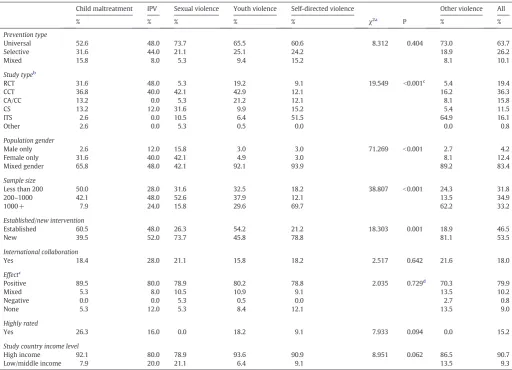
The annual number of studies identified increased from 2008 (n = 37) onwards reaching 64 in 2013 (mean 50.7). Of all 355 articles, over half (57.2%) evaluated interventions to prevent youth violence (Table 1). Child maltreatment accounted for 10.7% of articles, self-directed violence for 9.3%, IPV for 7.0% and sexual violence for 5.4%. In 2013, there was a notable increase in studies in the‘other violence’
category, examining non-specific violence types (e.g. violent crime, homi-cide, n = 6), alcohol-related violence (n = 5) andfirearms violence (n = 4). Study characteristics varied by year for sample size (e.g.b200, lowest 15.6% of studies in 2013, highest 44.9% in 2009), quality assessment (highly rated, lowest 6.2% in 2013, highest 30.8% in 2010) and proportions testing established interventions (lowest 35.9% in 2013, highest 67.3% in 2009). Across all years, most studies evaluated universal prevention pro-grams, and four infive reported positive effects (Table 2). Afifth of studies were RCTs and a third were CCTs, although there was a wide variation across violence types with RCTs accounting for 48.0% of IPV studies com-pared with 9.1% of directed violence studies. Around half of self-directed violence studies were ITSs and correspondingly studies on this violence type tended to have the largest sample sizes. Only 15.2% of stud-ies were highly rated on the quality assessment tool, ranging from 26.3% of child maltreatment studies to 0% of sexual violence studies. Established interventions accounted for 46.5% of studies and were most common for child maltreatment, youth violence and IPV. Studies addressing IPV, sexu-al violence and child msexu-altreatment were more likely than those for other violence types to work solely with females (including as mothers and partners).
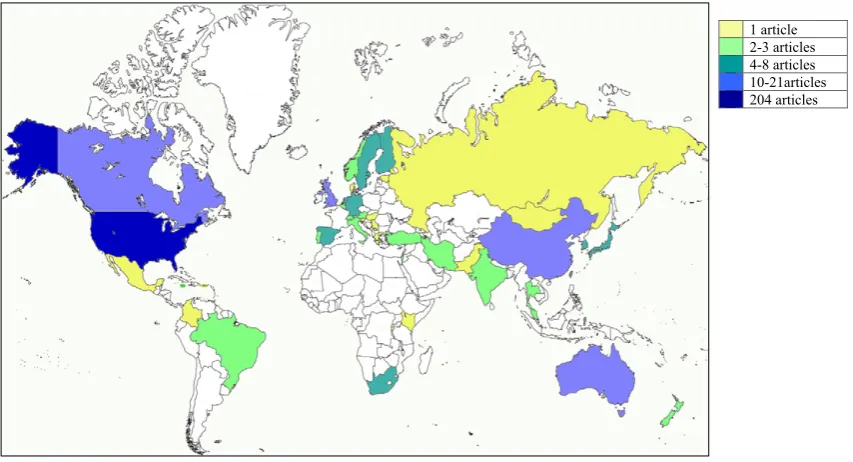
Less than one in ten studies (9.3%, n = 33) evaluated interventions in LMIC and there was no increase in the number of LMIC studies iden-tified over time (range 2 in 2008 to 7 in 2009). Two thirds of studies (65.1%, n = 231) examined interventions implemented in the WHO Region of the Americas, with 87.9% (n = 203) of these in the United States of America (USA). The WHO European region accounted for 19.7% (n = 70) of studies and the Western Pacific Region for 10.7% (n = 38). Eight studies (2.3%) had been undertaken in the African Region (six in South Africa),five (1.4%) in the South East Asia Region and three (0.8%) in the Eastern Mediterranean. The full geographical spread is shown inFig. 2. The distribution of studies by violence type did not vary between LMIC and HIC (Table 3). There were also no differ-ences between LMIC and HIC in prevention type, study type, population gender, sample size, effect or quality rating. However, LMIC studies were less likely to examine established interventions and more likely to in-volve international collaboration. All LMIC studies with international
16,683 references retrieved
for title/abstract review
605 identified as
potentially relevant and full
text reviewed
6,104 duplicates excluded;
9,974 excluded as not
relevant to violence
prevention evidence
355 studies included
20 additional relevant
studies identified
through reference
lists, user submissions
and research networks
270 excluded:
244 not primary
prevention
11 full papers not
available (non English
[image:3.595.136.474.56.318.2]language)
Fig. 1.Flow chart of the search process.*. *The seven electronic databases searched were: Applied Social Sciences Index and Abstracts (ASSIA), Cumulative Index to Nursing and Allied Health Literature (CINAHL), Criminal Justice Abstracts (CJA), Education Resources Information Center (ERIC), Medline, National Criminal Justice Reference Service (NCJRS), and PsycINFO.
Box 1
Search terms.The search strategy uses a combination of free text and controlled vocabulary terms referring to violence, prevention programs and study methodologies that are combined using Boolean operators (e.g. AND, OR, NOT), wildcard and truncation operators (e.g. * to search for all alternate endings to a word) and proximity definitions (e.g. N4 to specify that two terms must be within four words of one another). Base words include:
Violence
Violence, aggression, deviant/antisocial behavior, delinquency, crime victimization, homicide, murder, mistreatment, neglect, abuse (physical, sexual, mental, emotional, domestic, elder, child, psychological), bully,fight, assault, suicide, self-harm, self-injury.
Prevention
Prevention, intervention, program, training, support, education, mentor, life skill, psychosocial development, workshop, home visit, microfinance, bystander, behavior management, legislation, restriction, enforcement.
Study methodologies
collaboration had collaborators from HICs; none involved collaborations between LMICs. Conversely, all HIC collaborations in HIC studies involved HIC collaborators and none involved LMIC collaborators. Further infor-mation on LMIC studies is provided in Supplementary Table 1.
Skills-based programs were the most commonly studied interven-tion (28.5% of all studies;Fig. 3) and had been evaluated across all vio-lence types. They were also the most common interventions for youth violence (36.5% of articles), IPV (48.0%) and, along with social norms programs, sexual violence (36.8% each). Parenting programs accounted for most child maltreatment studies (39.5%). Legislative or policy approaches were most common for self-directed violence (36.4%) and the‘other violence’category (51.4%). There were few clear trends between years although 2012 saw a large increase in parent–child/ parent–child–school programs (n = 11) compared with other years (n = 3–5) and 2013 saw more multi-component and legislative/policy based interventions (n = 12 v 2–9 and n = 14 v 1–9 respectively). Skills-based programs dominated in both LMIC and HIC settings (48.5% vs. 26.4%). Multi-component programs were the second most common LMIC intervention type (15.2%; v 11.8% in HIC) while legis-lative/policy interventions were the second most common in HIC (12.7%; v 6.1% in LMIC).
4. Discussion
Preventing violence has been increasingly prioritized in global agendas, with growing recognition of the need for robust evidence to in-form policy and practice. This on-going violence prevention systematic
[image:4.595.34.558.77.164.2]review and thewww.preventviolence.inforesource were developed to support this need, facilitating access to scientific information on the effec-tiveness of interventions while also providing a mechanism for monitor-ing growth of the evidence base. Thisfirst analysis suggests that the evidence base is steadily expanding. Between 2007 and 2013 an average of 50.7 outcome evaluation studies were identified in peer-reviewed lit-erature annually, with numbers increasing year on year from 2008 (Table 1). This sustained if modest growth is encouraging. However, the distribution of studies across both violence types and geographies is uneven and identifies several areas where efforts require strengthening. By far the greatest focus of violence prevention studies has been youth violence. Here, factors including elevated homicide rates among youth, the damaging impact of youth violence on social and economic development, its highly visible nature and the public fear that it invokes (Krug et al., 2002; Sethi, Hughes, Bellis, Mitis, & Racioppi, 2010) may all have contributed to increased social and political interest in prevention. In contrast to youth violence, action addressing IPV, sexual violence and other forms of violence has often developed from a victim advocacy ap-proach. IPV and sexual violence were the subjects of just 7.0% and 5.4% of identified studies respectively, which is somewhat surprising given the relatively high visibility of violence against women in the global policy agenda (United Nations General Assembly, 2010). The strong ad-vocacy base and existence of high-level resolutions may paradoxically have hampered research on what works to prevent IPV by creating the impression that research is unnecessary to drive investment and action. Without research, however, investment and action may underperform, be misdirected or neglect prevention in favor of victim Table 1
Number of outcome evaluation studies included by year and violence type.
Child maltreatment Intimate partner violence Sexual violence Youth violence Self-directed violence Other violencea All
2007 4 1 3 23 9 3 43
2008 6 1 1 24 2 3 37
2009 6 2 5 30 4 2 49
2010 3 6 1 34 5 3 51
2011 7 3 6 30 3 5 54
2012 7 5 2 32 5 5 56
2013 5 7 1 30 5 16 64
All years 38 25 19 203 33 37 355
aThis includes violence against health staff (n = 7), gun violence (n = 8), alcohol-related violence (n = 9), workplace violence (n = 2), elder abuse (n = 1), violence among
pris-oners (n = 1), extremism (n = 1), and general community violence (n = 8).
1 article
2-3 articles 4-8 articles 10-21articles
204 articles
[image:4.595.81.508.497.728.2]support (World Health Organization & London School of Hygiene and Tropical Medicine, 2010). Critically, we found an almost complete ab-sence of studies on elder maltreatment, with just one identified over the seven year period. While elder maltreatment may lack the visibility and advocacy support of other violence types, with a rapidly ageing global population and the number of people aged 60 years and over expected to reach two billion by 2050 (United Nations, 2013), addressing this knowledge gap must be a priority.
Over half of all studies identified had been conducted in the USA. This proportion was highest in 2008 (62.2%) and lowest in 2012 (50.0%), although there was no clear trend suggestive of geographical diversifi ca-tion. Further, despite over 85% of violent deaths occurring in LMIC and global calls for research in these settings, fewer than 10% of articles examined interventions in LMIC with no indication that numbers were increasing (2007–2013, n = 5, 2, 7, 5, 3, 6 and 5 respectively). This research gap between LMIC and HIC is consistent with those identified for other health issues. For example, an examination of RCTs on interven-tions to address child and adolescent mental health disorders found that
only around 10% had been undertaken in LMIC despite around 90% of children and adolescents living in LMIC (Kieling et al., 2011). More broadly, in the 1990s and 2000s a‘10/90 gap’in health research funding (whereby only 10% of funding was thought to focus on health problems affecting the poorest 90% of the global population) was widely discussed (Currat et al., 2004), prompting action to redress the balance. This included promotion of health research funding in government and development agency budgets, establishment of global research funds, and research capacity building in LMIC (Lee & Mills, 2000). Such action helped boost investment in research for conditions including malaria and tuberculosis (Lee & Mills, 2000). The 10/90 movement may provide lessons for thefield of violence prevention where research remains largely entrenched in HIC.
[image:5.595.45.558.75.445.2]Understanding the factors that influence intervention evaluation priorities can help efforts to increase research investment in LMIC. Examination of the characteristics of studies from LMIC (Supplementary Table 1) revealed a wide variation between regions. Six of the eight studies in the African region had examined IPV or sexual violence Table 2
Characteristics of included articles by violence type.
Child maltreatment IPV Sexual violence Youth violence Self-directed violence Other violence All
% % % % % χ2a
P % %
Prevention type
Universal 52.6 48.0 73.7 65.5 60.6 8.312 0.404 73.0 63.7
Selective 31.6 44.0 21.1 25.1 24.2 18.9 26.2
Mixed 15.8 8.0 5.3 9.4 15.2 8.1 10.1
Study typeb
RCT 31.6 48.0 5.3 19.2 9.1 19.549 b0.001c 5.4 19.4
CCT 36.8 40.0 42.1 42.9 12.1 16.2 36.3
CA/CC 13.2 0.0 5.3 21.2 12.1 8.1 15.8
CS 13.2 12.0 31.6 9.9 15.2 5.4 11.5
ITS 2.6 0.0 10.5 6.4 51.5 64.9 16.1
Other 2.6 0.0 5.3 0.5 0.0 0.0 0.8
Population gender
Male only 2.6 12.0 15.8 3.0 3.0 71.269 b0.001 2.7 4.2
Female only 31.6 40.0 42.1 4.9 3.0 8.1 12.4
Mixed gender 65.8 48.0 42.1 92.1 93.9 89.2 83.4
Sample size
Less than 200 50.0 28.0 31.6 32.5 18.2 38.807 b0.001 24.3 31.8
200–1000 42.1 48.0 52.6 37.9 12.1 13.5 34.9
1000+ 7.9 24.0 15.8 29.6 69.7 62.2 33.2
Established/new intervention
Established 60.5 48.0 26.3 54.2 21.2 18.303 0.001 18.9 46.5
New 39.5 52.0 73.7 45.8 78.8 81.1 53.5
International collaboration
Yes 18.4 28.0 21.1 15.8 18.2 2.517 0.642 21.6 18.0
Effectc
Positive 89.5 80.0 78.9 80.2 78.8 2.035 0.729d 70.3 79.9
Mixed 5.3 8.0 10.5 10.9 9.1 13.5 10.2
Negative 0.0 0.0 5.3 0.5 0.0 2.7 0.8
None 5.3 12.0 5.3 8.4 12.1 13.5 9.0
Highly rated
Yes 26.3 16.0 0.0 18.2 9.1 7.933 0.094 0.0 15.2
Study country income level
High income 92.1 80.0 78.9 93.6 90.9 8.951 0.062 86.5 90.7
Low/middle income 7.9 20.0 21.1 6.4 9.1 13.5 9.3
IPV = intimate partner violence.
a
Chi squared analysis is limited to thefive violence types of child maltreatment, IPV, sexual violence, youth violence and self-directed violence.
b
Based on definitions provided by the Quality Assessment Tool for Quantitative Studies dictionary, briefly: RCT (randomized controlled trial), an experimental design where investigators randomly allocate eligible people to an intervention or control group; CCT (clinical controlled trial), an experimental design where the method of allocating study subjects to intervention or control groups is transparent; CA (cohort analytic study), an observational design where groups are assembled according to whether or not exposure to the intervention has occurred; CC (case control study), a retrospective design where investigators gather‘cases’of people who already have the outcome of interest and‘controls’who do not and identify whether they were exposed to the intervention; CS (cohort study), the same group is pretested, given an intervention, and tested immediately after the intervention. ITS (interrupted time series), multiple observations over time, knowing the specific point in the series when an intervention occurred.
c
RCT vs. non-RCT.
d
in the context of HIV prevention. These studies were all undertaken in South Africa with funding from the United States or international research grants. Conversely, of the six LMIC studies in the Americas, four focused on youth violence, one onfirearms violence and one on alcohol-related violence, implemented through various national and international funding streams. HIV and youth violence are leading causes of death in Sub-Saharan Africa and Latin America respectively (World Health Organization, 2013) and represent major barriers to social and economic development. Their prioritization in international, bilateral and national development agendas appears to act as a driver for prevention research funding. Identifying the health, social and eco-nomic impacts of violence in LMIC and estimating the gains that can be achieved through prevention should help support greater international investment in violence prevention research.
Given that self-directed violence accounts for over half of all violent deaths, with around 80% occurring in LMIC (World Health Organization, 2013), identification of only three studies on its prevention in such countries suggests a major evidence gap. Equally, despite growing awareness of the damaging impact that child maltreatment has on victims' long-term well-being, only three LMIC studies had evaluated child maltreatment interventions. Two of these were school interven-tions teaching children to protect themselves from sexual abuse (Chen, Fortson, & Tseng, 2012; Weatherley et al., 2012) and one was a parenting program (Oveisi et al., 2010). Early-life interventions that develop par-enting skills and strengthen parent–child bonding have among the strongest evidence from HICs and have longer-term benefits in improv-ing social outcomes for children and reducimprov-ing risk of violence in later life (World Health Organization & Centre for Public Health, Liverpool John Moores University). While they are being used and evaluated in LMIC, outcome measurements on violence are rare (Knerr, Gardner, & Cluver, 2013). To support the development of evidence in this area, the WHO has produced guidelines on outcome evaluations for parenting programs
(Wessels et al., 2013). Research examining the transferability of evidence-based violence prevention interventions such as parenting programs from HIC to LMIC settings is urgently required (Mercy et al., 2007; World Health Organization & Centre for Public Health, Liverpool John Moores University). Overall, only 24.2% of LMIC studies identified (n = 8) had evaluated established interventions compared with 48.4% in HIC (Table 3). Potential reasons for the lack of intervention replication or adaptation in LMIC may include insufficient investment for violence prevention, inadequate infrastructure for implementing evidence-based interventions, insufficient resources including research expertise, per-ceived cultural inappropriateness, or differing violence prevention prior-ities. Evidence-based interventions developed for HIC populations and infrastructures may not be appropriate in LMIC settings in their original form, yet some could be adapted tofit the needs and resources of differ-ent populations (e.g.Baker-Henningham, Scott, Jones, & Walker, 2012; Wechsberg et al., 2011). Further, evidence-based programs developed specifically for LMIC populations require replication and adaptation stud-ies to facilitate their dissemination (e.g.Jewkes et al., 2008). With support for LMIC violence prevention research growing, new funding opportuni-ties arising (e.g.Children & Violence Evaluation Challenge Fund) and technical support for LMIC researchers increasing (e.g.field epidemiology training programs, mentoring programs, global research networks), the on-going updates to the systematic reviews presented here will enable the identification of any growth in the evaluation of existing interven-tions in LMICs over future years.
[image:6.595.37.553.76.366.2]The search strategy used in this on-going systematic review will not identify all violence prevention outcome studies, and the online resource (www.preventviolence.info) addresses this issue by enabling users to submit relevant publications for review. Importantly, the strategy may have more easily missed studies published in major languages other than English, including Chinese, Spanish and Russian. However, many foreign language publications publish English abstracts that enable Table 3
Characteristics of articles by income level of intervention country.
Total Low & middle income economies High income economies χ2 P
n = 335 n = 33 n = 322
% % %
Violence type Child maltreatment 10.7 9.1 10.9 9.396 0.094
Intimate partner violence 7.0 15.2 6.2
Sexual violence 5.4 12.1 4.7
Youth violence 57.2 39.4 59.0
Self-directed violence 9.3 9.1 9.3
Other violence 10.4 15.2 9.9
Prevention type Universal 63.7 51.5 64.9 5.097 0.078
Selective 26.2 42.4 24.5
Mixed 10.1 6.1 10.6
Study type RCT 19.4 24.2 18.9 0.537 0.464a
CCT 36.3 30.3 37.0
CA/CC 15.8 21.2 15.2
CS 11.5 6.1 12.1
ITS 16.1 15.2 16.1
Other 0.8 3.0 0.6
Population gender Male only 4.2 6.1 4.0 3.068 0.216
Female only 12.4 21.2 11.5
Male and female 83.4 72.7 84.5
Sample size Less than 200 31.8 36.4 31.4 0.646 0.724
200–1000 34.9 36.4 34.8
1000+ 33.2 27.3 33.9
Established/new Established 46.5 24.2 48.4 7.055 0.008
Intervention New 53.5 75.8 51.6
International collaboration Yes 18.0 63.6 13.4 51.520 b0.001
Effect Positive 79.9 78.8 80.1 0.030 0.862b
Negative 0.8 0.0 0.9
Mixed 10.2 12.1 10.0
None 9.0 9.1 9.0
Highly rated Yes 15.2 15.2 15.2 0.000 0.992
RCT = randomized controlled trial; CCT = clinical controlled trial; CA = cohort analytic study; CC = case control study; CS = cohort study; ITS = interrupted time series.
aRCTs vs. non-RCTs. b
their incorporation into the international search engines that form the main source of the articles used here. The small number of studies on some violence types (e.g. elder maltreatment, workplace violence) meant that these studies could not be analyzed separately. Further, most articles identified showed positive outcomes. Although promising, this suggests publication bias and conflicts somewhat withfindings from various systematic reviews on violence prevention (MacMillan et al., 2009; Mikton & Butchart, 2009; World Health Organization & London School of Hygiene and Tropical Medicine, 2010). However, while sys-tematic reviews are often highly selective in their study inclusion criteria, this on-going systematic review has adopted a broader, inclu-sive approach that collates evidence from a wide range of study types and uses an established quality rating system to identify those of higher quality.
5. Conclusions
Violence prevention research is showing some promising trends with the number of outcome evaluation studies growing modestly. In HIC over 40% of published studies are testing established interventions, helping provide the depth of evidence needed for program investment and deployment at scale. This is especially the case for youth violence and child maltreatment. However, despite the disproportionate impacts of violence on LMICs, most studies are undertaken in HIC. Africa alone is estimated to suffer over 185,000 deaths annually through interpersonal and self-directed violence yet between 2007 and 2013 we identified only eight violence prevention outcome studies, mostly in South Africa. Programs successfully established here have capitalized on other major regional priorities (i.e. HIV). Increasingly apparent relationships between violence and social determinants, communicable and non-communicable diseases, and even economic prosperity should be explored as mecha-nisms to increase the uptake and global reach of violence prevention research. Finally, a greater understanding of bottle-necks in the diffusion of research is required. Diffusion of any innovation necessitates demon-strating a clear and observable advantage to any practice that it replaces and compatibility with the existing values, needs, skillsets and experi-ences of the individuals and communities in question. In contrast, violence prevention research is often complex and the full benefits of in-terventions can take years to be recognized. The successful global spread of violence prevention research, as well as ultimately its impact on health, depends on translating an increasingly convincing scientific case into one better understood by policymakers, practitioners and ultimately the people that it aims to protect.
Conflicts of interest
None declared.
Supplementary data to this article can be found online athttp://dx. doi.org/10.1016/j.avb.2014.09.006.
Acknowledgements
This analysis was undertaken as part of an ongoing research pro-gram to develop the prevent violence evidence base resource, funded by the United States Centers for Disease Control and Prevention and the World Health Organization. We thank Nicola Leckenby, Olivia Sharples, Ellie McCoy, Geoff Bates, Sara Wood, Anna Hunt and Stuart Cole for their support with the study.
References
Anda, R. F., Felitti, V. J., Bremner, J. D., Walker, J. D., Whitfield, C., Perry, B. D., et al. (2006).
The enduring effects of abuse and related adverse experiences in childhood: A con-vergence of evidence from neurobiology and epidemiology.European Archives of Psy-chiatry and Clinical Neuroscience,256(3), 174–186.
Baker-Henningham, H., Scott, S., Jones, K., & Walker, S. (2012).Reducing child conduct prob-lems and promoting social skills in a middle-income country: Cluster randomised con-trolled trial.British Journal of Psychiatry,201, 101–108 (Epub ahead of print).
Bellis, M. A., Lowey, H., Leckenby, N., Hughes, K., & Harrison, D. (2013).Adverse childhood experiences: Retrospective study to determine their impact on adult health behav-iours and health outcomes in a UK population.Journal of Public Health,36(1), 81–91.
Brown, D. W., Anda, R. F., Tiemeier, H., Felitti, V. J., Edwards, V. J., Croft, J. B., et al. (2009).
Adverse childhood experiences and the risk of premature mortality.American Journal of Preventive Medicine,37(5), 389–396.
Chen, Y. C., Fortson, B. L., & Tseng, K. W. (2012).Pilot evaluation of a sexual abuse preven-tion program for Taiwanese children.Journal of Child Sexual Abuse,21(6), 621–645.
Children & Violence Evaluation Challenge Fund (d).http://www.evaluationchallenge.org/
Currat, L. J., de Francisco, A., Al-Tuwaijri, S., Ghaffar, A., Jupp, S., & Secretariat of the respective networks (2004).10/90 report on health research 2003-2004.Geneva: Global Forum for Health Research.
Danese, A., & McEwen, B. S. (2012).Adverse childhood experiences, allostasis, allostatic load, and age-related disease.Physiology & Behavior,106(1), 29–39.
Effective Public Health Practice Project (d). Quality assessment tool for quantitative studies. Retrieved from.http://www.ephpp.ca/tools.html
Felitti, V. J., Anda, R. F., Nordenberg, D., Williamson, D. F., Spitz, A. M., Koss, M. P., et al. (1998).Relationship of childhood abuse and household dysfunction to many of the leading causes of death in adults. The Adverse Childhood Experiences (ACE) Study.
American Journal of Preventive Medicine,14(4), 245–258.
Jamison, D. T., Breman, J. G., Measham, A. R., Alleyne, G., Claeson, M., Evans, D. B., et al. (2006).Disease control priorities in developing countries (2nd ed.). New York: The World Bank and Oxford University Press.
0 10 20 30 40 50 60 70 80 90 100
Other Support group Screening and referral Mentoring/social learning Media/education program Therapy/counselling Behavior management Home visiting program Social norms program Parenting program Parent/child/school program Legislation/policy Multicomponent program Skills-based program
Number of articles
Child maltreatment
Intimate partner violence
Sexual violence
Youth violence
Self-directed violence
[image:7.595.142.470.55.223.2]Other violence
Fig. 3.Types of interventions evaluated in articles, by type of violence addressed.a.aInterventions that focused on developing participants' interpersonal or practical skills were categorized as
Jewkes, R., Nduna, M., Levin, J., Jama, N., Dunkle, K., Puren, A., et al. (2008).Impact of stepping stones on incidence of HIV and HSV-2 and sexual behaviour in rural South Africa: Cluster randomised controlled trial.BMJ,337, a506.
Kessler, R. C., McLaughlin, K. A., Green, J. G., Gruber, M. J., Sampson, N. A., Zaslavsky, A. M., et al. (2010).Childhood adversities and adult psychopathology in the WHO World Mental Health Surveys.British Journal of Psychiatry,197(5), 378–385.
Kieling, C., Baker-Henningham, H., Belfer, M., Conti, G., Ertem, I., Omigbodun, O., et al. (2011).Child and adolescent mental health worldwide: Evidence for action.Lancet,
378(9801), 1515–1525.
Knerr, W., Gardner, F., & Cluver, L. (2013).Improving positive parenting skills and reduc-ing harsh and abusive parentreduc-ing in low- and middle-income countries: A systematic review.Prevention Science,14(4), 352–363.
Krug, E., Dahlberg, L. L., Mercy, J. A., Zwi, A. B., & Lozano, R. (2002).World report on violence and health.Geneva: World Health Organization.
Lee, K., & Mills, A. (2000).Strengthening governance for global health research.BMJ,
321(7264), 775–776.
MacMillan, H. L., Wathen, C. N., Barlow, J., Fergusson, D. M., Leventhal, J. M., & Taussig, H. N. (2009).Interventions to prevent child maltreatment and associated impairment.
Lancet,373(9659), 250–266.
Mercy, J. A., Butchart, A., Rosenberg, M. L., Dahlberg, L., & Harvey, A. (2007).Preventing violence in developing countries: A framework for action.National Research Council. Violence prevention in low- and middle-income countries: Finding a place on the global agenda. Workshop summary. Washington, D.C.: The National Academies Press.
Mikton, C., & Butchart, A. (2009).Child maltreatment prevention: A systematic review of reviews.Bulletin of the World Health Organization,87(5), 353–361.
Oveisi, S., Ardabili, H. E., Dadds, M. R., Majdzadeh, R., Mohammadkhani, P., Rad, J. A., et al. (2010).Primary prevention of parent–child conflict and abuse in Iranian mothers: A randomized–controlled trial.Child Abuse & Neglect,34(3), 206–213.
Pinheiro, P. S. (2006).World report on violence against children.Geneva: United Nations Secretary-General's Study on Violence against Children.
Sethi, D., Hughes, K., Bellis, M. A., Mitis, F., & Racioppi, F. (2010).European report on preventing violence and knife crime among young people.Copenhagen: World Health Organization Regional Office for Europe.
Shonkoff, J. P., Boyce, T., & McEwen, B. S. (2009).Neuroscience, molecular biology, and the childhood roots of disparities: Building a new framework for health promotion and disease prevention.JAMA,301(21), 2252–2259.
United Nations (2013).World population prospects: The 2012 revision.New York: United Nations.
United Nations General Assembly (2009). Promoting development through the reduction and prevention of armed violence: Report of the Secretary-General. Retrieved from.
http://www.genevadeclaration.org/advocacy/un-process.html
United Nations General Assembly (2010). Intensification of efforts to eliminate all forms of violence against women: Report of the Secretary-General. Retrieved from.http:// www.un.org/womenwatch/daw/vaw/v-work-ga.htm#in
Weatherley, R., Hajar, A. B. S., Noralina, O., John, M., Preusser, N., & Yong, M. (2012).
Evaluation of a school-based sexual abuse prevention curriculum in Malaysia.
Children and Youth Services Review,34(1), 119–125.
Wechsberg, W. M., Zule, W. A., Luseno, W. K., Kline, T. L., Browne, F. A., Novak, S. P., et al. (2011).Effectiveness of an adapted evidence-based woman-focused intervention for sex workers and non-sex workers: The Women's Health CoOp in South Africa.J. Drug Issues,41(2), 233–252.
Wessels, I., Mikton, C., Ward, C. L., Kilbane, T., Alves, R., Campello, G., et al. (2013).
Preventing violence: Evaluating outcomes of parenting programmes.Geneva: World Health Organization.
World Health Organization (2013).Disease and injury regional mortality estimates, 2000–2011.Geneva: World Health Organization.
World Health Organization & Centre for Public Health, Liverpool John Moores University (2009).Prevent violence: The evidence.Geneva: World Health Organization.
World Health Organization & London School of Hygiene and Tropical Medicine (2010).