1 | P a g e
REINVESTMENT PROJECT FINAL REPORT
NHS Workforce Access and Progression Projects
July 2011
2 | P a g e Acknowledgements:
The project team are grateful to all the people who supported and contributed to this
project and gave recommendations, suggestions and advice. We could not have
achieved the end product without the technical expertise of Tracey Penberthy who
helped shape the look of the websites. The project team would particularly like to
thank the Project Board and Steering Group members whose expertise and insight
were invaluable.
Thank you to:
Amanda Shobrook - Widening Participation Lead SW Strategic Health Authority
Dr Billie Oliver – UWE/SHA Joint Projects Lead
Rhian Walters – Project Administration
Derek Sprague – Workforce Development Lead SW Strategic Health Authority
Tracey Penberthy, Jane Wathan & Ian Parsons - UWE IT support
Jonathan Evans – SW Director Skills for Health
Marie Horton, Delyse Taylor, Cathy Dullehan – N. Somerset 14-19 Education Team
Tom Lawton - SHD Diploma Student
Carolyn Griffiths - Education Business Partnership West
Dorothy Wright - WellUK Independent Sector representative
Giovanna Edwards – QIPP Project Lead
Jane Hadfield, Sue Crew, Tina Alner - North Bristol NHS Trust
Sue Cotterell - University Hospitals Bristol
Mandy Johnson - Derriford Hospital Plymouth
Vera Byfield - Royal Devon & Exeter Foundation Trust
Mark Curtis - Creative & Media Tutor Backwell School North Somerset
Elliot Lamb - Seb Swift - Jamie Carter - Katherine Shaw Creative & Media Diploma
students at Backwell School
South West Skills Alliance Group and Skills for Health Employers Council members
3 | P a g e Contents
1 Executive Summary ... 4
2 Background ... 8
3 Project Aims and Scope ... …..12
4 Project Activity………..13
- Scoping existing provision and identification of gaps - Development of resources - Partnership and stakeholder working and sharing best practice - Promotion and evaluation 5 Project Outcomes and Key Findings ... 45
6 Recommendations and Next Steps ... 50
4 | P a g e 1. Executive Summary
1.1 The Day in the Life website was developed in response to the need to create a
South West specific resource that raised awareness and aspiration towards the wide
range of jobs and careers in the health care sector to under-represented groups. It
was also identifed that there was a need to engage with NHS Trusts to encourage
the sharing of best practise around work experience and apprenticeship
opportunities.
1.2 The South West Strategic Health Authority funded project commenced in May
2009, when there were concerns about a future skills gap due to a predicted and
significant retirement of the workforce over the next 5 years. This predicted gap
leads to the need to attract people into health care employment. Additional project
priorities lay in demonstrating that the workforce represented the population it serves
to ensure that widening participation and diversity targets are met particularly in
relation to young people and ethnic minority groups within the region.
1.3 The project was also asked to look at progression routes and self development
opportunities for staff once part of the workforce particularly in light of a strong focus
being place on training opportunities for the previously under resourced groups within
Bands 1-3. The progression routes and development element grew in importance
during the project‟s lifespan with the increasing need to create redeployment
opportunities for existing staff and the introduction of apprenticeships. Additionally
there became a need to help potential new staff and those undergoing redeployment
identify their transferable skills.
Scoping existing provision and identification of gaps
1.4 Scoping was undertaken to identify what information and resources were already
available, where they were stored and how they were used. A range of methods
were used to undertake this including; extensive internet research, discussions with
representatives from all 40 SW NHS Trusts, individual and group meetings. The
5 | P a g e range of these as possible, therefore an ongoing organic approach was taken to the
development of all resources.
1.5 The scoping exercise identified that although there is a wide range of local,
regional and national information available to individuals, schools, colleges and
adults, it is not always readily available or presented in a way that is easy to access
or navigate. It was found that it often stood in isolation from other sources and did
not have a specific South West focus which was identified as of critical importance.
1.6 It was identified that both young people and the more mature workforce often
know what area they want to work in, for example; engineering, IT or catering, but
would not necessarily consider the health care sector as an employer within these
areas. It was agreed that more needed to be done to promote opportunities within
the health care sector to demonstrate the variety of jobs that can be undertaken in a
wide range of locations.
1.7 There was also a need to encourage existing staff to undertake further training
thus increasing their skill sets to meet current and future organisational requirements,
particularly around numeracy and literacy.
Development of resources
1.8 A central repository or portal (www.dayinthelife.org.uk) was developed to enable the storage and easy access of newly created and existing resources. The new
resources were designed to address particular issues and gaps around topics such
as attracting a diverse workforce, training & education, retaining, and re-deploying
the right staff. This portal also holds new information and activities developed by the
project leads to meet the explicit requirements of the potential and existing workforce.
1.9 Information developed and stored on the website has been categorised into
different sections, with the aim that there is a natural progression through them all but
6 | P a g e different sections sought to provide information on qualifications, work experience,
pay and benefits and completing university and job applications. Different search
methods were designed to help individuals identify their skills and find different jobs.
There is also a section on development opportunities for existing staff about issues
relating to development and training, redeployment, career progression, appraisals,
staff case studies and SW NHS and Educational contact maps.
Partnership & Stakeholder Working
1.10 Partnership and stakeholder working has had a particularly strong focus within
this project with Project Leads, partners and practitioners worked together in directing
the course of this work using a style similar to elements of an action learning/action
research approach.
1.11 A project steering group was established in order to get a breadth of
representatives from a wide range of organisations and community groups.
1.12 Specific work was undertaken around the sharing of best practice in relation to
work experience programmes, application forms and the development of
apprenticeships. SW NHS Trusts were encouraged to share their experiences and
documentation to encourage others to offer opportunities. A number of interactive
events and workshops were run to best facilitate this sharing process.
Evaluation and Promotion
1.13 The project achievements have been presented at a number of meetings and
conferences, again, both nationally and regionally. Promotional bookmarks were
designed and distributed to encourage people to visit the website.
1.14 Evaluation and feedback was sought throughout the duration of the project to
ensure the ongoing validity and relevance of the website to all end users. A
comprehensive evaluation of the website showed that it was well received by all
7 | P a g e 2. Background
2.1 There are currently 159,000 people employed in the health sector in the South
West Region (SfH 2010). However it is forecast that an average of 8,200 employees
will leave the sector every year across the South West, with 82,000 people predicted
to retire from the sector between 2007 and 2017. Therefore, despite the financial
drive to decrease staff numbers, the region and its employers will still need a
substantial number of people to fill new jobs and replace existing workers who will
retire or leave the sector (SfH 2010).
2.2 While this retirement allows the health care sector to look at ways to achieve a
more cost effective skill mix through role reconfiguration, redeployment and decrease
in staff numbers there will still be a need to employ new members of staff, albeit in
different roles than those currently recognised.
2.3 The White Paper Equity and Excellence: Liberating the NHS (July 2010), requires
healthcare providers to employ staff with the skill mix appropriate to deliver a high
quality service to patients in every circumstance. It discusses the need to generate security of workforce supply to enable people to have the “right skills in the right place at the right time”. It is calling for high quality education and training to allow
greater flexibility of care and a workforce that is responsive to changes in service
delivery that meets patients changing needs. This requires a future supply of people
interested in working within the sector.
2.4 With this in mind, the South West Strategic Health Authorities commissioned the
University of the West of England to undertake a project to look at ways individuals
access employment within, and progression through, the NHS. It was identified that
there was a need to raise individuals and group‟s awareness and perception of the
Health Care Sector as an employer. Although there is a wide range of information
available to individuals, schools, colleges and adults it is not always readily
accessible or presented in a way that is easy to navigate. Gaps in the information
8 | P a g e project was created to look at the issues of recruitment and progression both in terms
of new recruits into the NHS and existing staff who feel that they would like to move
within their organisation particularly in light of the need for redeployment. A strong
South West focus was emphasised throughout the work undertaken.
2.5 The project, therefore, was designed to look more widely than the obvious
choices of health and social care careers to include areas such as; estates, catering
and administration and, in particular, jobs and careers within current risk areas
identified within the Skills for Health Labour Market Intelligence Document (2010).
2.6 Potential recruits could be young people straight from school and college, or
adults who have worked in other areas and, although new to the NHS, are not new to
the work environment. Additionally they could be individuals seeking redeployment within the sector. It was identified that people don‟t understand the range of jobs that
are available within the health care sector and therefore do not look to it for
employment.
2.7 It was identified that both young people and the more mature workforce often
know what area they want to work in, for example; IT, science or catering, but would
not necessarily consider the Health Care Sector as an employer. However, recently
there seems to be an increase in the amount and diversity of people applying for
work within the NHS, possibly due to the current financial climate.
2.8 Many applicants seem to be insufficiently versed in the language and style of the
NHS and, often, are not able to complete applications effectively, indeed there is
anecdotal evidence that this issue impacts upon all ages and professional groups. It
is also generally considered harder recruiting adequate staff members into Bands 1-
4 than into Bands 5 - 9, as recruiting adults, who are already working, and young
people who have left school or college, are much harder groups to identify, and
target. Additionally local job market competition is often strong with competitive pay
9 | P a g e 2.9 There is also a need to help existing staff identify what opportunities are available
for them to retrain or move into other areas of work to maintain their interest, keep
them in the workforce, aid with redeployment and ensure that people are appropriately trained and educated to provide “the right skill in the right place at the right time” (DH 2010). It was identified that more needed to be done to promote
opportunities within the NHS to demonstrate the variety of interesting and rewarding
jobs that can be undertaken in a wide range of locations and encouraging existing
staff to consider increasing their skill sets by undertaking further training and
therefore hopefully retaining staff members.
2.10 The availability of dedicated funding for bands 1- 4 since 2008, through the Joint
Investment Framework, has raised NHS organisations‟ and staffs‟ awareness of the
learning and development needs of staff within these bands. Miers & Shobrook
(2010) found that the Joint Investment Framework funding has improved in-house
learning provision with learners reporting positively on learning provision and
organisations identifying that this learning led to an increased understanding of their
roles, an increase in confidence, communication and a better understanding of the patient/customers‟ need.
2.11 The work of Miers & Shobrook (2010) also found that there was an improvement
in productivity and identification of opportunities for career progression. It was further
identified that the transparency and consistency of opportunities within health care
organisations in the South West needs development in order to improve equality and
parity of service throughout the region.
2.12 The formation of the coalition government in the May 2010 resulted in a shift in
priorities for the funding of training opportunities. Train to Gain was abolished and
financial resources were targeted into Apprenticeship opportunities instead of
standalone vocational qualifications. These opportunities were open to new and
10 | P a g e West NHS Trusts were actively encourage to put in place and offer apprenticeship
opportunities in order to meet the government public sector organisation target of
approximately 500 for 2010-2011.
2.13 The Health Care Sector also needs to reflect the communities in which it
functions and as such a diverse workforce is required. It therefore needs to ensure
equal recruitment opportunities for ethnic minority groups, disabled staff and people
of all ages and genders. Adding to this there are currently low numbers of 16-24 year
olds employed within the sector, this number is less than half of those employed in
the local economy (SfH 2010) and while this may be due to the time taken to qualify
for specialist roles, young people need to be encouraged to identify that working
within the health care sector is a valuable career option.
11 | P a g e 3. Project aims and scope
The initial aims of the project were:
3.1 To identify what resources were currently available to help individuals and groups
identify the wide range of job and career opportunities within the NHS and other
health care organisations.
3.2 To identify which organisations were offering what services to schools and other
health care organisations to help with the identification of the NHS and other Health
& Social Care providers as employers.
3.3 To promote the NHS and other health care organisations as an employer with a
extensive range of jobs and career opportunities.
3.4 To build a central resource, acting as both a storage for information and to allow
the sharing of best practice through the development of an interactive web portal: the
Day in the Life website www.dayinthelife.org.uk
3.5 To provide information on development opportunities for existing members of
health care sector staff and organisations to help meet the current challenges.
12 | P a g e 4. Project Activity
4.1 Project activity has been broken down into 4 areas:
Scoping existing provision and identification of gaps
Development of resources
Partnership and stakeholder working and sharing best practice
Promotion and evaluation
4.2 Scoping existing provision and identification of gaps
4.2.1 Scoping exercises were undertaken to find both national and local information.
A range of methods were used to undertake the initial and ongoing scoping exercises
of what was already available, where this was stored and how it was used. This
included; a trawl of the internet, discussions with members of the three Skills Alliance
Groups in the South West, individual meetings and the establishment of a project
steering group with representatives from South West Strategic Health Authority, Skills
for Health, Human Resources representatives, NHS Trusts (both Acute and
Community), the Independent and Voluntary Sectors, Job Centre Plus, the
Connexions Service, Education & Business Partnerships, 14-19 Education Leads
and young people. Additional work has been undertaken with Bristol City Council,
the Western Vocational Lifelong Learning Network and Aimhigher.
4.2.2 It was identified that although there is a wide range of information available to
individuals, schools, and colleges this is not easy for the individual to find or access.
For example, schools and colleges have information about how to complete a strong
UCAS application, however, this information would be difficult for the stand alone
individual to find, access and utilise.
4.2.3 While there is explicitness to individual sites, they don‟t always make sense to
13 | P a g e organisations; however these often leave the “outsider” outside, with the risk that this
will lead to missed opportunities for recruitment of staff from a wide range of social
groups. All new developments were discussed with a wide range of individuals and
groups to ensure it met regional requirements and that the content and language was
appropriate.
4.2.4 The scoping exercise found examples of best practice within the South West
which were then shared with other South West organisations by the project leads and
developed further to meet wider requirements. The scoping exercise also enabled
the identification of extensive information stored on a range of national websites that
would not be readily found by the casual browser. This was collated and explicitly
linked to work that was being undertaken within the South West and to the Day in the
Life website www.dayinthelife.org.uk. The development of this website became a significant part of this project.
4.2.5 The recruitment process is a clear example of the use of specialised
terminology. Within the national NHS websites, health sector jobs can fall under categories such as “Corporate Services” or “Hotel Services” which don‟t necessarily
mean very much to people outside of the NHS. On the other hand, external
recruitment agencies use terminology such as; Information Management, Secretarial
and PA, Chefs and Kitchens, Security, Portering and Driving, Science and
Engineering, all of which are more readily understandable by the public, who could
miss opportunities for employment within the health care sector because of this
language/jargon barrier.
4.2.6 Apart from NHS Careers, there were few websites that promoted the full range
of work opportunities within the health care sector or indeed the wide range of
locations where work can be undertaken. For example, when asked, most people identified “big town hospitals” but found it harder to recognise that health care was also provided in an individual‟s home or on the high street; in Chemist shops,
14 | P a g e forgot that health care was provided within their school settings and interestingly did
not equate inoculations for holidays with health care. Therefore extensive work was
carried out showing the diversity of work places as well as job types.
4.2.7 Building on work undertaken by St Mark & St John University Plymouth (Bell
2006) where analysis of questionnaires given to young people identified that some
were reluctant to work directly with patients, the jobs and careers available within the
NHS and Health Care settings were broken down into Direct Physical Contact, Direct
Verbal Contact (i.e. in the vicinity of the client group) and Minimal to No Contact.
The search categories were also broken down into the type of working style an
individual wanted (e.g. team working, community working) and into areas of work e.g.
community, hospital. This lead to the development of a pictorial high street where
health care jobs were identified within communities e.g. pharmacies, within
[image:14.612.60.563.418.768.2]supermarkets, health care within sport centres.
15 | P a g e 4.2.8 Working closely with individuals and groups, the project leads were able to
identify existing work and best practice within the South West and ensured that this
was shared, and used as a resource to help others develop practice both by face to
face communications and, more sustainably storage on the day in the life web site
www.dayinthelife.org.uk. This also allowed the information to be given a South West focus that is missing from national information.
Action Taken:
Extensive online research or local, regional and national resources undertaken
Extensive face-to-face contact made to relevant individuals and groups
Perceived Benefit:
Utilisation of existing resources to decrease duplication of effort
Increased user friendly use of language and terminology
Involvement of young people in the development of resources
Identification and sharing of best practice across the South West
Development of a central storage and access point
4.3 Development of resources
4.3.1 The development of the website was undertaken in close conjunction with the University of the West of England‟s IT staff who developed it in its early stages. It was
originally designed under the auspices of Aimhigher, to help potential university
students searching for careers within the health care professions available at the
University of the West of England. The website has been extended to include as
many careers and jobs within the health care sector as possible and especially
non-clinical Bands 1-4. The website sought to cover the whole of the South West and no
longer has the strong Higher Education and University of the West of England focus
16 | P a g e
Figure 2 – Screen shot of the Day in the Life website home page
4.3.2 The website is broken down into 3 discreet areas:
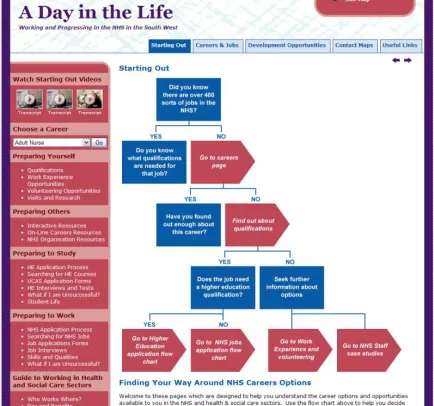
Starting Out - which is aimed at people interested in finding out more about a career
in the Health Care Sector and has information and activities to help teachers and
young people
Careers & Jobs -which is aimed at helping people identify what jobs are available
and how their existing skills, attributes and work styles would help them.
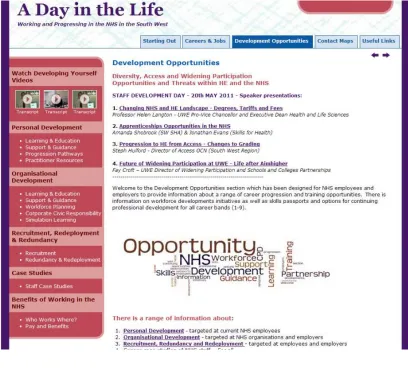
Development Opportunities -which is aimed at helping people once employed
17 | P a g e Starting Out;
Figure 3 – Screen shot of the Day in the Life ‘Starting Out’ section
4.3.3 “Starting Out” looks at the qualifications required for a wide range of specific
jobs within the health care sector. It identifies ways an individual can make
themselves a more attractive candidate on a job or UCAS application form. It has
18 | P a g e making sure that individuals are better informed about the jobs available. Thus
organisations and individuals save time and money on recruitment and training.
4.3.4 Additionally, information supplied by NHS Trusts actively engaged in delivering
Work Experience opportunities is stored here as a central point to enable
organisations starting out on this process to have a wide range of useful policies,
procedures, risk assessment strategies, orientation programmes, etc to make the
introduction of Work Experience a less onerous task and to decrease the risk to the
organisation.
4.3.5 Best practice in relation to Work Experience has been identified across the
South West through two workshops run in Plymouth and Taunton and relevant
documentation shared with other interested NHS Trusts. The profiling of
documentation from Trusts offering work experience has allowed some Trusts to
begin to develop work experience programmes and other more established ones to
look at their own practices and fine tune these.
4.3.6 There are a range of resources and activities specifically aimed at allowing
teachers and students to work with examples of real documentation and equipment
from the health care sector. There is information for both young and mature people
looking to make a university application. There is information and guidance on the
completion of job applications particularly following concerns raised about the poor
quality of application forms in general. There is also a strong focus on helping the
hard to reach groups and supporting people going through redeployment. The wide
range of jobs and environments in which individuals can work are identified using
language that is in common usage rather than the terminology used within the health
care sector.
4.3.7 It was identified that the website language and approach needed to be
19 | P a g e easily established within organisations with the risk that this leads to missed
opportunities for recruitment of staff from a wide range of social groups
[image:19.612.87.536.210.558.2]Careers & Jobs;
Figure 4 – Screen shot of the Day in the Life ‘Careers and Jobs’ section
4.3.8 The “Careers & Jobs” section gives a wide range of search options to identify
what sort of work and careers are available within the health care sector, and which ones would appeal to an individual‟s personal working style. A variety of search
options were developed to cover as wide a range of individual styles as possible such
20 | P a g e Alphabetical
Job groups Education level Work place Work style
Amount of patient contact
It also has a focus on pay and benefits, which was deemed of particular importance
by the young people consulted during this work and interestingly, the young people
often underestimated the salary for jobs with the NHS.
[image:20.612.93.501.339.707.2]Development Opportunities
21 | P a g e 4.3.9 The “Development Opportunities” section looks at how an individual can
develop themselves after they have commenced employment and what career
progression routes are open to them. There is also information for existing health
care workforce and organisations about issues relating to development and training,
redeployment, career progression, appraisals and redundancies. There is extensive
material on how NHS organisations can also develop and improve with regards to
workforce planning and how to best incorporate apprenticeship opportunities into
their workforce plans.
4.3.10 The aim was to develop a way to signpost routes and pathways into the NHS
and progression through jobs and careers once employed. Much of the work
developed and stored on the website gives underpinning information and guidance to
help people individualise both these elements, however it was important that this
could also be represented in a diagram format. A number of differing options were
looked at. However, as this work was being developed it became clear that this was a
complex task with such a vast range of jobs and careers available within health &
social care with subtly different job titles used in different organisations. There was
also a significant risk that this work would become dated very quickly as a result of
changes being made during the current financial climate within the UK.
4.3.11 With further consideration, it was identified it would be useful to look at the
trigger that led to people to look for career progression. This trigger would often be
via the appraisal but may be another event, redeployment for example, or a
readiness to extend oneself. The diagram then looks at what an individual needs to
do to prepare themselves for a new job/career This may be more training or
undertake some formal education but would definitely include completion of an
application form and preparation for interview and interview feedback for both the
successful and non successful candidates. The cycle would then recommence. This
cycle was then replicated for individuals looking to join the health & social care
22 | P a g e 4.3.12 The focus on self development started once an individual was part of the
workforce and covers a range of options and strategies that help individuals develop
and further themselves. A range of approaches was taken to achieve this wide remit, many of which link closely with fulfilling an organisation‟s civic corporate
responsibilities.
4.3.13 A number of staff progression success stories from around the South West
were videoed and included on the site as an inspiration to others. For example, one
person talks about starting out as a cleaner in a theatre suite and is now an
Operating Department Practitioner.
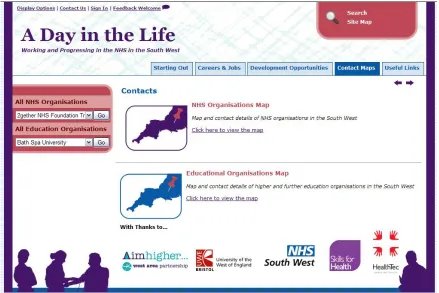
4.3.14 There is also a further section containing two contacts maps:
A NHS Organisation contacts map with details for all the NHS
organisations within the South West.
An Educational contact map of the contact details for Further
Education Providers, Higher Education Institutes and private training
23 | P a g e Figure 5 – Screen shot of the Day in the Life ‘Maps’ section
4.3.15 The aim was to produce a natural progression through the three areas while
allowing each area to fulfil the requirements of an individual or group at any one time.
4.3.16 To help ensure sustainability upon completion of the project, there are copious
links from the Day in the Life website to other national websites that will be
maintained by their providers e.g. Government sites, NHS Careers, Skills for Health,
National Apprenticeship Service. An agreement has been reached with UWE for
ongoing site maintenance at the end of the project for the initial duration of 3 years.
4.3.17 The resources and products from a number of related SHA and UWE projects
24 | P a g e Action Taken:
Identified and links established to existing regional and national resources.
Creation of focused SW specific resources.
Worked with technical team to develop interactive website.
Care taken to ensure appropriate usage of language and terminology.
Care taken to ensure sustainability and currency of website information.
Perceived Benefit:
Central storage point created so that individual users of the website could easily
navigate to relevant other resources.
Allowed connections to and from other organisations websites as a reciprocal benefit.
Low maintenance needed after project completion to update information stored.
4.4 Partnership and stakeholder working and sharing best practice
4.4.1 Partnership and stakeholder working has had a particularly strong focus within
this project with Project Leads, partners and practitioners worked together in directing
the course of this work using a style similar to elements of an action learning/action
research approach. This was of particular importance as the work had to be
undertaken with people making contributions, suggesting solutions and sharing
existing resources. Using a collaborative approach allows new knowledge to be
generated while allowing this knowledge to be utilised in the change process. This
approach was felt to be important to ensure validity and relevance, and allowed
teams to embed the developments within their organisations.
Steering group
4.4.2 A steering group for the project was established to enable the project leads to
stay focused and ensure as wide a voice and range of individuals as possible
informed the work. The membership was taken from a wide range of organisations
with membership representing: South West Strategic Health Authority, Voluntary (3rd
Sector), Private (Independent) Sector, Skills for Health, NHS Human Resources
representatives, NHS Trusts both Acute and Community, Job Centre Plus,
25 | P a g e colleges, 14-19 Education Leads and young people. Thus a wide range of people
and organisations were involved, all of whom had different priorities.
4.4.3 The wider value of the work this group could produce in terms of reference (see
Appendix 1) and importance was identified early on and a commitment was made for
this group to continue after the completion of this project.
Action Taken:
Establishment of steering group from a wide range of organisations
Perceived Benefit:
Strong links made across organisations and different sectors
Close and effective sharing of resources and ideas
Useful multi and cross agency working
Constant reflection on the relevance of the website to different audiences.
Group will aim to be ongoing after completion of its initial remit
Young person’s perpective
4.4.4 North Somerset Education Authority through its 14-19 Diploma leads kindly
gave the project access to two groups of Diploma students. The first group were
Society Health & Development students based at Weston FE College and this group
helped with the content and language of the website, and importantly challenged the
direction of thinking that allowed the project to see the importance of looking at the
NHS and other health care providers from the outside rather than from the inside. Thus the use of words like “Acute Trust” and “Corporate Services” were challenged
as these are not familiar to a non NHS audience. They were replaced with the words “large city hospital” and “information management and computing & IT” to bring them
in line with terminology used by recruitment agencies and therefore more
26 | P a g e 4.4.5 The students also approved of the development of the Community Map to show
where health & social care work could be undertaken and by whom. A lively debate
took place about how best to pictorially represent where health care was delivered
within a community. The representation of a town (See Figure 1) was finally
identified as the most appropriate choice.
4.4.6 Students undertaking the Creative and Media 14-19 Diploma from Backwell
School, North Somerset were also approached to help with this project with the aim
that their work would become part of their extended project course work. They were
asked to develop media that would appeal to a younger age group (Appendix 3).
They were given access to a range of individuals who represented the less well
known jobs within the NHS, including those working in; the science laboratory,
catering, CSSD, library, crèche, administration (a young person undertaking an apprenticeship) and a cleaner. The students chose to link all these people‟s recordings together with the phrase “I‟m NHS too”.
4.4.7 The project has also worked closely with the Education Business Partnership
West, Aimhigher West and Aimhigher Peninsula Healthcare Strands who have help
the project team gain access to a wide range of schools to promote and seek young people‟s evaluation of the website and promote the health service as a career.
4.4.8 A young person undertaking the Diploma qualification was invited to represent
the views of his peers at the Steering Group meetings which he regularly attended.
He did this with confidence and maturity and also undertook a small research project
that also informed his course work and the website development.
Action Taken:
Involvement of young people was sought at various stages of project activity
Perceived Benefit:
27 | P a g e Efforts made to ensure that a young person friendly approach was adopted for both
content and design
The language and terminologies were constantly challenged and refined to maintain
relevance to the intended audience.
The project provided a „real life‟ employer focused media project opportunity for the
Creative Media students
Allowed a young person to confidently develop communication, team working and
negotiation skills.
Graduates
4.4.9 The website has also been used as a resource for graduates looking for work
within the NHS and other health care providers. The Project Leads encouraged
cross project collaboration which led to working closely with a colleague who secured
funding to purchase a Day in the Life Ad button presence on the GradSouthWest
website as this is a site used by recent graduates to look for career opportunities
and/or further training. After the advert was placed, a significant rise was seen in the
amount of traffic entering the site at that page. The aim was to demonstrate the
range of career opportunities open to all graduates but specifically science graduates
who might consider a career in Health Sciences.
4.4.10 Two careers Fairs were attended in Bristol and Plymouth to promote the
website to this audience and demonstrate how it could help them seek employment
and consider different career options after graduation. One group were third year
applied science students and the other were healthcare students so they had
differing needs. The events were helpful in order to gain feedback about other
information they would like to see included in the future.
Action Taken:
Advertisement button added to national Grad SW website and career fairs attended.
Perceived Benefit:
28 | P a g e An opportunity to speak to this user group and gauge levels of interest and
interaction.
Useful feedback about what specific information graduates would want from the
website.
Recruitment processes, completion of application forms and transferable skills
4.4.11 It was identified, by a number of staff within a range of organisations, that
there is an issue relating to the successful completion of application forms for
employment and potentially redeployment within the NHS. There was a sense of
frustration that potentially good and valuable members of the workforce could not be
shortlisted due to poor standard of completion, particularly in relation to how they met
the person specification. It was noted that this applied to all ages and a wide range
of grades and professional qualifications.
4.4.12 While the ownership of this issue is contentious; the potential employers or the
potential candidate, it is clear that there is a bigger issue than first thought, especially
when considering ages and cultural backgrounds and the need for employers to
engage with their local communities and meet equality and diversity legislation. It
was also felt that employers could be missing members of society who would make
valuable contributions to the NHS in relation to enthusiasm, commitment, loyalty,
diversity and innovation.
4.4.13 Additionally, it was identified that individuals, who needed to follow the
re-deployment route, particularly if they had been in their jobs for some time, would
need support, help and guidance in this area.
4.4.14 There is an underlying commonality of need around issues of literacy, spell checking, grammar and text speak and while some of this is related to today‟s
society, it was clear that people are not always aware of the inappropriateness of
informal language in formal applications. It was also found that some individuals did
29 | P a g e importance of meeting the person specification, and the depth of information required. Concerns were also raised in relation to candidates‟ presentation of self at
interview e.g. appropriate clothing. It was also noted that while unsuccessful
candidates are given the offer of feedback this could be a daunting process, that the
under confident would not engage with.
4.4.15 With this in mind a number of initiatives were undertaken by the project leads.
Links were made to a range of information about completion of UCAS forms. A
sample of a weak and strong application form was developed using a real job that
was being advertised on the NHS Jobs website; this is already proving of value to
those seeking redeployment. A group has been set up to look at the issue of
application form completion and a paper has been written for circulation highlighting
the main areas of concern (See Appendix 2).
4.4.16 Two NHS focused Employment Workshops were developed in conjunction
with Business in the Community which aimed to help unemployed people identify
their skills and qualities and successfully match them to a job description and person
specification in order to complete an application form. Thirty seven individuals
attended and they evaluated the events extremely well. The Business in the
Community coordinator stated that the sessions were exactly the sort of interactive
activities that these individuals needed to help give them the confidence and
knowledge to successfully apply and gain employment.
4.4.17 A workshop was run to help inform careers advisors, teachers and tutors
about opportunities in the healthcare sector and the recruitment process
(presentations available on the website) and provided them with interactive activities
that teachers could take back to the classroom to use with their students. The evaluation feedback from these stated that they “exceeded expectation”. They also
30 | P a g e 4.4.18 The project leads have worked closely with JobCentre Plus to identify ways to
attract their clients into the NHS as they are a particularly target group for Bands 1-4
jobs. They have run Back to Work Fairs to promote the web resource to individuals
looking for work. They supported a recruitment fair aimed at filling non-clinical
positions at the newly opened Minehead Hospital.
4.4.19 The project leads have been collaborating with the Bristol City Council‟s
Regeneration Team and looking at ways in which NHS organisations can engage
more fully with their local community and support empoyment initiatives. The Council
have included the weblink on their Ways to Work Employment pack that is available
in all of their libraries.
Action Taken:
Meeting convened to discuss the issues and propose solutions.
Briefing document written for wide circulation.
Paper was tabled and presented at the SW Skills for Health Employers Council and
Bristol City Council Employability Forum.
Information on the completion of applications forms included on the website along
with a strong and a weak example.
Perceived Benefit:
Raised awareness of issues related to the poor completion of application forms.
Improvement in the completion of application forms by candidates.
Information, advice and guidance package developed for inclusion on the website for
use by careers advisors, teachers and individuals.
Interactive resources used at employability workshops designed to help unemployed
individuals gain meaningful employment.
31 | P a g e Minorities and hard to reach individuals and groups
4.4.20 In conjunction with the University of the West of England‟s Faculty of Health &
Life Science Widening Participation lead and people within the UWE Refugee and
Migrant Support Hub tasked with engaging with refugee migrant or other
underrepresented members of the community, it was also decided to pilot an
approach that could be attractive to minority groups. Funding was gained from the
Western Vocational Lifelong Learning Network (WVLLN), who were particularly
interested due to their work developing LifePilot (www.life-pilot.co.uk a website to help adults access university) to help with this pilot.
4.4.21 An open day event in November 2010 was held within the heart of the community at the Pierian Centre, Portland Square, St Paul‟s, Bristol, where advice
and guidance was available on a range of related topics. While the initial aim of the
day was to engage with a group of people who can be challenging to reach, the long
term aim was to pilot an approach to identify if this is an effective and efficient way to
encourage marginalised groups into employment in the Health & Social Care sectors.
4.4.22 Topics for the event included:
Finding out about opportunities to study in Higher Education Getting help with university (UCAS) or online application forms Getting advice on NHS related courses and entry requirements Finding out whether you have the right qualifications
Getting general information on careers and jobs in the NHS Getting help with completing job application forms
Finding out how your skills match the jobs available in the NHS Finding out what other help is available and how to access it Attending a One-to-One individual surgery
32 | P a g e Action Taken:
Event hosted in city centre to attract individuals from the local community to seek
information and advice.
Individuals targeted from minority groups – Black & Ethnic Minorities, migrant
workers and long term unemployed.
Perceived Benefit:
Increase in confidence about their skills and ability to apply for work and university
courses.
Increased awareness of the healthcare sector as an employer and routes into work.
The translation of their overseas qualifications to the UK equivalent.
Better understanding of funding and visa conditions.
Improvement in the completion of appropriate application forms by candidates.
Work Experience
4.4.23 Work experience can be defined as: A placement on employers‟ premises in
which a pupil / individual carries out a particular task or duty, more or less as would
an employee, but with the emphasis on the learning aspects of the experience. The
placement would need to be Health and Safety approved and it is usual for this sort
of programme to be at least 5 days.
4.4.24 Work experience has become increasingly popular and important as more
people realise the benefits of going into a place of work to find out more about what
is involved. Schools have increasingly made commitments to employer engagement
via the Diplomas and this has particular importants to this project in relation to raising
the profile of health care as a future employer. Giving young people access to work
experience within the sector both helps individual schools and parents identify the
health & social care sector as an employer who offers a large range of jobs and careers. It also helps people identify what they don‟t want to do and so helps prevent
young people commencing careers that are not suitable for them.
4.4.25 A big commitment was made to working with schools & colleges and schools
33 | P a g e environments. Work experience is viewed, within many Trusts, as an important
opportunity to engage with schools in their catchment areas to achieve three aims:
Raise awareness of the NHS and the wider health care communities
of the potential of future work.
To help raise the awareness of healthy living.
Go some way to meeting their corporate civic responsibilities within in
their communities.
4.4.26 A number of Trusts within the South West are actively engaged with work
experience while others are interested in establishing it within their organisations. To
help with this, two work experience workshops were undertaken for NHS Work
Experience Coordinators throughout the South West – held in Taunton and
Plymouth. The aim of these days was to share resources, approaches and identify
concerns and develop a consistent approach across the South West to the provision
of work experience. It was felt important that the health care sector could clearly
articulate to outside organisations the extent of the work experience provision they
could offer and that clear guidelines will be available to schools and colleges.
Aligned with this, it was identified that schools, colleges and partner organisation
needed to be able to articulate their role and responsibilities within this partnership.
To help achieve this, teachers and Connexion PA‟s were invited to join the group at
the second workshop which led to a lively and successful meeting.
4.4.27 The group identified that the value of the meetings was in looking at how other
organisations provided work experience, what they offered and how, the
transferability of Criminal Record Bureau checks, the use of risk assessments, who
they partnered with e.g. Education & Business Partnerships and Connexions
services. Sharing resources in relation to role descriptions and paperwork was felt to
be useful to both established Work Experience Coordinators and members of the
group who had been tasked to set up work experience and needed guidance and
34 | P a g e 4.4.28 It was identified that a shared approach with work experience across the
South West would be useful, however, during the workshops it became clear that
there were two differing approaches taken around the formalising of the relationship
between the candidate and the host organisation. Some organisations offered „honorary contracts‟ which gave the candidates the same rights as an employee and
some organisations chose to clearly indicate that the candidate was not an employee and had chosen to offer „agreements.‟ Both approaches were clearly articulated by
their organisations and it has to be acknowledged that it is unlikely in the term of this
project that the differing approaches would be reconciled. Nevertheless, this does
not mean that shared working cannot take place. This has proved very useful to
others looking to offer a programme of work experience. The project leads also met
people individually as necessary to help with this work.
4.4.29 These meetings were evaluated were found to be a very valuable resource by
all who attended, not least because many of the people delivering on the work
experience agenda are often working in solo capacities.
4.4.30 There is even more pressure than ever for NHS organisations to provide work
experience opportunities to local young people as the coalition government has
withdrawn the funding for Education Business Partnerships which used to source the
placement and conduct the health and safelt checks. The onus has been placed
back with the school but it is unlikely that they will have the time or resources to
35 | P a g e Action Taken:
SW workshops run to share best practice around work experience for NHS
organisations, careers advisors and teachers.
SW communication network established
Perceived Benefit:
Sharing of best practice and documentation from SW Trusts.
Identification of alternative ways of offering Work Experience.
Help, support and guidance given to areas looking to establish Work Experience.
The addition of relevant and useful documentation to the website for general usage.
Apprenticeships
4.4.31 The development of the role of the Apprentice is of increasing importance. To
help organisations with the introduction of apprenticeship programmes it was decided
to build on work undertaken by NHS Dorset PCT and North Bristol NHS Trust. An
Apprenticeship Work book has been developed, this includes; an action plan which
gives background information, guidance to the steps in the process from concept to
commencement, a generic orientation programme based on Skills for Health
Competencies with a focus on customer care/service and a generic statement if two
organisations are looking to work together for example an NHS Trust and a Local
Authority. Contributions to this work have also been made by the regional National
Apprenticeship Scheme lead.
Action Taken:
Sharing of good practice around apprenticeship programmes within NHS Trusts.
Information sourced and then housed on the website
Development of booklet to aid introduction of apprentices into organisations
Perceived Benefit:
More SW NHS Trusts to offer apprenticeship opportunities to all age groups and new
and existing staff groups.
To employ a diverse and competent workforce that is fit for purpose and has the skills
and knowledge needed to provide excellent patient care.
36 | P a g e Simulation Suites
4.4.32 It was also identified that the HealthTec simulation suite in Plymouth was a
valuable resource that needed to be replicated in the North of the South West
http://www.healthtecsw.org.uk/. Papers were presented to The University of the West of England, who identified this as a valuable resource and have made a
commitment to the development of an extended facility within their new build on the
Coldharbour Lane Campus. This resource will be extended by the inclusions of 2nd
Life, Patient Pathways other IT teaching resources and the potential to develop
specific scenarios for health & social communities.
4.4.33 An event was hosted at the University of the West of England in May 2010 in
order to encourage collaborative working with external partners and establish pilot
working parties around specific simulation topics and priority areas for the Trusts.
Projects are now in development with the RUH and Bath and NBT in Bristol.
4.4.34 Contact and networks are being established with the Peninsula and Severn
Deaneries as well as Health Innovation and Education Cluster Project Lead around
the formation of a SW Network of Simulation.
Action Taken:
Paper in support of developing a Simulation Centre in the north of the SW was
written with help from Plymouth HealthTec.
Paper was submitted to UWE for consideration and accepted.
Partnership meeting was coordinated by project leads to gauge local interest with a
range of organisations.
Perceived Benefit:
Raised awareness of simulation and technology enhanced learning as an accessible
teaching and learning tool.
Pilot projects initiated between UWE and local NHS Trusts on priority issues.
37 | P a g e 4.5 Promotion and evaluation
4.5.1 The Project Leads have presented their work to and sought guidance from the SW SHA Skills Alliance Groups, the Skills for Health Employers‟ Council and the South West Local Education Authorities‟ Regional 14-19 meeting.
4.5.2 The project achievements have been presented at a number of meetings and
conferences, again, both nationally and regionally.
4.5.3 Reciprocal hyperlinks have been established from the SW section of the Skills
for Health website, the workforce development section of the SW SHA website, the SW Observatory website, SW LifePilot website, UWE‟s HSC webpages, and Bristol
City Councils Employability Directory.
4.5.4 In partnership with Skills for Health marketing materials, such as the magnetic
bookmarks have been developed to help promote the website. Over 10,000 have
been distributed to a wide range of contacts to give out to their user group and
encourage them to visit the website and gain relevant information.
4.5.5 Evaluation and feedback was sought throughout the duration of the project to
ensure the ongoing validity and relevance of the website to all end users. A
comprehensive evaluation of the website was undertaken at the end.
4.5.6 The online survey software on www.surveymonkey.com was used to seek the views and comments of people connected with the project. A 10 question survey
was created and emailed out to over 100 people from a range of organisations with
38 completing the survey. A 3 week deadline was set for responses to be returned
38 | P a g e 4.5.7 The respondents came from a range of organisations which included:
NHS Organisation 17
Government Body (SW SHA, Skills for Health, NHS Careers 3
Higher Education Institution 6
Further Education College 3
School 2
Education-related organisation/body 2
Careers Information Advice and Guidance 0
Jobcentre Plus 0
Local authority or Council 1
Council related Scheme or Programme 0
Voluntary Sector 1
Private Employer 0
Other 1
4.5.8 From the NHS organisations that replied, there was a wide mix of different
Trusts from across the whole of the SW region.
Devon and Cornwall Dorset and Somerset Avon, Gloucester and
Wiltshire
Acute Trust 5 4 2
Primary Care Trust 0 0 4
Mental Health Trust 1 0 0
Ambulance Trust 0 0 1
The respondents were asked their job titles and it was pleasing to note that there a number senior staff had looked at the site and evaluated it‟s usefulness. Therefore,
as part of their role they would cascade the information down to other staff in their
organisations by recommending that staff accessed the resources on the website.
39 | P a g e 1. Assistant Director - Corporate Learning and Development
2. Careers Adviser and consultant
3. Teacher Placement Manager
4. Learning Advisor Community Partnerships
5. Placement Development Practice Lead & work experience lead
6. Academy & workforce redesign Lead
7. Lead Commissioner (Raising Participation)
8. Employee Services Manager
9. Workforce Development Facilitator (Engaging with the Young Workforce Lead)
10. Vocational Learning Lead
4.5.9 The survey asked the respondents to rate how useful they found the different
areas on the Starting Out section which were:
1. Preparing Yourself Section, with info on qualifications and work experience 2. Preparing Others Section, with interactive and on-line careers resources 3. Preparing to Study Section, with info on the HE application process, UCAS
application forms and student life
4. Preparing to Work section, with info on the NHS application process, job applications forms & transferable skills and qualities
5. Benefits of Working in the NHS with information on pay and benefits and the Community Map
40 | P a g e 4.5.10 They were then asked about their perception of the usefulness of the different
ways of searching through the jobs on the Careers and Jobs section and again the feedback indicated that they found all methods either „quite‟ or „very‟ useful.
4.5.11 They commented on extent with which they agreed that the Day in the Life
website achieved the aims stated below: 0 2 4 6 8 10 12 14 Preparing Yourself Section Preparing Others Section Preparing to Study Section Preparing to Work section Benefits of Working in the NHS Very useful Quite useful
Not very useful
Not at all useful
Can't Comment 0 2 4 6 8 10 12 Very useful Quite useful
Not very useful
Not at all useful
41 | P a g e 1. To raise awareness of jobs and careers in the NHS
2. To demonstrate career routes available in the healthcare sector
3. To provide general information advice and guidance
4. To help give people the confident and skills to complete an NHS
application form and interview
5. Form To help people identify their own transferable skills and qualities
6. To encourage and share good practise around work experience
7. To showcase positive case studies of NHS staff
8. To help people going through redundancy or redeployment
The feedback revealed that 96% of the respondents considered that the website had
delivered on the aims stated above which given the scope of them is a considerable
achievement.
0 2 4 6 8 10 12 14 16
Strongly agree
Agree
Disagree
Strongly disagree
42 | P a g e 4.5.12 The final question on the survey asked them to comment on the impact and
effectiveness of the Day in the Life project in relation to their work, students, clients,
staff or organisation. This elicited a large number of positive comments about all aspects of it‟s usefulness across a range of situations. These included:
“I have found this website an
invaluable link for students who
are just starting out to people wishing to develop their career”
“Being involved in the project has given
me a greater understanding of the
diversity of roles in the NHS and wider
healthcare. It is a fantastic resource for a
wide variety of individuals, including our
target audience - young people. In the
climate of reduced one to one and more
on-line careers advice on the way, this is
a fabulous additional information portal for many.”
“A very informative and wide-ranging
NHS careers resource with
applicability beyond the NHS too. Will support good careers education”
“I think the website offers an extremely
comprehensive overview of the NHS in the SW
with good links to, and explanations of, the
many national initiatives that influence the
area. I find the site helpful for my own
immediate work as well as signposting much of what the NHS does to potential newcomers”
“We advise all our
students, Bands 1-4 to visit
the site, many have
commented on the
benefits”
43 | P a g e 4.5.13 The overwhelming positive responses to the survey demonstrated the success
of the website in achieving all of the aims as identified in the Project Initiating
Document, Steering Group meetings and wider consultation events.
4.5.14 The conclusion from this evaluation process is that the resource has fully met
its aims and purposes of being used by a wide variety of people in a large number of
settings across the South West with a diverse end user group.
Action Taken:
Funding sought to design and purchase promotional bookmarks.
Bookmarks widely distributed to a range of individuals and organisations to
encourage website visitations.
On line survey of stakeholders‟ thoughts on the website was undertaken
Perceived Benefit:
Awareness was raised as to the existence of the website
Increased website footfall and usage
The bookmarks acted as a memory aid for the website and web address
The on line survey demonstrated the value of the website to many different users and
44 | P a g e 5. Project outcomes and key findings
5.1 Scoping existing provision and identification of gaps
Action Taken:
Extensive online research or local, regional and national resources undertaken
Extensive face-to-face contact made to relevant individuals and groups
Perceived Benefit:
Utilisation of existing resources to decrease duplication of effort
Increased user friendly use of language and terminology
Involvement of young people in the development of resources
Identification and sharing of best practice across the South West
Development of a central storage and access point
5.2 Development of resources
Action Taken:
Identified and links established to existing regional and national resources.
Creation of focused SW specific resources.
Worked with technical team to develop interactive website.
Care taken to ensure appropriate usage of language and terminology.
Care taken to ensure sustainability and currency of website information.
Perceived Benefit:
Central storage point created so that individual users of the website could easily
navigate to relevant other resources.
Allowed connections to and from other organisations websites as a reciprocal benefit.