Review Article
Accuracy of urinary kidney injury molecule-1
in predicting acute kidney injuries associated with
cardiac surgery: a systematic review and meta-analysis
Hao Wang1*, Wen-Juan Wang2*, Cheng-Cheng Zhou1, Dong Cen1
1Department of Laboratory Test, Yinzhou Second Hospital, Ningbo, Zhejiang Province, China; 2Ningbo College of
Health Sciences, Ningbo, Zhejiang Province, China. *Equal contributors.
Received February 5, 2019; Accepted March 11, 2019; Epub June 15, 2019; Published June 30, 2019
Abstract: Objectives: Urinary kidney injury molecule-1 (uKIM-1) is a very promising diagnostic biomarker for acute kidney injuries (AKI), but its accuracy has varied widely in different studies. The current study reviewed clinical ob-servation studies, investigating the accuracy of uKIM-1 in predicting AKI associated with cardiac surgery. Methods:
Central, PubMed, Embase, and Congress abstracts databases were searched for studies reporting uKIM-1 levels predicting AKI after cardiac surgery. Standardized data sheets were used to perform a meta-analysis of diagnostic studies. Bivariate and hierarchical summary models were used to calculate diagnostic odds ratios (DOR) and areas under the curve for the receiver-operating characteristic (AUROC). Results: Analysis included 15 observational stud-ies in 7 countrstud-ies, with a total of 4,120 patients. Of these, 983 (23.9%) developed AKI. The DOR of uKIM-1 was 2.4,
with a sensitivity of 0.76, specificity of 0.84, and an AUROC of 0.71. Levels of uKIM-1 in adults (DOR: 3.7, AUROC:
0.79) and children (DOR: 2.6, AUROC: 0.76) were predicted to be more accurate than those in infants (DOR: 1.5, AUROC: 0.60). Moreover, the accuracy of using standardized detection of uKIM-1 (DOR: 2.5, AUROC: 0.78) was
sig-nificantly higher than that of the research-based assay (DOR: 1.8, AUROC: 0.71). Conclusion: Levels of uKIM-1 can be used to diagnose AKI associated with cardiac surgery, with high sensitivity and specificity.
Keywords: Urinary kidney injury molecule-1 (uKIM-1), acute kidney injury (AKI), cardiac surgery, meta-analysis
Introduction
Acute kidney injury (AKI) is a common complica-tion of critically ill patients, with a persistent increase in morbidity rates. The etiology and
pathogenesis are complex, leading to a signifi -cant increase in mortality rates for hospitalized patients [1]. In recent years, although research-ers have conducted in-depth studies on the pathogenesis of AKI and have gained new in- sight, there are still no effective interventions.
Many studies have reported a significant
in-crease in incidence of AKI in patients undergo-ing cardiac surgery, especially in critical ill pa- tients after percutaneous coronary interven-tion (PCI) [2]. The use of contrast agents is an important factor leading to AKI. However, it lacks predictive biomarkers with high
sensitivi-ty and specificisensitivi-ty, making early diagnosis and effective intervention difficult [3, 4]. At present,
serum creatinine (Scr) and blood urea nitrogen
(BUN) are commonly used indicators of renal dysfunction in clinical practice. However,
sensi-tivity and specificity for diagnosis of AKI are too
low [5]. The International Society of Nephrology proposed the AKI Network (AKIN) and Acute Dialysis Quality Initiative (ADQI) system for pro-vision of early and effective assessment of severity of kidney damage and for development and validation of new predictive biomarkers of AKI [6, 7]. If AKI is diagnosed early, it could assist in timely and effectively protecting kid-ney function, avoiding renal replacement thera-py (RRT), and improving patient survival rates. In recent years, proteomics and genomics tech-niques have established that kidney injury mol-ecule-1 (KIM-1) is an early biomarker of AKI [8]. In animal experiments, expression of KIM-1 in renal tissues and related mechanisms has been elucidated. In clinical studies, it has also
early diagnosis of AKI, having very broad appli-cation prospects [9, 10]. As an early biomarker of AKI, predictive accuracy of KIM-1 has been examined in many prospective studies for dif-ferent clinical diseases, such as critically ill pa- tients, sepsis, postoperative cardiac surgery, and patients receiving intravenous contrast agents [11-13]. Study populations included ad- ults [14], children [15], and infants [16], with urine samples as the most commonly used measurement.
However, concerning the accuracy of urinary KIM-1 (uKIM-1) diagnosis of AKI patients after cardiac surgery, results of clinical studies have varied widely. Therefore, the accuracy of uKIM-1 as an important biomarker for future diagno-sis of AKI is controversial. To clarify the accura-cy of uKIM-1 in predicting AKI associated with cardiac surgery, the current study systemati-cally evaluated published clinical observational studies. The aim was to assess the sensitivity
and specificity of uKIM-1 in the diagnosis of AKI
after cardiac surgery, clarifying the value of uKIM-1 for diagnosis of AKI.
Methods
Data sources and search strategy
This study conducted a search strategy for all relevant observational cohort studies. Two re- searchers (Hao Wang and Wen-juan Wang), in- dependently, conducted searches in four ma- jor databases (Central, PubMed, Embase, and Congress abstracts databases), with a dead-line of December 31, 2018. Keywords included “urinary kidney injury molecule-1”, “kidney inju-ry molecule-1”, “KIM-1”, “uKIM-1”, “acute kid-ney injury”, “AKI”, and “cardiac surgery”, with no restrictions on language. Irrelevant articles were excluded by reviewing the abstracts. Full texts of the remaining articles were reviewed, selecting relevant studies.
Study selection
Two researchers (Hao Wang and Wen-juan Wang) independently reviewed, screened, and
finalized the studies. If the two disagreed, a
third researcher (Cheng-cheng Zhou) inter-vened to discuss and resolve the problem. Included studies were required to be human observational studies, with the content con-cerning the accuracy of uKIM-1 levels in
pre-dicting AKI after cardiac surgery. The use of uKIM-1 as part of an intervention study was excluded.
Data extraction and end points
Due to different research methods and con-tent, many included studies had different AKI
definitions. Measurement times of uKIM-1 were
also different, making required data extraction
difficult. Standardized data collection tables
and measurement unit conversions were made
to facilitate uniform definition and data.
Re-quired data and content was emailed to the corresponding authors, requesting help in re- calculating relevant variables, including patient age, gender, sample size, the type and time of cardiac surgery, baseline Scr levels, population, inclusion and exclusion criteria, number of patients with AKI, uKIM-1 test methods, time points of detection, and prognosis of patients. For all included studies, uKIM-1 reagent infor-mation and measurement methods were indi-cated in the data sheet, especially whether to use a research-based assay or a standardized assay. Antibody information was also used in the assay. Corresponding authors needed to provide cut-off values of uKIM-1, along with
cor-responding sensitivity and specificity, 95% con
-fidence intervals (CI), and area under the
re-ceiver operating characteristic curve (AUROC) values. There may have been some errors in the times of AKI and measurement times of uKIM-1. Therefore, if the time of kidney injury was known, uKIM-1 would be measured within 12 hours. If the time of kidney injury was un- known, uKIM-1 was measured within 48 hours prior to AKI diagnosis. The corresponding AU- ROC was also calculated. In addition, data con-cerning uKIM-1 sample collection, processing, and storage standards were required.
Statistical analysis
Sample-size funnel plots were used to assess publication bias. SAS software (SAS, 2012V1.3, US) “METADAS” macro was used to automati-cally match the bivariate model and hierarchi-cal summary ROC (HSROC) model based on the
Proc NLMIXED process [17]. Furthermore,
HS-ROC and bivariate models in RevMan5 were used to summarize ROC curves and to average
operating points [including 95% confidence
infants. The most common of these studies was AKI after CPB. Five studies did not specify the type of car-diac surgery and 1 study was open cardiac surgery [26]. Most studies tested
uKIM-1 using the ELISA
method. However, 1 used the MAP method [14] and 2 studies did not specify the method used [23, 26]. Quality assessment
Of included studies, 12 we- re prospective cohort stud-ies [16, 12-14, 20-23, 25- 28], 2 were case-control st- udies [15, 24], and 1 was a retrospective cohort study [29]. As shown in Table 2, reover, I2 statistic was calculated to estimate
the variation ratio of AUROC between studies.
This study defines 25%-49% as the low thresh -old, 50%-74% as the medium thresh-old, and more than 75% as the high threshold [18].
AUROC >0.70 is defined as a significant risk
predictor [19]. Results
Study characteristics
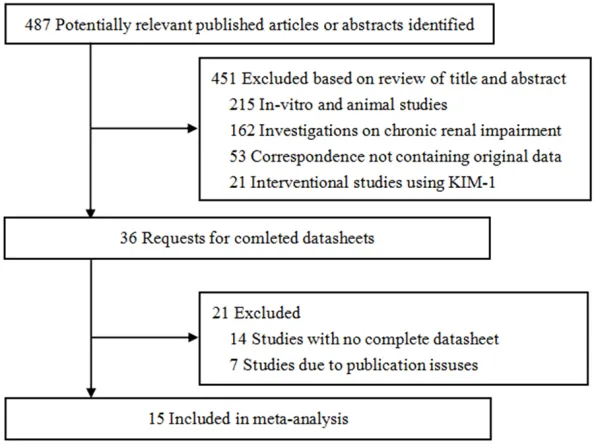
Based on previously identified keywords, 487
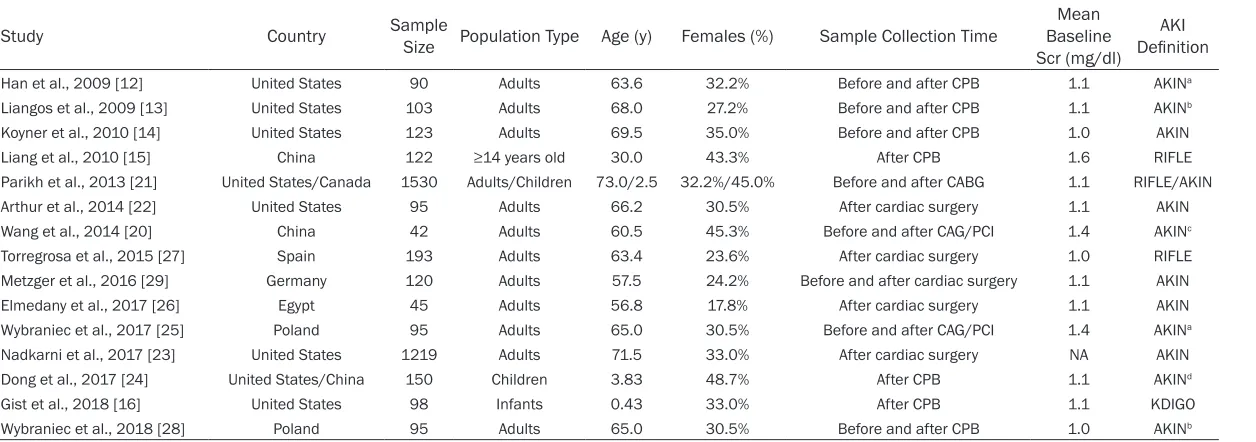
studies and abstracts on AKI after cardiac sur-gery were searched. After a thorough evalua-tion of these documents, a total of 15 studies were selected for analysis, including a Chinese-published study [20]. Figure 1 shows the de- tailed process of study selection. Basic charac-teristics of studies included are listed in Table 1. All studies provided AUROC values. However, 3 studies did not provide uKIM-1 cut-off values
(including sensitivity and specificity values).
Moreover, these results could not be obtained by calculations [14, 21, 22].
Of the studies included, 5 were multicenter clinical trials [13, 16, 21-23], 2 were for chil-dren [21, 24], and 1 was for infants [25]. All studies excluded patients with chronic kidney diseases and long-term hemodialysis. The cur-rent study included 4,120 patients [1,617 fe- males (39.2%)], including adults, children, and
all studies examined the accuracy of uKIM-1 levels in the diagnosis of AKI after cardiac
sur-gery. These studies clearly defined patient
inclusion criteria and exclusion criteria. A sec-ondary analysis of the diagnostic accuracy of uKIM-1 was performed. Three studies evaluat-ed the sample [15, 16, 24] and 12 studies usevaluat-ed the convenience sample size [12-14, 20-23,
25-29]. All studies used a modified Jaffé meth -od based on Scr levels to assess AKI. Patient range represented a patient that might be test-ed in practice. Moreover, no patients ustest-ed renal biopsies or renal angiographies to diag-nose AKI.
There were no studies receiving support by industry or reagent company sponsors. Thus, none of the results of these studies were com-mercially affected. Neither the clinician nor the laboratory doctor knew the source of urine samples. Therefore, results were not subjected
to human influence. All samples were collected
and processed in accordance with standard-ized procedures. Ten studies indicated that the sample storage temperature was -80°C [12-16, 24, 25, 27-29], while 5 studies did not specify sample storage conditions [20-21, 23, 26].
[image:3.612.90.388.70.293.2]There was no evidence of significant publica -tion bias in the results of the accuracy of uKIM-1 predictions for AKI associated with cardiac surgery (asymmetric-regression test, P<0.1).
Table 1. Characteristics of studies
Study Country Sample Size Population Type Age (y) Females (%) Sample Collection Time Baseline Mean
Scr (mg/dl)
AKI
Definition
Han et al., 2009 [12] United States 90 Adults 63.6 32.2% Before and after CPB 1.1 AKINa
Liangos et al., 2009 [13] United States 103 Adults 68.0 27.2% Before and after CPB 1.1 AKINb
Koyner et al., 2010 [14] United States 123 Adults 69.5 35.0% Before and after CPB 1.0 AKIN
Liang et al., 2010 [15] China 122 ≥14 years old 30.0 43.3% After CPB 1.6 RIFLE
Parikh et al., 2013 [21] United States/Canada 1530 Adults/Children 73.0/2.5 32.2%/45.0% Before and after CABG 1.1 RIFLE/AKIN
Arthur et al., 2014 [22] United States 95 Adults 66.2 30.5% After cardiac surgery 1.1 AKIN
Wang et al., 2014 [20] China 42 Adults 60.5 45.3% Before and after CAG/PCI 1.4 AKINc
Torregrosa et al., 2015 [27] Spain 193 Adults 63.4 23.6% After cardiac surgery 1.0 RIFLE
Metzger et al., 2016 [29] Germany 120 Adults 57.5 24.2% Before and after cardiac surgery 1.1 AKIN
Elmedany et al., 2017 [26] Egypt 45 Adults 56.8 17.8% After cardiac surgery 1.1 AKIN
Wybraniec et al., 2017 [25] Poland 95 Adults 65.0 30.5% Before and after CAG/PCI 1.4 AKINa
Nadkarni et al., 2017 [23] United States 1219 Adults 71.5 33.0% After cardiac surgery NA AKIN
Dong et al., 2017 [24] United States/China 150 Children 3.83 48.7% After CPB 1.1 AKINd
Gist et al., 2018 [16] United States 98 Infants 0.43 33.0% After CPB 1.1 KDIGO
Wybraniec et al., 2018 [28] Poland 95 Adults 65.0 30.5% Before and after CPB 1.0 AKINb
Abbreviations and definitions: CPB, cardiopulmonary bypass; Scr, serum creatinine; NA, not applicable; CABG, coronary artery bypass grafting; CAG, coronary angiography; PCI, percutaneous coronary inter -vention; AKIN, acute kidney injury network; RIFLE, “Risk”/“Injury”/“Failure”/“Loss”/“End”; KDIGO, the kidney disease improving global outcomes. a≥50% relative or ≥0.3 mg/dl absolute increase of serum
creatinine concentration at 48 hours after the procedure. b≥50% absolute increase of serum creatinine concentration at 72 hours after the procedure. c≥25% relative or ≥2.6 mg/dl absolute increase of
Evidence synthesis
The aim of this study was to investigate the accuracy of uKIM-1 levels in predicting AKI. True-positive, false-positive, false-negative, tr- ue-negative, and corresponding cut-off values,
sensitivities, and specificities, for each study,
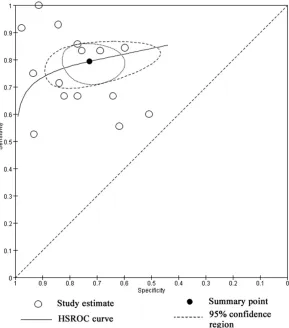
are shown in Table 3. Furthermore, HSROC was used to summarize ROC curves. It was found
that the diagnostic odds ratio (DOR) of uKIM-1
was 2.4, with a sensitivity of 0.76 and specific -ity of 0.84 (Figure 2). The AUROC was 0.71. In addition, levels of uKIM-1 in adults (DOR: 3.7, AUROC: 0.79) [12-14, 20, 22, 23, 25-29] and children (DOR: 2.6, AUROC: 0.76) [24] were pre-dicted to be more accurate than those in infants
(DOR: 1.5, AUROC: 0.60) [16]. Studies by Liang
[image:5.612.92.527.83.302.2]et al. [15] and Parikh et al. [21] were excluded Table 2. Design characteristics of individual studies
Study Design Criteria Clearly Eligibility
Defined
Sample Size Estimation
Representativeness of Patients (within
setting) Blinding Funding Storage uKIM-1 Assay
Han et al., 2009 [12] PC Yes No Yes Yes No -80°C ELISAa
Liangos et al., 2009 [13] PC Yes No Yes Yes No -80°C ELISAa
Koyner et al., 2010 [14] PC Yes No Yes Yes No -80°C MAPb
Liang et al., 2010 [15] CC Yes Yes Yes Yes No -80°C ELISAa,c
Parikh et al., 2013 [21] PC Yes No Yes Yes No NA ELISAd
Arthur et al., 2014 [22] PC Yes No Yes Yes No NA ELISA
Wang et al., 2014 [20] PC Yes No Yes Yes No NA ELISAc
Torregrosa et al., 2015 [27] PC Yes No Yes Yes No -80°C ELISAc
Metzger et al., 2016 [29] RC Yes No Yes Yes No -80°C ELISAe
Elmedany et al., 2017 [26] PC Yes No Yes Yes No NA NA
Wybraniec et al., 2017 [25] PC Yes No Yes Yes No -80°C ELISAe
Nadkarni et al., 2017 [23] PC Yes No Yes Yes No NA NA
Dong et al., 2017 [24] CC Yes Yes Yes Yes No -80°C ELISAc
Gist et al., 2018 [16] PC Yes Yes Yes Yes No -80°C ELISAc
Wybraniec et al., 2018 [28] PC Yes No Yes Yes No -80°C ELISAe
Abbreviations and definitions: PC, prospective cohort study; CC, case-control study; RC, retrospective cohort study; NA, not applicable; ELISA, enzyme-linked immunosorbent assay; MAP, multi-analyte profiling. aResearch-based assay. bMicrosphere-based Luminex xMAP technology. cR&D,
Minneapolis, MN, USA. dSekisui Diagnostics LLC developed assays. eEnzo Life Sciences, Exeter, UK.
Table 3. Paired sensitivity and specificity of individual studies for KIM-1 in predicting AKI
Study No. of Patients KIM-1 Cutoff (ng/mg) Sensitivity (95% CI) Specificity (95% CI) (95% CI)AUROC
TP FP FN TN
Han et al., 2009 [12] 5 31 4 50 >1.20 0.56 (0.21-0.86) 0.62 (0.50-0.72) 0.65 (0.54-0.75)
Liangos et al., 2009 [13] 11 2 1 86 >0.40 0.92 (0.62-1.00) 0.98 (0.92-1.00) 0.78 (0.64-0.91)
Koyner et al., 2010 [14] 4 42 2 75 NA 0.67 (0.22-0.96) 0.64 (0.55-0.73) 0.69 (0.58-0.80)
Liang et al., 2010 [15] 13 17 1 91 >1.50 0.93 (0.66-1.00) 0.84 (0.76-0.91) 0.88 (0.81-0.93)
Parikh et al., 2013 [21] 10 103 9 1408 NA 0.53 (0.29-0.76) 0.93 (0.92-0.94) 0.71 (0.63-0.78)
Arthur et al., 2014 [22] 2 21 1 71 NA 0.67 (0.09-0.99) 0.77 (0.67-0.85) 0.73 (0.60-0.83)
Wang et al., 2014 [20] 6 8 1 27 >4.60 0.86 (0.42-1.00) 0.77 (0.60-0.90) 0.83 (0.70-0.98)
Torregrosa et al., 2015 [27] 5 30 2 156 >1.70 0.71 (0.29-0.96) 0.84 (0.78-0.89) 0.71 (0.55-0.88)
Metzger et al., 2016 [29] 3 56 2 58 >2.10 0.60 (0.15-0.95) 0.51 (0.41-0.60) 0.57 (0.47-0.67)
Elmedany et al., 2017 [26] 4 7 2 32 >10.00 0.67 (0.22-0.96) 0.82 (0.66-0.92) 0.70 (0.54-0.87)
Wybraniec et al., 2017 [25] 3 6 1 85 >0.40 0.75 (0.19-0.99) 0.93 (0.86-0.98) 0.81 (0.42-0.94)
Nadkarni et al., 2017 [23] 27 478 5 709 >0.17 0.84 (0.67-0.95) 0.60 (0.57-0.63) 0.70 (0.48-0.81)
Dong et al., 2017 [24] 5 45 1 99 >0.09 0.83 (0.36-1.00) 0.69 (0.61-0.76) 0.76 (0.53-0.87)
Gist et al., 2018 [16] 10 21 2 65 >0.53 0.83 (0.52-0.98) 0.76 (0.65-0.84) 0.60 (0.46-0.74)
Wybraniec et al., 2018 [28] 2 8 0 85 >0.18 1.00 (0.16-1.00) 0.91 (0.84-0.96) 0.73 (0.51-0.86)
[image:5.612.91.525.364.575.2]ing that most studies sup-ported KIM-1 levels for dia- gnosis of AKI after cardiac surgery.
Discussion
In recent years, incidence and mortality rates of acu- te kidney injuries (AKI) ha- ve continuously increased, due to various reasons [1, 2]. Early diagnosis and ti- mely intervention are keys to treatment of AKI pati- ents. Finding accurate and effective biomarkers has become a hot topic in the
field of AKI research.
How-ever, due to the many dr- awbacks of clinical patho-logical diagnosis of AKI (Ki- dney Puncture Pathology), related study progress has been slow [30]. In clinical practice, serum creatini- ne (Scr) and urea nitrogen (BUN) levels are the most commonly used and popu-larized test items. However, they have large heteroge- neity for different genders, ages, and even ethnic gro- ups, limiting clinical diagno-sis [5].
because they included adults and children. It
was difficult to obtain valid data by
calculati-ons.
To rule out limitations of different assays on uKIM-1 levels, this study compared the accu-racy of uKIM-1 levels in standardized assays and research-based assays for predicting AKI associated with cardiac surgery. Results sh- owed that the accuracy of using standardized detection of uKIM-1 (DOR: 2.5, AUROC: 0.78)
was significantly higher than that of
research-based assays (DOR: 1.8, AUROC: 0.71). The degree of consistency of standardized
detec-tion of uKIM-1 was also significantly higher
than that of research-based assays. Although there were some deviations in results of the studies included, the values obtained after meta-analysis were broadly consistent,
indicat-Some studies have proposed a method for assessment of renal function using radioiso-tope labeling. However, the research is only permitted in animal experiments because of its invasiveness and the likelihood of causing cause renal damage [1, 31]. Regarding related biomarkers of AKI, urinary kidney injury mole-cule-1 (uKIM-1) is a hot spot, highly praised in recent years [8]. With the improvement of labo-ratories in medical centers around the world, the rapid standardization of detection of uKIM-1 has arisen. However, results of different clini-cal studies have varied widely. Therefore, the accuracy of uKIM-1 as an important biomarker for future diagnosis of AKI remains contro- versial.
[image:6.612.95.384.70.398.2]In present study, a systematic review and meta-analysis was conducted, aiming to clarify the
Figure 2. Hierarchical summary receiver operating characteristic (HSROC) plot of urinary kidney injury molecule-1 (uKIM-1) to predict acute kidney injury after
accuracy of uKIM-1 in predicting AKI associat-ed with cardiac surgery. This study systemati-cally reviewed published clinical observational studies. Studies concerning post-cardiac AKI were included, with the study population includ-ing adults, children, and infants. This study also analyzed the accuracy of different methods for detection of uKIM-1 in the diagnosis of AKI, as
well as its sensitivity and specificity in early
diagnosis of AKI after cardiac surgery. Results suggest that uKIM-1 is an effective biomarker for early diagnosis of AKI after cardiac surgery and that standardized detection of uKIM-1 is
more sensitive and specific.
In different studies, the definition of AKI was
different. Times to collect urine samples from
patients were also different, making it difficult
to evaluate levels of uKIM-1 in diagnosing AKI. The International Health Organization and So- ciety of Nephrology have not yet proposed a clear cut-off value of uKIM-1 for diagnosis of
AKI. HO et al., [32], for the first time, conducted
a meta-analysis of the accuracy of uKIM-1 in the diagnosis of postoperative cardiac AKI. A total of 6 studies were included in the analysis. However, their results did not clearly indicate cut-off values of uKIM-1 and AUROC values. The current study included a total of 15 clinical observation studies. A more systematic meta-analysis of the accuracy of uKIM-1 in post-car-diac AKI was performed. Cut-off values and
AUROC values of uKIM-1 were clarified, provid -ing reference value for future research and guidance.
The current meta-analysis also assessed
uKIM-1 using a uniform AKI definition and standard -ized time. This method could be used directly in the clinic. Results suggest that uKIM-1 is a valuable biomarker for diagnosis of
post-cardi-ac AKI, with high sensitivity and specificity. It
could be used in adults and children, but with a lower diagnostic value for infants. The reason might be that the organs of infants are not yet well developed. In all included studies, they
clearly defined inclusion and exclusion criteria.
All patients with chronic kidney disease were excluded. Thus, data quality was relatively high. However, due to different clinical circumstanc-es of each institute, normal and critical valucircumstanc-es of uKIM-1 were different. Therefore, further international large-scale multicenter
random-ized controlled trials are necessary to confirm
present results.
There were 5 studies [20-21, 23, 26] with
unspecified sample storage times. There was a
certain heterogeneity in the detection of uKIM-1 levels, but the data obtained was broadly consistent. Therefore, these studies were not excluded. Of these studies, 8 (53.3%) were from the United States [12-14, 16, 21-24], 4 (26.7%) were from Europe [25, 27-29], 3 (20%) were from China [15, 20, 24], and 1 (6.7%) was from Egypt [26]. Thus, whether levels of uKIM-1 are universal requires further study. In addition, if uKIM-1 levels are measured using uniform normalization, it is believed that the diagnostic accuracy of AKI assessments could be made more comparable.
The current study had five limitations. First, many of the studies included used AKI defini -tions differently and uKIM-1 levels were mea-sured at different times. There may be some errors in data acquisition and calculations. Second, AKI occurred at different times in these studies. Urine collection, processing, and storage criteria were also different. Therefore, resulting values were heterogeneous. Third, in the standardized form developed, the urine
quantity definition of AKI was not used.
How-ever, the AKIN standard was to evaluate the AKI, indicating the need to recalculate the origi-nal data and achieve data integration. Fourth,
there was insufficient data to assess the impact
of uKIM-1 levels on patient mortality and RRT. This study did not conduct a comprehensive analysis of these results. Fifth, none of these studies used radiolabeling or inulin clearance to assess renal function and verify the perfor-mance of 1. Therefore, accuracy of uKIM-1 levels for diagnosis of AKI and the predictive ability of renal function recovery were limited. In summary, a total of 15 studies (4120 pa- tients) from 7 countries were included in the current meta-analysis. Results suggest that
uKIM-1 levels are highly sensitive and specific
for diagnosis of AKI after cardiac surgery. How- ever, due to heterogeneity, large multicenter clinical randomized controlled trials are neces-sary to validate present conclusions.
Disclosure of conflict of interest
None.
998 Qianhe North Road, Ningbo, Zhejiang Province, China. E-mail: [email protected]
References
[1] Levey AS, James MT. Acute kidney injury. Ann
Intern Med 2017; 167: ITC66-ITC80.
[2] Izkhakov E, Rozenbaum Z, Margolis G, Khoury S, Keren G, Shacham Y. Prolonged hyperglyce-mia and renal failure after primary percutane-ous coronary intervention. Cardiorenal Med 2019; 9: 92-99.
[3] Xue W, Xie Y, Wang Q, Xu W, Mou S, Ni Z.
Diagnostic performance of urinary kidney inju-ry molecule-1 and neutrophil gelatinase-asso-ciated lipocalin for acute kidney injury in an obstructive nephropathy patient. Nephrology (Carlton) 2014; 19: 186-194.
[4] Ariza X, Solà E, Elia C, Barreto R, Moreira R,
Morales-Ruiz M, Graupera I, Rodríguez E, Hue-
lin P, Solé C. Analysis of a urinary biomarker
panel for clinical outcomes assessment in
cir-rhosis. PLoS One 2015; 10: e0128145.
[5] Field M, Dronavalli V, Mistry P, Drayson M, Ready A, Cobbold M, Inston N. Urinary bio-markers of acute kidney injury in deceased or-gan donors--kidney injury molecule-1 as an adjunct to predicting outcome. Clin Transplant 2014; 28: 808-815.
[6] Lee CW, Kou HW, Chou HS, Chou HH, Huang
SF, Chang CH, Wu CH, Yu MC, Tsai HI. A combi-nation of SOFA score and biomarkers gives a better prediction of septic AKI and in-hospital mortality in critically ill surgical patients: a pilot study. World J Emerg Surg 2018; 13: 41. [7] Shao Y, Fan Y, Xie Y, Yin L, Zhang Y, Deng L, Sun
X, Shao X, Tan X, He J, Zhao S. Effect of con -tinuous renal replacement therapy on kidney injury molecule-1 and neutrophil gelatinase-associated lipocalin in patients with septic acute kidney injury. Exp Ther Med 2017; 13: 3594-3602.
[8] Tu Y, Wang H, Sun R, Ni Y, Ma L, Xv F, Hu X, Jiang L, Wu A, Chen X, Chen M, Liu J, Han F.
Urinary netrin-1 and KIM-1 as early biomarkers for septic acute kidney injury. Ren Fail 2014; 36: 1559-1563.
[9] Park M, Vittinghoff E, Liu KD, Shlipak MG, Hsu
CY. Urine biomarkers neutrophil
gelatinase-as-sociated lipocalin (NGAL) and kidney injury
molecule-1 (KIM-1) have different patterns in heart failure exacerbation. Biomark Insights 2013; 8: 15-18.
[10] Verbrugge FH, Dupont M, Shao Z, Shrestha K, Singh D, Finucan M, Mullens W, Tang WH. Novel urinary biomarkers in detecting acute kidney injury, persistent renal impairment, and all-cause mortality following decongestive the- rapy in acute decompensated heart failure. J Card Fail 2013; 19: 621-628.
[11] Fan H, Zhao Y, Sun M, Zhu JH. Urinary neutro-phil gelatinase-associated lipocalin, kidney
in-jury molecule-1, N-acetyl-β-D-glucosaminidase
levels and mortality risk in septic patients with acute kidney injury. Arch Med Sci 2018; 14: 1381-1386.
[12] Han WK, Wagener G, Zhu Y, Wang S, Lee HT.
Urinary biomarkers in the early detection of acute kidney injury after cardiac surgery. Clin J Am Soc Nephrol 2009; 4: 873-882.
[13] Liangos O, Tighiouart H, Perianayagam MC,
Kolyada A, Han WK, Wald R, Bonventre JV,
Jaber BL. Comparative analysis of urinary bio -markers for early detection of acute kidney in-jury following cardiopulmonary bypass. Bio- markers 2009; 14: 423-431.
[14] Koyner JL, Vaidya VS, Bennett MR, Ma Q,
Wor-cester E, Akhter SA, Raman J, Jeevanandam V, O’Connor MF, Devarajan P, Bonventre JV, Mu- rray PT. Urinary biomarkers in the clinical prog-nosis and early detection of acute kidney inju-ry. Clin J Am Soc Nephrol 2010; 5: 2154-2165. [15] Liang XL, Liu SX, Chen YH, Yan LJ, Li H, Xuan HJ, Liang YZ, Shi W. Combination of urinary kid -ney injury molecule-1 and interleukin-18 as early biomarker for the diagnosis and progres-sive assessment of acute kidney injury follow-ing cardiopulmonary bypass surgery: a pro-spective nested case-control study. Biomarkers 2010; 15: 332-339.
[16] Gist KM, Cooper DS, Wrona J, Faubel S, Alt- mann C, Gao Z, Marino BS, Alten J, Hock KM, Mizuno T, Vinks AA, Joy MS, Wempe MF, Ben-
nett MR, Goldstein SL. Acute kidney injury bio -markers predict an increase in serum milri-none concentration earlier than serum
creati-nine-defined acute kidney injury in infants af -ter cardiac surgery. Ther Drug Monit 2018; 40: 186-194.
[17] Bae JM. An overview of systematic reviews of diagnostic tests accuracy. Epidemiol Health 2014; 36: e2014016.
[18] Swets JA. Measuring the accuracy of diagnos-tic systems. Science 1988; 240: 1285-1293. [19] Higgins JP, Thompson SG, Deeks JJ, Altman
DG. Measuring inconsistency in meta-analy-ses. BMJ 2003; 327: 557-560.
[20] Wang L, Pu X. Predict value of monitoring
ch-anges of urinary neutrophil gelatinase-associ-ated lipocalin and kidney injury molecule-1 af-ter coronary angiography and percutaneous coronary intervention on early diagnosis of
contrast-induced nephropathy. Zhonghua Xin Xue Guan Bing Za Zhi 2014; 42: 301-304.
[Article in Chinese].
[21] Parikh CR, Thiessen-Philbrook H, Garg AX, Kadiyala D, Shlipak MG, Koyner JL, Edelstein CL, Devarajan P, Patel UD, Zappitelli M,
mol-ecule-1 and liver fatty acid-binding protein and combined biomarkers of AKI after cardiac sur-gery. Clin J Am Soc Nephrol 2013; 8: 1079-1088.
[22] Arthur JM, Hill EG, Alge JL, Lewis EC, Neely BA, Janech MG, Tumlin JA, Chawla LS, Shaw AD;
SAKInet Investigators. Evaluation of 32 urine biomarkers to predict the progression of acute kidney injury after cardiac surgery. Kidney Int 2014; 85: 431-438.
[23] Nadkarni GN, Coca SG, Meisner A, Patel S,
Kerr KF, Patel UD, Koyner JL, Garg AX, Philbrook HT, Edelstein CL. Urinalysis findings and uri -nary kidney injury biomarker concentrations. BMC Nephrol 2017; 18: 218.
[24] Dong L, Ma Q, Bennett M, Devarajan P.
Urina-ry biomarkers of cell cycle arrest are delayed predictors of acute kidney injury after pedia- tric cardiopulmonary bypass. Pediatr Nephrol 2017; 32: 2351-2360.
[25] Wybraniec MT, Chudek J, Bożentowicz-Wikarek
M, Mizia-Stec K. Prediction of contrast-induced acute kidney injury by early post-procedural analysis of urinary biomarkers and intra-renal
Doppler flow indices in patients undergoing
coronary angiography. J Interv Cardiol 2017; 30: 465-472.
[26] Elmedany SM, Naga SS, Elsharkawy R, Mah- rous RS, Elnaggar AI. Novel urinary biomarkers and the early detection of acute kidney injury after open cardiac surgeries. J Crit Care 2017; 40: 171-177.
[27] Torregrosa I, Montoliu C, Urios A, Andrés-Costa MJ, Giménez-Garzó C, Juan I, Puchades MJ, Blasco ML, Carratalá A. Urinary KIM-1, NGAL and L-FABP for the diagnosis of AKI in patients
with acute coronary syndrome or heart failure undergoing coronary angiography. Heart Ves- sels 2015; 30: 703-711.
[28] Wybraniec MT, Chudek J, Mizia-Stec K. Asso- ciation between elevated urinary levels of kid-ney injury molecule type 1 and adverse cardio-vascular events at 12 months in patients with coronary artery disease. Pol Arch Intern Med 2018; 128: 301-309.
[29] Metzger J, Mullen W, Husi H, Stalmach A, Her- get-Rosenthal S, Groesdonk HV, Mischak H, Klingele M. Acute kidney injury prediction in cardiac surgery patients by a urinary peptide pattern: a case-control validation study. Crit Care 2016; 20: 157.
[30] George B, Joy MS, Aleksunes LM. Urinary pro -tein biomarkers of kidney injury in patients re-ceiving cisplatin chemotherapy. Exp Biol Med (Maywood) 2018; 243: 272-282.
[31] Akdeniz D, Celik HT, Kazanci F, Yilmaz H, Yalcin S, Bilgic MA, Ruzgaresen N, Akcay A, Eryonucu B. Is kidney injury molecule 1 a valuable tool for the early diagnosis of contrast-induced ne-phropathy? J Investig Med 2015; 63: 930-934. [32] Ho J, Tangri N, Komenda P, Kaushal A, Sood M,