Organisational Learning Cycles
by means of Knowledge Dynamics
Eckhard Ammann,
Member, IAENG
Abstract—Knowledge development in an enterprise is about approaches, methods, techniques and tools, which will support the advancement of individual and organisational knowledge for the purpose of an improvement of businesses. As a basis, conceptions of knowledge and of knowledge conversions are needed. Here knowledge dynamics is understood to cover all of acquisition, conversion, transfer and usage of knowledge. Conceptions of knowledge and of knowledge conversions are provided in this paper, which introduce three dimensions of knowledge and general conversions between knowledge assets, respectively. Knowledge is represented by a three-dimensional model of knowledge with types, kinds and qualities. General knowledge conversions between the various knowledge assets are introduced as a model for knowledge dynamics in the enterprise. First a basic set of such conversions is defined. Building on this set general knowledge conversions can be defined, which reflect knowledge transfers and development. In effect, the well-known SECI model for knowledge development is as well extended as generalised in this approach.
While organisational learning is not merely a multiplicity of individual learning efforts of its members, organisations learn through experience and activities of individuals to a large extent. Built on the presented conception of knowledge development, organisational learning scenarios involving teams of members and the organisational memory are identified and described in this paper.
Three basic learning cycles are identified, which are closely related with appropriate combinations of basic and general knowledge conversions. Through appropriate combinations of such basic learning cycles, important learning scenarios in an organisation can be described. Especially, important known organisational learning types are covered by this approach, including single-loop learning and double-loop learning. In order to validate the approach to knowledge development and organisational learning, an example of an organisational learning scenario is given, namely a supervised learning-by-doing scenario in a team.
Index Terms—Conception of knowledge, knowledge
dynamics, organisational learning cycles, single-loop and double-loop learning.
I. I
NTRODUCTIONKnowledge development in an enterprise is about approaches, methods, techniques and tools, which will support the advancement of individual and organisational knowledge for the purpose of an improvement of businesses. As a basis, a conception of knowledge
Manuscript received November 16, 2011.
Eckhard M. Ammann is with the Department of Business Informatics, School of Informatics, University of Reutlingen, Germany (phone: 0049-7121-2714026, fax: 0049-7121-2714032,
e-mail: [email protected]).
and of knowledge dynamics is needed. Here, knowledge dynamics is understood to cover all of acquisition, conversion, transfer and usage of knowledge. While organisational learning is not merely a multiplicity of individual learning efforts of its members, organisations learn through experience and activities of individuals to a large extent. Built on a conception of knowledge development, organisational learning scenarios involving teams of members and the organisational memory are identified and described in this paper.
A number of approaches for knowledge management exist, including the classic asset-oriented approach, the process-oriented approach, the knowledge-intensive process-oriented approach, and finally the community-oriented approach, see [1], [9], and [10]. While the management aspect of knowledge management seems to be rather well understood and practised in many companies ([10]), there is no common concept and understanding of knowledge and of knowledge development as basis of it.
There exist several approaches, of course. A specific approach for enterprise knowledge development is EKD (Enterprise Knowledge Development), which aims at articulating, modeling and reasoning about knowledge, which supports the process of analyzing, planning, designing, and changing your business; see [5] and [7] for a description of EKD. However, EKD does not provide a conceptual description of knowledge and knowledge development. The well-known knowledge development model by Nonaka/Takeuchi is built on the distinction between tacit and explicit knowledge and on four fundamental knowledge conversions between those knowledge types (SECI-model, see [12]). However, many discussions exist, whether to interpret the explicit knowledge part as still bound to the human being, or as already detached from him. Another important work is the introduction of the type/quality dimensions of knowledge in (De Jong [7]). Finally, important distinctions of implicit knowledge are given in (Hasler Rumois [8]). A different approach of knowledge development is given by Boisot (see Boisot [4]), where knowledge passes through the three dimension of the so-called information space (I-space) in a social learning cycle, while changing its characteristics of abstraction, codification, and diffusion. The research on knowledge transfer, which is an important part of knowledge development, is reviewed in (Ling [11]). The approaches by Nonaka/Takeuchi and by Boisot are also included in this work. In (Wahab [17]) a review on technologie transfer models, which also includes knowledge-based models on technology transfer, is provided.
knowledge available to a company, i.e. let it be converted from internal to more external types. As the two other dimensions of knowledge, the kind dimension distinguishes various knowledge kinds, namely propositional, procedural, strategic knowledge and familiarity. Finally, in the quality dimension, several quality measures of knowledge are given.
Using this conception we introduce general knowledge conversions between the various knowledge variants. First a basic set of such conversions is defined, which extends the set of the four conversions of the well-known SECI-model ([12]). Building on this set, general knowledge conversions can be defined, which reflect knowledge transfers and development more realistically and do not suffer from the restrictions of the SECI-model. These general knowledge conversions take effect as well in the form of changes of knowledge of a person as in the form of transfers of knowledge between persons.
A well-known approach to a learning organisation is provided by Senge (see [15]) identifying fve disciplines included the sytsem understanding as fifth discipline. Most influential in the area of organisational learning have been the concepts of Argyris and Schön ([2], [3]), which include the notions of single-loop, double-loop, and deutoro learning.
Built on the approach by Argyris and based on the introduced concepts of knowledge and knowledge development, organisational learning scenarios are modeled in this paper. Three basic learning cycles are identified, which are closely related with appropriate combinations of basic and general knowledge conversions. Through appropriate combinations of such basic learning cycles, important learning scenarios in an organisation can be described. Especially, known important organisational learning types are covered by this approach, including single-loop and double-loop learning (Argyris [2], [3]). In order to validate the approach to knowledge development and organisational learning, an example of an organisational learning scenario is given, namely a supervised learning-by-doing scenario in a team.
The structure of the paper is as follows. After an introduction, the two sections 2 and 3 will introduce the conceptions of knowledge and of knowledge dynamics, respectively. Section 4 applies these conceptions to organisational learning. Basic organisational learning cycles are identified. Appropriate combinations of these basic cycles lead to important organisational learning scenarios, among them the two well-known learning types. The following section 5 provides an example of an organisational learning scenario. A supervised learning-by-doing scenario is described. Finally, section 6 concludes the paper.
II. C
ONCEPTION OFK
NOWLEDGEA. General Understanding of Knowledge
In this section we provide a conception of knowledge, and of knowledge types, kinds and qualities. As our base notion knowledge is understood as justified true belief, which is (normally) bound to the human being, with a dimension of purpose and intent, identifying patterns in its validity scope, brought to bear in action and with a generative capability of new information, see (Hasler Rumois [8], Lehner [10], and Williams [18]). It is a perspective of “knowledge-in-use” (De Jong [6]) because of the importance for its utilisation in companies and for knowledge management. In contrast, information is understood as data in relation with a semantic dimension, but is lacking the pragmatic and pattern-oriented dimension, which characterises knowledge. We distinguish three main dimensions of knowledge, namely types, kinds and qualities, and describe those in the following three sub-sections. The whole picture leads to the three-dimensional knowledge cube, which is introduced at the end of this section.
B. Type Dimension of Knowledge
The type dimension is the most important for knowledge management in a company. It categorizes knowledge according to its presence and availability. Is it only available for the owning human being, or can it be communicated, applied or transferred to the outside, or is it externally available in the company’s organisational memory, detached from the individual human being? It is crucial for the purposes of the company, and hence a main goal of knowledge management activities, to make as much as possible knowledge available, i.e. let it be converted from internal to more external types of knowledge.
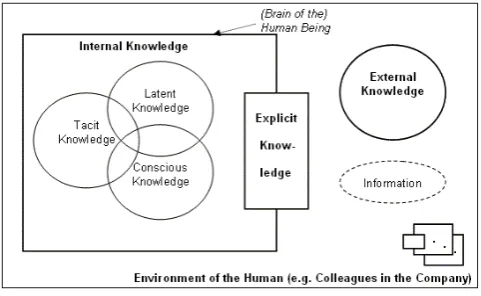
[image:2.595.305.546.322.470.2]Our conception for the type dimension of knowledge follows a distinction between the internal and external knowledge types, seen from the perspective of the human being. As third and intermediary type, explicit knowledge is seen as an interface for human interaction and for the purpose of knowledge externalisation, the latter one ending up in external knowledge. Internal (or implicit) knowledge is bound to the human being. It is all that, what a person has “in its brain” due to experience, history, activities and learning. Explicit knowledge is “made explicit” to the outside world e.g. through spoken language, but is still bound to the human being. External knowledge finally is detached from the human being and may be kept in appropriate storage media as part of the organisational memory. Fig. 1 depicts the different knowledge types.
Fig. 1. Conception of knowledge types
Internal knowledge can be further divided into tacit, latent and conscious knowledge, where those subtypes do partly overlap with each other, see (Hasler Rumois [8]). Conscious knowledge is conscious and intentional, is cognitively available and may be made explicit easily. Latent knowledge has been typically learning as a by-product and is not available consciously. It may be made explicit, for example in situations, which are similar to the original learning situation, however. Tacit knowledge is built up through experiences and (cultural) socialisation situations, is specific in its context and based on intuition and perception. Statements like “I don’t know, that I know it” and “I know more, than I am able to tell” (adapted from Polanyi [13]) characterise it.
C. Kind Dimension of Knowledge
D. Quality Dimension of Knowledge
The quality dimension introduces five characteristics of
knowledge with an appropriate qualifying and is
independent of the kind dimension, see [6].
The level characteristics aims at overview vs. deep knowledge, structure distinguishes isolated from structured knowledge. The automation characteristic of knowledge can be step-by-step-doing by a beginner in a domain of work or automated fast acting by an expert. All these qualities measure work along an axis and can be subject to knowledge conversions, see section 3. Modality as the fourth quality asks for the representational form of knowledge, be it words versus pictures in situational knowledge kinds, or propositions versus pictures in procedural knowledge kinds. Finally, generality differentiates general versus domain-specific knowledge. Knowledge qualities apply to each knowledge asset.
E. The Knowledge Cube
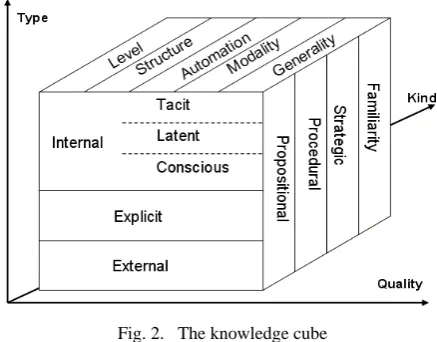
Bringing all three dimension of knowledge together, we gain an overall picture of our knowledge conception. It can be represented by the knowledge cube, as is shown in Fig. 2.
[image:3.595.57.276.279.450.2]Fig. 2. The knowledge cube
Note, that the dimensions in the knowledge cube behave different. In the type and kind dimensions, the categories are mostly distinctive (with the mentioned exception in the sub-types), while in the quality dimension each of the given five characteristics are always present for each knowledge asset.
III. K
NOWLEDGEC
ONVERSIONSIn this section we give a conception of knowledge conversions. The transitions between the different knowledge types, kind and qualities are responsible to a high degree for knowledge development in an organisation.
Most important for knowledge management purposes are conversions between the knowledge types and they will be the focus in the following. Among those, especially those conversions making individual and internal knowledge of employees usable for a company, are crucial for knowledge management. The explicitation and externalisation conversion described in this section achieve this. Implicitly socialisations between tacit knowledge of different people also may contribute to this goal. Conversions in the kind dimension of knowledge are seldom, normally the kind dimension of knowledge remains unchanged in a knowledge conversion changing the type dimension. Those in the quality dimension are mostly knowledge developments aiming at quality improvement and will not change the type and kind dimensions of the involved knowledge assets.
Five basic knowledge conversions (in the type dimension) are distinguished here: Socialisation, explicitation, externalisation, internalisation and combination. Basic conversion means, that exactly one source knowledge asset is converted into exactly one destination knowledge asset. More complex conversions may be
easily gained by building on this set as described later in this section. They will consist of m-to-n-conversions and include information assets in addition.
Socialisation converts tacit knowledge of a person into tacit knowledge of another person. For example, this succeeds by exchange of experience or in a learning-by-doing situation under supervision of an experienced person. Explicitation is the internal process of a person, to make internal knowledge of the latent or conscious type explicit, e.g. by articulation and formulation (in the conscious knowledge type case) or by using metaphors, analogies and models (in the latent type case). Externalisation is a conversion from explicit knowledge to external knowledge or information and leads to detached knowledge as seen from the perspective of the human being, which can be kept in organisational memory systems. Internalisation converts either external or explicit knowledge into internal knowledge of the conscious or latent types. It leads to an integration of experiences and competences in your own mental model. Finally, combination combines existing explicit or external knowledge in new forms.
The Nonaka/Takeuchi-model ([12]) uses four basic knowledge conversions in the sense defined above, which interact in a spiral of knowledge creation, which itself becomes larger in scale as it moves up the ontological dimension from the individual to groups and the whole organisation. This limiting linearity of its knowledge development spiral concept and the restriction to basic conversions has been criticised, besides the discussions on the meaning of explicit knowledge.
Our conception allows the generalisation of the basic five knowledge conversions described above. General knowledge conversions are modeled converting several source assets (possibly of different types, kinds and quality) to several destination assets (also possibly different in their knowledge dimensions). In addition, information assets are considered as possible contributing or generated parts of general knowledge conversions.
For example, in a learning-by-doing situation seen as a complex knowledge conversion, a new employee may extend his tacit and conscious knowledge by working on and extending an external knowledge asset in a general conversion, using and being assisted by the tacit and conscious knowledge of an experienced colleague. A piece of relevant information on the topic may also be available on the source side of the conversion. Here on the source side of the general conversion we have two tacit, two conscious and one external knowledge assets plus one information asset, while on the destination side one tacit, one explicit and one external knowledge asset (i.e. the resulted enriched external knowledge) arise.
Completing this section, we shortly mention knowledge conversions in the quality dimension of knowledge. In three out of the five quality measures, basic conversions can be identified, which are working gradually. Those are, firstly, a deepening conversion, which converts overview knowledge into a deeper form of this knowledge. Secondly, there is a structuring conversion, which performs improvement in the singular-versus-structure scale of the structural measure. Finally, conscious and step-by-step-applicable knowledge may convert into automated knowledge in an automation conversion, which describes a process from beginner to expert in a certain domain. The remaining two quality measures of knowledge, namely modality and generality, do not lend themselves to knowledge conversions. They just describe unchangeable knowledge qualities.
IV. L
EARNINGCYCLES AND
S
CENARIOSFig. 3. Basic organisational learning cycles
through (inter-) actions along the organisational processes within the framework of the organisational environment. Argyris and Schön conceptualised organisational learning processes in the sense of a theory of action (Argyris [2]). Organisational learning then is, to discover problems and mismatching situations, to correct them, and to change the organisational knowledge base in a way, that reflect new problem solving and action competences. Learning processes enhance the organisational knowledge, which itself may be represented in the minds of organisational members (normally only a certain part per employee) or stored in the organisational memory. Earlier in this paper we already stated the importance for knowledge management of making implicit knowledge explicit and available for the organisation and of possibly storing it in the organisational memory (system) as external knowledge. In this section we start by identifying basic organisational learning cycles. Through appropriate combinations of such learning cycles more complex learning scenarios in an organisation can be described. Especially, important known organisational learning types are covered by this approach, including single-loop learning and double-loop learning (Argyris [2], [3], Vlismas [16]).
A. Basic Organisational Learning Cycles
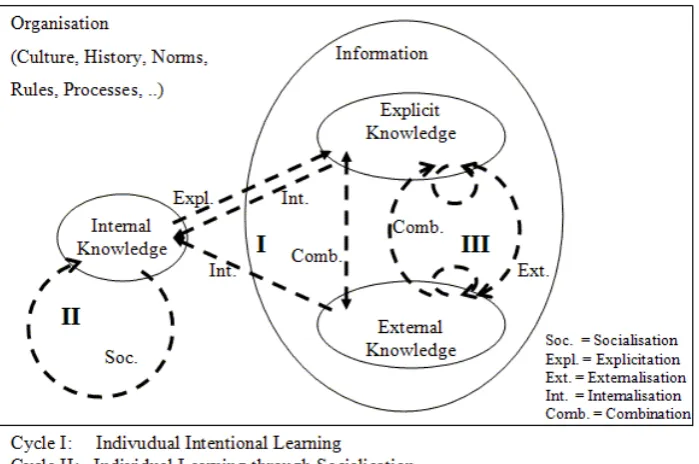
Built on our conception of knowledge and of knowledge dynamics as presented in sections 2 and 3, we can identify three basic cycles of organisational learning. They are shown in Fig. 3.
Cycle I is intentional individual learning of a single member of the organisation in the first instance. This of course is influential on the whole organisation or a part of it. The cycle consists of explicitation of internal knowledge, possibly following combination conversions between the explicit knowledge of the employee and that of other employees or external knowledge, and .
a following internalisation of aquired knowledge and/or generated information.
The second cycle, Cycle II, covers individual learning through socialisation. Employees learn by taking problem solving behaviour of other employees as example. Finally, Cycle III represents a combined individual and organisational learning cycle. Through combination conversions between explicit and external knowledge and possibly information, individuals extend their (explicit) knowledge as well as the organisation itself learns by extending the organisational knowledge base and (indirectly) by the individual learning part of the cycle. Note, that the learning cycles I and III as described here are not disjoint. The optional middle part of Cycle I may consist of instantiations of Cycle III.
Through appropriate combinations of these basic learning cycles, important learning scenarios in an organisation can be described. Two important scenarios are described in the following sub-section.
B. Important Learning Scenarios
In this sub-section we focus on two important and well-known organisational learning scenarios, namely single-loop learning and double-loop learning. They have been first introduced and described by Argyris and Schön (Argyris [2], [3]).
Single-loop learning is adaption learning within a given frame of governing variables of the organisation. Governing variables are understood as the “theory-in-use”, interpretation systems and frames of reference, i.e. the organisational rules, norms, and procedures to give a more concrete description. Corresponding organisational actions intend to eliminate detected gaps and mismatches (between organisational expectations and outcomes) under the guidance of these governing variables, but without
[image:4.595.69.521.690.765.2]
changing these. Fig. 4 depicts this kind of organisational learning. Double-loop learning can be described as transformation learning, where in addition to the actions in the single-loop case the governing variables in the organisation are revised and eventually adjusted. If the environment of the organisation provides a challenging feedback to the assumptions of the organisation as provided by the governing variables, then these assumptions have to be changed, redefined or altered completely in order to fit to the demand from the environment. This second loop compared to the single-loop learning situation causes the denotation double-loop learning. Double-loop learning is also shown in Figure 5
A third learning type called deutero learning exists, which in fact is a kind of meta-learning. Subject of this organisational learning type is to learn how to (better) learn in the organisation. We do not further elaborate on this learning type here, see (Argyris [3] and Vlismas [16]) for details
[image:5.595.311.545.63.198.2]The single-loop and double-loop learning types can be modelled with the help of the three basic organisational learning cycles as introduced in sub-section 4.1 and with combinations of them. Note, that these cycles and combinations themselves are based on the conception of knowledge and knowledge dynamics as presented in section 2 and 3.
Fig. 5. Single-loop learning with a general knowledge conversion
[image:5.595.54.288.308.470.2]Fig. 5 and Fig. 6 illustrate the coverage of single-loop and double-loop learning by our approach, respectively. In these figures, ellipses denote general knowledge conversions with
Fig. 6. Double-loop learning with a general knowledge conversion
incoming and outgoing arrows for their source and destination knowledge assets, grey-shaded rectangles represent knowledge or information.
An internal or explicit knowledge asset is associated with an employee. See [1] for more details on this graphical notation for knowledge-intensive processes.
Governing variables in the learning loop scenarios are modeled as external knowledge. The detected problem or mismatch in the organisation is represented by an information asset. In the single-loop learning case as shown in Fig. 5, the problem is solved (new information is generated as representation of this), but the governing variables remain unchanged and valid. This action occurs through utilisation of the knowledge of the employee, which is extended during the action.
In the double-loop learning case, the external knowledge representing the governing variables have to be changed in order to cover with the problem. This is shown in Fig. 6.
V. E
XAMPLE OF ANO
RGANISATIONALS
CENARIOAs an example for an organisational learning scenario, we describe a supervised learning-by-doing scenario. It is important to note, that this scenario is different from the much simpler example given in section 3, which demonstrated a single general knowledge conversion. Here a new employee is able to extend his explicit and
[image:5.595.127.444.525.764.2]
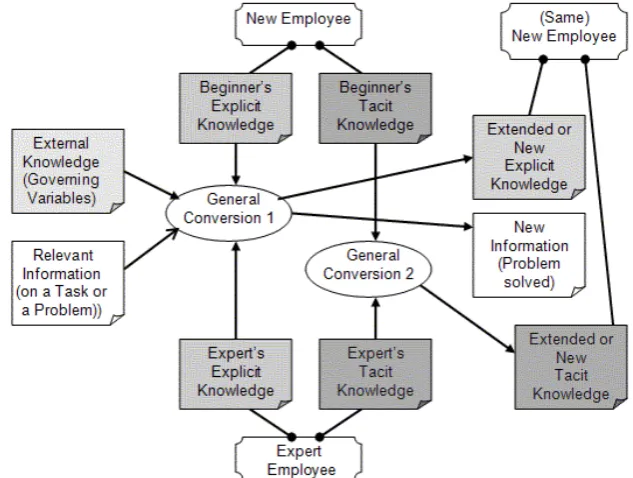
tacit knowledge by working on and extending an information asset in two general conversions. This information asset represents the task at hand to be performed or a yet unsolved problem. He is using the explicit and tacit knowledge of an experienced colleague, who is assisting him. The overall activity is governed by external knowledge, which represents organisational norms and rules. Fig. 7 displays this scenario. Again ellipses denote general knowledge conversions, while the rectangles stand for knowledge assets. The fill colour of the rectangles varies from dark grey (for internal knowledge, here tacit knowledge) to middle grey for explicit knowledge, light grey for external knowledge and while for information assets. See [1] for more details on this notation, which allows for modeling of knowledge-intensive business processes.
The results of the two general conversions in Fig. 7 are the following. General conversion 1 models the task-solving or problem-solving activity, which as well leads to the problem solution as to extended explicit knowledge of the new employee. The new employee is more skilled and experienced than before. General conversion 2 denotes the extended or new tacit knowledge, which arose at the new employee during the activity by observing the actions and advises of the experienced colleague. This is a more unconscious side effect of the activity, which advances the abilities of the new employee in addition. In an overall view, the scenario establishes a single-loop learning cycle when seen from the perspective of the new employee. It is single-loop, because the governing variables represented by the external knowledge asset are not changed during and by the activity.
VI. S
UMMARY ANDC
ONCLUSIONConceptions of knowledge and of knowledge dynamics are introduced in this paper, which can be seen as basis for knowledge development in a company. For the knowledge development part, the well-known SECI-model is as well extended as generalised by this approach.
These conceptions of knowledge and knowledge dynamics are then applied to the area of organisational learning. Three basic organisational learning cycles have been identified, namely individual intentional learning, individual learning through socialisation, and combined individual and organisational learning. They can be combined appropriately to cover important organisational learning scenarios. Especially, the well-known single-loop and double-loop learning cycles are covered by this approach. In order to validate the approach to knowledge development and organisational learning, an example of an organisational learning scenario is given, namely a supervised learning-by-doing scenario in a team.
R
EFERENCES[1] Ammann, E. 2009. The Knowledge Cube and
Knowledge Conversions. In: Proc. of the World Congress of Engineering, International Conference on Data Mining and Knowledge Engineering, London, UK, pp. 319-324.
[2] Argyris, C. and Schön, D.A. 1978. Organizational Learning: a Theory of Action Perspective. Addison-Wesley, Reading, Massachusetts.
[3] Argyris, C. and Schön, D.A. 1996. Organizational Learning II – Theory, Method, and Practice. Addison-Wesley, Reading, Massachusetts.
[4] Boisot, M.H. 1998. Knowledge Assets – Securing
Competitive Advantage in the Information Economy. Oxford University Press, Oxford.
[5] Bubenko, J.A., Jr., Brash, D., and Stirna, J. 1998. EKD User Guide. Dept. of Computer and System Science, KTH and Stockholm University, Elektrum 212, S-16440, Sweden [6] De Jong, T. and Fergusson-Hessler, M.G.M. 1996. Types and Qualities of Knowledge. Educational Psychologist, 31(2), pp.105-113.
[7] EKD – Enterprise Knowledge Development. ekd.dsv.su.se/home.html.
[8] Hasler Rumois, U. 2007. Studienbuch Wissensmanagement (in German). UTB orell fuessli, Zürich, Switzerland. [9] Gronau, N. and Fröming, J. 2006. KMDL® - Eine semiformale Beschreibungssprache zur Modellierung von Wissenskonversionen (in German). Wirtschaftsinformatik, Vol. 48, No. 5, pp. 349-360, 2006.
[10] Lehner, F. 2009. Wissensmanagement (in German). 3rd ed., Hanser, München, Germany.
[11] Ling, L.H. 2007. From Shannon-Weaver to Boisot: A Review on the Research of Knowledge Transfer. In: Proc. of Wireless Communications, Networking and Mobile Computing (WiCom 2007), pp. 5439-5442,
[12] Nonaka, I. and Takeuchi, H. 1995. The Knowledge-Creating Company – How Japanese Companies Foster Creativity and Innovation for Competitive Advantage. Oxford University Press, London.
[13] Polanyi, M. 1966. The Tacit Dimension. Routledge and Keegan, London, UK.
[14] Sterman, J.D. 2000. Business Dynamics – Systems Thinking and Modeling for a Complex World. McGraw Hill, Boston, USA.
[15] Senge, P. 1994. The Fifth Discipline. Currency Doubleday, New York.
[16] Vlismas, O. and Venieris, G. 2010. Towards an Ontology for the Intellectual Capital Domain. In: Journal of Intellectual Capital, Vol.12, No. 1, pp. 75-110.
[17] Wahab, S.A., Rose, R.C., Uli, J., and Abdullah, H. 2009. A Review on the Technology Transfer Models, Knowledge- Based and Organizational Learning Models on Technology Transfer. European Journal of Social Sciences, Vol. 10, No. 4, pp. 550-564.