[ 6 i
5]
A STUDY OF THE OXYGEN CONSUMPTION
OF FIVE SPECIES OF LEECH
BY K. H. MANN University of Reading
(Received 21 April 1956)
A correlation between the oxygen consumption of aquatic animals and their ecology has been demonstrated on many occasions (see Prosser, 1950, table 42; Whit-ney, 1942; Walshe, 1948; and Berg, 1952). Regarding fresh-water forms, two main conclusions emerge: (1) that many inhabitants of rapid streams have a higher rate of oxygen consumption than similar and closely related forms from slow streams or standing water; and (2) that inhabitants of oxygen-deficient water are often able to maintain a steady rate of oxygen consumption in the face of falling oxygen tension in the medium, until a critical level of oxygen tension is reached, below which the oxygen consumption falls rapidly.
This paper records a preliminary investigation into the oxygen consumption of
five species of leech, Glossiphonia complanata (L.), Helobdella stagnalis (L.), Erpo-bdella octoculata (L.), E. testacea (Sav.) and Piscicola geometra (L.). An earlier study
of the ecology of leeches (Mann, 1955) had shown that, while several of these species are widely distributed in various types of fresh-water habitat, each has a distinct habitat optimum, where it is the most abundant leech species and can be found in good numbers. Glossiphonia complanata thrives best in hard, fast-running water, but is by no means uncommon in lakes and ponds, and Helobdella stagnalis is abundant in hard, eutrophic lakes. Erpobdella octoculata occurs most frequently in soft-water streams, but it also survives better than other leeches in soft, peaty lakes and ponds. E. testacea is restricted in its distribution, and in the survey mentioned above its optimum habitat was not determined. Subsequent observations suggest that its preference is for overgrown situations, perhaps best described as reed swamps. Piscicola geometra may be found in the same situations as Glossiphonia complanata, viz. fast-running water, and it is rarely found in standing water, except in the surf zone of lakes.
METHODS
The concentration of dissolved oxygen was determined by polarography, a method in which a small voltage is applied between a dropping mercury electrode and a calomel electrode, and in which the resulting diffusion current is proportional to the concentration of oxygen in solution (for details see Kolthoff & Lingane, 1952). Guigere & Lauzier (1945) have shown that the concentration of oxygen in sea water can be determined polarographically to the nearest 002 ml./l., and Bartels (1949) showed that the curve relating diffusion current to oxygen concentration is a straight line passing through the origin if the applied voltage is carefully chosen. In certain solutions it is necessary to add substances such as gelatin, in order to suppress polarographic maxima, which have the effect of distorting the calibration curve. In the present work it was found that filtered water from Whiteknights Lake, Reading, could be used without the addition of a suppressing substance, and that the calibration curve relating concentration of dissolved oxygen to diffusion current was a straight line passing through the origin when the applied voltage was — 0-55 V. The original calibration curve was obtained by plotting the diffusion current against the concentration of dissolved oxygen as measured by the Winkler method. For subsequent calibration of the instrument it was only necessary to determine the diffusion current for air-equilibrated water (containing 6-35 ml. oxygen per litre at 200 C. and 760 mm. pressure), and then join this point to the origin.
This electrical method has the advantage over chemical methods of greater rapidity, of comparable or greater accuracy, and of permitting a continuous record of changes in oxygen concentration to be obtained if required.
It was established that the leeches could live for many days in contact with mercury (even if, as sometimes occurred, they swallowed beads of mercury) and that the presence of mercury has no discernible effect on their oxygen consumption. To determine the oxygen consumption for a particular species at a particular oxygen concentration, the leeches were sorted according to size into about five small glass-stoppered bottles, the number of leeches and the size of bottle being chosen so that the leeches produced a drop of 10—20% in the concentration of oxygen when kept at 20 ± o-i° C. for about 1 hr. The activity of the leeches was kept at a minimum by wrapping the respiration bottles in black paper. The oxygen con-centration was determined polarographically both before and after the period of oxygen uptake, and the leeches were then removed and weighed alive after drying surface moisture on filter-paper. In all experiments, other than those in §C below, care was taken to acclimatize the leeches to a temperature of 200 C. for at least 24 hr., and usually for 36-48 hr. During temperature acclimatization they were kept in well-aerated water.
EXPERIMENTS
A. Oxygen consumption in relation to size
Study of oxygen consumption of five species of leech 617
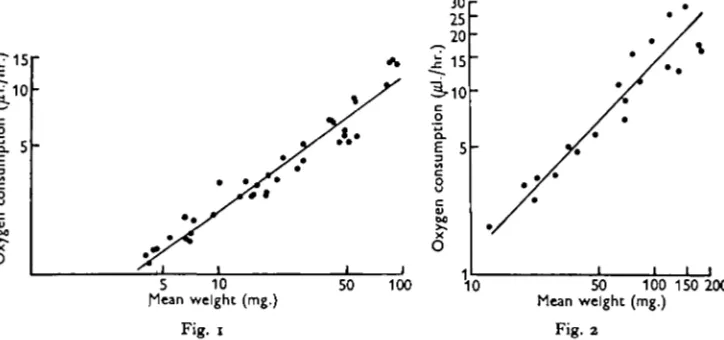
first to be investigated. Fig. 1 shows the results of forty determinations of oxygen consumption of Glossiphonia complanata in air-saturated water at 200 C. Each point represents the mean oxygen consumption of two to six leeches enclosed in a bottle of capacity 6-7 ml. for 1-1 \ hr. The equation of the regression line is
log r = 0715 log W+log k,
where r = the mean rate of oxygen consumption, W= the mean weight of the leeches and k is a constant. This may also be written r = kW°'ni indicating that the rate of uptake is roughly proportional to the surface area rather than to the mass.
30 25
15
5 10 Mean weight (mg.)
Fig. I
100 10 50 100 150 200
[image:3.451.46.408.199.369.2]Mean weight (mg.) Fig. 2
Fig. 1. Oxygen consumption of Glossiphonia complanata in air-saturated water at 200 C , plotted as a function of live weight.
Fig. 2. Oxygen consumption of Erpobdella octoculata in air-saturated water at 20° C , plotted as a function of weight.
Table 1. Slope (m) of the Une relating oxygen concentration to weight for five species of leech
Species
Glossiphonia complanata Helobdella stagnalii Pisdcola geometra ErpobdeUa testacea E. octoculata
Weight range (mg-)
4-94 2-6 2-22 6-37 12-104
m
0-715 o-8i 0-695 o-8i 106
Table 1 shows the results of similar determinations of the slope of the line relating log r to log W, for the other species investigated. In every case the slope of the line is greater than two-thirds, the most remarkable being Erpobdella octoculata where it is greater than unity (Fig. 2.).
B. Comparison of the oxygen consumption of the five species
covering suggested that the leeches were reasonably inactive while the oxygen con-centration was at or near that of air-saturated water, so that the figures obtained represent something approaching the basal or standard metabolic rate. Owing to the wide range of sizes of leeches used, it was not possible to arrive at a representa-tive figure for oxygen uptake in terms of ml./g./hr. For example, Fig. i shows that with Glossiphoma complanata the rate of uptake varies from 286/xl./g./hr. for a small leech, to iO2ftl./g./hr. for a large one. Comparison was therefore made on the basis of the oxygen consumption of a leech of 30 mg. This figure can be obtained for each species from the line relating oxygen consumption to weight, either directly or by extrapolation. The values for the various species are given in Table 2. The outstanding feature is that Piscicola geometra has a much higher oxygen consump-tion than the other leeches.
Table 2. Oxygen consumption of a leech of 30 mg. at 200 C. in air-saturated water
Species
Glossiphoma complanata Helobdella stagnalis Piscicola geometra ErpobdeUa testacea E. octoculata
Oxygen consumption (ftl./hr.)
449S 6-io IO-IO S-98 40
C. The effects of starvation
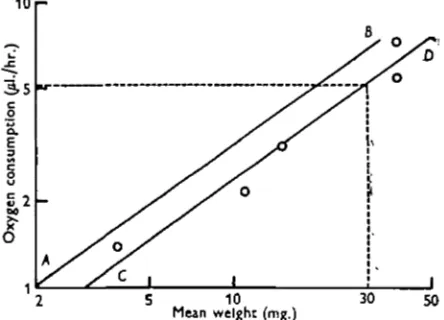
Specimens of Glossiphonia complanata were collected from the River Pang near Bradfield, Berkshire, and estimations of the oxygen consumption were made at intervals over a period of 7 days. (Each estimation was based on five measurements, as explained previously.) The method used to calculate the oxygen consumption of a leech of 30 mg. was a graphical one suggested by Prof. Kaj Berg. The mean oxygen consumption for the leeches in each bottle was plotted against their mean weight on a logarithmic scale, and the line of best fit to the five points thus obtained was drawn in, keeping the slope of the line at the value previously determined for the species, and varying only the point of intersection of the line with the Y axis. For example, it was shown in §A above that the slope of the line relating oxygen con-sumption to weight in G. complanata is 0-715. The five points shown on Fig. 3 were obtained by the methods described above, and the line AB was drawn through the origin to make an angle tan"1 0-715 with the X axis. The line CD was drawn parallel to AB at the level which provided the best fit for the five points. The oxygen consumption for a leech of 30 mg. is seen to be 5-2/xl./hr.
Study of oxygen consumption of five species of leech 619
experiment with G. complanata for at least 7 days without the results being affected by starvation. The same conclusion was reached in respect of the other species.
10
o.
3
£ 2
5 10 Mean weight (mg.)
[image:5.451.116.338.117.277.2]30 50
Fig. 3. Diagram illustrating graphical method of calculating the oxygen uptake of a leech of standard weight. For explanation see text.
Table 3. Oxygen consumption of starved Glossiphonia complanata 0/30 mg. at 2OCC. in air-saturated water
Oxygen consumption (/d./hr.)
Time in laboratory after collection
1-5 hr.
5 2
475 hr.
S-6
65 hr.
4 8
105 hr.
4-6
23-5 hr.
4-a
3 days
5h r .
4-4
7 days
5 2
D. Oxygen consumption in relation to oxygen tension
K. H. M A N N
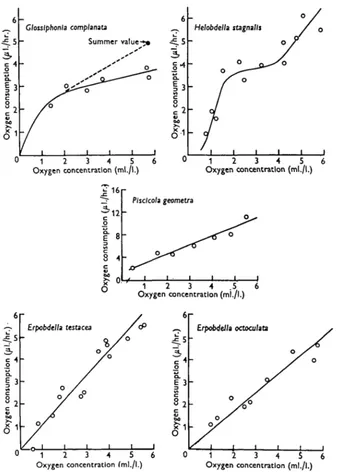
that shown in Fig. i for conditions of air-saturation. The experiments on G. com-planata with reduced oxygen concentrations were made in December, while the
earlier experiments were carried out in September, and it may be that the form of the curve in summer is that indicated by the dotted line, and the effect of winter conditions is to depress the line at higher oxygen concentrations.
c 4 o
| 3
x O
Glosslphonia complanata
Summer
6
=5.5
§•4 S. | 3 C o u
Dxyge
i
Helobdella stagnalls
-- /
/ , , ,
o /
/ 0
° /
1 1 1 1 2 3 4 5 6
Oxygen concentration (ml./l.)
1 2 3 4 5 6 Oxygen concentration (ml./l.)
t 16
1 2
o
I 8
8 4P/sc/co/a geometra
1 2 3 4 .5 6 Oxygen concentration (ml./l.)
c 4 jo
3
1Erpobdella testacea
I
3 82Erpotxiella octocufata
0
1 2 3 4 5 6 0 1 2 3 4 S 6
[image:6.451.60.398.144.616.2]Oxygen concentration (ml./l.) Oxygen concentration (ml./l.)
Study of oxygen consumption of five species of leech
6 2 1E. The effect of acclimatization to low oxygen concentration
The measurements made in the previous section were repeated, but instead of the leeches being taken from air-saturated water and placed directly in the respira-tion bottles, they were placed overnight in water of the oxygen concentrarespira-tion required for the experiment. For instance, in one experiment ten leeches were placed in the evening in 2 1. of water having an oxygen concentration of 4 ml./l., and this was covered with liquid paraffin. By morning the concentration had fallen to 375 ml./l. and this water was then used for determining oxygen consumption by
o
Erpobdelli testacea
Erpobdella octocu/ata
0
1 2 3 4 5 6
[image:7.451.128.328.207.396.2]Oxygen concentration (ml./l.)
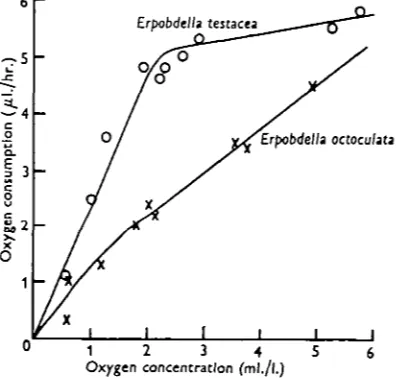
Fig. 5. The relation between oxygen consumption and oxygen concentration in the two species of Erpobdclla, after acclimatization overnight to the concentration of oxygen at which the readings were taken.
the method described above. All the species except ErpobdeUa testacea showed the same relationship between oxygen consumption and oxygen concentration as before, but E. testacea now showed a high degree of independence, as illustrated in Fig. 5., there being little change in the oxygen consumption between 6-o and 3-0 ml./l. oxygen.
F. Oxygen consumption and behaviour of Erpobdella Testacea when confined in a small volume of water
increased ventilation, resulted in a rapid fall in the oxygen concentration, i.e. an increased uptake by the leeches. At about 1-5 ml./l. the pumping became less frequent, and was soon stopped. There was then a corresponding fall in their rate of uptake.
Undulation* begin
Locomotion
Undulation
Undulation
Undulation
Resting
Slight undulation
Resting
10 1-5 20 25 Time In hours from closing of bottle
35
Fig. 6. Change in oxygen concentration with time, when four specimens of Erpobdella testacea were enclosed in 15 ml. of air-saturated water at 20° C. Notes refer to type of behaviour.
G. Rate of respiration of Erpobdella testacea at low temperature (0-4° C.) with and without acclimatisation
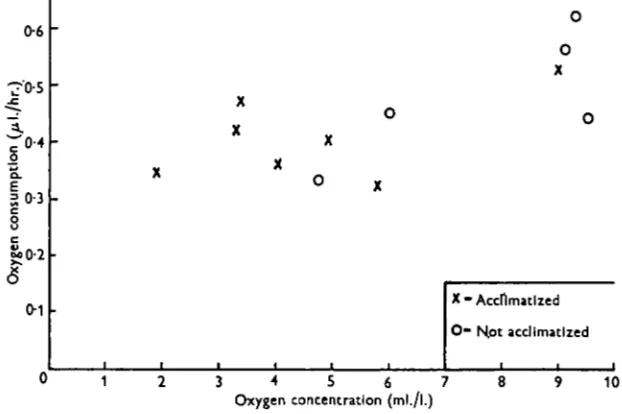
The previous experiment suggested that the respiratory independence of E. testacea illustrated in Fig. 5 might be produced by muscular ventilating activity rather than by an internal physiological mechanism, so experiments D and E were repeated at 0-4° C , at which temperature there were almost no muscular movements. The results, illustrated in Fig. 7, show that there was little difference between the oxygen uptake with and without acclimatization, suggesting that the acclimatization effect previously observed was brought about by the leech ventilating its body surface by undulation.
DISCUSSION
Study of oxygen consumption of five species of leech 623
related to the weight, W, according to the formula r = &W*. On the other hand, he found that some species departed widely from the law. For Polycelis mgra he found that the oxygen consumption per unit weight was actually lower in the smaller animals, and in the present study the same is true for ErpobdeUa octoculata, where r = k W1 '°6. It appears from Prosser (1950) that the cause of the normal relationship between body weight and oxygen uptake is obscure, so there seems little point in speculating as to the reasons for departures from the rule.
0-6
_c
Q.
8
»0-2
i
0-1
-X
•
1 1
X
x
x X
0
1 1 1
o
X
o
0 X
0
X - Acclimatized
O - Not acclimatized
• • i
8 10
[image:9.451.70.381.183.390.2]0 1 2 3 4 S 6 7 Oxygen concentration (ml./l.)
Fig. 7. The relation between oxygen concentration and oxygen consumption in Erpobdella tatacea at 0-4° C.
The outstandingly high rate of oxygen consumption of Piscicola geometra is in accordance with expectations for three reasons. First, it is the only leech studied which does not rely entirely on diifusion of oxygen through the general body surface. Its pulsatile vesicles are thin-walled bulges from the sides of the body. They are in direct communication with the coelomic lacunar system, and are equipped with valves so that their pulsations bring about a one-way circulation of coelomic fluid (Selensky, 1915). Piscicola then, has the advantage over the other leeches of an organ system which brings coelomic fluid into proximity with the water, and then pumps it round the body. Secondly, Piscicola feeds by attaching itself to passing fish, and sucking their blood. During the period when it is actively seeking a host it has to perform extremely rapid movements, and one would expect there to be an efficient system of gaseous exchange if only for use at this time. Thirdly, Piscicola is characteristically a stream form, and as has been previously mentioned, there is an increasing body of evidence for the view that stream forms normally have a higher oxygen consumption than pond or lake animals.
possibility that the level of activity of the different species may vary slightly under the conditions of the experiment.
The relation of oxygen consumption to oxygen concentration for the various species is still far from clear owing to the large number of variables in the situation. Perhaps the two most important in the present study are (i) seasonal variation in oxygen consumption, and (ii) the effects of acclimatization to the temperature and oxygen concentration of the experiment. Regarding (i), seasonal variation, all the work was carried out in the months April-September, with the exception of the determination of the relationship between oxygen concentration and oxygen consumption in Glossiphonia, which was carried out in December. As has been mentioned, it looks very much as if the oxygen consumption at higher oxygen concentrations is de-pressed in winter, but the details of seasonal variations have yet to be studied. Re-garding (ii), the effects of acclimatization are known to a limited extent. Care was taken to ensure that the leeches were acclimatized to the experimental temperature of 20° C. for at least 24 hr., and it was shown that the oxygen consumption of Glossiphonia in September did not change significantly from 1 \ hr. to 7 days after collection; but this would not necessarily be true for animals collected in December from very cold water and transferred to water at 200 C.
For the four species other than Erpobdella testacea, acclimatization to water of low oxygen concentration made no significant difference to their oxygen consump-tion, but with E. testacea this difference was very marked, suggesting that it rapidly becomes acclimatized to life in a low oxygen concentration. This is interesting in view of the fact that it characteristically inhabits reed swamps where there are large amounts of decaying organic matter which reduce the concentration of oxygen in the water. It is also relevant to note that the two species of Erpobdella have haemo-globin in the blood, and from work on other annelids (Johnson, 1942; Fox, 1945) one would expect this to assist oxygen uptake, at least at low oxygen tensions. There is, however, no evidence that the haemoglobin affected oxygen uptake in the present experiments. Preliminary observations on the ventilation activity of Erpobdella testacea suggest that this plays an important part in maintaining a steady rate of oxygen consumption in the face of falling oxygen tension, and the fact that there was no difference in the oxygen consumption of leeches acclimatized and leeches not acclimatized when ventilation was inhibited by low temperatures supports this idea. If it is correct, then the difference between the oxygen consumption of the two species of Erpobdella at low oxygen tensions after acclimatization must be related to their different patterns of behaviour under these conditions. This aspect requires further study.
Study of oxygen consumption of five species of leech 625
below which oxygen consumption falls rapidly, but above which oxygen con-sumption is relatively independent of the oxygen tension. Hyman (1929) has shown how acclimatization can alter the critical concentration for Planaria from 3 to 0-5 ml./I., and there is little doubt that statements regarding tc values ought
always to be qualified by details of previous acclimatization. In many experiments where animals have been confined in a vessel and allowed to reduce the oxygen concentration slowly (e.g. Hiestand, 1937), it is probable that some acclimatization occurred during the course of the experiment. In the present work a clear distinc-tion has been made between experiments in which no acclimatizadistinc-tion was possible (other than during the hour of the experiment) and experiments in which the animals were acclimatized overnight, but it would be desirable to know the effect of longer periods of acclimatization, or better still, to have a record of the oxygen consumption under conditions of constant low oxygen tension over a considerable period of time.
SUMMARY
1. The oxygen consumption of five species of leech has been investigated and considered in relation to their ecology.
2. Glossiphonia complanata and ErpobdeUa octoculata which are most common in, but not confined to, hard and soft water streams respectively, have their oxygen consumption dependent on the concentration of dissolved oxygen, at least in spring and summer. Their oxygen uptake is not affected by acclimatization overnight to a low level of oxygen, but the uptake of Glossiphonia at the higher oxygen concentra-tions is depressed in winter.
3. ErpobdeUa testacea has an oxygen consumption which is independent of the oxygen concentration between 60 and 3-oml./l., provided that the leeches have been acclimatized overnight to the oxygen concentration at which their uptake is measured. Ventilation of the body surface by dorso-ventral undulations appears to be an important factor in the maintenance of a high rate of oxygen uptake at low concentrations. This species is found in reed swamps.
4. Helobdella stagnate, which is most abundant in stagnant eutrophic lakes, maintains a level of oxygen consumption which is independent of the oxygen con-centration between 2*0 and 4-0 ml./l., even without previous acclimatization.
5. Piscicola geometra, which is virtually absent from stagnant water, has a higher rate of oxygen uptake than any of the other species under conditions of air-satura-tion, and its rate is strictly dependent on the concentration of oxygen in the water.
REFERENCES
BARTELS, H. (1949). Die Bestimmung des physikalisch gel5sten Sauerstoffs in biologischen Flflssig-keiten mit der Quicksilbertropf-electrode. Naturwissenschaften, 36, 375-8.
BERG, K. (195a). The oxygen consumption of Ancylidae (Gastropoda) from an ecological point of view. Hydrobiologia, 4, 125—67.
Fox, H. M. (1945). The oxygen affinities of certain invertebrate haemoglobins. J. Exp. Biol. ai,
161-5.
GUIGERE, P. A. & LAUZIER, L. (1945). Le dosage polarographique l'oxygene dissous dans l'eau de mer. Canad. J. Res. 23, 76-83.
HIESTAND, W. A. (1937). Respiration studies with fresh water molluscs. Proc. Ind. Acad. Set. 47, 287-98.
HYMAN, L. H. (1929). The effect of oxygen tension on oxygen consumption in Planaria and some echinoderms. Phytiol. Zodl. a, 505-34.
JOHNSON, M. L. (1942). The respiratory function of the haemoglobin of the earthworm. J. Exp.
Biol. 18, 266-77.
KOLTHOFF, J. M. & LINCANE, J. J. (1952). Polarograpky. New York.
MANN, K. H. (1955). The ecology of the British freshwater leeches. J. Anitn. Ecol. 24, 98-119. PROSSER, C. L. (1950). (ed.). Comparative Animal Physiology. Philadelphia and London. RUBNER, M. (1883). Ueber den Einflus der K8rpergr6sse auf Stoffund Kraftwechsel. Z. Biol. 19,
536-62.
SELENSKY, W . D . ( 1 9 1 5 ) . Etudes morphologiques et tystimatiquet twr la Hirudinies. i.VOrganisation
des Ichthyobdellides. Petrograd.
Vorr, E. (1901). Uber die Grdsse des Energiebcdarfes der Tiere im Hungerrustande. Z. BioL 41,
113-54-WALSHE, B. M. (1948). The oxygen requirements and thermal resistance of chironomid larvae from flowing and from still waters. J. Exp. Biol. 35, 35-54.