IoT based Ultraviolet Radiation Sensing
Vineela Thonduri1, Sandeep Pothineni2, Santhi Kalyan Thamanam3, Siva Nageswar Rao Ravuri4, Sai Prakash Podilapu5
1
Asst. Prof, Dept. of ECE, VVIT, Guntur, Andhra Pradesh, India.
2, 3, 4, 5
Student of ECE, VVIT, Guntur, Andhra Pradesh, India.
Abstract: Sun is an essential factor for our wellbeing, an excessive amount of introduction to daylight may cause medical issues going from sunburns to skin malignancy. Despite the fact that individuals know about these dangers, daylight related skin harms have expanded over the previous decades. These days, people in general essentially get data about UV brilliance through climate estimates. Be that as it may, they give unpleasant and normal predication to a specific vast locale. This paper presents an idea that can quantify UV brilliance by utilizing UV sensors which will distinguish the radiation. What's more, by using Arduino microcontroller we can control and show the preparatory strides to be taken. Android application is created to know the detected esteem.
Keywords: IoT, Arduino Uno, Ultraviolet sensor, Ultraviolet source, Thingspeak.
I.INTRODUCTION
Bright (UV) radiation is unsafe to human wellbeing. Numerous investigations have demonstrated that UV is contained in daylight and is a cancer-causing agent, which can cause skin growth. At present, the best method to square UV radiation is applying sunscreen. Be that as it may, numerous individuals disregard ensuring their skin essentially on the grounds that they don't have the foggiest idea about the power of UV radiation outside. It will be vital and supportive to give an approach to give individuals a chance to quantify UV beams advantageously and precisely. There are two noteworthy kinds of hardware, which can quantify UV radiation. The primary sort is spectroradiometers, which are essentially utilized as a part of research centers. In spite of the fact that spectroradiometers can give amazingly precise outcomes, they are very costly and complex to work. The second kind is compact advanced UV meters. There are a few varieties in this write. Some are little and simple to convey, however are not fit to give exact readings. Some have somewhat bigger size and give generally precise readings yet are as yet costly for customers. Subsequently, the undeniable drawbacks are the promotion of customary UV estimation hardware: neither precise nor sufficiently moderate. As of late, utilizing PDAs to recognize UV radiation has developed. Since there are no advanced cells outfitted with UV sensors available, the techniques for the most part look for other UV related sources. We can actualize by utilizing UV to process the UV radiation comes about.
[image:1.612.101.446.509.711.2]II. METHODOLOGY
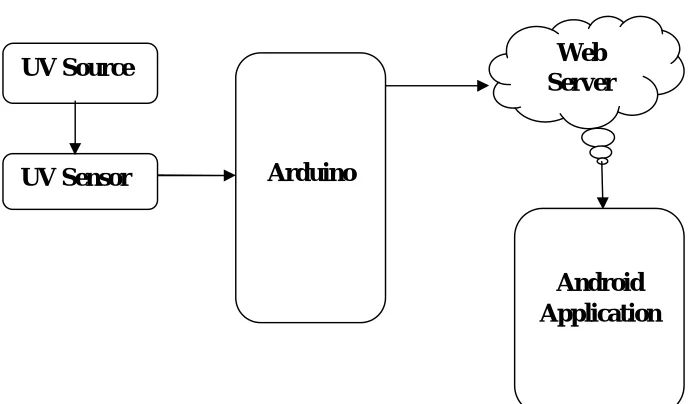
Fig. 1Architecture for UV Radiation Sensing
III. COMPONENTS
[image:2.612.215.402.99.284.2]A. Arduino
Fig. 2: Arduino
Arduino is an open-source hardware and software company, project and user community that designs and manufactures single-board microcontrollers and microcontroller kits for building digital devices and interactive objects that can sense and control both physically and digitally.Arduino board designs use a variety of microprocessors and controllers. The boards are equipped with sets of digital and analog input/output (I/O) pins that may be interfaced to various expansion boards or breadboards (shield) and other circuits.
[image:2.612.217.399.391.546.2]B. Ultraviolet Sensor
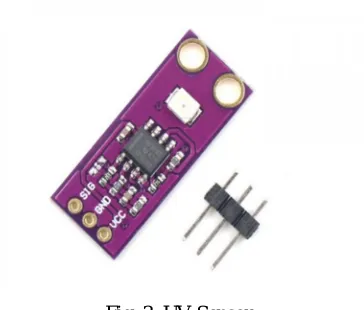
Fig. 3: UV Sensor
An UV Sensor is used for detecting the intensity of incident unltraviolet (UV) radiation – radiation lying in the ultraviolet range, with wavelengths shorter than light but longer than X-rays. This form of electromagnetic radiation has shorter wavelengths than visible radiation. UV sensors are widely used in many different applications, including but not limited to automobiles, pharmaceuticals and robotics.
C. Ultraviolet Source
An ultraviolet source is used to incident the ultraviolet rays on the ultraviolet (UV) sensor. The amount of radiation of the ultraviolet rays is measured when the rays are incident on the sensor. The ultraviolet source used in the experiment has the wide length of 395-400 nm.
[image:3.612.233.380.159.299.2]D. WI-FI Module (ESP8266)
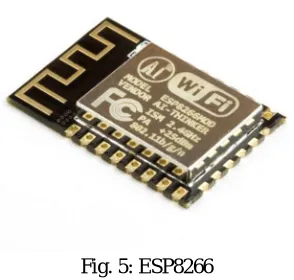
Fig. 5: ESP8266
The ESP8266 series, or family, of Wi-Fi chips is produced by Espressif Systems, a fabless semiconductor company operating out of Shanghai, China. The ESP8266 series presently includes the ESP8266EX and ESP8285 chips. It employs a 32-bit RISC CPU based on the Tensilica Xtensa L106 running at 80 MHz. It has a 64 KB boot ROM, 64 KB instruction RAM and 96 KB data RAM. External flash memory can be accessed through SPI. ESP8266 module is low cost standalone wireless transceiver that can be used for end-point IOT developments.
E. Arduino Software
Fig. 6: Arduino Logo
Node red The Arduino integrated development environment is a cross-platform application that is written in the programming language Java. It is used to write and upload programs to Arduino board. The source code for the IDE is released under the GNU General Public License, version 2.
F. Thingspeak
[image:3.612.228.385.635.718.2]This is an open source IoT application and API to store and retrieve data from thingsusing the http protocol over the cloud. It is used for tracking applications and status updates. The operating system of thingspeak is CROSS-PLATFORM.
The data from the sensors is sent to the Arduino and by using Arduino software we can read the data from the arduino and then we can send it to Thingspeak cloud, where all the physical data can be stored.
Fig. 8: Experimental Setup of Ultraviolet Radiation Sensing System
In this paper, a three-phase operation is performed. In phase I, the data is read from the sensors through arduino and is posted into the cloud through ESP8266 using Arduino software. The information in the cloud can be accessed from anywhere and at any time as it stored there permanently.
In phase II, the data in the cloud will be accessed through a personal computer or any smart device using the web server to check the amount of radiation available at a place.
In phase III, based on the data, the necessary steps are taken. Here again, three conditions arise. Firstly, the low condition. Here, less care is enough to get protected. Secondly, the intermediate condition. And finally, the high condition. The information in all these conditions is regularly shared with necessary precautions any individual can take.
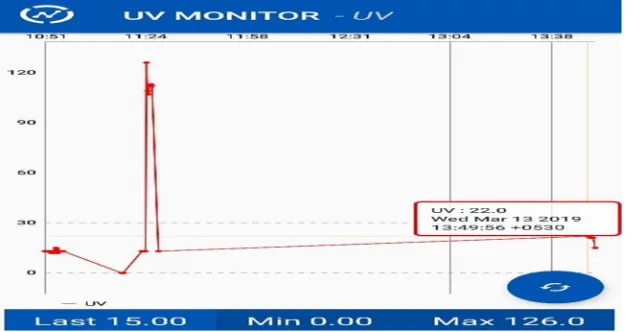
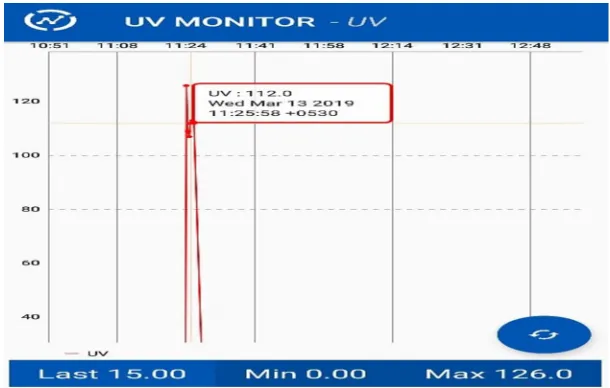
Based on the results in the cloud, action is taken according to the amount of Ultraviolet level present around an individual. The readings of the ultraviolet radiation can be observed by accessing the webserver THINGSPEAK or by accessing the app THINGVIEWER which is available on play store.
Necessary precautions can be taken in order to protect the skin from the harmful ultraviolet rays such using sun screen lotions or creams, wearing dress which covers the exposed skin and by using shades.
[image:4.612.157.458.143.329.2]Ultraviolet radiation couldn’t be completely controlled or prevented but its effects could be reduced if possible actions are taken.
[image:4.612.151.467.558.724.2]Fig. 11: Obtained highest reading of Ultraviolet radiation reading
IV.CONCLUSION and FUTURE WORKS:
In this project, we proposed a methodology which could legitimately quantify UV radiation at a particular area by utilizing UV sensors. The technique specifically used readings from sensors for constant calculation, implying that it can be utilized on all the savvy gadgets available. Moreover, we acquainted how with exploit Arduino to enhance the outcome exactness progressively. Besides, the created UV android application was powerful.
V.ACKNOWLEDGEMENT
I thank the department of Electronics and Communication Engineering of VVIT (Vasireddy Venkatadri Institute of Technology), Guntur, Andhra Pradesh, India for permitting me use the computational facilities available in the center for Research and Development cell.
REFERENCES
[1] Robert wirko, joanna wirko, zbigniew bielecki, measurement system for testing the optical radiation detectors in a broad temperature range, military university of technology, faculty of electronics, institute of electronic systems, gen. Sylwestra kaliskiego 2, 00-908 warszawa, poland.
[2] Igoe dp1, amar a2, parisi av2, turner j2. Characterisation of a smartphone image sensor response to direct solar 305nm irradiation at high air masses, 017 jun 1;587-588:407-413. Doi: 10.1016/j.scitotenv.2017.02.175. Epub 2017 feb 27.
[3] Piotr miluski, marcin kochanowicz, jacek żmojda, dominik dorosz measurement system for testing the optical radiation detectors in a broad temperature range [4].
[4] M. Watson, d. M. Holman, and m. Maguire-eisen, “ultraviolet radiation exposure and its impact on skin cancer risk,” seminars oncol. Nurs., vol. 32, no. 3, pp. 241–254, 2016.
[5] Bo mei (gs’15) received the bachelor’s degree in material science and engineering from the beijing institute of technology, beijing has conducted extensive study on system applications on iot devices.
[6] Ruinian li (s’17) received the bachelor’s degree in software engineering from nanchang university, nanchang, china his current research interests include network security, applied cryptography, and privacy preserving computations.
[7] Wei cheng (s’08–a’10–m’11–sm’16) received the b.s. Degree in applied mathematics and m.s. Degree in computer science from the national university of defense technology his current research interests include privacy-aware computing, wireless networking, distributed algorithms, peer-to-peer computing, and graph theory.
[8] A. R. Young, j. Claveau, and a. B. Rossi, “ultraviolet radiation and the skin: photobiology and sunscreen photoprotection,” j. Amer. Acad. Dermatol., vol. 76, no. 3, pp. S100–s109, 2017.