Design of Bow-Tie Microstrip Patch Antenna using
different Techniques
Amitesh Ranjan1, Dr. Shailendra Singh Pawar 2, Himanshu Kumar3 1, 3
Scholar (M. Tech, Digital Communication)
2 Asst. Professor, Department of Electronics and Communication Engineering, All Saints College of Technology Bhopal India,
Abstract: One of the advance and ingenious antenna in the antenna theory is MicroStrip patch Antenna (MSA). It is small in size and volume, so low manufacturing cost and thus used in wireless communication. There are certain issues with this antenna like low bandwidth and low gain. Here we will discuss the basic features of MSA and proposed design technique . We will also compare the post design parameters of each method. we have proposed a technique to design and compare a bow-tie patch antenna with the help of various soft computation techniques such as Adaptive Neuro Fuzzy Inference System (ANFIS), Genetic Algorithm (GA) and others.. The software used is HFSS software. The goal of this work is to observe the antenna parameters which appear suitable for the respective design. Obtained antenna parameters are employed to design bow tie antenna using HFSS software.
Keywords: ANFIS; GA; resonant frequency; gain; efficiency; directivity; MPA.
I. INTRODUCTION
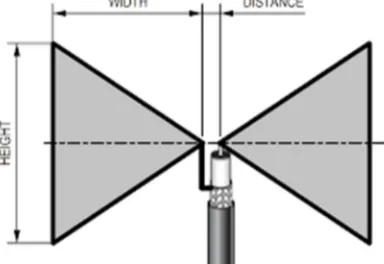
[image:1.612.211.403.418.550.2]An Antenna is a metallic device for radiating and receiving radio waves. It is used in systems such as radio and satellite broadcasting, point-to-point radio. Parameters affecting an antenna's performance are directivity, gain, efficiency, resonant frequency and its radiation pattern . A bow-tie antenna is a wire approximation in two dimensions of a bi-conic dipole antenna . It usually consists of two triangular flat metal plates, placed in the configuration of a bow-tie, with the feed point at the gap between the apexes of the triangles.
Fig 1. Bow-Tie antenna basic design
It is a broad bandwidth antenna made of two conical objects, nearly touch at their points . It is generally used for UHF television reception . Bandwidth of Bow tie antenna is usually higher than a dipole antenna. It has a omni-directional radiation pattern. It gives a moderate gain of about 3.5-7 dB .
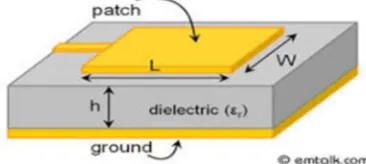
This design involves designing a bow-tie antenna on a patch. A patch antenna is also known as a rectangular micro-strip antenna. It is a type of radio antenna with a low profile, which can be mounted on a flat surface. It consists of a flat rectangular sheet or "patch" of metal, mounted over a larger sheet of metal called a ground plane.They are usually employed at UHF (Ultra-high frequencies) and (Ultra-higher frequencies because the size of the antenna is directly tied to the wavelength at the resonant frequency. A single patch antenna provides a maximum directive gain of around 6-9 dB. The ability to create high gain arrays in a low-profile antenna is one reason that patch arrays are common on airplanes and in other military applications.
Fig 2. Microstrip Patch Antenna basic construct
The different computation techniques used to calculate the dimensions of the bow-tie patch antenna are as follows –
A. Genetic Algorithm (GA)
A genetic algorithm is a search heuristic that is inspired by Charles Darwin's theory of natural evolution. This algorithm reflects the process of natural selection where the fittest individuals are selected for reproduction in order to produce offspring of the next generation. It is a global optimization algorithm derived from evolution and natural selection. Genetic algorithms belongs to the larger class of evolutionary algorithms, which generate solutions to optimization problems using techniques such as inheritance, mutation, selection, and crossover i.e. the techniques inspired by natural evolution. Genetic algorithm finds application in bio-informatics, computational science, engineering, economics, chemistry, manufacturing, mathematics, physics, and several other fields . Although genetic algorithm not necessarily provide optimal solution, as it has its own advantages and is a powerful tool for solving complex problems . Genetic algorithm method is used to find out the optimum solution of each of the antenna parameters(Length and Breadth) . Using the calculated dimensions obtained from the computation technique, the antenna can be developed using HFSS software.
B. Adaptive Neuro Fuzzy Inference System (ANFIS)
ANFIS is a kind of artificial neural network which is based on Takagi-Sugeno fuzzy inference system. As it integrates neural networks and fuzzy logic principles, so it has potential to recreate the benefits of both together in a single framework. Using a given input/output data set, the toolbox function ANFIS constructs a fuzzy inference system (FIS) whose membership function parameters are adjusted or tuned using either a back propagation algorithm alone, or in combination with a least squares type of method. In the simulation, the ANFIS architecture is employed to model non-linear functions, identify non-linear components on-line in a control system, and predict a time series, all yielding results [10].
This technique has a sequence of data is trained i.e. a training sequence is developed. This training sequence is used to get the optimized value of the output parameter corresponding to the respective input parameter . Let us assume that a sequence of resonant frequencies are trained corresponding to the length of the antenna.
This ANFIS technique gives us the optimized value of resonant frequency corresponding to any length within the limits of the training sequence. Thus, the antenna can be designed using HFSS software and resonant frequency corresponding to that particular length.
C. Hybrid Technique (ANFIS and Genetic Algorithm)
As per the name, this technique is a combination of both the optimization techniques already used to design the bow-tie antenna. Genetic algorithm is used to find out the dimensions of the bow-tie patch antenna. It employs fitness function and constraints to calculate the optimum solution of the required dimension.
II. DESIGN
The steps followed for carrying out this antenna design are as follows-
A. Antenna design using Genetic Algorithm Method
1) A genetic algorithm code for finding out the length and width of the bow-tie antenna is developed using MATLAB software.
2) After finding out the dimensions of the antenna, the required antenna is designed using HFSS software.
B. Antenna Design using ANFIS Method
1) Various antennas of different lengths are designed and resonant frequency is found out for each antenna. Thus, a training sequence is developed.
2) Using this ANFIS code, resonant frequency for a given length of antenna is found out using MATLAB software.
3) The antenna is, thus designed using HFSS software and various antenna parameters are obtained.
C. Antenna Design using the Hybrid Model Consisting of both ANFIS and Genetic Algorithm 1) By using genetic algorithm code, a proper length of the antenna is obtained.
2) Using the ANFIS code, resonant frequency for that particular length of the antenna is obtained.
3) The antenna is designed using HFSS software and the resonant frequency is checked.
III. COMPUTATION
The bow-tie antenna is designed using the various soft computation methods. A description of each technique is as given below -
A. Using Genetic Algorithm Technique
A genetic algorithm code is developed using MATLAB software for finding out values of dimensions of the antenna.
1) Equations: Bow-tie antenna dimensions can be found out by the use of following simple formulas –
a) Width of the antenna can be calculated by – W=
( )/ ---(1)
b) The effective dielectric constant is given by – εeff= + ---(2)
c) For TM10 mode, length of patch must be less than λ/2. This difference in length is given by ∆L=0.412h( . )( . )
( . )( . ) ---(3)
d) The effective length of the antenna is given by Leff= ---(4)
e) The length of the bow-tie antenna can be calculated by – L=Leff-2∆L ---(5)
2) Antenna Design: After obtaining the optimized values for the dimensions of the bow-tie antenna using the genetic algorithm technique, the antenna is designed using the HFSS software.
Table I. Shows the Values of the Input Parameters for Design of Both the Antennas:
Sl. No. Input Parameter Values using genetic algorithm method
1 Length of the antenna 15.855103155624192 mm
2 Width of the antenna 7.707257944176302 mm
B. Using Adaptive Neuro Fuzzy Inference System (ANFIS) technique -
C. Using the Hybrid Technique Consisting of Both ANFIS and GA
1) Antenna Design: Using the genetic algorithm technique, the length of the antenna is found out to be 22.0531 mm. This length is taken as input to the ANFIS program. The limits of the length was considered to be from 5-25 mm. The resonant frequency corresponding to the input length is found out to be 11.2773 GHz.
IV. RESULTS AND DISCUSSION
[image:4.612.67.573.202.322.2]After the design of antenna using the soft computation techniques, the output parameters were compared. The output parameters which were taken into consideration were – resonant frequency, directivity, gain and antenna efficiency.
Table II Gives the Comparison Between the Antenna Designs Using the Various Soft Computation Techniques: Sl.
No.
Output Parameters Antenna designed
using genetic
algorithm technique
Antenna designed using ANFIS technique
Antenna designed using hybrid technique
1 Resonant Frequency
(GHz)
12.12 12.12 12.188
2 Directivity 5.20 5.27 4.82
3 Gain 4.15 4.13 4.09
4 Antenna Efficiency 80.08% 78.67% 85.06%
As per above table various antenna parameters are obtained using different design methods. None of the method is found suitable for this design rather each one gives interesting outputs, which must be taken into consideration while assessing our requirements. Resonant frequency for GA and ANFIS is 12.12 respectively, however for Hybrid one it is 12.188. Again directivity for GA,ANFIS and Hybrid are 5.20, 5.27 and 4.82 respectively. More interesting is gain ie. for GA(4.15), ANFIS(4.13) and Hybrid (4.09) respectively. Hybrid technique gives highest antenna efficiency, however ANFIS the least ie. 78.67 %.
V. CONCLUSION
It has been observed that using various soft computation methods, bow-tie antennas gives better directivity, gain and antenna efficiency. Bow-tie antenna is a miniaturized antenna and it is used Ultra-High Frequency (UHF) television reception. It gives optimized values of the antenna parameters as chosen. The ANFIS technique gives the most directive antenna, however more gain is obtained using the genetic algorithm technique. The hybrid model consisting of both genetic algorithm and ANFIS gives the highly efficient antenna. So, the soft computation techniques can be opted according to his requirement. Bow-tie antenna is a bi-conical antenna which is usually multiband. Because of their broadband characteristics, it can be employed in the Very High Frequency (VHF) and Ultra High Frequency (UHF) frequency ranges. It is very useful antenna as it can be grossly used in higher frequency ranges, it is a multiband antenna, it gives good directivity and it is small in size and easy to design , efficiency and gain. The increased demand for communication , the use of band has gone from narrowband to wideband and broadband within a very short time. To meet the increasing demands, more efficient antennas are required such as bow-tie patch antennas .
REFERENCES
[1] Olabisi O | Adewumi A. S | Ajao O. S | Adeniran A. O "Bow-Tie Microstrip Patch Antenna – Design and Implementation for Dual Band WLAN
Applications" Published in International Journal of Trend in Scientific Research and Development (ijtsrd), ISSN: 2456-6470, Volume-3 | Issue-4, June
2019, pp.1136-1140, URL: https://www.ijtsrd.com/papers/ijtsrd25087.pdf
[2] D.K. Naji, R.S. Fyath, “Miniaturized dual fractal antenna structure for RFID tags,” in International Journal of Electromagnetics and Applications 2013, vol. 3,
Issue 4, pp. 103-119, April 2013.
[3] A.C. Bhosale, V.U. Deshmukh, “ Design of Bow-Tie Microstrip Antenna with Fractal shape for W-LAN Applications,” IJECT, Vol. 3, Issue 4,
October-December 2012.
[4] M. N. A. Karim, M. K. A. Rahim, H. A. Majid, O. Ayop, M. Abu and F. Zubir, “ Log Periodic Fractal Koch Antenna For UHF Band Applications, Progress In
Electromagnetics Research, PIER 100, pp. 201-218, 2010.
[5] Constantine A. Balanis, “Antenna Theory, Analysis and Design,” John Wiley & Sons Inc., Third Edition, 2005.
[6] A.R. Bretones, F.J.G. Ruiz, S.G. Garcia, “GA design of a thin-wire bow-tie antenna for GPR applications,” Department of Electromagnetism, University
of Granada, Spain, IEEE Transactions on Geoscience and Remote Sensing, May 2006.
[8] Eiben, A. E. et al (1994). "Genetic algorithms with multi-parent recombination". PPSN III: Proceedings of the International Conference on Evolutionary Computation. The Third Conference on Parallel Problem Solving from Nature: 78–87. ISBN 3-540-58484-6.
[9] V.Indhumathi, “Design of Koch fractal bow-tie antenna for wireless applications,” SSRG International Journal of Mobile Computing & Application
(SSRG-IJMCA), vol. 1, Issue 2, October 2014
[10] M. Abri, H. AbriBadouni, M.A. Belhadi, I. Kalai, “Log Periodic Bow-tie Antennas (LPA) design using the transmission line model,” Journal of Radio
Electronics, June 2012.
[11] Hector Fraga-Rosales, Mario Reyes-Ayala* , Genaro Hernandez-Valdez, Edgar Alejandro Andrade-Gonzalez, Jose Raul Miranda-Tello, Felipe Alejandro
Cruz-Perez and Sandra Lirio Castellanos-Lopez “Design of a Microstrip Bowtie Antenna for Indoor RadioCommunications” ITM Web of Conferences 9, 03011 (2017)
[12] Abas Sabouni, Optimization of microstrip patch antenna using generic algorithm method, publish by IEEE, ANTEM 2005
[13] M.Jamshidifar,al et, a new approach to enhance the bandwidth of a novel miniaturized fractal microstrip fpatch antenna published by IEEE in
Antenna Technology and Applied Electromagnetic [ANTEM 2005],
[14] Chopara Bandana, Design and optimization of microstrip patch antenna withdefected ground structure and circular slot on the patch, publish by Int. Journal of
Applied Sciences and Engineering Research, Vol. 2, Issue 4, 2013
[15] S. Kohli, S S Dhillon, “optimization of multiband microstrip patch antenna for wireless application, publisher IEEE 27-29 sep 2013 5th International Conference