Proceedings of the Shared Task on Cross-Framework Meaning Representation Parsing at the 2019 CoNLL, pages 40–44 Hong Kong, November 3, 2019. c2019 Association for Computational Linguistics
40
The ERG at MRP 2019:
Radically Compositional Semantic Dependencies
Stephan Oepen♣andDan Flickinger♠ ♣
University of Oslo, Department of Informatics ♠
Stanford University, Center for the Study of Language and Information
[email protected], [email protected]
Abstract
The English Resource Grammar (ERG) is a broad-coverage computational grammar of English that derives underspecified logical-form representations of meaning. Elementary Dependency Structures (EDS) and DELPH-IN MRS Bi-Lexical Dependencies (DM) are graph-based simplifications of ERG mean-ing representations. As a point of refer-ence outside the official competition of the 2019 Shared Task on Cross-Framework Mean-ing Representation ParsMean-ing, we evaluate ERG-derived EDS and DM graphs. These graphs yield higher accuracy scores than the purely data-driven parsers in the shared task, sug-gesting that the general-purpose grammatical knowledge encoded in the ERG aids parsing into these meaning representations.
1 Introduction
Two of the target representations in the 2019 Shared Task on Cross-Framework Meaning Representation Parsing (MRP 2019; Oepen et al., 2019) derive from the framework dubbed English Resource Se-mantics (ERS;Flickinger et al.,2014;Bender et al., 2015). ERS instantiates the designer logic for sco-pally underspecified meaning representation called Minimal Recursion Semantics (MRS;Copestake et al.,2005); in and of themselves, ERS terms are logic- rather than graph-based, i.e. require conver-sion into graph-structured representations of mean-ing in the context of the MRP shared task. Ele-mentary Dependency Structures (EDS;Oepen and Lønning,2006) and DELPH-IN MRS Bi-Lexical Dependencies (DM;Ivanova et al.,2012) achieve simplification of ERS into labeled directed graphs by elimination of most of the information regard-ing scope underspecification and, in the case of DM, further reduction into pure bi-lexical graphs. Oepen et al.(2019) provide additional background on these representations. This paper gives some lin-guistic and technical background on ERS parsing (§2), summarizes the processes used in deriving EDS and DM graphs for the MRP evaluation data
(§3), and puts quantitative ERS parsing results into the perspective of the shared task at large (§4).
2 The LinGO English Resource Grammar and Redwoods Treebank
At the core of this work are two linguistic resources that have been under continuous development for multiple decades now, as part of the world-wide Deep Linguistic Processing with HPSG Initiative (DELPH-IN;http://delph-in.net). First, the LinGO English Resource Grammar (ERG; Flickinger,2000) is an implementation of the gram-matical theory of Head-Driven Phrase Structure Grammar (HPSG;Pollard and Sag,1994) for En-glish, i.e. a computational grammar that can be used for parsing and generation. Development of the ERG started in 1993, building conceptually on earlier work on unification-based grammar engi-neering for English at Hewlett Packard Laborato-ries (Gawron et al.,1982). The ERG has contin-uously evolved through a series of R&D projects (and a small handful of commercial applications) and today allows the grammatical analysis of run-ning text across domains and genres. The hand-built ERG lexicon of some 38,000 lemmata (for 27,000 distinct citation forms) aims for complete coverage of function words and open-class words with ‘non-standard’ syntactic properties (e.g. argu-ment structure). Built-in support for light-weight named entity recognition and an unknown word mechanism combining statistical PoS tagging and on-the-fly lexical instantiation for ‘standard’ open-class words (e.g. names or non-relational common nouns and adjectives) typically enable the grammar to derive complete syntactico-semantic analyses for
85–95percent of all utterances in standard corpora, including newspaper text, the English Wikipedia, or bio-medical research literature (Flickinger et al., 2017). Parsing times for these data sets measure in seconds per sentence, time comparable to human production or comprehension.
cor-pora, where for each sentence an annotator has selected the intended analysis among the alterna-tives provided by the grammar (or has recorded that no appropriate analysis is available, in a given version of the grammar). This companion resource is called the LinGO Redwoods Treebank (Oepen et al.,2004). For each release of the ERG, a cor-responding version of the treebank has been pro-duced, manually validating and updating existing analyses to reflect changes in the underlying gram-mar, as well as ‘picking up’ analyses for previously out-of-scope inputs and new development corpora. Since mid-2016, the current version of Redwoods (dubbed Ninth Growth, corresponding to ERG re-lease 1214) encompasses gold-standard analyses for some 85,400 utterances (or close to 1.3 million tokens) of running text from half a dozen different genres and domains, including the first 22 sections of the venerable Wall Street Journal (WSJ) text in the Penn Treebank (PTB;Marcus et al.,1993).
The original motivation for treebanking ERG analyses was to enable training discriminative parse ranking models, i.e. a conditional probability distri-bution over ERG derivations (Johnson et al.,1999). For this purpose, the treebank must disambiguate at the same level of granularity as is maintained in the grammar, i.e. encode its exact linguistic dis-tinctions. Furthermore, to train discriminative (i.e. conditional) stochastic models, both the intended as well as the dispreferred analyses are needed.
The Redwoods treebank is built exclusively from ERG analyses, i.e. full HPSG syntactico-semantic signs. Annotation in Redwoods amounts to disam-biguation among the candidate analyses derived by the grammar (identifying the intended parse) and, of course, analytical validation of the final result. To make this task practical, a specialized tree selection tool extracts a set of what are called discriminantsfrom the complete set of analyses. Discriminants encode contrasts among alternate analyses—for example whether to treat a word like crop as nominal or verbal, or where to attach a prepositional phrase modifier. While picking one full analysis (among a set of hundreds or thousands of trees) would be daunting (to say the least), the isolated contrasts presented as discriminants are comparatively easy to judge for a human annotator.
Discriminant-based tree selection was first pro-posed by Carter(1997) and has since been suc-cessfully applied to a range of grammatical frame-works. To the best of our knowledge, Redwoods is
the most comprehensive such effort, complement-ing the original proposal byCarter(1997) with the notion ofdynamictreebanking, in two senses of this term. First, different views can be projected from the multi-stratal HPSG analyses at the core of the treebank, highlighting subsets of the syn-tactic or semantic properties of each analysis, e.g. HPSG derivations, more conventional phrase struc-ture trees, full logical-form meaning representa-tions, and various variable-free forms of semantic dependency graphs—including EDS and DM.
Second, the dynamic treebank is extended and refinedover time. As the grammar (the core reposi-tory of knowledge about derivation and composi-tion) evolves, dynamic refinement refers to the abil-ity to mostly automatically update the Redwoods treebank, to for example add detail to the linguistic analyses or apply targeted error correction while minimizing any loss of manual input from previous annotation cycles. Although we can by no means quantify precisely the effort devoted to ERG and Redwoods development to date, we estimate that in excess of thirty person years have been accumu-lated between 1993 and 2019.
3 Parsing with the ERG
There are several highly engineered implemen-tations of the DELPH-IN feature structure refer-ence formalism; for our experiments we used the PET parser ofCallmeier(2002), as bundled in the open-source distribution of DELPH-IN resources called LOGON (Lønning and Oepen,2006).1 At its core, PET is a classic, agenda-driven chart parser (Kay, 1986), synthesizing a large body of algo-rithm design for efficient feature structure manip-ulation and unification-based parsing by among others Tomabechi (1995), Malouf et al. (2000), Erbach (1991), Kiefer et al. (1999), and Oepen and Callmeier(2000). The parser achieves exact inference by constructing the completeparse for-est, factoring local ambiguity under feature struc-ture subsumption (a technique termedretroactive packingbyOepen and Carroll,2000) and subse-quently enumeratingn-best full derivations from the forest according to a discriminative parse rank-ing model in the tradition ofJohnson et al.(1999) andToutanova et al.(2005).
Despite the non-local nature of features (of ERG derivations) used in parse ranking, the selective unpackingprocedure ofCarroll and Oepen(2005)
Tops Labels Properties Anchors Edges Attributes All
P R F1 P R F1 P R F1 P R F1 P R F1 P R F1 P R F
ERG .92 .92 .918 .99 .99 .987 .96 .96 .956 .99 .99 .994 .91 .91 .912 – – – .96 .96 .961 .95 .95 .950 .99 .99 .987 .98 .98 .978 .99 .00 .995 .93 .93 .927 – – – .97 .97 .973
SJTU–NICT .93 .93 .933 .95 .95 .949 .96 .95 .955 .99 .99 .993 .93 .92 .924 – – – .96 .95 .955 .97 .96 .965 .93 .93 .933 .94 .94 .944 .99 .99 .990 .93 .93 .933 – – – .95 .95 .949
DM HIT-SCIR
.93 .93 .926 .93 .93 .930 .95 .95 .953 .99 .99 .993 .93 .92 .925 – – – .95 .95 .951 .95 .95 .950 .93 .93 .928 .95 .95 .947 .99 .99 .990 .94 .94 .935 – – – .95 .95 .950
SUDA–Alibaba .91 .91 .911 .90 .91 .903 .91 .92 .915 .97 .99 .982 .89 .91 .898 – – – .91 .93 .923 .91 .88 .893 .86 .89 .872 .88 .91 .895 .96 .99 .979 .88 .92 .896 – – – .89 .92 .907
Peking .93 .93 .927 .92 .91 .915 .95 .94 .945 .99 .99 .991 .92 .92 .924 – – – .94 .94 .944 .96 .96 .960 .88 .88 .882 .91 .92 .914 .99 .99 .989 .92 .92 .921 – – – .92 .93 .925
ERG .90 .90 .902 .97 .96 .965 .96 .96 .960 .96 .96 .963 .93 .93 .929 – – – .95 .95 .952 .93 .93 .930 .96 .97 .964 .85 .88 .863 .98 .99 .983 .93 .94 .932 – – – .96 .96 .959
SUDA–Alibaba .90 .90 .899 .91 .91 .912 .89 .91 .897 .95 .95 .949 .90 .90 .897 – – – .92 .92 .918 .94 .94 .940 .91 .92 .913 .72 .84 .778 .95 .96 .953 .91 .91 .911 – – – .92 .93 .925
EDS HIT-SCIR
.88 .82 .852 .90 .89 .894 .89 .91 .895 .95 .94 .943 .89 .88 .888 – – – .91 .90 .907 .92 .91 .915 .85 .86 .854 .76 .88 .815 .95 .96 .950 .89 .89 .890 – – – .89 .90 .898
SJTU–NICT .91 .85 .877 .93 .86 .894 .79 .76 .775 .97 .90 .934 .95 .82 .878 – – – .95 .86 .899 .97 .89 .927 .93 .88 .904 .27 .24 .255 .97 .93 .949 .94 .86 .894 – – – .94 .88 .912
[image:3.595.74.527.63.373.2]Peking .83 .83 .829 .95 .94 .946 .91 .96 .936 .96 .96 .961 .94 .93 .933 – – – .95 .94 .945 .89 .89 .890 .91 .92 .918 .49 .88 .629 .95 .96 .959 .92 .92 .918 – – – .92 .93 .928
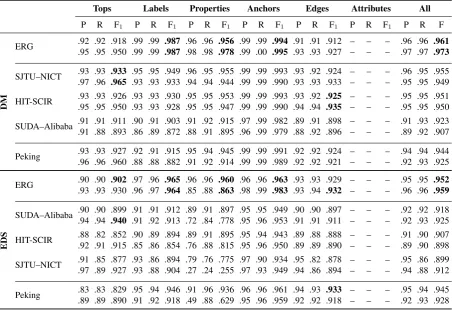
Table 1: MRP results for DM (top) and EDS (bottom), with precision (P), recall (R), and F1for different types of graph components: top nodes, node labels, other node properties, anchoring into the surface string, labeled edges, and all of these combined (neither DM nor EDS use edge attributes). Best F1scores in each category are in bold. The pair of rows per submission indicate the full MRP evaluation data vs. the 100-sentenceLittle Princesubset.
guaranteesn-best enumeration from the parse for-est in globally correct rank order. At its core, this is a specialized search procedure on a weighted and–or graph (the forest), where for packed (i.e. disjunctive) nodes local contexts of optimization are established on demand. Although worst-case complexity for both forest construction and unpack-ing is in principle exponential, parsunpack-ing times (for small values ofn) with the ERG in practice mostly grow polynomially in input length. For example, parser throughput for the sentences from the Lit-tle Princesubset of the MRP evaluation data (see Oepen et al.,2019) averages at two sentences per second, whereas average parse times for the much longer 100-sentence MRP sample of WSJ text lie around four seconds per sentence.
For parsing the MRP evaluation data, we applied ERG release 1214 with its bundled WSJ parse rank-ing model, which uses the feature configuration of Zhang et al.(2007) and was trained on Sections 00– 20 of the Redwoods Ninth Growth using the Maxi-mum Entropy estimation toolkit ofMalouf(2002). We use the LOGON distribution as of August 2019
to parse in one-best mode the ‘raw’ strings for the MRP evaluation data whose target representations were indicated as DM or EDS. The resulting HPSG derivations each uniquely determine an ERS mean-ing representation in underspecified logic, which we subsequently convert to EDS and DM.2
Given the formal nature of this process, the re-sulting graphs are guaranteed to reflect the com-position algebra of the ERG, recursively building larger fragments of meaning from smaller parts.
4 Experimental Results
Parsing accuracies for PET and the ERG are sum-marized in Table 1, for both the DM (top) and EDS (bottom) evaluation graphs. The table com-pares ERG parsing results to a selection of ‘real’ submissions to the shared task, viz. the top per-formers within each framework and for the task
2
The ERS-to-EDS converter ofOepen and Lønning(2006) is part of the LOGON distribution, as is the converter of
overall: HIT-SCIR (Che et al.,2019), Peking (Chen et al.,2019)3, SJTU–NICT (Bai and Zhao,2019), and SUDA–Alibaba (Zhang et al.,2019). In con-trast to the ERG parser, all of these systems are purelydata-driven, in the sense that they do not incorporate manually curated linguistic knowledge (beyond finite-state tokenization rules, maybe) but rather learn all their parameters exclusively from the shared task training data.
By and large, the data-driven parsers are compet-itive to the ERG, in particular the SJTU–NICT and HIT-SCIR systems for DM, and the Peking parser for EDS. For some structural types of graph com-ponents (tops and edges), the ERG is in fact out-performed by some submissions, whereas it holds at times commanding leads on node-local types of information, e.g. labels, properties, and achors. It could be argued that comparison for some of these graph components favors the ERG, seeing as it em-bodies the exact principles of deriving these values that were used in creating the Redwoods annota-tions. However, for DM at least, node labels are essentially lemmas, and it is prima facie surprising that none of the data-driven parsers succeeds very well in replicating ERG-style lemmatization.
Likewise, anchoring for EDS is a many-to-many relation between graph nodes and (arbitrary) input sub-strings, where one can speculate that at least some of the conventions used in the ERG may be linguistically idiosyncratic. Inasmuch as that may (or may not) be the case, the Peking parser shows anchoring accuracies comparable to the ERG.
TheLittle Princesubset of the evaluation data is comprised of much shorter sentences, and ob-served accuracies for some types of graph compo-nents may appear to correlate with input complex-ity, notably top node and (to a lesser) degree edge prediction. At the same time, the novelistic style of this subset most likely makes it least similar to the WSJ-derived training data for the data-driven parsers, hence some submissions can seem to suffer from detrimental cross-domain effects.
5 Reflections
As long-term co-developers of the ERG and its PET parser, we are impressed by the overall perfor-mance levels of the data-driven submissions to the MRP 2019 shared task. We hope to conduct more
3The Peking submission is not considered in the
primary ranking of the official shared task results, because the team in-advertently used tokenization training data beyond the ‘white-listed’ resources for task participants
contrastive error-analysis, possibly in collabora-tion with other parser developers, to further isolate effects of domain variation, for example, and gener-ally gauge the contributions (if any) of the explicit body of linguistic knowledge in the ERG.
References
Hongxiao Bai and Hai Zhao. 2019. SJTU at MRP 2019: A transition-based multi-task parser for cross-framework meaning representation pars-ing. In Proceedings of the Shared Task on Cross-Framework Meaning Representation Parsing at the 2019 Conference on Natural Language Learning, pages 86 – 94, Hong Kong, China.
Emily M. Bender, Dan Flickinger, Stephan Oepen, Woodley Packard, and Ann Copestake. 2015. Lay-ers of interpretation. On grammar and composition-ality. InProceedings of the 11th International Con-ference on Computational Semantics, pages 239 – 249, London, UK.
Ulrich Callmeier. 2002. Preprocessing and encoding techniques in PET. InCollaborative Language En-gineering. A Case Study in Efficient Grammar-based Processing, pages 127 – 140, Stanford, CA. CSLI Publications.
John Carroll and Stephan Oepen. 2005. High-efficiency realization for a wide-coverage unifica-tion grammar. In Proceedings of the 2nd Interna-tional Joint Conference on Natural Language Pro-cessing, pages 165 – 176, Jeju, Korea.
David Carter. 1997. The TreeBanker. A tool for super-vised training of parsed corpora. InProceedings of the Workshop on Computational Environments for Grammar Development and Linguistic Engineering, pages 9 – 15, Madrid, Spain.
Wanxiang Che, Longxu Dou, Yang Xu, Yuxuan Wang, Yijia Liu, and Ting Liu. 2019. HIT-SCIR at MRP 2019: A unified pipeline for meaning repre-sentation parsing via efficient training and effective encoding. In Proceedings of the Shared Task on Cross-Framework Meaning Representation Parsing at the 2019 Conference on Natural Language Learn-ing, pages 76 – 85, Hong Kong, China.
Yufei Chen, Yajie Ye, and Weiwei Sun. 2019. Peking at MRP 2019: Factorization- and composition-based parsing for Elementary Dependency Struc-tures. InProceedings of the Shared Task on Cross-Framework Meaning Representation Parsing at the 2019 Conference on Natural Language Learning, pages 166 – 176, Hong Kong, China.
Ann Copestake, Dan Flickinger, Carl Pollard, and Ivan A. Sag. 2005. Minimal Recursion Semantics. An introduction. Research on Language and Com-putation, 3(4):281 – 332.
Claus-Rainer Rollinger, editors,Text Understanding in LILOG, pages 74 – 87. Springer, Berlin, Germany.
Dan Flickinger. 2000. On building a more efficient grammar by exploiting types. Natural Language En-gineering, 6 (1):15 – 28.
Dan Flickinger, Emily M. Bender, and Stephan Oepen. 2014. Towards an encyclopedia of compositional se-mantics. Documenting the interface of the English Resource Grammar. In Proceedings of the 9th In-ternational Conference on Language Resources and Evaluation, pages 875 – 881, Reykjavik, Iceland.
Dan Flickinger, Stephan Oepen, and Emily M. Bender. 2017. Sustainable development and refinement of complex linguistic annotations at scale. In Hand-book of Linguistic Annotation, pages 353 – 377, Dor-drecht, The Netherlands. Springer.
Jean Mark Gawron, Jonathan King, John Lamping, Egon Loebner, E. Anne Paulson, Geoffrey K. Pul-lum, Ivan A. Sag, and Thomas Wasow. 1982. Pro-cessing English with a Generalized Phrase Struc-ture Grammar. In Proceedings of the 20th Meet-ing of the Association for Computational LMeet-inguistics, pages 74 – 81, Toronto, Canada.
Angelina Ivanova, Stephan Oepen, Lilja Øvrelid, and Dan Flickinger. 2012. Who did what to whom? A contrastive study of syntacto-semantic dependen-cies. In Proceedings of the 6th Linguistic Annota-tion Workshop, pages 2 – 11, Jeju, Republic of Ko-rea.
Mark Johnson, Stuart Geman, Stephen Canon, Zhiyi Chi, and Stefan Riezler. 1999. Estimators for stochastic ‘unification-based’ grammars. In Pro-ceedings of the 37th Meeting of the Association for Computational Linguistics, pages 535 – 541, Col-lege Park, MD, USA.
Martin Kay. 1986. Algorithm schemata and data struc-tures in syntactic processing. In In Barbara J. Grosz, Karen Sp¨arck Jones, and Bonnie Lynn Weber, ed-itors, Readings in Natural Language Processing, pages 35 – 70. Morgan Kaufmann, San Francisco, CA, USA.
Bernd Kiefer, Hans-Ulrich Krieger, John Carroll, and Robert Malouf. 1999. A bag of useful techniques for efficient and robust parsing. In Proceedings of the 37th Meeting of the Association for Computa-tional Linguistics, pages 473 – 480, College Park, MD, USA.
Jan Tore Lønning and Stephan Oepen. 2006. Re-usable tools for precision machine translation. In Proceed-ings of the COLING|ACL 2006 Interactive Presenta-tion Sessions, pages 53 – 56, Sydney, Australia.
Robert Malouf. 2002. A comparison of algorithms for maximum entropy parameter estimation. In Pro-ceedings of the 6th Conference on Natural Language Learning, pages 49 – 55, Taipei, Taiwan.
Robert Malouf, John Carroll, and Ann Copestake. 2000. Efficient feature structure operations without compi-lation. Natural Language Engineering, 6(1):29 – 46.
Mitchell Marcus, Beatrice Santorini, and Mary Ann Marcinkiewicz. 1993. Building a large annotated corpus of English. The Penn Treebank. Computa-tional Linguistics, 19:313 – 330.
Stephan Oepen, Omri Abend, Jan Hajiˇc, Daniel Her-shcovich, Marco Kuhlmann, Tim O’Gorman, Nian-wen Xue, Jayeol Chun, Milan Straka, and Zdeˇnka Ureˇsov´a. 2019. MRP 2019: Cross-framework Meaning Representation Parsing. InProceedings of the Shared Task on Cross-Framework Meaning Rep-resentation Parsing at the 2019 Conference on Nat-ural Language Learning, pages 1 – 27, Hong Kong, China.
Stephan Oepen and Ulrich Callmeier. 2000. Measure for measure: Parser cross-fertilization. Towards in-creased component comparability and exchange. In
Proceedings of the 6th International Conference on Parsing Technologies, pages 183 – 194, Trento, Italy.
Stephan Oepen and John Carroll. 2000. Ambigu-ity packing in constraint-based parsing. Practical re-sults. InProceedings of the 1st Meeting of the North American Chapter of the Association for Compu-tational Linguistics, pages 162 – 169, Seattle, WA, USA.
Stephan Oepen, Daniel Flickinger, Kristina Toutanova, and Christopher D. Manning. 2004. LinGO Red-woods. A rich and dynamic treebank for HPSG. Re-search on Language and Computation, 2(4):575 – 596.
Stephan Oepen and Jan Tore Lønning. 2006. Discriminant-based MRS banking. InProceedings of the 5th International Conference on Language Resources and Evaluation, pages 1250 – 1255, Genoa, Italy.
Carl Pollard and Ivan A. Sag. 1994. Head-Driven Phrase Structure Grammar. Studies in Contempo-rary Linguistics. The University of Chicago Press, Chicago, USA.
Hideto Tomabechi. 1995. Design of efficient unifica-tion for natural language. Journal of Natural Lan-guage Processing, 2(2):23 – 58.
Kristina Toutanova, Christopher D. Manning, Dan Flickinger, and Stephan Oepen. 2005. Stochastic HPSG Parse Disambiguation using the Redwoods Corpus. Research on Language and Computation, 3:83 – 105.
Yi Zhang, Stephan Oepen, and John Carroll. 2007. Ef-ficiency in unification-based n-best parsing. In Pro-ceedings of the 10th International Conference on Parsing Technologies, pages 48 – 59, Prague, Czech Republic.