Proceedings of the CoNLL 2018 Shared Task: Multilingual Parsing from Raw Text to Universal Dependencies, pages 238–247 238
A Morphology-based Representation Model for LSTM-based Dependency
Parsing of Agglutinative Languages
S¸aziye Bet ¨ul ¨Ozates¸∗, Arzucan ¨Ozg ¨ur∗, Tunga G ¨ung¨or∗, Balkız ¨Ozt ¨urk‡ ∗
Department of Computer Engineering ‡Department of Linguistics
Bo˘gazic¸i University Bebek, 34342 ˙Istanbul, Turkey
saziye.bilgin,arzucan.ozgur,gungort,[email protected]
Abstract
We propose two word representation mod-els for agglutinative languages that bet-ter capture the similarities between words which have similar tasks in sentences. Our models highlight the morphological features in words and embed morpho-logical information into their dense rep-resentations. We have tested our mod-els on an LSTM-based dependency parser with character-based word embeddings proposed byBallesteros et al.(2015). We participated in the CoNLL 2018 Shared Task on multilingual parsing from raw text to universal dependencies as the BOUN team. We show that our morphology-based embedding models improve the parsing performance for most of the agglu-tinative languages.
1 Introduction
This paper describes our submission to the CoNLL 2018 Shared Task (Zeman et al.,2018b) on pars-ing of Universal Dependencies (UD) (Nivre et al., 2016). We propose morphologically enhanced character-based word embeddings to improve the parsing performance especially for agglutinative languages. We apply our approach to a transition-based dependency parser by Ballesteros et al. (2015) that uses stack Long Short Term Mem-ory structures (LSTMs) to predict the parser state. This parser uses character-level word represen-tation, which has been shown to perform better for languages with rich morphology (Ballesteros et al.,2015;Dozat et al.,2017). From our exper-iment results performed on UD version 2.2 data sets (Nivre et al., 2018; Zeman et al.,2018a) we observe that including morphological information to a character-based word embedding model yields
a better learning of relationships between words and increases the parsing performance for most of the agglutinative languages with rich morphology. The rest of the paper is organized as follows: Section 2 provides a brief description of the LSTM-based dependency parser used in this study and introduces our embedding models. Section 3 gives the implementation details of our system and describes the training strategies we apply to differ-ent languages. Section 4 discusses our results on the shared task as well as the post-evaluation ex-periments and Section 5 concludes the paper.
2 Parsing Model
We use the LSTM-based parser by Ballesteros et al.(2015). It is an improved version of a state-of-the-art transition-based dependency parser pro-posed byDyer et al.(2015) and uses stack LSTM structures with push and pop operations to learn representations of the parser state. Instead of lookup-based word representations, bidirectional LSTM modules are used to create character-based encodings of words. With this character-based modelling, the authors obtain improvements on the dependency parsing of many morphologically rich languages.
2.1 Character Embeddings of Words
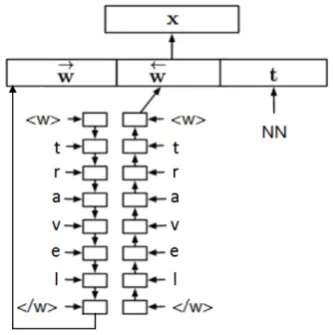
POS-tag of the word t are concatenated to pro-duce the vector representation of the word. A lin-ear mapping of POS-tag words to integers is used to create a representation of the POS tags as in (Ballesteros et al.,2015).
Figure 1: Vector represetntation of the word
travelwith the character-based embedding model in (Ballesteros et al.,2015).
2.2 Morphology-based Character Embeddings
To improve the parsing performance of the LSTM parser with character-based word embeddings mentioned in Section 2.1, we include the mor-phological information of words to the embedding model. In agglutinative languages like Turkish, a stem usually takes different suffixes and by this way, different meanings are created using a single root-word. Words that share the same suffixes tend to have similar roles in a sentence. For instance, gerunds in Turkish are a kind of derivational fixes. Verbs that take the same gerund as a suf-fix have usually the same role in sentences. Table 1 shows some statistics of verbs with gerunds in the development data set of Turkish-IMST tree-bank for demonstration purposes. The first col-umn shows some example suffixes that attach to verbs and turn them to adverbs. The second col-umn shows the number of verbs with the corre-sponding suffix in the development set. The third column shows the statistics of the dependency la-bels of these verbs. As it can be seen from the ta-ble, these suffixes help determining the role of the word they attach to. Therefore, representing each word using its corresponding lemma and suffixes separately and utilizing the morphological
infor-mation of words can improve the parsing perfor-mance in agglutinative languages.
Figure 2: Vector representation of the wordtravel
with the character-based embedding model in (Ballesteros et al.,2015).
Lemma-Suffix Model
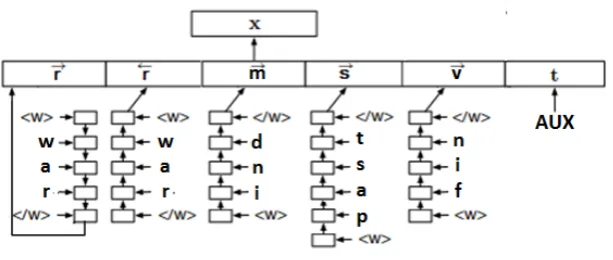
For agglutinative languages where the stem of a word does not change in different word forms, we created a model that uses lemma and suffix infor-mation of words in character-based embeddings. In this model, each word is separated to its lemma and suffixes. Then, the embedding system first reads the lemma of the word character by charac-ter from the beginning to the end and computes an embedding vector of the character sequence of the lemma which is denoted as~r. Secondly, the sys-tem reads the lemma character by character from the end to the beginning and the produced embed-ding is denoted as ←−r . A similar process is per-formed for the suffixes of the word and the pro-duced vectors are denoted as~sand←−s. These four embedding vectors and the vector representation of the POS-tag of the word t are then concate-nated to produce the vector representation of the word. POS-tag representations are created by lin-early mapping the POS-tag words to integers as in (Ballesteros et al.,2015). Vector representation of an example word using this model is depicted in Figure3.
Morphological Features Model
[image:2.595.100.266.144.311.2]fea-Suffix Number of Occurrences Dependency Label
-Ip 41 23 nmod 8 compound 5 conj 4 obj 1 root
-ArAk 32 26 nmod 3 conj 2 compound 1 root
-ken 20 18 nmod 1 conj 1 acl
-IncA 8 7 nmod 1 compound
-mAdAn 7 4 nmod 2 compound 1 obj
[image:3.595.106.478.61.134.2]-DIkc¸A 3 3 nmod
[image:3.595.168.429.183.303.2]Table 1: Number of occurrences of some example suffixes and the corresponding dependency labels of verbs with these suffixes in the development data ofTurkish-IMSTtreebank.
Figure 3: Character-based word embedding of a Turkish wordgitti(”it went”in English) using lemma-suffix embedding model.
tures of each word are embedded to the dense rep-resentations of the words. The reason behind this choice is that some morphological features have a direct impact in identifying the dependency la-bels of words. For instance, if a word has acase
feature and its value is accusative, then it is usu-ally an object of the sentence. By extracting and utilizing such morphological features, we can im-prove the parsing accuracy for languages that suit this model.
In this model, the embedding of a word is created character by character as in Section 2.1. Then, the embedding vector of each of its selected morphological features are created by reading the feature value character by character from the be-ginning to the end. Finally, these embedding vec-tors and the vector representation of the POS-tag of the word are concatenated to produce the vector representation of the word.
The vector representation of an example word using its morphological features is shown in Fig-ure4.
3 Implementation
The systems participating in the CoNLL 2018 Shared Task on UD Parsing are expected to parse raw text without any gold-standard pre-processing operations such as tokenization, lemmatization,
and morphological analysis. However, the base-line pre-processed versions of the raw text by the UDPipe system (Straka et al.,2016) are available for the participants who want to focus only on the dependency parsing task. We used the automat-ically annotated version of the corpora provided by UDPipe, since our primary aim is to observe the effect of our embedding models on the depen-dency parsing of agglutinative languages.
No morp.parser With morp.parser Word Lemma Suffix Lemma Suffix
Her her - her
-s¸eyden s¸ey den s¸ey DAn
¨once ¨once - ¨once
-sanatc¸ıydı sanat c¸ıydı sanat CHY DH
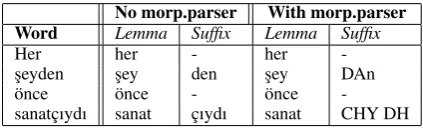
Table 2: Lemma and suffix separation example without using morphological analyzer and disam-biguator and with using morphological analyzer and disambiguator on the Turkish sentence ”Her s¸eyden ¨once sanatc¸ıydı.”(English meaning: ”She was an artist before anything else.”)
[image:3.595.312.524.512.576.2]ver-Figure 4: Character-based word embedding of a German wordwar(”was”in English) with its morpho-logical features beingM ood = Ind|N umber = Sing|P erson = 3|T ense = P ast|V erbF orm =
F inusing morphological features embedding model. The selected features for German areCase, Mood, Tense, andVerbForm. Since there is noCase feature in the morphological features ofwar, the Case
feature is represented with an empty string in the word vector ofwar.
sion of the treebank data and subtracted the lemma from the word to find the suffix information. We compared these two approaches on the Turkish-IMST treebank. For this purpose, we utilized the Turkish morphological parser and disambiguator by (Sak et al.,2008). A comparison between the two approaches is shown on an example sentence in Table2. We observed that finding the suffixes by subtracting the lemmas from the words gives the same parsing performance as using a morpho-logical analyzer tool to find the lemma and suffixes of a word. So, we opted not to use a morphological analyzer and disambiguator for the languages with the lemma-suffix embedding model due to the ad-ditional costs of these tools.
3.1 Embedding Model Selection for Different Languages
We applied the lemma-suffix model in 2.2 to Buryat, Hungarian, Kazakh, Turkish, and Uyghur languages because these languages have aggluti-native morphology, take suffixes, and the stem of a word usually does not change in different word forms. We also applied this model to Danish to observe the effect in parsing performance of a lan-guage with little inflectional morphology.
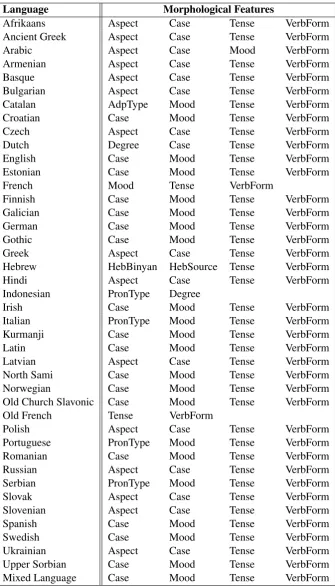
For the languages that do not follow this scheme, we applied the morphological features embedding model in2.2. Table3shows the mor-phological features selected for these languages in the shared task. We selected four morphological features from the input conll-u files for most of the languages. For French, Indonesian, and Old French, we used less than four features because
there are less than four common morphological features in the conll-u files of these languages.
For Persian, Japanese, Korean, Vietnamese, and Chinese, we used the baseline embedding model due to the lack of representative morphological features in their corresponding conll-u files.
Languages without Training Data
We trained a mixed language parser model with morphological features embedding model for the languages with no training data. For training this parser model, we used the mixed language training data supplied by the organizers of the shared task. This data is created by including the first 200 sentences of each treebank.
In the shared task, this model is applied to the Buryat-KEB, Czech-PUD, English-PUD, Faroese-OFT, Japanese-Modern, Naija-NSC, Swedish-PUD,andThai-PUDtreebanks.
We trained parser models for the Upper Sorbian-UFAL and Galician-TreeGal treebanks using the morphological features embedding model and for theBuryat-BDTtreebank using the lemma-suffix embedding model. However, we used the mixed language parser model for these treebanks in the shared task due to some software issues.
3.2 Training Specifications
[image:4.595.145.452.68.198.2]Language Morphological Features
Afrikaans Aspect Case Tense VerbForm
Ancient Greek Aspect Case Tense VerbForm
Arabic Aspect Case Mood VerbForm
Armenian Aspect Case Tense VerbForm
Basque Aspect Case Tense VerbForm
Bulgarian Aspect Case Tense VerbForm
Catalan AdpType Mood Tense VerbForm
Croatian Case Mood Tense VerbForm
Czech Aspect Case Tense VerbForm
Dutch Degree Case Tense VerbForm
English Case Mood Tense VerbForm
Estonian Case Mood Tense VerbForm
French Mood Tense VerbForm
Finnish Case Mood Tense VerbForm
Galician Case Mood Tense VerbForm
German Case Mood Tense VerbForm
Gothic Case Mood Tense VerbForm
Greek Aspect Case Tense VerbForm
Hebrew HebBinyan HebSource Tense VerbForm
Hindi Aspect Case Tense VerbForm
Indonesian PronType Degree
Irish Case Mood Tense VerbForm
Italian PronType Mood Tense VerbForm
Kurmanji Case Mood Tense VerbForm
Latin Case Mood Tense VerbForm
Latvian Aspect Case Tense VerbForm
North Sami Case Mood Tense VerbForm
Norwegian Case Mood Tense VerbForm
Old Church Slavonic Case Mood Tense VerbForm
Old French Tense VerbForm
Polish Aspect Case Tense VerbForm
Portuguese PronType Mood Tense VerbForm
Romanian Case Mood Tense VerbForm
Russian Aspect Case Tense VerbForm
Serbian PronType Mood Tense VerbForm
Slovak Aspect Case Tense VerbForm
Slovenian Aspect Case Tense VerbForm
Spanish Case Mood Tense VerbForm
Swedish Case Mood Tense VerbForm
Ukrainian Aspect Case Tense VerbForm
Upper Sorbian Case Mood Tense VerbForm
[image:5.595.125.461.101.688.2]Mixed Language Case Mood Tense VerbForm
the original character-based embedding model with our embedding models. In the lemma-suffix model, the forward word vector and the backward word vector of the lemma of a word both have 50 dimensions. The forward and backward word vec-tors of the suffix of a word also have 50 dimen-sions each. In the morphological features model, each of the forward and backward word vectors of a word have 50 dimensions. Each of the four mor-phological feature vectors have 25 dimensions. If a morphological feature is absent in a word, an embedding vector of an empty string is created for that feature. So, we increased the dimension of the character-based representations to 200 in total.
The original parser is not compatible with UD parsing. We adapted it to be able to take input and produce output in conll-u for-mat. The source code of our modified version of the LSTM-based parser by Ballesteros et al. (2015) can be found at https://github. com/CoNLL-UD-2018/BOUN.
A full run over the 82 test sets takes about 3 hours when no pre-trained embeddings are used, and 20 hours when the CoNLL-17 pre-trained word embeddings from (Ginter et al., 2017) are used on the TIRA virtual machine (Potthast et al., 2014). The largest of the test sets needs 4 GB memory without pre-trained word vectors. When the CoNLL-17 pre-trained vectors are used, mem-ory usage can reach to 32 GB depending on the pre-trained vector sizes.
4 Results
This section presents the parsing performance of our parser models on the CoNLL-18 Shared Task as well as the post-evaluation scores of our mod-els.
4.1 Shared Task
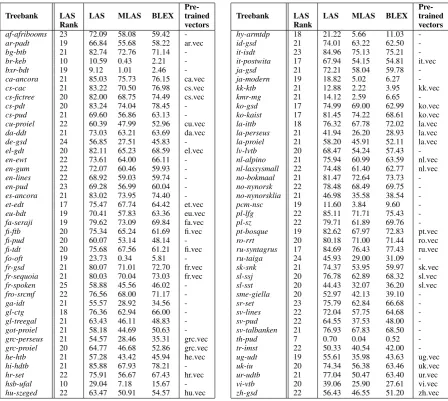
Table 4 shows our official LAS, MLAS, and BLEX results in the CoNLL-18 Shared Task. The models that use the CoNLL-17 pre-trained word embeddings from (Ginter et al., 2017) are indicated in pre-trained vectors column. We also trained parser models using pre-trained word embeddings forCzech-PDT, German-GSD, English-EWT, English-GUM, English-LinES, Spanish-AnCora, Indonesian-GSD, Latvian-LVTB, Swedish-LinES, Swedish-Talbanken, and
Turkish-IMST. However, we could not run these models with their corresponding embedding files
inside the TIRA virtual machine due to some unknown memory and disk issues.
Although the parser we used does not obtain competitive performance when compared with the best performing systems in the shared task, it achieves better performance on the treebanks with no training data when compared to its performance on treebanks with training data. We exclude the parallel UD treebanks from this judgment because one can get better performance on parallel UD treebanks by training the parser using the train-ing data of the treebanks that have the same lan-guage with the parallel UD treebanks (e.g., the training data of English-EWT for English-PUD,
Czech-PDT for Czech-PUD etc.). Due to time-constraints, we did not focus on the parallel UD treebanks and treated them as unknown languages.
4.2 Post-Evaluation
We performed another set of experiments using our models on the test data of UD version 2.2 data sets. The purpose of these experiments is to inves-tigate the effect of our embedding models on pars-ing performance. Here we used the gold-standard conll-u files instead of the automatically annotated corpora by UDPipe, since our aim in these exper-iments is to observe the performance difference between our embedding models and the baseline embedding model.
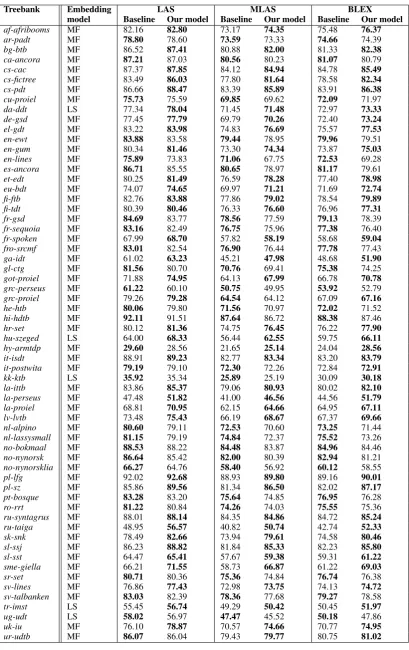
In Table 5, we compare our models with the baseline model proposed in (Ballesteros et al., 2015). Due to time constraints, we trained all models without pre-trained word embeddings.
From the comparative results shown in Table 5, we observe that on the languages that have rich inflectional and derivational processes mostly by adding suffixes to words, our morphological features model outperforms the baseline model in terms of parsing scores. This is the case for the Bulgarian, Croatian, Czech, Basque, Gothic, Latin, Polish, Russian, Slovak, Slovene, North Sami, and Ukrainian languages.
Pre-Treebank LAS LAS MLAS BLEX trained
Rank vectors
af-afribooms 23 72.09 58.08 59.42
-ar-padt 19 66.84 55.68 58.22 ar.vec
bg-btb 21 82.74 72.76 71.14
-br-keb 10 10.59 0.43 2.21
-bxr-bdt 19 9.12 1.01 2.46
-ca-ancora 21 85.03 75.73 76.15 ca.vec
cs-cac 21 83.22 70.50 76.98 cs.vec
cs-fictree 20 82.00 68.75 74.49 cs.vec
cs-pdt 20 83.24 74.04 78.45
-cs-pud 21 69.60 56.86 63.13
-cu-proiel 22 60.39 47.99 52.96 cu.vec
da-ddt 21 73.03 63.21 63.69 da.vec
de-gsd 24 56.85 27.51 45.83
-el-gdt 20 82.11 65.23 68.59 el.vec
en-ewt 22 73.61 64.00 66.11
-en-gum 22 72.07 60.46 59.93
-en-lines 22 68.92 59.03 59.74
-en-pud 23 69.28 56.99 60.04
-es-ancora 21 83.02 73.95 74.40
-et-edt 17 75.47 67.74 64.42 et.vec
eu-bdt 19 70.41 57.83 63.36 eu.vec
fa-seraji 19 79.62 73.09 69.84 fa.vec
fi-ftb 20 75.34 65.24 61.69 fi.vec
fi-pud 20 60.07 53.14 48.14
-fi-tdt 20 75.68 67.56 61.21 fi.vec
fo-oft 19 23.73 0.34 5.81
-fr-gsd 21 80.07 71.01 72.70 fr.vec
fr-sequoia 21 80.03 70.04 73.03 fr.vec
fr-spoken 25 58.88 45.56 46.02
-fro-srcmf 22 76.56 68.00 71.17
-ga-idt 21 55.57 28.92 34.56
-gl-ctg 18 76.36 62.94 66.00
-gl-treegal 21 63.43 46.11 48.83
-got-proiel 21 58.18 44.69 50.63
-grc-perseus 21 54.57 28.46 35.31 grc.vec
grc-proiel 20 64.77 46.68 52.86 grc.vec
he-htb 21 57.28 43.42 45.94 he.vec
hi-hdtb 21 85.88 67.93 78.21
-hr-set 22 75.91 56.67 67.43 hr.vec
hsb-ufal 10 29.04 7.18 15.67
-hu-szeged 22 63.47 50.91 54.57 hu.vec
Pre-Treebank LAS LAS MLAS BLEX trained
Rank vectors
hy-armtdp 18 21.22 5.66 11.03
-id-gsd 21 74.01 63.22 62.50
-it-isdt 23 84.96 75.13 75.21
-it-postwita 17 67.94 54.15 54.81 it.vec
ja-gsd 21 72.21 58.04 59.78
-ja-modern 19 18.82 5.02 6.27
-kk-ktb 21 12.88 2.22 3.95 kk.vec
kmr-mg 21 14.12 2.59 6.65
-ko-gsd 17 74.99 69.00 62.99 ko.vec
ko-kaist 17 81.45 74.22 68.61 ko.vec
la-ittb 18 76.32 67.78 72.02 la.vec
la-perseus 21 41.94 26.20 28.93 la.vec
la-proiel 21 58.20 45.91 52.11 la.vec
lv-lvtb 20 68.47 54.24 57.43
-nl-alpino 21 75.94 60.99 63.59 nl.vec
nl-lassysmall 22 74.48 61.40 62.77 nl.vec
no-bokmaal 21 81.47 72.64 73.73
-no-nynorsk 22 78.48 68.49 69.75
-no-nynorsklia 21 46.98 35.58 38.54
-pcm-nsc 19 11.60 3.84 9.60
-pl-lfg 22 85.11 71.71 75.43
-pl-sz 22 79.71 61.89 69.76
-pt-bosque 19 82.62 67.97 72.83 pt.vec
ro-rrt 20 80.18 71.00 71.44 ro.vec
ru-syntagrus 17 84.69 76.43 77.43 ru.vec
ru-taiga 24 45.93 29.00 31.09
-sk-snk 21 74.37 53.95 59.97 sk.vec
sl-ssj 20 76.78 62.89 68.32 sl.vec
sl-sst 20 44.43 32.07 36.20 sl.vec
sme-giella 20 52.97 42.13 39.10
-sr-set 23 75.79 62.84 66.68
-sv-lines 22 72.04 57.75 64.68
-sv-pud 22 64.55 37.53 48.00
-sv-talbanken 21 76.93 67.83 68.50
-th-pud 7 0.70 0.04 0.52
-tr-imst 22 50.33 40.54 42.00
-ug-udt 19 55.61 35.98 43.63 ug.vec
uk-iu 20 74.34 56.38 63.46 uk.vec
ur-udtb 21 77.04 50.47 63.40 ur.vec
vi-vtb 20 39.06 25.90 27.61 vi.vec
[image:7.595.80.529.200.601.2]zh-gsd 22 56.43 46.55 51.20 zh.vec
Treebank Embedding LAS MLAS BLEX model Baseline Our model Baseline Our model Baseline Our model
af-afribooms MF 82.16 82.80 73.17 74.35 75.48 76.37
ar-padt MF 78.80 78.60 73.59 73.33 74.66 74.39 bg-btb MF 86.52 87.41 80.88 82.00 81.33 82.38
ca-ancora MF 87.21 87.03 80.56 80.23 81.07 80.79 cs-cac MF 87.37 87.85 84.12 84.94 84.78 85.49
cs-fictree MF 83.49 86.03 77.80 81.64 78.58 82.34
cs-pdt MF 86.66 88.47 83.39 85.89 83.91 86.38
cu-proiel MF 75.73 75.59 69.85 69.62 72.09 71.97 da-ddt LS 77.34 78.04 71.45 71.48 72.97 73.33
de-gsd MF 77.45 77.79 69.79 70.26 72.40 73.24
el-gdt MF 83.22 83.98 74.83 76.69 75.57 77.53
en-ewt MF 83.88 83.58 79.44 78.95 79.96 79.51 en-gum MF 80.34 81.46 73.30 74.34 73.87 75.03
en-lines MF 75.89 73.83 71.06 67.75 72.53 69.28 es-ancora MF 86.71 85.55 80.65 78.97 81.17 79.61 et-edt MF 80.25 81.49 76.59 78.28 77.40 78.98
eu-bdt MF 74.07 74.65 69.97 71.21 71.69 72.74
fi-ftb MF 82.76 83.88 77.86 79.02 78.54 79.89
fi-tdt MF 80.39 80.46 76.33 76.60 76.96 77.31
fr-gsd MF 84.69 83.77 78.56 77.59 79.13 78.39 fr-sequoia MF 83.16 82.49 76.75 75.96 77.38 76.40 fr-spoken MF 67.99 68.70 57.82 58.19 58.68 59.04
fro-srcmf MF 83.01 82.54 76.90 76.44 77.78 77.43 ga-idt MF 61.02 63.23 45.21 47.98 48.68 51.90
gl-ctg MF 81.56 80.70 70.76 69.41 75.38 74.25 got-proiel MF 71.88 74.95 64.13 67.99 66.78 70.78
grc-perseus MF 61.22 60.10 50.75 49.95 53.92 52.79 grc-proiel MF 79.26 79.28 64.54 64.12 67.09 67.16
he-htb MF 80.06 79.80 71.56 70.97 72.02 71.52 hi-hdtb MF 92.11 91.51 87.64 86.72 88.38 87.46 hr-set MF 80.12 81.36 74.75 76.45 76.22 77.90
hu-szeged LS 64.00 68.33 56.44 62.55 59.75 66.11
hy-armtdp MF 29.60 28.56 21.65 25.14 24.04 28.56
it-isdt MF 88.91 89.23 82.77 83.34 83.20 83.79
it-postwita MF 79.19 79.10 72.30 72.26 72.84 72.91
kk-ktb LS 35.92 35.34 25.89 25.19 30.09 30.18
la-ittb MF 83.86 85.37 79.06 80.93 80.02 82.10
la-perseus MF 47.48 51.82 41.00 46.56 44.56 51.79
la-proiel MF 68.81 70.95 62.15 64.66 64.95 67.11
lv-lvtb MF 73.48 75.43 66.19 68.67 67.37 69.66
nl-alpino MF 80.60 79.11 72.53 70.60 73.25 71.44 nl-lassysmall MF 81.15 79.19 74.84 72.37 75.52 73.26 no-bokmaal MF 88.53 88.22 84.48 83.87 84.96 84.46 no-nynorsk MF 86.64 85.42 82.00 80.39 82.94 81.21 no-nynorsklia MF 66.27 64.76 58.40 56.92 60.12 58.55 pl-lfg MF 92.02 92.68 88.93 89.80 89.16 90.01
pl-sz MF 85.86 89.56 81.34 86.50 82.02 87.17
pt-bosque MF 83.28 83.20 75.64 74.85 76.95 76.28 ro-rrt MF 81.22 80.84 74.26 74.03 75.55 75.36 ru-syntagrus MF 88.01 88.14 84.35 84.86 84.72 85.24
ru-taiga MF 48.95 56.57 40.82 50.74 42.74 52.33
sk-snk MF 78.49 82.66 73.94 79.61 74.58 80.46
sl-ssj MF 86.23 88.82 81.84 85.33 82.23 85.80
sl-sst MF 64.47 65.41 57.67 59.38 59.31 61.22
sme-giella MF 66.21 71.55 58.73 66.87 61.22 69.03
sr-set MF 80.71 80.36 75.36 74.84 76.74 76.38 sv-lines MF 76.86 77.43 72.98 73.75 74.13 74.72
sv-talbanken MF 83.03 82.39 78.36 77.68 79.27 78.58 tr-imst LS 55.45 56.74 49.29 50.42 50.45 51.97
ug-udt LS 58.02 56.97 47.47 45.52 50.18 47.86 uk-iu MF 76.10 78.87 70.57 74.66 70.77 74.95
[image:8.595.94.504.58.709.2]ur-udtb MF 86.07 86.04 79.43 79.77 80.75 81.02
Singular Plural Singular Plural
[image:9.595.162.437.62.115.2]Nominative ember ember-ek adam adam-lar Accusative ember-et ember-ek-et adam-ı adam-lar-ı Dative ember-nek ember-ek-nek adam-a adam-lar-a Locative ember-ben ember-ek-ben adam-da adam-lar-da
Table 6: Word-morpheme structure on the Hungarian wordemberand the Turkish wordadam(English meaning:man).
Treebank Number Embedding LAS MLAS BLEX of words dimension
tr-imstwithout pre-trained embeddings - - 56.74 50.42 51.97 tr-imstwith CoNLL-17 ud-word-embeddings 3,633,786 100 59.11 53.02 54.51 tr-imstwith Facebook word-embeddings 416,051 300 59.69 53.56 54.98
Table 7: The effect of using pre-trained word embeddings on parsing performance on Turkish-IMST test data set.
an independent word. English, Hebrew, Hindi and Urdu languages are also categorized as mostly an-alytic languages which do not use inflections and have a low morpheme-per-word ratio (Moravcsik, 2013). Dutch, Norwegian, and Swedish languages have a very simplified inflectional grammar. So, these languages are not represented well using our morphology-based embedding models. Be-sides, our model is not the best choice for the lan-guages that have high ratio of morphophonologi-cal modifications to the root word like Old Church Slavonic.
The lemma-suffix embedding model is applied to the Danish, Hungarian, Kazakh, Turkish, and Uyghur languages. The best performance is reached in the Hungarian language with more than 4% increase in LAS score. Our model outper-forms the baseline in Turkish too. These lan-guages are highly agglutinative lanlan-guages where words may consist of several morphemes and the boundaries between morphemes are clearcut. In this type of languages, there is a one-to-one form-meaning correspondence and shape of a mor-pheme is invariant (Moravcsik,2013). An exam-ple word-morpheme relationship in Hungarian and Turkish languages is shown in Table6. As it can be seen from the table, this structure is very suit-able to the lemma-suffix embedding model.
However, the lemma-suffix model fails to reach better performance than the baseline system on the Kazakh and Uyghur treebanks. A possible reason might be that our embedding model increases the complexity of the system unnecessarily for these languages with very little training data. Although Danish can be considered as an analytic language with a simplified inflectional grammar, the lemma-suffix model outperforms the baseline for this
lan-guage.
Table 7shows the parsing scores of the parser with lemma-suffix embedding model on the test data of Turkish-IMST treebank version 2.2. We compared the parsing performances when the parser does not use pre-trained word embed-dings, when it uses pre-trained embeddings from CoNLL-17 UD word embeddings, and when it uses pre-trained embeddings from word vectors trained on Wikipedia by Facebook (Bojanowski et al., 2017). From the results, we observe that the usage of pre-trained word vectors increases the parsing performance by great extent for Turk-ish. We also observe that Facebook word vectors outperform the CoNLL-17 UD word vectors, al-though the number of words in the Facebook vec-tors data set is much smaller than the number of words in the CoNLL-17 UD word vectors data set.
5 Conclusion
We introduced two morphology-based adaptations of the character-based word embedding model in (Ballesteros et al., 2015) and experimented with these models on the UD version 2.2 data set. The experiment results suggest that our models utilizing morphological information of words in-creases the parsing performance in agglutinative languages.
Acknowledgments
References
Miguel Ballesteros, Chris Dyer, and Noah A. Smith. 2015. Improved transition-based parsing by mod-eling characters instead of words with lstms. In
Proceedings of the 2015 Conference on Empirical Methods in Natural Language Processing. Associa-tion for ComputaAssocia-tional Linguistics, pages 349–359. https://doi.org/10.18653/v1/D15-1041.
Piotr Bojanowski, Edouard Grave, Armand Joulin, and Tomas Mikolov. 2017. Enriching word vectors with subword information. Transactions of the Asso-ciation for Computational Linguistics 5:135–146. http://aclweb.org/anthology/Q17-1010.
Timothy Dozat, Peng Qi, and Christopher D. Manning. 2017. Stanford’s graph-based neural dependency parser at the conll 2017 shared task. InProceedings of the CoNLL 2017 Shared Task: Multilingual Pars-ing from Raw Text to Universal Dependencies. Asso-ciation for Computational Linguistics, pages 20–30. https://doi.org/10.18653/v1/K17-3002.
Chris Dyer, Miguel Ballesteros, Wang Ling, Austin Matthews, and Noah A. Smith. 2015. Transition-based dependency parsing with stack long short-term memory. InProceedings of the 53rd Annual Meeting of the Association for Computational Lin-guistics and the 7th International Joint Conference on Natural Language Processing (Volume 1: Long Papers). Association for Computational Linguistics, pages 334–343. https://doi.org/10.3115/v1/P15-1033.
Filip Ginter, Jan Hajiˇc, Juhani Luotolahti, Milan Straka, and Daniel Zeman. 2017. CoNLL 2017 shared task - automatically annotated raw texts and word embeddings. LINDAT/CLARIN digital li-brary at the Institute of Formal and Applied Linguis-tics ( ´UFAL), Faculty of Mathematics and Physics, Charles University. http://hdl.handle.net/11234/1-1989.
E.A. Moravcsik. 2013. Introducing Language Typology. Cambridge introductions to lan-guage and linguistics. Cambridge University Press. https://books.google.com.tr/books?id=9sdanQAACAAJ.
Joakim Nivre, Marie-Catherine de Marneffe, Filip Gin-ter, Yoav Goldberg, Jan Hajiˇc, Christopher Man-ning, Ryan McDonald, Slav Petrov, Sampo Pyysalo, Natalia Silveira, Reut Tsarfaty, and Daniel Zeman. 2016. Universal Dependencies v1: A multilingual treebank collection. InProceedings of the 10th In-ternational Conference on Language Resources and Evaluation (LREC 2016). European Language Re-sources Association, Portoro, Slovenia, pages 1659– 1666.
Joakim Nivre et al. 2018. Universal Dependen-cies 2.2. LINDAT/CLARIN digital library at the Institute of Formal and Applied Lin-guistics, Charles University, Prague, http:
//hdl.handle.net/11234/1-1983xxx.
http://hdl.handle.net/11234/1-1983xxx.
Martin Potthast, Tim Gollub, Francisco Rangel, Paolo Rosso, Efstathios Stamatatos, and Benno Stein. 2014. Improving the reproducibility of PAN’s shared tasks: Plagiarism detection, author iden-tification, and author profiling. In Evangelos Kanoulas, Mihai Lupu, Paul Clough, Mark Sander-son, Mark Hall, Allan Hanbury, and Elaine Toms, editors, Information Access Evaluation meets Mul-tilinguality, Multimodality, and Visualization. 5th International Conference of the CLEF Initiative (CLEF 14). Springer, Berlin Heidelberg New York, pages 268–299. https://doi.org/10.1007/978-3-319-11382-1 22.
Has¸im Sak, Tunga G¨ung¨or, and Murat Sarac¸lar. 2008. Turkish language resources: Morphological parser, morphological disambiguator and web corpus. In
Advances in natural language processing, Springer, pages 417–427.
Milan Straka, Jan Hajiˇc, and Jana Strakov´a. 2016. UD-Pipe: trainable pipeline for processing CoNLL-U files performing tokenization, morphological anal-ysis, POS tagging and parsing. In Proceedings of the 10th International Conference on Language Resources and Evaluation (LREC 2016). European Language Resources Association, Portoro, Slovenia.
Dan Zeman et al. 2018a. Universal Dependencies 2.2 CoNLL 2018 shared task development and test data. LINDAT/CLARIN digital library at the Insti-tute of Formal and Applied Linguistics, Charles Uni-versity, Prague, http://hdl.handle.net/ 11234/1-2184. http://hdl.handle.net/11234/1-2184.