Sludge Management in Industries - A Perspective
Gauri Pardhi
1, Savita Moundekar
2, Shilpa Bhajani
3, V.P. Thergaonkar
41, 2ENV. Chemist, ETC, 3Trainee on deputation 4 Retd.Scientist, NEERI, Nagpur & Technical Head
Abstract: Regular analyses for characterization of sludge samples from effluent/sewage treatment plants in a few industries viz. automobile / tractor unit, synthetic/man- made fibre unit, cotton textile unit, steel processing/cold rolling mill, hard board/ packing production unit, paper mill prompted this in House R & D unit to investigate into possibility of alternate and appropriate method of sludge management suitable for environmental setting of these industries.
A few projects on sludge management from these units were assigned to students of M. Tech. (Env Engg.) from G.H. Raisoni College of Engg., Nagpur. Joint investigations have indicated more compatible sludge management system than the one being adapted at these industries e.g. i) phosphoric sludge by composting along with biological sludge from ETP at the automobile unit, ii) composting starch sludge from hard board packaging unit along with soil/cow dung, ii) pyrolysis of paint sludge in the automobile unit and probable recovery of organic chemicals like xylene, benzene etc. and iii) recovery of lignin from small scale paper mills using paddy husk/baggasse etc. for pulp production and use of recovered lignin for use as binder material.
I. INTRODUCTION
Enviro Techno Consult, Nagpur, a DST/DSIR recognized “In House R&D unit since 1993, has been associated with various industries in and around Nagpur. One of the reasons of this recognition is to help industries in their environment – related problems since each industry is unique and is required to be treated independently for its waste management. Enviro Techno Consult is also associated with G.H. Raisoni College of Engineering (Env. Engg.).
This college deputes two or three M. Tech. (Env. Engg.) students for one year for training and for dissertation on any environment- related subjects as a part of the curriculum. Hence, Enviro Techno Consult, has been able to depute these students on “real life” field problems related to projects in its scope of work. This practice has helped many students to get better jobs at the beginning of their service carriers.
Industries with which ETC has been associated in the recent past include i) automobile/tractor unit , ii) synthetic/man- made fibre unit, iii) cotton textile unit, iv) steel processing/cold rolling mill, v) hard board/ packing production unit, vi) paper mill etc. These industries have to operate under prevailing environment–related Environment Protection Act, Water Act, Air Act, Hazardous waste management rules.
Most industries generate wastewater, gaseous emissions, solid wastes etc. Effluent treatment plants (ETP) have been installed in the industries mentioned above. Majority of ETPs are based on aerobic biological techniques viz. activated sludge systems. Such systems invariably generate sludge (primary & or secondary) which is usually dried over sludge drying beds as a part of ETP design. ETP sludge has been legally categorized as “hazardous” and has to be disposed as per notification by MPCB1. Most
industries have requested this laboratory to routinely analyze sludge samples from the effluent/sewage treatment plants. Presently, most industries transport the sludge to the common facility for disposal of “hazardous wastes”. Commonly practiced method of sewage/biological sludge management is by its anaerobic digestion and to recover methane.
II. PURPOSE OF PAPER
An over view of industry-wise i) origin of sludge, ii) sludge characteristics has been collated in this paper. Predominant ingredient in each sludge type was identified. Other methods of sludge treatment depending on its characteristics which were tried in the laboratory and findings have been included in this paper. Present paper includes industry-wise average characteristics of sludge samples from automobile/tractor unit, synthetic/man- made fibre units, cotton textile units, steel processing/cold rolling mill, hard board/ packing production unit and paper mill. Valorization of sludge wherever possible has been indicated.
III. APPROACH
Table 1: Sludge category
S. No Industry Source of sludge Category
1 Cotton mill ETP Biological
2 Synthetic fibre plant ETP Biological
3 Steel processing Pickling,
ETP
Inorganic/acidic Inorganic
4 Hard board/ packaging unit de-inking
starch/ packaging
Coloured, scum starchy
5 Paper mill
waste paper as raw material
ETP Biological /cellulosic
6 Fruit processing ETP Biological
7 Automobile Paint shop
Phosphoric
ETP
Sewage treatment plant
Synthetic/coloured
pretreatment of parts to be painted
[image:2.595.41.548.109.339.2]Biological Biological
[image:2.595.44.559.385.546.2]Table 2 includes industry -wise manufacturing processes generating waste water which is being treated in the respective ETP.
Table 2 : Processes in industries
Name of Industry Processes involved
Cotton mill A Cotton fibre processing - bleaching, spinning, weaving mercerizing, dyeing
Cotton mill B Weaving, mercerizing, dyeing etc.
Synthetic fibre PTA, polymerization and spinning.
Steel processing Pickling of H.R. sheets in hydrochloric acid, washing, rolling, colour-coating, etc.
Packaging Unit Conversion of paper into packing hard paper board sheets and printing.
Fruit processing unit Freeze drying of fruits and packing of fruit powder.
Automobile Assembly of vehicles, their washing, drying, phosphate treatment before painting.
Composite paper mill Raw material is bagasse, bamboos, trees, paddy husk etc. These mills segregate
cellulosic contents of for pulp for paper making by using strong alkalis during which lignin is dissolved and black liquor containing lignin is generated.
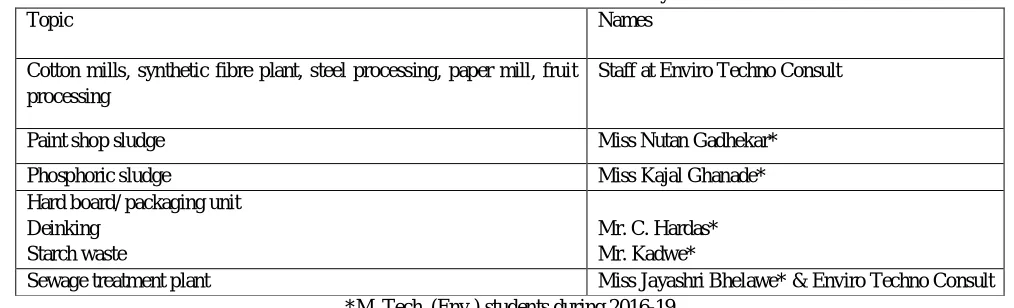
[image:2.595.43.550.585.739.2]Table 3 includes the names of persons those who have characterized and worked on these samples.
Table 3 : Personnel involved in the study
Topic Names
Cotton mills, synthetic fibre plant, steel processing, paper mill, fruit processing
Staff at Enviro Techno Consult
Paint shop sludge Miss Nutan Gadhekar*
Phosphoric sludge Miss Kajal Ghanade*
Hard board/ packaging unit Deinking
Starch waste
Mr. C. Hardas* Mr. Kadwe*
IV. FINDINGS AND RESULTS
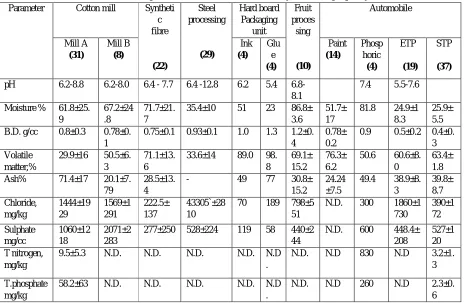
[image:3.595.68.532.166.469.2]Averages of chemical characteristics of sludge samples from individual industries are given in Table 4 along with standard deviations wherever sufficient number of analyses were available.
Table 3: Averages & standard deviation of industry-wise sludge quality
Parameter Cotton mill Syntheti
c fibre (22) Steel processing (29) Hard board Packaging unit Fruit proces sing (10) Automobile Mill A (31) Mill B (8) Ink (4) Glu e (4) Paint (14) Phosp horic (4) ETP (19) STP (37)
pH 6.2-8.8 6.2-8.0 6.4 - 7.7 6.4 -12.8 6.2 5.4
6.8-8.1
7.4 5.5-7.6
Moisture % 61.8±25.
9
67.2±24 .8
71.7±21. 7
35.4±10 51 23 86.8±
3.6
51.7± 17
81.8 24.9±1
8.3
25.9± 5.5
B.D. g/cc 0.8±0.3 0.78±0.
1
0.75±0.1 0.93±0.1 1.0 1.3 1.2±0.
4
0.78± 0.2
0.9 0.5±0.2 0.4±0.
3 Volatile
matter,%
29.9±16 50.5±6.
3
71.1±13. 6
33.6±14 89.0 98. 8
69.1± 15.2
76.3± 6.2
50.6 60.6±8.
0
63.4± 1.8
Ash% 71.4±17 20.1±7.
79
28.5±13. 4
- 49 77 30.8±
15.2
24.24 ±7.5
49.4 38.9±8.
3 39.8± 8.7 Chloride, mg/kg 1444±19 29 1569±1 291 222.5± 137 43305`±28 10
70 189 798±5
51
N.D. 300 1860±1
730 390±1 72 Sulphate mg/cc 1060±12 18 2071±2 283
277±250 528±224 119 58 440±2
44
N.D. 600 448.4±
208
527±1 20 T nitrogen,
mg/kg
9.5±5.3 N.D. N.D. N.D. N.D. N.D
.
N.D. N.D 830 N.D 3.2±1.
3
T.phosphate mg/kg
58.2±63 N.D. N.D. N.D. N.D. N.D
.
N.D. N.D 260 N.D 2.3±0.
6
N.B. i) Number in parenthesis contains is of samples analysed; ii) Heavy metals ( Cr, Cd, Cu, Pb, Ni, Zn) were estimated in steel processing, paint sludge, phosphoric sludge and ,ETP for the automobile plant.
V. DISCUSSION
Main sources of sludge were effluent treatment plants (ETP) and sewage treatment plants (STP) in the industries under study viz. synthetic/ man- made fibre units, cotton textile units, steel processing/cold rolling mill, hard board/ packing production unit and paper mill. But, in the automobile industry sludge is also generated during manufacturing processes e.g. i) phosphoric sludge is generated during treatment of parts to be painted, ii) paint sludge is generated in paint booths in the washed water. Present sludge management systems, in vogue in these industries are included in Table 4.
Table 4 : Present sludge management in industries:
Industry & type of sludge Predominant parameter/s in sludge Disposal practice in vogue
Textile –cotton & synthetic fibre Moisture & organic matter Land disposal
Steel processing Chloride Stored in premises
Hard board/ packaging Organic matter Land disposal
Fruit processing Moisture & organic matter Land disposal
Sewage treatment plants Moisture & organic matter Land disposal
Automobile unit Paint sludge Phosphoric
Volatile matter, moisture
Phosphate, nitrogen, organic matter
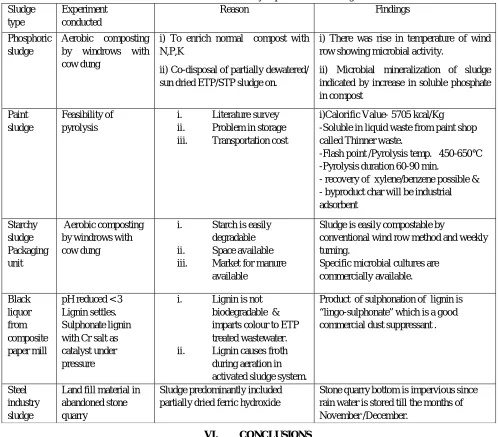
[image:3.595.31.565.594.734.2]Laboratory scale experiments were jointly conducted by the students cited earlier and the staff of Enviro Techno Consult on i) paint sludge, ii) phosphoric sludge and iii) the starch-rich sludge from hard board packaging unit. Table 5 includes an abstract of what was experimented with a few sludge samples in the laboratory and of observations on findings. Details of experiments are available 2-5.
Table 5 : Abstract of laboratory experiments & findings Sludge
type
Experiment conducted
Reason Findings
Phosphoric sludge
Aerobic composting by windrows with cow dung
i) To enrich normal compost with N,P,K
ii) Co-disposal of partially dewatered/ sun dried ETP/STP sludge on.
i) There was rise in temperature of wind row showing microbial activity.
ii) Microbial mineralization of sludge indicated by increase in soluble phosphate in compost
Paint sludge
Feasibility of pyrolysis
i. Literature survey
ii. Problem in storage
iii. Transportation cost
i)Calorific Value- 5705 kcal/Kg -Soluble in liquid waste from paint shop called Thinner waste.
-Flash point /Pyrolysis temp. 450-650°C -Pyrolysis duration 60-90 min.
- recovery of xylene/benzene possible & - byproduct char will be industrial adsorbent
Starchy sludge Packaging unit
Aerobic composting by windrows with cow dung
i. Starch is easily
degradable
ii. Space available
iii. Market for manure
available
Sludge is easily compostable by
conventional wind row method and weekly turning.
Specific microbial cultures are commercially available.
Black liquor from composite paper mill
pH reduced < 3 Lignin settles. Sulphonate lignin with Cr salt as catalyst under pressure
i. Lignin is not
biodegradable & imparts colour to ETP treated wastewater.
ii. Lignin causes froth
during aeration in activated sludge system.
Product of sulphonation of lignin is “lingo-sulphonate” which is a good commercial dust suppressant .
Steel industry sludge
Land fill material in abandoned stone quarry
Sludge predominantly included partially dried ferric hydroxide
Stone quarry bottom is impervious since rain water is stored till the months of November /December.
VI. CONCLUSIONS
Following conclusions can be drawn on basis a) studies conducted and b) characteristics of sludge samples and in the interest of industry.
A. Phosphoric Sludge From Automobile Unit
1) It should be sundried over the existing filter beds at STP/ETP.
2) Mixed sludge can be composted in windrows of 1m3 capacity each, height being 0.5 m.
3) Windrows to be turned over every 10th day & treated effluent to be used to maintain moisture
B. Packaging Unit Starch Sludge
C. Paint Sludge
Pyrolysis of sludge is feasible. A pilot pyrolysis unit with following configuration can be considered which will help in assessment of quantities of i) recovered chemical, ii) by product char, iii) method of heating micro wave or conventional and iv) optimization of pyrolysis process –duration and temperature
D. Lignin Problem In Small Scale Paper Mills
Small paper mills produce pulp out of paddy husk, bagasse and other cellulosic material. They do not separate lignin. They hold wastewater in lagoons which are emptied in rainy seasons. Pilot scale studies mentioned below can be useful. They can acidify a part of their wastewater to remove lignin at pH less than 4.0 allow the acid treated wastewater to settle in properly designed tanks. Precipitated lignin can be dried. It can contain chemicals like sweet -smelling vanillin. It can be used for manufacture of lingo-sulphonate or as binding material for scented sticks.
E. Steel Industry Sludge
Steel industry sludge if used for restoring the mine pit would not allow leachate to percolate. EIA of for small back filling project at Hingna industrial area an experimental has been carried out without any adverse impact.
REFERENCES
[1] MPCB - The hazardous Wastes (Management & Handling) Rules, 1989 (as amended, May 2003) [2] Anupama B.S.- Soil/solid waste analysis CPCB, Bangaluru
[3] Hardas C.G.et.al. –IJSART - Volume 5 Issue 4 –APRIL 2019 ISSN [ONLINE]: 2395-1052 Page | 1060 www.ijsart.com Treatment of Ink Wastewater From Cardboard Printing Industry.
[4] Kadwe B.A. – Dissertation -Treatability of starch wastewater from an industry.