Advance Bandwidth Distribution Concept Using
Artificial Intelligence
Abhishek Singh1, Shantanu Choudhary2, Shalinee Pareek3, Nisha Choudhary4
1
Assistant Professor (M. Tech CSE)
2
ERP Manager (M. Tech CSE)
3
Teaching Associate
4
MCA Student (Sangam University)
Abstract: In a network domain which is connected to the Internet along multiple edge routers to ISP’s, the consumers are categorized into groups where one edge router is connected to each group. Each edge link of the network domain has allocated a specified amount of bandwidth that is dispensed by the ISP. The network domain is classified into the different brackets of consumers and the bandwidth is dispensed to each bracket at a uniform scale.
If one bracket of consumers of network domains consumed the whole bandwidth and get overhead and at another bracket the bandwidth is vacant. In this paper, we try to provide an appropriate method for this problem by balancing the utilization of bandwidth dynamically. At the router side, there is inspected the consumption of bandwidth by different brackets and perform the transformation of bandwidth from underutilizing to over utilizing bracket. This method is proposed an efficient utilization of bandwidth and load balances in intradomain
Keywords: Load balancing, bandwidth optimization, network domain.
I. INTRODUCTION
Load balancing method normally distributes workload across multiple resources [1]. Link aggregate, a common solution of link load balancing aggregates multiple physical links to a virtual logical link to transmit workload. A stub network is a computer network with no knowledge of other networks.
A stub autonomous system is one that is connected to only one other autonomous system, through which it gains access to the Internet. A person, or workgroup, who has connected to an ISP, by only one router, is a stub network with respect to the ISP.
This stub network is part of the ISP’s autonomous system. In a stub network which is connected to the Internet via more than one edge routers to Internet Service Providers,(Kappa & BSNL) the users are classified into groups where each group is connected to one edge router. Some users might download large files while some may not. Each edge link of the stub network has it owns maximum available bandwidth provided by the LBR(Load Balancing Router). If the group of users assigned to the bandwidth which exceeds the maximum available bandwidth provided by that edge link, then the link is said to be over-utilized. While some group of users might download very less, under-utilizing the capacity of the edge link assigned to them. It is always possible that a stub network has some edge links which are under-utilized while some edge links are over-utilized.
Total bandwidth is divided into two parts:
1) Shared: Shared is the portion of bandwidth; which is equally distributed in all the students.
2) Reserved: Reserved is the portion of bandwidth; which is distributed on the basis of analysis (Decision).
In this paper, we try to provide a suitable solution for this problem by finding a better possible way of assignment of users to edge links so that the bandwidth of all the edge links is fairly loaded balanced with Artificial Intelligence algorithm
II. CHALLENGES IN LOAD BALANCING
Before we review the current load balancing approaches for, we need to identify the main issues and challenges involved. In this paper, we identify that in a particular reason where some user utilized the bandwidth. And during the utilization of bandwidth, some user utilized the bandwidth over the limit while someone underutilization.
III.LOAD BALANCING TECHNIQUES
Load Balancing is another important aspect to balance the load among various servers. It is a mechanism that distributes the excess workload dynamically and evenly across all the servers. It is used to achieve high user satisfaction and resource utilization ratio and hence improving the overall performance of the system. Proper load balancing can help in utilizing the available resources optimally, thereby reducing response time, and cost & energy consumption. There are different types of Load balancing areas.
A. Static Load Balancing
Static load-balancing algorithms [20] assume that a priori information about all of the characteristics of the jobs, the computing nodes, and the communication network are known. Load-balancing decisions are made at compile time, Transfer decisions are independent of the actual current system state. In Static Load Balancing, the performance of the processor is determined at the beginning of the execution and the tasks are assigned to the individual processors by the master processor and are always executed by the same processor to which it is assigned.
Then depending upon their performance, the workload is distributed in the start by the master processor [13]. The slave processors calculate their allocated work and submit their result to the master. A task is always executed on the processor to which it is assigned that is static load balancing methods are no preemptive. Static load balancing method is to reduce the overall execution time of a concurrent program while minimizing the communication delays. A disadvantage of all static schemes is that the final selection of a host for process allocation is made when the process is created and cannot be changed during process execution to make changes in the system load.
1) There are four types of static load balancing[21]
a) Round Robin Algorithm [14]: it distributes jobs evenly to all processors. Processors perform locally on each process independent of allocation of another processor.
b) Randomized Algorithm [14]: it uses random numbers to choose the processors. The random numbers are generated based on a statistic distribution.
c) Central Manager Algorithm [15]: in this, a central process will choose a slave processor and assign a job. The selection is based on the least load
d) Threshold Algorithm [15]: here the processors are assigned immediately upon creation to hosting two threshold parameter under and upper are used to describe the three main levels, underloaded, medium loaded and overloaded
2) The advantages of Static Load Balancing are
a) No execution overhead.
b) The methods are very simple.
c) Minimal communication delay.
3) The disadvantages of Static Load Balancing are
a) It is very difficult to estimate a priori the execution time of various parts of a program.
b) Sometimes there are communication delays that vary in an uncontrollable way for some problems the number of steps to reach a solution is not known in advance No accurate methods to estimate execution time.
c) The process allocation cannot be changed during execution. These methods do not consider data distribution complications.
B. Dynamic Load Balancing
Dynamic load-balancing algorithms [18] attempt to use the run-time state information to make more informed decisions in sharing the system load. It allocates the tasks of a parallel program to workstations Dynamic Load Balancing algorithm makes use of system state information and allocates the jobs to the processor during run time and this can be changed as the circumstances changes [16].
Here continuous monitoring of load on all the processors is done and whenever the load imbalance reaches some predefined level the redistribution of work is done. This causes an extra overhead at execution time. There are different strategies required by the Dynamic Load Balancing algorithm. Load distribution decision based on current workload. The mechanism for collecting and managing system state information. Mechanisms to assist each node to decide which job is eligible for load balancing and assist job transfer from local to the remote node. The mechanism through the destination node is selected.
Based on the above requirements three main strategies are used [17].
1) Information strategy: This is responsible for collecting the information about the nodes.
2) Transfer strategy: This select the job for selection of a job for transfer from a local node to a remote node.
a) There are two types of Dynamic Load Balancing algorithm.
i) Central Queue Algorithm [19]: the principle of dynamic distribution. It stores new activities and unfulfilled request as a cyclic FIFO queue on the main host.
ii) Local queue Algorithm [19]: it works on the principle of process migration. Initially, the static allocation of the processors is done and process migration is initiated by a host when the load falls under some user-defined threshold limit.
b) The general advantages of Dynamic Load Balancing are
i) More efficient compared to Static Load Balancing.
ii) Runtime decisions are done.
c) The general disadvantages of Dynamic Load Balancing are
i) Centralized algorithm cause bottleneck in the system.
ii) More suitable for networks with the smaller size it works on the principle of dynamic distribution
IV.RELATED WORK
Many studies have been conducted on load balancing in traditional networks. Among them, Equal Cost Multipath(ECMP)[4] and Valiant Load Balance (VLB)[5] have been widely used in multipath networks. ECMP set is formed when the routing table contains multiple next hop address for the same destination with equal cost. The VLB technique distributes traffic among all available paths and uses randomization method to pick the next hop switch.
There two techniques use fixed methods and cannot pick transmission path adaptively based on current load condition. A few research works have been proposed on network load balancing, for example in [6], the plug-n-serve systemuses Open Flow to calculate the state of the network. Here, they have effectively reduced response time on web services.
Richard Wang et al [7] presented a scalable solution with an algorithm that concise wildcard rules and automatically adjust to change load balancing policies. The solution presents a partitioning algorithm to determine a minimal set of wildcard rules to install. Marc Koerner, OdejKao [8] developed a load balance service which can handle a load of multiple serviceswith the multiple OpenFlow controllers. This method increases efficiency by distributing the workload to multiple controllers. However, it can suffer from scalability problems due to constantly changing and increasing services.
Li-der Chou et al [9] presented an intelligent loadbalancing method using Genetic Algorithm. It pre-configures the rules to the switches for flow directed in advance. The proposed system can save the cost and avoid the bottleneck of a single controller.To solve the issue of a balanced routing path inOpenFlow-enabled data center network,
Hui Long et al [10] proposed LIBERIA, a path switching algorithm which balances the traffic dynamically during the transmission. When the link load exceeds the threshold value, the link load detectorwill notify to the central controller. The controller willschedule biggest flow on the busiest hop with the max-minremainder capacity strategy.
Yu Li and Deng [11] implemented a dynamic routingthe algorithm in the load balancer to achieve high performance andlow latency. The algorithm distributes traffic of upcoming network flows and makes each alternative path to receive an equal amount of traffic load. Here, loads are equally divided without checking the previous load of the links.
Saumya Hedge et al [12] presented a routing an algorithm which split the elephant traffic into mice anddistributes them to multiple paths. Through that, they enabled scalable and fair forwarding
V. PROPOSED METHOD
The Purposed method defines in 3 phases
A. Analysis Phase.
We collected data from a static rule base router of different- different Students to identify the behavior of the Students. At the time of collecting data, we distributed equivalent bandwidth to all Students from shared & reserved bandwidth.
The Student'sbehavior has been categorized in the following two behavior classes.
1) Class I: Rational Use (Education, Govt.).
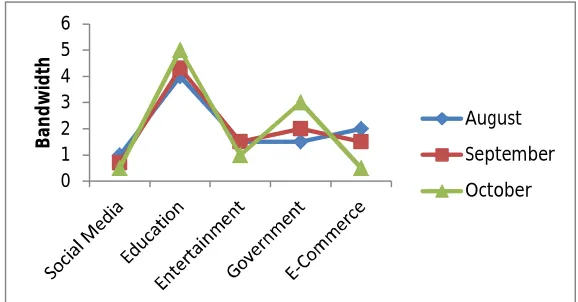
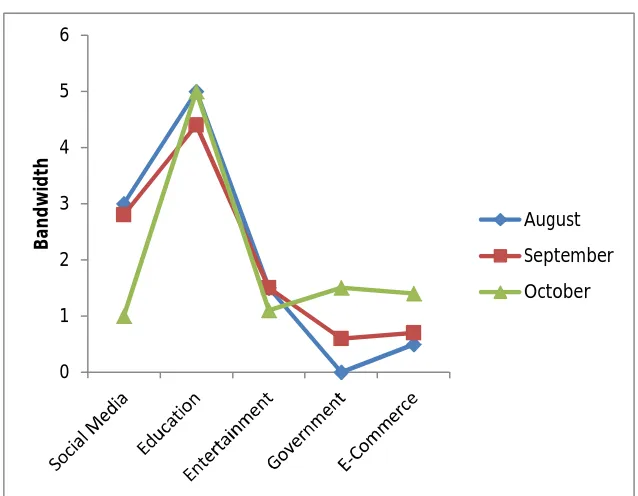
For this, we have plotted data in the followinggraphical view
[image:4.612.162.464.313.505.2]Fig. 1 Behavior pattern of browsing history of the Three Months (Student-1)
Fig.2: The Behavior pattern of browsing history of the Three Months (Student-2)
[image:4.612.168.457.535.686.2]Fig. 4 Behavior pattern of browsing history of the Three Month (Student-4)
Fig. 5 Behavior pattern of browsing history of the Three Months (Student-5)
B. Classification Phase.
The above graph is used to analyze the data to make the cluster of students.
According to the Internet web browsing habits of Students, we define three clusters of a Student. All these clusters of Student have a combination of both behaviorclasses, Class I and Class II form 1 description in a ratio ( Class I%: Class II%). In the current study, the following will be criteria,
1) Cluster A will be having a defined ratio of 80%: 20%.
2) Cluster B will be having a defined ratio of 50%:50%.
3) Cluster C will be having a defined ratio of 20%: 80%. 0
2 4 6 8 10 12
B
a
n
d
w
id
th
October
September
August
0 1 2 3 4 5 6
B
an
d
w
id
th
August
September
[image:5.612.153.472.348.596.2]Fig: 6 Flow of Decision for Distributing Bandwidth.
Shared is going to normally distributed and reserved will distributed on the basis of 3 cluster rule
a) If Studentconsumes bandwidth 80% in rational use and 20% in emotional use then we provide 512 Kbps bandwidth from Reserved.
b) If Studentconsumes bandwidth 50% in rational use and 50% in emotional use then we provide 256 Kbps bandwidth from Reserved.
c) If Studentconsumes bandwidth 20% in rational use and 80% in emotional use then we provide 64 Kbps bandwidth from Reserved.
C. Decision Phase.
Fig: 7 Flow of Allocation (After 3 Months)
VI.CONCLUSION
We first categorized the algorithms as static and dynamic. Then we have analyzed the various algorithms which can be applied in static environments. After that, we described the various dynamic load balancing algorithms. For solving any particular problem some special conditions need to be applied. So we have discussed some additional algorithms which can help in solving some sub-problems in load balancing.
In this paper provided the way to utilize the bandwidth in an efficient way. If a user browsing habits are rational then provide extra bandwidth. If they decrease the rational use, the extra bandwidth will be reduced in the same manner and vice versa.
In our future work, we will analyze the algorithms with numerical analysis and simulation.
REFERENCES
[1] Zhang, Qi, et al. "Workload-aware load balancing for clustered webservers." IEEE Transactions on Parallel and Distributed Systems 16.3(2005): 219-233 [2] J. Clerk Maxwell, A Treatise on Electricity and Magnetism, 3rd ed., vol. 2. Oxford: Clarendon, 1892, pp.68–73.
[3] J I. S. Jacobs and C. P. Bean, “Fine particles, thin films, and exchange anisotropy,” in Magnetism, vol. III, G. T. Rado, and H. Suhl, Eds. New York: Academic, 1963, pp. 271–350.
[4] Chim, Tat Wing, Kwan L. Yeung, and King-Shan Lui. "Trafficdistribution over equal-cost-multi-paths." Computer Networks 49.4 (2005): 465-475. [5] Dally, William James, and Brian Patrick Towles. Principles and practices of interconnection networks. Elsevier, 2004
[6] Handigol, Nikhil, et al. "Plug-n-Serve: Load-balancing web traffic using OpenFlow." ACM Sigcomm Demo 4.5 (2009.
[7] Wang, Richard, Dana Butnariu, and Jennifer Rexford. "OpenFlow-based Server Load Balancing Gone Wild." Hot-ICE 11 (2011): 12-12.
[9] Chou, Li-Der, et al. "A Genetic-based load balancing algorithm in OpenFlow Network." Advanced Technologies, Embedded and Multimedia for Human-centric Computing. Springer Netherlands, 2014. 411-417.
[10] Long, Hui, et al. "LIBERIA: Dynamic load-balanced routing in
OpenFlow-enabled networks." Advanced Information Networking and Applications (AINA), 2013 IEEE 27th International Conference on. IEEE, 2013. [11] Li, Yu, and Deng Pan. "OpenFlow based load balancing for Fat-Tree networks with multipath support." Proc. 12th IEEE International Conference on
Communications (ICC’13), Budapest, Hungary. 2013.
[12] Hegde, Saumya, Shashidhar G. Koolagudi, and Swapan Bhattacharya. "Scalable and fair forwarding of elephant and mice traffic in software defined networks." Computer Networks 92 (2015): 330-340.
[13] Hisao Kameda, El-Zoghdy Said Fathyy and InhwanRyuzJieLix, “A Performance Comparison of Dynamic vs.Static Load Balancing Policies in a Mainframe { Personal Computer Network Model”, Proceedings of the 39th IEEE Conference on Decision and Control, 2000.
[14] Sandeep Sharma, Sarabjit Singh, and Meenakshi Sharma, “Performance Analysis of Load Balancing Algorithms”, the academy of science, engineering and technology, issue 38, February 2008, pp. 269-272 .
[15] M. Dobber, R. Mei, and G. Koole, “Dynamic Load Balancing and Job Replication in a Global-Scale Grid Environment: A Comparison”, IEEE Transaction on Parallel and Distributed Systems, Vol. 20, no. 2, pp. 207-218, February 2009.
[16] Abhijit A. Rajguru, S.S. Apte, "A Comparative Performance Analysis of Load Balancing Algorithms in Distributed System using Qualitative Parameters", International Journal of recent.
[17] Ratnesh Kumar Nath, ”Efficient Load Balancing Algorithm in Grid Environment”, Thapar University, Patiala, May 2007.
[18] BelabbasYagoubi and YahyaSlimani, ”Dynamic Load Balancing Strategy for Grid Computing”, World Academy of Science, Engineering and Technology 19, 2006.
[19] Shahzad Malik, “Dynamic Load Balancing in a Network of Workstations”, 95.515F Research Report, November 29, 2000.
[20] HendraRahmawan, YudiSatriaGondokaryono, “The Simulation of Static Load Balancing Algorithms”, 2009 International Conference on Electrical Engineering and Informatics, Malaysia.