Event Embeddings for Semantic Script Modeling
Ashutosh Modi Saarland University,
Germany
Abstract
Semantic scripts is a conceptual represen-tation which defines how events are orga-nized into higher level activities. Practi-cally all the previous approaches to induc-ing script knowledge from text relied on count-based techniques (e.g., generative models) and have not attempted to compo-sitionally model events. In this work, we introduce a neural network model which relies on distributed compositional repre-sentations of events. The model captures statistical dependencies between events in a scenario, overcomes some of the short-comings of previous approaches (e.g., by more effectively dealing with data spar-sity) and outperforms count-based coun-terparts on the narrative cloze task.
1 Introduction
It is generally believed that the lack of knowl-edge on how individual events are organized into higher-level scenarios is one of the major obstacles for natural language understanding. Texts often do not provide a detailed specification of underly-ing events as writers rely on the ability of humans to read between the lines or, more specifically, on their common sense knowledge of underlying sce-narios. For example, going to a restaurant involves entering the restaurant, getting seated, making an order and so on. Consequently, when describing a visit to a restaurant, a writer will not specify all the events, as they are obvious to the reader. This kind of knowledge is typically refereed to as se-mantic scripts (Schank and Abelson, 1977), and, in this work, will aim to capture some aspects of this knowledge within our probabilistic model.
Early work on scripts focused on manual construction of knowledge bases and rule-based
systems for inference using these knowledge bases (Schank and Abelson, 1977). More re-cent approaches relied on automatically learning script knowledge either from crowd-sourced or naturally-occurring texts (Chambers and Jurafsky, 2008; Regneri et al., 2010; Modi and Titov, 2014; Frermann et al., 2014; Jans et al., 2012; Pichotta and Mooney, 2014; Rudinger et al., 2015a).
Most of these methods represent events as ver-bal predicates along with tuples of their immediate arguments (i.e. syntactic dependents of the pred-icate). These approaches model statistical depen-dencies between events (or, more formally, men-tions of events) in a document, often restricting their model to capturing dependencies only be-tween events sharing at least one entity (a common protagonist). We generally follow this tradition in our approach.
Much of this previous work has focused on count-based techniques using, for example, either the generative framework (Frermann et al., 2014) or relying on information-theoretic measures such as pointwise mutual information (PMI) (Chambers and Jurafsky, 2008). Some of these techniques treat predicate-argument structures as an atomic whole (e.g., Pichotta and Mooney (2014)), in other words their probability estimates are based on co-occurrences of entire (predicate, arguments) tu-ples. Clearly such methods fail to adequately take into account compositional nature of expressions used to refer to events and suffer from data spar-sity.
In this work our goal is to overcome the short-comings of the count-based methods described above by representing events as real-valued vec-tors (event embeddings), with the embeddings computed in a compositional way relying on the predicate and its arguments. These embeddings capture semantic properties of events: events which differ in surface forms of their constituents
but are semantically similar will get similar em-beddings. The event embeddings are used and es-timated within our probabilistic model of seman-tic scripts. We evaluate our model on predicting left-out events (the narrative cloze task) where it outperforms existing count-based methods.
2 Background
The general idea in the previous count based meth-ods is to collect events sequences for an entity from the corpus (referred as a script). Anentityis typically a noun/pronoun describing a person, lo-cation or temporal construct mentioned in a docu-ment. A document is parsed using a statistical de-pendency parser. Then, the document is processed with a coreference resolution system, linking all the mentions of an entity in the document. Infor-mation from the parser and the coreference system is used to collect all the events corresponding to an entity. Different systems differ on how they rep-resent an event. We later explain in detail these event representation differences. The process de-scribed above is repeated for all the documents in the corpus to collect event chains for each of the entities. The collected event sequences are used to build different statistical script models. These script models are typically evaluated using a nar-rative cloze test as explained in section 3. In the cloze test, an event is removed from an event chain and the task is to predict the missing event.
As described above different script models dif-fer in, how they represent an event. Chambers and Jurafsky (2008), Jans et al. (2012) and Rudinger et al. (2015a) represent an event as verb depen-dency type (for example subject, object etc) pair. Using dependency parser and coreference system, they collect verbs governing entity mentions, this chain of verbs along with corresponding depen-dency, forms the event chain. Recently, Pichotta and Mooney (2014) extended the concept of an event to include multiple arguments. In their model, an event is a tuplev(es, eo, ep), where, en-titieses, eoandepare arguments with subject, ob-ject and prepositional relation with the governing verb v. A multi-argument event model encodes a richer representation of events. They have em-pirically show the advantages of having multiple arguments in an event. In our work, we follow the event definition of Pichotta and Mooney (2014) and include multiple arguments in an event.
One of the disadvantage of the count based
models described above is poor event representa-tions. Due to these impoverished representations, these models fail to take into account composi-tional nature of an event and suffer from sparsity issues. These models treat verb-argument pair as one unit and collect chains of verb-arguments pair observed during training. Verb-arguments com-binations never observed during training are as-signed zero (or very small, if model is smoothed) probability, even if these are semantically similar to the ones in training. These models fail to ac-count for semantic similarity between individual components (verbs and arguments) of an event. For example, events cook(John,spaghetti,dinner)
andprepared(Mary,pasta,dinner)are semantically very similar but count based models would not take this into account unless both events occur in similar context. Due to sparsity issues, these models can fail. This can be exemplified as fol-lows. Suppose the following text is observed dur-ing model traindur-ing :
John cooked spaghetti for dinner. Later, John ate dinner with his girlfriend. After dinner, John took a dog for a walk. After 30 minutes, John came home. After a while, John slept on the bed.
Event sequence (script) corresponding to the above story is:
cook(john,spaghetti,dinner)→eat(john,dinner,girlfriend)→
take(john,dog,walk)→come(john,home)→sleep(john,bed)
Suppose during testing the following event sequence is observed :
prepared(mary,pasta,dinner)→eat(mary,dinner,boyfriend)→
take(mary,cat,walk)→?→sleep(mary, couch)
The model is required to guess the missing event marked with ‘?’. A count-based model would fail if it never encountered the same events during training. It would fail to take into account the semantic similarity between words prepared and cook, dog and cat.
di-rectly proportional to number of free parameters in the model.
To counter the shortcomings of count based script models, we propose a script model based on distributed representations (Bengio et al., 2001; Turian et al., 2010; Collobert et al., 2011). Our model tries to overcome the curse of dimension-ality and sparsity by representing events as vec-tor of real values. Both verbs and arguments are represented as a vector of real values (a.k.a em-beddings). Verb and argument embeddings are composed to get event vector (event embedding). The model automatically learns these embeddings from the data itself and in the process encodes se-mantic properties in the event representations.
3 Tasks Definition
One of the standard tasks used for evaluating script models is Narrative Cloze (Chambers and Jurafsky, 2008; Jans et al., 2012; Pichotta and Mooney, 2014; Rudinger et al., 2015a). Origins of narrative cloze lie in psychology where it was used to assess child’s ability to fill in missing word in a sentence (Taylor, 1953). In our setting the cloze task is described as follows : given a sequence of events with an event removed from the sequence, guess the missing event. For example, given the sequence
cook(john,spaghetti,dinner)→eat(john,dinner,girlfriend)→
take(john,dog,walk)→?→sleep(john,bed) , predict the event that should come at position marked by?
Narrative cloze task evaluates models for exact correctness of the prediction. It penalizes predic-tions even if they are semantically plausible. It would be more realistic to evaluate script models on a task that gives credit for predicting seman-tically plausible alternatives as well. We propose adversarial narrative cloze task. In this task, the model is shown two event sequences, one is the correct event sequence and another is same se-quence but with one event replaced by a random event. The task is to guess which of the two, is the correct event sequence. For example, given two sequences below, the model should be able to dis-tinguish the correct event sequence from the incor-rect one. Interestingly, Manshadi et al. (2008) also propose a similar task for evaluating event based language model and they refer to it as event order-ing task. As explained in section 5, we evaluate our model on both the tasks: narrative cloze and adversarial narrative cloze.
embarked batmobile subj
predicate embedding event embedding
dep embedding
Ta1 Rp Ta2 e
a1=Csubj p=Cembark a2=Cbatmobile arg embedding hidden layerh
[image:3.595.315.514.62.213.2]Ah
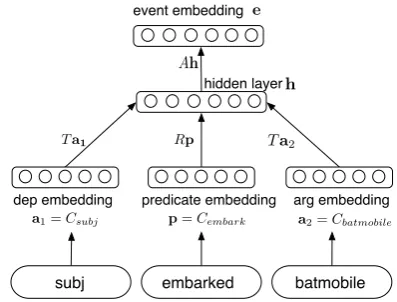
Figure 1: Computation of an event representa-tion for a predicate with dependency and an ar-gument (subj (batman) embarked batmobile), an arbitrary number of arguments is supported by our approach.
Correct:
cook(john,spaghetti,dinner)→eat(john,dinner,girlfriend)
→take(john,dog,walk)→come(john,home)→sleep(john,bed)
Incorrect:
cook(john,spaghetti,dinner)→eat(john,dinner,girlfriend)
→take(john,dog,walk)→play(john,tennis)→sleep(john,bed)
4 Script Model
We propose a probabilistic model for learning a sequence of events corresponding to a script. The proposed model predicts the event incrementally. It first predicts a verbal predicate, followed by pro-tagonist position (since the propro-tagonist argument is already known) and followed by remaining ar-guments. We believe this is more natural way of predicting the event as opposed to predicting the complete event, treating it as an atomic unit. The information about the predicate influences the pos-sible arguments that could come next due to selec-tional preferences of the verb.
ek 1 ek+1
hidden layers
embeddingcontext softmax predictions
future events past events
embeddings embeddings
Cp Cp Cf
We
W(in) p
{Ws, Wo, Wpr} {Ws, Wo, Wpr} {Ws, Wo, Wpr}
u(pred) p
e1 u(arg)
a1
Wp
u(entity) d
predicted predicate :p predicted dependency :d predicted argument :a1 predicted argument :a2
(predicatepembedding) (dependencydembedding) (argumenta1embedding)
We
We We W(in)
p
{W(in)
s , Wo(in), Wpr(in)} {W(in)
s , Wo(in), Wpr(in)}
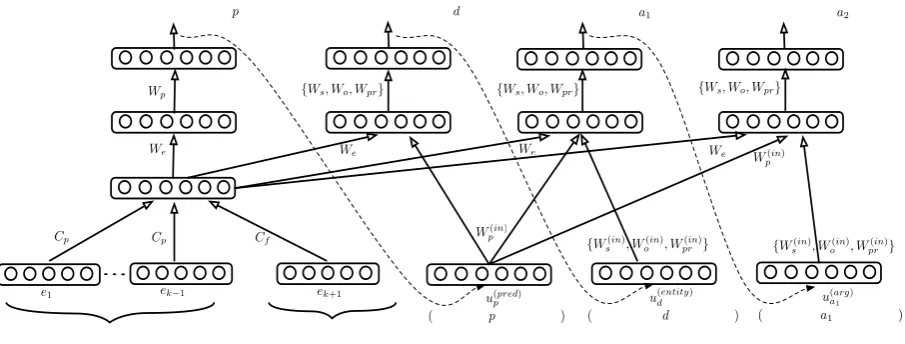
Figure 2: Model for learning event sequence. Here, we are given sequence of events
e1, e2, ..., ek−1, ek, ek+1. Eventekis removed from the sequence and it is predicted incrementally.
4.1 Event Representation
For event representation, one could use a sophis-ticated compositional model based on recursive neural networks (Socher et al., 2012) , we take a simpler approach and choose a feedforward net-work based compositional model as this is eas-ier to train and more robust to choice of hyper-parameters. Our event representations model is inspired from the event ordering model of Modi and Titov (2014). Their model uses distributed word representations for representing verb and ar-gument lemmas constituting the event. Distributed word representations (also known as word embed-dings) encode semantic and syntactic properties of a word in a vector of real values (Bengio et al., 2001; Turian et al., 2010; Collobert et al., 2011). Word embeddings have been shown to be benefi-cial in many NLP applications Turian et al. (2010); Collobert et al. (2011).
The event model is a simple compositional model representing an event. The model is shown in Figure 1. Given an event, e = (v, d, a1, a2), (herevis the predicate lemma,dthe dependency and a1, a2 are corresponding argument lemmas), each lemma (and dependency) is mapped to a vec-tor using a lookup matrixC. For example, a par-ticular row number of C, corresponding to index of a predicate in the vocabulary, gives the ding for the predicate. These constituent embed-dings are projected into same space by multiplying with respective projection matrices R (for predi-cates) andT (for arguments). Hidden layerh is obtained by applying a nonlinear activation func-tion (tanhin our case). Final event representation
eis obtained by projecting the hidden layer using a matrixA. Formally, event representation is given bye=A∗tanh(T∗Ca1,:+R∗Cv,:+T∗Ca2,:)+b. All the projection matrices (R, T, A) and lookup matrixCare learned during training. We also ex-perimented with different matrices T for subject and object positions, in order to take into account the positional information. Empirically, this had negligible effect on the final results.
4.2 Event Sequence Model
A good script model should capture the mean-ing as well as the statistical dependencies between events in an event sequence. More importantly, the model should be able to learn these represen-tations from unlabeled script sequences available in abundance.
We propose a neural network based probabilis-tic model for event sequences, for learning event sequence as well as the event representations. The model is shown in Figure 2. The model is trained by predicting a missing event in an event se-quence. During training, a window (size = 5 = 3*2 + 1) is moved over all events in each event se-quence corresponding to each entity. The event in window’s center is the event to be predicted and events on the left and right of the window are the context events. As explained earlier, the missing event is predicted incrementally, beginning with a predicate, followed by the protagonist position, followed by other participants in the event.
In order to get an intuition how our model pre-dicts an event, consider the following event se-quence in a script, with a missing event : (e1 →
[image:4.595.74.527.60.232.2]would like to predict the missing event, say ek.
The event model is used to obtain event repre-sentations for each event in the context. These event representations are then composed into con-text representation by summing the representation for each of the event in the context. We sum the representations, as this formulation works well in practice. The desired eventek is predicted
incre-mentally, beginning with the predicate p for ek.
The context embedding is used to predict the ver-bal predicate via a hidden layer followed by a multiclass logistic regression (softmax) classifica-tion. Next, the protagonist positiond(subject, ob-ject etc) is predicted. For predicting d, the con-text embedding and the predicate embedding (cor-responding to the predicate predicted in previous step) are linearly combined to be given as input to a hidden layer. This is followed by regular softmax prediction. Similarly, arguments are pre-dicted. For each of the argument, predicate em-bedding and the previous prediction (position or argument) are linearly combined with the context embedding. If at each prediction stage we used gold predicate/position/argument embedding for linearly combining with context embedding, our model would not be robust to wrong predictions during testing. Using the embeddings correspond-ing to predicted unit would make the model robust against noise and would help the model to partially recover from wrong predictions during testing.
We train the model by minimizing the negative likelihood function for the event prediction. For-mally, we minimize the objective function−J(Θ) as shown in equation 1 and 2. As shown in equa-tion 3, we factorize the event distribuequa-tion into con-stituents, making appropriate independence as-sumptions as explained earlier. Each of the factor is a multiclass logistic regression (softmax) func-tion. Equation 4 illustrates the probability distri-bution for the predicate given the context. Here,
uvi is the word embedding for the predicate vi,
E is the context embedding and bvi is the bias. Probability distributions for arguments has simi-lar form and are not shown here due to space con-straints.
Θ ={C, T, R, A, Cp, Cf, We, Wp, Ws, Wo, Wpr, Wp(in), Ws(in), Wo(in), Wpr(in), B} is the
pa-rameter vector to be learned. Papa-rameters are learned using mini-batch (size=1000) stochastic gradient descent with adagrad (Duchi et al., 2011) learning schedule. During training, the error
in-curred during predictions at each stage are back-propagated to update the parameters for the model including the embeddings for predicates and argu-ments (matrixC).
We regularize the parameters of the model us-ing L2 regularization (regularization parameter = 0.01). All the hidden layers have a dropout fac-tor of 0.5. We trained a word2vec model on train set documents to learn word embeddings. Pred-icate and arguments vectors are initialized using the learned word embeddings. Predicate and argu-ment embeddings have dimensionality of 50 and hidden layers have dimensionality of 50. All the hyper-parameters were tuned using a dev set.
Θ∗=argmin
Θ−J(Θ) (1)
J(Θ) = N Y
i=1
p(ei|e1, ..., ei−1, ei+1, ek,Θ)
| {z }
prob. of an event given context
= N Y
i=1
p(ei| e |{z}
context events
,Θ) (2)
p(ei|e,Θ) =p(vi, di, a(1)i , a(2)i |e,Θ) =p(vi|e,Θ)
| {z } verb prob.
∗p(di|vi,e,Θ)
| {z }
dependency prob.
∗
p(a(1)i |vi, di,e,Θ)
| {z }
first arg prob.
∗
p(a(2)
i |vi, a(1)i ,e,Θ)
| {z }
second arg prob.
(3)
p(vi|e,Θ) = exp(u T
vi(Wptanh(WeE)) +bvi)
P
kexp(uTk(Wptanh(WeE)) +bk) (4)
5 Experiments and Analysis
5.1 Data
There is no standard dataset for evaluating script models. We experimented with movies summary corpus1(Bamman et al., 2014). The corpus is cre-ated by extracting 42,306 movie summaries from November, 2012 dump of Wikipedia2. Each doc-ument in the corpus concisely describes a movie plot along with descriptions of various characters involved in the plot. Average length of a docu-ment in the corpus is 176 words. But more pop-ular movies have much more elaborate descrip-tions going up to length of 1,000 words. The cor-pus has been processed by the Stanford Corenlp pipeline (Manning et al., 2014). The texts in the corpus were tokenized and annotated with POS
Data Set No. of Scripts No. of Unique Events
Train Set 104,041 856,823
Dev Set 15,169 119,302
[image:6.595.76.288.62.133.2]Test Set 29,943 231,539
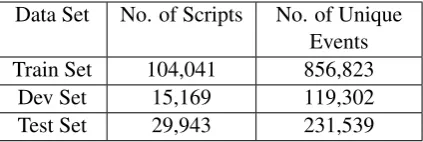
Table 1: Data statistics
tags, dependencies, NER and coreference (coref) information. Since, each of the document in the corpus is about a movie, the scripts in this corpus involve interesting interactions between different entities (actors/objects). In order to study and ex-plore the above mentioned rich script structure, we selected this corpus for our experiments. Never-theless, our model is domain agnostic, the experi-ments performed on this corpus are generalizable to any other corpus as well.
As mentioned in section 2, we extract scripts corresponding to each of the entities using the de-pendency annotations and coref information. The corpus documents are divided randomly into three parts: train (~70%), development (~10%) and test (~20%). Data statistics about the data set are given in Table 1. As a preprocessing step, low frequency (< 100) predicates and arguments are mapped to a special UNK (unknown) symbol. Similarly, ar-guments consisting of only digits are mapped to a NUMB (number) symbol. There are 703unique predicate lemmas and 46,644 unique argument lemmas in the train set. Average length of a script is 10 events. During testing, predicate and argu-ments not observed during training are mapped to the same UNK symbol.
5.2 Baselines Systems
We compare our model against two baseline models: Unigram model and MultiProtagonist model.
A unigram model is a simple but competitive script model. This model predicts an event by sampling from unigram event frequency distribu-tion of the train set. The events are predicted inde-pendent of the context.
MultiProtagonist (M-Pr) is the model proposed by Pichotta and Mooney (2014) and described as joint model in Pichotta and Mooney (2014). The model calculates conditional probability of an event given another context event (P(e2 |e1 ) by counting the co-occurrence counts of the events in the corpus. The model predicts the missing event
given the context events by maximizing the sum of log conditional probabilities of an event w.r.t each of the context events i.e.
e∗= argmax
ePki=1−1log P(e|ei)+PKi=k+1log P(ei|e) For evaluation and comparison purposes, we reimplemented both baselines on our dataset. In the experiments described next, we refer our model as NNSM (Neural Network based Script Model).
5.3 Evaluation Metrics
We evaluated models for narrative cloze task with three metricsRecall@50andAccuracyand Event Perplexity. Recall@50 is the standard met-ric used for evaluating script models (Jans et al., 2012; Pichotta and Mooney, 2014). The idea here is to evaluate top 50 predictions of a script model on a test script with a missing event. The metric is calculated as fraction of the predictions containing the gold held-out event. Its value lies in the range 0 (worst) and 1(best). Accuracy is a new metric introduced by Pichotta and Mooney (2014). This metric evaluates the event prediction, taking into account prediction of each constituent. Specifi-cally, it is defined as average of the accuracy of the predicate, the dependency, the first argument and the second argument predictions. This is a more robust metric as it does not treat an event as an atomic unit. This is in contrast to Recall@50 which penalizes semantically correct guesses and awards only events which have exactly the same surface form.
The baseline models and our model are prob-abilistic by nature. Taking inspiration from lan-guage modeling community, we propose a new metric Event Perplexity. We define event perplex-ity as 2−1
N P
ilog2p(ei|e(context,i)). The perplexity measure, like the accuracy takes into account the constituents of an event and is a good indicator of the model predictions.
5.4 Narrative Cloze Evaluation
Model R@50 Accuracy Event Perplexity
Unigram 0.32 34.26% 298.45
M-Pr 0.31 35.67% 276.54
[image:7.595.72.299.62.134.2]NNSMfull 0.37 44.36% 256.41
Table 2: Model evaluation on test set for narrative cloze task against the baselines
Model R@50 Accuracy Event
Perplexity
Unigrampred 0.27 23.79% 264.16
M-Prpred 0.27 24.04% 260.34
[image:7.595.332.503.62.119.2]NNSMpred 0.49 33.40% 247.64
Table 3: Model evaluation on predicate only event test set for narrative cloze task against the base-lines
having distributed representation for events rather than atomic representations. Unigram, although a simple model, is competitive with the M-Pr model. We performed an interesting experiment. We evaluated another simplistic baseline model, most frequent event. This baseline model predicts by sampling from top-5 most frequent predi-cate/argument in the full event narrative cloze task. Surprisingly, the accuracy reported by this sim-ple baseline is 45.04% which is slightly more than our best performing NNSM model and much more than the M-Pr baseline. This simple looking base-line is hard to beat by both count-based methods and NNSM. None of the previous methods have been evaluated against this baseline. We propose using this baseline for evaluation of script mod-els. We think this outperformance is due to skewed distribution of the predicate and arguments in the corpus. As we found empirically, these distribu-tions have a very long tail and this makes it hard for the models to beat the most frequent baseline.
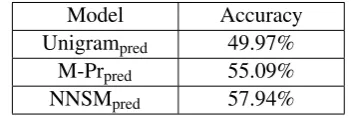
5.5 Adversarial Narrative Cloze Evaluation Similar to narrative cloze, adversarial narrative cloze task was evaluated on 29,943 test set scripts. In each of the event sequence an event was re-placed by a random event. The results for the ad-versarial narrative cloze task are shown in Table 4 and 5. As evident from the results Unigram model is as good as random. In this task as well, our model outperforms the count based M-Pr model by 2.3% and 2.9% for full and pred model
respec-Model Accuracy
Unigram 50.07%
M-Pr 53.04%
NNSMfull 55.32%
Table 4: Model evaluation on test set for adversar-ial narrative cloze task against the baselines
Model Accuracy
Unigrampred 49.97%
M-Prpred 55.09%
NNSMpred 57.94%
Table 5: Model evaluation on predicate only test set for adversarial narrative cloze task against the baselines
tively.
6 Related Work
Work on scripts dates back to 70’s beginning with introduction of Frames by Minsky (1974), schemas by Rumelhart (1975) and scripts by Schank and Abelson (1977). These early formula-tions were not statistical in nature and used hand-crafted complex rules for modeling relations be-tween events. These formulations were limited to few scenarios and did not generalize well.
Miikkulainen (1990) proposed DISCERN sys-tem for learning script knowledge. Their neu-ral network based model read event sequences and stored them in episodic memory. The model was capable of generating expanded paraphrases of narratives and was able to answer simple ques-tions. Similarly, Lee et al. (1992) proposed DY-NASTY (DYNAmic STory understanding sYs-tem). This system was also based on distributed representations. It predicted missing events in event sequences and performed script based infor-mation retrieval. Their system was limited to only few scenarios and did not generalize well.
[image:7.595.327.503.168.227.2]auto-matic script learning systems. McIntyre and Lap-ata (2009) developed a system for generating sto-ries, they learned an object based script model on fairy tales.
Orr et al. (2014) proposed hidden markov model (HMM) approach to learn scripts. The model clus-ters event descriptions into different event types and then learns an HMM over the sequence of event types. Again this model treats an event as an atomic unit and the inference algorithm may not generalize well, as the number of event types increases. Similarly, Frermann et al. (2014) pro-posed non-parametric Bayesian model for learning script ordering. The inference procedure may not scale well, as number of event chains increases.
Manshadi et al. (2008) proposed language model based approach to learning event se-quences, in their approach as well, events are treated as atomic units (a predicate-argument tu-ple). Recently, Rudinger et al. (2015b) have pro-posed a neural network approach to learn scripts by learning a bilinear distributed representation based language model over events. Their model is non-compositional in nature and they also con-sider events as an atomic unit and directly learn distributed representation for events. Granroth-Wilding and Clark (2015) also propose a compo-sitional neural network based model for events. Our model is more general than their model. They learn event representations by modeling pair wise event scores for calculating compatibility between two events. This score is then used to predict the missing event by selecting an event that maxi-mizes the average score between the event and the context events.
7 Conclusion and Future Work
In this paper we proposed a probabilistic composi-tional model for scripts. As shown in experiments, our model outperforms the existing co-occurrence count based methods. This further reinforces our hypothesis of having more richer compositional representations for events. Current tasks to eval-uate script models are crude, in the sense that they penalize semantically plausible events. In the fu-ture, we propose to create a standard data set of event sequence pairs (correct sequence vs incor-rect sequence). The replaced event in the incorincor-rect sequence should not be a random event but rather a semantically close but incorrect event. Models evaluated on this data set would give a better
in-dication of script learning capability of the model. Another area which needs further investigation is related to developing models which can learn long tail event distributions. Current models do not cap-ture this well and hence do not perform better than most frequent event baseline on accuracy task.
In this paper, we proposed a very simple compo-sitional feed forward neural network model. In the future we plan to explore more sophisticated re-current neural network (RNN) based models. Re-cently, RNN based models have shown success in variety of applications (Graves, 2012).
Acknowledgments
We would like to thank anonymous reviewers for their helpful comments. This research was funded by the German Research Foundation (DFG) as part of SFB 1102 ’Information Density and Lin-guistic Encoding’.
References
David Bamman, Brendan O’Connor, and Noah A Smith. 2014. Learning latent personas of film characters. InProceedings of the Annual Meet-ing of the Association for Computational Lin-guistics (ACL). page 352.
Yoshua Bengio, R´ejean Ducharme, and Pascal Vincent. 2001. A neural probabilistic language model. InProceedings of NIPS.
Nathanael Chambers and Daniel Jurafsky. 2008. Unsupervised learning of narrative event chains. InProceedings of ACL.
R. Collobert, J. Weston, L. Bottou, M. Karlen, K. Kavukcuoglu, and P. Kuksa. 2011. Natural language processing (almost) from scratch.
Journal of Machine Learning Research
12:2493–2537.
John Duchi, Elad Hazan, and Yoram Singer. 2011. Adaptive subgradient methods for online learn-ing and stochastic optimization. The Journal of Machine Learning Research12:2121–2159. Lea Frermann, Ivan Titov, and Manfred Pinkal.
2014. A hierarchical bayesian model for un-supervised induction of script knowledge. In
EACL, Gothenberg, Sweden.
Alex Graves. 2012. Supervised sequence la-belling. Springer.
Bram Jans, Steven Bethard, Ivan Vuli´c, and Marie Francine Moens. 2012. Skip n-grams and ranking functions for predicting script events. In Proceedings of the 13th Conference of the European Chapter of the Association for Com-putational Linguistics. Association for Com-putational Linguistics, Stroudsburg, PA, USA, EACL ’12, pages 336–344.
Geunbae Lee, Margot Flowers, and Michael G Dyer. 1992. Learning distributed representa-tions of conceptual knowledge and their ap-plication to script-based story processing. In
Connectionist Natural Language Processing, Springer, pages 215–247.
Christopher D Manning, Mihai Surdeanu, John Bauer, Jenny Rose Finkel, Steven Bethard, and David McClosky. 2014. The stanford corenlp natural language processing toolkit. In ACL (System Demonstrations). pages 55–60.
Mehdi Manshadi, Reid Swanson, and Andrew S Gordon. 2008. Learning a probabilistic model of event sequences from internet weblog stories. InFLAIRS Conference. pages 159–164. Neil McIntyre and Mirella Lapata. 2009.
Learn-ing to tell tales: A data-driven approach to story generation. InProceedings of the Joint Confer-ence of the 47th Annual Meeting of the ACL and the 4th International Joint Conference on Nat-ural Language Processing of the AFNLP: Vol-ume 1-VolVol-ume 1. Association for Computational Linguistics, pages 217–225.
Risto Miikkulainen. 1990. DISCERN: A
Dis-tributed Artificial Neural Network Model Of Script Processing And Memory. Ph.D. thesis, University of California.
Risto Miikkulainen. 1995. Script-based inference and memory retrieval in subsymbolic story pro-cessing. Applied Intelligence5(2):137–163. Marvin Minsky. 1974. A framework for
represent-ing knowledge .
Ashutosh Modi, Tatjana Anikina, and Manfred Pinkal. 2016. Inscript: Narrative texts anno-tated with script information. InProceedings of the 10th International Conference on Language Resources and Evaluation (LREC 16), Portoroˇz, Slovenia..
Ashutosh Modi and Ivan Titov. 2014. Inducing neural models of script knowledge. InCoNLL. volume 14, pages 49–57.
John Walker Orr, Prasad Tadepalli, Janardhan Rao Doppa, Xiaoli Fern, and Thomas G Dietterich. 2014. Learning scripts as hidden markov mod-els. InAAAI. pages 1565–1571.
Karl Pichotta and Raymond J Mooney. 2014. Statistical script learning with multi-argument events. InEACL. volume 14, pages 220–229. Michaela Regneri, Alexander Koller, and Manfred
Pinkal. 2010. Learning script knowledge with web experiments. InProceedings of ACL. Rachel Rudinger, Vera Demberg, Ashutosh Modi,
Benjamin Van Durme, and Manfred Pinkal. 2015a. Learning to predict script events from domain-specific text. Lexical and Computa-tional Semantics (* SEM 2015)page 205. Rachel Rudinger, Pushpendre Rastogi, Francis
Ferraro, and Benjamin Van Durme. 2015b. Script induction as language modeling. In Pro-ceedings of the 2015 Conference on Empiri-cal Methods in Natural Language Processing (EMNLP-15).
David E Rumelhart. 1975. Notes on a schema for stories. Representation and understanding: Studies in cognitive science211(236):45. R. C Schank and R. P Abelson. 1977. Scripts,
Plans, Goals, and Understanding. Lawrence Erlbaum Associates, Potomac, Maryland. Richard Socher, Brody Huval, Christopher D.
Manning, and Andrew Y. Ng. 2012. Seman-tic compositionality through recursive matrix-vector spaces. InProceedings of EMNLP. Wilson L Taylor. 1953. Cloze procedure: a new
tool for measuring readability. Journalism and Mass Communication Quarterly30(4):415. Joseph Turian, Lev Ratinov, and Yoshua Bengio.
2010. Word representations: A simple and gen-eral method for semi-supervised learning. In
Proceedings of ACL.