Abstract- This paper examined the application of Machine Learning techniques for famine prediction. Early detection of famine reduces vulnerability of the society at risk. The dataset used in the study was collected between 2004 to 2005 across households in the different regions of Uganda. Dataset from the northern region was found to be most suitable to training datasets of other regions. Classification performance of four methods as Support Vector Machine, K- Nearest Neighbours, Naïve Bayes and Decision tree in prediction of famine were evaluated. Support Vector Machine and K- Nearest Neighbours performed better than the rest of the methods however Support Vector Machine produced the best ROC which can be used by policy makers to determine the cut-off for determining famine prone households. It is recommended in this study that satellite data could be used in combination to show the relationship in prediction of food security as this may increase the specificity of those households at risk.
Index Terms— Classification, Disaster, Famine, Machine Learning, Prediction
I. INTRODUCTION
Famine is a disaster that affects many households in developing countries, Uganda inclusive [1],[2]. It is caused by a combination of many factors such as drought, poverty and armed conflict. Early prediction of famine ensures its avoidance or control. Machine Learning (ML) technique which extracts information automatically by computational and statistical methods is useful in this kind of prediction because of its ability to improve classification performance based on previous results of labeled training examples from a problem domain. In this study the application of Machine Learning in structured data mining for purpose of risk classification in a disaster like famine is explored.
Structured data mining is search for interesting information in given structures like relational databases. It is applied in the representation of „real-world‟ data like famine disaster since they do not have natural representation as a single table.
The relationship between the different famine indicators such as agricultural production, agricultural shocks, household
Manuscript received October 04, 2010; revised January 22, 2011 W. Okori is with Department of Computer Science, Faculty of Computing and Information Technology, Makerere University. (phone: +256-790790185; e-mail: [email protected]).
J. Obua is with The Inter-University Council for East Africa (e-mail: [email protected])
income and labour input is important in establishing the link between different variables used to detect famine [3]. Relationship of this nature is helpful in designing entry points in intervention during and before famine disaster occurs. Non parametric techniques like classification and regression (CART), and parametric techniques like logistic regression, have been used in vulnerability studies like famine [4]. Classification techniques with non parametric nature have the advantage of enabling modeling of irregularities such as data sparsity in the risk function over the feature spaces which is an abstract space where each pattern sample is represented as a point in n-dimensional space[5],[6]. Support Vector Machine (SVM), K-Nearest Neighbour (KNN), Naïve Bayes (NB), and Decision Tree (DT) used in this study are nonparametric in nature and have advantages over methods like CART since they show probability levels of predictions. Causal structure learning algorithms that determine causal relationship between the different variables have been applied in studying the relationships between the different variables that cause famine [3].
Supervised learning has been applied in this study because the features are known and the dataset is split into training and validation sub-sets in order to enhance classifier accuracy [7]. However, one of the challenges of using Machine Learning techniques is the need for ground truthing and an accurately labeled data set that can be used for training and testing of classification accuracy. Due to stability and better generalization, pattern recognition technique that proved to be suitable for this dataset for identification and classification of households prone to famine were Support Vector Machine and K-Nearest Neighbour. Support Vector Machine has best generalization performance as it depends on the support vectors which provide a hyperplane with a maximal separation between classes. This provide least chance of causing misclassification if an error is made in the location of the boundary. The maximum margin of the liner classifier is identified by the plus and minus planes [8],[9] as represented below:
Plus-plane = { x : w . x + b = +1 } (1)
Minus-plane = { x : w . x + b = -1 } (2)
where w is vector perpendicular to the planes and b is the bias.
Machine Learning Classification Technique for
Famine Prediction
Washington Okori and Joseph Obua
Maximum margin separating the planes is therefore represented as:
M=2/ √M.M (3) where M is the maximum margin
For K-Nearest Neighbour [10] it assumes in a feature space arbitrary instances represented as:
(a1(x), a2(x),…,a n(x)) (4)
where ai(x) are features
The nearest neighbour of an instance based on the k-th minimum distance between the instances used in classification is defined interms of Euclidean distance represented as:
n
d(xi, xj) = √ ∑(ar (xi)-a r(xj))2 (5)
r=1
This method classifies objects based on close training examples in the future space with the object being assigned to the class most common amongst its k-nearest neighbours. The training set for the KNN algorithm is taken from a set of objects for which the correct classification is known. In this study the vector in the multidimensional feature space used had class label for households with food security status categorized as food secure and insecure.
The overall objective of the study was to accurately classify households prone to famine using ML techniques. The specific objectives were to (i) train dataset that can be used in household food insecurity prediction (ii) show levels of prediction accuracy using different measurements (iii) evaluate prediction accuracy using Receiver Operating Characteristics (ROC)/Area Under the Curve (AUC).
II. CONCEPTUAL SUPERVISED LEARNING FRAMEWORK
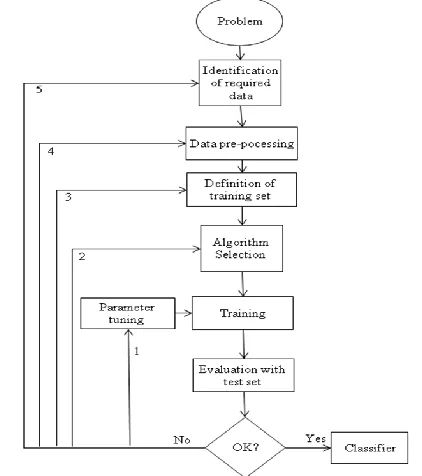
The supervised learning process of classification examined for prediction of famine prone households is shown in Figure 1.
Figure 1. Conceptual supervised learning framework (Adopted from Kotsiantis, 2007).
It was adopted from the work of Kotsiantis [11] and is applicable since famine is a real world problem.
In this study possibility of noise and missing features were reduced by identification of required data using the domain knowledge gained during this study.
III. MATERIALS AND METHODS
A. Study Area
Secondary data for two agricultural seasons: July–December 2004 and January–June 2005 on agricultural households in northern, central, eastern and southern parts of Uganda were obtained from Uganda Bureau of Statistics (UBOS). Uganda is located between 4012‟N and 10 29‟S, 29034‟E and 350E with a total area of 241,500 km2. The projected population is 31,135,292 growing at an average 3.2% per annum. Uganda is bordered to the west by the Democratic Republic of Congo, to the north by Sudan, to the east by Kenya, to the south by Tanzania, and to the southwest by Rwanda. Uganda‟s main economic activity is subsistence agriculture and the major crops are maize, millet, sorghum, rice, beans, groundnuts, simsim, cassava, sweet potato, Irish potatoes, and bananas [12].
B. Data Description
Data on agricultural crop production collected during the survey were not standardized because it was easier to use measurement units such as tins which is known to subsistence farmers.. Maize, beans and groundnuts were wet or dry and the units of measurements were tins, kilogram and
baskets were not uniform. Feature
transformation/construction was performed on crop condition state and measurements to standardize them by applying predetermined conversion factors[12]. The data contained 5,040 cases but 3,030 cases remained after deleting missing cases.
[image:2.612.72.283.470.708.2]food insecure [1]. After feature transformation/construction fifteen variables were used for classification of household food security status.
C. Classification of Households and Performance Evaluation of Classification Methods
Classification of Households
Data from the four regions of Uganda were classified using Support Vector Machine , k-nearest neighbor, Naïve Bayes, and Decision Tree to establish the influence of regional disparity. Sensitivity, specificity, accuracy and area under the curve were used to evaluate prediction performance of the four classification methods. Multi label classification was applied using KNN to show whether prediction could be done based on regional class labels.
Prediction Performance Evaluation of Classification Methods
Prediction accuracy, error rate, sensitivity, specificity and receiver operating characteristics (ROC) were used to evaluate the prediction performances of classification methods. The tradeoff between sensitivity and specificity (ROC) was plotted and area under the curve (AUC) calculated to show the accuracy of the predictions [13]. For k- nearest neighbor, the numbers of neighbors were varied until the highest value of ROC was obtained.
D. Visualization of Classification
Classification was visualized in 2-d to display the training and testing data on selected features like dietary energy intake and size of household with the class having two labels as food insecure and food secure and the values normalized using z-score. Visualization demonstrated how the training and testing datasets can be separated into feature space with corresponding known and predicted classes to establish interesting patterns [14].
IV. RESULTS
A. Prediction Evaluation
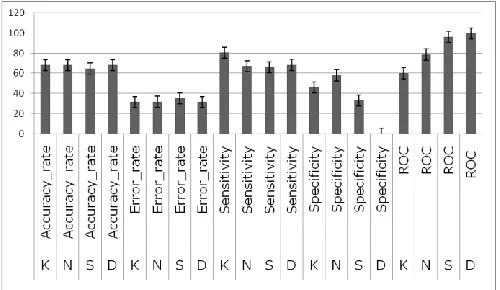
Results of prediction measures for the four regions of Uganda performed using SVM, KNN, NB, and DT is given in Figure 2. Overall, there appears to be more famine in northern region than the rest of the country.
Variation in average prediction performance of the different methods applied to the dataset for the four regions is shown in Figure 3. It is clear that KNN had the highest average sensitivity ( 80.63%) while SVM, NB and DT had between 65% to 70%. The error bar indicates possible statistical significant difference between the mean of KNN and the rest of the methods and higher preference for KNN for sensitivity measurement, while Support Vector Machine (96.25%) is preferred for ROC measurement because of its ability to minimize the probability of misclassification of the
future patterns for unknown probability distribution of the dataset.
Figure 2. Performance comparision of data from the four regions using KNN (K), NB (N) , SVM (S) and DT (D).
Figure 3. Comparison of prediction performance of different classification methods.
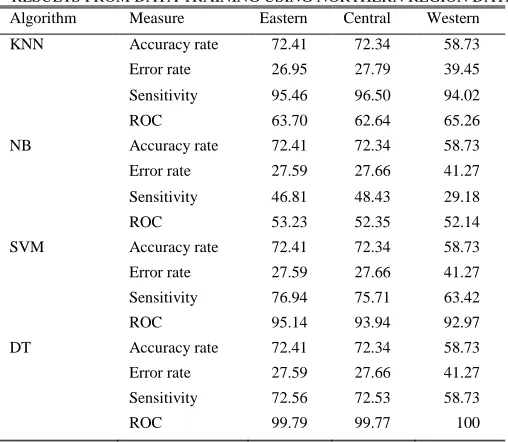
All the four methods had similar average error rates (less than 35%) which is good since they are below 50%. Since data from northern region performed better than data from the other regions, it was used to train data from other regions using different classification methods such as SVM and the prediction results are presented in Table 1.
[image:3.612.310.566.104.282.2] [image:3.612.310.560.352.497.2]TABLE 1
RESULTS FROM DATA TRAINING USING NORTHERN REGION DATA
Algorithm Measure Eastern Central Western
KNN Accuracy rate 72.41 72.34 58.73
Error rate 26.95 27.79 39.45
Sensitivity 95.46 96.50 94.02
ROC 63.70 62.64 65.26
NB Accuracy rate 72.41 72.34 58.73
Error rate 27.59 27.66 41.27
Sensitivity 46.81 48.43 29.18
ROC 53.23 52.35 52.14
SVM Accuracy rate 72.41 72.34 58.73
Error rate 27.59 27.66 41.27
Sensitivity 76.94 75.71 63.42
ROC 95.14 93.94 92.97
DT Accuracy rate 72.41 72.34 58.73
Error rate 27.59 27.66 41.27
Sensitivity 72.56 72.53 58.73
ROC 99.79 99.77 100
Decision tree seems to over fit the data. Support Vector Machine exhibited less reduction in specificity compared to KNN and gave best results of over 90% for area under the curve for ROC for all the other regions therefore supporting its generalization potential which is appropriate for prediction in a study like famine. All methods exhibited decrease in specificity between 10 – 40% after training with data from the north indicating loss in location specific characteristics except NB which showed increase in specificity by approximately 50% for eastern and western regions. Receiver operating characteristics curves were plotted for central and western regions after training with data from the north as shown in Figure 4.
Figure 4. Relationship between false and true positive rates for central and western regions after training.
Regions like western had the AUC increased by 7% with well distributed AUC above 90% for SVM rendering it more appropriate for decision makers to use it to determine the cut off points for determination of food insecurity level in an area.
Five nearest neighbours were chosen in KNN algorithm since this number lies between one and nine and was identified to
[image:4.612.306.564.142.206.2]be the maximum number of neighbours that could be applied. This helped to avoid the outliers by using a small number and overfitting by using a large number of neighbours since the specificity and AUC with these number of neighbours was optimal. The effect of increasing the neighbours is given in Table 2.
TABLE 2
PREDICTION PERFORMANCES AT DIFFERENT KNN VALUES k-NN
(k = 1)
k-NN (k=3)
k-NN (k = 5)
k-NN (k = 7)
k-NN (k = 9)
Accuracy rate 80.00 80.00 80.00 80.00 80.00
Sensitivity 90.48 90.70 91.57 93.10 94.32
Specificity 55.56 52.94 54.05 45.45 40.63
AUC 56.83 57.49 57.55 52.43 54.14
The prediction performance shown in Table 2 indicates that specificity and AUC increased as number of nearest neighbours increased to a maximum of five neighbours. Receiver operating characteristics values increased from 56.83% up to a maximum of 57.55% and thereafter decreased to 52.43%. The accuracy rates which indicate the number of training data instance that were correctly classified was constant for all the neighbours.
[image:4.612.303.560.389.460.2]Attempt to predict by regions using multi label classification on combined dataset showed very appreciable sensitivity (more than 65% ) indicating better chances to correctly identify origin of data by regions as indicated in Table 3.
TABLE 3
RESULTS OF MULTI LABEL CLASSIFICATION
Northern Eastern Central Western
Accuracy rate 0.7695 0.6005 0.6138 0.5472 Error rate 0.2305 0.3995 0.3862 0.4528 Sensitivity 0.1557 0.2857 0.2417 0.3035 Specificity 0.8659 0.7227 0.7409 0.6644
Eastern region class were in some cases predicted as northern and western as central. This could have been due to proximity in agro ecological zones in addition to similarity in socio-economic constraints and effect of adverse weather conditions during the years when the data was collected. Comparing all the regions, northern had the best prediction as exhibited in accuracy rate (76.95%) , error rate (23.05%) and specificity (86.55%) however with least sensitivity (15.57%) since some of its data is classified as originating from the eastern region.
B. Visualization of Classification
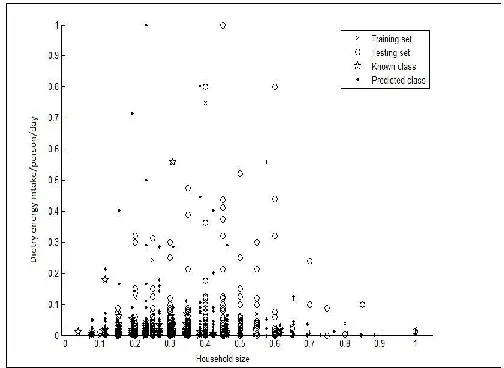
Results from visualization of the classes into the feature space on two features of dietary energy intake and size of household is displayed in Figure 5.
[image:4.612.47.299.474.622.2]Figure 5. Visualization of classes into the feature space between dietary energy intake and size of household.
V. DISCUSSION
A. Evaluation of the Four Classification Methods used in Famine Prediction
Evaluation of famine prediction showed that data from the northern region are more consistent and reliable than data from other regions. Therefore, they can be used for training data from other regions that had poor prediction performance. Prediction performance of eastern region ranked close to that of northern region which indicates similarity in the datasets. This is confirmed by studies which showed that northern region is more prone to food insecurity possibly due to insecurity that was experienced for over 20 years [15]. Both eastern and northern region experienced adverse weather conditions such as floods and drought that directly and adversely affected agricultural production between 2005 – 2007 [1],[16].
Support vector machine and kNN performed better than the rest of the methods because SVM has high generalization performance [17] which is desirable in such studies while the attributes of kNN which is good for risk studies are its ability to assign each example to the majority class of its closest neighbours and its instance based learning power [18]. K-nearest neighbor assumes nonparametric nature of data and uses probability density function estimation. The nonparametric nature enables modeling of irregularities such as data sparsity in the risk function over the feature spaces. Minimum Euclidean distance is assumed between matching patterns and this is enhanced by increasing the number of neighbours which increased the specificity and ROC to maximum prediction performance measurement values and thereafter decreased indicating reduced prediction performance.
Naïve Bayes may not have produced results with high prediction measures because of assumption of conditional independence amongst some of the features like landsize and production which may have affected its performance as reported by Kotsiantis [11], and Bhargavi and Jyothi [19]. Decision tree results indicated that there was over fitting in
decision tree learning due to noise in the data as per the ROC values and generalization errors which are not good as observed by Anyanwu and Shiva [7]. This overfitting results in misclassification error where classes are assigned wrong labels which reduces or produces inconsistencies in prediction results.
Agricultural shock which comprised of drought, floods, hailstorm, fire accidents, pest attack and livestock epidemic are part of environmental factors which cause decline in agricultural food productivity [20] in addition to poverty and conflicts which were experienced in some areas like northern and eastern regions. In general land degradation and loss of agricultural land for industrial and residential developments is an environmental factor that has influence on food security and this is starting to be experienced in Uganda due to industrialization and rapid population increase which is currently at the rate of 3.2% per annum [21]. In all the four methods, incorporation of agricultural shock as a predictor variable is relevant in famine prediction which confirms strong contribution of environmental hazards in food production chain.
The identification of class labels in the multi label classification demonstrated the ability of KNN classification method to generalize datasets with similar patterns as a class due to its intuitive appeal [22], [23]. In some instances the class label of eastern was identified as northern and central as western. This could be explained by their proximity in agro-ecological zones and similarity in socio-economic constraints experienced during the time of data collection already reported by Okori et al. [1].
Bolat and Yildirim [24] emphasized the importance of selecting good training set to improve performance both in training and testing datasets. In this study, this aspect was achieved by identifying using ML techniques northern region dataset for training data from other regions which improved prediction performance of up-to 10% for western region.
B. Visualization of Classification
According to Liu et al. [25] and Mramor et al. [14] visualization of datasets in the future space provides better understanding of data structure and relationship. This study has demonstrated that it can reduce complexity and provide insight into the data as exemplified by clear distinction between representation of food secure and insecure households. In addition, it also expedites decision making [26].
[image:5.612.44.296.50.234.2]VI. CONCLUSIONS AND RECOMMENDATIONS
The following conclusions and recommendations were drawn.
A. Conclusions
Machine Learning techniques are well suited for prediction of risks like famine since they can enhance classification accuracy. Suitable training dataset is important in improving prediction measurements while different classification methods may perform differently on the same dataset.
B. Recommendations We recommend that:
(i) The best dataset for training for famine prediction in Uganda is from the northern and eastern regions.
(ii) Satellite image and socio-economic data for specific areas and periods need to be used in combination to show the relationship in prediction of food security.
(iii) Transfer learning techniques need to be explored for prediction of famine and to determine its contribution to improvement of classification accuracy.
REFERENCES
(1) W. Okori, J. Obua. and V. Baryamureeba, “Logit Analysis of Socio Economic Factors Affecting Famine in Uganda,” Journal of Disaster Research vol. 5, no. 2, pp 208 – 215, 2010.
(2) Food and Agriculture Organization of the United Nations. “Assessement of the World Food Security Situation,” Committee on World Food Security, Rome, 2007.
(3) E. Mwebaze, W. Okori and J. Quinn, “Causal Structure Learning for Famine Prediction,” In Proc. of the Association for the Advancement Artificial Intelligence (AAAI) Spring Symposium on Artificial Intelligence for Development, Technical Report SS-10-01, 2010. (4) Y. Yohannes and P. Webb, “Classification and regression trees: A user
manual for identifying indicators of vulnerability to famine and chronic food insecurity,” International Food Policy Research Institute, Washington, D.C. Mimeo, 1998.
(5) J. Zurada and R.M. Barker, “Using Memory-Based Reasoning For Predicting Default Rates On Consumer Loans,” Review of Business Information Systems – Second Quarter, vol. 11, no. 1, 2007.
(6) W. Hand and V. Vinciotti, V., “Choosing k for Two-Class Nearest Neighbor Classifiers with Unbalanced Classes,” Pattern Recognition Letters, Vol. 24, pp. 1555-1562, 2003.
(7) M.N. Anyanwu and S. G. Shiva, “Comparative Analysis of Serial Decision Tree Classification Algorithms,” International Journal of Computer Science and Network Security, vol. 3, no. 3, pp. 230 – 240, 2009.
(8) Y. Cai, X. Liu, X. Xu and K. Chou, “Support vector machines for predicting the specificity of GalNAc-transferase,” Elsevier- Peptides, vol. 23, pp. 205–208, 2002.
(9) V. Vapnik, The nature of statistical learning theory, New York: Springer-Verlag, 1995.
(10) M. Moradian and A. Baraani, “KNNBA: K-NEAREST-NEIGHBOR-BASED-ASSOCIATION ALGORITHM”, Journal of Theoretical and Applied Information Technology, vol. 6, no. 1, pp. 123-129, 2009. (11) S. B. Kotsiantis, “Supervised Machine Learning: A Review of
Classification Techniques,” Informatica, vol. 31, pp. 249 -268, 2007. (12) Uganda Bureau of Statistics. Uganda National Household Survey
2005/2006, Report on the Agricultural Module, 2007.
(13) M. Ramaswami and M. Bhaskaran, “A study on feature selection techniques in educational data mining,” Journal of Computing vol. no. 11, pp. 7-11, 2009.
(14) M. Mramor, G. Leban, J. Demsar and B. Zupan, “Visualization-based cancer microarray data classification analysis,” Bioinformatics, vol. 23, no. 16, pp. 2147-2154, 2007.
(15) W. Okori, J. Obua and V. Baryamureeba, “Famine Disaster Causes and Management Based on Local Community‟s Perception in Northern Uganda,” Journal of Social Sciences, vol. 4, pp. 21 -32, 2009. (16) National Environment Management Authority, State of the
environment report for Uganda, 2007.
(17) S. S. Keerthi, O. Chapelle and D. DeCoste, “Building Support Vector Machines with Reduced Classifier Complexity,” Journal of Machine Learning Research, vol. 7, pp. 1493–1515, 2006.
(18) B. Zhang and W. Zuo, “ Reliable Negative Extracting Based on kNN for Leraning from Positive and Unlabeled Examples,” Journal of Computers, vol. 4, no. 1, pp. 94-101, 2009.
(19) P. Bhargavi and S. Jyothi, “Applying Naive Bayes Data Mining Technique for Classification ofAgricultural Land Soils,” International Journal of Computer Science and Network Security vol. 9, no. 8, pp. 117 – 122, 2009.
(20) Food and Agriculture Organization of the United Nations. Food insecurity in the Horn of Africa, Rome, Italy, 2010.
(21) World Bank, “Republic of Uganda - Annual progress report of poverty reduction strategy and joint IDA-IMF staff advisory note,” World Bank Publication, Washington, 2008.
(22) M. R. Hassan, M. M. Hossain, J. Bailey and K. Ramamohanarao, “Improving k-Nearest Neighbour Classification with Distance Functions Based on Receiver Operating Characteristics,” in Lecture Notes In Artificial Intelligence - Springer-Verlag , vol. 5211, pp. 489 – 504, 2008.
(23) T. M. Cover and P.E. Hart, ``Nearest neighbor pattern classification,''
IEEE Transactions on Information Theory, vol. IT-13, pp. 21-27, 1967.
(24) B. Bolat and T. Yildirim, “A Data Selection Method for Probabilistic Neural Networks,” Journal of Electrical and Electronics Engineering,
vol. 4, no. 2, pp. 1137-1140, 2004.
(25) K. Liu, D. Zhou and X. Zhou, “Clustering by Ordering Density-Based Subspaces,” In Proc. of International Workshop on Visual Data Mining, pp. 1-9, 2002.
(26) A. Heijs, “Visualization of Statistical and Text Mining Results from Large Document Collections,” In Proc. of ICIC Conference, 2009. (27) United Nations Development Program, UNDP Uganda Newsletters,
Quarterly Report, pp. 1 -20, 2008.