Abstract— Knowledge discovery process from databases has gained importance recently. Finding and using the valuable and meaningful data which is hidden in large databases can have strategic importance for the organizations to gain competitive advantage. Knowledge discovery process that is based on data mining consists of two methods named symbolic and numeric. The symbolic methods based on formal concept analysis classification are frequent itemset search and association rule extraction. Concept lattices are the knowledge representation of formal concept analysis. Association rules based on lattice reflect the relationships among the attributes in a database. In this study, the mathematical background and definition of formal concept analysis which is a powerful tool in knowledge representation and discovery are explained. Then, an experimental study is given in employee recruitment function of human resources management by using formal concept analysis method to model the qualifications of candidates during the recruitment process by taking into consideration the essential qualifications needed for the job position. After that association rules and implications are obtained in order to facilitate the decision making process to select the appropriate candidate for the vacant position.
Index Terms— Association rules, formal concept analysis,
human resources, implications, knowledge discovery, knowledge representation.
I. INTRODUCTION
atabases are widely used in data processes and each day their sizes are getting larger. In order to access the data stored in growing databases and to use them, new techniques are developed to discover the knowledge automatically. Data mining techniques may be used to find the useful knowledge with analyzing and discovering the data. The most well-known method of data mining is known as Knowledge Discovery in Databases (KDD).
Data mining is the search for the relations and the rules, which help us to make estimations about the future from
Manuscript received March 03, 2011
Mert BAL is with Yildiz Technical University, Mathematical Engineering Department, Davutpasa Campus Istanbul, TURKEY (corresponding author to provide phone: 0090 212 3834612; e-mail: [email protected]).
Yasemin BAL is with Yildiz Technical University, Faculty of Administrative Science and Economics, Business Administration Department, Yildiz Campus 34349 Istanbul, TURKEY (e-mail: [email protected]).
Alp USTUNDAG is with Istanbul Technical University, Industrial Engineering Department, Macka Campus 34365 Istanbul, TURKEY (e-mail: [email protected]).
large-scale databases, using computer programs. Data mining is a process that uses the existing technology and acts as a bridge between data and logical decision-making. The KDD process based on data mining methods those are either symbolic or numerical. Symbolic methods based on Formal Concept Analysis (FCA) [1] (concept lattice design or lattice-based classification), frequent itemset search, and association rule extraction [2]. Knowledge representation for discovery tasks and discovered knowledge is one of the fundamental issues in KDD theory [3].
FCA is a field of applied mathematics that aims to formalize the notions of a concept and a conceptual hierarchy by means of mathematical tools. It facilitates the use of mathematical reasoning for conceptual data analysis and knowledge representation and processing. FCA emerged around 1980 as a result of the attempts to restructure mathematical order and lattice theory [4].
FCA (lattice-based classification) relies on the analysis of such binary tables and may be considered as a symbolic data mining technique to be used for extracting (from a binary database) a set of concepts organized within a hierarchy (i.e. partial ordering). The extraction of frequent itemset, i.e. set of attribute of data occurring together with a certain frequency, and of association rules emphasizing correlations between sets of attributes with a given confidence, are related activities. The search for frequent itemsets and association rules [5] extraction are well-known symbolic data mining methods. These processes usually produce a large number of items and rules, leading to the associated problems of “mining the sets of extracted items and rules”. Some subsets of itemsets, e.g. frequent closed itemsets, allow to find interesting subsets of association rules, e.g. informative association rules [2]. Association rules with 100% confidence are called as implication.
In this study, the mathematical background and definition of formal concept analysis which is a powerful tool in knowledge representation and discovery are explained. Then, an experimental study is given in employee recruitment function of human resources management by using formal concept analysis method to model the qualifications of candidates during the recruitment process by taking into consideration the essential qualifications needed for the job position. After that association rules (approximate rules) and implications (exact rules) are obtained in order to facilitate the decision making process to select the appropriate candidate for the vacant position.
Knowledge Representation and Discovery
Using Formal Concept Analysis:
An HRM Application
M. Bal, Y. Bal, and A. Ustundag
II. KNOWLEDGE DISCOVERY AND REPRESENTATION
Knowledge discovery is the nontrivial extraction of implicit, previously unknown, and potentially useful information knowledge from data [6]. Knowledge Representation for discovery tasks and discovered knowledge is one of fundamental issues in KDD theory [3].
One of the methods used in the representation of the valuable knowledge that is discovered from large databases. Knowledge representation and reasoning is an area of artificial intelligence whose fundamental goal is to represent knowledge in a manner that facilitates inference from knowledge. It analyzes how to formally think - how to use a symbol system to represent a domain of discourse, along with functions that allow inference (formalized reasoning) about the objects [7]. Knowledge representation is most important, because accuracy, inference and knowledge retrieval all depend on its accuracy. Therefore, a good knowledge representation should have the capability to store and retrieve knowledge accurately and quickly [8]. Concept lattices are the knowledge representation of FCA [9].
III. FORMALCONCEPTANALYSIS
Formal Concept Analysis (FCA) is a theoretical method for the mathematical analysis of scientific data and was found by Wille [1] in the middle of 80s during the development of a framework to carry out the lattice theory applications. FCA models the real world as objects and attributes. FCA will define concepts in their given content and study the inter-concept relationship regarding the structure of the lattice that corresponds to the content. The mathematical notion of concept has its origin in formal logic [10]. This common definition can be made by two routes, extent and intent. The intent provides the attributes of context while extent covers the objects that are included in the concept. Many applications of FCA to real-life problems in intelligent data analysis, data mining, knowledge representation and acquisition, software engineering, database systems and information retrieval and may other disciplines [10]. The mathematical background and definitions of FCA will be explained below.
A. Order-Theoretic Preliminaries
In this subsection, the main concepts that constitute FCA will be defined briefly.
Definition 1 (Partial Order): A binary relation
R
(often use the symbol≤
) on a setM
is called an partial order relation, if it satisfies the following conditions for all elementsx
,
y
,
z
∈
M
;1.
x
≤
x
2.
x
≤
y
andy
≤
x
⇒
x
=
y
3.x
≤
y
andy
≤
z
⇒
x
≤
z
These conditions are referred to, respectively as reflexivity, antisymmetry and transitivity. A partially ordered set (poset) is a pair
(
M
,
≤
)
, withM
being a set and≤
an order relation onM
. A relation≤
on a setM
which is reflexive and transitive but not necessarily antisymmetric is called a quasi-order [4] - [11].Definition 2 (Infimum, Supremum): Let
(
M
,
≤
)
be a partially ordered set (poset) andA
a subset ofM
. A lower bound ofA
is an elements
ofM
withs
≤
a
for alla
∈
A
. An upper bound ofA
is defined dually. If there is a largest element in the set of all lower bounds ofA
, it is called the infimum ofA
and is denoted byinf
A
or∧
A
; dually, a least upper bound is called supremum and denoted bysup
A
or∨
A
. IfA
=
{ }
x
,
y
, we also writex
∧
y
forA
inf
andx
∨
y
forsup
A
. Infimum and supremum are frequently also called meet and join.Definition 3 (Lattice, Complete Lattice): A partially
ordered set (poset)
ν
:
=
( )
V
,
≤
is called a lattice, if for any two elementsx
andy
inV
the supremumx
∨
y
and the infimumx
∧
y
always exist.ν
is called a complete lattice, if the supremum∨
X
and the infimum∧
X
exist for any subsetX
ofV
. Every complete latticeν
has a largest element,∨
V
, called the unit element of the lattice, denoted by1
V. Dually, the smallest element0
V is called the zero element. The definition of a complete lattice assumes that supremum and infimum exist for every subsetX
, in particular forX
=
∅
. We have∧
∅
=
1
V and∨
∅
=
0
V , from which it follows thatV
≠
∅
for every complete lattice. Every non-empty complete lattice is a complete lattice [11].Definition 4: Let
S
be a set andϕ
a mapping from the power set ofS
into the power set ofS
. Thenϕ
is called a closure operator onS
if it is,1. Extensive:
A
⊆
ϕ
( )
A
for allA
⊆
S
;2. Monotone:
A
⊆
B
⇒
ϕ
( )
A
⊆
ϕ
( )
B
for allS
B
A
,
⊆
; and3. Idempotent:
ϕ
(
ϕ
( )
A
) ( )
=
ϕ
A
.We say that a set
A
⊆
S
isϕ
-closed ifA
=
ϕ
( )
A
. The set of allϕ
-closed sets, i.e.{
A
⊆
S
|
A
=
ϕ
( )
A
}
is called a closure system [4].B. Formal Context and Derivation Operator
Let K
:
=
(
G
,
M
,
I
)
be a formal context. For a set of objectsA
⊆
G
, we define the set of attributes that are satisfied by all objects inA
as follows [4]:(
)
{
m
M
g
A
g
m
I
}
A
′
:
=
∈
|
∀
∈
:
,
∈
(1) Similarly, for a set of attributesB
⊆
M
, we define the set of objects that satisfy all attributes inB
as follows:(
)
{
g
G
m
B
g
m
I
}
B
′
:
=
∈
|
∀
∈
:
,
∈
. (2) Lemma 1: Let K:
=
(
G
,
M
,
I
)
be a formal context.G
A
A
1,
2⊆
sets of objects, andB
1,
B
2⊆
M
sets of attributes. Then the following holds:(1a)
A
1⊆
A
2⇒
A
2′
⊆
A
1′
(2a)A
⊆
A
′′
(3a)
A
′
=
A
′′′
(4)
A
⊆
B
′
⇔
B
⊆
A
′
⇔
A
×
B
⊆
I
(1b)B
1⊆
B
2⇒
B
2′
⊆
B
1′
(2b)
B
⊆
B
′′
(3b)B
′
=
B
′′′
C. Formal Concept and Formal Concept Lattice
A formal concept of the formal context K
:
=
(
G
,
M
,
I
)
is a pair( )
A,
B
such thatA
⊆
G
,B
⊆
M
,A
′
=
B
, andA
B
′
=
; (this is equivalent toA
⊆
G
andB
⊆
M
being maximal withA
×
B
⊆
I
) the setsA
andB
are called the extent and intent of the formal concept( )
A,
B
, respectively [13]. The hierarchical subconcept-superconcept-relation of concepts is formalized by:(
A
1,
B
1) (
≤
A
2,
B
2)
:
⇔
A
1⊆
A
2(
⇔
B
1⊇
B
2)
.The set of all formal concepts of a context K together with the partial order relation the
≤
is always a complete lattice, called the concept lattice of K and denoted by B(K).This means that for every set of concepts there exists a unique largest subconcept (the infimum) and a unique smallest superconcept (the supremum).
The following lemma shows, together lemma 1.(3b), that a concept lattice can be derived from the set of its concept intents.
Lemma 2: Let K
:
=
(
G
,
M
,
I
)
be a formal context. Then B(K)=
{
(
B
′
,
B
′′
)
|
B
⊆
M
}
(3)The fundamental theorem of FCA [1] shows that each concept lattice is a complete lattice, and that the set of its intents is closure system.
Theorem (Fundamental Theorem of Formal Concept Analysis): The concept lattice of any formal context
K
:
=
(
G
,
M
,
I
)
is a complete lattice. For an arbitrary set(
)
{
A
j,
B
j|
j
∈
I
}
⊆
B(K) of formal concepts the supremum and infimum can be described as following equations [13]:(
)
″
=
∈ ∈ ∈∨
U
I
J j j J j j j j J j
B
A
B
A
,
,
(4)(
)
″
=
∈ ∈ ∈∧
I
U
J j j J j j j j J j
B
A
B
A
,
,
(5)The first equation describes the aggregation along the subconcept-superconcept-hierarchy: The extent of the least common superconcept is the closure by '' of the set union
U
J j jA
∈. Because of the symmetry of the definition, attributes can be aggregated in an analogous way by descending the hierarchy (cf. second equation). Again, the appropriate aggregation is not set union, but its closure by ''.This allows the investigation of implications (functional dependencies) between the attributes [12].
A complete lattice
L
is isomorphic to B(K) if and only if there are mappingsγ
~
:
G
→
L
andµ
~
:
M
→
L
such thatγ
~
( )
G
is supremum-dense andµ
~
( )
M
is infimum-dense inL
and(
g
,
m
)
∈
I
⇔
γ
~
( ) ( )
g
≤
µ
~
m
. In particular,L
≅
B(
L
, L
,
≤
)
[14].D. Line Diagram
below in the hierarchy, and the intent consists of all attributes attached to concepts above in the hierarchy [9].
E. Implications Between Attributes
Given a formal context K, one other common method to analyze it is to find (a canonical base of) the implications between the attributes of this context [4]. They are statements of the form “Every object that satisfies the attributes
m
i1,
m
i2,...,
m
ik also satisfies the attributesm
j1,
m
j2,...,
m
jl”. Formally, an implication between attributes is defined as follows.Dependencies among attributes in the dataset constitute important type of knowledge and may be the goal of a separate analysis process for a formal context. FCA offers a compact representation mode for this type of knowledge, the implication rules (or exact association rules), which follows the same pattern as its logical counterpart, with two attribute sets, premise and conclusion,
X
⇒
Y
(
X
,
Y
⊆
M
)
. Intuitively, an implication is valid in a context if none of the objects violates it which basically meansX
⇒
Y
is valid if and only ifY
⊆
X
′′
[18]. The support and confidence values ofX
⇒
Y
rule are defined as below:(
)
G
Y
X
Supp
′
∪
=
:
(6)(
)
X
Y
X
Conf
′
′
∪
=
:
(7)An association rule having confidence is equal to 1 is called implication (exact association rule), otherwise, this rule is called approximate association rule.
The set of all implications that hold in K is denoted by Imp(K), and called if the implicational theory of K [4]. When we consider the rules obtained in the 4 th section, while the rule {EXP, HCS}
⇒
{AT, DM, EXP} is an implication{ED:BA}⇒
{AT, DM, EXP}rule is not an implication. Moreover, a rule is informative if its premise is minimal and its consequence maximal for set inclusion. The minimal sets that may be put in the premise part of a rule for a given conclusion are called (minimal) generators (or key sets). Formally,Y
⊆
M
is a generator if and only if∀
Y
⊂
Y
,Y
″
⊂
Y
′′
.Implication rules as closely related to functional dependencies in the database field made their way into data mining, where approximate functional dependencies inspired the association rule mining [18].
IV. EXPERIMENTAL STUDY
We have determined the essential qualifications of the employees needed for a position in an organization. The qualifications of the candidates applying fort his position are determined by the evaluations and test during the
recruitment process. The qualifications of these candidates considering the needed qualifications for this position are shown in the candidate context table. The qualifications in the table 1 are listed as follows: Decision Making (DM), Analytical Thinking (AT), Team Work (TW), Foreign Language (FL), High Communication Skill (HCS), Experience (EXP), Education : Business Administration (ED:BA) and Finance (ED:F)
TABLE 1 FORMAL CONTEXTKcandidates
Attributes (Qualifications)
Kcandidate
s DM AT TW FL HCS EXP ED:BA ED:F
C1 X X X X X X
C2 X X
C3 X X X X X X
C4 X
C5 X X X X
C6 X X
C7 X X
C8 X X X X X
The formal context Kcandidates in Example has 9 formal
concepts. These formal concepts are as below:
• ({
∅
}, {DM, AT, TW, FL, HCS, EXP, ED:BA, ED:F})• ({C4}, {ED:F})
• ({C1,C3}, {DM,AT,FL,HCS,EXP,ED:BA})
• ({C6,C7}, {FL,ED:BA})
• ({C5}, {TW,FL,HCS,ED:F})
• ({C2,C5}, {TW,ED:F})
• ({C1,C3,C8}, {DM,AT,FL,EXP,ED:BA})
• ({C1,C3,C5}, {FL,HCS})
• ({
∅
}, {C1,C2,C3,C4,C5,C6,C7,C8})The set
A
=
{C1, C3} is the extent of the concept given in example and the setB
=
{DM, AT, FL, HCS, EXP, ED:BA}is the intent of the same concept. On the other hand the set {C1, C4,C7} is not an extent of any concept of the formal context (Kcandidates) described in table 1.Figure 1. The formal concept lattice corresponding to the candidate formal context (Kcandidates ) in Table I
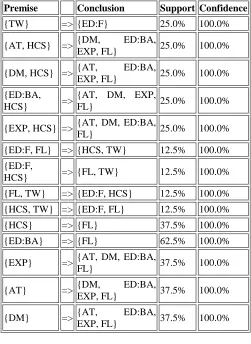
After the concept lattice of this context is formed, the implications (or exact association rules) and association rules (approximate rules) are obtained. These rules are shown in table 2 and table 3 below. As mentioned above, the rules with 100% confidences are called as implications. These implications play an important role in data analysis, and are also crucial for knowledge acquisition by attribute exploration [12].
Consider Kcandidates given in example. Let us consider the
implications {ED:BA, HCS}
⇒
{AT, DM, EXP, FL}According to these implications, it is found that the candidates who educated business administration and have high communication skills also have analytical thinking and decision making ability, have foreign language and experience.Beside it, it can be seen from the context table that the implication {AT, DM, EXP, FL}
⇒
{ED:BA, HCS}is not right. These implications can also expressed by Boolean operators. In this situation, the implication above can be shown as {AT∧
DM∧
EXP∧
FL}⇒
{ED:BA∧
HCS}. It is obvious that these rules will help the decision maker during the recruitment process to select the appropriate person for a specific position in human resources management (HRM). Especially, if we consider that so many candidates can apply for some positions, these rules will facilitate to reduce the number of candidates and make a decision among these candidates.This experimental study presents a different approach for employee selection process in HRM.
TABLE II
THE IMPLICATIONS (EXACT ASSOCIATION RULES)GAINED FROM CANDIDATE CONTEXT
Premise Conclusion Support Confidence
{TW} => {ED:F} 25.0% 100.0%
{AT, HCS} => {DM, ED:BA,
EXP, FL} 25.0% 100.0%
{DM, HCS} => {AT, ED:BA,
EXP, FL} 25.0% 100.0%
{ED:BA, HCS} =>
{AT, DM, EXP,
FL} 25.0% 100.0%
{EXP, HCS} => {AT, DM, ED:BA,
FL} 25.0% 100.0%
{ED:F, FL} => {HCS, TW} 12.5% 100.0% {ED:F,
HCS} => {FL, TW} 12.5% 100.0%
{FL, TW} => {ED:F, HCS} 12.5% 100.0% {HCS, TW} => {ED:F, FL} 12.5% 100.0%
{HCS} => {FL} 37.5% 100.0%
{ED:BA} => {FL} 62.5% 100.0%
{EXP} => {AT, DM, ED:BA,
FL} 37.5% 100.0%
{AT} => {DM, ED:BA,
EXP, FL} 37.5% 100.0%
{DM} => {AT, ED:BA,
EXP, FL} 37.5% 100.0%
TABLE III
THE ASSOCIATION RULES (APPROXIMATE RULES)GAINED FROM CANDIDATE CONTEXT
Premise Conclusion Support Confidence
{FL} => {ED:BA} 62.5% 83.33%
{ED:F} => {TW} 25.0% 66.66%
{HCS} => {AT, DM, ED:BA,
EXP} 25.0% 66.66%
{AT} => {HCS} 25.0% 66.66%
{DM} => {HCS} 25.0% 66.66%
{EXP} => {HCS} 25.0% 66.66%
{ED:BA} => {AT, DM, EXP} 37.5% 60.0%
{TW} => {FL, HCS} 12.5% 50.0%
{FL} => {HCS} 37.5% 50.0%
{HCS} => {ED:F, TW} 12.5% 33.33%
V. CONCLUSION
[image:5.595.301.552.92.436.2]to strategic role, selecting and managing the most suitable employees has gained more importance for the organizations. Human resources have become the most valuable and strategic assets for gaining competitive advantage. The human resources functions and practices should be designed consistent with the goals, missions, visions and strategies of the organizations. During this process, selecting and managing the employees having the essential qualifications to the suitable positions in order to pursue the strategies of the organization is vital. In order to select these employees, different techniques are developed fort he recruitment process in HRM. Data mining techniques can be used during this process to find and select the qualified employees and by that way it can facilitate the decision making process for human resources managers.
In this study, the mathematical background and definitions of FCA which is one of the symbolic data mining methods are explained. Then, the qualifications of the candidates applied for a specific position have been modeled by concept lattice. By that way, the implications and association rules are obtained. These rules can help the decision makers to make the best decision.
REFERENCES
[1] R. Wille, “Restructuring lattice theory: an approach based on hierarchies of concepts”, in graph and order, NATO ASI Series 147, I. Rival, Ed., Dordrecht: Reidel, 1982, pp. 445-470.
[2] J. Lieber, A. Napoli, L. Szathamary and Y. Toussaint, “First elements on knowledge discovery guided by domain knowledge (KDDK)”, in
Proc. 4 th. International Conference on Concept Lattices and Their Applications, Tunis, 2008, pp.22-41.
[3] D. Li, J. Han, X. Shi and M. C. Chan, “Knowledge Representation and Discovery based on Linguistic Atoms”, Knowledge-Based Systems, vol. 10, pp. 431-440, 1998.
[4] B. Sertkaya, “Formal Concept Analysis Methods for Description Logics” Ph. D. dissertation, Dept. Informatics, Dresden Tech. Univ., Dresden, 2008.
[5] R. Agrawal and R. Srikant, “Fast algorithms for mining association rules”, in Proc. 20 th. International Conference on Very Large Data
Bases”, Santiago, 1994, pp.478-499.
[6] W. J. Frawley, G. P.-Shapiro and C. J. Matheus, “Knowledge Discovery in Databases: An Overview”, AI Magazine, vol.13, no. 3, pp. 57-70, 1992.
[7] Available: http://en.wikipedia.org/wiki/Knowledge_representation
[8] K. H. Yang, D. Olson, and J. Kim, “Comparison of First Order Predicate Logic, Fuzzy Logic and Non-Monotonic Logic as Knowledge Representation Methodology”, Expert Systems with
Applications, vol. 27, pp. 501-519, 2004.
[9] G. Stumme, “Conceptual Knowledge Discovery with Frequent Concept Lattices”, FB4-Preprint 2043, TU Darmstadt, 1999.
[10] J. S. Deogun and J. Saquer, “Monotone Concepts for Formal concept Analysis”, Discrete Applied Mathematics, vol. 144, pp. 70-78, 2004. [11] B. Ganter and R. Wille, “Formal Concept Analysis: Mathematical
Foundations”, Berlin: Springer Verlag, 1999, pp. 1-21.
[12] G. Stumme, “Acquiring expert knowledge for the design of conceptual information systems”, in Proc. 11 th. European Workshop on
Knowledge Acquisition, Modeling and Management”, Dagstuhl
Castle, 1999, pp. 275-290.
[13] G. Stumme, R. Taouil, Y. Bastide, N. Pasquier and L. Lakhal, “Computing Iceberg Concept Lattices wit TITANIC”, Data and
Knowledge Engineering , vol. 42, no. 2, pp. 189-222, 2002.
[14] B. Ganter and R. Wille. (1997). Applied Lattice Theory: Formal Concept Analysis [Online]. Available:
http://citeseerx.ist.psu.edu/viewdoc/summary?doi=10.1.1.42.9907
[15] J. H. Correia, G. Stumme, R. Wille and U. Wille, “Conceptual knowledge discovery and data analysis”, in Proc. 8 th. International
Conference on Conceptual Structures, Darmstadt, 2000, pp. 421-437.
[16] R. Freese, “Automated Lattice Drawing”, in Proc. 2 nd. International
Conference on Formal Concept Analysis, Sydney, 2004, pp. 112-127.
[17] P. Eklund, J. Ducrou and P. Brawn, “Concept lattices for information visualization: can novices read-line diagrams?”, in Proc. 2 nd.
International Conference on Formal Concept Analysis, Sydney, 2004,
pp. 55-73.
[18] P. Valtchev, R. Missaoui and R. Godin, “Formal concept analysis for knowledge discovery and data mining: the new challenges”, in Proc. 2
nd. International Conference on Formal Concept Analysis, Sydney,
2004, pp. 352-371.
[19] B. Lahcen and L. Kwuida, “Lattice Miner: a tool for concept lattice construction and exploration”, Available: