Performance Evaluation of Efficient and Reliable
Smart Grid AMI for Meter Reporting Technique
Nikhil M. Manekar1, Prof. A. N. Thakare2
1
M.Tech (Comptuter Science & Engineering)Bapurao Deshmukh college of Engineering,sewagram
2
Assistant Professor at Computer Science And Engineering,Bapurao Deshmukh college of Engineering,sewagram.
Abstract: Implementing of efficient and reliable smart grid AMI is very tough task. In AMI networks the regular data collection from smart meter create large amount of data collections. Enabling a real time exchange of data and information necessary for the management of the system and for ensuring improvements in terms of efficiency and reliability, so it is very challenging task to collect these data at server side and insert into the Database correctly. Due to the lack of automated scrutinizing, poor visibility, situational alertness and mechanical switches, today's electric power grid is getting older and unsuitable for twenty-first century’s increasing demand for electricity. To realize the SG, an advanced metering infrastructure (AMI) based on smart meters is the most important key. A smart grid is an intelligent electricity grid that analyzes the distribution and consumption of electricity, which can be used to optimize the generate on, distribution, and consumption of electricity. Keywords: advanced metering infrastructure, communications, security, smart grid and smart meters.
I. INTRODUCTION
[image:1.612.191.403.543.717.2]AMI (Advanced Metering Infrastructure) is the collective term to describe the whole infrastructure from Smart Meter to two way-communication network to control center equipment and all the applications that enable the gathering and transfer of energy usage information in near real-time. Two-way communication with the customers has been possible by the usage of AMI, which is the backbone of smart grid. The objectives of AMI can be remote meter reading for error free data, network problem identification, load profiling, energy audit [2]. Thus, besides enabling a more accurate fine-grained power data from the consumers for grid operations, many new applications can also use this Advanced Metering Infrastructure [1]. For instance, in Outage Management System (OMS) application [5], SMs can collect and send the real-time outage information when outage occurs. SMs can also send on-demand verification after outage restoration information based on the utility company’s request. While many approaches exist for the performance improvement of SG AMI communications networks, none of these approaches considered the impact of the gateway location on the performance of data collection. Different gateway locations will affect the routing paths from SMs and thus the performance of SG AMI communications network under different gateway placement locations needs to be investigated before it can be deployed, particularly when the peak load traffic occurs. This may happen when all SMs send their data simultaneously or when outage occurs in large area due to the bad weather and many SMs send their outage reports to the utility company in real time. Here the gateway placement in a NAN by exploiting the combinatorial optimization for network facility location problems [1].
The rest of the paper is organized as fallows. In the below Section II, the literature review is described. Section III the proposed System, Smart Meter architecture is described briefly with working functionality and their main communication requirements. Section IV contains result and discussion section the discuss the implemented system result. Finally, the paper is concluded in section V.
II. LITERATUREREVIEW
NicoSaputro, [1] In this paper, author proposed three novel data collection mechanisms to set the periodic reporting time of each smart meter to improve TCP performance in IEEE 802.11s-based wireless mesh AMI networks. In this paper, solve the problem of data collection in IEEE 802.11s-based SG AMI networks in terms of scheduling and gateway placement also. NicoSaputro, [2] the author proposed a packet reassembly mechanism for TCP. He evaluated end-to-end delay on an 802.11s-based wireless mesh network by using the ns-3 network simulator. K. Akkaya, [3] focus on the routing issues in the SG communications infrastructure which consists of different network components. Here the author has also identified the future research issues that are yet to be addressed with respect to the applications and network components. V. Gungor, [4] in this paper overviews the issues related to the smart grid architecture from the perspective of potential applications and the communications requirements needed for ensuring performance, flexible operation, reliability and economics. Hamid Gharavi, [5] In this paper, the author presents a multi-gate mesh network architecture that has been developed to ensure high performance and reliability under emergency conditions when a system expects to receive power outage notifications and exchanges. Athar Ali Khan, [6] it overcome issues like rising energy demand, aging infrastructure, emerging renewable energy sources, as well as reliability and security. S. Shao, [7] in this paper solve the large density of meter data collection problems of a traffic scheduling mechanism based on interference avoidance for meter data collection in Meter Data Collection Building Area Network. Nithin.S, [8] in this paper studied a smart grid test bed based on GSM technology which is capable of load management, fault detection and self-healing. This work could be extended into the smart meter can be easily modified into a smart Energy meter. V. CagriGungor, [9] A sophisticated, reliable and fast communication infrastructure is, in fact, necessary for the connection among the huge amount of distributed elements. BassamAoun. [10] In this paper, address the problem of gateways placement, consisting in placing a minimum number of gateways such that quality-of-service (QoS) requirements are satisfied. Trong Nghia Le [11] In this paper, derived the Security standards and address the problem network based threats. Ramyar Rashed Mohassel [12] This paper introduces AMI technology and its current status, as the foundation of SG, which is responsible for collecting all the data and information from loads and consumers. Sujni Paul [13]. purpose Data mining algorithms deal predominantly with simple data formats there is an increasing amount of focus on mining complex and advanced data types such as object-oriented, spatial and temporal data. Md Rahat Hossain et al. [15] discuss the Smart Grid concept, evolution and components of Smart Grid, environmental impacts of Smart Grid and then in some detail, to describe the technologies that are required for its realization. Ramyar Rashed Mohassel et al. [14] focuses on the Smart Grid and the role of Advanced Metering Infrastructure (AMI) in SG. These papers introduce AMI technology and its current status, as the foundation of SG, which is responsible for collecting all the data and information from loads and consumers.
III. PROPOSEDSYSTEM
A. Smart Meter Architecture
As compared with the conventional energy meter, Smart meter is an advanced energy meter that supports two‐way communications.
[image:2.612.206.405.594.715.2]Hence, it can measure the energy consumption data of a consumer and then transmits added information to the utility companies and energy storage devices, and bill the customer accordingly [11].
By using bidirectional communication of data, smart meters can collect information regarding the electricity consumption values of customer premises. The different parameters such as the unique meter identifier and the unit of electricity consumption are combined together and stored by smart meter. The usage of the energy can be monitored on the basis of the data collected by smart meters [14]. We implemented all proposed approaches and extensively evaluate these proposed approaches using IOT Smart meters can be programmed such that, only power consumed from the utility grid is billed whereas the power consumed from the distributegeneration sources or storage devices owned by the customers is not billed [11].
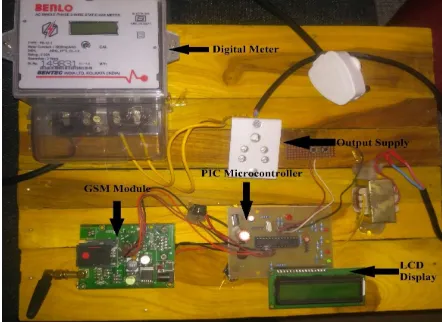
A smart meter system includes various control devices and microcontroller to identify parameters in SG and then the collected data is transmitted to the control centre via GSM device in smart meter [8]. The utility companies get an advantage to manage electricity demand/response more efficiently from the collected electricity consumption data from all devices of customers on a regular basis and it also helps the utility companies to provide useful information to the customers about the variations in the electricity usage in their residence. SM supports a wide range of data collection frequencies that can be configured remotely. The frequency of readings (or reports) from SMs may change from one utility to another and type of the consumers. For instance, residential homes’ data can be collected in every one minutes. Hence, smart meters would play an extremely important role in monitoring the performance and the energy usage characteristics of the load on the electricity and reliability in distribution grid in the future [9].
Snapshot 4.1: Implemented Hardware Design
The appropriate design architecture for providing end-to-end metering reporting solution. The communication provider may adopt GPRS/3G/4G communication technology or RF based canopy system or a combination of these technologies as per the site requirement adopting best available technology in the proposed area of implementation [7][6].
[image:3.612.194.415.265.426.2]The following core modules of AMI system shall be provided
Figure 3: Operational Procedure of Smart Grid
1) Smart Meters
3) Meter Data Management System (MDM)
4) Web application with updated on-line data of consumers etc.
5) Mobile app
B. Functions of AMI
The AMI system shall help utility to manage their resource and business process efficiently. AMI system shall support the following minimum functionalities:
1) Remote Meter data reading at configurable intervals.
2) Time of day (TOD)/TOU metering
3) bill paid functionality
4) Net Metering/Billing
5) Notification and reporting
6) Remote firmware upgrade.
7) Integration with other existing systems like Billing & collection software, consumer indexing, new connections & disconnection.
8) Security features to prevent unauthorized access to the AMI including Smart meter & meter data etc. and to ensure authentication of all AMI elements by third party.
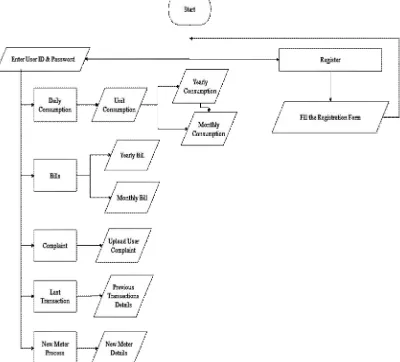
Figure 4: Data flow diagram of mobile application module.
C. Smart Meters
[image:4.612.206.406.304.485.2]The Smart meter installation shall be as per the rules and regulations and practices of Utility. After meter installation, customer identification no., meter ID, its hardware & software configuration, name plate details, make shall be updated in control server. The information would also be updated on the portal/app for providing information to consumers.
D. Data Distribution Algorithm
This algorithm is designed to minimize computational redundancy and maximize use of the memory bandwidth of each workstation. It works by partitioning the current maximal-frequency item set candidates (like those generated by Apriori) amongst work stations [13]. Thus, each workstation examines a disjoint set of possibilities; however, each workstation must scan the entire database to examine its candidates. Thus this algorithm trades off a huge amount of communication (to fetch the database partitions stored on other workstations) for better use of machine resources and to avoid duplicated work. [12] The general method in our study is to allocate different database resources to different classes of user first and then apply the distribution strategy to each user class. Such procedure is expressed in the following steps:
Step1: Use resource allocation strategy to decide the number of database nodes of each user class.
Deriving database access pattern from the character tics of this class.Collecting and analyzing the related statistics information. Applying data distribution algorithm.
IV. RESULT AND DISSCUSSION
A. Communication Infrastructure
The communication infrastructure should either be based on cellular network. The communication network shall be based on suitable standards from for NAN or WAN network. Communication network shall provide reliable medium for two-way communication between various nodes (smart meter) & HES. RF based network should use license free frequency band available in India.
Display: Smart meters will send and display information usage of electricity energy to customers for billing in real-time. Besides, the information of real time consumption displayed on smart meters helps customers to manage their demand efficiently.
Synchronization: Typically, smart meters transmit data of customers to the collector systems or central hubs for billing and data analysis. Hence, timing synchronization is very important for reliable transmission of data.
Snapshot 2: Connection to SM and Server.
The connection is establishing with the Smart meter and the database. After the connection is established, the data receive to the server using GSM. The data contain two parameters i.e. Meter_ID and unit. The DCU provides the central link between Smart Meters and control server, enabling continuous/periodic meter reading and control.
Snapshot 5: Details of Customer and Smart Meter Reading.
After meter installation, customer identification no., meter ID, its hardware & software configuration, name plate details, make shall be updated in control server. The meter ID and consumed unit in every one minutes will be send to the control server via GSM. Then the control server sends this Packet to the MDM for updating the database to the respected smart meter owner/consumer.
Snapshot 6: Graph of Consumption of electricity on monthly basis.
V. CONCLUSION
AMI based on smart meters in SG has been identified, and their state-of-the-art research activities were reviewed. In this paper, considered the problem of data collection in SG AMI networks. These approaches are implemented and compared with the strategy of setting the same time schedule for all SMs. We also proposed and evaluated strategies for periodic data reporting from SMs. The idea of the approaches was to set the time schedule for every SM individually in order to reduce the end to end packet delay. The results indicated that our proposed approaches outperform the same time schedule and significant reductions in the delay can be achieved and provides the best performance.
VI. ACKNOWLEDGMENT
I would like to express my deepest appreciation to all those who provided me the possibility to complete this research. A special gratitude I give to our final year project guide, Prof. A. N. Thakare, whose contribution in stimulating suggestions and encouragement, helped me to coordinate my project especially in writing this research. My thanks and appreciations also go to my colleague in developing the project and people who have willingly helped me out with their abilities. My thanks and appreciations also go to my colleague in developing the project and people who have willingly helped me out with their abilities.
REFERENCES
[1] Nico Saputro, Kemal Akkaya, “Investigation of Smart Meter Data Reporting Strategies for Optimized Performance in Smart Grid AMI Networks” IEEE Internet ofThings Journal 2017.
[2] Samet Tonyali, Kemal Akkaya. “A Reliable Data Aggregation Mechanism with Homomorphic Encryption in Smart Grid AMI Networks”, 13th IEEE Annual Consumer Communications & Networking Conference 2016.
[3] N. Saputro, K. Akkaya, and S. Uludag, “A survey of routing protocols for smart grid communications” Comput. Netw., vol. 56, no. 11, pp.2742–2771, Jul. 2012.
[5] Hamid Gharavi, Chong Xu “Traffic Scheduling Technique for Smart Grid Advanced Metering Applications” IEEE Transaction on communication Vol. 60 June 2012.
[6] Athar Ali Khan, Martin Reisslein, “Cognitive Radio for Smart Grids: Survey of Architectures, Spectrum Sensing Mechanisms, and Networking Protocols”, IEEE Communications Surveys & Tutorials 2015.
[7] S. Shao, S. Guo, X. Qiu, L. Meng, Y. Jiao, and W. Wei, “Traffic scheduling for wireless meter data collection in smart grid communication network,” in Computing, Communication and Networking Technologies International Conference on, July 2014.
[8] Nithin.S, N.Radhika “Smart Grid Test Bed Based On GSM “, International Conference on Communication Technology and System Design Elsevier 2011. [9] V. Cagri Gungor, Taskin Kocak, “A Survey on Smart Grid Potential Applications and Communication Requirements “IEEE Transaction on industrial
informatics Vol. 9 February 2013.
[10] Bassam Aoun, Raouf Boutaba, “Gateway Placement Optimization in Wireless Mesh Networks with QoS Constraints” IEEE Journal on selected areas in communication Vol. 24 Nov 2006.
[11] Trong Nghia Le, Wen‐Long Chin, “Advanced Metering Infrastructure Based on Smart Meters in Smart Grid” Inspirations for Energy Utilities – INTECH June 29, 2016.
[12] Haewei Ye, “Data Distribution Strategies for Providing Database Scalability in E-commerce Applications” IEEE 1530-1354/01 JAN 2001.
[13] Bassam Aoun, Raouf Boutaba, “Gateway Placement Optimization in Wireless Mesh Networks with QoS Constraints” IEEE Journal on selected areas in communication Vol. 24 Nov 2006.
[14] Sujni Paul,” Parallel and Distributed Data Mining, New Fundamental Technologies in Data Mining” INTECH ISBN: 978-953-307-547-1 JAN 2011. [15] Ramyar Rashed Mohassel, “A survey on Advanced Metering Infrastructure” ELSEVIER June 2014.
![Figure 1: Architectural model of conventional energy meter and smart meter [11].](https://thumb-us.123doks.com/thumbv2/123dok_us/1257696.653165/1.612.191.403.543.717/figure-architectural-model-conventional-energy-meter-smart-meter.webp)