by Combining Human Elicitation and
Machine Learning
Kemal Oflazer*
Sabancl UniversityMarjorie McShane*
New Mexico State UniversitySergei Nirenburg*
New Mexico State University
This paper presents a semiautomatic technique for developing broad-coverage finite-state mor-
phological analyzers for use in natural language processing applications. It consists of three
components--elicitation of linguistic information from humans, a machine learning bootstrap-
ping scheme, and a testing environment. The three components are applied iteratively until a
threshold of output quality is attained. The initial application of this technique is for the mor-
phology of low-density languages in the context of the Expedition project at NMS U Computing
Research Laboratory. This elicit-build-test technique compiles lexical and inflectional information
elicited from a human into a finite-state transducer lexicon and combines this with a sequence
of morphographemic rewrite rules that is induced using transformation-based learning from
the elicited examples. The resulting morphological analyzer is then tested against a test set,
and any corrections are fed back into the learning procedure, which then builds an improved
analyzer.
1. Introduction
Computational Linguistics Volume 27, Number 1
The work reported in this paper describes the process of building and refining mor- phological analyzers using data elicited from human informants and machine learning. The main use of machine learning in our current approach is in the automatic learning of formal rewrite or replace rules for morphographemic changes derived from the ex- amples provided by the informant. The subtask of accounting for morphographemic changes is perhaps one of the more complicated aspects of building an analyzer; by automating it, we expect to improve productivity.
After a review of related work, we very briefly describe the Boas project, of which the current work is a part. Subsequent sections describe the details of the approach, the architecture of the morphological analyzer, the elicited descriptive data, and the computational processes performed on this data, including segmentation and the in- duction of morphographemic rules. We then provide a detailed example of applying this approach to developing a morphological analyzer for Polish. Finally, we provide some conclusions and ideas for future work.
2. Related Work
Machine learning techniques are widely employed in many aspects of language pro- cessing. The availability of large, annotated corpora has fueled a significant amount of work in the application of machine learning techniques to language processing prob- lems, such as part-of-speech tagging, grammar induction, and sense disambiguation, as witnessed b y recent workshops and journal issues dedicated to this topic. 1 The cur- rent work attempts to contribute to this literature b y describing a human-supervised machine learning approach to the induction of morphological analyzers--a problem that, surprisingly, has received little attention.
There have been a number of studies on inducing morphographemic rules from a list of inflected words and a root w o r d list. Johnson (1984) presents a scheme for in- ducing phonological rules from surface data, mainly in the context of studying certain aspects of language acquisition. The premise is that languages have a finite number of alternations to be handled b y morphographemic rules and a fixed number of contexts in which they appear; so if there is enough data, phonological rewrite rules can be generated to account for the data. Rules are ordered b y some notion of "surfaciness", and at each stage the most surfacy rule--the rule with the most transparent context-- is selected. Golding and Thompson (1985) describe an approach for inducing rules of English w o r d formation from a corpus of root forms and the corresponding inflected forms. The procedure described there generates a sequence of transformation rules, 2 each specifying h o w to perform a particular inflection.
More recently, Theron and Cloete (1997) have presented a scheme for obtaining two-level morphology rules from a set of aligned segmented and surface pairs. They use the notion of string edit sequences, assuming that only insertions and deletions are applied to a root form to get the inflected form. They determine the root form associated with an inflected form (and consequently the suffixes and prefixes) b y ex- haustively matching the inflected form against all root words. The motivation is that "real" suffixes will appear frequently in the corpus of inflected forms. Once common suffixes and prefixes are identified, the segmentation for an inflected word can be determined b y choosing the segmentation with the most frequently occurring affix segments; the remainder is then considered the root. While this procedure seems to
be reasonable for a small root word list, the potential for "noisy" or incorrect align- ments is quite high when the corpus of inflected forms is large and the procedure is not given any prior knowledge of possible segmentations. As a result, automati- cally selecting the "correct" segmentation becomes nontrivial. An additional compli- cation is that allomorphs show up as distinct affixes and their counts in segmentations are not accumulated, which might lead to actual segmentations being missed due to fragmentation. The rules are not induced via a learning scheme: aligned pairs are compressed into a special data structure and traversals over this data structure gener- ate morphographemic rules. Theron and Cloete have experimented with pluralization in Afrikaans, and the resulting system has shown about 94% accuracy on unseen words.
Goldsmith (1998) has used an unsupervised learning method based on the mini- m u m description length principle to learn the "morphology" of a number of languages. What is learned is a set of root words and affixes, and common inflectional-pattern classes. The system requires just a corpus of words in a language. In the absence of any root word list to use as a scaffolding, the shortest forms that appear frequently are assumed to be roots, and observed surface forms are then either generated by the concatenative affixation of suffixes or by rewrite rules. 3 Since the system has no notion of what the roots and their part-of-speech values really are, and what morphological information is encoded by the affixes, this information needs to be retrofitted manually by a human, who has to weed through a large number of noisy rules. We feel that this approach, while quite novel, can be used to build real-world morphological analyzers only after substantial modifications are made.
3. The BOAS Project
Boas (Nirenburg 1998; Nirenburg and Raskin 1998) is a semiautomatic knowledge elicitation system that guides a team of two people (a language informant and a programmer) through the process of developing the static knowledge sources required to produce a moderate-quality, broad-coverage MT system from any "low-density" language into English. Boas contains knowledge about human language phenomena and various realizations of these phenomena in a number of specific languages, as well as extensive pedagogical support, making the system a kind of "linguist in a box," intended to help nonprofessional users with the task. In the spirit of the goal- driven, "demand-side" approach to computational applications of language processing (Nirenburg and Raskin 1999), the process of acquiring this knowledge has been split into two steps: (i) acquiring the descriptive, declarative knowledge about a language and (ii) deriving operational knowledge (content for the processing engines) from this descriptive knowledge.
An important goal that we strive to achieve regarding these descriptive and op- erational pieces of information, be they elicited from human informants or acquired via machine learning, is that they be transparent, human-readable, and, where neces- sary, human-maintainable and human-extendable, contrary to the opaque and unin- terpretable representations acquired by various statistical learning paradigms.
Before proceeding any further, we would also like to make explicit the aims and limitations of our approach. Our main goal is to significantly expedite the develop- ment of a morphological analyzer. It is clear that for inflectional languages where each
Computational Linguistics Volume 27, Number 1
root w o r d can be associated with a finite number of word forms, one can, with a lot of work, generate a list of word forms with associated morphological features encoded, then use this as a lookup table to analyze word forms in input texts. Since this pro- cess is time consuming, expensive, and error-prone, it is something we would like to avoid. We prefer to capture general morphophonological and morphographemic phe- nomena using sample paradigms as the basis of lexical abstractions. This reduces the acquisition process to assigning citation forms to one of the established paradigms; the automatic generation process described below does the rest of the work. 4 This process is still imperfect, as we expect human informants to err in making their paradigm abstractions and to overlook details and exceptions. So, the whole pro- cess is an iterative one, with convergence to a wide-coverage analyzer coming slowly at the beginning (where morphological phenomena and lexicon abstractions are be- ing defined and tested), but significantly speeding up once wholesale lexical acqui- sition starts. Since the generation of the operational content (data files to be used by the morphological analyzer engine) from the elicited descriptions is expected to take only a few minutes, feedback on operational performance can be provided very quickly.
H u m a n languages have many diverse morphological phenomena and it is not our intent at this point to have a universal architecture that can accommodate any and all phenomena. Rather, we propose an extensible approach that can accommo- date additional functionality in future incarnations of Boas. We also intend to limit morphological processing to single tokens and to deal with multitoken phenomena, such as partial or full w o r d reduplications, with additional machinery that we do not discuss here.
4. The Elicit-Build-Test Loop
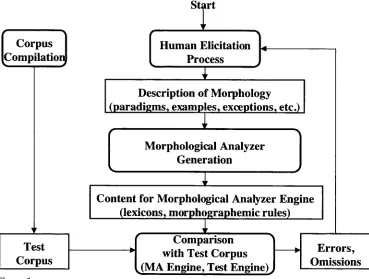
In this paper we concentrate on operational content in the context of building a mor- phological analyzer. To determine this content, we integrate the information provided b y the informant with automatically derived information. The whole process is an iterative one, as illustrated in Figure 1: the elicited information is transformed into the operational data required b y the generic morphological analyzer engine and the resulting analyzer is then tested on a test corpus, s'6 Any discrepancies between the output of the analyzer and the test corpus are then analyzed and potential sources of errors are given as feedback to the elicitation process. Currently, this feedback is limited to identifying problems in handling morphographemic processes (such as for instance the change of word-final -y to -i when the suffix -est is added).
The box in Figure 1 labeled Morphological Analyzer Generation is the main com- ponent, which takes in the elicited information and generates a series of regular ex- pressions for describing the morphological lexicon and morphographemic rules. The morphographemic rules describing changes in spelling as a result of affixation opera- tions are induced from the examples provided b y using transformation-based learning (Brill 1995; Satta and Henderson 1997). The result is an ordered set of contextual re- place or rewrite rules, much like those used in phonology.
4 We u s e the t e r m citation f o r m to refer to the w o r d f o r m that is u s e d to look u p a g i v e n inflected f o r m in a dictionary. It m a y be t h e root or s t e m f o r m that affixation is a p p l i e d to, or it m a y h a v e a d d i t i o n a l m o r p h o l o g i c a l m a r k e r s to indicate its citation f o r m status.
5 We c u r r e n t l y u s e XRCE finite-state tools as o u r target e n v i r o n m e n t ( K a r t t u n e n et al. 1996).
C o r p u s 1
~ompilatiol~
Start
I Human Elicitation
1~Process
I
Description
of Morphology
(paradigms~ examples~ exceptions~ etc.)
[image:5.468.35.404.61.340.2]i Test I
Corpus
Omissions
Err°rs, I
Figure 1
I
Morphological Analyzer
1
Generation
[ Content for Morphological Analyzer Engine ]
(lexicons~ morphographemic rules)
["
Comparison
~
~l
~'|
with Test Corpus
[
[,(MA Engine, Test Engine)J "[
The elicit-build-test paradigm for bootstrapping a morphological analyzer.
4.1 Morphological Analyzer Architecture
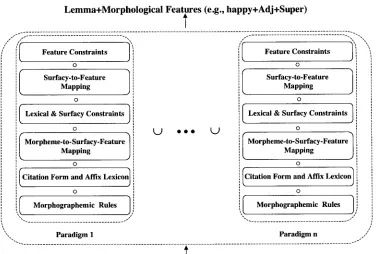
We adopt the general approach advocated b y Karttunen (1994) a n d build the morpho- logical analyzer as the combination of several finite-state transducers, some of which are constructed directly from the elicited information, a n d others of which are con- structed from the o u t p u t of the machine learning stage. Since the combination of the transducers is c o m p u t e d at compile-time, there are no run-time overheads. The ba- sic architecture of the morphological analyzer is depicted in Figure 2. The analyzer consists of the u n i o n of transducers, each of which implements the morphological analysis process for one paradigm. Each transducer is the composition of a n u m b e r of components. These components (from bottom to top) are described below:
.
.
The bottom c o m p o n e n t is an ordered sequence of m o r p h o g r a p h e m i c rules that are learned via transformation-based learning from the sample inflectional p a r a d i g m s provided b y the h u m a n informant. These rules are then composed into one finite-state transducer (Kaplan a n d Kay 1994).
The
citation form and affix lexicon
contains the citation forms a n d the affixes. We currently assume that all affixation is concatenative a n d that the lexicon is described b y a regular expression of the sort[ P r e f i x e s ]* [ C i t a t i o n F o r m s ] [ S u f f i x e s
].7
Computational Linguistics Volume 27, Number 1
Lemma+Morphological Features (e.g., happy+Adj+Super)
. - - - ~ ZZ-_Z,Z,Z-,--22-7.--7.2--ZZZZZZZZZ--Z'2~ . . . 7 ~ 2 - = 2 = 2 - = 2 - : 2 2 : : 2 = : = : = = - = = : = = : = : 2 = : = : : ~ - - .
i
Feature ConstraintsJ
Feature Constraintso
',
I
Surfacy-to-Feature
Mapping
1
O
I Lexical
& Surfacy Constraints I
U 0 0 0 U
O
Surfacy-to-FeatureMapping
)
,,
0
•
1'
Lexical
& Surfacy
ConstraintsO
I Morpheme-to-Surf icy-Feature
1
r
Morpheme-to-Surfacy-FeatureMapping J Mapping
J
O o
nl
1
Citation Form and Affix Lexico itation Form and Affix Lexicon
O O
[,I
Morphographemic RuleslJ
![
Morphographemic Rules11
Paradigm 1 Paradigm
n
" ' ' 4 . . . I " *
Surface Form (e.g., happiest)
Figure 2
General architecture of the morphological analyzer.
.
.
.
The morpheme to surfacy feature mapping essentially m a p s
m o r p h e m e s to feature n a m e s b u t retains s o m e e n c o d i n g of the surface m o r p h e m e . Thus, a l l o m o r p h s that e n c o d e the same feature w o u l d be m a p p e d to different surfacy features.
The lexical a n d s u r f a c y c o n s t r a i n t s specify a n y conditions to constrain the possibly o v e r g e n e r a t i n g m o r p h o t a c t i c s of the citation f o r m a n d m o r p h e m e lexicons. These constraints can be e n c o d e d using the citation f o r m s a n d the surfacy features g e n e r a t e d b y the p r e v i o u s m a p p i n g . The use of surfacy features also enables reference to zero m o r p h e m e s , w h i c h otherwise c o u l d not be used. For instance, if in some p a r a d i g m a certain prefix does not co-occur w i t h a certain suffix, or always occurs w i t h some other suffix, or if a certain citation f o r m in that p a r a d i g m has exceptional b e h a v i o r w i t h respect to one or m o r e of the affixes, or if the affixal a U o m o r p h that goes w i t h a certain citation f o r m d e p e n d s o n the p r o p e r t i e s of the citation form, these are e n c o d e d at this level as finite-state constraints.
[image:6.468.64.440.58.312.2]. The feature constraints specify constraints among the symbolic features. They are different means of constraining morphotactics than the one provided by lexical and surfacy constraints. At this level, one refers to and constrains symbolic morphosyntactic features as opposed to surfacy features. This m a y provide a more natural or convenient abstraction, especially for languages with long-distance morphotactic constraints.
These six finite-state transducers are composed to yield a transducer for the paradigm. The union of the transducers for all paradigms produces one (possibly large) trans- ducer for morphological analysis, where surface strings applied at the lower end pro- duce all possible analyses at the upper end.
4.2 Information Elicited from Human Informants
The Boas environment guides the language informant through a series of questions leading up to paradigm delineation. The informant indicates the parameters for which a given part of speech inflects (e.g., Case, Number), the relevant values for those pa- rameters (e.g., Nominative, Accusative; Singular, Plural), and the licit combinations of parameter values (e.g., Nominative Singular, Nominative Plural). The informant then posits any number of paradigms, whose members are expected to show sim- ilar patterns of inflection. It is assumed that all citation forms that belong to the same paradigm take essentially the same set of inflectional affixes (perhaps subject to morphophonological variations). It is expected that the citation forms a n d / o r the affixes may undergo systematic or idiosyncratic morphographemic changes. It is also assumed that certain citation forms in a given paradigm may behave in some excep- tional w a y (for instance, contrary to all other citation forms, a given citation form m a y not have one of the inflected forms.) A paradigm description provides the full inflectional pattern for one characteristic or distinguished citation form and additional examples for any other citation forms whose inflectional forms undergo nonstandard morphographemic changes. If necessary, any lexical and feature constraints can be encoded. Currently the provisions we have for such constraints are limited to writing regular expressions (albeit at a much higher level than standard regular expressions); however, capturing such constraints using a more natural language (e.g., Ranta 1998) can be incorporated into future versions.
4.3 Elicited Descriptive Data
Figure 3 presents the encoding of the information elicited for one paradigm of a Polish morphological analyzer, which will be covered in detail later, s
The data elicited using the user interface component of Boas is converted into a description text file with various components delineated by SGML-like tags. The components in the description are as follows:
• The <LANGUAGE-DESCRIPTION... > component lists information about the
language and specifies its vowels and consonants, and other orthographic symbols that do not fall into those two groups.
• A paradigm description starts with the tag <PARADIGM NAME=... >, which lists the name of the paradigm, its part-of-speech category, and any
Computational Linguistics Volume 27, Number 1
< L A N G U A G E - D E S C R I P T I O N T Y P E = " m o r p h o l o g y " N A M E = " P o l i s h "
A L P H A B E T = " a ~ b c d d e ~ f g h i j k l h n n f i o 6 p q r s ~ t u v w x y z ~ z " V O W E L S = " a g e @ i o 6 u y "
C O N S O N A N T S = "bcddfghjkl~mnfipqrs~tvwxz~z" O T H E R = "">
< P A R A D I G M N A M E = " M a s c l n U S t a r t " P O S = "Noun" F E A T U R E S = " M a s c u l i n e " > < P R I M A R Y - E X A M P L E >
< I N F - G R O U P >
< P R I M A R Y - C I T - F O R M F O R M = " t e l e f o n " >
< I N F - F O R M F O R M = " t e l e f o n " F E A T U R E = "Nom. S g . " > < I N F - F O R M F O R M = " t s l e f o n " F E A T U R E = " A c c . S g . " >
< I N F - F O R M F O R M = " t e l e f o n a c h " F E A T U R E = " L o c . P l . " > < I N F - F O R M F O R M = " t e l e f o n a m i " F E A T U R E = " I n s t r . P l . " > < / I N F - G R O U P >
< / P R I M A R Y - E X A M P L E > < E X A M P L E >
< I N F - G R O U P >
< / I N F - G R O U P > < / E X A M P L E >
< L E X I C O N >
< / L E X I C O N > < / P A R A D I G M >
< C I T - F O R M F O R M = " a k c e n t " >
< I N F - F O R M F O R M = " a k c e n t " F E A T U R E = "Nom. S g . " > < I N F - F O R M F O R M = " a k c e n c i e " F E A T U R E = " L o c . S g . " >
< C I T - F O R M F O R M = " s t r o n " > < C I T - F O R M F O R M = " k l u b " > < C I T - F O R M F O R M = " s k l e p " >
< / L A N G U A G E - D E S C R I P T I O N >
Figure 3
Sample paradigm description generated by Boas elicitation.
additional morphosyntactic features that are common to all citation forms in this paradigm. In the example in Figure 3, the paradigm is for masculine nouns. Everything up to the </PARADIGM> tag is part of the descriptive data for the paradigm. This descriptive data consists of a primary example, a series of zero or more additional examples, and the lexicon.
The primary example is given between the <PRIMARY-EXAMPLE> and
</PRIMARY-EXAMPLE> tags. The description is given as a sequence of one
or m o r e inflection groups between <INF-GROUP> and </INF-GROUP> tags.
In s o m e instances, a given lexical item can use different citation forms in
different inflectional forms. For example, one citation form might be
used with multisyllable affixes and another with single-syllable affixes. Thus, a given lexical item can have multiple citation forms, each of which gets associated with a mutually exclusive subset of inflectional forms. All the citation forms for a given lexical item, plus all its inflectional forms, are represented in an inflection group. If the association of citation forms with inflectional forms is predictable (as indicated by the language informant), the subsets of inflectional forms are processed separately; if not, we assume that all citation forms can be used in all inflectional forms and hence overgenerate. Manual constraints can later be added, if necessary, to constrain this overgeneration.
Additional examples are provided between <EXAMPLE> and </EXAMPLE> tags. Examples contain new citation forms plus any inflectional forms that are not predictable based on the primary example. Each example is considered an inflectional group and is enclosed within the
corresponding tags.
The citation forms given in the primary example and any additional examples are considered to be a part of the citation form lexicon of the paradigm definition. Any additional citation forms in this paradigm are listed between the <LEXICON> and </LEXICON> tags.
5. Generating the Morphological Analyzer
The morphological analyzer is a finite-state transducer that is actually the union of the transducers for each paradigm definition in the description provided. Thus, the elicited data is processed one paradigm at a time. For each paradigm we proceed as follows:
.
.
.
The elicited primary citation form and associated inflected forms are processed to find the "best" segmentation of the forms into
stem
and affixes. 9 Although we allow for inflectional forms to have both a prefix and a suffix (one of each), we expect only suffixation to be employed by the inflecting languages with which we are dealing (Sproat 1992).Once the affixes are determined, we segment the inflected forms for the primary example and any additional examples provided, and pair them with the corresponding surface forms. The segmented forms are now based on the citation form plus the affixes (not the stem). The reason is that we expect the morphological analyzer to generate the citation form for further access to lexical databases to be used in the applications. The resulting segmented form-surface form pairs make up the example base of the paradigm.
The citation forms given in the primary example, in additional examples, and explicitly in the lexicon definition of the elicited data, along with the mapping from suffix strings to the corresponding morphosyntactic features, are compiled (by our morphological analyzer generating system) into suitable regular expressions (expressed using the regular
Computational Linguistics Volume 27, Number 1
.
.
expression language of the XRCE finite-state tools [Karttunen et al. 1996]). l°
The example base of the paradigm generated in step 2 is then used by a learning algorithm to generate a sequence of morphographemic rules (Kaplan and Kay 1994) that handle the morphographemic phenomena.
The regular expressions for the lexicon in step 3 and the regular expressions for the morphographemic rules induced in step 4 are then compiled into finite-state transducers and combined by composition to generate the finite-state morphological analyzer for the paradigm.
The resulting finite-state transducers for each paradigm are then unioned to give the transducer for the complete set of paradigms.
5.1 Determining Segmentation and Affixes
The suffixes and prefixes in a paradigm are determined by segmenting the inflected forms provided for the primary example. This process is complicated by the fact that the citation form may not correspond to the stem--it m a y contain a morphological in- dication that it is the citation form. Furthermore, since the language informant provides only a small number of examples, statistically motivated approaches like the one sug- gested by Theron and Cleoete (1997) are not applicable. We have experimented with a number of approaches and have found that the following approach works quite well. Using the notion of description length (Rissanen 1989), we try to find a stem and a set of affixes that account for all the inflected forms of the primary example. Let C = (cl, c2 . . .
ccl
be the character string for the citation form in the primary example(ci
are symbols in the alphabet of the language). LetSk
= (cl, c2 . . .Ckl, 1 < k <_ c
be a (string) prefix of C length k. We assume that the stem onto which morphological affixes are attached is
Sk
for some k. 11 The set of inflectional forms given in the primaryJ J ,fill (f//are alphabet
example are {F1,
F2,..., El},
with eachFj = ~f~,f~
. . . . symbols in theof the language and
lj
is the length of the jth form). The functioned(v,w) (ed
for edit distance), where v and w are strings, measures the minimum number of symbol insertions and deletions (but not substitutions) that can be applied to v to obtain w (Damerau 1964). 12 We definej=f
d(Sk) = k + ~_~ ed(Sk, Fj)
j = l
as a measure of the information needed to account for all the inflected forms. The first term above, k, is the length of the stem. The second term, the summation, measures how m a n y symbols must be inserted and deleted to obtain the inflected form. The
Sk
with the minimumd(Sk)
is then chosen as the stem S. Creating segmentations based on stem S proceeds as follows: To determine the affixes in each inflected formFj
= ~f~,f~ . . . f/i/, we compute the projection of the stemPj = ~f~ .. . . ,f/el in Fj,
as that10 Note that other finite state tools could also be u s e d (e.g., Mohri, Pereira a n d Riley 1998; v a n N o o r d 1999).
11 The stem can also be an arbitrary substring of C, not just s o m e initial prefix. O u r a p p r o a c h can certainly extend to that.
substring of Fj whose alignment with S provides the m i n i m u m edit distance, that is,
P j = argmin ed ( S, ~f~ . . . /d,>)
(f~ ... ,fd,>,l<_b'<e'<lj
Then we select the substring ~f~ . . . f~-l> of Fj (if it exists) as the prefix and ... ,J~}
q~+l"
(if it exists) as the suffix. If there are multiple substrings of Fj that give the same (minimum) edit distance when aligned with S, we prefer the longer substring. We then create
f~_l + C + 9<~+1
. . . . . .
as an aligned segmented form-surface form pair and add it to the example base that we will use in the learning stage. Note that we now use the citation form C, and not the stem S, as a part of the segmented form.
Thus, at the end of the process we generate pairs of inflected forms and their corresponding segmented forms to be used in the derivation of the morphographemic rules. These pairs come from both the inflected forms given in the primary example and from any additional examples given.
For example, suppose we have the following primary example:
< P R I M A R Y - E X A M P L E >
< I N F - G R O U P >
< P R I M A R Y - C I T - F O R M F O R M = " s t r o n a " >
< I N F - F O R M F O R M = " s t r o n a " F E A T U R E = "Nom. S g . " >
< I N F - F O R M F O R M = " s t r o n g " F E A T U R E = "Acc. S g . " >
< I N F - F O R M F O R M = " s t r o n y " F E A T U R E = "Gen. S g . " >
< I N F - F O R M F O R M = " s t r o n i e " F E A T U R E = " D a t . S g . " >
< I N F - F O R M F O R M = " s t r o n i e " F E A T U R E = " L o c . S g . " >
< I N F - F O R M F O R M = " s t r o n g " F E A T U R E = " I n s t r . S g . " >
< I N F - F O R M F O R M = " s t r o n y " F E A T U R E = "Nom. P l . " >
< I N F - F O R M F O R M = " s t r o n y " F E A T U R E = " A c c . P I . " >
< I N F - F O R M F O R M = " s t r o n " F E A T U R E = "Gen. P l . " >
< I N F - F O R M F O R M = " s t r o n o m " F E A T U R E = "Dat. P l . " >
< I N F - F O R M F O R M = " s t r o n a c h " F E A T U R E = " L o c . P l . " >
< I N F - F O R M F O R M = " s t r o n a m i " F E A T U R E = " I n s t r . P l . " >
< / I N F - G R O U P >
< / P R I M A R Y - E X A M P L E >
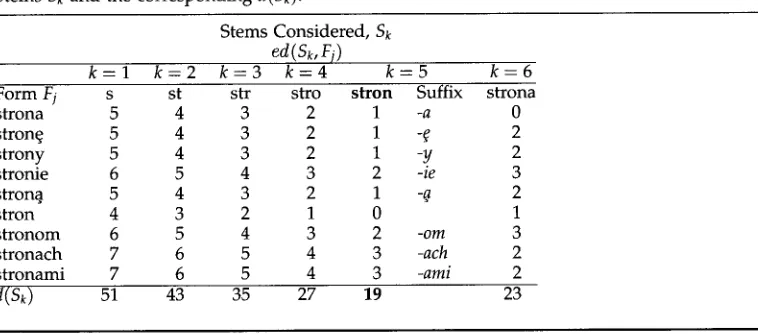
For this example, stems Sk: s, st, str, stro, stron, strona, are considered. Table 1 tabulates d(Sk) considering all the unique inflected forms above. It can be seen that the value of d(Ss) is minimum for $5 = S = stron. We then determine suffixes based on this stem selection. The suffixes are given in this table under k = 5, where the stem
S = stron perfectly aligns with the initial substring stron in each inflected form Fj, with 0 edit distance.
The segmented form-surface form pairs in Table 2 are then generated from the alignment of the stem with each surface form.
5.2 Learning Segmentation and Morphographemic Rules
Computational Linguistics Volume 27, Number 1
Table 1
Stems Sk and the corresponding
d(Sk).
k = l k = 2
Stems Considered, Sk
k = 3 k = 4 k = 5 k = 6
Form Fj s st str stro stron
strona 5 4 3 2 1
stron~ 5 4 3 2 1
strony 5 4 3 2 1
stronie 6 5 4 3 2
stron G 5 4 3 2 1
stron 4 3 2 1 0
stronom 6 5 4 3 2
stronach 7 6 5 4 3
stronami 7 6 5 4 3
Suffix -a -¢ -y
-ie
-om -ach -ami
strona 0 2 2 3 2 1 3 2 2
d(Sk) 51 43 35 27 19
Table 2
The segmented and surface pair examples obtained.
Segmented Surface
strona+a strona
strona+~ stron~
strona+y strony
strona+ie stronie strona+ G stron G
strona+ stron
strona+om stronom
strona+ach stronach strona+ami stronami
of each p a r a d i g m . 13 The e x a m p l e s e g m e n t a t i o n s are fed into the learning m o d u l e to induce m o r p h o g r a p h e m i c rules.
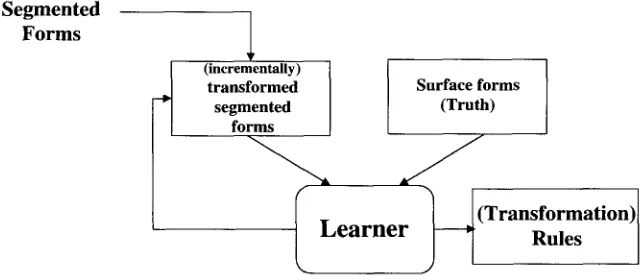
5.2.1 G e n e r a t i n g C a n d i d a t e R u l e s f r o m E x a m p l e s . The p r e p r o c e s s i n g stage yields a list of pairs of s e g m e n t e d lexical f o r m s a n d surface forms. The s e g m e n t e d f o r m s contain the citation f o r m s a n d affixes; the affix b o u n d a r i e s are m a r k e d b y the + symbol. This list is then p r o c e s s e d b y a t r a n s f o r m a t i o n - b a s e d learning p a r a d i g m (Brill 1995; Satta a n d H e n d e r s o n 1997), as illustrated in Figure 4. The basic idea is that w e consider the list of s e g m e n t e d w o r d s as o u r i n p u t a n d find t r a n s f o r m a t i o n rules (expressed as contextual rewrite rules) to incrementally t r a n s f o r m this list into the list of surface forms. The t r a n s f o r m a t i o n w e choose at e v e r y iteration is the one that m a k e s the list of s e g m e n t e d f o r m s closest to the list of surface forms.
The first step in the learning process is an initial a l i g n m e n t of pairs u s i n g a stan- d a r d d y n a m i c p r o g r a m m i n g scheme. The o n l y constraints in the a l i g n m e n t are: (i) a + in the s e g m e n t e d lexical f o r m is a l w a y s aligned w i t h an e m p t y string o n the surface side, n o t a t e d b y 0; (ii) a c o n s o n a n t o n one side is a l w a y s aligned w i t h a c o n s o n a n t or 0 on the other side, a n d likewise for vowels; (iii) the a l i g n m e n t m u s t c o r r e s p o n d to
[image:12.468.55.434.89.256.2]S e g m e n t e d F o r m s
I
Figure 4
l
(incrementally)
transformed segmented
forms
Learner
Surface forms (Truth)
Transformation-based learning of morphographemic rules.
the m i n i m u m edit distance b e t w e e n the original lexical a n d surface forms. 14 F r o m this p o i n t on, w e will use a simple example from English to clarify o u r points.
A s s u m e that w e h a v e the pairs ( u n + h a p p y + e s t , u n h a p p i e s t ) a n d (shop+ed, shopped) in o u r e x a m p l e base. We align these a n d d e t e r m i n e the total n u m b e r of " e r r o r s " in the s e g m e n t e d forms that w e h a v e to fix to m a k e all s e g m e n t e d forms m a t c h the c o r r e s p o n d i n g surface forms. The initial a l i g n m e n t p r o d u c e s the aligned pairs:
un + h a p p y + est s h o p O + ed un 0 h a p p i 0 est shopp 0 ed
with a total of five errors. F r o m each s e g m e n t e d pair w e generate rewrite rules of the sort is
u - > i [] L e f t C o n t e x t , R i g h t C o n t e x t ;
w h e r e u(pper) is a s y m b o l in the s e g m e n t e d form, l ( o w e r ) is a s y m b o l in the surface form. Rules are g e n e r a t e d only from those aligned s y m b o l pairs that are different. L e f t C o n t e x t a n d R i g h t C o n t e x t are simple regular expressions describing contexts in the s e g m e n t e d side (up to some small length), also taking into account the w o r d boundaries. For instance, from the first aligned-pair example, this p r o c e d u r e w o u l d generate rules such as the following ( d e p e n d i n g on the a m o u n t of left a n d right context allowed):
y -> i y -> i y -> i
+ -> 0 + -> 0
+ -> 0 + -> 0
p _ y - > i
p _ + e s y - > i
p _ + e s t # y - > i
# U n
e s t
e s t # . .
e s t #
P p y -
+ -> 0
p _ + e p _ + e s t p p _ + e
# u n _ h a p
14 We arbitrarily choose one if there are multiple legitimate alignments.
[image:13.468.57.379.63.203.2]Computational Linguistics Volume 27, Number 1
The # symbol denotes a word boundary and is intended to capture any word-initial and word-final phenomena. The segmentation rules (+ -> 0) require at least some minimal left or right context (usually longer than the minimal context for other rules in order to produce more accurate segmentation decisions). We disallow contexts that consist only of a morpheme boundary, as such contexts are usually not informative. It should be noted that these rules transform a segmented form into a surface form (contrary to what may be expected for analysis). This lets us capture situations where multiple segmented forms map to the same surface form, which occurs when the language has morphological ambiguity. Thus, in a reverse lookup, a given surface form may be interpreted in multiple ways, if applicable.
Since we have m a n y examples of aligned pairs in our example base, it is likely that a given rule will be generated from m a n y pairs. For instance, if the pairs (stop+ed, stopped) and ( t r i p + e d , t r i p p e d ) were also in the list, the gemination rule 0 -> p
I I p - + e d (along with certain others) will also be generated from these examples. We count how m a n y times a rule is generated and associate this number with the rule as its promise, meaning that it promises to fix this m a n y "errors" if it is selected to apply to the current list of segmented forms.
5.2.2 G e n e r a l i z i n g R u l e s . The candidate rules generated by the processes described above refer to specific strings of symbols as left and right contexts. It is, however, possible to obtain more generalized rules by classifying the symbols in the alphabet into phonologically relevant groups, like vowels and consonants. The benefit of this approach is that the number of rules thus induced is typically smaller, and more unseen cases can be covered.
For instance, in addition to a rule like 0 -> p I I p - + e , the rules
0 -> p 0 -> p
CONSONANTS _
p _ + VOWELS + e
0 - > p C O N S O N A N T S _ + VOWELS
can be generated, where symbols such as CONSONANTS and VOWELS stand for regu- lar expressions denoting the union of relevant symbols in the alphabet. The promise scores of the generalized rules are found b y adding the promise scores of the origi- nal rules generating them. Generalization substantially increases the n u m b e r of can- didate rules to be considered during each iteration, but this is not a very serious issue, as the n u m b e r of examples per paradigm is expected to be quite small. The rules thus learned w o u l d be the most general set of rules that do not conflict with the evidence in the examples. It is possible to use a m o r e refined set of classes that
correspond to subclasses of vowels (e.g., high vowels) and consonants (e.g., frica-
tives) but these will substantially increase the n u m b e r of candidate rules at every iteration and will have an impact on the iteration time unless examples are chosen
carefully.
for treating the s e g m e n t a t i o n rules s e p a r a t e l y a n d later in the process is that affixa- tion b o u n d a r i e s constitute contexts for all m o r p h o g r a p h e m i c changes; therefore t h e y s h o u l d n o t be e l i m i n a t e d if there are a n y (more) m o r p h o g r a p h e m i c p h e n o m e n a to process.
Starting w i t h the t o p - r a n k e d rule, w e test e a c h rule on the s e g m e n t e d c o m p o - n e n t of the pairs. A finite-state engine e m u l a t e s the replace rules to see h o w m u c h the s e g m e n t e d f o r m s are "fixed." The first rule that fixes as m a n y " e r r o r s " as it p r o m i s e s to fix, a n d d o e s n o t g e n e r a t e an i n t e r i m e x a m p l e b a s e w i t h g e n e r a t i o n ambiguity, is selected. 16 The issue of g e n e r a t i o n a m b i g u i t y refers to cases w h e r e the s a m e s e g m e n t e d f o r m s are p a i r e d w i t h distinct surface forms. 17 In s u c h cases, find- ing a rule that fixes b o t h p a i r s is n o t possible, so in c h o o s i n g rules, w e a v o i d a n y rules w h o s e tentative a p p l i c a t i o n g e n e r a t e s an i n t e r i m e x a m p l e b a s e w i t h such a m - biguities. In this way, w e can a c c o u n t for all the discrepancies b e t w e e n the sur- face a n d s e g m e n t e d f o r m s w i t h o u t falling into a local m i n i m a . A l t h o u g h w e d o n o t h a v e f o r m a l p r o o f that this s i m p l e heuristic a v o i d s such local m i n i m a situations, in o u r e x p e r i m e n t a t i o n w i t h a large n u m b e r of cases w e h a v e n e v e r seen s u c h an in- stance.
The c o m p l e t e p r o c e d u r e for rule l e a r n i n g can n o w be g i v e n as follows:
- Align surface and segmented forms in the example base;
- Compute total Error;
- while(Error > O) {
-Generate all possible rewrite rules subject to context size limits;
-Rank R u l e s ;
- w h i l e ( t h e r e a r e more r u l e s and a r u l e h a s n o t y e t b e e n s e l e c t e d ) {
- Tentatively apply the next rule to all the segmented forms; - Re-align the resulting segmented forms with the
corresponding surface forms to see how many ''errors'' have been fixed;
- If the number of errors fixed is equal to what the rule
promised to fix AND the result does not have generation ambiguity, select this rule;
}
-Commit the changes performed by the rule on the segmented forms to the example base;
-Reduce Error by the promise score of the selected rule;
This p r o c e d u r e e v e n t u a l l y g e n e r a t e s an o r d e r e d s e q u e n c e of t w o o r d e r e d g r o u p s of r e w r i t e rules. The first g r o u p of rules is for a n y m o r p h o g r a p h e m i c p h e n o m e n a in the g i v e n set of e x a m p l e s , a n d the s e c o n d g r o u p of rules h a n d l e s s e g m e n t a t i o n . All these rules are c o m p o s e d in the o r d e r in w h i c h t h e y are g e n e r a t e d to construct the M o r p h o g r a p h e m i c Rules t r a n s d u c e r at the b o t t o m of each p a r a d i g m (see Fig- ure 2).
16 Note that a rule may actually introduce unintended errors in other pairs, since context checking is done only on the segmented form side; therefore what a rule delivers may be different than what it promises, as promise scores also depend on the surface side.
Computational Linguistics Volume 27, Number 1
5.3 Identifying Errors and Providing Feedback
Once the Morphographemic Rules transducers are compiled and composed with the lexicon transducer that is generated automatically from the elicited information, we obtain an analyzer for the paradigm. The analyzer for the paradigm can be tested b y using the
xfst
environment of the XRCE finite-state tools. This environment provides machinery for testing the output of the analyzer by generating all forms involving a specific citation form, a specific morphosyntactic feature, or the like. This kind of testing has proved quite sufficient for our purposes.When the full analyzer is generated b y unioning all the analyzers for each para- digm, one can do a more comprehensive test against a test corpus to see what surface forms in the test corpus are not recognized b y the generated analyzer. Apart from revealing obvious deficiencies in coverage (e.g., missing citation forms in the lexicon), such testing provides feedback about minor human errors--the failure to cover cer- tain morphographemic phenomena, or the incorrect assignment of citation forms to paradigms, for example.
Our approach is as follows: we use the resulting morphological analyzer with an error-tolerant finite-state recognizer engine (Oflazer 1996). Using this engine, we try to find words recognized b y the analyzer that are (very) close to a rejected (correct) w o r d in the test corpus, essentially performing a reverse spelling correction. If the rejection is due to a small number of errors (1 or 2), the erroneous words recognized b y the recognizer are aligned with the corresponding correct words from the test corpus. These aligned pairs can then be analyzed to see what the problems may be.
5.4 Applicability to Infixing, Circumfixing, and Agglutinating Languages
The machine learning procedure for inducing rewrite rules is not language dependent. It is applicable to any language whose lexical representation is a concatenation of free and b o u n d morphemes (or portions thereof). All this stage requires is a set of pairs of lexical and surface representations of the examples compiled for the example base.
We have tested the rule learning component above on several other languages in- cluding Turkish, an agglutinating language, using an example base with lexical forms produced b y a variant of the two-level morphology-based finite-state morphological analyzer described in Oflazer (1994). The lexical representation for Turkish also in- volved meta symbols (such as H for high vowels, D for dentals, etc.), which w o u l d be resolved with the appropriate surface symbol b y the rules learned. For instance, vowel harmony rules w o u l d learn to resolve H as one of ~, i , u, ii in the appropriate context.
Furthermore, the version of the rule learning (sub)system used for Turkish also made use of context-bound morphophonological distinctions that are not elicited in Boas, such as high vowels, low unrounded vowels, dentals, etc. The rules generated were the most general set of rules that did not conflict with the example base. There were many examples in the example base that involved multiple suffixes, not just one, as in the inflecting languages we address in this paper. It was quite satisfying to observe that the system could learn rules for dealing with vowel harmony, de- voicing, and so on. A caveat is that if there were too many examples and too many morphophonological classes, the number of candidate rules to be tried increased ex- ponentially. This could be alleviated to a certain extent b y a careful selection of the example base.
atic to have a linear representation of the infixation, with the lexical root being split in two and the morphotactics picking up the first part, the infix, and the second part. To prevent overgeneration, the infix lexicon might have to be replicated for each root, to enforce the fact that the two parts of the stem go together. 18 The case for circumfix- ation is simpler since the number of such morphemes is assumed to be much smaller than the number of stems, so the circumfixing morphemes can be split up into two lexicons and treated as a prefix-suffix combination. The co-occurrence restrictions for the respective pairs can then be manually enforced with finite-state constraints that can be added to the lexical and surfacy constraints section of the analyzer (see Fig- ure 2).
Thus, in all three cases, learning the rules is not a problem provided the example base is in the requisite linear representation. On the other hand, this approach as such is inapplicable to languages like Arabic, which have radically different word formation processes (for which a number of other finite-state approaches have been proposed; (see, for example, Beesley [1996] and Kiraz [2000]).
On the other hand, in contrast to acquiring the rewrite rules, eliciting the mor- photactics and the affix lexicons for an agglutinating language (semi)automatically is a very different process and is yet to be addressed. There are three parts to this problem:
.
2.
3.
Determining the boundaries of free and bound morphemes, accounting for any morphographemic variations;
Determining the order of morphemes;
Determining the "semantics" of the morphemes, that is, the features they encode.
These are complicated by a number of additional issues such as zero morphemes, local and long-distance co-occurrence restrictions (e.g., for allomorph selection), exceptions, productive derivations, circular derivations, and morphemes with the same surface forms but a totally different morphotactic position and function. Also, in languages that have a phenomenon like vowel harmony, such as Turkish, even if all harmonic allomorphs of a certain suffix are somehow automatically grouped into a lexicon with- out any further abstraction, severe overgeneration would result, unless the all root and suffix lexicons were split or replicated along vowel lines. In such cases, a h u m a n in- formant (who possesses a certain familiarity with morphographemics and issues of overgeneration) m a y have to resort to manual abstraction of the morpheme represen- tations. Then the process of acquiring the features for inflectional and derivational morphemes could proceed.
6. Bootstrapping a Polish Analyzer
This section presents a quite extensive example of bootstrapping a morphological an- alyzer for Polish by iteratively providing examples and testing the morphological an- alyzer systematically. The idea of this exercise was to have a relatively limited number of paradigms that bunched words showing slight inflectional variations. 19 For reasons
18 This is much like what one encounters when dealing with reduplication in the FS framework. Also note that this is a lexicon issue and not a rule issue.
Computational Linguistics Volume 27, Number 1
of space, the exposition is limited to developing four paradigms, of which one will be covered in detail. The p a r a d i g m s here cover only a subset of masculine norms, a n d do not treat feminine or neuter n o u n s at all; however, they cover all the problems that w o u l d be f o u n d in w o r d s of those genders.
For purposes of testing the learner off-line (i.e., outside the Boas environment), we tried to keep to a m i n i m u m the n u m b e r of inflected forms given for each additional citation form. This was a learner-oriented task a n d i n t e n d e d to determine h o w robust the learner could become w i t h a m i n i m u m of input. W h e n using the Boas interface, the language informant will not have the option of selectively providing inflected forms. The interface works as follows: the informant gives all forms of the p r i m a r y example a n d lists other citation forms that he or she thinks belong to the given paradigm. Hav- ing learned rules from the p r i m a r y example, the learner generates all the inflectional forms for each citation form provided. The informant then corrects all mistakes a n d the learner relearns the rules. So, the i n f o r m a n t never has the o p p o r t u n i t y to say "Well, I k n o w the learner can't predict the locative singular for this word, so I will s u p p l y it overtly from the outset." The informant will just have to wait for the learner to get the given forms w r o n g a n d then correct them. A n y other approach w o u l d m a k e for a complex interface a n d w o u l d require a sophisticated language i n f o r m a n t - - n o t w h a t we are expecting.
Polish is a highly inflectional West Slavic language that is written using extended Latin characters (six consonants a n d three vowels have diacritics). Certain p h o n e m e s are written using combinations of letters: e.g., sz, cz, a n d szcz represent phonetic ~, G a n d ~ , respectively. R° Polish nominals inflect for seven cases: Nominative (Nom.), Accusative (Acc.), Genitive (Gen.), Dative (Dat.), Locative (Loc.), Instrumental (Instr.), a n d Vocative (Voc.); a n d two numbers: Singular (Sg.) a n d Plural (P1.). 21 The complex- ity of Polish declension derives from four sources: (i) certain stem-final consonants m u t a t e d u r i n g inflection; these are called "alternating" consonants, a n d are contrasted with so-called "nonalternating" consonants (alternating/nonalternating is a crucial diagnostic for p a r a d i g m delineation in Polish); (ii) certain letters are spelled differ- ently d e p e n d i n g on w h e t h e r they are word-final or word-internal (e.g., word-final -d is written -si w h e n followed b y a vocalic ending); (iii) final-syllable vowels are a d d e d / d e l e t e d in some (not entirely predictable) words; a n d (iv) declension is not entirely phonologically d r i v e n - - s e m a n t i c s a n d idiosyncrasy affect inflectional end- ings.
The following practical simplifications have been m a d e for testing purposes:
Words that are normally capitalized (like names) are not capitalized here.
Some inflectional form(s) that might not be semantically valid (e.g., plurals for collectives) were disregarded. Thus a bit of overgeneration still remains b u t can be r e m o v e d w i t h some additional effort.
6.1 Paradigm 1
The process starts w i t h the description of P a r a d i g m 1, w h i c h describes alternating inanimate masculine n o u n s w i t h genitive singular in -u a n d no vowel shifts. The
20 We actually treat these as single symbols during learning. Such symbols are indicated in the description file in a special section that we have omitted in Figure 3.
following p r i m a r y e x a m p l e for the
Case
N o m .
Acc. Gen. Dat. Loc. Instr.
citation f o r m telefon is g i v e n in full: Number
Singular Plural telefon telefony telefon telefony telefonu telefon6w telefonowi telefonom telefonie telefonach telefonem telefonami
All inflectional f o r m s in this p a r a d i g m are trivial except:
• The Loc.Sg. d e p e n d s on the final c o n s o n a n t a n d i n d u c e s o r t h o g r a p h i c alternations for s o m e a l t e r n a t i n g consonants: 22
Final Consonant(s) b, p, f, w, m, n, s, z t, d, st, zm
Lr, st g, k, ch
Loc.Sg. Ending -ie
- i e -e - u
Consonant Alternations
t-,c, d--,dz, st--+gc, zm--*;~m f ~ l , r--*rz, sl--*gl
• Instr.Sg. a n d Nom.P1. d e p e n d o n the final consonant; t w o velars h a v e an idiosyncratic ending:
Final Consonant(s)
b, p, f, w, m, n, s, z t, d, st zm, L r, st, ch g , k
Instr.Sg. Ending
- e m
- i e m
Nom.P1. Ending -y
-i
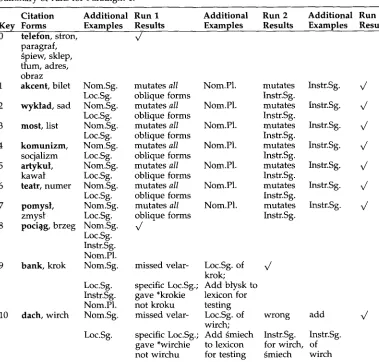
The following e x a m p l e s w e r e p r o v i d e d in addition to the inflectional f o r m s of the p r i m a r y e x a m p l e in o r d e r to s h o w Loc.Sg. e n d i n g s a n d a c c o m p a n y i n g c o n s o n a n t al- ternations that could n o t be p r e d i c t e d b a s e d o n the p r i m a r y example:
1. t~c: akcent (Nom.Sg.), akcencie (Loc.Sg.)
2. d --* dz: wyktad (Nom.Sg.), wyktadzie (Loc.Sg.)
3. st ---~dc: most (Nom.Sg.), modcie (Loc.Sg.)
4. zm---~m: komunizm (Nom.Sg.), komuni~mie (Loc.Sg.)
5. t-*l: artykut (Nom.Sg.), artykule (Loc.Sg.)
6. r--*rz: teatr (Nom.Sg.), teatrze (Loc.Sg.)
7. st~sl: pomyst (Nom.Sg.), pomydle (Loc.Sg.)
The following a d d i t i o n a l e x a m p l e s w e r e p r o v i d e d to s h o w velar pecularities:
8. g: pociqg (Nom.Sg.), pociqgu (Loc.Sg.), pociqgiem (Instr.Sg.), pociqgi (Nom.Pl.)
22 Strictly speaking, the consonants b, p,f, w, m, n, s, and z alternate as well in the Loc.Sg., since
Computational Linguistics Volume 27, Number 1
Table 3
Summary of runs for Paradigm 1.
Citation Additional Run 1 Additional Run 2 Additional Run 3
Key Forms Examples Results Examples Results Examples Results
0 telefon, stron, x/
paragraf, ~piew, sklep, ttum, adres, obraz
1 akcent, bilet Nom.Sg. mutates all Nom.P1. mutates Instr.Sg. x/
Loc.Sg. oblique forms lnstr.Sg.
2 wyklad, sad Nom.Sg. mutates all Nom.P1. mutates Instr.Sg. x/
Loc.Sg. oblique forms Instr.Sg.
3 most, list Nom.Sg. mutates all Nom.P1. mutates Instr.Sg. V'
Loc.Sg. oblique forms Instr.Sg.
4 komunizm, Nom.Sg. mutates all Nom.P1. mutates Instr.Sg. ~/
socjalizm Loc.Sg. oblique forms Instr.Sg.
5 artykut, Nom.Sg. mutates all Nora.P1. mutates Instr.Sg. x/
kawat Loc.Sg. oblique forms Instr.Sg.
6 teatr, numer Nom.Sg. mutates all Nom.P1. mutates Instr.Sg. x/
Loc.Sg. oblique forms Instr.Sg.
7 pomysl, Nom.Sg. mutates all Nom.P1. mutates Instr.Sg. x/
zmyst Loc.Sg. oblique forms Instr.Sg.
8 poci~g, brzeg Nom.Sg. x/ Loc.Sg. Instr.Sg. Nora.P1.
9 bank, krok Nom.Sg. missed velar- Loc.Sg. of v / krok;
Loc.Sg. specific Loc.Sg.; Add btysk to Instr.Sg. gave *krokie lexicon for Nom.P1. not kroku testing
10 dach, wirch Nom.Sg. missed velar- Loc.Sg. of wrong add v / wirch;
specific Loc.Sg.; Add ~miech Instr.Sg. Instr.Sg. gave *wirchie to lexicon for wirch, of not wirchu for testing ~miech wirch Loc.Sg.
.
10.
k: bank (Nom.Sg.), banku (Loc.Sg.), bankiem (Instr.Sg.), banki (Nom.Pl.)
ch: dach (Nom.Sg.), dachu (Loc.Sg.)
Table 3 summarizes the first three runs for this paradigm, which were sufficient to create a relatively robust set of morphological rules that required only slight a m e n d - m e n t a n d further testing in two additional runs. For this a n d subsequent such tables w e use the following conventions: Key 0 shows the p r i m a r y citation form a n d addi- tional citation forms w h o s e inflectional patterns should be fully covered b y the rules generated for the p r i m a r y example. The other key n u m b e r s correspond to the addi- tional examples given above. Boldface citation forms u n d e r the lexicon c o l u m n are those for w h i c h some additional inflectional examples were given. The citation forms given in plain text are for testing purposes. Oblique cases refer to the Genitive, Dative, Locative, a n d Instrumental cases.
[image:20.468.54.433.86.448.2]fore, another unmutated form had to be added as a "control." Adding the Nom.P1. forms fixed most oblique forms for all the words, but it left the Instr.Sg. mutated. This appears to be because the inflectional ending for the Loc.Sg. (which mutates) and the Instr.Sg. (which does not) both begin in -e for the words in question. Adding the Instr.Sg. overtly counters overgeneralization of the alternation. The source of the velar errors is not immediately evident.
Supplementary testing was carried out after the above-mentioned words were all correct. Correct forms were produced for all new words showing consonant mutations and velar peculiarities:
samolot, przyklad, pretekst, podziaL kolor, dtug, lek, gmach.
One error for a nonmutating word (in Key 0) occurred. This word,herb,
ends in a different consonant than the primary example and produced the wrong Loc.Sg. form. This was later added overtly and more words with other nonmutating consonants(postcp, puf,
gniew, film, opis, raz)
were tested; all were covered correctly. 6.2 Paradigm 2The paradigm implemented next was Paradigm 2: alternating inanimate masculine nouns with genitive singular in -u and vowel shifts. The following primary example for the citation form
gr6b
was given in full:Case Nom. Acc. Gen. Dat. Loc. Instr.
Number Singular Plural
gr6b groby
gr6b groby
grobu grob6w grobowi grobom grobie grobach grobem grobami
This paradigm is just like Paradigm 1, except that there are vowel shifts that are not entirely graphotactically predictable; therefore, words showing these shifts must be classed separately. The vowel shifts occur in all inflectional forms except the Nom.Sg. and the Acc.Sg., which are identical. The following vowel shifts occurred in the cases we considered (~b indicates vowel deletion).
Vowel in Vowel in Nom.Sg./Acc.Sg. Other Forms
6 o
e
ie ~b
a e ~
This shift only occurs in Loc.Sg.
The following consonant alternations are also observed in this paradigm:
Consonant in Most Forms
d dz
t r
Consonant in Loc.Sg.
d z
~dz 1
r z
Computational Linguistics Volume 27, Number 1
The following examples were given to exemplify vowel shifts w i t h an u n m u t a t i n g consonant:
1. e --* q~ shift with n: sen(Nom.Sg.), snie (Loc.Sg.)
The following examples were e m p l o y e d to s h o w vowel shifts in combination w i t h various consonant alternations in the Loc.Sg. forms:
.
.
,
5. 6.
d ~ o a n d d --* dz: samoch6d (Nom.Sg.), samochodzie (Loc.Sg.), samochodem
(Instr.Sg.)
a --~ e a n d zd ~ ~dz: dojazd (Nom.Sg.), doje~dzie (Loc.Sg.), dojazdem
(Instr.Sg.)
d --+ o a n d t --* h st6t (Nom.Sg.), stole (Loc.Sg.), stotem (Instr.Sg.) e -* ~ a n d r --~ rz: puder (Nom.Sg.), pudrze (Loc.Sg.), pudrem (Instr.Sg.)
ie --~ ~ a n d r ~ rz: cukier (Nom.Sg.), cukrze (Loc.Sg.), cukrem (Instr.Sg.)
Finally, the following examples were given to s h o w velar peculiarities:
.
.
e --, ~ w i t h k: budynek (Nom.Sg.), budynku (Loc.Sg.), budynkiem (Instr.Sg.),
budynki (Nom.P1.)
d --* 0 with g: r6g (Nom.Sg.), rogu (Loc.Sg.), rogiem (Instr.Sg.), rogi
(Nom.P1.)
At the e n d of first r u n for this p a r a d i g m only one of the eight groups above was covered completely. All vowel shifts for all groups came out right. However, the Nom.P1. a n d Acc.P1. endings were incorrectly generalized as -i instead of -y, probably because two "exceptional" velar examples (in -i) were p r o v i d e d in contrast to one "regular" nonvelar example (in -y). A d d i n g the Nom.P1. forms of three nonvelar w o r d s fixed this error. The results for velars were perfect except for the loss of z in 10 of 12 forms of obowiqzek. A d d i n g the Nom.P1. form obowi~zki fixed this. For st6t a n d d6t, the consonant alternation was incorrectly extended to Gen.Sg. A d d i n g the Gen.Sg. form of st6t fixed this error for b o t h words. At the e n d of the second run, all groups were correctly learned.
S u p p l e m e n t a r y testing after the above-mentioned w o r d s were correct included the words naw6z, doch6d, poz6r, rozbi6r, gr6d, rozch6d, nar6d, wtorek, kierunek; all forms were correct.
6.3 P a r a d i g m 3
P a r a d i g m 3 contains alternating " m a n " n o u n s - - t h a t is, masculine n o u n s referring to h u m a n men. The following p r i m a r y example for the citation form pasierb was given in full:
Case
Nom.
a c c .
Gen. Dat. Loc. InstE
N u m b e r Singular
pasierb
pasierba pasierba pasierbowi pasierbie pasierbem
Plural