Modelling and Verification of Compensating
Transactions using the Spin Tool
Kaiyu Wan, Hemangee K. Kapoor, Shirshendu Das, B. Raju, Tomas Krilaviˇcius, and Ka Lok Man
Abstract—Complex transactions are part of the most
com-monly used systems. Substantial part of such transactions are business transactions. Usually, they coordinate complex interaction among multiple systems, so called Long Running Transactions (LRT). Well known roll-back mechanism does not suffice to handle faults in LRTs, therefore compensation mechanisms are introduced. However, introduced structures are rather complex and hard to be understood and handled. Formal methods are well known tool for modelling, analysis and synthesis of complex systems. In this paper we introduce a work in progress, a technique that allows modelling LRTs using Compensating CSP, then translating them to Promela language and analysing using SPIN tool. We exemplify it using Car Broker Service.
Index Terms—Long Running Transactions, Compensation
Mechanisms, CSP, Promela, SPIN
I. INTRODUCTION
B
USINESS transactions typically involve coordination and interaction between multiple partners. These trans-actions involve hierarchies of activities and need to be orchestrated. Business transactions need to deal with faults that can arise in any stage of the transactions. In usual database transactions, a roll-back mechanism is used to handle faults in order to provide atomicity to a transaction. However, for transactions that require long periods of time to complete, also called Long Running Transactions (LRT), roll-back is not always possible. LRTs are usually interactive (communication with several agents). Handling faults where multiple partners are involved are both difficult and critical. Due to their interactive nature, it is not possible to checkpoint LRTs, e.g. a sent message cannot be unsent. In such cases, a separate mechanism is required to handle faults. A possible solution of the problem would be that the system designer can provide a mechanism to compensate the actions that cannot be undone automatically.Compensation is defined as an action taken to recover from
error in business transactions or cope with a change of plan [1]. Consider an example: a customer buys some items from an on-line store. The store debits the customer’s account for the payment of the items. Later the store realizes that one or more items are not available at that time. So, to compensate the customer, the store can credit the already debited amount
K. Wan is with the Department of Computer Science and Soft-ware Engineering, Xian Jiaotong-Liverpool University, China. Email: [email protected]
H. K. Kapoor, S. Das and B. Raju are with the Department of Computer Science and Engineering, Indian Institute of Technology Guwahati, Assam, India. E-mail:{hemangee, shirshendu, b.raju}@iitg.ernet.in
T. Krilaviˇcius is with Faculty of Informatics, Vytautas Magnus University, Kaunas, Lithuania and Baltic Institute of Advanced Technology, Lithuania. E-mail:[email protected]
K.L. Man is with Xi’an Jiaotong-Liverpool University - China, Myongji University - South Korea and Baltic Institute of Advanced Technology, Lithuania. E-mail:[email protected]
and at the same time apologize to the customer, or the store can take alternate actions, such as, arranging items from an alternative source or asking the customer whether they want a later delivery, etc. The scenario shows that the concept of compensation is more general than traditional database roll-back. Compensations are very important for handling failures in long running transactions. Compensations are installed for every committed activity in a long-running transaction. If one sub-transaction fails, then compensations of the committed sub-transactions in the sequence are executed in reverse order.
Web services technology provides a platform on which we can develop distributed services. The interoperability among these services is achieved by the standard protocols (WSDL [2], SOAP [3]) that provide the ways to describe services, to look for particular services and to access services. With the emergence of web services, business transactions are conducted using these services [4]. Web services provided by various organizations can be inter-connected to implement business collaborations, leading to composite web services.
Business collaborations require interactions driven by explicit process models. Web services are distributed, in-dependent processes which communicate with each other through the exchange of messages. The coordination between business processes is particularly crucial as it includes the logic that makes a set of different software components become a whole system. Hence it is not surprising that these coordination models and languages have been the subject of thorough formal study, with the goal of precisely describing their semantics, proving their properties and deriving the development of correct and effective implementations.
Formal techniques proved their usefulness in quite a few areas, e.g. automotive industry [5], electronics [6], [7], in-dustrial devices control [8], medical devices control [9], [10], [11]. Process calculi are models or languages for concurrent and distributed interactive systems. They have also been used for modelling interactions in latency insensitive SoC inter-connects [12]. It has been advocated in [13], [14] that process algebras provide a complete and satisfactory assistance to the whole process of web services development. Being simple, abstract, and formally defined, process algebras make it easier to formally specify the message exchange between web services and to reason about the specified systems. Transactions and calculi have met in recent years both for formalizing protocols as well as adding transaction features to process calculi [15], [16], [17], [18].
research. We exemplify the process with a business web service called Car Broker Web Service [21].
In section II we concisely overview existing results. Then we present cCSP (section III-A) and Promela/SPIN (sec-tion III-B). In sec(sec-tion IV we discuss transla(sec-tion of cCSP model to Promela, then exemplify it in section V-A with the Car Broker Web Service. We finalize paper with conclusions (section VI).
II. RELATEDWORK
Several research issues, both theoretical and practical, are raised by web services. Some of the issues are to specify web services by a formally defined expressive language, to com-pose them, and to ensure their correctness; formal methods provide an adequate support to address these issues [15]. Recently, many XML-based process modelling languages such as WSCI [22], BPML [23], WSFL [24], XLANG [25] have emerged that capture the logic of composite web services. These languages also provide primitives for the definition of business transactions.
Fu et al. [26] propose a method that uses the SPIN model-checking tool. The SPIN [20] tool takes PROMELA (Process or Protocol Meta Language)[19] as the input language and verifies its LTL (Linear Temporal Logic) [27] properties. In-teractions of the peers (participating individual web services) of a composite web service are modeled as conversations and LTL is used for expressing the properties of these conversations.
Several proposals have been made in recent years to give a formal definition to compensable processes by using process calculi. These proposals can be roughly divided into two categories. In one category, suitable process algebras are designed from scratch in the spirit of orchestration languages, e.g., BPEL4WS. Some of them can be found in [28], [29], [30]. In another category, process calculi like theπ-calculus [31], [32] and the join-calculus [33] are extended to describe the interaction patterns of the services where, each service declares the ways to be engaged in a larger process.
III. COMPENSATINGCSP (CCSP)ANDSPIN
A. Compensating CSP (cCSP)
Transaction processing and process algebra inspired the development of process algebra cCSP [34], [35], [30]. A subset of the original cCSP is considered in this paper, which includes most of the operators, as summarized in Table I. Similar to CSP, processes in cCSP can engage in atomic events and can be composed using sequential, choice and parallel composition operators. The processes are categorised into two types: (i) standard; and (ii) compensable: which have a separate set of actions to be executed upon failure of a transaction. Variables P, Q, . . .are used for standard pro-cesses andP P, QQ, . . . are used for compensable processes. Input on channel a and output on channelb can be de-scribed asP?aandQ!brespectively. The operators different from CSP are discussed below. In case of failures in long running transactions, we need support to raise interrupt and handle the interrupt. The THROW action is used to raise and interrupt and the YIELD is used to handle it. For example, (P;Y IELD;Q) is willing to yield to an interrupt in between the execution ofP, andQ.
A compensable process is constructed using a pair
(P÷Q), whereP is the forward behaviour used to model normal execution, andQis the associated compensation de-signed to compensate actions executed inP. The sequential composition is defined in such a way, that actions done in
P are accumulated and will be executed in reverse order in case composition needs to be aborted and compensated. By enclosing a compensable process P P inside a trans-action block [P P], we get a complete transaction, where the transaction block is also a standard process. Successful completion of P P represents successful completion of the block. But, when the forward behavior of P P throws an interrupt, the compensations are executed inside the block, and the interrupt is not observable from outside the block.
B. PROMELA and SPIN
PROMELA is the modelling language used in the Spin tool. It is used to model the required interaction behaviour and verify properties. The model consists of processes and channels. Processes are independent entities which need to be invoked using the run clause. Processes interact with each other over message channels and/or globally declared variables. Variables can be of types:bit, bool, byte, arrayetc. For details of all data types see the PROMELA manual in [19], [20].
The behavior of a process is defined by a proctype decla-ration and instantiated using theruncommand.
proctype A() { byte state; state = 3;} init
{ run A(); }
The keywordatomicmakes all the enclosed statements to be executed as one indivisible unit, non-interleaved with any other processes.
atomic{statements;}
Message channels are either input or output and carry data between processes. For example, the channelmyoutoutputs value of variablea, whereas the channelmyinputreads the incoming value in the variableb.
chan myout = [2] of byte; chan myinput = [0] of byte; myout!a ;
myinput?b ;
The channel capacity can be given after its name. In the above example, channel myout has buffer capacity of 2 and the channel myinput having capacity zero is used for rendezvous communication. As cCSP uses rendezvous communication, we have used similar channels in our model. For control flow, the if statement does a selection be-tween a set of options. If multiple options are enabled, then any one is chosen at random. If none of the options are enabled, then the statement blocks until some statement becomes executable. In the following example, any one option will get executed, depending on the condition.
if
:: (a != b) -> option1; :: (a == b) -> option2; fi
The most important statement of PROMELA that we used in this paper is the unless statement
{ statements1 } unless { statements2 }
Standard Processes: Compensable Processes:
P, Q ::= A (atomic event) |P;Q (sequential composition) |P2Q (choice)
|P||XQ (parallel composition)
|SKIP (normal termination) |T HROW (throw an interrupt) |Y IELD (yield to an interrupt) |P ⊲ Q (interrupt handler) |[P P] (transaction block)
P P, QQ ::= P÷Q (Compensation Pair) |P P;QQ
|P P2QQ |P P||XQQ
|SKIP P |T HROW W |Y IELDD
TABLE I
LANGUAGE SYNTAX FOR CCSP
statement in statements2can be executed. If yes, then the control transfers to statements2 else it continues execution ofstatements1. Ifstatements1terminates, statements2is ignored.
IV. MODELLING COMPENSATION OF CCSPIN PROMELA
We propose a simple techniques for converting cCSP models to Promela and analysing them using SPIN. In this paper we just overview general principles of translation and leave formal treatment for the future research.
Translation of the simple cCSP process is rather straight-forward and we do not discuss it here. Interesting part is translation of compensable processes. We divide them into two classes
1) single process in one transactional block, 2) multiple processes in one transactional block.
First, we will discuss a simpler case, and then we will build on it and show how more complex translation can be performed. Consider the following cCSP model of a
compensable process: Proc = [R]
R = (((channel1?1;SKIPP)
2
(channel1?0;THROWW))÷Compensation Actions)
R receives input from channel1 and if input is 0, it raises an interrupt to start Compensation Actions. The PROMELA implementation ofR will be:
byte doCompansate=0; // Global variable proctype R()
{ byte value; /*local variable*/
{ //**********FORWARD SECTION************ channel1?value; //Wait for input.
if
::(value==1)->printf("Success");
::(value==0)->doCompansate=1; // interrupt fi }
unless
//*******COMPENSATION SECTION************* { doCompansate==1;
... //Compensation Actions. } }
The first statement in compensation section is a blocked statement and it has to be enabled first, to run
Compensation Actions.
V. WEBSERVICEMODEL
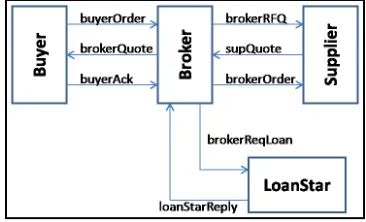
Car Broker Model is used in [21], where the author used it as a case study for cCSP. Our Car Broker Model will be slightly different from his proposed model but most of the properties are common. The car broker web service negotiates car purchases for buyers and arranges loans for these. The car broker uses two separate web services: a
Supplier to find a suitable quote for the requested car model
[image:3.595.334.517.317.428.2]and a Lender to arrange loans. Each web service can operate separately and can be used in other web services. In the following sections, we describe all three web services. We abstract several details from our description, e.g., how a supplier finds suitable quote for a car model, how a broker selects a quote from several available quotes, how a lender decides to select a loan request, the details a buyer request etc. The behavior of the web service is depicted in Figure 1.
Fig. 1. Architectural view of the Car Broker Web Service
A. Broker Web Service
We model the car broker using the process Broker. It provides online support to customers to negotiate car pur-chases and arranges loans for these. A buyer provides a need for a car model. The broker first uses its business partner
Supplier to find the best possible quote for the requested
model and then uses another business partner LoanStar to arrange a loan for the buyer for the selected quote. The buyer is also notified about the quote and the necessary arrangements for the loan. Both LoanStar and the Buyer can cause an interrupt to be invoked. A loan can be refused due to a failure in the loan assessment and a customer can reject the loan and quoted offer. In both cases, there is a need to run the compensation, where the car might have already been ordered, or the loan has already been offered.
Broker ∼= ((buyerOrder?m:M;ProcessOrder(m)) ÷CompensateBroker)
ProcessOrder(m) ∼= brokerRF Q.m;supQuote?q:FQ; 2c∈q•(SendOrder(c)||Loan(a)
||SendQuote(c))
SendOrder(c) ∼= (brokerOrder.c÷CancleSendOrder)
Loan(a) ∼= (brokerReqLoan.a:Amt÷CancleLoan); (loanStarReply?accept;SKIP P 2loanStarReply?reject;T HROW W)
SendQuote(c) ∼= brokerQuote.c; (buyerAck?accept;SKIP P 2buyerAck?reject;T HROW W)
CompensateBroker ∼= SKIP P
CancleSendOrder ∼= SKIP P
CancleLoan ∼= SKIP P
selects a quote from the received quotes (supQuote). We abstract away from the details of how decisions are made. The Broker then arranges a loan for the quoted car by requesting a loan from LoanStar. The amount of loan to be requested is decided from the selected quote and then passed to the process Loan. It requests loan from LoanStar and it can be either accepted or rejected. In the case where the loan is accepted, it is assumed that the loan provider starts its processing to arrange the loan. If the loan cannot be provided then an interrupt is thrown to cancel the actions that already took place. The buyer is also notified of the quote for the selected car (from SendQuote(c)). The Broker receives an acknowledgment (buyerAck) from the Buyer for either accepting or rejecting the quote. In case of rejection, an interruption is thrown to cancel the transaction and run the appropriate compensation. The processes SendQuote, Loan and SendOrder do not have any synchronization between them and they interleave with each other. An interrupt thrown from either the Buyer or the LoanStar can occur before or after ordering the car to the Supplier. In either case, the compensation mechanism takes care of it and the proper compensations will run.
B. Buyer Web Service
Buyer web service starts the whole process by expressing
his need for a car to the Broker web service. Initially
Buyer will send a request (buyerOrder) to the Broker and waits for a quote from the Broker. The Broker will collect the quote (the complete processing of Broker is already explained) and send it to the Buyer(brokerQuote). After receiving the Quote from Broker, Buyer can either accept it or reject it. In both situations Buyer must inform the broker about his decision (buyerAck). Buyer also has an associated compensation action called CompensateBuyer to cancel his order in case of exception occurred.
Buyer ∼= ((buyerOrder.m:M;brokerQuote?q:Q; (buyerAck.accept2buyerAck.reject);
SKIP P)÷CompensateBuyer) CompensateBuyer ∼= SKIP P
C. Lender Web Service
We assume a lender web service LoanStar, that offers loans to online customers. A customer submits a request for an amount to be loaned along with other required information. LoanStar first checks the loan amount and if the amount is 10,000 or more, then LoanStar asks its business partner Assessor to thoroughly assess the loan.
After a detailed assessment of the loan, Assessor can either approve the loan or reject the loan. A full assessment is costly, so if the loan amount is less than 10,000, then we assume that the LoanStar will directly grant the loan.
LoanStar ∼= (brokerReqLoan?a:Amt;Process(a))
÷CancelLoan
Process(a) ∼= ChkAmt.a; ((Below.a;loanStarReply.accept) 2(Over.a ;Assessor(a)))
Assessor(a) ∼= ChkRisk.a; ((Low.a;loanStarReply.accept) 2(High.a;loanStarReply.accept))
CancelLoan ∼= SKIP P
At the top level, the transaction is defined as a se-quence of two processes. First, it receives a loan order (brokerReqLoan) from the Broker and then processes the loan. After the request is received from the Broker, the requested amount is passed to the process called Process to take the necessary steps before arranging the requested loan. It first checks the loan amount in order to determine the type of evaluation that it needs to perform before accepting the loan. We define a processChkAmt which checks the loan amount in the order to determine whether the amount is over or below the given limit, which is in this case 10,000. Here,
ChkAmt,BlowandOverabstract away the details of how the checking has been done. If the loan amount is less than 10,000, then Process will grant the loan by sendingaccept
vialoanStarReply. If the risk is high then control is passed to Assessor to perform a full assessment. On the other hand, if the amount is higher than or equal to 10,000, then Assessor will start its assessment immediately. After performing a full assessment and depending on the outcome, Assessor either accepts or rejects the requested loan. In the example, we abstract the details of the behavior of Assessor. It can be modeled as a separate web service or as a part of the lender web services. The associated compensation action here is called CompensateLoan and will be run if any exception occurred.
D. Supplier Web Service
It sends a set of quotes (supQuote) to the Broker after receiving a request for quotes (brokerRF Q) from Broker. We have not explained the detail quotes selection procedure here. We assumed that the Supplier will nondeterministically select one set of quotes (q) from the multi-set of quotes (FQ). After sending the quotes to the Broker it will wait for the
Broker for ordering a car mentioned in the quotes. It has
associated compensation action called CompensateSupplier to cancel the order in case of exception occurred.
Supplier ∼= (brokerRF Q?m:M;supQuote?q:FQ; (brokerOrder?c);SKIP P)
÷CompensateSupplier CompensateSupplier ∼= SKIP P
E. The whole car broker system
After defining each web services separately, now we are going to define the whole car broker web system. The cCSP description of this model is given below: We have enclosed
all the web service processes into a single transactional block (see section III-A). Hence all the processes can automatically yield the interrupt thrown by any of them to run the corre-sponding compensation actions.
F. Accomplishing Compensation
As mentioned in section V-A that the Broker will throw an exception if the Buyer rejects the quote or if the LoanStar rejects the loan. Since all the above cCSP processes (Broker,
Buyer, Supplier and LoanStar) are running in parallel and
comes under one single transactional block, the interrupt thrown by Broker can be automatically yielded by the other processes. So, whenever Broker throws some interrupt it will be yielded by all the processes (including Broker) and starts their individual associated compensation action. The purpose of compensation sub-process in each process is to revert back all of its updates. We are assuming that each web service maintain enough log records, so that they can revert their own updates in case of transaction failure. Since the compensation actions of each processes are all internal actions we are ignoring them by just assuming aSKIP.
G. PROMELA Model for Car Broker Web Service
Our complete system is enclosed within one transactional block as explained in section V-E. The detail explana-tion about how to convert such type of cCSP model into PROMELA is already discussed in section IV. Success of a transaction is dependent on two conditions: (i) Buyer accepts the quote and (ii) LoanStar grants the loan. Otherwise transaction cannot succeed and compensation must run.
In our implementation we use two global variables sqSuccessandlSuccessto represent the status of buyer acceptance and loan grant respectively. Initially both assigned to 0. Two subprocess of Broker will decide the success of the transaction by setting the appropriate variables. If any condition is not satisfied, the corresponding compensate vari-able is set, in particular varivari-ablessqCompensate=1. and lCompensate=1. If any one of the compensate variables is1, then the “unless” part of all the compensation processes will become enabled and hence starts compensation. So for each compositional process in our model, we define suc-cess as:(lSuccess==1 && sqSuccess==1)and run com-pensation if: (lCompensate==1 || sqCompensate==1)
Note that in our model every transaction will eventually either succeed or fail. Hence, either of the above state will eventually be true.
The sub-processLoan of theBrokerprocess is shown below. It sets the appropriate variables depending on the decision of the loan agentLoanStar.
proctype Loan(int qL) {
{ brokerReqLoan!qL; loanStarReply?lresult; if
:: lresult==1 -> // loan accepted lSuccess=1;
:: lresult==0 -> // loan rejected lCompensate=1;
fi;
if // Wait for success indication :: (lSuccess==1 && sqSuccess==1)
-> loanSuccessful=1; fi }
unless {
(lCompensate==1 || sqCompensate==1) // run compensation
-> loanCancelled=1; } }
TheSendQuotesub-process of theBrokerprocess deals with theBuyerand sets the appropriate variables depending upon the Buyer’s decision.
proctype SendQuote(int qSQ) {
{ brokerQuote!qSQ; buyerAck?sqresult; if
:: sqresult==1 -> // Buyer accepts quote sqSuccess=1;
:: sqresult==0 -> // Buyer reject quote sqCompensate=1;
fi; ... } unless {
(lCompensate==1 || sqCompensate==1) -> // Run compensation
... } }
1) Verification: We verified safety and liveness properties
for the model. The verification output for deadlock freedom is given below.
(Spin Version 6.1.0 -- 4 May 2011) Bit statespace search for:
never claim - (not selected) assertion violations +
cycle checks - (disabled by -DSAFETY) invalid end states +
State-vector 212 byte, depth reached 78, errors: 0 3791795 states, stored
21925798 states, matched
25717593 transitions (= stored+matched) 9 atomic steps
The verification output for liveness is given below. Liveness is checked by showing the absence of acceptance cycles and also non-progress cycles. The model was free of acceptance cycles:
(Spin Version 6.1.0 -- 4 May 2011) Bit statespace search for:
never claim - (not selected) assertion violations +
acceptance cycles + (fairness disabled) invalid end states +
State-vector 212 byte, depth reached 78, errors: 0 3774707 states, stored
21983418 states, matched
25758125 transitions (= stored+matched) 11 atomic steps
The model was free of non-progress cycles and it also satisfied several LTL properties. Following is the output for the propertyltl_0along with freedom from non-progress cycles.
(Spin Version 6.1.0 -- 4 May 2011) Bit statespace search for:
never claim + (ltl_0)
assertion violations + (if within scope of claim) non-progress cycles + (fairness disabled) invalid end states - (disabled by never claim) State-vector 224 byte, depth reached 145, errors: 0
3945154 states, stored 27937663 states, matched
31882817 transitions (= stored+matched) 7 atomic steps
The list of LTL properties satisfied by the model is given below:
1) If quote is rejected by the buyer then all processes are compensated.
ltl{ []( // ltl_0 (lCompensate==1) -> <> (
(supplierCancelled==1)&&(brokerCancelled==1)&& (buyerCancelled==1) &&
(sendOrderCancelled==1)&&
(sendQuoteCancelled==1)&&(loanCancelled==1)&& (sendOrderCancelled==1)&&
(loanStarCancelled==1) &&
(assessorCancelled==1)&&(processCancelled==1) ) ) }
3) If quote is accepted by buyer and the loan is sanc-tioned, then the processes are successful.
4) If no compensation request comes due to the buyer rejecting the quote and for the loan amount if there is low risk involved or the loan amount is less, then the loan is sanctioned.
ltl{ [](
((lowRisk||lessLoanAmount)&&sqCompensate==0) -> <> ( lSuccess==1))}
5) If there is no compensation request from LoanStar and if the buyer accepts the quote, then the quote accepted variable is set.
ltl{ [](
(buyerAccepts && lCompensate==0) -> <> ( sqSuccess==1))}
VI. CONCLUSIONS
Modelling, analysis and implementation of complex busi-ness transactions is not a trivial task. In this paper we present a technique that could be helpful in solving this problem. We propose to use cCSP for modelling of business transactions, then to translate cCSP model to Promela and to analyze it using SPIN. In such a way a language designed for such processes can be used for modelling (cCSP) and then, a well known and mature tool (SPIN) can be used for analysis of the system. We have defined a procedure for translating cCSP model to Promela language and exemplified using realistic Car Broker example. The results seem very promising. However, these results are just work in progress, because it is necessary to define formal translation from cCSP to Promela to be able to show how analysis results translate back to cCSP model.
ACKNOWLEDGMENT
This paper is partially supported by Research Grant from National Natural Science Foundation of China (61103029) and the project VIZIT-1-TYR-003 (VP1-3.1- ˇSMM-01-V-02-001), Research Council of Lithuania.
REFERENCES
[1] J. Gray and A. Reuter, Transaction Processing : Concepts and
Tech-niques. Morgan Kaufmann Publishers, 1993.
[2] E. Christensen, F. Curbera, G. Meredith, and S. Weerawarana, “Web services description language (wsdl) 1.1,” March 2001. [Online]. Available: http://www.w3.org/TR/wsdl
[3] F. Curbera, M. Duftler, R. Khalaf, W. Nagy, N. Mukhi, and S. Weer-awarana, “Unraveling the web services web: An introduction to SOAP, WSDL, and UDDI.” IEEE Internet Computing, vol. 6, pp. 86–93, 2002.
[4] M. Little, “Transactions and web services,” Commun. ACM, vol. 46, pp. 49–54, October 2003.
[5] B. Gebremichael, T. T. Krilaviˇcius, and Y. S. Usenko, “A formal model of a car periphery supervision system in UPPAAL,” in Proc.
of Workshop on Discrete Event Systems, sep 2004, pp. 433–438.
[6] H. K. Kapoor, “Formal modelling and verification of an asynchronous dlx pipeline,” in The 4th Int, Conf. on ESoftware Engineering and
Formal Methods (SEFM), 2006, pp. 118–127.
[7] K. Man, T. Krilaviˇcius, C. Chen, and H. Leung, “Application of bhave toolset for systems control and mixed-signal design,” in Proc. of the
Int. MultiConference of Engineers and Computer Scientists (IMECS),
Hongkong, March 2010.
[8] T. Krilaviˇcius and V. Miliukas, “Functional modelling and analysis of a distributed truck lifting system,” in The 5th Int. Conf. on Electrical
and Control Technologies (ECT 2010), Kaunas, Lithuania, 2010, p. 6.
[9] T. Krilaviˇcius, D. Vitkute-Adˇzgauskien˙e, and K. ˇSidlauskas, “Sim-ulation of the radiation therapy system for respiratory movement compensation,” in Proc. of the 7th Int. Conf. Mechatronic Systems
and Materials (MSM 2011), Kaunas, Lithuania, July 2011.
[10] T. Krilaviˇcius and K. Man, “Timed model of the radiation therapy system with respiratory motion compensation,” in The 6th Int, Conf.
on Electrical and Control Technologies (ECT 2011), Lith., 2011, p. 6.
[11] K. Man, T. Krilaviˇcius, K. Wan, D. Hughes, and K. Lee, “Modeling and analysis of radiation therapy system with respiratory compensation using Uppaal,” in Proc. of the 9th IEEE Int. Symp. on Parallel and
Distributed Processing with Application (ISPA 2011), Korea, 2011.
[12] H. K. Kapoor, “Process algebraic view of latency-insensitive systems,”
IEEE Transactions on Computers, vol. 58, no. 7, pp. 931–944, 2009.
[13] L. G. Meredith and S. Bjorg, “Contracts and types,” Commun. ACM, vol. 46, pp. 41–47, October 2003.
[14] G. Salaun, L. Bordeaux, and M. Schaerf, “Describing and reasoning on web services using process algebra,” in Proc. of IEEE Int. Conf,
on Web Services, july 2004, pp. 43 – 50.
[15] M. Berger and K. Honda, “The two-phase commitment protocol in an extended pi-calculus.” Electr. Notes Theor. Comput. Sci., 2000. [16] A. Black, V. Cremet, R. Guerraoui, and M. Odersky, “An equational
theory for transactions,” in In Proc of FSTTCS. Springer, 2003, pp. 38–49.
[17] L. Bocchi, C. Laneve, and G. Zavattaro, “A calculus for long-running transactions,” in Formal Methods for Open Object-Based Distributed
Systems, ser. LNCS, E. Najm, U. Nestmann, and P. Stevens, Eds.
Springer, 2003, vol. 2884, pp. 124–138.
[18] R. Bruni, C. Laneve, and U. Montanari, “Orchestrating transactions in join calculus,” 2002.
[19] Promela manual. [Online]. Available: http://spinroot.com/spin/Man/promela.html
[20] Basic spin manual. [Online]. Available: http://spinroot.com/spin/Man/Manual.html
[21] S. H. Ripon, “Process algebraic support for web service composition,”
SIGSOFT Softw. Eng. Notes, vol. 35, pp. 1–7, March 2010.
[22] “Web service choreography interface (wsci) 1.0,” August 2002. [Online]. Available: http://www.w3.org/TR/wsci/
[23] “Business process modeling language (bpml).” [Online]. Available: http://www.bpmi.org/
[24] F. Leymann, The web services flow language (WSFL1.0),
IBM Software Group, 2001. [Online]. Available: http://www-4.ibm.com/software/solutions/webservices/pdf/WSFL.pdf
[25] S.Thatte, XLANG: Web Services for Business Process Design, Microsoft Corporation, 2001. [Online]. Available: http://www.gotdotnet.com/team/xml wsspecs/xlang-c/default.htm [26] X. Fu, T. Bultan, and J. Su, “Analysis of interacting bpel web services,”
in Proc. of the 13th Int. Conf. on World Wide Web, 2004, pp. 621–630. [27] B. Banieqbal, H. Barringer, and A. Pnueli, “Temporal logic in
speci-fication,” in LNCS. UK: Springer, 1989, pp. 8–10.
[28] R. Bruni, H. Melgratti, and U. Montanari, “Theoretical foundations for compensations in flow composition languages,” SIGPLAN Not., vol. 40, pp. 209–220, January 2005.
[29] M. Butler and C. Ferreira, “A process compensation language,” in
Integrated Formal Methods, ser. LNCS, W. Grieskamp, T. Santen, and
B. Stoddart, Eds. Springer Berlin / Heidelberg, 2000, vol. 1945, pp. 61–76.
[30] M. Butler, C. Hoare, and C. Ferreira, “A trace semantics for long-running transactions,” in 25 Years of CSP, A. Abdallah, C. Jones, and J. Sanders, Eds., vol. Lectur. Springer, October 2005, pp. 133–150. [31] R. Milner, J. Parrow, and D. Walker, “A calculus of mobile processes,
i,” Inf. Comput., vol. 100, pp. 1–40, September 1992.
[32] J. Parrow, Handbook of Process Algebra. Elsevier, 2001, ch. 8, pp. 479–543.
[33] C. Fournet and G. Gonthier, “The reflexive cham and the join-calculus,” in In Proc. of the 23rd ACM Symp. on Principles of
Programming Languages. ACM Press, 1996, pp. 372–385. [34] S. Ripon, “Extending and relating semantic models of
compensating csp,” Ph.D. dissertation, 2008. [Online]. Available: http://eprints.ecs.soton.ac.uk/16584/