MARK 13 AND THE RETURN OF THE SHEPHERD: THE NARRATIVE
LOGIC OF ZECHARIAH IN MARK
Paul Sloan
A Thesis Submitted for the Degree of PhD
at the
University of St Andrews
2017
Full metadata for this item is available in
St Andrews Research Repository
at:
http://research-repository.st-andrews.ac.uk/
Please use this identifier to cite or link to this item:
http://hdl.handle.net/10023/10823
Mark 13 and the Return of the Shepherd: The Narrative
Logic of Zechariah in Mark
Paul Sloan
This thesis is submitted in partial fulfilment for the degree of PhD
at the
University of St Andrews
Mark 13 contains numerous interpretative puzzles that continue to generate discussion in contemporary scholarship. One such puzzle is the apparent disparity between a question from the disciples about the destruction of the temple, and the answer by Jesus that seemingly refers to his second coming. Why are the two events conjoined? Additionally, how should one interpret the numerous allusions throughout Mark 13? This study seeks to contribute to the conversation on these and other topics by employing narrative analysis of Mark’s Gospel with special attention to his intertextual allusions to Zechariah.
By incorporating intratextual, intertextual, and extratextual data, this study examines the extent to which Zechariah informs Mark’s narrative, with particular focus on Jesus’ speech on the Mount of Olives in Mark 13. Within the parameters of this project, broadly speaking, intratextual data refers to the narrative as Mark presents it; intertextual data refers to Mark’s allusions to external bodies of literature; and extratextual data refers to the codified knowledge of Mark’s cultural encyclopedia. By examining Mark, and particularly Mark 13, with reference to each body of data, I argue that Mark alludes to Zechariah throughout the Gospel in order to express several elements of Jesus’ life and teaching.
i
Contents
Chapter One: Shape of the Question
1.1 Introduction ... 1
1.2 Narrative Analysis and the Cultural Encyclopedia ... 5
1.3 Method ... 9
1.3.1 Method for Identifying Intertexts ... 11
1.3.2 Applying the Criteria ... 16
1.4 History of Research ... 18
1.5 Zechariah 9-14 in Mark ... 18
1.5.1 C. H. Dodd, Barnabas Lindars, and F. F. Bruce ... 18
1.5.2 H. C. Kee ... 20
1.5.3 Douglas Moo ... 21
1.5.4 Mark C. Black ... 22
1.5.5 Joel Marcus ... 23
1.5.6 Craig A. Evans ... 25
1.5.7 Sandra Hübenthal ... 26
1.5.8 Richard B. Hays ... 27
1.5.9 Summary ... 28
1.6 Conclusion ... 30
Chapter Two: Analysis of Second Temple Literature 2.1 Introduction ... 32
2.2 1 Enoch 52:6 ... 32
2.3 Qumran ... 33
2.3.1 1QM ... 33
2.3.1.1 Assistance of the Holy Angels ... 34
2.3.1.2 Summary ... 35
2.3.2 4Q176 ... 36
2.3.3 The Damascus Document ... 38
2.3.4 Summary ... 40
2.4 Sibylline Oracles III ... 40
2.5 1 Thessalonians 3:13 ... 41
2.6 Matthew 16:27 and 25:31 ... 43
2.7 Targum Zechariah 13:9 ... 45
2.8 Conclusion ... 46
Chapter Three: Allusions to Zechariah Throughout Mark 3.1 Introduction ... 48
3.2 Zechariah 9:9–10 and Mark 11:1–10 ... 49
3.3 Zechariah 14:21 and Mark 11:15–19 ... 51
3.4 Zechariah 9–14 and Mark 14:24, 25, 26, 27 ... 56
3.4.1 Zechariah 9:11 and Mark 14:24 ... 56
3.4.2 Zechariah 14 and Mark 14:25–26 ... 58
3.5 Summary ... 58
3.6 Zechariah 3:2, 13:2, and ‘Rebuking the Clean Spirit’ in Mark ... 59
3.6.1 Zechariah 13:2 and the Unclean Spirit ... 61
ii
3.9 Summary ... 71
3.10 Conclusion ... 72
Chapter Four: The Bookends: The Use of Zechariah 13:7 and 14:5 in Mark 4.1 Introduction ... 76
4.2 Mark 14:26–31 ... 77
4.2.1 Wilcox and Moo on Mark 14:27–31, Mark 13, and Zechariah 13:7–9 ... 79
4.2.2 Specific Features of Mark 14:27–31 vis-à-vis Zechariah 13:7–9 and Mark’s Gospel ... 82
4.2.2.1 Correspondences between Mark 13–14 ... 91
4.2.3 Summary ... 95
4.3 Zechariah 14:5 and the Coming of the Son of Man ... 96
4.4 Mark 8:34–38 and Mark 13 ... 99
4.5 Conclusion ... 101
Chapter Five: Allusions to Zechariah throughout Mark 13 5.1 Introduction to Studies on Mark 13 ... 103
5.2 Intentional Ambiguity ... 103
5.2.1 Analysis ... 105
5.3 Temple-Only Interpretation ... 108
5.3.1 Analysis ... 111
5.3.1.1 Mark’s Apocalyptic Language ... 111
5.3.1.2 Mark 13:27, “the Angels,” and Mark 13:10 ... 117
5.3.1.3 The Disciples’ Question and Jesus’ Answer ... 119
5.3.2 Summary ... 120
5.4 Tribulation and Parousia ... 120
5.4.1 Analysis ... 124
5.5 The Temple and Parousia ... 125
5.6 Summary ... 126
5.7 Introduction to Mark 13 ... 129
5.8 Mark 13:1–4 ... 131
5.8.1 Narrative Context ... 131
5.8.2 The Structure of Mark 13:1–5 ... 132
5.8.3 Mark 13:3 and Zechariah 14:4 ... 133
5.8.3.1 Setting in Mark ... 135
5.8.4 The Disciples’ Question ... 137
5.8.4.1 Proto-Theodotion Daniel in Mark 13 ... 139
5.8.5 Summary ... 142
5.9 Mark 13:5–8 ... 142
5.9.1 The False Prophets and Zechariah 13, Deuteronomy 13, and Mark 13 ... 144
5.9.2 Mark 13:7–8 and Zechariah 13:8 ... 146
5.9.3 Summary ... 149
5.10 Mark 13:9–13 ... 149
5.10.1 Mark 13:10 and Zechariah 14 ... 152
5.10.2 Mark 13:11 and Zechariah 4:6 ... 154
iii
5.11 Mark 13:14–23 ... 156
5.11.1 Zechariah 14:1–5 and Mark 13:14–23 ... 161
5.11.1.1 Zechariah 14:5 and the Flight to the Hills ... 163
5.11.1.2 Zechariah 14:2 and Mark 13:14–17 ... 164
5.12 Mark 13:24–27 ... 166
5.12.1 The Cosmic Phenomena ... 168
5.12.2 The Coming of the Son of Man ... 170
5.12.3 Coming “With Great Power and Glory” ... 171
5.12.4 The Cosmic Imagery and the Angels ... 173
5.12.5 Coming with Great Power and Zechariah 14:5 ... 174
5.12.6 Gathering the Elect and Zechariah 2:10 ... 175
5.12.7 “That Day” ... 177
5.12.8 Concerning That Day, No One Knows ... 178
5.13 Mark 13:28–37 ... 178
5.14 Conclusion ... 184
Chapter Six: Conclusion 6.1 Mark’s Allusions to Zechariah ... 186
6.2 Didache 16 ... 189
6.3 Cyril of Alexandria ... 191
1
Shape of the Question
1.1: Introduction
Mark presents the story of Jesus as in accord with Israel’s scriptures. Of particular importance
for Mark are Israel’s prophets. This thesis explores Mark’s use of one of those prophets – Zechariah – in
his portrayal of Jesus’ actions and teaching. My overall purpose is to examine the extent of Zechariah’s
influence upon Mark 13, and to offer an interpretation of that discourse in light of Mark’s allusions to
that prophetic text. This project thus entails two distinct, but interrelated components: Mark’s
intertextual use of Zechariah, and a comprehensive narrative analysis of Mark 13 within the context of
Mark as a whole.
Mark 13 provides a quagmire at every turn. Why, for example, does the discourse conspicuously
shift from the temple courts to the Mount of Olives? How should one interpret the disciples’ two-part
question? What is “the end” in 13:7? What is the “abomination of desolation” in 13:14? What is the
nature of the apocalyptic language in 13:24–25, what is the meaning of the “coming of the Son of Man”
in 13:26, and when does it all happen? Does Jesus predict his “second coming” within a generation?
How are the subsequent parables related to the events depicted in the discourse? How does one
interpret the many scriptural allusions in the discourse? And what is the relation of Mark 13 to the rest
of the Gospel?
These questions have generated plentiful discussion. But even if one answers them all, and
concludes that Jesus discusses the temple’s destruction and his second coming in the same discourse, a
question remains: why does Jesus answer a question about the timing of the destruction of the temple
with a discourse about earthquakes, persecution, an abomination, and his so-called parousia? The
parousia seemingly has nothing to do with the destruction of the temple, so why are the events joined?
The latter question, in fact, has been an underlying crux interpretum for nearly 200 years. D.F. Strauss,
for example, writing between 1835–40, concludes, “Thus it is impossible to evade the
acknowledgement, that in this discourse, if we do not mutilate it to suit our own views, Jesus at first
speaks of the destruction of Jerusalem, and . . . of his return at the end of all things, and that he places
the two events in immediate connexion. . . . It follows that in this particular he was mistaken.”1 In 2008,
1 D.F. Strauss 1973, 589, 591. This English translation reproduces that of G. Eliot’s 1892 edition, which is itself the
2
on the other hand, Michael Bird writes, “I cannot imagine Mark depicting the disciples as asking Jesus a
question about the destruction of the Temple and then having Jesus respond by engaging in a speech
about his return from heaven.”2 Bird thus concedes no error in Mark 13, but interprets the “coming of
the Son of Man” not as his parousia, but as “Israel’s vindication through the fulfilment of Jesus’
prophecy against the Temple.”3
The above conclusions, in addition to indicating the wide range of possible interpretations of
Mark 13, demonstrate the need to address apparent disparity between the disciples’ question and
Jesus’ answer. Thus a major conundrum created by the Olivet Discourse is, why does it begin with a
prophecy and question about the destruction of the temple and end with a statement about “the
coming of the Son of Man”? How do those events relate? The different exegetical paths one could take
throughout the discourse naturally lead to varied destinations. The outline in Figure 1.1 below4 lists four
common interpretations of Mark 13:1–37, which is said to refer to:
Figure 1.1
1) Temple’s destruction and Jesus’ parousia5
a. 13:1–4: Jesus’ prophecy and disciples’ question about temple’s destruction b. 13:5–23: events leading up to the temple’s destruction
c. 13:24–27: Jesus’ parousia
d. 13:28–31: resumes discussion of Jerusalem and temple e. 13:32–27: resumes discussion of Jesus’ parousia 2) Future tribulations and Jesus’ parousia6
edition (1840), represented a return to the more “radical” positions of his first edition (1835). This timeline is explained in op. cit., xxiv–xlvii.
2 Bird 2008, 56.
3 Ibid., 58.
4 This outline is indebted to that of Robert Stein 2008, 584–85.
5 Strauss (1973, 588, n 16) cites H.A. Schott 1819, ad loc. See also William Lane 1974, 466–82; Larry Hurtado 1989,
211–27; Ben Witherington 2001, 336–50; Stein 2008, 582–626; idem 2014; C. Clifton Black 2011, 264–75. Option 1 naturally contains variations. See e.g. George Beasley-Murray 1993, 377–475; Adela Yarbro Collins 2007, 603–17. Beasley-Murray and Collins take the tribulation in 13:5–23 to refer to the events of 66–70 CE, but include reference to Jesus’ parousia in point (d). Schott, Lane, Hurtado, Witherington, and Stein, however, distinctly interpret points (b) to (e) in Option 1 in an ABA’B’ pattern. Option 1 is common in contemporary scholarship.
6 This option is not completely distinct from Option 1, as some from Option 2 understand 13:5–23 to refer both to
a. 13:1–4: Jesus’ prophecy and disciples’ question about temple’s destruction b. 13:5–23: future tribulations
c. 13:24–27: parousia
d. 13:28–37: parables regarding the unknown time of Jesus’ parousia 3) Temple’s destruction7
a. 13:1–4: Jesus’ prophecy and disciples’ question about temple’s destruction b. 13:5–23: signs and tribulations which precede temple’s destruction
c. 13:24–27: vindication of Jesus and his prophecy regarding temple’s destruction d. 13:28–37: parables and exhortations regarding unknown time of previous predictions 4) Temple’s destruction and parousia8
a. 13:1–4: Jesus’ prophecy and disciples’ question about temple’s destruction b. 13:5–23: tribulation preceding temple’s destruction
c. 13:24–27: vindication of Jesus and his prophecy regarding temple’s destruction d. 13:28–31: parable about timing of temple’s destruction
e. 13:32–37: Exhortations about unknown day of parousia
This outline does not represent an exhaustive list, but rather attempts to show common
interpretations in currency. The above conclusions result from various methodologies, including form
criticism, redaction criticism, and narrative criticism. Broadly speaking, however, a common
denominator in each methodology is intertextuality.9 That is, it is universally recognized that Mark 13
contains numerous allusions to Israel’s scriptures, and that every interpretation must make decisions
regarding their meaning in Mark. This study seeks to contribute to the discussion by attending to the
allusions to Zechariah throughout Mark, and particularly Mark 13, and by providing a detailed
interpretation of the Olivet Discourse in light of those allusions.
Gundry (738) claims that Jesus ignores the disciples’ question and describes future tribulations and the parousia without reference to the events of 66–70 CE. Evans (292, 322), Adams (2007, 145–46), Marcus, (894–96), and Shively (211) understand the tribulations in Mark 13 to be split between those related to the destruction of Jerusalem and the temple, on the one hand, and still-future, “end-time” tribulations, on the other, typically claiming 13:19 as the transition. Option 2 is common among contemporary scholarship.
7 Adherents of Option 3 take all of Mark 13 to refer exclusively to the destruction of Jerusalem and the temple, and
therefore completely fulfilled in the events of 66–70 CE. Strauss (1973, 585) cites C.F. Bahrdt 1773, 1103; J.C.R. Eckermann 1801–03, 579. See also Ezra Gould 1896, 240–55; George Caird 1994, 365–66; N.T. Wright 1996, 339– 66; Thomas Hatina 1996, 43–66; idem 2002, 325–73; Scot McKnight 1999, 139–49; Rikki Watts 2007, 223–29; Bird 2008, 55–58; Timothy Gray 2010, 106–55. Option 3 is still relatively rare, but it has gained adherents, in my estimation, due to the work of Wright, Hatina, and France.
8 Option 4 follows the exegesis of Option 3 through Mark 13:31, but takes 13:32 as reference to the parousia. See
Keith Dyer 1998, 195–200, 276–77; R.T. France 2002, 494–546. Option 4 is the least attested among contemporary scholars.
4
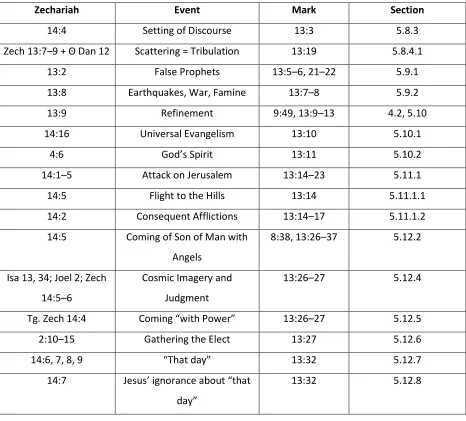
Mark contains numerous allusions to Zechariah throughout the Gospel,10 and these allusions
partially shape his presentation of Jesus’ actions and teaching. This thesis aims to demonstrate both
Mark’s use of Zechariah throughout the Gospel, and the underestimated importance of Zech 13–14 for
an understanding of the Olivet Discourse. In particular, I argue that allusions to Zech 13–14 contribute to
the shape and content of Mark 13. Undoubtedly Zech 13–14 is not the sole influence to the exclusion of
other texts. On the contrary, I argue that Mark brings Zechariah into conversation with other texts on
the basis of shared themes and lexemes, and show, within the matrix of prophetic texts utilized in Mark
13, that recognition of the allusions to Zech 13–14 affects the interpretation of the discourse.
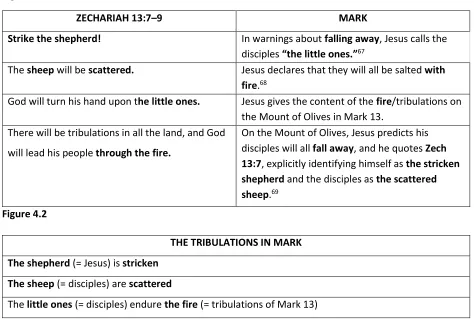
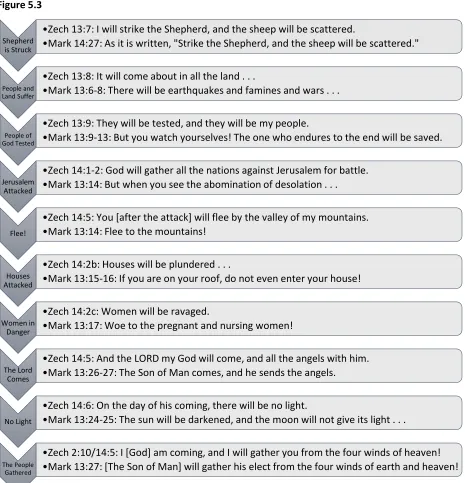
In particular, I argue that Mark describes Jesus’ death and parousia with a citation of and
allusion to Zech 13:7 and Zech 14:5, respectively.11 Those allusions serve as frames, or bookends, for the
tribulation depicted in Mark 13. Zechariah 13:7 prophesies the “striking of the shepherd,” and Zech 14:5
describes God’s theophany with angels. The material between those bookends, namely Zech 13:8–14:4,
is 1) the tribulation in all the land;12 2) the refinement by fire of God’s covenantal people;13 and 3) an
international war waged in Jerusalem, with concomitant suffering for Jerusalem’s inhabitants.14 These
events culminate in the arrival of the Lord “with all his holy ones.”15 Such events, I argue, comprise the
material of Mark 13, the narrative fulfilment of which takes place precisely between “the striking of the
shepherd” and the arrival of the Son of Man “with the holy angels.” The events of Mark 13 are 1)
earthquakes, famines, and wars;16 2) the persecution and affliction of God’s covenantal people;17 and 3)
an attack on Jerusalem, with concomitant suffering for Jerusalem’s inhabitants.18 These events similarly
culminate in a theophany with angels.19 I argue that the sequence of events in Zech 13–14 influences
Mark’s description of the tribulations in the Olivet Discourse.
10 See discussion in Section 1.5 and 1.5.9.
11 In Mark 14:27 and 8:38, respectively.
12 Zech 13:8. 13 Zech 13:9.
14 Zech 14:1–4.
15 Zech 14:5.
16 Mark 13:7–8.
17 Mark 13:9–13.
18 Mark 13:14–22.
In short, Jesus’ quotation20 of Zech 13:7 indicates that the striking of the shepherd signals the
onset of the eschatological tribulations of Zech 13:8–9 and 14:1–4, which culminate in the theophany of
Zech 14:5. Those tribulations, I argue, comprise the content of Mark 13, which also culminates in a
theophany. I detect such influence not only by mapping thematic coherence between Zechariah and
Mark, but also by identifying lexical parity between phrases from Zech 13–14 and Mark, and interpreting
them in light of Mark’s Gospel as a whole.
1.2: Narrative Analysis and the Cultural Encyclopedia
This study employs narrative analysis with special attention to Mark’s intertextual dynamics.
Narrative analysis entails examining the Gospel with typical literary tools, attending to Mark’s plot and
characterization, and interpreting the Gospel as a unified, coherent story.21 The scope of the study is
limited by necessity to certain Markan passages, but each passage is interpreted within both its
immediate literary context and within the “universe of discourse”22 created by the whole of Mark. The
goal of this study is not to discover the history behind the text,23 but to propose the meaning that the
text could generate within its historical location. This method does not deny the use of multiple sources
by “Mark” (the author), nor does it deny that Mark redacted pre-existing material; it simply limits its
object of study to the material as Mark has presented it: the Gospel itself as a story with a plot,
characters, conflict, and resolution.24
20 In order to avoid cumbersome circumlocutions, I typically avoid phrases like “the Markan Jesus” or “Mark’s
Jesus.” In this study I use “Jesus” always in reference to “Mark’s Jesus,” i.e. the “character” named “Jesus” in Mark’s Gospel.
21 See e.g. the definition by Robert C. Tannehill 1990, 488–89. I use “coherent” as opposed to “incoherent.” I do
not mean that its “coherence” contains no tensions. See Mary Ann Tolbert 1989, 11, for a similar description of the intrinsic “coherence” of the text that narrative/literary criticism assumes.
22 See discussion of “intratextuality” in Section 1.3.
23 For example, my goal is not to verify the historicity of a particular account or the origin of Mark’s sources. See
the discussion of narrative criticism and “methodological pluralism” in Hatina 2002, 49–89. Regarding narrative criticism he writes, “Instead of focusing on biblical narratives as historical sources for the purpose of uncovering that which lies behind them, narrative critics begin with the view that a narrative is a literary whole, a coherent and intelligible story, which is dynamic and interactive in its own right” (59). See the comparable distinction between “historical criticism” and “literary criticism” in Norman Petersen 1978, particularly pp 9–23. Malbon 1982, 242–55, also criticizes interpretations of Mark whose goal is to deduce something historical about the author of the Gospel, or its community/original audience. See especially ibid., 255.
24 This study accordingly examines Mark in its so-called final form, which I take to end with Mark 16:8 (so mss. א
6
Though the primary object of study is the meaning generated by the story,25 the study does not
ignore historical data. On the contrary, the existence of the Gospel assumes an author and an audience.
Thus the object of this study is the potential meaning of the Gospel as produced by a mid-first-century
author for a mid-first-century audience; accordingly, the meaning of the Gospel is conditioned by its
location in a given historical time and place.26 Thus the meaning of individual words and pericopae is
examined within the presumed “cultural encyclopedia” in which they were produced. Umberto Eco
describes the “cultural encyclopedia” as the conventional knowledge and shared beliefs of a given
people group in a given time and place.27 Thus the probable meaning of a phrase, action, or gesture is
conditioned by the location of its utterance, and the parameters of its “location” entail both the
contextual and circumstantial conditions of the utterance, and the “most statistically probable” meaning
in light of the virtual knowledge of that socially defined group.28 Eco’s theory describes language as a
dynamic reality in constant interaction with its users and environment, continually shaping and being
shaped by the culture in which it is used.
Eco describes this reality with an illustration of a box of marbles, where each marble emits a
certain wavelength and thereby attracts a limited, but vast, number of other marbles.29 The box
represents the cultural encyclopedia or framework within which a given utterance takes place; the
marbles represent “cultural units.”30 The marbles emit charges that attract and repel other respective
marbles. The given charges are “transitory” and “conventional,” that is, conditioned by their historical
location and are subject to change.31 Eco characterizes this change as “shaking the box,”32 the
manifestation of which includes cultural events on any scale. The event could be as large-scale as a
nation-wide catastrophe, in which case the ramifications upon the cultural encyclopedia, and thereby
the “statistically probable meaning” of an utterance, would be great; or it could be as small-scale as the
25 By “meaning generated by the story,” see below on “narcotizing,” “blowing up” and narratological “pressure.”
26 See the conclusion drawn by Hatina (2002, 70): “The intention on the part of the author to communicate with his
audience must remain as a foundational hermeneutical principle. If this is the case then all background (i.e. historical) information becomes a useful resource for illuminating the ‘universe of possible meanings.’” Hatina quotes from Christopher Marshall 1989, 28. See also David Rhoads 1982, 413, for a similar discussion regarding the importance of historical and cultural data for understanding “Mark’s story-world.”
27 Eco 1976, 110.
28 Ibid. The “contextual” conditions refer to the intratextual, syntactical/grammatical conditions of the utterance.
The “circumstantial” conditions refer to the narrative situation of the utterance, interpreted within its presumed cultural encyclopedia. See ibid., 107–8.
29 Ibid., 124–26.
30 Ibid., 124. A “cultural unit” is an utterance or act of communication, including, but not limited to, written text, a
spoken word or phrase, or a gesture. 31 Ibid., 126.
events in a popular television show, in which case the ramifications would be considerably fewer, felt
only by those who watch that show, and perhaps less likely to conjure vastly different connotations.
For an instance of a large-scale occurrence that “shook the box,” David Moffitt supplies the
example of the events of September 11, 2001.33 He argues that a competent user of the English
language living in America in the mid-21st century could expect to be understood when she refers to
“the events of September the eleventh.”34 The cultural encyclopedia that she shares with most adults
living in the United States at that time includes an “entry” that she can expect a hearer to understand,
because that phrase probably conjures the events of that day, and thereby conjures a probable sphere
of connotations. Importantly, such connotations are not the probable connotations that would have
been conjured by the same phrase in the year 2000.35
A pertinent example that demonstrates the relevance of the encyclopedia and the “box of
marbles” for the study of early Christianity is the crucifixion of Jesus. It is highly improbable, for
example, based on the available knowledge of the religious, political, and social data of most, if not all,
Jewish groups of the first century BCE, that the phrase “the cross of the Messiah” would have meant
then what it evidently means when Paul says it in Phil 3:18.36 In other words, to use Eco’s metaphor,
within the box of Jewish discourse of the first decade of the first century BCE, the marbles “cross” and
“Messiah” seemingly emitted different wavelengths, such that the concepts shared no attraction. Or, if
there were any attraction, it was one of negative assessment, where “crucifixion” implied the person
was certainly not “Messiah.” For Jesus’ disciples, the latter arrangement of marbles slowly shifted in
response to Jesus’ teaching. At first, those cultural units, “cross” and “Messiah,” were antithetical to
Peter,37 but suddenly seeing Jesus risen from the dead shook Peter’s framework such that “cross” and
“Messiah” were inextricable.38 This example illustrates a presupposition of this study, namely that Jesus’
claim to be Messiah, his subsequent death, resurrection, and ascension, and the community’s reception
of God’s Spirit,39 function as box-shaking events that reordered Mark’s marbles. The reordering of
33 See Moffitt 2006, 299–320. The cited example is in 301–2, n 8.
34 Ibid., 302, n 8. 35 Ibid.
36 “The cross of Christ” plausibly refers to Jesus’ mode of death, and metonymously, to his self-giving. In context, it
may refer to a pattern of self-sacrificial living. See Markus Bockmuehl 1997, 230–32.
37 E.g. Mark 8:28–33.
38 E.g. Acts 2:36: “Therefore [as a result of Jesus’ crucifixion, resurrection, and ascension] . . . God made him Lord
and Messiah, this Jesus whom you crucified” (my translation).
39 Each of these events is a demonstrable feature of Mark’s text. Respective to the order of events listed above,
8
Israel’s scriptures, already plausibly a feature of Mark’s encyclopedia, accordingly finds expression in
Mark’s Gospel in its description of the action and teaching of Jesus.
In summary, the encyclopedia represents the body of knowledge that might be known by
members of a given culture in a given time and place, and as such, it conditions what a sender might
intend, and therefore what a receiver might understand, with respect to a given utterance.40 The
narrative, circumstantial conditions of the utterance pressure the receiver to “narcotize” certain
elements of the discourse and “blow up” others.41 For the study of early Christianity, the codified
knowledge of the encyclopedia is available through various media, including, but not limited to: coins,
art, inscriptions, archaeology, geography, and literature, whether that literature is “historical,” such as
the works of Josephus or Tacitus, or “narrative,” such as Virgil’s Aeneid or Matthew’s Gospel.
This project assumes, on the basis of internal Markan evidence, that Israel’s scriptures form a
major part of the author’s cultural encyclopedia.42 The Gospel betrays the influence of Israel’s scriptures
from the first sentence, and such influence continues throughout the Gospel, evident through multiple
citations from, and references to, “the scriptures.”43 Due to limited knowledge of Mark’s date and
provenance, the selection of a precise cultural encyclopedia within which to interpret Mark is
40 See Mark Allan Powell 2011, 24, for a comparable description of Powell’s “implied reader,” who theoretically
knows everything that is “assumed to be common knowledge within the story” (e.g. the worth of a denarius, or the job description of a centurion, or certain contemporary cultures’ burial practices). For Powell, such knowledge, in conjunction with the narrative itself, sets limits around “expected readings” (ibid., 24–25).
41 See Eco 1981, 23–24. Eco describes “narcotizing” as reducing, or setting aside, certain semantic connotations in
favor of other ones. The connotations that the reader/receiver does select are those she “blows up.” The reader is pressured by the text, in light of the contextual and circumstantial conditions of the discourse, to narcotize certain connotations and blow up others. When faced, for example, with the phrase, “I passed the bar,” the receiver requires contextual and circumstantial information to know which connotations of “passed” and “bar” to actualize.
In the 21st century in the United States, “bar” may refer to many things, including the exam that law students must
pass, or the local drinking establishment. Thus the phrase, “I passed the bar” may mean that the speaker can now practice law, as she passed the bar exam; or it may mean that she walked by the pub and needs to turn around. The receiver resorts both to “common frames,” which are stores of encyclopedic information common to daily life (Eco 1981, 21), and to the circumstantial conditions of the utterance, in order to narcotize certain connotations and blow up others, and thereby actualize a discursive meaning.
42 Richard Hays (2016, 10) summarizes this position well in his work on the Gospels: “This study presupposes that
all four canonical Gospels are deeply embedded in a symbolic world shaped by the Old Testament – or, to put the point in a modern critical idiom, that their ‘encyclopedia of production’ is constituted in large measure by Israel’s Scripture.” See the similar conclusion by Juel 1988, 14.
43 “The scriptures” (αἱ γραφαί) is used in Mark 14:49 in reference to Jesus’ arrest. To name but a handful of
necessarily provisional. I follow the view that the Gospel was composed pre-70 CE,44 though a date
immediately after the destruction of Jerusalem and the temple is certainly possible.45 In either case, I
agree with the majority who take certain features of the Gospel to reflect a concern over the events of
the Jewish conflict with Rome from 66–74 CE.46 The particular arguments set forth in this study do not
require settling upon a precise date and provenance, not because such matters are unimportant, but
because I do not want thereby to exclude some elements of a potential encyclopedia on the basis of
limited hypotheses. In other words, the specific arguments set forth could be made whether the Gospel
were written in Rome or a Syrian city.47
1.3: Method
This study proceeds by examining Mark’s “intratextual,” “intertextual,” and “extratextual”
relationships in order to provide an interpretation of Mark 13 within Mark as a whole. Stefan Alkier
employs these three categories to describe a methodology he calls “semiotic exegesis.”48 Semiotic
exegesis proceeds by first examining the “intratextual data,” that is, all the textual data within the object
of study – in the present case, the Gospel of Mark. These data include the “syntactic, semantic, and
pragmatic textual relationships in connection with the models of analysis of literary-critical
structuralism.”49 Potential categories of an intratextual examination of Mark may include, but are not
44 So e.g. Martin Hengel 1985, 1–30; idem 2005, 70–96; Evans 2001, lxii–lxiii; Collins 2007, 11–14; Stein 2008, 12–
15. Fergus Millar 2006, 141, does not decide firmly on a date, but argues that the present form of the Gospels demonstrates familiarity with the geography, social structures, and “concerns” of pre-70 Palestinian Judaism (italics original).
45 So e.g. Rudolf Pesch 1976, 1:14; Marcus 1992a, 441–62; John Kloppenborg 2005, 419–50; Joachim Gnilka 2010,
34. The external evidence for Mark’s date and provenance is Papias’ testimony (recorded in Eusebius’ Hist. eccl. 3.39.15), which places Mark in Rome and dates his Gospel to the mid-60s. Those who date Mark post-70 consider that testimony unreliable, and rely on internal evidence, which characteristically centers upon data from Mark 13, namely the prediction of the destruction of the temple in 13:2. Kloppenborg (2005, 448–50), for example,
concludes that Mark 13:2 is evidence of Mark’s knowledge that the temple is destroyed. He dates Mark post-70 on that basis.
46 Gnilka perhaps overstates the point, but he is nonetheless clear: “Das entscheidende Kriterium ist der Jüdische
Krieg mit der Tempelzerstörung. Alle Interpreten gruppieren ihre Meinung um dieses Ereignis, sind aber geteilter Auffassung, wenn zu entscheiden ist, ob das Markusevangelium vor, in oder nach dem Krieg enstanden ist” (2010, 34).
47 Marcus (1992a, 441–62) argues for a Syrian provenance. Marcus bases his argument on features of Mark 13
(namely, the prediction of 13:2, the cryptic warning in 13:14, and the “false messiahs” in 13:22) that suggest a familiarity with the events unfolding in Jerusalem. For example, the warnings of “false messiahs” in 13:22 reflect knowledge of messianic pretenders in the late 60s (442). Marcus could be right, but his methodology rests on much of Mark being necessarily reactionary to the actions of the “revolutionaries.”
48 For the three separate “textual” categories, see Alkier 2009a, 8–9. He provides an extended discussion on
“semiotic exegesis” in Alkier 2009a, 251 n 17; idem 2009b, 223–48. Cf. Vernon Robbins 1996, 24–36, for comparable categories that he terms the “inner texture,” “intertexture,” and “social and cultural texture.”
10
limited to, Mark’s syntax, characteristic vocabulary, and discernible plot.50 Attending to Mark’s
intratextual “echoes” or “foreshadowings” is a vital feature of this study’s interpretation of Mark 13.51
Such “echoes” refer to Mark’s repetition of distinct events, phrases, and syntactical patterns, across
multiple Markan passages. The echoes recall previous elements of Mark’s narrative, and encourage
mutual interpretation of the distinct passages. I discuss and employ this method in more detail in
Section 4.2.2 and 4.2.2.1.
An example of a conclusion drawn from intratextual examination is the notion that Mark
repudiates “signs” in and of themselves. Timothy Geddert examines all the uses of the word σημεῖον in
the Gospel of Mark, noting their narrative context, and concludes that Mark’s Jesus regards
“sign-seeking” as fundamentally misguided.52 He uses this judgment to conclude that the disciples’ question in
Mark 13:4, which asks for the “sign” that will precede “all these things,” is misguided, and as a result,
that Jesus does not answer that question. Though I disagree with both of Geddert’s conclusions about
“signs” and Jesus’ response to them, they nonetheless serve as good examples of the potential fruit of
an intratextual examination.53
Examination of “intertextual” relationships includes exploring the resultant meanings of
references made by a given text to other texts.54 Alkier delimits three types of an intertextual approach:
production-oriented, reception-oriented, and experimental.55 The present study pursues the
production-oriented approach. This model explores the meaning created by identifiable texts embedded in a given
text. The cultural encyclopedia in which a given text is produced naturally conditions both which prior
texts may be available, and what their potential effect in the alluding text may be.56 Ulrich Luz describes
a comparable model for his study of Matthew in which he seeks “specific and identifiable intertexts in a
50 See e.g. Shively 2009, 122–44, where she describes “Mark’s larger narrative” as “a resource for interpreting” a
given pericope (141).
51 “Echoes” and “foreshadowings” are Elizabeth Malbon’s terms. See Malbon 1993, 213. Joanna Dewey 1991,
221–36, prescribes and employs a comparable method using the terms “forecasts” and “echoes.”
52 Geddert 1989, 29–58. See especially pp 33, 57.
53 For my critique of Geddert’s position, see Section 5.2.1. Another example gleaned from intratextual examination
is Mark’s practice of “intercalation,” often called “Markan sandwiches,” in which he interweaves events for rhetorical purposes. A good example is Mark’s account of the temple incident wrapped by the accounts of the cursed fig tree (see Mark 11:12–21).
54 Alkier 2009a, 9.
55 Ibid., 10.
56 Ibid. “Alluding text” and “reference text” are Ziva Ben-Porat’s terms. She refers to the antecedent text from
manner that is subject to control and verification.”57 Participating in what Alkier would call the
“production-oriented perspective,” Luz seeks to interpret such “intertexts as reflections of a specific
historical and cultural situation.”58 In line with these approaches, this study seeks to identify uses of
Zechariah in Mark and to interpret the resultant meaning of the intertext in Mark, noting both the ways
in which Mark’s presumed cultural encyclopedia, and the circumstantial and contextual conditions in
which the utterance is embedded, affect the meaning of Mark.59
Examination of the “extratextual” data includes analysis of a given text in relation to all
extratextual, or “text-external” signs.60 Such signs include all elements of a cultural encyclopedia outside
of “literary” media; for example, geography, socio-political questions, patterns of behavior, and
day-to-day existence.61 The media of such codified knowledge include, for example, coins, inscriptions,
archaeology, and the writings of ancient historians. The labels “intertextual” and “extratextual” are
heuristic labels intended to capture different aspects, or different media, of a cultural encyclopedia.62
That is, both labels technically refer to text-external signs in that “intertextual” and “extratextual” signs
are both “outside” of any given text. “Intertextual,” however, is employed here and by Alkier to refer to
the aspect of the cultural encyclopedia represented by literary works. Thus with respect to Mark, other
works of literature represent potential “intertexts”63 in his cultural encyclopedia. “Extratextual” signs are
similarly representative of a given cultural encyclopedia, though the media of such data are all signs
other than “literary” works.
1.3.1: Method for Identifying Intertexts
Richard Hays supplies seven well-known criteria for identifying “echoes of scripture in the letters
of Paul.”64 He employs the criteria both in order to identify the presence of prior texts, and to interpret
57 Luz 2004, 119–37. Quotation from p 122.
58 Ibid., 122.
59 Criteria for identifying uses of a prior text are delineated below.
60 Alkier 2009a, 9.
61 Elizabeth Malbon’s articulation of “narrative criticism” (2000, 1–40) largely neglects “extratextual data,” focusing
instead only on what Alkier terms “intratextual” and “intertextual” data. See also Malbon 1982, 247–48.
62 Alkier 2009a, 8. He says, “The level of encyclopedia involves the intertextual and extratextual opening of the
autonomous structure of the universe of discourse of a given text” (8).
63 An “intertext” in this study refers to the prior text that is embedded in the alluding text. Studying the
“intertextual” relationship is not confined, however, simply to identifying the prior text, but includes interpreting the resultant meaning of the alluding text’s invocation of the prior text. In the present study, this means
interpreting the resultant meaning of a given Markan passage in light of its appropriation of words or themes from Zechariah.
12
the new meaning created by their use. In dialogue with John Hollander’s claim that “allusive echo
generates new figuration”65 [in the alluding text], Hays writes, “The twofold task of a criticism attuned to
such echoes, then, is (a) to call attention to them so that others might be enabled to hear; and (b) to
give an account of the distortions and new figuration that they generate.”66 Similarly, my task does not
cease after alerting readers to the presence of Zechariah, but necessarily continues into exploration of
the new meaning of Zechariah and Mark that is generated by Mark’s use of that prophet. Hays employs
these seven criteria with respect to the letters of Paul, though I adapt them below to suit the contours
of my project on Mark.
1) Availability: Was the proposed source of the echo available to Mark (the implied author) and/or
the readers?67
2) Volume: What is the degree of explicit repetition of words or syntactical patterns in the Markan
text? How distinctive or prominent is the precursor text among the Jewish scriptures? How much
rhetorical stress does the echo receive in Mark’s text?68
3) Recurrence: How often does Mark elsewhere cite or allude to the same scriptural passage?69 4) Thematic coherence: How well does the echo fit into the plot or argument Mark is developing?70 5) Historical plausibility: Could Mark have intended the alleged meaning effect? Could his readers
have understood it?71
6) History of interpretation: Have other readers, both critical and pre-critical, heard the same
echoes?72
7) Satisfaction: Does the proposed reading of Mark make sense? Does it illuminate the surrounding
discourse? Does it produce for the reader a satisfying account of the effect of the intertextual
relation?73
Hays’ work has been frequently utilized in works whose arguments depend upon an alleged use
of Jewish scriptures.74 As influential as it remains, it has not been received without criticism. Three
65 Hollander 1981, ix; cited in Hays 1989, 19.
66 Hays 1989, 19.
67 Ibid., 29–30. 68 Ibid., 30. 69 Ibid. 70 Ibid. 71 Ibid., 30–31.
72 Ibid., 31. Hays regards this criterion as “one of the least reliable guides of interpretation” (31).
73 Ibid., 31–32.
particular criticisms are presently pertinent. First, Hays largely bypasses the interpretative traditions in
which his subject, Paul, might have received the scriptures. Craig Evans raises this issue and claims it
would be more accurate “to speak of the echoes of interpreted Scripture in the letters of Paul.”75 This
study will accordingly examine the uses of Zechariah throughout extant, Second Temple literature to
ascertain the ways it has been read and reemployed. Those readings will not require that Mark use
Zechariah in the same way as those Second Temple texts, but those texts will provide a plausible context
in which Mark may have read or received traditions from Zechariah.
Second, Paul Foster criticizes Hays for only interpreting Paul within the cultural framework of
the Jewish scriptures, thereby ignoring Paul’s other textual influences.76 Foster claims that “this prior
decision to limit Paul’s cultural sphere solely to the Jewish scriptures fails to take account of the
multicultural world that Paul inhabited, and it ignores the variegated textual influences that may have
shaped Paul’s thought.”77 Hays himself admits this limitation of scope in his own study, saying, “Such an
approach to reading Paul in no way seeks to deny or exclude the presence of nonscriptural influences on
his discourse. Paul’s discursive space encompassed countless codes and elements ‘already read’ from his
Hellenistic culture . . .”78 In any case, Foster’s criticism is duly noted, particularly when such criticism is
aimed at studies that otherwise intend to give a holistic account of a given New Testament document.
This deficiency will be addressed in this study by the incorporation of the “extratextual” data as
described in Section 1.3.
Third, William Tooman criticizes the lack of consistency and clarity with respect to the
employment of the terms “allusion” and “echo.”79 Again, Hays admits using the terms “flexibly,” though
this owes more to the complexity of distinguishing between “allusion” and “echo” than to Hays’ sloth.
For Hays, “allusion is used of obvious intertextual references, echo of subtler ones.”80 Tooman, however,
in contradistinction to Hays, employs “echo” to refer to a deliberate use of an antecedent text that is
not intended to affect the semantic value of the alluding text.81 “Echoes” for Hays are also potentially
75 Evans 1993, 20 (italics added).
76 Foster 2015, 96–111.
77 Ibid., 98, critiquing a statement from Hays 1989, 15.
78 Hays 1989, 16. In addition to accounting for nonscriptural textual influences, Foster desires more methodological
controls that might preclude fanciful identification of allusions and echoes; he correspondingly suggests the necessity of “significant or extensive verbal parallels” between the antecedent and alluding text.
79 Tooman 2011, 8 n 26. For a similar criticism of terminology, particularly with respect to the need for a broader
definition of “quotation,” see Stanley Porter 1997, 79–97.
80 Hays 1989, 29 (italics original).
14
intended, but the prescribed criteria must distinguish between intentional, semantic-affecting echoes,
and those which may only be “murmurings of our own imaginations.”82 Hays describes quotation,
allusion, and echo as descending points on “a spectrum of intertextual reference.”83 Discerning authorial
intent is difficult when attempting to distinguish between “allusion” and “echo,” as Hays defines them.
Irrespective of Hays’ alleged inconsistency, this study uses only the terms “quotation,” “allusion,” and
“influence.”84 I use “quotation” to refer to texts that contain introductory formulas and lexical
replication,85 and “allusion” to refer to instances in which Mark uses no formula, but the Markan text
contains lexical or thematic parity. Each Markan text regarded as an “allusion” to a prior text will be
argued for case-by-case. I use the term “influence” to describe an effect in the Markan text that is
present because of the antecedent text, and which may affect the meaning of the Markan text. Such
effects include distinct syntactical parallels or correspondences between events, even when the instance
contains no lexical parity.86 “Influences” and their potential semantic effect will also be examined
case-by-case.
Far from limiting his work to deconstructive criticism, Tooman contributes to the conversation
considerably by offering his own five criteria for determining “literary borrowing.” For Tooman, “Literary
allusion . . . is between written texts, and it is intentional.”87 Tooman’s five criteria for determining
“literary borrowing” are 1) uniqueness; 2) distinctiveness; 3) multiplicity; 4) thematic correspondence; 5)
inversion. I summarize only the first four below, as the latter is not pertinent to this study.
Uniqueness refers to the element of a marker that is unique, or exclusive, to a potential
reference text, except for its presence in the alluding text.88
Distinctiveness describes a marker that is distinctive, but not exclusive, to a particular source.89
He gives the example of the locution “in the beginning.”90 Though that phrase appears in many texts,91 it
82 Hays 1989, 23.
83 Ibid.
84 “Influence” is categorized by Tooman (2011, 8–9) as a potential literary dependence that does not transform or
affect the alluding text. I use the term differently than Tooman.
85 Introductory formulas include, for example, “it is written” (γέγραπται). See Mark 14:27.
86 In contradistinction to Tooman (2011, 8–9), I take “influences” as potentially transformative of the alluding text.
This is really only an issue of labels, however, as what I am describing as an “influence,” Tooman would probably describe as an “allusion” that is made by thematic similarity (See 2011, 30).
87 Ibid., 7. 88 Ibid., 27.
89 Ibid., 28. This criterion is similar to Hays’ “volume.” Cf. Hays 1989, 30.
90 Tooman 2011, 28.
is the well-known beginning of the creation account; thus a reuse of that phrase may constitute an
allusion to Gen 1. Tooman advocates utilizing the subsequent criterion – multiplicity – to support the
case for an allusion that is otherwise based on distinction, as the example shows that many texts besides
Gen 1 could be evoked by the phrase “in the beginning.”
Multiplicity refers to the presence of multiple elements from an antecedent text in the alluding
text. In other words, the replication of multiple locutions from a source text in the alluding text supports
recognition of an allusion to that prior text.92
Thematic correspondence describes an allusion that obtains on the basis of shared themes
between the alluding text and the reference text.93 Typically the reuse still contains shared locutions,
but occasionally, “one can observe a whole constellation of thematic correspondences between two
texts, so many that the identification of the source text is beyond doubt, even without the appearance
of identical language.”94 Tooman gives the example of Ps 79:1–4 and Ezek 39, each of which contains
elements of “unprovoked invasion, defilement of the land, uninterred corpses, wild animals feasting on
human carcasses, and verbal abuse from Gentile nations.”95 These themes are present in other texts,
but only Ps 79 and Ezek 39 collocate them so closely; accordingly, Ezek 39 probably depends literarily on
Psalm 79.96
As Hays’ and Tooman’s criteria are not completely distinct from one another, this study employs
their various criteria throughout. In particular, I consistently utilize Hays’ criteria of availability, history of
interpretation, and satisfaction. I use the latter two cautiously as “the history of interpretation” neither
proves nor disproves a case, and “satisfaction” is somewhat subjective. I use the latter, however, with
respect to the clarification that can be provided in the alluding text once the reference text is recognized
and interpreted.97 Additionally, I use Hays’ and Tooman’s shared criteria of distinctiveness, multiplicity,
92 Ibid., 28–29. This criterion is similar to Hays’ “recurrence.” Cf. Hays 1989, 30.
93 Tooman 2011, 29–30. This criterion is similar to Hays’ “thematic coherence.” Cf. Hays 1989, 30.
94 Tooman 2011, 30 (italics mine).
95 Ibid.
96 To clarify: the relationship between Ezek 39 and Ps 79 is not exclusively thematic. In this case, Ezek 39 and Ps 79
contain linguistic correspondences, but the case for the allusion is built on the thematic correspondence because the linguistic overlaps are not unique or necessarily distinctive.
97 A forthcoming example in this study (Section 5.10.1) is Mark 13:10 and its declaration that “all the nations must
16
and thematic coherence/correspondence, and I use Tooman’s (unique) criterion of uniqueness.
Importantly, these criteria represent only one feature of the methodology, namely identifying and
interpreting a literary intertext. I also incorporate intratextual and extratextual data as conditioning
elements of the final interpretation of the Markan passage.
1.3.2: Applying the Criteria
The study proceeds by arguing for literary allusions to Zechariah in certain Markan passages. In
each case, I argue for the presence of the allusion and interpret the Markan passage in light of its use of
Zechariah. Each argument does not walk through every criterion, noting its presence or absence; rather,
I note the criteria when pertinent. One criterion, however, can be discussed at the outset: availability.
For reasons already mentioned,98 this study assumes the availability of Jewish scriptures, and in
particular, the book of Zechariah, to the author of the Mark. The quotation from Zechariah in Mark 14,
in addition to the number of accepted allusions to Zechariah throughout the Gospel, indicate either
Mark’s possession of a physical text of Zechariah, or familiarity with its traditions and expressions, or
both. Even if Mark (the author) does have a physical text, the question of Mark’s versions must remain
open (as opposed to assuming he only relies on Septuagintal versions). The possibility that Mark knows
Hebrew, Aramaic, and Greek versions is a live option.99
Joel Marcus, for example, argues that the conflated citation of Isaiah and Malachi in Mark 1:2–3
is formed by the shared phrase “prepare the way.”100 That verbal link, however, obtains only between
known Hebrew versions of the passages; Septuagintal versions of the passage contain different verbs. If
the verbal link is the justification of joining the passages, then either the traditions Mark handles are
based on Hebrew versions, or they attest to Greek versions now lost that contained those verbal links. In
light of the extant evidence, however, the notion that the traditions are based on Hebrew versions of
the passages remains the best explanation of the data. If Mark himself composed the conflated citation,
as Marcus argues,101 then Mark himself is familiar with Hebrew, and probably Aramaic, sources.
Knowledge of Hebrew sources, however, does not in principle exclude knowledge of Greek sources. It is
widely acknowledged, for example, that the allusions to Dan 12 in Mark 13 attest to Mark’s use of a
98 See notes 42–43 above.
99 The most recent study on the Old Greek of Zechariah concluded that it originated ca. 150 BCE, possibly in an
Egyptian setting. See Gunnar Eidsvåg 2016.
100 Marcus 1992b, 15–17.
proto-Theodotion Daniel.102 Thus, as stated, the question of the traditions known to, and used by, Mark
remains open, and this study presumes he uses various text types.103
Importantly, my goal is not to identify and interpret every potential intertext in the Olivet
Discourse. My overall argument concerns the influence of Zechariah, particularly Zech 13–14, in Mark
13, thus I only argue for allusions to that prophetic text. In light of this goal, I note two important,
interrelated points: 1) my focus on the influence of Zech 13–14 in Mark 13 does not presume that the
former is the sole influence on the latter. On the contrary, Zech 13–14 is one of many prophetic texts
meaningfully utilized in Mark 13. However, 2) the presence of non-Zechariah texts does not wholly
indicate the non-influence of Zech 13–14. When an alluding text uses various reference texts in a single
discourse or pericope, the various reference texts are often interconnected by shared themes and
lexemes. Thus other reference texts may be present due to their lexical and/or thematic relationship to
material from Zech 13–14, and vice-versa. This practice of text-combination is well-observed by
scholars,104 thus I only note a single example: 1 Enoch 1:1–9.
Scholars acknowledge various allusions in the opening theophany of 1 En 1, particularly to Deut
33:2 and Mic 1:3.105 Importantly, these reference texts are probably combined on the basis of their
shared event of a theophany. Notably, they are not necessarily combined due to lexical parity. In any
case, however, the presence of Mic 1:3 in 1 En 1:3–9, for example, does not thereby indicate the
102 See e.g. C.H. Dodd 1952, 69; T.F. Glasson 1958, 213–215; Dyer 1998, 101–22. Dyer argues that Mark uses
traditions composed of several text types, including proto-Theodotion, LXX, MT, and Targum.
103 See also statements by Craig Evans 2006a, 83–103. He claims (85) that “all three major text types [are]
represented in Mark’s quotations of or allusions to the Old Testament: the Greek, the Hebrew (or proto-Masoretic Text), and the Aramaic (or proto-Targum).” He gives numerous examples from Mark (85). Hays (2016, 374 n 22) reaches a similar conclusion, following Marcus’ argumentation regarding Mark 1:2–3. When referring to
Septuagintal traditions, I use the common descriptor “LXX.” Greek reproduced in a given argument corresponds to the critical text represented in the Göttingen Septuagint edited by Joseph Ziegler, unless otherwise stated. When reproducing the results of a broad search for the frequency of a common phrase across LXX (for example, ἐν ἐκείναις ταῖς ἡμέραις) the results reproduced correspond to the searchable entries of Rahlfs Septuaginta. The Hebrew consonants reproduced in this study correspond to the consonants represented in Codex Leningradensis, unless stated otherwise.
104 See e.g. Lars Hartman 1966. He argues for the prominent influence of Daniel 9–12 in the formation of Mark 13,
a conclusion with which this study can agree. His argument, however, notes the presence of other intertexts besides Dan 9–12, and at times Hartman argues for their presence due to their thematic and lexical relationship to the Daniel material. See e.g. Hartman 1966, 149, where he argues for the influence of 2 Chr 15:6 and Isa 19:2 in Mark 13:8 due to their thematic and lexical relation to phrases in Dan 11. This study affirms the majority of Hartman’s findings, but I interact with his work only occasionally due to differing goals and methodologies.
105 Matthew Black, in consultation with James VanderKam 1985, 105–7. See also George Nickelsburg 2001, 144.
18
influence of Deut 33:1–2; rather, both texts are present due to their interrelated thematic data. This
observation is important for the present interpretation of Mark 13, as other scriptural texts employed in
Mark 13 do not indicate the non-use of Zech 13–14. Rather, the range of prophetic texts utilized in Mark
13 are arguably present due to their mutual correspondence via shared phrases and events.
1.4: History of Research
As this project advances a study of Mark 13 that depends on its use of Zechariah, two distinct,
but interrelated, histories of interpretation must be pursued. First, I trace the history of scholarship that
has attempted to describe not just Mark’s use of Jewish scriptures, but particularly Mark’s use of
Zechariah. The majority of the conclusions reached by such studies reinforce many aspects of the
present proposal, but this study will diverge from the majority interpretation of Mark’s quotation of
Zech 13:7 in Mark 14:27. Second, this study requires a history of the interpretation of Mark 13,
beginning approximately with studies from the late 1980s. George Beasley-Murray’s magisterial study
on the history of interpretation of the Olivet Discourse106 makes it unnecessary to repeat his arguments
here. My review of scholarship on Mark 13 surveys studies that utilize a similar methodology as mine,
namely narrative criticism.107 The remainder of this chapter surveys the history of interpretation of
Mark’s use of Zechariah. I reserve the survey of the interpretation of Mark 13 until the final chapter,
placing it immediately before my own interpretation of the discourse.
1.5: Zechariah 9–14 in Mark
1.5.1: C.H. Dodd, Barnabas Lindars, and F.F. Bruce
In 1952, C.H. Dodd argued that after Jesus’ death, resurrection, and ascension, the early church
characteristically read and taught from large sections of Jewish scriptures that appeared to express “the
Gospel facts” as the early Christian community knew them.108 En route to concluding that New
106 Beasley-Murray 1954. The second edition was published in 1956 under the same title and by the same
publishers. His 1993 edition updated the history of scholarship to include works from the early 1990s. I interact with the latter edition.
107 This decision is conditioned by the assumption that different methods concern different questions. My question
does not pertain to the potential oral or written sources behind Mark 13, but to the interpretation of the discourse as Mark has presented it within the context of the Gospel. Accordingly, it would be unfair to criticize findings of source-critical or redaction-critical studies for not coming to the “right” conclusion about Mark 13 when such studies, by definition, exclude examination of the questions I am asking. Thus, as I pursue largely “narrative” questions, I limit my examination to scholars who have similarly examined Mark 13. I occasionally discuss the works of Strauss, Colani, and Beasley-Murray due to the conversation-setting nature of their contributions.
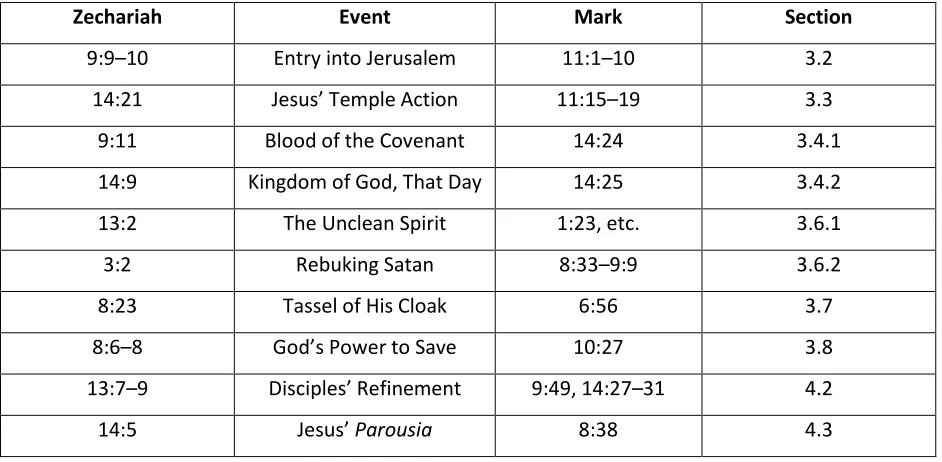
Testament authors knew whole passages of scripture in extenso,109 C.H. Dodd described Zech 9–14 as
“setting forth a whole eschatological programme, many elements of which have been taken up in the
New Testament.”110 According to Zech 9–14, the “programme” consists of at least 1) the entry of the
king into Jerusalem,111 2) the shedding of the “blood of the covenant,”112 3) the slaying of the
shepherd,113 4) the clearance of the merchants from the temple,114 5) the gentile mission,115 and 6) the
appearance of the Lord with all his holy ones.116 According to Dodd, Mark alludes at least to elements
(1), (2), and (3) in Mark 11:1–11, Mark 14:24, and Mark 14:27, respectively.117
In 1961, Barnabas Lindars, in wide agreement with Dodd’s conclusions, set out to detect the
shift in application of various passages that are widely attested across the New Testament.118
Hypothesizing that the shifts in application of various texts arise from the apologetic needs of the
particular author or community,119 he argued that the Gospels primarily use Zech 9–14 in defense of the
church’s claims that Jesus is Messiah and that the Messiah had to suffer.120 Regarding Mark’s use of Zech
9–14, Lindars, like Dodd, concluded that Mark alludes to Zech 9:9 in Mark 11:1–10, and to Zech 9:11 in
Mark 14:24. Regarding the quotation of Zech 13:7 in Mark 14:27, he noted that Zech 13:7–9’s notion
that the remnant would be refined after the striking of the shepherd “is highly suitable for the Church’s
needs.”121 He did not, however, justify that claim by citing any texts.
In 1968, F.F. Bruce sought “to take a few of the chief themes, motifs or images which are used
as vehicles of revelation in the Old Testament and consider how the New Testament writers continue to
use them to set forth the perfected revelation in Christ.”122 His study devoted a section entirely to the
Gospels’ use of Zech 9–14 in their description of Jesus as “the Shepherd King.”123 In his survey of Zech 9–
14 in Mark, he concluded, as Lindars and Dodd before him, that Mark alludes to Zech 9:9 in Mark 11:1–
109 See ibid., 57–60.
110 Ibid., 64. 111 Zech 9:9.
112 Zech 9:11.
113 Zech 13:7.
114 Zech 14:21.
115 Zech 14:16.
116 Zech 14:5. Summary of “programme” in Dodd 1952, 73–74.
117 See ibid., 49, 64. He claims that the quotation of Zech 13:7 in Mark 14:27 is “nearer to the Hebrew than to the
LXX” (66). He takes many allusions to Zechariah by the Gospels to reflect “the Massoretic [sic] text” (65).
118 Lindars 1961.
119 See ibid., 28. 120 Ibid., 75–77. 121 Ibid., 131.
122 F.F. Bruce 1968, 21.
20
10, “even in the absence of an explicit quotation,”124 and to Zech 9:11 in Mark 14:24.125 Additionally,
Bruce claimed that Zech 14’s “day of the Lord” imagery, particularly in reference to its depiction of the
siege of Jerusalem, “has influenced some of the language in the eschatological discourse.”126 Bruce did
not say more than this, except by noting that the influence is especially detectable in Luke 21.
In accord with the method described in Sections 1.2 and 1.3 above, my project goes beyond the
work of Dodd, Lindars, and Bruce by: 1) arguing for the presence of more allusions to Zechariah than
they note; 2) spending more time interpreting the Markan passage in light of the recognition of a
scriptural allusion; and 3) arguing for the influence of the scriptural context, if any, on the basis of
intratextual and extratextual data.
1.5.2: H.C. Kee
In 1975, Howard Clark Kee contributed to the conversation both by inquiring after the function
of scriptural allusions in Mark, and by limiting his scope to Mark.127 After surveying in tabular form the
numerous quotations, allusions, and scriptural influences in Mark 11–16,128 he noted that Mark uses a
range of text types, including the Targum of Isa 53, “the traditional Hebrew text,” “the LXX tradition,”
and “the tradition of the Greek Bible associated with Theodotion.”129 Additionally, he identified a key
element of Mark’s exegetical procedure that informs the present study, namely, the synthesis of
multiple passages to form a composite image in the Gospel.130 He cited as an example the heavenly
voice at Jesus’ baptism that “acclaims Jesus . . . by blending two [scriptures] (Isa 42:1 and Ps 2:7) into a
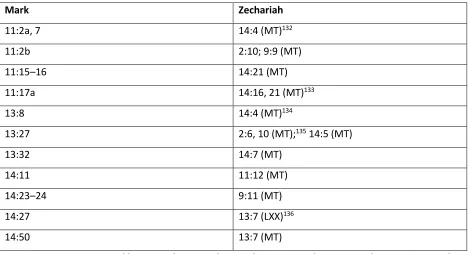
role which combines the kingly tradition of David with the servant of II Isaiah.”131 The table below
reproduces his findings regarding allusions to Zech 9–14 in Mark.
124 Ibid., 107.
125 Ibid., 102 n 3. Bruce wonders if the “blood of the covenant” from Zech 9:11 may be the same “covenant” of
Zech 13:9. He does not pursue the point, but the connection is intriguing in that it may supply a textual connection between Jesus’ covenant-inaugurating suffering, described as “the blood of the covenant” (Zech 9:11) and the covenantal status of those who are refined after the striking of the shepherd (Zech 13:7–9).
126 Ibid., 108.
127 H.C. Kee 1975, 165–188.
128 Ibid., 167–171.