This content has been downloaded from IOPscience. Please scroll down to see the full text.
Download details:
IP Address: 138.251.162.161
This content was downloaded on 08/05/2014 at 14:33
Please note that terms and conditions apply.
Effect of the radial and azimuthal mode indices of a partially coherent vortex field upon a
spatial correlation singularity
View the table of contents for this issue, or go to the journal homepage for more 2013 New J. Phys. 15 113053
(http://iopscience.iop.org/1367-2630/15/11/113053)
partially coherent vortex field upon a spatial
correlation singularity
Yuanjie Yang1,2, Mingzhou Chen2,4, Michael Mazilu2, Areti Mourka2, Yi-Dong Liu3 and Kishan Dholakia2
1School of Astronautics & Aeronautics, University of Electronic Science and
Technology of China, Chengdu 611731, People’s Republic of China
2SUPA, School of Physics and Astronomy, University of St. Andrews,
North Haugh, St Andrews KY16 9SS, UK
3School of Physical Electronics, University of Electronic Science and
Technology of China, Chengdu 610054, People’s Republic of China E-mail:[email protected]
New Journal of Physics15(2013) 113053 (9pp)
Received 26 August 2013 Published 26 November 2013 Online athttp://www.njp.org/ doi:10.1088/1367-2630/15/11/113053
Abstract. The existence of a spatial correlation singularity or a ring dislocation in the spatial coherence function when a vortex is present has been demonstrated recently. Here, we investigate how the spatial correlation singularity is affected by both the radial and azimuthal mode indices (p,`) in a partially coherent light field. Theoretically, we find that the spatial correlation singularity may exist even in a non-vortex beam (`=0) due to the radial index. Numerical simulations show the number of ring dislocations in the far-field cross correlation function is equal to 2p+|`| for the low coherence cases. This is confirmed by our experimental results. This phenomenon may occur in any partially coherent vortex wave.
S Online supplementary data available from stacks.iop.org/NJP/15/113053/ mmedia
4Author to whom any correspondence should be addressed.
2
Contents
1. Introduction 2
2. Cross-correlation function in the far-field 3
3. Numerical simulations 3
4. Experimental results 5
5. Conclusion 8
Acknowledgments 9
References 9
1. Introduction
In the past few years, great interest has been focused on vortex fields. They are associated with wave phenomena and appear in a wide range of physical systems. Vortices denote singular (zero intensity) points in a given field that have indeterminate phase, and phase circulation a multiple of 2π in the plane transversal to the direction of wave propagation [1]. Optical vortices are characterized by an azimuthal phase term exp(−i`ϕ) that encircles the singular point, where
` is the azimuthal mode index (topological charge), and ϕ denotes the azimuthal coordinate. Optical vortices find numerous applications in quantum information, astrophysics, microscopy and the manipulation of atoms or microscopic particles [2]. Some of these applications arise from the orbital angular momentum associated with the nature of propagation of the Poynting vector field [3] in these fields.
The preservation of the vortex structure during propagation makes partially coherent vortex beams good candidates for various applications; accordingly, a better understanding of the spatial coherence properties is of fundamental importance. Coherence vortices and the phase singularities of a partially coherent field have been studied extensively within optical coherence theory [4–8]. In 2004, it was shown that a spatial correlation singularity will exist in the spatial coherence function when a vortex is present [6]. More recently, the effect of the topological charge `on the cross-correlation function (CCF) of a partially coherent beam has been studied theoretically and experimentally [9–11]. It has been shown that spatial correlation functions have interesting topological properties associated with their phase singularities. However, it is noteworthy that all of these studies have assumed that the partially coherent optical field possesses a radial index p=0, ignoring the effect of the radial mode index. To our knowledge, a generic understanding of how both the radial and azimuthal degrees of freedom influence the form of the CCF has not been presented yet. More importantly, the radial degree of freedom is a crucial facet for the correct description of the transversal state of these light fields and thus it is necessary to understand this in relation to the CCF.
In this study, we theoretically and experimentally delineate the form of the CCF for a partially coherent light field including both the azimuthal and radial mode indices. Our results show that there are 2p+|`|spatial correlation singularities or ring dislocations in the CCF for low coherence cases. This result has major significance for the measurement and use of partially coherent vortex light fields.
2. Cross-correlation function in the far-field
If we consider a cylindrical coordinate system, a fully coherent Laguerre–Gaussian (LG) optical vortex with topological charge ` at the source plane z=0 has a complex amplitude proportional to
up,`(ρ, ϕ,0)∝ρ`Lp|`|
2ρ2
w2 0 exp −ρ 2 w2 0
exp (−i`ϕ)exp (iθ) , (1)
where w0 is the waist width, L|`|p(·) is the associated Laguerre polynomial, p is the radial
mode index, ` is the azimuthal mode index,ρ andϕ are the radial and azimuthal coordinates, respectively, andθ is an arbitrary phase.
By propagating a fully coherent LG beam through a rotating optical diffuser, we can create a partially coherent LG beam that can be described using the Gaussian Schell-model correlator:
µ(ρE10,ρE20)=exp(−|Eρ10 − Eρ20| 2/L2
c), where Lc is the transverse coherence length. One can write
the mutual coherence function (MCF) of a partially coherent vortex beam at the source plane z=0 as [6]
00(ρE0
1,ρE20,0)∝ |Eρ10 · Eρ20|`exp −
ρE10 − Eρ20 2 L2 c !
L|`|p
2ρ102
w2 0
L|p`|
2ρ202
w2 0
×exp −ρ102+ρ
02 2 /w2 0
exp −i` φ20−φ10
. (2)
In the far field, the MCF is given by [6]
0 (ρE1,ρE2,z)=(1/λz)2 ZZ ZZ
00 ρE0
1,ρE20,0
exp
−i2π
λz ρE 0
1· Eρ1− Eρ20 · Eρ2
dρE10dρE20, (3)
whereλis the wavelength.
3. Numerical simulations
From the far-field MCF in equation (3), one may determine the far-field CCF, χc(ρ)E =
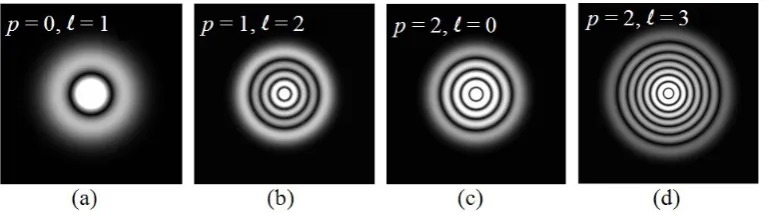
0 (ρ,E −Eρ), which is a more robust pattern than the intensity in a partially coherent beam [6]. The far-field CCF of partially coherent optical vortices with different radial and azimuthal mode indices is shown in figure 1, where the transverse coherence length Lc=w0. The ring
dislocations denote places where the two-point correlation vanishes, the physical meaning of which indicates an absence of coherence. One can also see the number of ring dislocations in the far-field CCF is dependent on both the radial and azimuthal mode indices of a partially coherent optical vortex beam. It is noted that Palacioset al[6] showed that a spatial correlation singularity exists when a vortex is present, whereas figure 1(c) shows in fact that a spatial correlation singularity may exist even in a non-vortex beam (i.e. `=0). A careful observation of the far-field CCFs of partially coherent vortex beams (figure 1) gives a definitive general relationship between the number of dislocation rings, N, and the radial and azimuthal mode indices of a partially coherent beam as
N =2p+|`|. (4)
4
Figure 1. Far-field CCFs of partially coherent LG beams with different mode indices.
CCF. When p=0 and`6=0, equation (4) is rewritten as N = |`|, which is consistent with the earlier theoretical study [9].
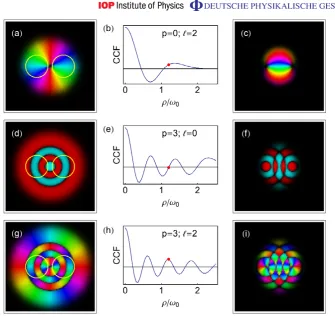
Equation (4) can be understood by considering the different steps involved in measuring the far-field CCF of a LG beam. Figure 2 and the supplementary video 1 (available at stacks.iop.org/NJP/15/113053/mmedia) show how the CCF cross-correlates two regions of the partially coherent vortex beam, diametrically opposite to each other (highlighted using the yellow circles in parts (a), (d) and (g)). The size of these regions is determined by the transverse coherence length, Lc. The product of the two fields in these two regions corresponds to the integrand of the far-field CCF and is represented in parts (c), (f) and (i) of figure 2. We observed that this product has multiple features. In the ‘horizontal’ direction, one sees that the p ring dislocations originating from the p6=0 beam appear doubled up, one for each region. Further, in the ‘vertical’ direction, the phase changes due to the`th order vortex charge. As we increase the distance between the two regions, a number of destructive interferences appear, each corresponding to a ring dislocation in the CCF function. Altogether, the number of destructive interferences observed is given by 2p+|`|, originating from the doubling up of rings due to the two regions and the`component originating from the 2π`phase changes in the ‘vertical’ direction.
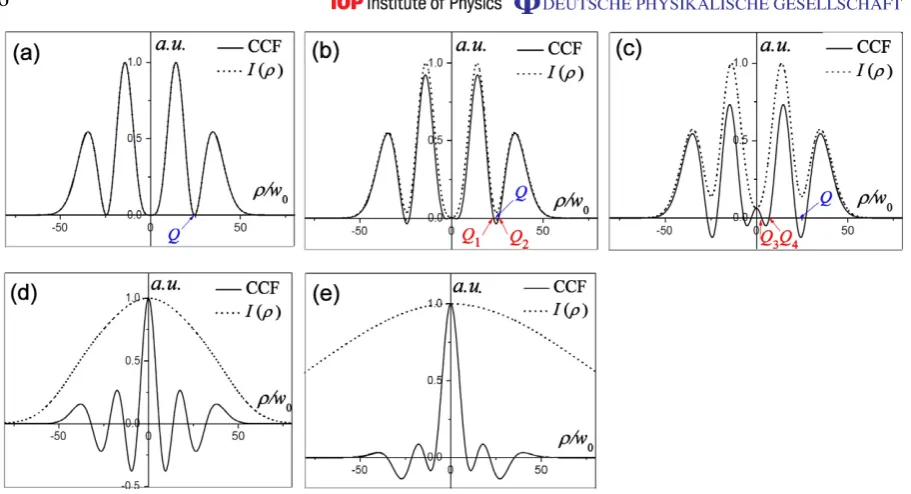
In order to understand the general relationship in equation (4), especially to highlight which ring dislocations are associated with p and which are associated with `, we present in figure 3 the one dimensional far-field CCF and intensity distributions of a partially coherent vortex beam with p=1 and `=2, for various coherence lengths. In figure 3(a) one observes that for a high coherence length, the far-field CCF is the same as the intensity distribution. It is well known that the intensity profile of a coherent LG vortex beam with radial mode indexphas pdark rings and a dark centre, therefore, for p=1 in figure3, we observe one dark ring in the intensity distribution atρ=24.5w0(indicated by the pointQand the blue arrow in figure3(a)).
Accordingly, we can say that the zero of the far-field CCF at pointQin figure3(a) is associated with p. Furthermore, the former pointQdenotes zeros in both intensity and the far-field CCF. From figure3(b), one observes that as the coherence length Lc decreases to 10w0, the intensity
at the former point Q increases; while the far-field CCF at Q decreases below zero, creating two new crossing points Q1andQ2. When the coherence length decreasesLc=5w0, two zeros
in the far-field CCF appear near the former dark centre of the intensity, as shown by points Q3 and Q4 in figure 3(c). Additionally, figures 3(d) and (e) indicate that the number of zeros
in the far-field CCF is unchanged for the case of even lower coherence length. Recalling the recent studies [9, 11], that is, the number of ring dislocations in the far-field CCF is equal to
Figure 2. Step by step simulation of the far-field CCF pattern for different mode indices: (a)–(c) p=0, `=2; (d)–(f) p=3, `=0; (g)–(i) p=3, `=2. The phase is represented by the hue and the amplitude by the luminosity. Parts (a, d, g) correspond to the LG beam profile superimposed with two, yellow circle delimited, regions that are used for each CCF point. Parts (c, f, i) correspond to the CCF integrand and parts (b, e, h) to the CCF as a function of the radial distance.
the azimuthal mode index` when p=0, we can draw a conclusion that there are 2p+|`|ring dislocations in the far-field CCF for low coherence length cases.
4. Experimental results
We measured the CCF of a partially coherent beam with the aid of a wavefront folding (WFF) interferometer [6]. A schematic overview of the experimental setup is shown in figure 4. A partially coherent optical field is generated by focusing a He–Ne laser beam (λ=633 nm) onto a rotating holographic diffuser (Edmund Optics, 0.5◦ diffusing angle). The beam is re-collimated onto a spatial light modulator (SLM, Holoeye HEO 1080P), where an intensity-coded phase function [13] is imprinted in order to generate LG beams with different radial and azimuthal mode indices. By selecting the first diffraction order with a pinhole (P1), we realize a
partially coherent LG beam at the focal plane of lens (L3) with a designated radial and azimuthal
6
Figure 3.Far-field CCF (—) and intensity (· · · ·) distributions for a partially coherent vortex beam with p=1 and `=2, for various coherence lengths Lc. (a)Lc=100w0; (b)Lc=10w0; (c) Lc=5w0; (d) Lc=w0; (e) Lc=w0/5.
Figure 4. Schematic of the experimental setup used for measuring the ring dislocations of the far-field CCFs in a partially coherent vortex field. D1=
rotating holographic diffuser, L= lens, SLM = spatial light modulator, M = mirror, P=pinhole, CCD=charge coupled camera, B=beam splitter cube and DP = dove prism. Focal widths of lenses: f1= f2=400 mm, f3=1000 mm,
f4=200 mm and f5=400 mm.
unblocked, the recorded interferograms can reveal the locations of ring dislocations in the CCF,
χc(ρ)E =0(ρ,E −Eρ)[6]. The relation between theχc(ρ)E and the expected interferogramF(x, y)
is given by [6]
F(x,y)=I (−x,y)+I (x,−y)+ 2Re[χc(ρ)E ] cos(1Ek⊥· Eρ), (5) where I(−x,y) and I(x,−y) are the intensities of the two beams emerging from the interferometer, respectively; and 1Ek⊥ is the difference between the wave vectors of the two beams.
[image:7.595.149.466.389.538.2]Figure 5.Far-field CCFs of partially coherent LG beams (`=1, 3 and p=1, 3), where w=2.7 mm is the beam waist on the CCD. The concentric dashed-line circles are an aid to the eye to visualize the ring dislocations.
In this study, we considered partially coherent LG beams with both radial and azimuthal mode indices each ranging from 0 to 5, in integer steps. As an example, figure 5 shows the interferograms of CCF when`=1, 3 and p=1, 3. As shown in figure5, the ring dislocations are experimentally observed and visualized (dashed-line concentric circles indicate the ring dislocations).
One notes that there are many fringes in figure 5, due to the difference between the wave vectors of the two beams emerging from the interferometer. We remark that the fringe visibility vanishes at the boundary of the ring dislocation in CCF (see [6]). Moreover, there is a single-fringe shift at each ring dislocation because of the π phase jump. Therefore, the fringes can help us recognize the ring dislocations more clearly. The spatial coherence of the optical field is controlled by changing the position of the holographic diffuser along the optical axis [12], and we observe that the coherence length influences the far-field CCF significantly.
8
Figure 6.Far-field CCFs of partially coherent LG beams (`=2, 4 and p=2, 4), where w=3.2 mm for radial index mode p=2 (upper row) and w=2.7 mm for radial index mode p=4 (lower row). The concentric dashed-line circles are an aid to the eye to visualize the ring dislocations.
setup, we observe 2p+|`| ring dislocations for values of ` and p up to 5, beyond which the visibility in the interferograms of CCF is too low to recognize the ring dislocations.
Additionally, for partially coherent LG beams with no vortices (`=0), we performed two experiments for the cases of p=1 and 2 (not shown here). The number of ring dislocations in the recorded far-field CCF is equal to 2p, which obeys the relation in equation (4). Our experimental results verify that the number of ring dislocations in the CCF of such a partially coherent vortex beam is exactly equal to the absolute value of the azimuthal index`whenp=0 and`6=0, which is in agreement with theoretical predictions [9].
5. Conclusion
The dependence of the spatial correlation singularity upon both the radial and azimuthal mode indices (p, `) in a partially coherent light field is studied. A relationship between the number of ring dislocations in the far-field CCF and both the radial and azimuthal mode indices is presented numerically and experimentally. We found that the number of ring dislocations in the far-field CCF is equal to 2p+|`|for the low coherence cases, and the visibility of the ring dislocations is clearest when the coherence length is approximately equal to the waist width of the beam. Though this phenomenon is observed in the optical field, it may occur in any partially coherent wave. This offers a powerful relationship useful for the characterization of
partially coherent fields with embedded vortices and higher order radial modes. Our results will be useful for applications using partially coherent vortex fields. As an example, the radial index adds a new degree of freedom that may be exploited for quantum communication or information processing.
Acknowledgments
We thank the UK Engineering and Physical Sciences Research Council for funding. YY acknowledges support by the National Natural Science Foundation of China under grant numbers 61205122, 60908034 and 61107037, the Fundamental Research Funds for the Central Universities under grant no. ZYGX2010J112, and Doctoral Fund of Ministry of Education of China under grant no. 20090185120016. KD is a Royal Society-Wolfson Merit Award Holder.
References
[1] Nye J F and Berry M V 1974Proc. R. Soc. Lond.A336165–90
[2] Molina-Terriza G, Torres J P and Torner L 2007Nature Phys.3305–10
[3] Allen L, Beijersbergen M W, Spreeuw R J C and Woerdman J P 1992Phys. Rev.A458185–9
[4] Maleev I D, Palacios D M, Marathay A S and Swartzlander G A Jr 2004J. Opt. Soc. Am.B211895–900
[5] Gbur G and Visser T D 2003Opt. Commun.222117–25
[6] Palacios D, Maleev I D, Marathay A S and Swartzlander G A Jr 2004Phys. Rev. Lett.92143905
[7] Gbur G and Swartzlander G A Jr 2008J. Opt. Soc. Am.B251422–9
[8] Pires H D L, Woudenberg J and van Exter M P 2010J. Opt. Soc. Am.A272630–7
[9] Yang Y, Mazilu M and Dholakia K 2012Opt. Lett.374949–51
[10] Pires H D L, Woudenberg J and van Exter M P 2010Opt. Lett.35889–91
[11] Zhao C, Wang F, Dong Y, Han Y and Cai Y 2012Appl. Phys. Lett.101261104
[12] Shirai T and Wolf E 2004J. Opt. Soc. Am.A211907–16
[13] Leach J, Dennis M R, Courtial J and Padgett M J 2005New J. Phys.755