J. Water Resource and Protection, 2010, 2, 267-281
doi:10.4236/jwarp.2010.23031 Published Online March 2010 (http://www.scirp.org/journal/jwarp)
Simulation of Runoff and Sediment Yield for a Himalayan
Watershed
Using SWAT Model
Sanjay K. Jain¹, Jaivir Tyagi¹, Vishal Singh² 1
National Institute of Hydrology, Roorkee, India
2
Alternate Hydro-Energy Centre, I IT, Roorkee, India E-mail: [email protected]
Received October 12,2009; revised December 7,2009; accepted January 25,2010
Abstract
Watershed is considered to be the ideal unit for management of the natural resources. Extraction of water-shed parameters using Remote Sensing and Geographical Information System (GIS) and use of mathematical models is the current trend for hydrologic evaluation of watersheds. The Soil and Water Assessment Tool (SWAT) having an interface with ArcView GIS software (AVSWAT2000/X) was selected for the estimation of runoff and sediment yield from an area of Suni to Kasol, an intermediate watershed of Satluj river, located in Western Himalayan region. The model was calibrated for the years 1993 & 1994 and validated with the observed runoff and sediment yield for the years 1995, 1996 and 1997. The performance of the model was evaluated using statistical and graphical methods to assess the capability of the model in simulating the run-off and sediment yield from the study area. The coefficient of determination (R2) for the daily and monthly runoff was obtained as 0.53 and 0.90 respectively for the calibration period and 0.33 and 0.62 respectively for the validation period. The R2 value in estimating the daily and monthly sediment yield during calibration was computed as 0.33 and 0.38 respectively. The R2 for daily and monthly sediment yield values for 1995 to 1997 was observed to be 0.26 and 0.47.
Keywords:AVSWATX, Calibration, Validation, Image Processing, Remote Sensing, GIS, Runoff, Sediment Yield
1. Introduction
A Watershed is a hydrologic unit which produces water as an end product by interaction of precipitation and the land surface. The quantity and quality of water produced by the watershed are an index of amount and intensity of precipitation and the nature of watershed management. In some watersheds the aim may be to harvest maximum total quantity of water throughout the year for irrigation and drinking purpose. In another watershed the objec-tives may be to reduce the peak rate of runoff for mini-mizing soil erosion and sediment yield or to increase ground water recharge. Hence, the modeling of runoff, soil erosion and sediment yield are essential for sustain-able development. Further, the relisustain-able estimates of the various hydrological parameters including runoff and sediment yield for remote and inaccessible areas are te-dious and time consuming by conventional methods. So it is desirable that some suitable methods and techniques are used/ evolved for quantifying the hydrological pa-rameters from all parts of the watersheds. Use of
mathe-matical models for hydrologic evaluation of watersheds is the current trend and extraction of watershed parame-ters using remote sensing and geographical information system (GIS) in high speed computers are the aiding tools and techniques for it.
model. The application of AVSWAT2000/X in the pre-sent study provided the capabilities to stream line GIS processes tailored towards hydrologic modeling and to automate data entry communication and editing envi-ronment between GIS and the hydrologic model. The time series data on rainfall, runoff and sediment yield were available at the gauging station of the catchment and these were used to calibrate and validate the SWAT model and to assess its applicability in simulating runoff and sediment yield from the intermediate watershed in the Himalayan region.
2. The Study Area
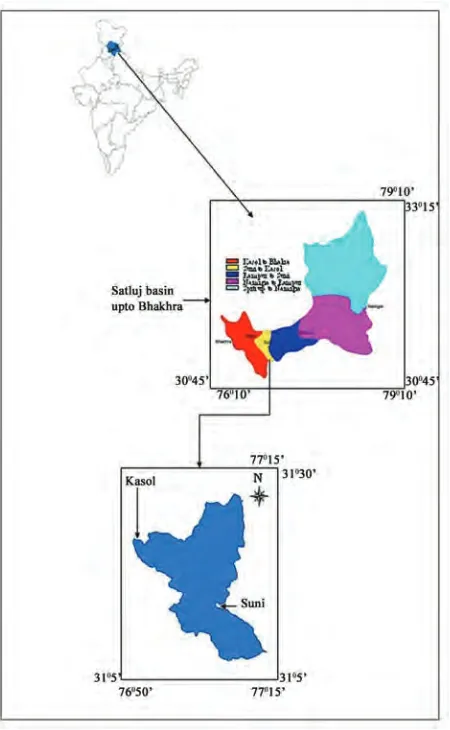
The data of an intermediate watershed of Satluj river was used for assessment of runoff and sediment yield in the present study. The study watershed (Figure 1) lying be-tween Suni to Kasol in the state of Himachal Pradesh, India is located between latitudes 31˚ 5` to 31˚ 30` N and longitudes 76˚ 50` to 77˚15` E. The watershed covers an area of about 681.5 sq km with an elevation between 600 to 3200 m above mean sea level (msl). The Satluj River flows through the Western Himalayan region. The West-ern Himalayas cover the hilly areas of Jammu- Kashmir, Himachal Pradesh and Uttarakhand states in India. Two important river systems originating from the Western Himalayan region are 1) Indus system consisting of In-dus, Jhelum, Chenab, Ravi, Beas and Satluj rivers, and 2) Ganga system consisting of Yamuna, Ramganga, Sarda, and Karnali rivers. These rivers are fed by snowmelt and rainfall during the summer and by groundwater flow during the winter.
3. Swat Model
[image:2.595.313.538.78.443.2]The SWAT (Soil and Water Assessment Tool) is one of the most recent models developed jointly by the United States Department of Agriculture - Agricultural Research Services (USDA-ARS) and Agricultural Experiment Station in Temple, Texas [1]. It is a physically based, continuous time, long-term simulation, lumped parame-ter, deterministic, and originated from agricultural mod-els. The computational components of SWAT can be placed into eight major divisions: hydrology, weather, sedimentation, soil temperature, crop growth, nutrients, pesticides, and agricultural management. The SWAT model uses physically based inputs such as weather variables, soil properties, topography, and vegetation and land management practices occurring in the catchment. The physical processes associated with water flow, sediment transport, crop growth, nutrient cycling, etc. are directly modeled by SWAT [2,3]. Some of the advan-tages of the model include: modeling of ungauged
Figure 1. Study area between Suni to Kasol.
catchments, prediction of relative impacts of scenarios (alternative input data) such as changes in management practices, climate and vegetation on water quality, quan-tity or other variables. SWAT has a weather simulation model also that generates daily data for rainfall, solar radiation, relative humidity, wind speed and temperature from the average monthly variables of these data. This provides a useful tool to fill in missing daily data in the observed records. The hydrologic cycle as simulated by SWAT is based on the water balance equation:
n i gw seep a surf day ot
SW
R
Q
E
w
Q
SW
1
)
(
where, SWt is the final soil water content (mm H2O),
S. K. JAIN ET AL. 269
the amount of return flow on day i (mm H2O).
In SWAT, a basin is delineated into sub-basins, which are then further subdivided into hydrologic response units (HRUs). HRUs consist of homogeneous land use and soil type (also, management characteristics) and based on two options in SWAT, they may either repre-sent different parts of the sub-basin or sub-basin area with a dominant land use or soil type (also, management characteristics). With this semi-distributed (sub-basins) set-up, SWAT is attractive for its computational effi-ciency as it offers some compromise between the con-straints imposed by the other model types such as lumped, conceptual or fully distributed, physically based models. A full model description and operation is pre-sented in Neitsch et al. [4,5]. SWAT uses hourly and daily time steps to calculate surface runoff. The Green and Ampt equation is used for hourly and an empirical SCS curve number (CN) method is used for the daily computation.
Spruill et al. [6] evaluated the SWAT model and pa-rameter sensitivities were determined while modeling daily streamflow in a small central Kentucky watershed comprising an area of 5.5 km2 over a two year period. Streamflow data from 1996 were used to calibrate the model and streamflow data from 1995 were used for evaluation. The model accurately predicted the trends in daily streamflow during this period. The Nash-Sutcliffe [7] R2 for monthly total flow was 0.58 for 1995 and 0.89 for 1996 whereas for daily flows it was observed to be 0.04 and 0.19. The monthly total tends to smooth the data which in turn increases the R2 value. Overall the results indicated that SWAT model can be an effective tool for describing monthly runoff from small water-sheds.
Fohrer et al. [8] applied three GIS based models from the field of agricultural economy (ProLand), ecology (YELL) and hydrology (SWAT-G) in a mountainous meso-scale watershed of Aar, Germany covering an area of 59.8 km2 with the objective of developing a multidis-ciplinary approach for integrated river basin management. For the SWAT–G model daily stream flow were pre-dicted. The model was calibrated and validated followed by model efficiency using Nash and Sutcliffe test. In general the predicted streamflow showed a satisfying correlation for the actual landuse with the observed data.
Francos et al. [9] applied the SWAT model to the Kerava watershed (South of Finland), covering an area of 400 km2. The temporal series comprised temperature and precipitation records for a number of meteorological sta-tions, water flows and nitrogen and phosphorus loads at the river outlets. The model was adapted to the specific conditions of the catchment by adding a weather genera-tor and a snowmelt submodel calibrated for Finland. Calibration was made against water flows, nitrate and total phosphorus concentrations at the basin outlet. Simulations were carried out and simulated results were
compared with daily measured series and monthly aver-ages. In order to measure the accuracy obtained, Nash and Suttcliffe efficiency coefficient was employed which indicated a good agreement between measured and pre-dicted values.
Eckhartd and Arnold [10] outlined the strategy of im-posing the constraints on the parameters to limit the number of interdependently calibrated values of SWAT. Subsequently an automatic calibration of the version SWAT-G of the SWAT model with a stochastic global optimization algorithm and Shuffled Complex Evolution algorithm is presented for a mesoscale catchment.
Tripathi et al. [11] applied the SWAT model for Nag-wan watershed (92.46km2) with the objective of identi-fying and prioritizing of critical sub-watersheds to de-velop an effective management plan. Daily rainfall, run-off and sediment yield data of 7 years (1992-1998) were used for the study. Apart from hydro-meteorological data, topographical map, soil map, land resource map and sat-ellite imageries for the study area were also used. The model was verified for the monsoon season on daily ba-sis for the year 1997 and monthly baba-sis for the years 1992-1998 for both surface runoff and sediment yield.
Singh et al. [12] made a comparative study for the Iro-quois river watershed covering an area of 2137 sq. miles with the objectives to assess the suitability of two water-shed scale hydrologic and water quality simulation mod-els namely HSPF and AVSWAT 2000. Based on the completeness of meteorological data, calibration and validation of the hydrological components were carried out for both the models. Time series plots as well as sta-tistical measures such as Nash-Sutcliffe efficiency, coef-ficient of correlation and percent volume errors between observed and simulated streamflow values on both monthly and annual basis were used to verify the simula-tion abilities of the models.
The review indicated that SWAT is capable of simu-lating hydrological processes with reasonable accuracy and can be applied to large ungauged basin. Therefore, to test the capability of model in determining the effect of spatial variability of the watershed on runoff, AVSWAT 2000 with arcview interface was selected for the present study.
3. Methodology
3.1. Creation of Data Base
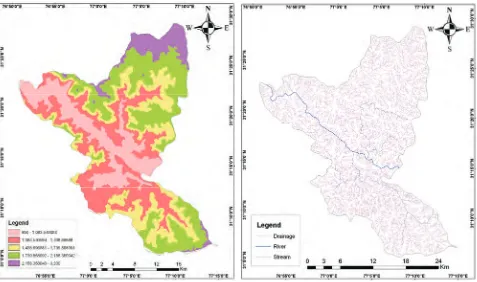
and for performing spatial modeling and analysis of flows, trends, and surfaces such as hydrology. Raster data records spatial information in a regular grid or ma-trix organized as a set of rows and columns. The DEM of the study watershed is shown in Figure 2. The drainage map (Figure 3) was digitized using Survey of India to-posheets at a scale of 1:50,000. The drainage map can be entered into AVSWAT as shape file and grid format.
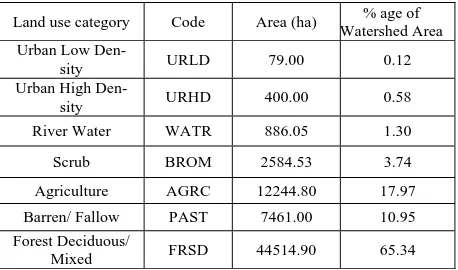
Landuse map is a critical input for SWAT model. Land use/land cover map was prepared using remote sensing data of Landsat ETM+. The classification of satellite data mainly follows two approaches i.e. super-vised and unsupersuper-vised classification. The intent of the classification process is to categorize all pixels in a digi-tal image into one of several land cover classes, or “themes”. This categorized data may then be used to produce thematic maps of the land cover present in an image. In the present study, the unsupervised classifica-tion method was used for preparaclassifica-tion of the land use map (Figure 4). The various land use categories and their coverage in the study watershed are presented in Table 1.
Soil map of the study area was digitized using soil map of the National Bureau of Soil Survey and Land Use Planning (NBSS&LUP) at a scale of 1:50,000. Soil plays an important role in modeling various hydrological processes. In the AVSWATX model, various soil prop-erties like soil texture, hydraulic conductivity, organic carbon content, bulk density, available water content are required to be analyzed to make an input in the model for simulation purpose. While carrying out the soil sampling, the soil map prepared by NBSS&LUP was used as a base map. The collected 26 soil samples were then analyzed in a standard soil laboratory. Based on the analysis it was observed that the soils in the study area were mostly clayey soils (Figure 5) and falls in the hydrologic soil group C & D.
[image:4.595.309.538.94.229.2]A hydro-meteorological observation network was set up in the Satluj River basin by Bhakra Beas Management Board (BBMB), Nangal. The rainfall is observed at 10 stations namely Bhakra, Berthin, Kahu, Suni, Kasol, Rampur, Kalpa, Rackchham, Namgia and Kaza. In the present study, the rainfall data of Suni and Kasol stations were used. The flows were monitored at Suni and Kasol gauging sites on the main Satluj river. The gauge-dis-charge sites were monitored for 24 hours during the monsoon period to observe the high floods. The daily runoff and sediment load data of two stations namely Suni and Kasol were collected for the years 1993 through 1997. The processing of meteorological data was done statistically. The simulated daily weather data on maxi-mum and minimaxi-mum temperature, rainfall, wind speed and relative humidity at all the grid locations for 5 years rep-resenting the series approximating 1993 to 1997 time period were processed.
Table 1. Coverage of various land use categories in the study.
Land use category Code Area (ha) % age of Watershed Area Urban Low
Den-sity URLD 79.00 0.12 Urban High
Den-sity URHD 400.00 0.58 River Water WATR 886.05 1.30
Scrub BROM 2584.53 3.74 Agriculture AGRC 12244.80 17.97 Barren/ Fallow PAST 7461.00 10.95 Forest Deciduous/
Mixed FRSD 44514.90 65.34
3.2. Model Set up
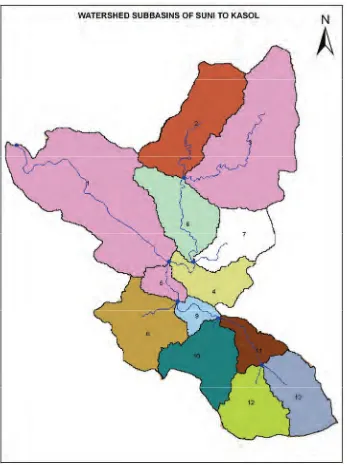
AVSWATX automatically delineates a watershed into sub-watersheds based on DEM and drainage network. After the DEM was imported in the model a masking polygon of the study area was created in Arc Info grid format and was loaded in the model in order to extract out only the area of interest. The critical source area or the minimum drainage area required to form the origin of a stream was taken as 2500 ha which formed 13 sub wa-tersheds (Figure 6). The area delineated by the AVSWATX interface was found to be 68,134.23 ha against the manually delineated area of 68,170.28 ha. The error of calculation was found to be 0.02%.
S. K. JAIN ET AL. 271
[image:5.595.57.536.414.694.2]Figure 2. Digital elevation model of the study watershed. Figure 3. Drainage network in the study area.
Figure 6. Delineation of sub-watersheds of the study area.
3.3. Performance Evaluation of the Model
Performance of the model was evaluated in order to as-sess how the model simulated values fitted with the ob-served values. Several statistical measures are available for evaluating the performance of a hydrologic model. These include coefficient of determination, relative error, standard error, volume error, coefficient of efficiency [13], among others. The coefficient of determination (R2) is one of the frequently used criteria and was employed in this study. R2 describes the proportion of the total vari-ance in the measured data that can be explained by the
model. It ranges from 0.0 to 1.0, with higher values in-dicating better agreement, and is given by,
2 5 . 0 1 2 5 . 0 1 2 1 2
N I avg N i avg N i avg S i S O i O S i S O i O R avgS. K. JAIN ET AL. 273
4. Results and Discussion
4.1. Model Calibration
The AVSWATX model was calibrated using the daily data of runoff and sediment yield recorded at the outlet of the study watershed for the years 1993 & 1994. The model was calibrated using the values of parameters for available
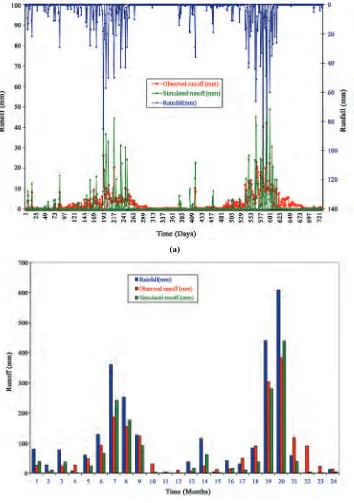
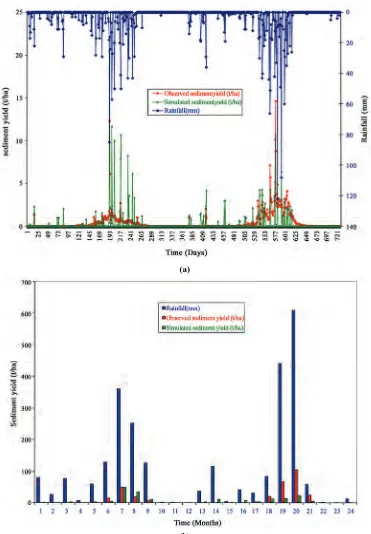
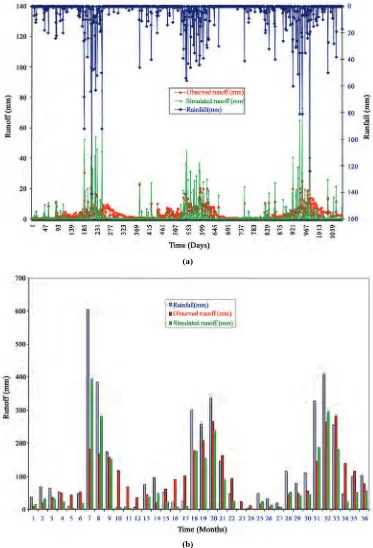
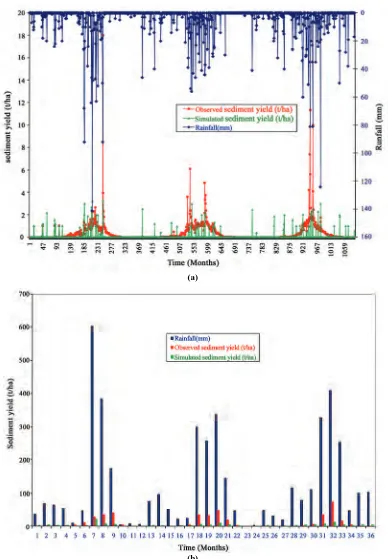
water content (AWC) and soil evaporation compensation factor (SECO) within the prescribed range of the model. Several simulation runs were applied to achieve the model calibration. The time series of the observed and simulated daily and monthly runoff (Figure 7(a), (b)) and daily and monthly sediment yield (Figure 8(a), (b)) for the calibra-tion period were plotted for visual comparison. From these figures, it can be observed in general that the model
(a)
[image:7.595.123.477.191.694.2](b)
(a)
[image:8.595.113.484.75.609.2](b)
Figure 8. Comparison of observed and simulated. (a) daily sediment yield; (b) monthly sediment yield for the calibration pe-riod 1993-1994.
overestimated the peaks of both runoff and sediment yield in both the years of calibration. The total runoff computed by the model was, however, found to be 691.67 mm and 911.85 mm against the observed runoff of 729.82 mm and 1127.66 mm during 1993 and 1994 respectively. The sediment yield computed by the model
S. K. JAIN ET AL. 275
(a)
[image:9.595.123.477.85.614.2](b)
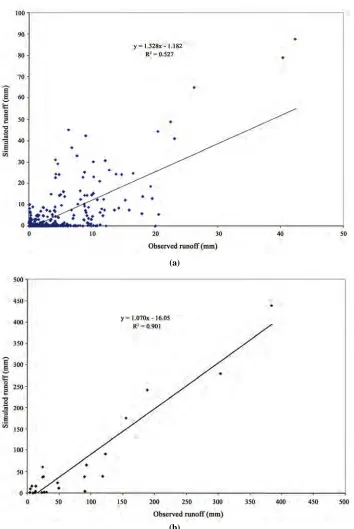
Figure 9. Goodness-of-fit for observed and simulated. (a) daily runoff; and (b) monthly runoff for the calibration period 1993-94.
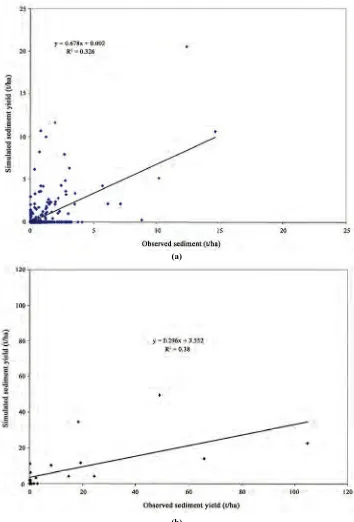
yield. The R2 value for daily and monthly values was obtained as 0.53 and 0.90 respectively for runoff (Figure 9(a), (b)) and 0.33 and 0.38 respectively for sediment yield (Figure 10(a), (b)). The analysis reveals that the monthly comparison showed a better correlation than the daily values. The poor correlation among daily values in
the present study can be supported by the inferences of Peterson and Hamlett [14], Benaman et al. [15], Varanou
lower Nash-Sutcliffe Coefficient (NSC) than monthly comparisons. The monthly totals tend to smooth the data, which in turn increases the NSC [6,18]. While simulating sediment loadings in the Cannonsville Reservoir water-shed (1,178 km2) in New York, Benaman et al. [15] noted that the model generally simulated watershed re-sponse on sediment, but it grossly under predicted
sedi-ment yields during high flow months. In the present study, the error in simulation may also be attributed to some extent perhaps to the unreliable observed data. An-other reason could be the number of delineated sub-wa-tersheds. It is reported that watershed subdivision has an effect on the sediment load [19].
(a)
[image:10.595.121.475.171.693.2](b)
S. K. JAIN ET AL. 277
4.2. Model Validation
The model validation was carried out for daily and monthly surface runoff and sediment yield for the years
1995 to 1997. A graphical comparison of the observed and simulated daily and monthly flows (Figure 11(a), (b)) show that the peaks of the surface runoff were over-estimated in most of the events. During the years 1995,
(a)
[image:11.595.110.483.148.696.2](b)
(a)
[image:12.595.105.493.75.634.2](b)
Figure 12. Comparison of observed and simulated. (a) daily sediment yield; (b) monthly sediment yield for the validation period 1995-97.
1996 and 1997, the simulated runoff was 957.13, 804.92 & 974.80 mm respectively as against the observed runoff of 931.47, 1252.68 and 1197.77 mm from a correspond-ing total rainfall of 1453, 1350 & 1641 mm. The plots of
S. K. JAIN ET AL. 279
the observed sediment yield of 125.21, 143.75 and 137.35 t/ha respectively for the years of 1995, 1996 and 1997. The R2 values for the daily and monthly runoff (Figure 13(a), (b)) were obtained as 0.33 and 0.62 re-spectively, while these values for sediment yield (Figure
14(a), (b)) were computed as 0.26 and 0.47 respectively for the validation period of 1995 to 1997.
The results of the study can further be assessed keep-ing in view the unreliability of the input data. The pa-rameter values derived from various sources need to be
(a)
[image:13.595.112.481.154.690.2](b)
(a)
[image:14.595.126.482.81.607.2](b)
Figure 14. Goodness-of-fit for observed and simulated. (a) daily sediment yield; (b) monthly sediment yield for the validation period 1995-97.
verified in the field which is a difficult task in view of its approachability and mostly covered by thick forest. Si- milarly, the land use derived from remote sensing data was based on unsupervised classification. Further, the rainfall, runoff and sediment yield data used in the study may involve a number of possible human and
S. K. JAIN ET AL. 281
5. Conclusions
In the present study, SWAT 2000, a physical based semi distributed hydrological model having an interface with ArcView GIS software was applied to a Himalayan wa-tershed for modeling runoff and sediment yield. After preparing all the thematic maps and database as per the format of AVSWAT model, the model was calibrated for the daily and monthly surface runoff and sediment yield using the observed data of 1993 and 1994. The model validation was carried out for a data set of three years of 1995 through 1997. The simulation performance of the model for calibration and validation was evaluated using graphical and statistical methods.
The coefficient of determination (R2) for the daily and monthly runoff was obtained as 0.53 and 0.90 respec-tively for the calibration period and 0.33 and 0.62 re-spectively for the validation period. The R2 value in es-timating the daily and monthly sediment yield during calibration was computed as 0.33 and 0.38 respectively. The R2 for daily and monthly sediment yield values for 1995 to 1997 was observed to be 0.26 and 0.47. The values of R2 can be considered reasonably satisfactory for estimating runoff and sediment yield from a remote watershed with scarce data.
6
. References
[1] J. G. Arnold, P. M. Allen, and D. Morgan, “Hydrologic model for design of constructed wetlands,” Wetlands,Vol. 21, No. 2, pp. 167–178, 2001.
[2] J. G. Arnold, and N. Fohrer, “SWAT2000: Current capa-bilities and research opportunities in applied watershed modeling,” Hydrology Process, Vol. 19, pp. 563–572, 2005.
[3] J. G. Arnold, R. S. Srinivasan, and J. R. Williams, “Large area hydrologic modeling and assessment: Part 1. Model development,” Journal of the American Water Resources Association, Vol. 34, No. 7389, 1998.
[4] J. Benaman, C. A. Shoemaker, and D. A. Haith, “Model-ing non-point source pollution us“Model-ing a distributed water-shed model for the Cannonsville Reservoir Basin,” Dela-ware County, New York. Proceedings of the World Wa-ter & Environmental Resources Congress, May 20-24, 2001.
[5] D. K. Borah and M. Bera, “SWAT model background and application reviews,” Paper Number: 032054, Pre-sented at the ASAE Annual International Meeting, July 27-July 30, 2003, Las Vegas, Nevada, USA.
[6] K. Eckhartd and J. G. Arnold, “Automatic calibration of a distributed catchment model,” Journal of Hydrology, Vol. 251, pp. 103–109, 2001.
[7] N. Fohrer, D. Moller, and N. Steiner, “An interdiscipli-nary modeling approach to evaluate the effects of land
use change,” Physics and Chemistry of the Earth, Vol. 27, pp. 655–662, 2002.
[8] A. Francos, G. Bidoglio, L. Galbiati, F. Bouraoui, F. J. Elorza, S. Rekolainen, K. Manni, and K. Granlund, “Hy-drological and water quality modelling in medium sized coastal basin,”Physics Chemistry Earth (B), Vol. 26, No. 1, pp. 47–52, 2001.
[9] N. S. Hsu, J. -T. Kuo, and W. S. Chu, “Proposed daily streamflow-forecasting model for reservoir operation,” Journal of Water Resource Planning and Management, ASCE, Vol. 121, No. 2, 1995.
[10] M. Jha, W. Philip Gassman, S. Secchi, R. Gu, and J. Ar-nold, “Effect of watershed subdivision on SWAT flow, sediment and nutrient predictions,”Journal of American Water Resources Association, Vol. 40, No. 3, pp. 811– 825, 2004.
[11] K. W. King, J. G. Arnold, and R. L. Bingner, “Compari-son of Green-Ampt and curve number methods on Goodwin Creek watershed using SWAT,” Transactions of the ASAE, Vol. 42, No. 4, pp. 919–925, 1999.
[12] J. E. Nash and J. V. Sutcliffe, “River flow forecasting through conceptual models Part I-a discussion of princi-ples,” Journal of Hydrology, Vol. 10, pp. 282–290, 1970. [13] S. L. Neitsch, J. G. Arnold, J. R. Kiniry, J. R. Williams,
and K. W. King, “Soil and water assessment tool thereo-tical documentation - version 2000,” Soil and Water Re-search Laboratory, Agricultural ReRe-search Service, Grass-land, 808 East Blackland Road, Temple, Texas.
[14] S. L. Neitsch, J. G. Arnold, J. R. Kiniry, R. Srinivasan, and J. R. Williams, “Soil and water assessment tool user’s manual - version 2000,” Soil and Water Research Laboratory, Agricultural Research Service, Grassland, 808 East Blackland Road, Temple, Texas.
[15] J. R. Peterson and J. M. Hamlett, “Hydrologic calibration of the SWAT model in a watershed containing fragipan soils,” Journal of the American Water Resources Asso-ciation,Vol. 37, No. 2, pp. 295–303, 1998.
[16] J. Singh, K. H. Verman, and M. Demissie, “Hydrologic modelling of the iroquois river watershed using HSPF and SWAT,” Illinous State Water Survey Contract Report, 2004–2008, 2008.
[17] C. A. Spruill, S. R. Workman, and J. L. Taraba, “Simula-tion of daily and monthly stream discharge from small watersheds using the SWAT model,” Transactions of ASAE, Vol. 43, No. 6, pp. 1431–1439, 2000.
[18] M. P. Tripathi, R. K. Panda, and N. S. Raghuwanshi, “Identification and prioritisation of critical sub-water-sheds for soil conservation management using SWAT model,” Biosystems Engineering, Vol. 85, No. 3, pp. 365 –379, 2003.