In-Situ
Study of Phase Transformation and Microstructural Evolution
of Ni
45Mn
37In
13Co
5Metamagnetic Shape Memory Alloy
Su Zhao
1,+and Binfeng Lu
2,+1School of Material Science and Engineering, Shanghai Dianji University, No. 1350 Ganlan Road, Shanghai 201306, China 2School of Chemistry and Materials Engineering, Jiangsu Key Laboratory of Advanced Functional Materials,
Changshu Institute of Technology, No. 99 3rd South Ring Road, Changshu 215500, China
This paper aims to study the phase transformation and microstructural evolution of Ni45Mn37In13Co5metamagnetic shape memory alloy
during heating and cooling in terms of differential thermal analysis, thermo-magnetic analysis, and temperature-variable optical Kerr microscopy. It has been found that two-stage phase transformation occurs for the alloy during heating. Thefirst stage is magneto-structural transition from low-magnetic martensite to ferromagnetic austenite with a transformation entropy change of about 30.5 J kg¹1K¹1, and the other is pure
magnetic transition from ferromagnetic austenite to paramagnetic austenite.In-situobservation of microstructural evolution at one given position during heating shows that the austenite transformation begins at 359 K (inferred as As), reaches a peak value at about 6 K above the Asand ends
at 375 K. Meanwhile, the temperature when the lath-like martensite begins to disappear (or appear) differs at different region, suggesting that various degrees of superheat (or supercool) and nucleation energy barriers are needed for different martensitic variants. However, one common feature in transformation at these different regions is that the collective formation of a series of austenite (martensite) plays a dominant role. [doi:10.2320/matertrans.M2017415]
(Received December 26, 2017; Accepted March 26, 2018; Published May 11, 2018)
Keywords: shape memory alloy, NiMnInCo, martensitic transformation, microstructure, in-situ observation
1. Introduction
Magnetic shape memory alloys (MSMAs), as one class of intelligent material system, have the features of martensitic transformation and magnetic phase transition, with large output strain and rapid response frequency driven by external magnetic field. Correspondingly, MSMA has been the research hotspot in the fields of condensed matter physics and materials science.17) Among the reported MSMA
systems, the NiMn based Heusler shape-memory alloys exhibit the magnetic-field-induced strain effect,810) the magnetic-field-induced reverse martensitic transformation,11) the giant magneto-resistance effect12,13) and the (inverse) magnetocaloric effect1418) in the vicinity of the martensitic transformation temperature. Such features make it a good candidate for future applications in the field of sensors and magnetic refrigeration.
NiMnInCo metamagnetic Heusler alloys possess both structural phase transition and magnetic transition as the alloy being cooled from high temperature to low temperature, which are from disorder to order austenitic transition, austenitic ferromagnetic order transition, and from ferromagnetic austenite to paramagnetic (antiferromagnetic) martensite transition sequentially.1,19) Kainuma et al.
demonstrated that the NiMnInCo alloy would show inverse martensitic transformation and one-way shape memory effect under the external magnetic field.20) Liu et al. reported that the ingredient of Ni45.2Mn36.7In13Co5.1
would have a giant inverse magnetocaloric effect, and the adiabatic temperature could reach¹6.2 K under 2 T magnetic field.21) In addition, the Ni45Mn36.5In13.5Co5 single crystal
sample would exhibit stress-driven superelasticity under the application of an uniaxial compressive stress, and its superelastic strain would be as high as about 5.2%.22)
It should be pointed that the nucleation and growth of the (inverse) martensite phase transformation should be involved in either magnetic-field-driven inverse martensitic transformation or stress-induced martensitic transformation. In view of the great significance of phase transition kinetics in its functional properties, the microstructures of NiMnIn Co polycrystalline alloys during the continuous heating and cooling were in-situ observed under zero-field conditions, which may enhance understanding of the mechanism of martensitic transformation.
2. Materials and Methods
A polycrystalline ingot with a nominal composition of Ni45Mn37In13Co5(at%) was prepared by arc melting under an
argon atmosphere. The ingot was cut into small pieces with a cubic shape and homogenized in vacuum at 1173 K for 24 h and then quenched in water. All the samples were cut from the same heat-treated slice (with a thickness of about 0.8 mm), and used for differential scanning calorimeter (DSC), magnetization and microstructure measurements, respectively.
The phase composition and crystal orientation of the polycrystalline alloy were analyzed with D8 Advance X-ray diffractometer (XRD, Bruker AXS) and Cu K¡. The phase transformation temperature of the alloy was measured by Diamond differential scanning calorimetry (DSC, Perkin-Elmer), with a heating/cooling rate of 10 K/min. Magnetization versus temperature (MT) curves were measured by a superconducting quantum interference device (SQUID, Quantum Design) at a magneticfield of 500 Oe and with a heating/cooling rate of 3 K/min. The critical magnetic field required to start the reverse martensite transformation is about 1.5 T for similar Ni45.2Mn36.7In13.0Co5.1 at 310 K, as
shown in Ref. 23). Here, the applied magneticfield (500 Oe) for magnetization measurements is well below the criticalfield. +Corresponding author, E-mail: wellzs@163.com; lubinfeng@cslg.edu.cn
In situ martensitic transformation was observed by the Magneto-optical Kerr microscopy (Evico magnetics GmbH). No magnetic fields were applied during the heating and cooling processes. On heating, the sample temperature increased from room temperature (298 K) to 398 K with a temperature interval of 1 K. Meanwhile, at each target temperature, an isothermal holding time of 60 s was conducted. Upon cooling, a continuous cooling from 398 K to room temperature (298 K) was utilized, and the corresponding microstructural evolutions were recorded in the form of videos. Therefore, snapshots of microstructural evolutions during cooling were presented at a time interval of 1 s.
3. Results and Discussion
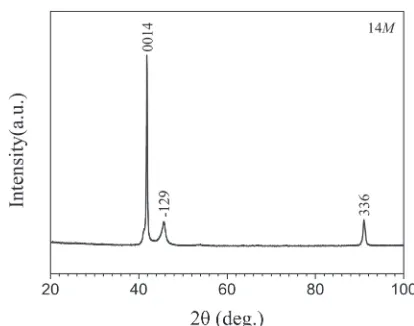
[image:2.595.321.528.66.229.2]3.1 Phase transformation temperature of the alloy Figure 1 shows the X-ray diffraction pattern of Ni45Mn37In13Co5 alloy at room temperature. It can be seen
that the alloy is single martensite phase at room temperature with a certain preferred crystal orientation and the highest peak intensity on (0014)M. The martensite of the alloy at
room temperature should be indexed as 14Mstructure, based on the diffraction peak position characteristics of martensitic structures (6M, 7M, 10Mand 14M) of NiMnIn(Co) alloy that are documented in scientific literatures.2426)
The DSC curve of the Ni45Mn37In13Co5alloy is presented
in Fig. 2. Upon heating, the apparent endothermic peak in the curve accords with the transformation from low-temperature martensite to high-temperature austenite. The corresponding latent heat L is about 10.9 J/g. Upon cooling, the apparent exothermic peak in the curve corresponds to the transformation from a high temperature parent phase to martensite. The starting temperature of martensitic transformation (Ms) was 347.2 K, and the peak temperature
(Mp) was 344.2 K, and the final temperature (Mf) was
340.5 K. The starting temperature of the inverse transformation (As) was 354.2 K, the peak temperature (Ap)
was 360.9 K, and thefinal temperature (Af) was 367.2 K. For
such a latent heat (10.9 J/g) and transformation temperature T0=357.2 K (both of which can be obtained from DSC
measurements), the resultant transformation entropy change ¦S is 30.5 J kg¹1K¹1, by using eq. (1) in Ref. 27), where
T0 is defined as (Af+Ms)/2. The transformation entropy
change in the present work (30.5 J kg¹1K¹1) is consistent
with and comparable to that for adjacent composition alloy (28.47 J kg¹1K¹1for In
13.4alloy), as reported by Itoet al.27)
It should be mentioned that the transformation temperatures in the present work, are significantly different from previous results by Li et al.28) In terms of factors influencing the transformation temperatures, both the chemical composition and structural order are potential factors, as verified in Refs. 29) and 30). Due to the identical heat treatment processes, similar structural order can be expected. The different real composition in our present work, resulting from different weight loss of Mn, can lead to distinctively different transformation temperature, which is in consistence with previous report for In13.5alloy in Ref. 27). On the other hand,
the magnetization values of ferromagnetic austenite phase in our present work are different between heating and cooling,
which is in contrast to the almost identical magnetization indicated by Liet al.28)Such phenomenon may be related to microstructural factors, as recently discovered in NiMnIn based Heusler alloys.31) The observed magnetization discrepancy upon heating and cooling in the present work may result from different phase transition temperature at different region of the sample which are due to the inhomogeneity of chemical composition or crystal structure at the nano-scale regions. Meanwhile, a weak but observable heatflow change (an inflection point) occurs at about 395 K during heating and cooling. The phase transformation at this stage occurs between ferromagnetic austenite and paramagnetic austenite, according to the Curie temperature data related to the alloy in the previous literature.27)
The thermo-magnetic curves of the Ni45Mn37In13Co5alloy
at 500 Oe magnetic field are presented in Fig. 3. The phase transformation temperature was also determined by the tangent method. The starting temperature of martensitic transformation (Ms) is 350.7 K and the final temperature
(Mf) is 340 K when cooled. The starting temperature of
the austenite transformation (As) is 355.6 K, and the final
temperature (Af) is 372.3 K when heated. Compared with the
phase transformation temperatures in Fig. 2, the values of the characteristic phase transformation temperatures (Ms, Mf, As)
have been obtained by the thermo-magnetic curve, which are basically consistent with the values obtained by the DSC method.
Fig. 1 The XRD pattern of Ni45Mn37In13Co5alloy at room temperature.
[image:2.595.318.533.268.429.2]It can be seen from Fig. 3 that the magnetic moment of the low-temperature martensitic phase is close to zero. As the temperature increases, the martensite of low-magnetic moment transforms into the high-magnetic austenite, that is, the structural transformation and the magnetic transition occur simultaneously. As the temperature increases further, the ferromagnetic austenite transforms into the paramagnetic austenite, corresponding to the pure magnetic transition, which is consistent with the appearance of inflection point in Fig. 2.
3.2 In situ observation of inverse transformation of temperature-induced martensite
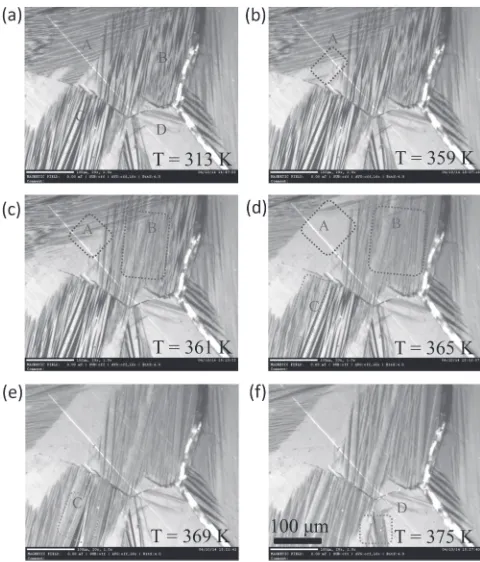
Figure 4 shows the microstructures of Ni45Mn37In13Co5
alloy at typical temperatures during the continuous heating. Similar to magnetic-field-driven martensitic transformation,32) the appearance (disappearance) of lath martensite also changes the angle of reflection, resulting in the change in brightness. The nucleation and growth processes of the austenite in a location 1 of the given alloy sample have been involved. For comparative analysis, the field of view is divided into four regions (marked as A, B, C and D), according to the chronological sequence for the disappearance of martensite slats (Fig. 4(a)). Here, the white line that runs through the A and D areas is a scratch. Figure 4(a) shows the microstructures, which are composed of lath martensite and a small amount of retained austenite at a temperature (T=313 K) below As. The martensitic
variants of the regions A and B belong to one grain, but significantly differ in their orientations. The orientation of martensite slats in the regions B and C are very close to each other, but these similar oriented martensite slats span the grain boundary and belong to different grains. As the temperature increases (T=315357 K), there is no changes occurred in the microstructures. When the temperature goes up to 359 K, the embossments of martensite slats begin to disappear at the position indicated by the dotted line in region A (Fig. 4(b)). That is, the inverse phase transition begins, while the other regions have no visible change. When the temperature further goes up to 361 K, the area where the martensite slabs disappear in region A becomes larger, and the martensite slats with another preferred orientation also
disappear in the position indicated by the dotted line in region B (Fig. 4(c)). Then when the temperature reaches 365 K, the transformation in the regions A and B ends, and the transformation occurs at the position indicated by the dotted line in the region C (Fig. 4(d)). Obviously, then a burst of phase transformation occurs at this temperature, which is in line with the peak temperature (Ap=As+6 K)
on DSC curve during the inverse phase transition. Moreover, when the temperature increases to 369 K, a small amount of martensite slats can be found in region C, and at this moment the phase transformation has been basically ceased (Fig. 4(e)). In addition, the transformation at the position indicated by the dotted line in the region D occurs, only when the temperature increases to 375 K (Fig. 4(f )). At 393 K, the microstructures in each region remain substantially unchanged, compared with that at 375 K, and it should be noted that there was still a portion of residual martensite at 393 K.
The phase transformation occurs and martensite slats disappear at the temperature range from 359 K to 375 K. The disappearance of martensite slats, which means the occurrence of transformation from martensite to austenite, mainly depends on the increased numbers of new austenite rather than the growth of existing austenite. Moreover, with the rising of temperature, the disappearance of martensite slats (especially in region A) and the movement of the austenite-martensite interface from the grain boundary to the grain interior occur. The interface movement mode should be the result of collective displacement of atoms. At the same time, the martensite slats disappear in different region (A, B, C and D) at different temperature, which indicates that the
Fig. 3 Thermo-magnetization curves of Ni45Mn37In13Co5 alloy at a low
field of 500 Oe.
Fig. 4 In-situobservation of phase transition of Ni45Mn37In13Co5 alloy
[image:3.595.306.546.68.349.2] [image:3.595.63.277.71.235.2]different degrees of superheat (nucleation barrier) for phase transformation are required.
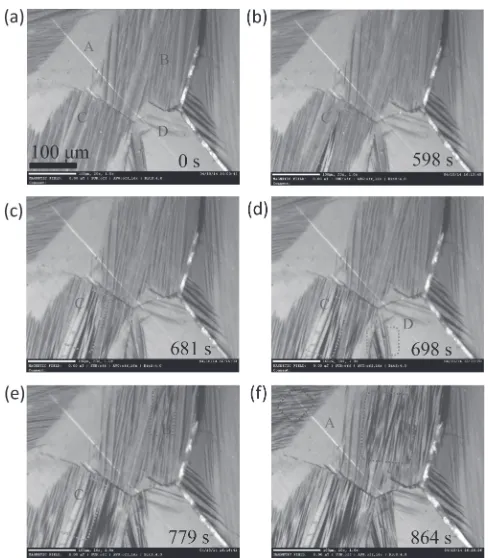
Corresponding to Location 1 of the sample (shown in Fig. 4), the microstructures of Ni45Mn37In13Co5 alloy at
typical temperatures during continuous cooling are shown in Fig. 5 which shows the nucleation and growth processes of martensite. The whole transformation process lasts for less than 270 s deduced from the occurring moment in Fig. 5(b) and 5(f ). In order to compare with the changes at a certain place in Fig. 4, the regions A, B, C, and D, marked in Fig. 5, represent the sequentially named areas according to the disappearance of the martensite slats during heating. It can be seen from Fig. 5(b) that the new martensite slats, different from the residual martensite during heating, starts to form in region C during cooling where the inverse phase transition occurred finally during heating (Fig. 4(e)). Such phenomenon is consistent with the characteristics of thermo-elastic martensite. With the decrease of temperature, the number of martensite slats in region C increases and the slats are mainly parallel to each other (Fig. 5(c)). Then, the martensite in region D starts to form (Fig. 5(d)). As the temperature further decreases, martensite begins to appear in a small area of region B (Fig. 5(e)), and then expands to most areas of regions B and A (Fig. 5(f )). It should be pointed that the austenite in region A does not emboss during cooling, that is, the austenite structure is retained (Fig. 5(a) and 5(f )). It is confirmed from the comparisons between Fig. 4(a) and Fig. 5(f ) that most of the room-temperature martensite can change back to the original martensite slats after a heating and cooling cycle, indicating that the phase transformation is reversible. Moreover, the order of the
disappearance of the martensite slats during heating is A-B-C-D, whereas the order of appearance during cooling is C-D-B-A.
In addition, in-situ observation of the same Ni45Mn37In13Co5 alloy sample upon heating at location 2
has also been conducted, and the starting temperature of phase transformation (about 353 K) and thefinal temperature (about 367 K) have been obtained. Correspondingly, the phase transformation temperatures obtained by in-situ observation, DSC and SQUID methods are systematically compared in Fig. 6. It can be seen that the phase transformation temperatures at location 1 differ from that at location 2 and the temperatures obtained by the DSC or SQUID method are just between the values obtained by in-situ observation. From the dynamics perspective, since the nucleation of martensite (austenite) proceeds as a function of time, transformation temperatures for forward (reverse) martensitic transformation are sweep-rate dependent. Due to the different sweep rates between DSC measurement and MT measurement, transformation temperatures from the two methods, are only utilized as a reference for the ones at local regions on heating.
4. Conclusions
(1) It is shown from the DSC curves that the inverse transformation of Ni45Mn37In13Co5 alloy begins at
354.2 K, reaches a peak value at 360.9 K (Ap) and
ends at 367.2 K (Af). The corresponding transformation
entropy change on heating is 30.5 J kg¹1K¹1. The
thermal magnetic curves during heating verify that the phase transformation of the alloy occurs from the low-magnetic-moment martensite to ferromagnetic austenite, followed by a transition from ferromagnetic austenite to paramagnetic austenite.
(2) With the in-situ observation of the microstructural evolution during heating, the inverse transformation begins at 359 K, reaches a peak value at 365 K (about 6 K above the As) which is consistent with that in the
DSC curve (Ap=As+6 K), and ends at 375 K (about
16 K above the As).
(3) The phenomenon that the appearance and dis-appearance of the martensite slats at different region
Fig. 5 In-situobservation of phase transition of Ni45Mn37In13Co5 alloy
upon cooling: (a)(f ) represent typical microstructures at different time ((a) 0 s, (b) 598 s, (c) 681 s, (d) 698 s, (e) 779 s, (f ) 864 s) during cooling from 398 K to room temperature.
Fig. 6 Characteristic transition temperatures of Ni45Mn37In13Co5 alloy
determined by various methods including DSC, SQUID and in-situ
[image:4.595.47.291.67.346.2] [image:4.595.321.537.67.222.2]vary at various temperature during heating or cooling indicates that various degrees of superheat (or supercool) and nucleation energy barriers are required for transformation. Meanwhile, the common charac-teristics of phase transformation at various regions lie in that the collective disappearance or formation of martensite slats plays a dominant role in the transformation process.
Acknowledgments
This work was supported by Natural Science Foundation of Jiangsu Province, No. BK20160408, Research and Innovation Project of Shanghai Municipal Education Commission, No. 14YZ159, Minhang District Science and Technology Project, No. 2017MH376, Manufacturing Collaborative Innovation Center, No. ZF1225 and Youth Foundation of Changshu Institute of Technology, No. XZ1614, Domestic Visiting Scholar program for young and middle-aged teachers in colleges and universities. B.F. Lu would like to acknowledge the support from Jiangsu Provincial Key Discipline of Materials Science and Engineering, Changshu Institute of Technology.
REFERENCES
1) A. Planes, L. Manosa and M. Acet:J. Phys.-Condens. Mat.21(2009) 233201.
2) C. Jiang, J. Wang and H. Xu: Mater. China30(2011) 4250. 3) T. Graf, C. Felser and S.S.P. Parkin:Prog. Solid State Chem.39(2011)
150.
4) Z. Nie, Y. Wang and D. Liu: Mater. China31(2012) 1525. 5) S.B. Roy:J. Phys.-Condens. Mat.25(2013) 183201.
6) G. Yu, Y. Xu, Z. Liu, H. Qiu, Z. Zhu and L. Pan:Rare Met.34(2015) 527539.
7) S. Sanvito, C. Oses, J. Xue, A. Tiwari, M. Zic, T. Archer, P. Tozman, M. Venkatesan, M. Coey and S. Curtarolo: Sci. Adv. 3 (2017) e1602241.
8) M. Chmielus, X.X. Zhang, C. Witherspoon, D.C. Dunand and P. Muellner:Nat. Mater.8(2009) 863866.
9) Z.M. Zhao, J.F. Wan and J.N. Wang:Mater. Trans.57(2016) 477480. 10) T. Sakon, N. Fujimoto, T. Kanomata and Y. Adachi:Metals7(2017)
410.
11) X. Xu, I. Katakura, T. Kihara, M. Tokunaga, W. Ito, R.Y. Umetsu and R. Kainuma:Mater. Trans.54(2013) 357362.
12) C. Biswas, R. Rawat and S.R. Barman:Appl. Phys. Lett. 86(2005) 202508.
13) S. Chatterjee, S. Giri, S. Majumdar and S.K. De:J. Phys. D42(2009) 065001.
14) Y. Sutou, Y. Imano, N. Koeda, T. Omori, R. Kainuma, K. Ishida and K. Oikawa:Appl. Phys. Lett.85(2004) 43584360.
15) T. Krenke, E. Duman, M. Acet, E.F. Wassermann, X. Moya, L. Manosa and A. Planes:Nat. Mater.4(2005) 450454.
16) A. Deltell, L. Escoda, J. Saurina and J. Josep Sunol:Metals5(2015) 695705.
17) Y.R. Umetsu, X. Xu, W. Ito and R. Kainuma:Metals7(2017) 414. 18) K.F. Li, L. Gao and Y.C. Liang:Mater. Trans.59(2018) 224229. 19) W. Ito, M. Nagasako, R.Y. Umetsu, R. Kainuma, T. Kanomata and K.
Ishida:Appl. Phys. Lett.93(2008) 232503.
20) R. Kainuma, Y. Imano, W. Ito, Y. Sutou, H. Morito, S. Okamoto, O. Kitakami, K. Oikawa, A. Fujita, T. Kanomata and K. Ishida:Nature 439(2006) 957960.
21) J. Liu, T. Gottschall, K.P. Skokov, J.D. Moore and O. Gutfleisch:Nat. Mater.11(2012) 620626.
22) H.E. Karaca, I. Karaman, A. Brewer, B. Basaran, Y.I. Chumlyakov and H.J. Maier:Scr. Mater.58(2008) 815818.
23) J. Liu, S. Aksoy, N. Scheerbaum, M. Acet and O. Gutfleisch:Appl. Phys. Lett.95(2009) 232515.
24) V.V. Khovaylo, T. Kanomata, T. Tanaka, M. Nakashima, Y. Amako, R. Kainuma, R.Y. Umetsu, H. Morito and H. Miki:Phys. Rev. B80(2009) 144409.
25) J. Liu, N. Scheerbaum, S. Weiß and O. Gutfleisch:Appl. Phys. Lett.95 (2009) 152503.
26) L. Zhou, A. Mehta, A. Giri, K. Cho and Y. Sohn:Mater. Sci. Eng. A 646(2015) 5765.
27) W. Ito, Y. Imano, R. Kainuma, Y. Sutou, K. Oikawa and K. Ishida: Metall. Mater. Trans. A38(2007) 759766.
28) Z. Li, C. Jing, H.L. Zhang, D.H. Yu, L. Chen, B.J. Kang, S.X. Cao and J.C. Zhang:J. Appl. Phys.108(2010) 113908.
29) Y.J. Huang, Q.D. Hu and J.G. Li:Appl. Phys. Lett.101(2012) 222403. 30) V. Recarte, J.I. Pérez-Landazábal, V. Sánchez-Alarcos and J.A.
Rodríguez-Velamazán:Acta Mater.60(2012) 19371945.
31) H. Sepehri-Amin, A. Taubel, T. Ohkubo, K.P. Skokov, O. Gutfleisch and K. Hono:Acta Mater.147(2018) 342349.