WORD EXPERT PARSING l
S t e v e n L. Small Department of Computer Science
University of Maryland College Park, Maryland 20742
This paper describes an approach to conceptual analysis and understanding of natural language in which linguistic knowledge centers on individual words, and the analysis mechanisms consist of interactions among distributed procedural experts representing that knowledge. Each word expert models the process of diagnosing the intended usage of a particular word in context. The Word Expert Parser performs conceptual analysis through the Interactlons of tl~e individual experts, which ask questions and exchange information in converging on a single mutually acceptable sentence meaning. The Word Expert theory is advanced as a better cognitive model of natural language understanding than the traditional rule-based approaches. The Word Expert Parser models parts o~ tSe theory, and the important issues of control and representation that arise in developing such a model [orm the basis of the technical discussion. An example from the prototype LISP implementation helps explain the theoretical results presented.
[. Introduction
Computational understanding of natural language requires complex Interactions among a variety of distinct yet redundant mechanisms. The construction of a computer
program to perform such a t a s k begins w i t h the
development o f an o r g a n i z a t i o n a l framework which
I n h e r e n t l y . i n c o r p o r a t e s c e r t a i n assumptions about the n a t u r e o t these processes and the environment i n which they take p l a c e . Such c o g n i t i v e premises a f f e c t n r o ? oundl y the scope and substance o f c o m p u t a t i o n a l ~ n a l y s i s f o r comprehension as found i n the program.
This paper d e s c r i b e s a t h e o r y o f c o n c e p t u a l p a r s i n g which considers knowledge about language t o be d i s t r i b u t e d a c r o s s a c o l l e c t i o n of p r o c e d u r a l e x p e r t s c e n t e r e d on i n d i v i d u a l words. N a t u r a l language p a r s i n g w i t h word e x p e r t s e n t a i l s s e v e r a l new hypotheses about the o r g a n i z a t i o n and r e p r e s e n t a t i o n o f l i n g u i s t i c and
p r a g m a t i c knowledge for computational l a n g u a g e
c o m p r e n e n s i o n . The Word E x p e r t P a r s e r [1] d e m o n s t r a t e s hpw the word e x p e r t q T t ~ T ~ e d w£~h c e r t a i n ocher choices oaseo on previous work, affect structure and p r o c e s s i n a c o g n i t i v e model of p a r s i n g .
The Word Expert P a r s e r i s a cognitive model of
c o n c e p t u a l language a n a l y s i s i n which the u n i t o f l t n g u ~ s t i c knowledge i s the w o r d and the fqcu~ o~ research ts the set or processes unoerlyinR comprehension. The model is aimed directly at problem~ of word sense ambiguity and idiomatic expressions, and in greatly generalizing the notion of wora sense, promotes these issues to a central place in the study of language parsing. Parsing models typically cope unsatisfactorily with the wide heterogeneity of usages of particular words. If a sentence contains a standard form of a word, it can usually be parsed; if it involves a less prevalent form which h a s a different p a r t of s p e e c h , perhaps it t o o can be parsed. Disti.nguishing amen 8 the ~any senses of a common v e r o , a d j e c t i v e , o r p r o n o u n , t a r example, o r correctly translating idioms are rarely p o s s i b l e ,
At the source of this difficulty is the reliance on rule-based formalisms, whethar syntactic or semantic (e.g.. cases), which attempt to capture ~he l i n g u i s t i c contributions inherent in constituent chunks or sentences that consist of more than single words. A crucial assumption underlying work on the Word Expert Parser is that the ~undamental unit of linguistic Knowledge is the word. and that understanding its sense or role in a p a r t i c u l a r c o n t e x t i s the c e n t r a l p a r s i n g p r o c e s s . In t h e p a r s e r t o be d e s c r i b e d , t h e word e x p e r t c o n s t i t u t e s the kernel of l i n g u i s t i c k n o w l e d ~ n d zts r e p r e s e n t a t i o n the e~emental data s t r u c t u r e . IE i s procedural i n nature and executes d i r e c t l y as a p r o c e s s , c o o p e r a t i n g w i t h the o t h e r e x p e r t s f o r a g i v e n sentence t o a r r i v e a t a m u t u a l l y acceptable sentence meaning.
Certaln principles behind the parser d 9 nqt follow directly from the view or worn primacy, out ~rom other recent t h e o r i e s of p a r s i n g . The c o g n i t i v e p r o c e s s e s i n v o l v e d i n l a n g u a g e c o m p r e h e n s i o n c o m p r i s e t h e f o c u s o f l i n g u i s t i c s t u d y o f t h e word e x p e r t a p p r o a c h . P a r s i n 8 i s v i e w e a a s an i n f e r e n t i a l p r o c e s s w h e r e l i n g u i s t i c k n o w l e d g e o f s y n t a x and s e m a n t i c s and g e n e r a l p r a g m a t i c k n o w l e d g e a r e a p p l i e d i n a u n i f o r m manner d u r i n g IThe r e s e a r c h d e s c r i b e d i n t h i s r e n o r ~ . i s f u n d e d by t h e N a t i o n a l A e r o n a u t i c s and Space A d m z n ~ s t r a t t o n u n d e r g r a n t , n umbe, r NSC-7255. T h e i r s u p p o r t i s g r a t e f u l l y acKnowleageG,
Interpretatlon. This methodological p o s i t i o n closely follows that of Rlosbeck (see [2] and [3 ]) and Schank [4]. The central concern with word usage and word sense ambiguity follows similar motivatlons of Wllks [5]. The control structure of the Word Expert Parser results from agreqment . w i t h ~he h y p o t h e s i s o f .Harcus t h a t p a r s i n g can he none aetermzntsttcally and ~n a way tn Dhlcn information ,gained through interpretation is permanent [6]. Rieger ~ view of inference as intelligent secectlon tmong a number of competing plausible alternatives {7J of course forms the c o r n e r s t o n e o f the new t h e o r y . Hi~ ideas on word sense s e l e c t i o n f o r language a n a l y s i s ( [ 8 ] and [ 9 ~ ) and s t r a t e g y s e l e c t i o n f o r g e n e r a l problem s o l v i n g [ 1 0 ] c o n s t i t u t e a c o n s i s t e n t c o g n i t i v e p e r s p e c t i v e .
Any natural language understanding system must
i n c o r p o r a t e mechanisms to perform word sense
dlsa?biguatlo~ in. the context .of ape, n-ended world gnow~eoge, rne Importance at these mechanisms tar wore usage diagnosis derives from the ubiquity of local ambiguities, and brought about the notion chat ~hey be made the central processes of computational analysls a n 9 understanding, Consideration of almost any Engllsn content word leads to a realization of the scope of the problem -- with a little time and perhaps help from the dlctlonaFy , man~.dlstinct usages can ee.id~ntifl~d. As.a stmpie lllustrarzon, several usages earn tar the worus "heavy" and "ice" appear in Figure I. Each of. these seemingly" benign words exhibits a rich depth of contextual use, An earlier paper contains.a list at almost sixty verbal usages for the word "take" [llJ.
The representation of all contextual word usages in
an a c t i v e way t~at insures their utility for linguistic
dlagnasis led to the notion of word experts. Each word expert is a procedural e n t i t ~ ~ f all posslblq contextual interpretations of the -word it represents. = Whe~ placed i n a c o n t e x t formed b y . e x p q r t s f o r t h g . o t h e ~ wares In a sentence, earn expert ShOUld De capaole or s u f f i c i e n t c o n t e x t - p r o b l n g and s e l f - e x a m i n a t i o n to determine s u c c e s s f u l l y ' i t s f u n c t i o n a l o r semantic r o l e , and further, to realize the nature of that function or the precise meaning of the word. The representation and control issues involved in basing a parser on word experts are discussed below, following presentation of an example execution of the existing Word Expert Parser. 2. Model Overview
The Word E x p e r t P a r s e r successfully p a r s e s t h e sentence
"The deep ~ h i l o s o p h e r t h r o w s the peach p i t i n t o the aeep p i t , "
t h r o u g h c o o p e r a t i o n among the a p p r o p r i a t e word. e x p e r t s , I n i t i a l i z a t i o n o f ~he p a r s e r c o n s i s t s o r r e t r l e v l n ~ t r ~ e x p e r t s f o r " t h e " , " d e e p ' , " p h i l o s o p h e r " , " t h r o w " , s " , ~
2An I m p o r t a n t aeeumption o f the word e x p e r t v i e w p o i n t is that the set or sucn contextual wars usages is not only finite, but fairly small as well.
Some word s e n s e s of " h e a v y "
1. An o v e r w e i g h t p e r s o n i s politely c a l l e d " h e a v y " : "He has become q u i t e h e a v y . "
2. E m o t i o n a l m u s i c i s r e f e r r e d t o a s " h e a v y " : "Mahler w r i t e s h e a v y m u s i c . "
~ . An i n t e n s i t y o f p r e c i p i t a t i o n i s " h e a v y " : "A h e a v y snow i s e x p e c t e d t o d a y . "
Some word senses o f " i c e " I . The s o l i d s t a t e o f w a t e r i s c a l l e d " i c e " :
" I c e m e l t s a t 0Oc. "
2. " I c e " p a r t i c i p a t e s I n an i d i o m a t i c neminal d e s c r i b i n g a f a v o r i t e d e l i g h t :
"Homemade i c e cream i s d e l i c i o u s . "
3 . "Dry I c e " i s t h e s o l i d s t a t e o f c a r b o n d i o x i d e : "Dry i c e w i l l keep t h a t c o o l ;11 d a y . " ~. " I c e " o r " i c e d " d e s c r i b e s t h i n g s t h a t have b e e n
c o o l e d ( s o m e t i m e s w i t h i c e ) : "One i c e d t e a t o go p l e a s e . "
5. " I c e " a l s o d e s c r i b e s t h i n g s made o f i c e : "The i c e s c u l p t u r e s are b e a u t i f u l ~ "
6 , 7 . " I c e hockey" i s the name o f a p o p u l a r s p o r t which has a r u l e p e n e l i z l n ~ an a c t i o n c a l l e d " i c i n g " :
"Re iced the puck causing a f a c e - o f f . "
~. The term " i c e box" r e f e r s t o b o t h a box c o n t a i n i n g ice used f o r c o o l i n g foods end a r e f r i g e r a t o r :
"This i c e box i s n ' t plugged i n ~ "
F l s u r e 1: Example c o n t e x t u a l word u s a g e s
".over", and ~o f o r t h , from a d i s ~ f l l e ~ a n d .or~anizin 8 them a l o n g w i t h d a t a r e p o s i t o r i e s c a l ~ e ~ wor~ o I n s i n a l e f t to r i g h t o r d e r i n ~he s e n t e n c e l e v e l wo~k~pace. Note t h a t t h r e e c o p i e s o t t T~-3R~...t ~ o r " t h e " anb c.~o cop.ies o f e a c h e x p e r t f o r "deep" and " p i t " a p p e a r i n th~ worKspace. S i n c e e a c h e x p e r t e x e c u t e s a s a p r o c e s s , each process Inetantlatlon in the workspa..ce must be put i n t o a n e x e c u t a o l e s t a t e . At t h i s p o i n t , t h e p a r s e i s r e a d y t o b e g i n .
The word e x p e r t f o r " t h e " r u n s f i r s t , and i s a b l e t o t e r m i n a t e i m m e d i a t e l y , c r e a t i n g a new concept d e s i g n a t o r ( c a l l e d a concept bin and participating i n t h e c o n c e p t l e v e l w o r k s p ~ f ~ " ~ i c l T - ' w i l l e v e n t u a l l y h o l d the d a t a the intellectual p h i l o s o p h e r d e s c r i b e d in the i n p u t . Next the "deep" e x p e r t r u n s , and s i n c e "deep" has a number o f word s e n s e s , 5 i s u n a b l e t o t e r N i n a t e ( i . e ~ , complete i t s dlscriminetlgn t a s k ) . . I n s t e a d , i t ~uspenas its execution, stating the c o n d i t i o n s upon w i n c h it should be resumed. These c o n d i t i o n s take the form o f a s s o c i a t i v e t r i g g e r p a t t e r n s , and a r e r e f e r r e d t o a s
d i s a m b i g u a t e e x p r e s s i o n s I n v o l v i n g gerunds o r p a r t i c i p l e s such as " t h e m a n eat ir~ tiger". A full discussion o t thls will appear in [12].
4Al~hough I call them "processes". word experts are actually coroutlnes resembling CONNIVER's generators [tS], and even more so, the stack groups of the MIT L~SP Machine [ 1 4 ] .
51t should be clear t h a t the notion of "word sense" as used here e n c o m p a s s e s what might more t r a d i t i o n a l l y be ~ e s c r . i b e a as " c o n t e x t u a ~ ~orn u s a g e " , A s p e c t s o~ a word token's linguistic envlromnent constitute Its b r o a d e n e d "sense".
r e s t a r t demons. The "deep" e x p e r t c r e a t e s .a r e s t a r t demon co wake l'C up when the sense o t the nominal t o i t s r i g h t ( l . e . , " ~ h l l o s o p h e r " ) becomes knoWn. The exper~ f.or " p h i l o s o p h e r now r u n s , observes the c o . n t r o l s t a t e o t t h e p a r s e r , a n t c o n t r i b u t e s the t a c t Chat One new c o n c e p t r e f e r s to a p e r s o n e.ngaged i n t h e s t u d y o f p h i l o s o p h y . As t h i s e x p e r t t e r m i n a t e s , t h e e x p e r t t o t "=eep" resumes s p o n t a n e o u s l y , a n d , c o n s t r a i n e d by t h e f a c t c h a t " d e e p " must d e s c r i b e an e n t i t y t h a t c a n be viewed a s a p e r s o n , i t f i n a l l y t e r m i n a t e s s u c c e s s f u l l y , c o n t r i b u t i n g the f a c t t h a t t h e p e r s o n is i n t e l l e c t u a l .
The " t h r o w " e x p e r t runs n e x t and s u c c e s s f u l l y prunes away s e v e r a l u s a g e s o f " t h r o w " f o r c o n t e x t u a , r e a s o n s . A m a j o r r e a s o n f o r t h e s e m a n t i c r i c h n e s s o f v e r b s s u c h a s " t h r o w " , " c a k e " , and "Jump", i s t h a t I n c o n t e x t , each i n t e r a c t s s t r o n g l y w i t h a number o f s u c c e e d i n 8 p r e ~ o s i t i o n s and a d v e r b s t o form d i s t i n c t m e a n i n B s , The woro e x p e r t a p p r o a c h e a s i l y h a n d l e s t h i s g r o u p i n g t o g e t h e r o r words t o t o r n l a r g e r w o r d - l i k e e n t i t i e s . I n t h e p a r t i c u l a r c a s e o f v e r b s , t h e e x p e r t f o r a word l i k e . " t h r o w " s i m p l y exam.ines.i~.s r S g h t l e x i c a l n . e i g h b o r , an~ o a s e s its oWn sense a l s c r t m l n e t 2 o n on the co(Rolnetlon o r
~
a t i t .expects co f i n d t h e r e , what I t a c t u a l l y f i n d s e r e , an~ what t h i s n e i g h b o r t e l l s i t ( i f I t Soas so r a t as t o a s k ) . No i n t e r e s t i n g p . a r t i c l e f o l l o w s throw" i n the c u r r e n t exampze, out I t snoulo oe easy t o c o n c e i v e or th.e b a s i c e x p e r t p r o b e s t o d i s c r i m i n a t e t h e s e n s e o f " t h r o w " wnen ; o l - o w e d by " a w a y " , " u p " , " o u t " ~ " i n t h e t o w e l " , o r o t h e r woras o r wore g r o u p s , when no s u c h word r o l l o w s " t h r o w " . a s I s t h e c a s e n e r e , i t s e x p e r t s l m p - y w a i t s f o r t h e e x i s t e n c e o f a n e n t i r e c o n c e p t t o I t s r i g h t , t o d e t e r m i n e i f i t m e e t s any o f t h e r e q u i r e m e n t s .~hat would make t h e c o r r e c t c o n t e x t u a l i n t e r p r e t a t i o n o f ' t h r o w " d i f f e r e n t trom the e x p e c t e d " p r o p e l by moving o n e s arm" ( e . g . , " t h r o w a p a r t y ' . ' ) . B e f o r e any s u c h s u b s t a n t i v e c o n c e p t u a l a c t i v i t y t a k e s place~ however, . t ~ "S" e x p e r t ~uns arm ~ o n t r i ~ u C e s I t s s t a n n a r o m o r p h o l o g i c a l i n f o r m a t i o n t o t h r o w " s d a t a b i n . T h i s e x e c u t i o n o f t h e " s " e x p e r t d o e s n o t , o f c o u r s e , a f f e c t " t h r o w " ' s s u s p e n d e d s t a t u s .The " t h e " e x p e r t f o r t h e s e c o n d " t h e " i n t h e s e n t e n c e r u n s n e x t , and a s i n t h e p r e v i o u s c a s e , c r e a t e s a new con.cep~ b i n t o r e p r e s e n t t h e da.~a a b o u t t h e no n i n a ~ and des c r l p t l o . n , to come. Lne " p e e c n " e x p e r t r e a l i z e s t h a t I t c o u l o oe e i t h e r a noun o r a n a d j e c t i v e , and t h u s a t t e m p t s what ~ c a l l a " p a i r i n g " o p e r a t i o n w i t h i t s r i g h t n e i g h b o r . I t e s s e n t i a l l y a s k s t h e e x p e r t f o r " p i t " i f t h e two o t them form a n o u n - n o u n p a i r . To d e t e r m i n e t h e a n s w e r , o o t h " p i t " and " p e a c h " have a c c e s s t o t h e e n t i r e model o f l i n g u i s t i c and p r a g m a t i c knowledBe. Durtn~ t h i s t i m e . ~peach" i s i n a st.a~e c a l l e d " a t t e m p t i n g p a i r i n g " w h i c h I s n l z r e r e n t t r o m the " s u s p e n d e d " s t a t e o f t h e " t h r o w " ex.~.ert. " P i t " a n s w e r s b a c k t h a t i t d o e s p a i r up w i t h " p e a c h ' ( s i n c e " p i t " i s a w a r e o f i t s r u n - t i m e c o n t e x t ) and e n t e r s t h e "rea.dy" s t a t e . " P e a c h " . n o w ned:ermines i t s c . o r r e ~ t s e n s e and t;erm~netee: An.d ~ n c ~ only one mean%ngrul sense ~ o r ' p l t remains, the pit e x p e r t e x e c u t e s q u i c k l y , . t . e r m l n a t t n g w i t h t h e c o n t e x t u a l l y a ~ p r o ~ r i a c e " t r u l C p i t " s e n s e . As i c t e r m i n a t e s , t h e p i C . e x p e r t c l o s e s o f f t h e c o n c e p t b.in I n which I t p a r t ~ c i p a c e s , s p o n t a n e o u s l y r e s u m i n s t h e " t h r o w " e x p e r t . An e x a m i n a t i o n o f t h e n a t u r e o f f r u i t pit.a r e v e a l s t h a t t h e y a r e p e r g e c t . l y s u i t e d t o p r o p e l l i n g w i t h o n e s . a r m , a r ~ t h u s , t h e "th.row" e x p e r t t e r m i n a t e s s u c c e s s z u l ~ y , c o n t r i b u t i n g its wore| s e n s e t o its e v e n t c o n c e p t b i n .
.The " l n t o ~ e x p e r t , r u n s n e x t , o p e n s a c o n c e p t b i n ~of t~pe ' s e t t i n g " ) r o t t h e t i m e , l o c a t i o n , o r s i t u a t i o n a b o u t to be d e s c r i b e d , and s u s p e n d s itself. On s u s p e n s i o n , " l n t o " ' s e x p e r t p o s t s a n a s s o c i a t i v e r e s t a r t condition that w i l l e.nable .its re.sumptlon w h e n a new p ~ c t u r e c o n c e p t ~s opened t o the r i g h t . This initial a c t i o n CaKes p~ace rot most prepositions. In c e r t a i n c a s e s , i f t h e end o f a s e n t e n c e i s r e a c h e d b e f o r e a n a p p r o p r i a t e e x p e c t e d c o n c e p t i s o p e n e d , a n e x p e r t w i l l t a k e a l t e r n a t i v e a c t i o n . For e x a m p l e , one o f t h e " i n " e x p e r t s r e s t a r t t r i g g e r p a t t e r n s c o n s i s t s o f c o n t r o l state data of Just this kind -- if the end of a sentence i s rear.had . a n d no. c o n c e p t u q l o b j e c t , f o r t h e s e c t . i n g c r e a c e o oy " I n " has o e e n r o u n d , t h e " i n " e x p e r t wxl~ resume n o n e t h e l e s s , and c r e a t e a d e f a u l t c o n c e p t t o r p e r f o r m some kind o f i n t e l l i g e n t r e f e r e n c e a e t e r m i n a t l o n . The s e n t e n c e "The d o c t o r i s I n . " i l l u s t r a t e s t h i s p o i n t .
bulletin board contains "deep"'s expectations of a ~ . o I ~ , or printed matter, "pit" maps immediately onto a large hole in the ground. This in turn, causes both the resumption and termination of the "deep" expert as well as the closure of the concept bin to whlch the~ oelong. At the closing of the concept bin, the "into
e x p e r t resumes, marks its concept as a location, and
terminates. With all t h e word experts completed and all concept b i n s c l o s e d , the expert f o r ".'" runs and completes the parse. The concept level workspace now contains five concepts: a picture concept designating an intellectual philosopher, an event concept representing the throwing action, another picture concept describing a fruit pit which came from a p e a c h , a setting concept representing a location, and the picture concept which describes precisely the nature of this location. Work o n
t h e mechanism to determine the schematic roles of the
concepts has just begun, and is described briefl~ later. A program trace that shows the actions ot the Nora Expert Parser on the example just presented is available on request.
3. Structure of the Model
The organization of the parser centers around data repositories on two levels -- the sentence level workspace contains a word bin for each word ( a n d sub-lexical morpheme) of the input and the concept level workspace contains a concept bin (described above) for each concept referred to in the input sentence. A third level of processing, the schema level workspaee, while not yet implemented, will contain a schema for each conceptual action of the input sentence. All actions affecting t h e c o n t e n t s of t h e s e data bins a r e c a r r i e d o u t by the word expert processes, one of which is associated with e a c h word bin in the wo r k s p a c e . In addition to this first order information about lexical and conceptual objects, the parser contains a central tableau of control s t a t e descriptions available t o any expert t h a t c a n make use of self referential knowledge about its own processing or the states of processing of other model components. The availability of such control state information improves considerably both the performance and the psychological appeal of the model -- each word expert attempting to disambiguate its contextual usage knows p r e c i s e l y t~e progress of its neighbors and the state of convergence (or the lack thereof) of the entire p a r s i n g p r o c e s s .
Word E x p e r t s
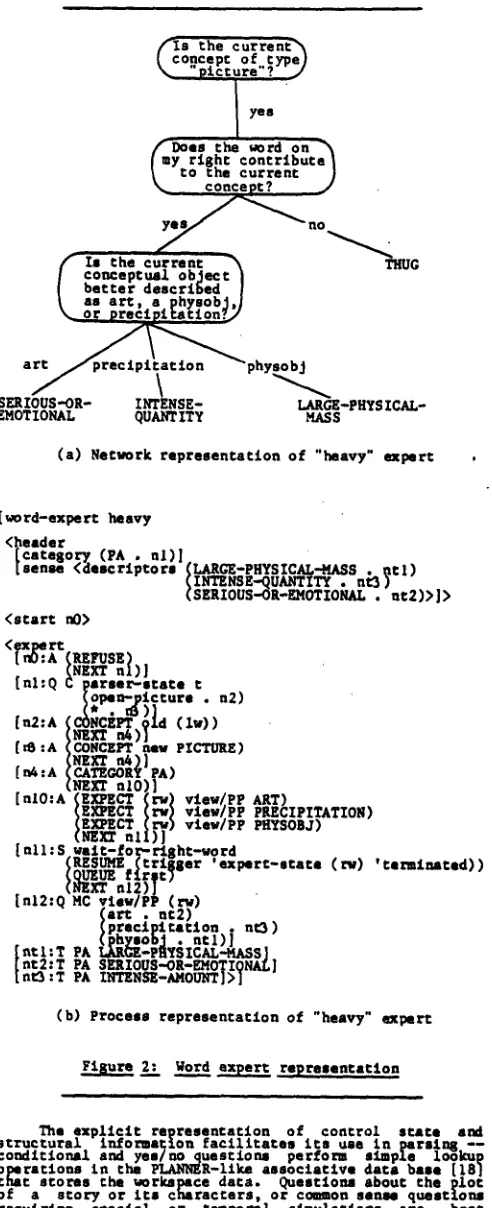
The p r i n c i p a l k n o w l e d g e s t r u c t u r e of t h e model i s t h e word s e n s e d i s c r i m i n a t i o n e x p e r t . A word e x p e r t r e p r e s e n t s t h e t h e l i n g u i s t i c k n o w l e d g e r e q u i r e d t o d l s a m b l g u a t e t h e m e a n i n g o f a s i n g l e word i n any c o n t e x t . A l t h o u g h r e p r e s e n t e d c u m p u t a t i o n s l l y a s c o r o u t l n e s , t h e s e e x p e r t s d i f f e r c o n s i d e r a b l y from ad hoc LISP p r o g r a m s and h a v e a p p r o x i m a t e l y t h e same ~ e l a t l o n ~o LISP a s a n augmented transition network [ 1 5 ] grammar. ° 2use a s rh~ graphic represeptatlon of an augmented transltlon networ~ aemonstrates the basic control paradigm of the ATN parsing approach, a graphic representation for word experts exists which embodies its functional framework. Each word expert derives from a branching discrimination structure called a word sense discrimination network or sense net. A sense nec consists of an ordered se~ of • /~tr~Ti~g (the nodes of the network), and for each one, the set of possible answers to that question (the b r a n c h e s e m a n a t i n g from e a c h n o d e ) . T r a v e r s a l o f a s e n s e
n e t w o r k represents the process of converging on a single
contextual usage of a word. The terminal nodes of a sense net represent d i s t i n c t word senses of the word modeled by the network. A s e n s e net for the word "heavy" appears in part (a) of Figure 2. Examination of this network reveals that four senses are represented -- the three adjective usages shown in Figure 1 plus the numinal sense of "thug" as In "Joe's heavy told me to beat it."
E x p e r t Representation
The n e t w o r k r e p r e s e n t a t i o n of a word e x p e r t l e a v e s out certain computational necessities of actually using it for parsing. A word expert has two fundamental activities. (I) An expert asks questions about the lexical and conceptual data being amassed by its neighbors, the control states of various model components, and more general issues requiring common sense or knowledge of the physical world. (2) In addition, a t each node an expert performs a c t i o n s t o affect the lexical and conceptual contents of the w o r k s p a c e s , the control states of itself, concept bins, 6An ATN without arbitrarily complex LISP computations on e a c h a r c and a t e a c h n o d e , t h a t i s .
7In addition t o common sense knowledge of t h e physical
w o r l d , this could include information about the plot,
characters, or focus of a children's s t o r y , or in a s p e c i a l i z e d domain such as medical d i a g n o s i s [ 1 7 ] , could i n c l u d e highly domain s p e c i f i c k n o w l e d g e .
and the parser as a whole, and the model's expectations. The current procedural representation of the word expert for "heavy" appears as part (b) of Figure 2.
Each word expert process Includes three components -- a declarative header, a start node, and a body. The header provides a description of the expert's behavior for purposes of inter-expert constraint forwarding. If sense discrimination by a word expert results in the knowledge that a word to its right, either not yet executed or suspended, must map to a specific sense or conceptual category, then it should constrain it to do so, thus helping it avoid unnecessary processing or fallacious reasoning. Since word experts are represented as processes, constraining an expert consists of altering the pointer to the address at which it expects to continue execution. Through its descriptive header, an expert conditions this activity and insures that it takes place without disastrous consequences.
Each node in the body of the expert has a type deslgnated by a letter following the node name. either Q (question), A (action), S (suspend), or T (terminal). By tracing through the question nodes (treating the others as vacuous except for their gore pointers), a sense network for each word expert process can be derived. The graphical f r a m e w o r k of a word expert (and thus the questions it asks) represents its principal linguistic task of word sense disamblguatlon. Each question node h a s a type, shown following the Q in the.node -- MC tmultiple choice), C (conditional), YN (yes/no/, and PI (posslble/Imposslble). In the e x a m p l e expert for "heavy", node nl represents a conditional query into the state of the entire parsing process, and n?de n[2 a multiple choice question involving the conceptual nature of the word to " h e a v y " s right in the input sentence. b Multiple choice questions typically delve into the
aslc relations among ob3ects ann actions zn the world. For example, the question asked at node n12 of the "heavy" expert is typical:
"Is the object to my right better described as an artistic object a a form of precipitation, or a p h y s i c a l object?
Action nodes in the "heavy" expert perform such tasks as determining the concept bin to which it contributes, and pqstin 8 expectations for the word to its right. In terms ot its side effects, the "heavy" expert is fairly simple. A full account of the word expert representation language will be available next year [12].
Expert Questions
The b a s i c s t r u c t u r e o f t h e Word E x p e r t P a r s e r d e p e n d s p r i n c i p a l l y on t h e r o l e o f i n d i v i d u a l word e x p e r t s i n a f f e c t l u g . ( 1 ) e a c h o t h e r : s a c t i o n s and ~2) t h e n e c l a r a t l v e r e s u l t o r c o m p u t a t l o n a l a n a l y s i s . ~ x p e r t s a f f e c t e a c h o t h e r by p o s t i n g e x p e c t a t i o n s on t h e c e n t r a l bulletin board, constraining each other, changing control states of model components (most notably themselves), and augmenting data. s t r u c t u r e s in. the workspeces. ° .They contribute to the conceptua£ ans ecnematlc result ot toe
p a r s e by contrlbuting object names, descrlptions~
schemata, ane other useful data to the concept level w o r k s p a c e . To d e t e r m i n e e x a c t l y what c o n t r i b u t i o n s . t o make, i.e.j the accurate ones In the p a r t i c u l a r run-tlme c o n t e x t a t h a n d j t h e e x p e r t s a s ~ q u e s t i o n s o t v a r i o u s k i n d s a b o u t t h e p r o c e s s e s o t t h e model and t h e w o r l d a t l a r g e .
Four t y p e s o f q u e s t i o n s may be a s k e d by an e x p e r t , and whereas some queries can be made in more than one way, the several question types solicit different kinds of information. Some questions requlre fairly involved inference t o be answered adequately, and others demand no more than simple register lookup. This variety corresponds well, in my opinion, with human processing involved in conceptual analysis. Certain contextual clues to meaning are structural; taking advantage of them r e q u i r e s s o l e l ~ k n o w l e d g e o f t h e s t a t e o f t h e p a r s i n g p r o c e s s ( e . g . , ' b u i l d i n g a noun p r a s e " ) . O t h e r c l u e s s u b t l y p r e s e n t t h e m s e l v e s t h r o u g h more g l o b a l e v i d e n c e , u s u a l l y h a v i n g to do w i t h l i n k i n g t o g e t h e r h i g h o r d e r i n f o r m a t i o n a b o u t t h e s p e c i f i c domain a t h a n d . In s t o r y comprehension, t h i s involves the plot, characters, focus of attention, and general social psychology as well as common sense knowledge about the world. Understanding texts uealing with specialized subject matter requires k n o w l e d g e about that p a r t i c u l a r s u b j e c t , other subjects related t o it, and of course, common sense. The q u e s t i o n s a s k e d by a word e x p e r t i n a r r i v i n g a t t h e c o r r e c t c o n t e x t u a l i n t e r p r e t a t i o n o f a word probe s o u r c e s of both kinds of information, and take different forms.
8The b l a c k b o a r d o f t h e H e a r s a y s p e e c h u n d e r s t a n d i n g system [~6]. ~s anelggous to the entire wormspace ot the p a r s e r , x n o l u a x n g the word b i n s , c o n c e p t b i n s , and o u l l e t i n b o a r d .
(~
's t h e c u r r e n t ~ o n c e p t o f t y p e )" v i c e u r e " ? /
y e s
~
e s t h e word o n ~r i g h t c o n t r i b u t e t o t h e c u r r e n t /
, c o n c e p t ? , / .
Is t h e c u r r e n t c o n c e p t u a l o b j e c t I b e t t e r d e s c r i b e d / a s a r c , e p h y e o b $ , ~
SERIOUS-OR- INTENSE-
EMOTIONAL 0UANTITY MASS
THUG
LARGE-PHYS ICAL-
( a ) Network r e p r e s e n t a t i o n o f " h e a v y " e x p e r t
[ w o r d - e x p e r t h e a v y < h e a d e r
c a t e g o r y (PA • n l ) ]
~ s e n s e < d e s c r i p t o r s (LARGE-PHYSICAL-MASS . n i l ) (INTENSE-~UANTITY . nO3) (SERIOUS-OR-EMOTIONAL . uS2)>]> <start nO>
< e x n e r t
[n~:A
(~E~USE)
(NEXT
nl)]
[ n l : ~ C p a r s e r - s t a t e t( o p e n - p i c t u r e . n2)
[ r S : A (CONCEPT new PICTURE)
~ r r
. 4 ]
(NEXT n l O ) ]
[nlO:A
(EX~C~(EX~R~
(r,,)Cr") vio,/pp~ie~P~
p~cART)I~ZnTZON)
~EX~C"I' ( r w ) view/PP I~¥SOBJ) (N~XT n i l ) ]
[ n l l : S w a i t - f o r - r ~ l g h t - w o r d
~RES_U_ME.~trlgger ' e x p e r t - s t a t e (ha) ' t e r m i n a t e d ) ) ~ u ~ u ~ t ~ r s t )
(NEXT n l 2 ) J t e l 2 : 0 HC v l e w / P P (rw)
t a r t . r i t z ) ~ . ~ p r a c l p i t a t i o n ~ nc~) ~ p n y s o b J . n t l ) I [ n t l : T P~ LARGE-PRYSICAL-MASS] [ n t 2 : T PA SERIOUS-OR-EMOTIONAL] [nCS:T PA INTENSE-AMOUNT]>]
(b) P r o c e s s r e p r e s e n t a t i o n o f " h e a v y " expert:
F i g u r e 2: Word e x p e r t r e p r e s e n t a t i o n
The e x p l i c i t r e p r e s e n t a t i o n o f c o n t r o l s t a t e and structural Informeclon racilltates i~s use in pars in~.-- c o n d i t i o n a l and y e s / n o questions p e t t e r s s~'nple lookup o p e r a t l o n a I n t h e PIAN~ER-IIke a s s o c i a t i v e d a c ~ b a s e [ 1 8 ] c h e f s t o r e s t h e w o r k a p a c e d a t a . ~ u e s t l o n s about t h e p l o t o r a s t o r y or ice cheracfiers, o r common sense q u e e t l o n a r e q u L r t n ~ s p a t i a l o r t e m p o r a l stmul, a t t o n a ~}re, bes.C p n r a s e e a s p o s s i b l e / i m p o s s i b l e ~ o r
yes/no/maybe)
q ~ e s t $ o n ~ , S o m e t i m e s d u r i n g s e n a ~ 4 i s c r t m ~ n ~ t i o n , . t h q p - a u s l ~ i l l t y or some gene.ra~ t g c C ~ e a u s t o t e e p u r s u l t o r ~ i f f e r e n t I n f o r m a t i o n t h a n I t s l m p z a u a t b t l i t y . Such aline t lone o c c u r w i t h enough f r e q u e n g y t o justify a spec~a~ type o r q u e s t l o n t o ueal w t t h them.
The Importance of HulClple Choice
M u l t i p l e c h o i c e q u e s t i o n s comprise the c e n t r a l inferential component of word experts. They derive from R1eger' s n o t i o n that i n t e l l i g e n t s e l e c t i o n among c o m p e t i n 8 a l t e r n a t i v e s by . r e l a t i v e . d i f f e r e n c i n g r e p r e s e n t s a n i m p o r t a n t a s p e c t oz human proe~em s o ~ v l r ~ [ 7 ] . The Word E x p e r t P a r s e r , u n l i k e c e r t a i n s t a n d a r d i z e d t e s t s , p r o h i b i t s m u l t i p l e c h o i c e q u e s t i o n s from c o n t a l n l n R a "none o f the above" c h o i c e . Thus, ehey demand t e e m o s t " r e a s o n a b l e " o r " c o n s i s t e n t " c h o i c e o f p o t e n t i a l . l y .unep~ealt.ng a n s w e r s . What d o e s a c h i l d ( o r adult) GO wnen zacea wlcn a sentence that seems Co state. an i m p l a u s i b l e p r o p o s i t i o n o r r e f e r e n c e l m p l a u q i b l e o b j e c t s ? He s u r e l y d o e s h i s best Co make s e n s e o t t h e sentence, no master what ie says. Depending on t h e context, certain intelligent and literate people create metaphorical interpretations for such sentences. The word e x p e r t a p p r o a c h i n t e r p r e t s m e t a p h o r , idiom s a n d " n o r m a l " t e x t wleh t h e same m e c h a n i s m .
M u l t i p l e c h o i c e q u e s t i o n s make t h i s p o s s i b l e h u t anewe r i n g them may r e q u i r e t r e m e n d o u s l y complex p r o c e s s i n g , A s u b s t a n t i a l k n o w l e d g e r e p r e s e n t a t i o n z o r m a l i s m b a s e d on s e m a n t i c n e t w o r k s , s u c h a s ~RI. ( 1 9 1 , w i t h m u l c l p l e p e r s p e c t i v e s , n r o c e d u r a l a t t a c h m e n t , and i n t e l l i g e n t a e s c r i p C i o n m a t c h i n g , m u s t be u s e d t o r e p r e s e n t i n a u n i f o r m way b o t h g e n e r a l w o r l d k n o w l e d g e a n d k n o w l e d g e a c g u i r e d t h r o u g h t e x t u a l Interprecatlon. I n KRL t e r m s , a m u l t i p l e c h o i c e q u e s t i o n s u c h a s " I s t h e o b j e c t RAIN more llke ARTISTIC-OBJECT, PHYSICAL-OBJECT, or PRECIPITATION?" must be answered by appeal co ~he u n i t s r e p r e s e n t i n g t h e f o u r n o t i o n s i n v o l v e d . C l e a r l y , RAIN can be viewed as s PHYSICAL-OBJECT; much less so as an ARTISTIC-OBJECT. However, i n almost all c o n t e x t s , RAIN is closest c o n c e p t u a l l y t o PRECIPITATION. Thus, this should be the answer. This multiple choice ge;~antsqa I~tS many u s e s ~n c onceptuaJ~, parslng ar~. : u l ~ T s c a l e l a n E u a g e c o m p r e n e ~ J l o n a s w e ~ a s l n g e n e r a - p r o b l e m , s o l v l n K [ 2 0 1 . T h a t a n y r r a E m e n t o t t e x t ( o r o c h e r n, l a n s e n s u a l i n p u t ) h a s some i n t e r p r e t a t i o n from t h e . p o i n t o f vi.ew o.~ a p a r c i c u l a . r r e a d . s t c o n s t i t u t e s , a z u n a a m e n t a ~ u n a e r l y ~ n g ~dea oz the worn e x p e r t a p p r o a c n .
Exper~ Side Effects
Word experts take two klnds of actions -- actions explicitly intended to affect sense d i s c r i m i n a t i o n by other e x p e r t s ) e n d actions to eugme`nC t h e conceptual infgrmaCion .chat constitutes the result or a parse. Each p a t h t h r o u K n a s e n s e n e t w o r k r e p r e s e n t s a d i s t i n c t u s a g e o f ~he m o d e l e d w o r d t a n d a t e a c h s e e p o f t h e way, t h e ~orcl e x p e r t m u s t update, t h e model Co r e f l e . c t the . s t a t e _ o f ~Cs p r o c e s s l n 8 end t~e e x t e n t o f 1 i s Kno.wieoge.. l e e
heavy" ~ p e r ~ o f F i g u r e 2(b) e x h i b i t s severaA o~ these a c t i o n s . Nodes n2 and ~ o f t h i s word e x p e r t process r e p r e s e n t . " h e a v y " ' s d e c i s i o n a b o u t t h e c o n c e p t b i n ( i . e . , ; p n c e p t u a , n o t i o n ) i n which I t p a r t l c l p a t e s . I ~ . the f i r s t c a s e . I t declaes Co c o n t r i b u t e t o tile same Din as i t s l e f t n e i g h b o r ; i n the second, i t c r e a t e s a new one, e v e n t u a l l y . [ o cunts.in the c o n c e p t u a l d a t a p r o v i d e d by l~.sml~.ana ~ e r n a p e o c h e r e x p e r t s t o i t s r 1 . s h t . . At node nius h e a v y p o s t s Its e x p e c t a t i o n s r e g a r o l r ~ t h e word to i c e r i g h t o n t h e . c e n t r a l . b u l l e t i n b o a r d . When i t tampora~'ll),, s u s p e c t , s e x e c u t i o n a t n o n e n i l , i t s "`suepand. e d ' c o n t r o l s t a t e d e s c r i p t i o n a l s o a p p e a r s o n c n l s taD.Leeu,
.Contro..~ s t a t e d e s c r i p t i o n s s u c h . a s " s u s p e n d e d " ~ t e r m i n a t e s ' , " a t t e m p t i n g . ~ a i r i n g " Ls.ee a b o v e ) ~ a n d " r e a a y " a r e p o s i e s o n t h i s o u ~ e t i n b o a r d , whlcn c o n t a i n s a s t a t e d e s i g n a t i o n f o r e a c h e x p e r t and c o n c e p t i n t h e w o r k J p m c e , a s w e l l a s a d e s c r i p t i o n o f t h e p a r s e r s t a t e a~ a w h o l e . U n d e r r e s ~ . r i o t e d c o n d L C i o n s ~ a n e x p e r t may a r z e c t t h e s t a t e o e e c r l p t i o n e o n t h l s t a o ~ e a u , a n e x p e r t t h a t h a s d e t e r m i n e d i t s n o m i n a l r o l e , may, f o r e x a m p l e , c h a n ~ e t h e . s t a t e o f . i t s . c o n c e p t .~the one t o w h i c h lC c o n t r i b u t e s ) t o "oounaea" o r ' c l o s e d " , d e p e n d i n g on w h e t h e r or. n o t a l l or.her e x p e r t s p a r t i c i p a t i n g i n c h a t concept nave c e ~ i n a t e d . Worn experts .may post e x p e c t a t i o n s , o n t h e b u l l e t i n . b o a r d co . t a c i l i t a c e h a n d s h a k i n g o e t w e e n t h e m s e l v e s an~ S U D s e q u e n t l y e x e c u t i n g n e i g h b o r s . I n t h e e x a m p l e . p a r s e ; t h e "de`ep" e x p e r t e x p e c t s a n e n t i t y t~aC I t c a n uescr~oe; oy s a y l n g so I n d e ~ a i l , . . ~ t e mi.bles the " p i t " e x p e r ~ Co eermloaCe succeseru.lly on flrst r u n n 1 ~ , somethln8 1c would not ~e a b l e to do other~r~se.
The . i n i t i a l e x e c u t i o n o f a w o r d . e x p e r t _ must accomplien c e r t a i n g o a ~ s o r a s t r u c t u r a ± n a t u r e . I t t e e word participates ~n a noun-noun pa~r, thls must be d e t e r m i n e d ; i n e i t h e r c a s e , t h e e x p e r t m u s t d e t e r m i n e t h e c o n c e p t b i n t o which i t c o n c r i b u c A s a l l o f i t s d e s c r i p t i v e d a t a t h r o u g h o u t t h e p a r s e . ~ T h i s concept
[image:4.612.57.303.67.671.2]could either be one that already exists in the workspace or a new one created by the expert at the time of its decision. After deciding on a concept, the principal role of a (content) word expert is to discriminate among the possibly many remaining senses of the word. Note that a good deal of this disambiguation may take place during t h e initial phase of concept determination. After asking enough questions to discover some piece of conceptual data, this data augments what already exists i n the w o r d ' s concept 5 i n , i n c l u d i n g d e c l a r a t i v e
s t r u c t u r e s put there both by itself and by the other
lexical participants in t h a t concept. The parse completes when each word expert in the .workspace nas terminated. At this point, the concept ievez worKspace contains a complete conceptual interpretation ot the input text.
Conceptual Case Resolution
Adequate conceptual parsing of input text regulres a stage missing from this dlscusslon and constituting the current phase of research --- the attachment of each picture and setting concept (bin) to the appropriate conceptual case of an event concept. Such a mechanism can be viewed in an entirely analogous fashion to the mechanisms just described for performln 8 local disamblguation o f word senses. Rather ~han word experts, however, the experts on this level are conceptual in nature. The concept level thus becomes the main level of activity and a new level, call it the schema level workspace, turns into the ma~n repository rot inferred I n f o r m a t i o n . When a concept bin has c l o s e d , a concept expert is retrieved from a disk file, and initialized. If it is an event concept, its function is to fill its conceptual cases with settings and pictures; if it is a setting or picture, it must aetermlne its schematic role. The activity on this level, therefore, involves higher order processing than sense discrimination, but occurs in Just about the same way. The ambiguities involved in mapping known concepts i n t o c o n c e p t u a l case schemata appear i d e n t i c a l to those having to do w i t h ma2ping words i n t o c o n c e p t s . D i s c o v e r i n g t h a t the word " p i t maps i n a c e r t a i n c o n t e x t to the n o t i o n o f a " f r u i t p i t " r e q u i r e s the same a b i l i t i e s and knowledge as r e a l i z i n g t h a t " t h e red house" maps i n some c o n t e x t to the n o t i o n o f "a ~ocation for smoking pot and listening to records". The implementation of the mechanisms to carry out this next level of inferential disambiguation has already begun. It should be quite clear that this schematic level is b y no means the end of the line -- active expert-baseo p~ot following and general text understanding flt nicely Int? the word expert framework and constitute its loglca~ extension.
4. Summary and Conclusions
The Word Expert Parser is a theory of o rganization and cgntro ~ for a conceptual, lansuage an@.~yzer. Th~ c o n t r o ~ e n v l r o s m e n t ts cnaracter~zeo ny a co£~ectlon ot g e n e r a t o r - l i k e c o r o u t i n e s , c a l l e d word experts, which c o o p e r a t i v e l y a r r i v e a t a c o n c e p t u a l i n t e r p r e t a t i o n o f an
~nput sentence. Many torms o f l i n g u i s t i c ann
non-lln~uistlc knowledge a r e available to these experts In performing t h e i r t a s k , including control s t a t e Knowledge and knowledge of the world, and by eliminating a l l but the mpst p e r s i s t e n t forms o f a m b i g u i t y , the p a r s e r models numan p r o c e s s i n g .
T h i s new model o f p a r s i n £ c l a i m s a number o f
t h e o r e t i c a l advantages: (I) I t s representations of
linguistic knowledge reflect the enormous redundancy in n a t u r a l languages - - w i t h o u t t h i s redundancy i n the model, the i n t e r - e x p e r t handshaking (seen i n many..forms i n the example parse) would not be p o s s i b l e . ~z) ~ne
model suggests some i n t e r e s t i n g approaches to language
acquisition. Since much of a word expert's knowledge Is encoded in a branching discrimination structure,, addlng new information about a word involves the addition oz a new branch. This branch would be placed in the expert at the point where the contextual clues for dlsambiguatlng the new usage differ from those present for a known u s a g e . (3) Idiosyncratic uses of langua8@ are easily e ncooea, s~nce the wore expert provides a c~esr way to no so. These uses are indistinguishable from other uses in their encodings in the model. (4) The parser represents a cognltively plausible model or se~uentlal coroutine-like processing in human ~anguage understanding. The organization of linguistic knowledge around the word, rather than the rewrite rule, motivates interesting conjectures about the flow of control In a human language understander.
ACKNOWLEDGEMENTS
I would llke to thank Chuck Rieger for his Insights, encouragement, and general manner. Many of the ideas presented here Chuck has graciously allowed me to steal. In addition, I thank the following people for helpin 8 me with this work through their comments and suggestions: Phil Agre, Milt Crlnberg, Phll London, Jim Reggla, Renan Samet, Randy Trigg, Rich Wood, and Pamela lave.
REFERENCES
~
I] gleger, C. and S. Small, Word . E x p e r t Parsing, roceedlngs ot the 6th International Jolnt Conzerence on Artificial Intelligence, 1979.~ ] Riesbeck, C., Computational Understanding: Analysis Sentences and Context, AI-Memo 238, Stanford University, 1974.
431 Riesbeck, C. and R. Schank, Comprehension by omputer: Expectation-based Analysis of Sentences in Context, Research Report 78, Yale University, 1976. [4] Schank, R., Conceptual Dependency: A T h e o r y of Natural Language Understanding, Cognitive Psychology, vol. 3, no. 4, 1972.
5] Wllks, Y. Making Preferences More Active, Artificial ntelli~ence, vol. II, no. 3, 1978.
[6] Marcus, M.,Capturlng Linguistic C~reralizatione in a Parser for E n s l l a h x Prqceedings of t h e _2nd Nat$onal ~onterence o t tne ~anaalan ~ o c l e t y rot ~ o m p u t a t l o n a i Studies of Intelligence, 1978.
[7] Ringer, C., "the Importance of Multiple Choice, Proceedings of the 2nd Conference on Theoretical Issues in Natural Language Processing, 1978.
~
8] Rieger, C., Viewing Parsing as Word Sense iscrimination, A Survey of Linguistic Science, Dingwall (ed.), Greylock F ' ~ b . , ~ . T T -~
9] Rieger~ C., .Five Aspects. of a Full Scale Story omprenens~on ~ o a e i , Assoc~atlve Networks -- The Representation and Use oz Knowledge in U ~ s , F i n d ~ ~eo.), academ~c-'FTe~r~,'r~79.[I0] Rieger, C., An Organization of Knowledge for Problem Solving and Language Comprehension, Artificial I n t e l l i g e n c e , vol. 7, no. 2, 1976.
~
11] S m a l l . S., Conceptual Language A n a l y s i s . f o r S t o r y omprehenalon. Technica~ ~ e p o r t 663, U n l v e r s i t y ot M a r y l a n d , 1978.[12] Small, S., Word E x p e r t s f o r Conceptual Language
Analysis, Ph.D. Thesis (forthcoming), University of Maryland, 1980.
[13] McDermott, D. and G. Sussman, The Conniver Reference
Manual. AI-Memo 259a, Massachusetts Institute o f
Technology, 1974.
[14] Lisp Machine Group, LISP Machine Progress R e p o r t , Al-Memo 444, Massachusetts Institute of Technology, 1977. [15] Woods, W., Transition Network Grammars for Natural Language A n a l y s i s , Communications o f the ACM, v o l . 13,
no. 10, 1970.
~
16] Erman, L. and V. Lesser, A Multi-Level Organization o r Problem S o l v i n g using Many, Diverse, C o o p e r a t i n gSources o f Knowledge, Proceedings o f the 4 t h
International Joint Conference on Artificial I n t e l l i g e n c e , 1975.
~
17] Reggia, J . , R e p r e s e n t i n g and Using M e d i c a l Knowledge o r the N e u r o ¢ o g i c a l L o c a l i z a t i o n Problem ( F i r s t Report o f the NE,UREX P r o j e c t ) , T e c n n i c a l Report 695, U n i v e r s i t y o f H a r y l a n a , 1978.Mll8] Sussman, G . , . T. W i n o g r a d , and E. C h a r u i a k ,
c r o - P l a n n e r Reference Manual, AI-Memo 205a,
Massachusetts I n s t i t u t e o f Technology, 1971.
~19] B o b r o w x D . and T. Wlnograd, An Overview of KRL, A nowledge ~.epresentation Eanguage, Cognitive Science, v o l . 1, no. 1, 1977.