Learning Semantic Textual Similarity with Structural Representations
Aliaksei Severyn(1) and Massimo Nicosia(1) and Alessandro Moschitti1,2 (1)DISI, University of Trento, 38123 Povo (TN), Italy
{severyn,m.nicosia,moschitti}@disi.unitn.it (2)QCRI, Qatar Foundation, Doha, Qatar
Abstract
Measuring semantic textual similarity (STS) is at the cornerstone of many NLP applications. Different from the major-ity of approaches, where a large number of pairwise similarity features are used to represent a text pair, our model features the following: (i) it directly encodes input texts into relational syntactic structures; (ii) relies on tree kernels to handle feature engineering automatically; (iii) combines both structural and feature vector repre-sentations in a single scoring model, i.e., in Support Vector Regression (SVR); and (iv) delivers significant improvement over the best STS systems.
1 Introduction
In STS the goal is to learn a scoring model that given a pair of two short texts returns a similar-ity score that correlates with human judgement. Hence, the key aspect of having an accurate STS framework is the design of features that can ade-quately represent various aspects of the similarity between texts, e.g., using lexical, syntactic and se-mantic similarity metrics.
The majority of approaches treat input text pairs as feature vectors where each feature is a score corresponding to a certain type of similarity. This approach is conceptually easy to implement and the STS shared task at SemEval 2012 (Agirre et al., 2012) (STS-2012) has shown that the best sys-tems were built following this idea, i.e., a num-ber of features encoding similarity of an input text pair were combined in a single scoring model, e.g., SVR. Nevertheless, one limitation of using only similarity features to represent a text pair is that of low representation power.
The novelty of our approach is that we treat the input text pairs as structural objects and rely on the power of kernel learning to extract relevant struc-tures. To link the documents in a pair we mark the
nodes in the related structures with a special rela-tional tag. This way effective structural relarela-tional patterns are implicitly encoded in the trees and can be automatically learned by the kernel-based machines. We combine our relational structural model with the features from two best systems of STS-2012. Finally, we use the approach of classi-fier stacking to combine several structural models into the feature vector representation.
The contribution of this paper is as follows: (i) it provides a convincing evidence that adding struc-tural features automatically extracted by strucstruc-tural kernels yields a significant improvement in accu-racy; (ii) we define a combination kernel that inte-grates both structural and feature vector represen-tations within a single scoring model, e.g., Sup-port Vector Regression; (iii) we provide a sim-ple way to construct relational structural models that can be built using off-the-shelf NLP tools; (iv) we experiment with four structural representa-tions and show that constituency and dependency trees represent the best source for learning struc-tural relationships; and (v) using a classifier stack-ing approach, structural models can be easily com-bined and integrated into existing feature-based STS models.
2 Structural Relational Similarity
The approach of relating pairs of input struc-tures by learning predictable syntactic transforma-tions has shown to deliver state-of-the-art results in question answering, recognizing textual entail-ment, and paraphrase detection, e.g. (Wang et al., 2007; Wang and Manning, 2010; Heilman and Smith, 2010). Previous work relied on fairly com-plex approaches, e.g. applying quasi-synchronous grammar formalism and variations of tree edit dis-tance alignments, to extract syntactic patterns re-lating pairs of input structures. Our approach is conceptually simpler, as it regards the prob-lem within the kernel learning framework, where we first encode salient syntactic/semantic
ties of the input text pairs into tree structures and rely on tree kernels to automatically generate rich feature spaces. This work extends in several di-rections our earlier work in question answering, e.g., (Moschitti et al., 2007; Moschitti and Quar-teroni, 2008), in textual entailment recognition, e.g., (Moschitti and Zanzotto, 2007), and more in general in relational text categorization (Moschitti, 2008; Severyn and Moschitti, 2012).
In this section we describe: (i) a kernel frame-work to combine structural and vector models; (ii) structural kernels to handle feature engineering; and (iii) suitable structural representations for re-lational learning.
2.1 Structural Kernel Learning
In supervised learning, given labeled data {(xxxi, yyyi)}ni=1, the goal is to estimate a decision
function h(xxx) = yyy that maps input examples to their targets. A conventional approach is to rep-resent a pair of texts as a set of similarity fea-tures {fi}, s.t. the predictions are computed as
h(xxx) = www·xxx = Piwifi, wherewwwis the model
weight vector. Hence, the learning problem boils down to estimating individual weights of each of the similarity featuresfi. One downside of such
approach is that a great deal of similarity infor-mation encoded in a given text pair is lost when modeled by single real-valued scores.
A more versatile approach in terms of the input representation relies on kernels. In a typical kernel learning approach, e.g., SVM, the prediction func-tion for a test inputxxxtakes on the following form h(xxx) =PiαiyiK(xxx, xxxi), whereαiare the model
parameters estimated from the training data,yiare
target variables,xxxiare support vectors, andK(·,·)
is a kernel function.
To encode both structural representation and similarity feature vectors of a given text pair in a single model we define each document in a pair to be composed of a tree and a vector: httt, vvvi. To compute a kernel between two text pairs xxxi
andxxxj we define the following all-vs-all kernel,
where all possible combinations of components, xxx(1) and xxx(2), from each text pair are consid-ered:K(xxxi, xxxj) =K(xxx(1)i , xxx
(1)
j )+K(xxx (1) i , xxx
(2) j )+
K(xxx(2)i , xxx(1)j ) +K(xxx(2)i , xxx(2)j ). Each of the
ker-nel computations K can be broken down into the following: K(xxx(1), xxx(2)) = K
TK(ttt(1), ttt(2)) +
Kfvec(vvv(1), vvv(2)), where KTK computes a
struc-tural kernel andKfvecis a kernel over feature
vec-tors, e.g., linear, polynomial or RBF, etc. Further
in the text we refer to structural tree kernel models asTKand explicit feature vector representation as fvec.
Having defined a way to jointly model text pairs using structuralTKrepresentations along with the similarity features fvec, we next briefly review tree kernels and our relational structures.
2.2 Tree Kernels
We use tree structures as our base representation since they provide sufficient flexibility in repre-sentation and allow for easier feature extraction than, for example, graph structures. Hence, we rely on tree kernels to computeKTK(·,·). Given
two trees it evaluates the number of substructures (or fragments) they have in common, i.e., it is a measure of their overlap. Different TK functions are characterized by alternative fragment defini-tions. In particular, we focus on the Syntactic Tree kernel (STK) (Collins and Duffy, 2002) and a Par-tial Tree Kernel (PTK) (Moschitti, 2006).
STKgenerates all possible substructures rooted in each node of the tree with the constraint that pro-duction rules can not be broken (i.e., any node in a tree fragment must include either all or none of its children).
PTKcan be more effectively applied to both con-stituency and dependency parse trees. It general-izes STK as the fragments it generates can contain any subset of nodes, i.e., PTK allows for breaking the production rules and generating an extremely rich feature space, which results in higher gener-alization ability.
2.3 Structural representations
In this paper, we define simple-to-build relational structures based on: (i) a shallow syntactic tree, (ii) constituency, (iii) dependency and (iv) phrase-dependency trees.
Shallow tree is a two-level syntactic hierarchy built from word lemmas (leaves), part-of-speech tags (preterminals) that are further organized into chunks. It was shown to significantly outperform feature vector baselines for modeling relationships between question answer pairs (Severyn and Mos-chitti, 2012).
Constituency tree. While shallow syntactic pars-ing is very fast, here we consider uspars-ing con-stituency structures as a potentially richer source of syntactic/semantic information.
de-Figure 1: A phrase dependency-based structural representation of a text pair (s1, s2): A woman with a knife is slicing a pepper (s1) vs. A women slicing green pepper(s2) with a high semantic similarity (human judgement score 4.0 out of 5.0). Related tree fragments are linked with aRELtag.
pendency relations are used to link words in a way that they are always at the leaf level. This reorder-ing of the nodes helps to avoid the situation where nodes with words tend to form long chains. This is essential for PTK to extract meaningful frag-ments. We also plug part-of-speech tags between the word nodes and nodes carrying their grammat-ical role.
Phrase-dependency tree. We explore a phrase-dependency tree similar to the one defined in (Wu et al., 2009). It represents an alternative struc-ture derived from the dependency tree, where the dependency relations between words belonging to the same phrase (chunk) are collapsed in a unified node. Different from (Wu et al., 2009), the col-lapsed nodes are stored as a shallow subtree rooted at the unified node. This node organization is par-ticularly suitable for PTK that effectively runs a sequence kernel on the tree fragments inside each chunk subtree. Fig 1 gives an example of our vari-ation of a phrase dependency tree.
As a final consideration, if a document contains multiple sentences they are merged in a single tree with a common root. To encode the structural relationships between documents in a pair a spe-cialREL tag is used to link the related structures. We adopt a simple strategy to establish such links: words from two documents that have a common lemma get their parents (POS tags) and grandpar-ents, non-terminals, marked with aRELtag.
3 Pairwise similarity features.
Along with the direct representation of input text pairs as structural objects our framework is also capable of encoding pairwise similarity feature vectors (fvec), which we describe below.
Baseline features. (base) We adopt similar-ity features from two best performing systems of STS-2012, which were publicly released1:
namely, the Takelab2 system (ˇSari´c et al., 2012)
and the UKP Lab’s system3 (Bar et al., 2012).
Both systems represent input texts with similarity features combining multiple text similarity mea-sures of varying complexity.
UKP (U) provides metrics based on match-ing of character, word n-grams and common subsequences. It also includes features derived from Explicit Semantic Analysis (Gabrilovich and Markovitch, 2007) and aggregation of word sim-ilarity based on lexical-semantic resources, e.g., WordNet. In total it provides 18 features.
Takelab (T) includes n-gram matching of vary-ing size, weighted word matchvary-ing, length differ-ence, WordNet similarity and vector space simi-larity where pairs of input sentences are mapped into Latent Semantic Analysis (LSA) space. The features are computed over several sentence rep-resentations where stop words are removed and/or lemmas are used in place of raw tokens. The total number of Takelab’s features is 21. The combined system consists of 39 features.
Additional features. We also augment theUand Tfeature sets, with an additional set of features (A) which includes: a cosine similarity scores com-puted over (i) n-grams of part-of-speech tags (up to 4-grams), (ii) SuperSense tags (Ciaramita and
1Note that only a subset of the features used in the fi-nal evaluation was released, which results in lower accuracy when compared to the official rankings.
2http://takelab.fer.hr/sts/
[image:3.595.119.480.66.201.2]Altun, 2006), (iii) named entities, (iv) dependency triplets, and (v) PTK syntactic similarity scores computed between documents in a pair, where as input representations we use rawdependencyand constituencytrees. To alleviate the problem of do-main adaptation, where datasets used for training and testing are drawn from different sources, we include additional features to represent the com-bined text of a pair: (i) bags (B) of lemmas, de-pendency triplets, production rules (from the con-stituency parse tree) and a normalized length of the entire pair; and (ii) a manually encoded cor-pus type (M), where we use a binary feature with a non-zero entry corresponding to a dataset type. This helps the learning algorithm to learn implic-itly the individual properties of each dataset.
Stacking. To integrate multiple TK representa-tions into a single model we apply a classifier stacking approach (Fast and Jensen, 2008). Each of the learnedTKmodels is used to generate pre-dictions which are then plugged as features into the finalfvecrepresentation, s.t. the final model uses only explicit feature vector representation. To obtain prediction scores, we apply 5-fold cross-validation scheme, s.t. for each of the held-out folds we obtain independent predictions.
4 Experiments
We present the results of our model tested on the data from the Core STS task at SemEval 2012.
4.1 Setup
Data. To compare with the best systems of the STS-2012 we followed the same setup used in the final evaluation, where 3 datasets (MSRpar, MSRvid and SMTeuroparl) are used for training and 5 for testing (two “surprise” datasets were added: OnWNandSMTnews). We use the entire training data to obtain a single model for making predictions on each test set.
Software. To encode TK models along with the similarity feature vectors into a single regression scoring model, we use an SVR framework imple-mented in SVM-Light-TK4. We use the
follow-ing parameter settfollow-ings -t 5 -F 1 -W A -C +, which specifies a combination of trees and fea-ture vectors (-C +), STK over trees (-F 1) (-F 3 for PTK) computed in all-vs-all mode (-W A) and polynomial kernel of degree 3 for the feature vector (active by default).
4http://disi.unitn.it/moschitti/Tree-Kernel.htm
Metrics. We report the following metrics em-ployed in the final evaluation:Pearsoncorrelation for individual test sets5 and Mean – an average
score weighted by the test set size.
4.2 Results
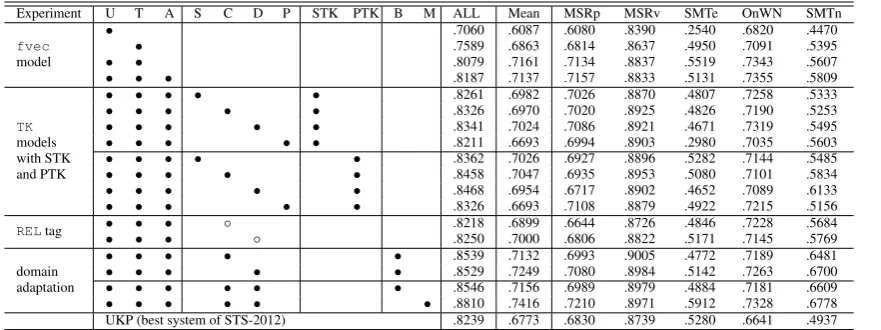
Table 1 summarizes the results of combining TK models with a strong feature vector model. We test structures defined in Sec. 2.3 when using STK and PTK. The results show that: (i) combining all three features sets (U, T,A) provides a strong baseline system that we attempt to further improve with our relational structures; (ii) the generality of PTK provides an advantage over STK for learn-ing more versatile models; (iii) constituency and dependency representations seem to perform bet-ter than shallow and phrase-dependency trees; (iv) using structures with no relational linking does not work; (v)TKmodels provide a far superior source of structural similarity thanU+T+Athat already includes PTK similarity scores as features, and fi-nally (vi) the domain adaptation problem can be addressed by including corpus specific features, which leads to a large improvement over the pre-vious best system.
5 Conclusions and Future Work
We have presented an approach where text pairs are directly treated as structural objects. This pro-vides a much richer representation for the learning algorithm to extract useful syntactic and shallow semantic patterns. We have provided an exten-sive experimental study of four different structural representations, e.g. shallow, constituency, de-pendency and phrase-dede-pendency trees using STK and PTK. The novelty of our approach is that it goes beyond a simple combination of tree kernels with feature vectors as: (i) it directly encodes input text pairs into relationally linked structures; (ii) the learned structural models are used to obtain pre-diction scores thus making it easy to plug into ex-isting feature-based models, e.g. via stacking; (iii) to our knowledge, this work is the first to apply structural kernels and combinations in a regres-sion setting; and (iv) our model achieves the state of the art in STS largely improving the best pre-vious systems. Our structural learning approach to STS is conceptually simple and does not re-quire additional linguistic sources other than off-the-shelf syntactic parsers. It is particularly suit-able for NLP tasks where the input domain comes
Experiment U T A S C D P STK PTK B M ALL Mean MSRp MSRv SMTe OnWN SMTn
fvec
model
• .7060 .6087 .6080 .8390 .2540 .6820 .4470
• .7589 .6863 .6814 .8637 .4950 .7091 .5395
• • .8079 .7161 .7134 .8837 .5519 .7343 .5607
• • • .8187 .7137 .7157 .8833 .5131 .7355 .5809
TK
models with STK and PTK
• • • • • .8261 .6982 .7026 .8870 .4807 .7258 .5333
• • • • • .8326 .6970 .7020 .8925 .4826 .7190 .5253
• • • • • .8341 .7024 .7086 .8921 .4671 .7319 .5495
• • • • • .8211 .6693 .6994 .8903 .2980 .7035 .5603
• • • • • .8362 .7026 .6927 .8896 .5282 .7144 .5485
• • • • • .8458 .7047 .6935 .8953 .5080 .7101 .5834
• • • • • .8468 .6954 .6717 .8902 .4652 .7089 .6133
• • • • • .8326 .6693 .7108 .8879 .4922 .7215 .5156
RELtag •• •• •• ◦ ◦ .8250.8218 .7000.6899 .6806.6644 .8822.8726 .5171.4846 .7145.7228 .5684.5769
domain adaptation
• • • • • .8539 .7132 .6993 .9005 .4772 .7189 .6481
• • • • • .8529 .7249 .7080 .8984 .5142 .7263 .6700
• • • • • • .8546 .7156 .6989 .8979 .4884 .7181 .6609
• • • • • • .8810 .7416 .7210 .8971 .5912 .7328 .6778
[image:5.595.84.525.62.227.2]UKP (best system of STS-2012) .8239 .6773 .6830 .8739 .5280 .6641 .4937
Table 1: Results on STS-2012. First set of experiments studies the combination offvecmodels from UKP (U), Takelab (T) and (A). Next we show results for four structural representations: shallow (S), constituency (C), dependency (D) and phrase-dependency (P) trees with STK and PTK; next row set demonstrates the necessity of relational linking for two best structures, i.e. C and D (empty circle denotes a structures with no relational linking.); finally, domain adaptation via bags of features (B) of the entire pair and (M) manually encoded dataset type show the state of the art results.
as pairs of objects, e.g., question answering, para-phrasing and recognizing textual entailment.
6 Acknowledgements
This research is supported by the EU’s Seventh Framework Program (FP7/2007-2013) under the #288024 LIMOSINEproject.
References
Eneko Agirre, Daniel Cer, Mona Diab, and Gonzalez-Agirre. 2012. Semeval-2012 task 6: A pilot on se-mantic textual similarity. In*SEM.
Daniel Bar, Chris Biemann, Iryna Gurevych, and Torsten Zesch. 2012. Ukp: Computing seman-tic textual similarity by combining multiple content similarity measures. InSemEval.
Massimiliano Ciaramita and Yasemin Altun. 2006. Broad-coverage sense disambiguation and informa-tion extracinforma-tion with a supersense sequence tagger. In
EMNLP.
Michael Collins and Nigel Duffy. 2002. New Ranking Algorithms for Parsing and Tagging: Kernels over Discrete Structures, and the Voted Perceptron. In
ACL.
Andrew S. Fast and David Jensen. 2008. Why stacked models perform effective collective classification. InICDM.
Evgeniy Gabrilovich and Shaul Markovitch. 2007. Computing semantic relatedness using wikipedia-based explicit semantic analysis. InIJCAI.
Michael Heilman and Noah A. Smith. 2010. Tree edit models for recognizing textual entailments, para-phrases, and answers to questions. InNAACL.
Alessandro Moschitti and Silvia Quarteroni. 2008. Kernels on linguistic structures for answer extrac-tion. InACL.
Alessandro Moschitti and Fabio Massimo Zanzotto. 2007. Fast and effective kernels for relational learn-ing from texts. InICML.
Alessandro Moschitti, Silvia Quarteroni, Roberto Basili, and Suresh Manandhar. 2007. Exploit-ing syntactic and shallow semantic kernels for ques-tion/answer classification. InACL.
Alessandro Moschitti. 2006. Efficient convolution ker-nels for dependency and constituent syntactic trees. InECML.
Alessandro Moschitti. 2008. Kernel methods, syntax and semantics for relational text categorization. In
CIKM.
Aliaksei Severyn and Alessandro Moschitti. 2012. Structural relationships for large-scale learning of answer re-ranking. InSIGIR.
Frane ˇSari´c, Goran Glavaˇs, Mladen Karan, Jan ˇSnajder, and Bojana Dalbelo Baˇsi´c. 2012. Takelab: Systems for measuring semantic text similarity. InSemEval. Mengqiu Wang and Christopher D. Manning. 2010.
Probabilistic tree-edit models with structured latent variables for textual entailment and question answer-ing. InACL.
Mengqiu Wang, Noah A. Smith, and Teruko Mitaura. 2007. What is the jeopardy model? a quasi-synchronous grammar for qa. InEMNLP.