Munich Personal RePEc Archive
Academic Support through Information
System : Srinivas Integrated Model
Aithal, Sreeramana and Kumar, Suresh
Srinivas Institute of Management Studies, Mangalore – 575001,
India, Srinivas Institute of Management Studies, Mangalore –
575001, India
May 2016
Academic Support through Information System :
Srinivas Integrated Model
P.S. Aithal
Srinivas Institute of Management Studies, Mangalore – 575001, India Email :[email protected]
P.M. Suresh Kumar
Srinivas Institute of Management Studies, Mangalore – 5750001, India Email :[email protected]
ABSTRACT
As part of imparting quality higher education for undergraduate and postgraduate students, Srinivas Institute of Management Studies (SIMS) developed an education service model for integrated academic support known as Srinivas Integrated Model. Backed by the presumption that knowledge is power and information is fundamental to knowledge building and knowledge sharing, this model is aimed to provide information support to students for improved academic performance. Information on the college and courses in the form of prospectus, information on curriculum, rules and regulations through college calendar, individual course wise pamphlets on value additions through certificate programmes, workshops and skill development programmes, teaching plan booklet enabling a student to forecast the outline of the curriculum, printed study material simplified to gain understanding and straight entry into the curriculum, provision to download examination related information through college website, and opportunity to get information related to individual attendance, examination marks, instructions from the faculty etc. through the unique college intranet service called Srinivas Information and Management System, are all integral part of this information system model. This paper discusses Srinivas Integrated Model as a best practice of regularizing and managing a complex network of communication traffic using a combination of print, digital and IT enabled techniques and how it serves academic support.
Keywords : Best practice in higher education, Srinivas Integrated Model
1. Introduction
In higher education quality is an important ingredient in deciding admission to various courses and choosing institutions students seek admission. Essentially a student has to know about institution he chooses to study well in advance before opting a course, including its affiliation, methods of classroom learning, ways of gaining practical experience, developing networks and relationships, improving communications and interpersonal skills, broadening personal horizons, knowing how to learn etc. Moreover, a student should know what is the strategy of the institution to improve the knowledge, skills and experience of students through advanced, unique and innovative learning skills called knowledge management.
programme? How is this programme ranked in the community ? How important is this programme to the institution ? These apprehensions not just at the beginning but also during the entire duration of the course will have to be addressed through an effective communication system. This paper discusses Srinivas Integrated Model which is developed in Srinivas Institute of Management Studies to provide an information umbrella for about forty components of information under eight broad categories through multi-pronged strategy involving use of print based, digital and IT enabled services. Finally, how such model provide academic support is also discussed.
2. Srinivas Integrated Model :
In order to find answers to stakeholder queries and provide answers in right time and to the required extent, Srinivas Institute of Management Studies (SIMS) has developed an education service model for integrated academic support known as Srinivas Integrated Model. This model is a part of imparting quality higher education for undergraduate and post graduate students [1-16]. Backed by the presumption that knowledge is power and information is fundamental to knowledge building and knowledge sharing, this model is aimed to provide information support to students for improved academic performance. Information on course and college in the form of prospectus, information on curriculum, rules and regulations through college calendar, individual course wise pamphlets to identify value additions through certificate programmes, workshops and skill development programmes, teaching plan booklet enabling a student to forecast the outline of the curriculum, printed study material simplified to gain understanding and straight entry into the curriculum, provision to download examination related information through college website, and opportunity to get information related to individual attendance, examination marks, instructions from the faculty through the unique college intranet called Srinivas Information and Management System, are integral part of this information system model.
3. Components of Integrated Model :
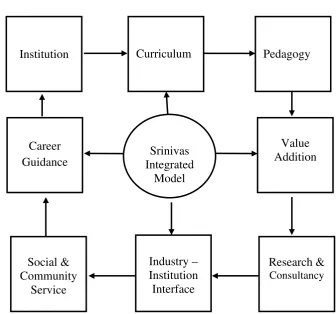
The information components of Srinivas Integrated Model for providing relevant information to students, faculty and other stake-holders is shown in figure 1. The model identifies eight sets of information, such as institution, curriculum, pedagogy, value addition, research and consultancy, industry-institution interface, social and community service and career guidance.
I. Institution :
(a) Courses (b) Admission (c) Faculty (d) Facility
(e) Examination & Results
II. Curriculum :
(a) Diversity
(b) Linking to needs (c) Industry Relevance (d) Matching student interest (e) Develop employment readiness
III. Pedagogy
(e) Innovation
IV. Research and Consultancy :
(a) Research centres (b) Student projects (c) Faculty consultancy (d) Doctoral programme (e) Publications
V. Institution-Industry Interface :
(a) Regular fieldwork (b) Research project work (c) Collaborations
[image:4.595.128.465.281.595.2](d) Guest lectures (e) Internship
Fig. 1: Information Components of Srinivas Integrated Model
VI. Social and Community Service :
(a) Rural camps (b) CSR Systems (c) Institutional NGO (d) NSS activities
(e) Red-Cross programme
VII. Career Guidance :
(a) Soft skill
Institution
Curriculum
Pedagogy
Career Guidance
Social & Community
Service
Industry – Institution Interface
Value Addition
Research &
Consultancy
Srinivas Integrated
(b) Training (c) Job-Fairs
(d) Campus Interviews (e) Placement
VIII. Value Addition :
(a) Certificate programme (b) Workshops/Seminars (c) Skill Development Courses (d) Bridge courses
(e) Electives
(1) Information about Institution
The Vision, Mission, Objectives and goals of the institution are made known to the students and other stakeholders through college website, prospectus, college calender, brochure, display boards in the college campus, alumni association, students meetings etc. The institute maintains a comprehensive website which details various activities conducted by the institute and opportunities for participation.
(2) Information about Courses
The college provides information about courses offered with eligibility conditions, in its prospectus, website, pamphlets used for admission announcement and many other printed college publications. The college website also contains copy of permissions obtained by affiliating university, state government, and other statutory regulating agencies like AICTE (New Delhi). These information are also incorporated in the college intranet.
(3) Information about value addition
The college provides various value added programmes in order to bridge the gap between university curriculum and industry requirements. Information on these courses are provided in the college calendar. A schedule of the courses offered for each academic year is publicized at the beginning to enable students to choose any particular course offered during that year. The regulations regarding conduct of these courses, examination and evaluation are also detailed in the college calendar. The hand book (calendar) also carry comprehensive information on all certificate courses offered to the students joining any particular programme. Information on value addition demonstrates institutional commitment and accountability through planned curriculum, hours of instruction, qualifying examination and award of certificate at the end of the programme.
(4) Information about Pedagogy
In addition to class room based learning, the pedagogy incorporates field based learning, project based learning, lab based learning, technology based learning, activity based learning, experiential learning etc., combining aids such as teaching plan, teachers diary, study material, web based and online supplements. Teachers are busy with improving pedagogy, devising new teaching techniques, creating new models in teaching, guiding research, examination, and evaluation and the information serves as input in the process.
(5) Information about Industry-institution Linkage
industry experts, industry research projects, business case studies, mentorship by industry managers, experience sharing of successful entrepreneurs, freelance business consultancy services through student developed mictro-projects, mini projects and team projects. Besides, job fairs attract huge publicity and receive placement assistance to eligible non-students also.
(6) Examination related information
Academic calendar is prepared by all course co-originators at the beginning of the semester. This contain schedule of two internal examinations and a preparatory (model) examination. The calendar is displayed on the notice board. The class teacher prepare the time of the examination and the schedule is announced in the class.
(7) Information about Placement and Training support
The placement cell displays the graphical presentation of the placement of the alumni -industry wise and percentagewise. The placement officer engages regular contact classes with the students with a view to understand their deficiencies and develop their capacities. English language classes focus on communication skills. Certificate courses are custom made to develop competency in public speaking, essay writing and comprehension. Websites periodically display placement related information. Alumni network support the activities of the placement cell. Registration of alumni association ensures sustainability of the network.
(8) Customized information to stakeholders through college intranet
The institute has introduced an intranet software package where faculty, students and parents can login to post or retrieve information exclusively on matters related to class attendance, classroom examination, internal assessment marks, deadlines for assignment completion, student presentations, workshops etc. This is a quick link for communicating vital information about day today activities.
(9) Information about future developmental plans of the institution
Institute looks ahead to the changes in the future where there will be radical transformation in teaching and learning and use of technology as well as new initiatives in addressing challenges. The institution adopts environmental friendly practices and there by display sensitivity to issues like climate change and environment. An ambitious plan to operate the entire activities of the institute on solar based power has been chalked out. Efforts are on to intensify collaborations with other universities and model institutes through faculty exchange visits, guest lectures, and specialized training. Adopting a new approach paves way for a radical thinking which looks at the definition, characteristic, process, and benefits of education with not just incremental but substantial changes.
(10) Information about Civic Responsibility and Social Service
This is an important component of institutional activities promoting neighborhood community network contributing to good citizenship and service orientation, achieved through working closely with NGO’s in service sector and outreach activities through student forums. The institutional NGO conducts regular programmes involving students, giving them valuable exposure in extension activities.
(11) Information about life-long learning
4. Benefits of Integrated Model to the Stakeholders : (a) Students :
(1) The prospective students get to know about their suitability and aptitude.
(2) They develop liking for the institution through information on faculty and facilities. (3) The admission process becomes transparent.
(4) Students improve their employability skills and become more competitive.
(5) The curriculum clearly spelt out in the teaching plan helps to regulate the pace of learning.
(6) Pedagogy offers variety and innovativeness.
(7) Research is encouraged and students get a feel through working on projects.
(8) Examinations test the knowledge, analytical ability, comprehension and application. (9) Internal assessments are discrete and reflect student involvement in learning.
(10)Placement opportunities are brought to the door.
(11)Participation in social activities gives satisfaction and civic consciousness. (12)Knowledge is never static. It keeps enhancing as you explore.
(13)Through more online courses students are converted to life-long learners.
(b) Faculty :
(1) Faculty enjoys status of working in institution of repute and good image.
(2) Professional respectability increases with increased popularity obtained through wide publicity.
(3) Admission process ensure good students to be admitted on whome the faculty can create result.
(4) Opportunity for consultancy increases earnings. (5) Encouragement to research improves faculty profiles. (6) Industry exposure increases professionalism.
(7) Teaching methods facilitate effective pedagogy.
(8) Teaching plan affords sequential and systematic teaching. (9) Placement services gives confidence to students.
(10)Attendance alert through SMS involves parents responsibility on their wards. (11)The examination related information helps develop preparedness.
(12)Future plans of the institution helps in framing individual career goals. (13)Involvement in social service gives contentment and responsibility. (14)Best practices could be initiated on their own.
(15)Faculty share the philosophy of life-long learning.
(c) Parents
(1) Parents can make informed choice of appropriate institution for their wards. (2) They would be happy that the wards use all available facilities.
(3) The children will grow in an atmosphere of academic ambience and high standards of discipline.
(4) Their wards will have ample opportunity for overall development.
(5) They can know about their wards progress in studies and class attendance through periodic sms alerts from the college.
(6) Teaching is made interesting and effective through a variety of methods. (7) Qualified and experienced faculty are engaging classes.
(8) Institution maintains good academic result.
(9) Students will have opportunity to learn additional skills. (10)The institute will assist in securing placement.
(11)Students will obtain industry exposure.
(14)Students will be transformed into lifelong learners.
(d) Industry
(1) Industry gets opportunity to engage in capacity building.
(2) Industry gets benefitted by trained and competent future employees. (3) Gets fruitful partners to collaborate.
(4) Find source for hiring through campus interviews. (5) Maintaining image in public by participating in job fairs. (6) Finds source for consultancy services.
(7) Gets support for scientific investigation of industrial problems. (8) Obtaining software through student mini project and teamwork. (9) Manpower for CSR activities.
(10)Industry managers get opportunity to transfer their learning to benefit future executives.
5. Analysis of the Model as Best Practice :
Srinivas Integrated Model as a best practice with the goal, context, description of the practice and its implementation, its uniqueness, evidence of success such as performance against targets, the problems encountered and resources required to implement the practice is discussed below. How such model provide support to all-round personality development of the students is also discussed.
(1) Goal of the practice
Information communication forms integral part of efficient functioning of any organization, and more so managing it is a challenge if the volume of the information is large and varied and network is complex. In order to provide institutional information in right time and required extent to all stakeholders namely, students, their parents, industry and larger community, it is essential to maintain a suitable information system which will provide such information regularly to all stake holders. Integrated model will enable regularizing and managing the complex network of information about various aspects of service, avoid repetition and afford access to all stakeholders. With this in view the college has adopted an Integrated Information Management System which gives scope for providing basic information, curricular information and supporting information to students, faculty and parents enabling academic support.
(2) Context and Description of the Practice
In the context of higher education, it is imperative that the required information about institution, about courses, about facilities, about office administration, about value additions, about office information system and about admission process ought to be conveyed to the aspirants. In a highly competitive field, with innumerable institutions providing same kind of courses, the potential students or their parents are interested to know which would offer greater value to their money. It is not limited to admission and enrollment, but throughout the entire lifespan of the course, communication is vital to ensure transparency and gain confidence. Therefore the integrated model has been devised. The integrated model also contain curriculum related information, pedagogy, research and industrial linkage, and examination. It also include, supporting information like placement and training, future plans, social service opportunity, and life-long learning. In the light of this, the college should provide a system to highlight its achievements, the quality of service it provides to the students, and facilities and opportunities available in the college.
(3) Implementation
The multi-pronged strategy involves a combination of print, digital and IT enabled methods. The college uses information system software developed using the indigenously developed intranet services.
The entire resources of the college are geared to promote hassle free learning and the information system is oriented to provide academic support. The increased enrollment, improved results, quality teaching, best use of facilities, greater involvement in community and social services, more of research and publications, better tie-up between industry and institution and enhance the placement of the students are a testimony of the success in performance.
(5) Problems encountered and resources required to implement the practice:
Comprehensive information is contained in the website since long, but gradually it was revamped to carry more and diverse information and there has been a vertical and horizontal growth in information service. Identification and exposure of the institution to a varity of stake holders and their requirements, purposeful interactions and feedbacks were instrumental in evolving the information. Ways and means of best communication methods for each of the information to be dissipated required continuous study and understanding. Role and importance of effective communication flow for academic support was best realized as the institution started to scale new heights.
6. Conclusion :
Srinivas Institute of Management Studies (SIMS) developed an education service model for integrated academic support known as Srinivas Integrated Model for imparting quality higher education for undergraduate and post graduate students. This model aims to provide information support to students for improved academic performance. The variety of information such as course and college, information on curriculum, rules and regulations, information on value additions through certificate programmes, workshops and skill development programmes, enable students to forecast the outline of the curriculum. Simplified study material to gain understanding and straight entry into the curriculum, provision to download examination related information are part of college website which is a reservoir of information. The unique, college intranet system called Srinivas Information and Management System add to the plethora of ways constituting the integrated model. Srinivas Integrated model could be envisioned as a best practice of regularizing, managing a complex network of communication traffic using a combination of print, digital and IT enabled techniques.
References :
1. Aithal P.S., & Suresh Kumar P. M., (2016) Innovations in Private Universities : A Case of Srinivas University, International Journal of Management, IT and Engineering, Volume 6, Issue 1, Page Number 250-264.
2. Aithal P. S. & Suresh Kumar P. M., (2015) Enhancement of Graduate attributes in Higher Education Institutions through Stage Models, IMPACT: International Journal of Research in Business Management, Vol. 3, Issue 3, Page Number 121 – 130.
3. Aithal P.S., (2015) MBA++ as a Unique & Successful Model in Integrated Development of Business Executives. International Journal of Management, IT and Engineering (IJMIE), Volume 5, Issue 7, pp. 124-133.
4. Aithal P.S., and Suresh Kumar P.M., (2015) Enhancement of Graduate attributes in Higher Education Institutions through Stage Models, IMPACT: International Journal of Research in Business Management, Vol. 3, Issue 3, pp. 121 – 130.
6. Srinivas Rao A., Suresh Kumar P.M., and Aithal P.S., Strategic Planning in Higher Education Institutions : A Case Study of SIMS - VISION 2025, International Journal of Educational Science and Research; Vol.5 Issue 2, April 30, 2015, pp. 29-42. 7. Aithal P.S., Srinivas Rao A., and Suresh Kumar P.M., (2015) Quality Enhancement in
Higher Education Institutions : A case study of SIMS, International Journal of Multidisciplinary Research and Development, Vol. 2, Issue 5, pp. 18-31.
8. Aithal P.S., (2015) Internal Quality Assurance Cell and its Contribution to Quality Improvement in Higher Education Institutions : A Case of SIMS, GE International Journal of Management Research (IJMR), Vol. 3, Issue 5, pp. 70-83.
9. Aithal P.S., (2015) Strategy Development and Deployment in Higher Education Institutions, Elixir International Journal, 84, pp. 33594 – 33597.
10.Aithal P.S., (2015) Strategies to be adopted in Higher Education Institutions to Enhance Admission Demand, International Journal of Extensive Research, 5, pp 9-25.
11.Aithal P.S., and Suresh Kumar P.M., (2015) Applying SWOC Analysis to an Institution of Higher Education. International Journal of Management, IT and Engineering (IJMIE), Volume 5, Issue 7, pp. 231-247.
12.Aithal P.S., Suresh Kumar P.M., and Pavithra Kumari, (2016) Methods and Approaches for Employability Skill Generation in Higher Educational Institutions. International Journal of Management, IT and Engineering (IJMIE), Volume 5, Issue 7, pp. 390-410.
13.Aithal P.S., and Harischandra P., (2015) Quality Enhancement in Higher Education Institutions through Best Practices in Library: A Case of SIMS. International Journal of Management, IT and Engineering (IJMIE), Volume 5, Issue 7, pp. 489-505.
14.Reshma, Shailashree V. T, Sridhar Acharya P., and Aithal P.S., (2015) Analysis of Academic Administrative System Implemented at SIMS. International Journal of Management, IT and Engineering (IJMIE), Volume 5, Issue 7, pp. 771-787.
15.Aithal P. S., (2016) Creating Innovators through setting up organizational Vision, Mission and Core Values : a Strategic Model in Higher Education, International Journal of Management, IT and Engineering (IJMIE), Volume 6, Issue 1, pp. 310-324. 16.Aithal P. S., and Shubhrajyotsna Aithal, (2016) Impact of On-line Education on
Higher Education System, International Journal of Engineering Research and