M U L T I - P A R A G R A P H
S E G M E N T A T I O N
E X P O S I T O R Y
T E X T
M a r t i A . H e a r s t
C o m p u t e r Science D i v i s i o n , 571 E v a n s Hall U n i v e r s i t y of C a l i f o r n i a , B e r k e l e y
B e r k e l e y , C A 94720 a n d
X e r o x P a l o A l t o R e s e a r c h C e n t e r
m a r t i @cs. berkeley, edu
O F
A b s t r a c t
This paper describes TextTiling, an algorithm for parti- tioning expository texts into coherent multi-paragraph discourse units which reflect the subtopic structure of the texts. The algorithm uses domain-independent lex- ical frequency and distribution information to recog- nize the interactions of multiple simultaneous themes. Two fully-implemented versions of the algorithm are de- scribed and shown to produce segmentation that corre- sponds well to human judgments of the major subtopic boundaries of thirteen lengthy texts.
I N T R O D U C T I O N
The structure of expository texts can be characterized as a sequence ofsubtopical discussions that occur in the context of a few main topic discussions. For example, a popular science text called Stargazers, whose main topic is the existence of life on earth and other planets, can be described as consisting of the following subdiscussions (numbers indicate paragraph numbers):
1-3 Intro - the search for life in space 4-5 The moon's chemical composition
6-8 How early proximity o f the moon shaped it
9-12 How the moon helped life evolve on earth 13 Improbability o f the earth-moon system 14-16 Binary/trinary star systems m a k e life un-
likely
17-18 The low probability of non-binary/trinary systems
19-20 Properties of our sun that facilitate life 21 S u m m a r y
Subtopic structure is sometimes marked in techni- cal texts by headings and subheadings which divide the text into coherent segments; Brown & Yule (1983:140) state that this kind of division is one of the most basic in discourse. However, many expository texts consist of long sequences of paragraphs with very little structural
demarcation. This paper presents fully-implemented al- gorithms that use lexical cohesion relations to partition expository texts into multi-paragraph segments that re- flect their subtopic structure. Because the model of dis- course structure is one in which text is partitioned into contiguous, nonoverlapping blocks, I call the general approach TextTiling. The ultimate goal is to not only identify the extents of the subtopical units, but to label their contents as well. This paper focusses only on the discovery of subtopic structure, leaving determination of subtopic content to future work.
Most discourse segmentation work is done at a finer granularity than that suggested here. However, for lengthy written expository texts, multi-paragraph seg- mentation has many potential uses, including the im- provement of computational tasks that make use of dis- tributional information. For example, disambiguation algorithms that train on arbitrary-size text windows, e.g., Yarowsky (1992) and Gale et ai. (1992b), and al- gorithms that use lexical co-occurrence to determine se- mantic relatedness, e.g., Schfitze (1993), might benefit from using windows with motivated boundaries instead. Information retrieval algorithms can use subtopic structuring to return meaningful portions of a text if paragraphs are too short and sections are too long (or are not present). Motivated segments can also be used as a more meaningful unit for indexing long texts. Salton et al. (1993), working with encyclopedia text, find that comparing a query against sections and then paragraphs is more successful than comparing against full documents alone. I have used the results of Text- Tiling in a new paradigm for information access on full- text documents (Hearst 1994).
of future work.
T H E D I S C O U R S E M O D E L
Many discourse models assume a hierarchical segmen- tation model, e.g., attentional/intentional structure (Crosz & Sidner 1986) and Rhetorical Structure T h e o r y (Mann ~ T h o m p s o n 1987). Although m a n y aspects of discourse analysis require such a model, I choose to cast expository text into a linear sequence of segments, both for computational simplicity and because such a struc- ture is sufficient for the coarse-grained tasks of interest here. 1
-2_ "- -- -- Chained
n l m i
-~__ -- _ / ' - Ringed m
Monolith
Pleeewise
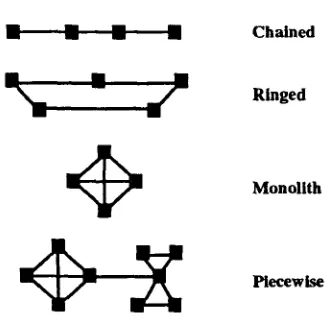
Figure 1: Skorochod'ko's text structure types. Nodes correspond to sentences and edges between nodes indi- cate strong term overlap between the sentences.
Skorochod'ko (1972) suggests discovering a text's structure by dividing it up into sentences and seeing how much word overlap appears among the sentences. T h e overlap forms a kind of intra-structure; fully con- nected graphs might indicate dense discussions of a topic, while long spindly chains of connectivity might indicate a sequential account (see Figure 1). T h e cen- tral idea is t h a t of defining the structure of a text as a function of the connectivity patterns of the terms t h a t comprise it. This is in contrast with segmenting guided primarily by fine-grained discourse cues such as register change, focus shift, and cue words. From a computa- tional viewpoint, deducing textual topic structure from lexical connectivity alone is appealing, b o t h because it is easy to compute, and also because discourse cues are sometimes misleading with respect to the topic struc- ture (Brown & Yule 1983)(§3).
1 Additionally, (Passonneau & Litman 1993) concede the difficulty of eliciting hierarchical intentional structure with any degree of consistency from their human judges.
T h e topology most of interest to this work is the final one in the diagram, the Piecewise Monolithic Structure, since it represents sequences of densely interrelated dis- cussions linked together, one after another. This topol- ogy maps nicely onto that of viewing documents as a sequence of densely interrelated subtopical discussions, one following another. This assumption, as will be seen, is not always valid, but is nevertheless quite useful.
This theoretical stance bears a close resemblance to Chafe's notion of T h e Flow Model of discourse (Chafe 1979), in description of which he writes (pp 179-180):
Our d a t a . . , suggest t h a t as a speaker moves from focus to focus (or from thought to thought) there are certain points at which there may be a more or less radical change in space, time, character config- uration, event structure, or, even, world . . . . At points where all of these change in a maximal way, an episode b o u n d a r y is strongly present. But often one or another will change considerably while oth- ers will change less radically, and all kinds of var- ied interactions between these several factors are possible. 2
Although Chafe's work concerns narrative text, the same kind of observation applies to expository text. T h e TextTiling algorithms are designed to recognize episode boundaries by determining where thematic components like those listed by Chafe change in a max- imal way.
Many researchers have studied the patterns of occur- rence of characters, setting, time, and the other the- matic factors t h a t Chafe mentions, usually in the con- text of narrative. In contrast, I a t t e m p t to determine where a relatively large set of active themes changes simultaneously, regardless of the
type
of thematic fac- tor. This is especially i m p o r t a n t in expository text in which the subject m a t t e r tends to structure the dis- course more so than characters, setting, etc. For ex- ample, in theStargazers
text, a discussion of continen- tal movement, shoreline acreage, and habitability gives way to a discussion of binary and unary star systems. This is not so much a change in setting or character as a change in subject matter. Therefore, to recognize where the subtopic changes occur, I make use of lexical cohesion relations (Halliday & Hasan 1976) in a manner similar to that suggested by Skorochod'ko.Morris and Hirst's pioneering work on computing dis- course structure from lexical relations (Morris & Hirst 1991), (Morris 1988) is a precursor to the work reported on here. Influenced by Halliday & Hasan's (1976) the- ory of lexical coherence, Morris developed an algorithm t h a t finds chains of related terms via a comprehensive thesaurus (Roget's Fourth Edition). 3 For example, the
2Interestingly, Chafe arrived at the Flow Model after working extensively with, and then becoming dissatisfied with, a hierarchical model of paragraph structure like that of Longacre (1979).
3The algorithm is executed by hand since the thesaurus
[image:2.612.122.287.234.398.2]Sentence: 05 10 15 20 25 30 35 40 45 50 55 60 65 70 75 80 85 90 95
...
1 i i i 1 1 1 1 1 1 1
I I 1 1 1 1 1
1 1 1 1
1
11 22 111112 1 1 1 11 1111 1
11 1 1 1
1 1 1 1
1 1 1 1 1 1
1 12 1 1
2 1 1 1 1
1 11 1 1 21 1 1 1 1 1 1 1
1 1 11 1 1
1 1 1 1
1 1 11 1 11 1 1 1 1 1 111 1 1
13 1 1 1 1 1 1 2 2 21 2 1 2 1 11 1 1 1 1
2 1 1 2 1 12
1 1 1 1 1 1
11 1
1 1 1 11 1
1 1 1
14 form
8 scientist
5 space II
25 star 1
5 binary
4 trinary
8 astronomer 1
7 o r b i t 1
6 pull
16 p l a n e t 1
7 galaxy 1
4 lunar
19 l i f e 1 1
27 moon
3 move
7 continent 3 shoreline
6 time
3 water
6 say
3 species
1 1
Sentence: 05 10 15 20 25 30 35 40 45 50 55 60 65 70 75 80 85 90 95
. . . .
Figure 2: Distribution of selected t e r m s from the
Stargazer
text, with a single digit frequency per sentence number (blanks indicate a frequency of zero).words
residential
andapartment
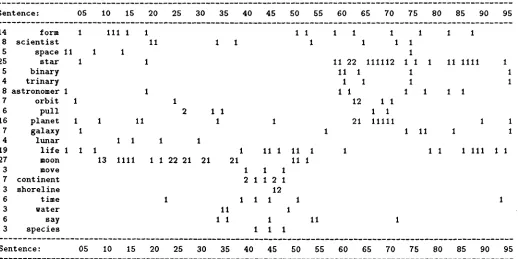
b o t h index the s a m e thesaural category and can thus be considered to be in a coherence relation with one another. T h e chains are used to structure texts according to the atten- tional/intentional theory of discourse structure (Grosz & Sidner 1986), and the extent of the chains correspond to the extent of a segment. T h e algorithm also incorpo- rates the notion of "chain returns" - repetition of t e r m s after a long hiatus - to close off an intention t h a t spans over a digression.Since the Morris & Hirst (1991) algorithm a t t e m p t s to discover a t t e n t i o n a l / i n t e n t i o n a l structure, their goals are different t h a n those of TextTiling. Specifically, the discourse structure they a t t e m p t to discover is hierar- chical and more fine-grained t h a n t h a t discussed here. Thus their model is not set up to take advantage of the fact t h a t multiple simultaneous chains might occur over the s a m e intention. Furthermore, chains tend to overlap one another extensively in long texts. Figure 2 shows the distribution, by sentence number, of selected t e r m s from the
Stargazers
text. T h e first two t e r m s have fairly uniform distribution and so should not be expected to provide much information a b o u t the di- visions of the discussion. T h e next two t e r m s occur m a i n l y at the beginning and the end of the text, while termsbinary
throughplanet
have considerable overlapis not generally available online.
from sentences 58 to 78. There is a s o m e w h a t well- demarked cluster of t e r m s between sentences 35 and 50, corresponding to the grouping together of paragraphs 10, 11, and 12 by h u m a n judges who have read the text. From the d i a g r a m it is evident t h a t s i m p l y looking for chains of repeated t e r m s is not sufficient for deter- mining subtopic breaks. Even combining terms t h a t are closely related semantically into single chains is insuf- ficient, since often several different themes are active in the s a m e segment. For example, sentences 37 - 51 contain dense interaction a m o n g the t e r m s
move, con-
tinent, shoreline, time, species,
andlife,
and all but the latter occur only in this region. However, it is the case t h a t the interlinked t e r m s of sentences 57 - 71(space,
star,binary, trinary, astronomer, orbit )
are closely re- lated semantically, assuming the a p p r o p r i a t e senses of the t e r m s have been determined.A L G O R I T H M S F O R D I S C O V E R I N G S U B T O P I C S T R U C T U R E
[image:3.612.46.564.52.311.2]structure using t e r m repetition as a lexical cohesion in- dicator.
T h e first m e t h o d compares, for a given window size, each pair of adjacent blocks of text according to how similar they are lexically. This m e t h o d assumes t h a t the more similar two blocks of text are, the more likely it is that the current subtopic continues, and, conversely, if two adjacent blocks of text are dissimilar, this implies a change in subtopic flow. T h e second method, an exten- sion of Morris & Hirst's (1991) approach, keeps track of active chains of repeated terms, where membership in a chain is determined by location in the text. T h e m e t h o d determines subtopic flow by recording where in the discourse the bulk of one set of chains ends and a new set of chains begins.
T h e core algorithm has three main parts:
1. Tokenization
2. Similarity Determination
3. Boundary Identification
Tokenization refers to the division of the input text into individual lexical units. For both versions of the algorithm, the text is subdivided into psuedosentences of a pre-defined size w (a p a r a m e t e r of the algorithm) rather than actual syntactically-determined sentences, thus circumventing normalization problems. For the purposes of the rest of the discussion these groupings of tokens will be referred to as token-sequences. In prac- tice, setting w to 20 tokens per token-sequence works best for m a n y texts. T h e morphologically-analyzed to- ken is stored in a table along with a record of the token- sequence number it occurred in, and how frequently it appeared in the token-sequence. A record is also kept of the locations of the paragraph breaks within the text. Closed-class and other very frequent words are elimi- nated from the analysis.
After tokenization, the next step is the comparison of adjacent pairs of blocks of token-sequences for over- all lexical similarity. Another i m p o r t a n t parameter for the algorithm is the blocksize: the n u m b e r of token- sequences that are grouped together into a block to be compared against an adjacent group of token-sequences. This value, labeled k, varies slightly from text to text; as a heuristic it is the average paragraph length (in token-sequences). In practice, a value of k = 6 works well for m a n y texts. Actual paragraphs are not used because their lengths can be highly irregular, leading to unbalanced comparisons.
Similarity values are computed for every token- sequence gap number; t h a t is, a score is assigned to token-sequence gap i corresponding to how similar the token-sequences from token-sequence i - k through i are to the token-sequences from i + 1 to i + k + 1. Note that this moving window approach means t h a t each token- sequence appears in k * 2 similarity computations.
Similarity between blocks is calculated by a cosine measure: given two text blocks bl and bz, each with k token-sequences,
•/E
t~JJt,bx
2Et=l ~/)2
nt,b~
where t ranges over all the terms that have been reg- istered during the tokenization step, and wt,b~ is the weight assigned to term t in block /)I- In this version of the algorithm, the weights on the terms are simply their frequency within the block .4 T h u s if the similarity score between two blocks is high, then the blocks have m a n y terms in c o m m o n . This formula yields a score between 0 and 1, inclusive.
These scores can be plotted, token-sequence n u m b e r against similarity score. However, since similarity is
measured between blocks bl and b2, where bl spans token-sequences i - k through i and b2 spans i + 1 to i + k + 1, the measurement's z-axis coordinate falls be- tween token-sequences i and i + 1. Rather than plot- ting a token-sequence number on the x-axis, we plot token-sequence gap number i. T h e plot is smoothed with average smoothing; in practice one round of aver- age smoothing with a window size of three works best for most texts.
Boundaries are determined by changes in the se- quence of similarity scores. T h e token-sequence gap numbers are ordered according to how steeply the slopes of the plot are to either side of the token-sequence gap, rather than by their absolute similarity score. For a given token-sequence gap i, the algorithm looks at the scores of the token-sequence gaps to the left of i as long are their values are increasing. When the values to the left peak out, the difference between the score at the peak and the score at i is recorded. T h e same proce- dure takes place with the token-sequence gaps to the right of i; their scores are examined as long as they continue to rise. T h e relative height of the peak to the right of i is added to the relative height of the peak to the left. (A gap occurring at a peak will have a score of zero since neither of its neighbors is higher than it.) These new scores, called depth scores, corresponding to how sharp a change occurs on both sides of the token- sequence gap, are then sorted. Segment boundaries are assigned to the token-sequence gaps with the largest corresponding scores, adjusted as necessary to corre- spond to true paragraph breaks. A proviso check is done that prevents assignment of very close adjacent segment boundaries. Currently there must be at least three intervening token-sequences between boundaries. This helps control for the fact that many texts have spurious header information and single-sentence para- graphs.
T h e algorithm must determine how m a n y segments to assigned to a document, since every paragraph is a
4Earlier work weighted the terms according to their fre- quency times their inverse document frequency. In these more recent experiments, simple term frequencies seem to work better.
I1
i
:il
I
O
m u i m m m i m m m l ~ m l m m m m ~ I m l l l
m l l l m I m I m m m ~ m l ~ m l l l l l l m m m ~ m m i n i m m m m l l m l m l m l ~ m m m i m ~ m m l l D ~ m l m ~ l m ~ m m m i m m ~ l l m ~ l m
1 . 1 1 l l m l E l l l l l E i l l m B . . . I . . . ~ . . . j ' . . . : . . . : : : : : . . . . : . . : . : . . . : . . : : : 7 . . . • s ~ ~ s e 7 • o 1 o 1 1 1 ~ • ~ 1 ~ , • l a • 7 1 8 • • ~ o
& 2o ~0' ..' 2o --' 7o' . ' ~ , . o
Figure 3: Judgments of seven readers on the
Stargazer
text. Internal numbers indicate location of gaps between paragraphs; x-axis indicates token-sequence gap number, y-axis indicates judge number, a break in a horizontal line indicates a judge-specified segment break.o . e
o . l L
0 . 4
o . i
o , 1
° 0
1 4 ~ s i l a
| i o
I I i / !
I o * o ~ T o ~ l o o
Figure 4: Results of the block similarity algorithm on the
Stargazer
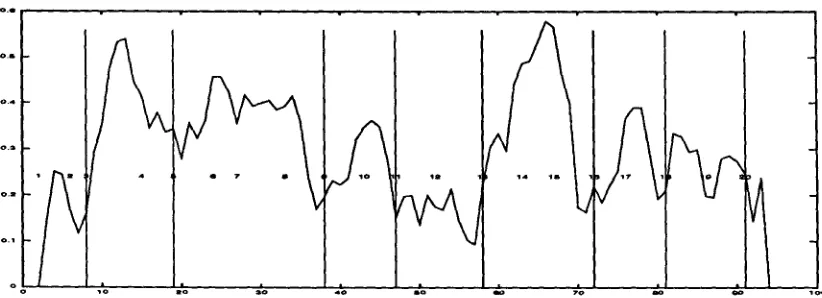
text. Internal numbers indicate paragraph numbers, x-axis indicates token-sequence gap number, y-axis indicates similarity between blocks centered at the corresponding token-sequence gap. Vertical lines indicate boundaries chosen by the algorithm; for example, the leftmost vertical line represents a boundary after paragraph 3. Note how these align with the boundary gaps of Figure 3 above.potential segment boundary. Any attempt to make an absolute cutoff is problematic since there would need to be some correspondence to the document style and length. A cutoff based on a particular valley depth is similarly problematic•
I have devised a method for determining the number of boundaries to assign that scales with the size of the document and is sensitive to the patterns of similarity scores that it produces: the cutoff is a function of the average and standard deviations of the depth scores for the text under analysis• Currently a boundary is drawn only if the depth score exceeds g - ¢r/2.
E V A L U A T I O N
One way to evaluate these segmentation algorithms is to compare against judgments made by human readers, another is to compare the algorithms against texts pre- marked by authors, and a third way is to see how well the results improve a computational task. This section
compares the algorithm against reader judgments, since author markups are fallible and are usually applied to text types that this algorithm is not designed for, and Hearst (1994) shows how to use TextTiles in a task (although it does not show whether or not the results of the algorithms used here are better than some other algorithm with similar goals).
R e a d e r J u d g m e n t s
Judgments were obtained from seven readers for each of thirteen magazine articles which satisfied the length criteria (between 1800 and 2500 words) 5 and which contained little structural demarkation. The judges
[image:5.612.94.508.42.192.2] [image:5.612.95.506.239.388.2]were asked simply to mark the paragraph boundaries at which the topic changed; they were not given more explicit instructions a b o u t the granularity of the seg- mentation.
Figure 3 shows the boundaries marked by seven judges on the
Stargazers
text. This f o r m a t helps il- lustrate the general trends made by the judges and also helps show where and how often they disagree. For instance, all b u t one judge marked a b o u n d a r y be- tween paragraphs 2 and 3. T h e dissenting judge did mark a boundary after 3, as did two of the concurring judges. T h e next three m a j o r boundaries occur after paragraphs 5, 9, 12, and 13. There is some contention in the later paragraphs; three readers marked both 16 and 18, two marked 18 alone, and two marked 17 alone. T h e outline in the Introduction gives an idea of what each segment is about.Passonneau & L i t m a n (1993) discuss at length con- siderations about evaluating segmentation algorithms according to reader j u d g m e n t information. As Figure 3 shows, agreement among judges is imperfect, but trends can be discerned. In Passonneau & L i t m a n ' s (1993) data, if 4 or more out of 7 judges mark a boundary, the segmentation is found to be significant using a variation of the Q-test (Cochran 1950). My d a t a showed similar results. However, it isn't clear how useful this signifi- cance information is, since a simple m a j o r i t y does not provide overwhelming proof about the objective real- ity of the subtopic break. Since readers often disagree about where to draw a boundary marking for a topic shift, one can only use the general trends as a basis from which to compare different algorithms. Since the goals of TextTiling are better served by algorithms t h a t produce more rather t h a n fewer boundaries, I set the cutoff for "true" boundaries to three rather than four judges per paragraph. 6 T h e remaining gaps are consid- ered nonboundaries.
R e s u l t s
Figure 4 shows a plot of the results of applying the block comparison algorithm to the
Stargazer
text. When the lowermost portion of a valley is not located at a para- graph gap, the j u d g m e n t is moved to the nearest para- graph gap. 7 For the most part, the regions of strong similarity correspond to the regions of strong agree- ment among the readers. (The results for this text were fifth highest out of the 13 test texts.) Note however, that the similarity information around paragraph 12 is weak. This paragraph briefly summarizes the contents of the previous three paragraphs; much of the terminol-6Paragraphs of three or fewer sentences were combined with their neighbor if that neighbor was deemed to follow at "true" boundary, as in paragraphs 2 and 3 of the
Stargazers
text.rThis might be explained in part by (Stark 1988) who shows that readers disagree measurably about where to place paragraph boundaries when presented with texts with those boundaries removed.
ogy that occurred in all of them reappears in this one location (in the spirit of a Grosz ~; Sidner (1986) "pop" operation). Thus it displays low similarity b o t h to itself and to its neighbors. This is an example of a breakdown caused by the assumptions about the subtopic struc- ture. It is possible that an additional pass through the text could be used to find structure of this kind.
T h e final paragraph is a s u m m a r y of the entire text; the algorithm recognizes the change in terminology from the preceding paragraphs and marks a boundary; only two of the readers chose to differentiate the sum- mary; for this reason the algorithm is judged to have made an error even though this sectioning decision is reasonable. This illustrates the inherent fallibility of testing against reader judgments, although in part this is because the judges were given loose constraints.
Following the advice of Gale et
al.
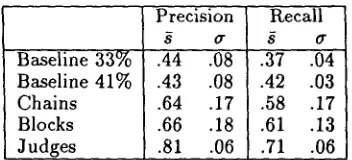
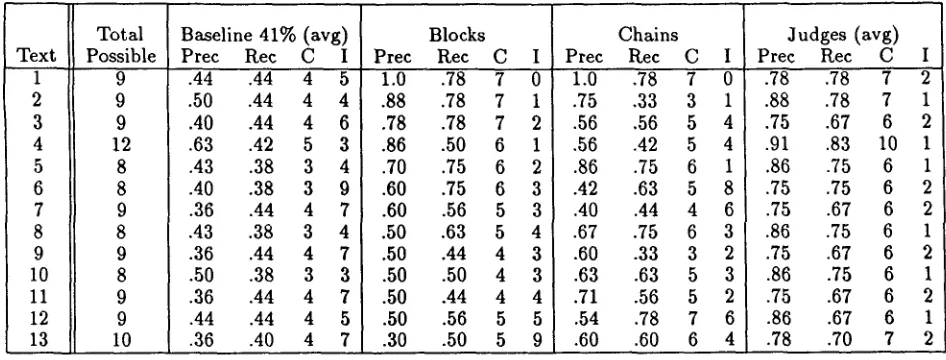
(1992a), I compare the Mgorithm against both upper and lower bounds. T h e upper bound in this case is the reader judgment data. T h e lower bound is a baseline algorithm that is a simple, reasonable approach to the problem that can be a u t o m a t e d . A simple way to segment the texts is to place boundaries randomly in the document, con- straining the number of boundaries to equal t h a t of the average number of paragraph gaps assigned by judges. In the test data, boundaries are placed in a b o u t 41% of the paragraph gaps. A program was written t h a t places a boundary at each potential gap 41% of the time (us- ing a r a n d o m number generator), and run 10,000 times for each text, and the average of the scores of these runs was found. These scores appear in Table 1 (results at 33% are also shown for comparison purposes).T h e algorithms are evaluated according to how many true boundaries they select out of the total selected (precision) and how many true boundaries are found out of the total possible (recall) (Salton 1988). T h e recall measure implicitly signals the number of missed bound- aries (false negatives, or deletion errors); the number of false positives, or insertion errors, is indicated explic- itly.
In many cases the algorithms are almost correct but off by one paragraph, especially in the texts that the al- gorithm performs poorly on. When the block similarity algorithm is allowed to be off by one paragraph, there is dramatic improvement in the scores for the texts that lower part of Table 2, yielding an overall precision of 83% and recall of 78%. As in Figure 4, it is often the case t h a t where the algorithm is incorrect, e.g., para- graph gap 11, the overall blocking is very close to what the judges intended.
Table 1 shows that both the blocking algorithm and the chaining algorithm are sandwiched between the up- per and lower bounds. Table 2 shows some of these results in more detail. T h e block similarity algorithm seems to work slightly better than the chaining algo- rithm, although the difference may not prove significant over the long run. Furthermore, in both versions of the algorithm, changes to the parameters of the algorithm
Baseline 33% Baseline 41% Chains Blocks Judges
Precision Recall
.44 .08 .37 .04' .43 .08 .42 .03 .64 .17 .58 .17 .66 .18 .61 .13 .81 .06 .71 .06
Table 1: Precision and Recall values for 13 test texts.
perturbs the resulting b o u n d a r y markings. This is an undesirable property and perhaps could be remedied with some kind of information-theoretic formulation of the problem.
S U M M A R Y A N D F U T U R E W O R K
This paper has described algorithms for the segmen- tation of expository texts into discourse units that re- flect the subtopic structure of expository text. I have introduced the notion of the recognition of multiple si- multaneous themes, which bears some resemblance to .Chafe's Flow Model of discourse and Skorochod'ko's text structure types. T h e algorithms are fully imple- mented: term repetition alone, without use of thesaural relations, knowledge bases, or inference mechanisms, works well for many of the experimental texts. T h e structure it obtains is coarse-grained but generally re- flects human judgment data.
Earlier work (Hearst 1993) incorporated thesaural information into the algorithms; surprisingly the lat- est experiments find that this information degrades the performance. This could very well be due to problems with the algorithm used. A simple algorithm that just posits relations among terms that are a small distance apart according to WordNet (Miller et al. 1990) or Ro- get's 1911 thesaurus (from Project Gutenberg), mod- eled after Morris and Hirst's heuristics, might work bet- ter. Therefore I do not feel the issue is closed, and in- stead consider successful grouping of related words as future work. As another possible alternative Kozima (1993) has suggested using a (computationally expen- sive) semantic similarity metric to find similarity among terms within a small window of text (5 to 7 words). This work does not incorporate the notion of multi- ple simultaneous themes but instead just tries to find breaks in semantic similarity among a small number of terms. A good strategy may be to substitute this kind of similarity information for term repetition in al- gorithms like those described here. Another possibility would be to use semantic similarity information as com- puted in Schiitze (1993), Resnik (1993), or Dagan et ai.
(1993).
T h e use of discourse cues for detection of segment boundaries and other discourse purposes has been ex- tensively researched, although predominantly on spo- ken text (see Hirschberg & Litman (1993) for a sum-
mary of six research groups' treatments of 64 cue words). It is possible that incorporation of such in- formation m a y provide a relatively simple way improve the cases where the algorithm is off by one paragraph.
A c k n o w l e d g m e n t s
This paper has benefited from the comments of Graeme Hirst, Jan Pedersen, Penni Sibun, and Jeff Siskind. I would like to thank Anne Fontaine for her interest and help in the early stages of this work, and Robert Wilen- sky for supporting this line of research. This work was sponsored in part by the Advanced Research Projects Agency under G r a n t No. MDA972-92-J-1029 with the Corporation for National Research Initiatives (CNRI), and by the Xerox Palo Alto Research Center.
R e f e r e n c e s
BROWN, GILLIAN, ~ GEORGE YULE. 1983. Discourse Anal-
ysis. Cambridge Textbooks in Linguistics Series. Cam-
bridge University Press.
CHAFE, WALLACE L. 1979. The flow of thought and the flow of language. In Syntax and Semantics: Discourse
and Syntax, ed. by Talmy Giv6n, volume 12, 159-182.
Academic Press.
COCrmAN, W. G. 1950. The comparison of percentages in matched samples. Biometrika 37.256-266.
DAGAN, IDO, SHAUL MARCUS, & SHAUL MARKOVITCH. 1993. Contextual word similarity and estimation from sparse data. In Proceedings of the 31th Annual Meet- ing of the Association for Computational Linguistics,
164-171.
GALE, WILLIAM A., KENNETH W. CHURCH, &: DAVID
YAROWSKY. 1992a. Estimating upper and lower
bounds on the performance of word-sense disambigua- tion programs. In Proceedings of the 30th Meeting of
the Association for Computational Linguistics, 249-
256.
- - , , & . 1992b. A method for disambiguating word senses in a large corpus. Computers and the Hu-
manities 5-6.415-439.
GRosz, BARBARA J., &: CANDACE L. SIDNER. 1986. Atten- tion, intention, and the structure of discourse. Compu-
tational Linguistics 12.172-204.
HALLIDAY, M. A. K., & R. HASAN. 1976. Cohesion in
English. London: Longman.
HEARST, MARTI A. 1993. TextTiling: A quantitative ap- proach to discourse segmentation. Technical Report Sequoia 93/24, Computer Science Department, Univer- sity of California, Berkeley.
, 1994. Context and Structure in Automated Full-Text
Information Access. University of California at Berke-
ley dissertation. (Computer Science Division Technical Report).
[image:7.612.71.247.45.125.2]T e x t
1 9
2 9
3 9
4 12
5 8
6 8
7 9
8 8
9 9
10 8
11 9
12 9
13 10
Total Baseline 41% (avg) Blocks Chains Judges (avg)
Possible Prec Rec C I Prec Rec C I Prec Rec C Rec C I
.44 .44 4 5 .50 .44 4 4 .40 .44 4 6 .63 .42 5 3 .43 .38 3 4 .40 .38 3 9 .36 .44 4 7 .43 .38 3 4 .36 .44 4 7 .50 .38 3 3 .36 .44 4 ? .44 .44 4 5 .36 .40 4 7
1.0 .78 7 0 .88 .78 7 1 .78 .78 7 2 .86 .50 6 1 .70 .75 6 2 .60 .75 6 3 .60 .56 5 3 .50 .63 5 4 .50 .44 4 3 .50 .50 4 3 .50 .44 4 4 .50 .56 5 5 .30 .50 5 9
1.0 .78 7 .75 .33 3 .56 .56 5 .56 .42 5 .86 .75 6 .42 .63 5 .40 .44 4 .67 .75 6 .60 .33 3 .63 .63 5 .71 .56 5 .54 .78 7 .60 .60 6
I Prec 0 .78 1 .88 4 .75 4 .91 1 .86 8 .75 6 .75 3 .86 2 .75 3 .86 2 .75 6 .86 4 .78
.78 7 2 .78 7 1 .67 6 2 .83 10 1 .75 6 1 .75 6 2 .67 6 2 .75 6 1 .67 6 2 .75 6 1 .67 6 2 .67 6 1 .70 7 2
Table 2: Scores by text, showing precision and recall. (C) indicates the n u m b e r of correctly placed boundaries, (I) indicates the n u m b e r of inserted boundaries. T h e n u m b e r of deleted boundaries can be determined by s u b t r a c t i n g (C) f r o m T o t a l Possible.
KOZIMA, HIDEKI. 1993. Text segmentation based on similar- ity between words. In Proceedings of the 31th Annual Meeting of the Association for Computational Linguis-
tics, 286-288, Columbus, OH.
LONGACRE, R. E. 1979. The paragraph as a grammatical unit. In Syntax and Semantics: Discourse and Syntax,
ed. by Talmy Givdn, volume 12, 115-134. Academic Press.
MANN, WILLIAM C., & SANDRA A. THOMPSON. 1987. Rhetorical structure theory: A theory of text organi- zation. Technical Report ISI/RS 87-190, ISI.
MILLER, GEORGE A., RICHARD BECKWITH, CHRISTIANE FELLBAUM, D E R E K GROSS, ~ KATHERINE J. MILLER. 1990. Introduction to WordNet: A n on-line lexical database. Journal of Lexicography 3.235-244.
MoPmIS, JANE. 1988. Lexical cohesion, the thesaurus, and the structure of text. Technical Report CSRI- 219, Computer Systems Research Institute, University of Toronto.
- - , ~z GRAEME HIRST. 1991. Lexical cohesion computed by thesaural relations as an indicator of the structure of text. Computational Linguistics 17.21-48.
PASSONNEAU, REBECCA J., ~z DIANE J. LITMAN. 1993. Intention-based segmentation: Human reliability and correlation with linguistic cues. In Proceedings of the 31st Annual Meeting of the Association for Computa-
tional Linguistics, 148-155.
RESNIK, PHILIP, 1993. Selection and Information: A Class-
Based Approach to Lexical Relationships. University of
Pennsylvania dissertation. (Institute for Research in Cognitive Science report IRCS-93-42).
SALTON, GERARD. 1988. Automatic text processing : the transformation, analysis, and retrieval of information
by computer. Reading, MA: Addison-Wesley.
- - , JAMES ALLAN, ~ CHRIS BUCKLEY. 1993. Ap- proaches to passage retrieval in full text information
systems. In Proceedings of the 16th Annual Inter-
national A C M / S I G I R Conference, 49-58, Pittsburgh,
PA.
SCHUTZE, HINRICH. 1 9 9 3 . Word space. In Advances
in Neural Information Processing Systems 5, ed. by
Stephen J. Hanson, Jack D. Cowan, & C. Lee Giles. San Mateo CA: Morgan Kaufmann.
SKOROCHOD'KO, E.F. 1972. Adaptive method of automatic abstracting and indexing. In Information Processing
71: Proceedings of the IFIP Congress 71, ed. by C.V.
Freiman, 1179-1182. North-Holland Publishing Com- pany.
STARK, HEATHER. 1988. What do paragraph markers do?
Discourse Processes 11.275-304.
TANNEN, DEBORAH. 1989. Talking Voices: Repetition, dia-
logue, and imagery in conversational discourse. Studies
in Interactional Sociolinguistics 6. Cambridge Univer- sity Press.
WALKER, MARILYN. 1991. Redundancy in collaborative dia- logue. In A A A I Fall Symposium on Discourse Structure in Natural Language Understanding and Generation,
ed. by Julia Hirschberg, Diane Litman, Kathy McCoy, & Candy Sidner, Pacific Grove, CA.
YAROWSKY, DAVID. 1992. Word sense disambiguation us- ing statistical models of Roget's categories trained on large corpora. In Proceedings of the Fourteenth Interna-
tional Conference on Computational Linguistics, 454-
460, Nantes, France.
[image:8.612.58.531.45.225.2]