U s i n g Higher-Order Logic Programming for Semantic
Interpretation of Coordinate Constructs
Seth Kulick
University of Pennsylvania
Computer and Information Science
200 South 33rd Street
Philadelphia, PA 19104-6389
USA
skulick@linc, cis. upenn, edu
A b s t r a c t
Many theories of semantic interpretation use A-term manipulation to composition- ally compute the meaning of a sentence. These theories are usually implemented in a language such as Prolog that can simulate A-term operations with first-order unifica- tion. However, for some interesting cases, such as a Combinatory Categorial Gram- mar account of coordination constructs, this can only be done by obscuring the un- derlying linguistic theory with the "tricks" needed for implementation. This paper shows how the use of abstract syntax per- mitted by higher-order logic programming allows an elegant implementation of the se- mantics of Combinatory Categorial Gram- mar, including its handling of coordination constructs.
1
I n t r o d u c t i o n
Many theories of semantic interpretation use A-term manipulation to compositionally compute the mean- ing of a sentence. These theories are usually imple- mented in a language such as Prolog that can sim- ulate A-term operations with first-order unification. However, there are cases in which this can only be done by obscuring the underlying linguistic theory with the "tricks" needed for implementation. For example, Combinatory Categorial Grammar (CCG) (Steedman, 1990) is a theory of syntax and seman- tic interpretation that has the attractive character- istic of handling many coordination constructs that other theories cannot. While many aspects of CCG semantics can be reasonably simulated in first-order unification, the simulation breaks down on some of the most interesting cases that CCG can theoreti- cally handle. The problem in general, and for CCG in particular, is that the implementation language does not have sufficient expressive power to allow a more direct encoding. The solution given in this pa- per is to show how advances in logic programming allow the implementation of semantic theories in a
very direct and natural way, using CCG as a case study.
We begin by briefly illustrating why first-order unification is inadequate for some coordination con- structs, and then review two proposed solutions. The sentence in (la) usually has the logical form (LF) in (lb).
(la) John and B i l l r u n .
(15) (and
(run John) (run
Bill))
CCG is one of several theories in which (lb) gets
derived by raising
John
to be the LFAP.(P
john),where P is a predicate that takes a NP as an argu-
ment to return a sentence. Likewise,
Bill
gets theLF
AP.(P
b i l l ) , and coordination results in the fol-lowing LF for
John and Bill:
(2) AP.(and (P john) (P bill))
When (2) is applied to the predicate, (15) will re- sult after 13-reduction. However, under first-order unification, this needs to simulated by having the variable z in Az.run(z) unify both with Bill and John, and this is not possible. See (Jowsey, 1990) and (Moore, 1989) for a thorough discussion.
(Moore, 1989) suggests that the way to overcome this problem is to use explicit A-terms and encode /~-reduction to perform the needed reduction. For example, the logical form in (3) would be produced, where X\rtm(X) is the representation of Az.run (z).
(3) and (apply (I\run(X), j ohn).
apply
(l\run(l), bill) )(Park, 1992) proposes a solution within first-order unification that can handle not only sentence (la), but also more complex examples with determiners. The method used is to introduce spurious bindings that subsequently get removed. For example, the semantics of (4a) would be (4b), which would then get simplified to (4c).
(4a) A farmer and every senator talk
(4b)
e x i s t s ( X 1 , f a n a e r ( I 1 )a(
exists
(x2, (x2=xl) ataZk (X2)) ) )
&f o r a l l C l 3 , s e n a t or (X3)
=> (exists (X2, (12=13) &talk (X2))
) )
(4c)
exists (Xl,fanaerCXl)ktalk(Xl))&forall (13, senator (13) =>talk (13))
While this pushes first-order unification beyond what it had been previously shown capable of, there are two disadvantages to this technique: (1) For ev- ery possible category that can be conjoined, a sepa-
rate lexical entry for
and
is required, and (2) As theconjoinable categories become more complex, the
and
entries become correspondingly more complexand greatly obscure the theoretical background of the grammar formalism.
The fundamental problem in both cases is that the concept of free and bound occurrences of variables is not supported by Prolog, but instead needs to be implemented by additional programming. While theoretically possible, it becomes quite problematic to actually implement. The solution given in this paper is to use a higher-order logic programming language, AProlog, that already implements these concepts, called "abstract syntax" in (Miller, 1991) and "higher-order abstract syntax" in (Pfenning and Elliot, 1988). This allows a natural and elegant im- plementation of the grammatical theory, with only
one lexical entry for
and.
This paper is meant to beviewed as furthering the exploration of the utility of higher-order logic programming for computational linguistics - see, for example, (Miller & Nadathur, 1986), (Pareschi, 1989), and (Pereira, 1990).
2
C C G
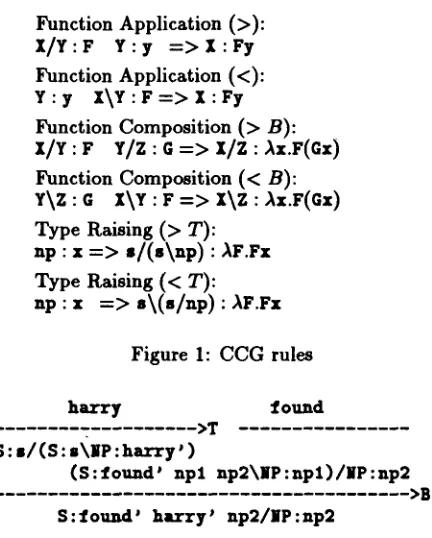
CCG is a grammatical formalism in which there is a one-to-one correspondence between the rules of composition 1 at the level of syntax and logical form. Each word is (perhaps ambiguously) assigned a cat- egory and LF, and when the syntactical operations assign a new category to a constituent, the corre- sponding semantic operations produce a new LF for that constituent as well. The CCG rules shown in Figure 1 are implemented in the system described
1In the genera] sense, not specifically the CCG rule for function composition.
Function Application (>): I / Y : F Y : y = > g : F y Function Application (<): Y : y I \ Y : F = > I : F y Function Composition (>
X/Y:F Y/Z:G=>X/Z:
Function Composition (<
Y\Z:G
X \ Y : F = > X \ Z : Type Raising (> T):n p : x = > . / ( s \ n p ) : ~F.Fx
Type Raising (< T):
n p : x = > e \ ( s / n p ) : A F . V x
B):
)tx.F(Gx)
B):
~x.F(Gx)
Figure 1: CCG rules
h a r r y found
. . . ~ . . . >T
S:s/(S:s\NP:harry')
(S:found ~ npl np2\NP:npl)/NP:np2
>B
S:found' harry' np2/NP:np2
Figure 2: CCG derivation of
harry found
simulatedby first-order unification
in this paper. 2 3 Each of the three operations have both a forward and backward variant.
As an illustration of how the semantic rules can be simulated in first-order unification, consider the
derivation of the constituent
harry found,
whereharry
has the category np with LF h a r r y ' andfound
is a transitive verb of category ( s \ n p ) / n p with LF (5)
Aobject.Asubject.(found' subject object)
In the CCG formalism, the derivation is as fol-
lows:
harry
gets raised with the > T rule, andthen forward composed by the > B rule with
found,
and the result is a category of type s/rip with LF Az.(found' h a r r y ' z). In section 3 it will be seen how the use of abstract syntax allows this to be ex- pressed directly. In first-order unification, it is sim- ulated as shown in Figure 2. 4
The final CCG rule to be considered is the coor- dination rule that specifies that only like categories can coordinate:
2The type-raising rules shown are actually a simplifi- cation of what has been implemented. In order to handle determiners, a system similar to NP-complement cate- gories as discussed in (Dowty, 1988) is used. Although a worthwhile further demonstration of the use of ab- stract syntax, it has been left out of this paper for space reasons.
3The \ for a backward-looking category should not be confused with the \ for A-abstraction.
[image:2.612.323.539.56.325.2](6)
X ¢on3 X=>
xThis is actually a schema for a family of rules, col- lectively called "generalized coordination", since the semantic rule is different for each case. 5 For exam- ple, if X is a u n a r y function, then the semantic rule is (Ta), and if the functions have two arguments, then the rule is (7b). s
(7a) @FGH = Az.F(Gz)(Hz)
(7b) @ ~ F G H = A z . A y . F ( G z y ) ( H z y )
For example, when processing ( l a ) , rule (Ta) would be used with:
• F = Az.Ay.(~md' z y)
• G = AP.(P
john')
, H = A P . ( P
b i l l ' )
with the result
c~FGH =
Az.(and' (z john') (z b i l l ' ) )
which is c=-equivalent to (2).
3
~ P R O L O G and Abstract Syntax
AProlog is a logic programming language based on higher-order hereditary Harrop formulae (Miller et al., 1991). It differs from Prolog in t h a t first-order terms and unification are replaced with simply-typed A-terms and higher-order unification 7, respectively. It also permits universal quantification and implica- tion in the goals of clauses. T h e crucial aspect for this paper is t h a t together these features permits the usage of abstract s y n t a x to express the logical forms terms c o m p u t e d by CCG. T h e built-in A-term ma- nipulation is used as a "meta-language" in which the "object-language" of CCG logical forms is expressed, and variables in the object-language are m a p p e d to variables in the meta-language.
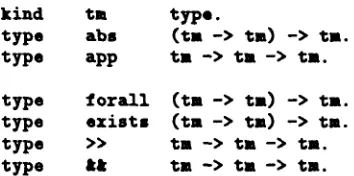
T h e AProlog code fragment shown in Figure 3 de- clares how the CCG logical forms are represented. Each CCG LF is represented as an untyped A-term, namely type t=. abe represents object-level abstrac- tion Az.M by the meta-level expression (abe I ) , sit is not established
if
this schema should actually produce an unbounded family of rules. See (Weir, 1988) and (Weir and Joshi, 1988) for a discussion of the im- plications for automata-theoretic power of generalized coordination and composition, and (Gazda~, 1988) for linguistic axguments that languages like Dutch may re- quire this power, and (Steedman, 1990) for some further discussion of the issue. In this paper we use the general- ized rule to illustrate the elegance of the representation, but it is an easy change to implement a bounded coor- dination rule.eThe ,I~ notation is used because of the combina- tory logic background of CCG. See (Steedman, 1990) for details.
7defined as the unification of simply typed A-terms, modulo ~,/conversion.
k i n d tat t y p e .
t y p e a b e (tat - > tat) - > tat. t y p e a p p tat - > tat - > tat.
t y p e f o r a l l (tat - > tat) - > tat. t y p e e x i s t s (tat - > tat) - > tat. t y p e >> tat - > t m - > tat. t y p e , t tat - > t a - > tat.
Figure 3: Declarations for AProlog representation of C C G logical forms
where N is a meta-level function of type t a ---* tat.
A meta-level A-abstraction Ay.P is written y\p.S
Thus, if waZked' has type tat --* tat, then
y \ ( w a l k e d ' y) is a AProlog (meta, level) function with type t a -* tat, and (abe y \ ( w a l k e d ' y)) is the object-level representation, with type tat. T h e LF for found shown in (5) would be represented as
Cabs obj\(abs sub\(found' sub obj))),
app en-
codes
application, and so in the derivation of harry found, the type-raised harry has the AProlog value(abe
p \ ( a p p pharry')). 9
T h e second part of Figure 3 shows declares how quantifiers are represented, which are required since the sentences to be processed m a y have determiners. f o r a l l and e x i s t s are encoded similarly to abstrac- tion, in t h a t they take a functional argument and so object-level binding of variables by quantifiers is handled by m e t a - h v e l A-abstraction. >> and t t are simple constructors for implication and conjunction, to be used with f o r a l l and e x i s t s respectively, in the typical m a n n e r (Pereira and Shieber, 1987). For example, the sentence every man found a bone has as a possible LF (8a), with the AProlog representation
(8b)10:
SThis is the same syntax for ~-abstraction as in (3). (Moore, 1989) in fact borrows the notation for A- abstraction from AProlog. The difference, of course, is that here the abstraction is a meta-level, built-in con- struct, while in (3) the interpretation is dependent on an extra layer of programming. Bound variables in AProlog can be either upper or lower case, since they axe not logic vaxlables, and will be written in lower case in this paper. 9It is possible to represent the logical forms at the
object-level without using abs and app, so that harry
could be simply p\(p harry'). The original implemen- tation of this system was in fact done in this manner. Space prohibits a full explanation, but essentially the fact that AProlog is a typed language leads to a good deal of formal clutter if this method is used.
1°The LF for the determiner has the form of a Mon- tagovian generalized quantifier, giving rise to one fully
scoped logical form for the sentence. It should be
[image:3.612.311.488.63.151.2]t y p e apply tm -> tm -> tm -> o. type compose tm -> tm -> tm -> o.
type raise tm -> tm -> o. apply (abs R) S (R S ) .
compose (abs F) (abs G) (abs x \ ( F (G x ) ) ) . raise Tn (abe P\(app P Tm)).
Figure 4: ~Prolog implementation of CCG logical form operations
(8a) 3=.((bone' =)
Ay)
( ound' =)))
(8b) ( e x i s t s x \ ((bone' x) it&
( f o r a l l x l \
(CLan' x l ) >> ( f o u n d ' x l x ) ) ) ) )
Figure 4 illustrates how directly the CCG opera- tions can be encoded 11. o is the type of a meta-level proposition, and so the intended usage of apply is to take three arguments of type tm, where the first should be an object-level )~-abstraction, and set the third equal to the application of the first to the sec- ond. Thus, for the query
?- apply (abe s u b \ ( w a l k e d ' sub)) h a r r y ' N.
It unifies with the t a -~ t a function
sub\(walked ~ sub), S with h a r r y ' and M with (It S), the recta-level application of R to S, which by the built-in fi-reduction is (walked' h a r r y ' ). In other words, object-level function application is handled simply by the meta-level function application.
Function composition is similar. Consider
again the derivation of
harry found
by type-raising and forward composition,
harry
wouldget type-raised by the r a i s e clause to produce (abe p\(app p haxry~)), and then composed with
found,
with the result shown in the following query:?- compose (abe p \ ( a p p p h a r r y ' ) ) (abe o b j \
(abe s u b \
(found' sub o b j ) ) ) M.
M = (abe x \ (app
(abs s u b \ ( f o u n d ~ sub x ) ) h a r r y ' ) ) .
derivation fails to yield all available quantifier scopings. We do not address here the further question of how the remaining scoped readings axe derived. Alternatives that appear compatible with the present approach are quanti- tier movement (Hobbs & Shieber, 1987), type-ralsing at LF (Paxtee & Rooth, 1983), or the use of disambiguated quantifers in the derivation itself (Park, 1995).
11There are other clauses, not shown here, that deter- mine the direction of the CCG rule. For either direction, however, the semantics axe the same and both directiona.I rules call these clauses for the semantic computation.
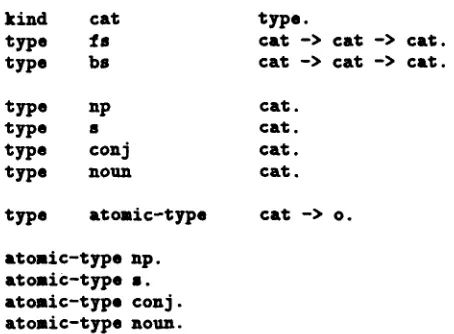
k i n d c a t t y p e f s
t y p e bs
t y p e np
type s type conj
t y p e noun
t y p e .
cat -> cat -> c a t . cat -> cat -> c a t .
c a t . c a t . c a t . c a t . t y p e a t o m i c - ~ y p e c a t -> o. a t o m i c - t y p e rip.
a t o m i c - t y p e s . a t o m i c - t y p e c o n j . a t o m i c - t y p e noun.
Figure 5: Implementation of the CCG category sys- tem
At this point a further/~-reduction is needed. Note however this is not at all the same problem of
writing a /~-reducer in Prolog. Instead it is a
simple matter of using the meta-level ~-reduction to eliminate ~-redexes to produce the final result (abe x \ ( f o u n d I h a r r y x)). We won't show the complete declaration of the/~-reducer, but the key clause is simply:
red (app (abe N) N) (N N).
Thus, using the abstract syntax capabilities of ~Prolog, we can have a direct implementation of the underlying linguistic formalism, in stark contrast to the first-order simulation shown in Figure 2.
4 I m p l e m e n t a t i o n o f C o o r d i n a t i o n A primary goal of abstract-syntax is to support re- cursion through abstractions with bound variables. This leads to the interpretation of a bound variable as a "scoped constant" - it acts like a constant that is not visible from the top of the term, but which becomes visible during the descent through the ab- straction. See (Miller, 1991) for a discussion of how this may be used for evaluation of functional pro- grams by "pushing" the evaluation through abstrac- tions to reduce redexes that are not at the top-level. This technique is also used in the fl-reducer briefly mentioned at the end of the previous section, and a similar technique will be used here to implement coordination by recursively descending through the two arguments to be coordinated.
[image:4.612.319.546.56.223.2]t y p e c o o r d
c a t - > tm - > tm - > tm - > o .
c o o r d ( f s • B) ( a b s It) ( a b s S) ( a b s T) "- p i x \ ( c o o r d B (~ x) (S x) (T x ) ) . c o o e d ( b e i B) ( a b e R) ( a b e S) ( a b e T) " -
p i x \ ( c o o r d B (R x) (S x) (T x ) ) . c o o r d B R S ( a n d ' E S) : - a t o m i c - t y p e B.
Figure 6: I m p l e m e n t a t i o n of coordination
to be constructors for forward and backward slash. For example, the C C G category for a transitive verb ( s \ n p ) / n p would be represented as ( f s np (bs np s ) ) . Also, the predicate a t o m i c - t y p e is declared to be true for the four atomic categories. This will be used in the implementation of coordination as a test for termination of the recursion.
T h e implementation of coordination crucially uses the capability of AProlog for universal quantification in the goal of a clause, p i is the meta-level operator for V, and Vz.M is written as p i x\l|. T h e oper- ational semantics for AProlog state t h a t p i x\G is provable if and only if [c/z]G is provable, where c is a new variable of the same type as z t h a t does not otherwise occur in the current signature. In other words, c is a scoped constant and the current signa-
ture gets expanded with c for the proof of [c/z]G.
Since e is m e a n t to be treated as a generic place- holder for any a r b i t r a r y z of the proper type, c must not appear in any terms instantiated for logic vari-
ables during the proof of [c/z]G. T h e significance of
this restriction will be illustrated shortly.
T h e code for coordination is shown in Figure 6. T h e four arguments to c o o e d are a category and three terms t h a t are the object-level LF rep- resentations of constituents of t h a t category. T h e last argument will result from the coordination of the second and third arguments. Consider again the earlier problematic example ( l a ) of coordina-
tion. Recall t h a t after john is type-raised, its LF
will be (abs p \ ( a p p p j o h n ' ) ) and similarly for bill. T h e y will b o t h have the category ( f s (bs np s)
s ) . Thus, to obtain the LF for John and Bill, the
following query would be made: ? - c o o r d ( f s (bs np s ) s)
( a b s p \ ( a p p p j o h n ' ) )
Cabs pkCapp p
bill'))
M.
This will m a t c h with the first clause for c o o r d , with • t instantiated to (be np s)
• B t o s
• It to ( p \ ( a p p p j o h n ' ) ) •
S
to(p\(app p b i l l ' ) )
• and T a logic variable waiting instantiation. Then, after the meta-level/~-reduction using the new scoped constant c, the following goal is called: ? - c o o r d s ( a p p ¢ j o h n ' ) (app c b i l l ' ) II. where II = (T c ) . Since s is an atomic type, the third c o o r d clause matches with
• B instantiated to s • R to (app c j o h n ' ) • S to ( a p p c b i l l ' )
• II to ( a n d ' ( a p p c j o h n ' ) ( a p p c b i l l ' ) ) Since I = (T c ) , higher-order unification is used by AProlog to instantiate T by extracting c from II with the result
T = x \ ( a n d ' (app x j o h n ' ) (app x b i l l ' ) ) and so H from the original query is
(abe x \ ( a n d ' (app •
john')
(app • b i l l ' ) ) ) Note t h a t since c is a scoped constant arising from the proof of an universal quantification, the instan- tiationT = x \ ( a n d ' (app
¢ john')
(app • b i l l ' ) ) is prohibited, along with the other extractions that do not remove c from the b o d y of the abstraction.This use of universal quantification to extract out c from a t e r m containing c in this case gives the same result as a direct implementation of the rule for coo- ordination of u n a r y functions (7a) would. However, this same process of recursive descent via scoped constants will work for any m e m b e r of the c o n j rule family. For example, the following query
? - c o o r d
( ~ s np ( b e np s ) )
Cabs o b j \ ( a b s s u b \ ( l i k e ' sub o b j ) ) ) ( a b s o b j \ ( a b s s u b \ ( h a t e ' sub o b j ) ) ) M.
14 = ( a b e x \ ( a b e x l \
( a n d ' ( l i k e ' x l x)
(hate'
x lx ) ) ) ) .
corresponds to rule (7b). Note also t h a t the use
of the same bound variable names o b j and sub
causes no difficulty since the use of scoped-constants, meta-level H-reduction, and higher-order unification is used to access and manipulate the inner terms. Also, whereas (Park, 1992) requires careful consider- ation of handling of determiners with coordination, here such sentences are handled just like any others.
For example, the sentence Mary gave every dog a
bone and some policeman a flower results in the LF 12.
(and'
( e x i s t s x\C(bone' x) Itlt ( f o r e 1 1 x l \ ( ( d o g ' x l )
>> ( g a v e ' a a x y ' x x l ) ) ) ) )
( e x i s t s x \ ( ( f l o v e r J x) 11 ( e x i s t u x l \ ( ( p o i i c e m a n ' x l )
IU~ ( g a v e ' =axy' x x l ) ) ) ) ) )
Thus, "generalized coordination", instead of being a family of separate rules, can be expressed as a sin- gle rule on recursive descent through logical forms. (Steedman, 1990) also discusses "generalized com- position", and it may well be that a similar imple- mentation is possible for that family of rules as well.
5
C o n c l u s i o n
We have shown how higher-order logic programming can be used to elegantly implement the semantic the- ory of CCG, including the previously difficult case of its handling of coordination constructs. The tech- niques used here should allow similar advantages for a variety of such theories.
An argument can be made that the approach taken here relies on a formalism that entails im- plementation issues that are more difficult than for the other solutions and inherently not as efficient. However, the implementation issues, although more complex, are also well-understood and it can be ex- pected that future work will bring further improve- ments. For example, it is a straightforward matter to transform the ,XProlog code into a logic called L~ (Miller, 1990) which requires only a restricted form of unification that is decidable in linear time and space. Also, the declarative nature of ~Prolog pro- grams opens up the possibility for applications of program transformations such as partial evaluation.
6 A c k n o w l e d g m e n t s
This work is supported by ARC) grant DAAL03-89- 0031, DARPA grant N00014-90-J-1863, and ARO grant DAAH04-94-G-0426. I would like to thank Aravind Joshi, Dale Miller, Jong Park, and Mark Steedman for valuable discussions and comments on earlier drafts.
R e f e r e n c e s
David Dowty. 1988. Type raising, functional com- position, and non-constituent conjunction. In Richard T. Oehrle, Emmon Bach, and Deirdre Wheeler, editors,
Categorial Grammars and Natu-
ral Language Structures.
Reidel, Dordrecht, pages 153-198.Gerald Gazdar. 1988. Applicability of indexed grammars to natural languages. In U. Reyle and C. Rohrer, editors,
Natural language parsing and
linguistic theories.
Reidel, Dordrecht, pages 69-94.Jerry R. Hobbs and Stuart M. Shieber. 1987. An al- gorithm for generating quantifier scopings.
Com-
putational Linguistics,
13:47-63.Einar Jowsey. 1990.
Constraining Montague Gram-
mar for Computational Applications.
PhD thesis, University of Edinburgh.Dale Miller. 1990. A logic programming language with lambda abstraction, function variables and simple unification. In P. Schroeder-Heister, ed- itor,
Eztensions of Logic Programming,
Lecture Notes in Artifical Intelligence, Springer-Verlag, 1990.Dale Miller. 1991. Abstract syntax and logic pro- gramming. In
Proceedings of the Second Rus-
sian Conference on Logic Programming,
Septem- ber 1991.Dale Miller and Gopalan Nadathur. 1986. Some uses of higher-order logic in computational linguis- tics. In
24th Annual Meeting of the Association
for Computational Linguistics,
pages 247-255. Dale Miller, Gopalan Nadathur, Frank Pfenning,Andre Scedrov. 1991. Uniform proofs as a foun- dation for logic programming. In
Annals of Pure
and Applied Logic,
51:125-157.Robert C. Moore. 1989. Unification-based seman- tic interpretation. In
27th Annual Meeting of the
Association for Computational Linguistics,
pages 33-41.Remo Pareschi. 1989.
Type-Driven Natural Lan-
guage Aanalysis.
PhD thesis, University of Edin- burgh.Jong C. Park. 1992. A unification-based semantic interpretation for coordinate constructs. In
80th
Annual Meeting of the Association for Computa-
tional Linguistics,
pages 209-215.Jong C. Park. 1995. Quantifier scope and con- stituency. In
33rd Annual Meeting of the Associa-
tion for Computational Linguistics
(this volume). Barbara Partee and Mats Rooth. 1983. General- ized conjunction and type ambiguity. In Rainer Banerle, Christoph Schwarze, and Arnim von Ste- chow, editors,Meaning, Use, and Interpretation
of Language.
W. de Gruyter, Berlin, pages 361- 383.Fernando C.N. Pereira. 1990. Semantic interpre- tation as higher-order deduction. In Jan van Eijck, editor,
Logics in AI: European Workshop
JELIA '90,
Lecture Notes in Artificial Intelligence number 478, pages 78-96. Springer-Verlag, Berlin, Germany.Fernando C.N. Pereira and Stuart M. Shieber. 1987.
1985. Distributed by the University of Chicago Press.
Frank Pfenning and Conal Elliot. 1988. Higher- order abstract syntax. In
Proceedings of the A CM-
SIGPLAN Conference on Programming Language
Design and Implementation,
1988.Mark J. Steedman. 1990. Gapping as constituent coordination. In
Linguistics and Philosophy
13, pages 207-263David Weir. 1988.
Characterizing Mildly Contezt-
sensitive Grammar Formalism.
CIS-88-74, PhD thesis, University of Pennsylvania.