this work, three brands of nuclear graphite for HTGR (i.e., HSM-SC, IG-11, and NBG-18) are oxidized under 873 and 1073 K in open air, and their weight loss curves are obtained. The acceleration of oxidizing rate is observed for both HSM-SC and IG-11, and is attributed to the large porosity increase during oxidation process. For HSM-SC, the porosity increase comes from preferential binder oxidation, and thus its binder quality shall be improved to obtain better oxidation resistance. Temperature effects on oxidation for HSM-SC are also studied, which shows that oxidizing gas tends to be exhausted at graphite surface at high temperature instead of penetrate into the interior of bulk.
[doi:10.2320/matertrans.MBW201107]
(Received November 28, 2011; Accepted March 26, 2012; Published May 25, 2012)
Keywords: nuclear graphite, oxidation behavior, porosity, thermo gravimetric analysis
1. Introduction
The nuclear accidents in Fukushima have convincingly shown that there is a strong need for safe and sustainable nuclear energy. New nuclear reactors should preferably be inherently safe to meet the publics’ concern about nuclear energy. The High Temperature Gas-cooled Reactor (HTGR), the forerunner of the Generation-IV Very High Temperature gas-cooled Reactor (VHTR) design, is considered to be a good option, as this reactor type can transfer all its decay heat to the environment without any need for active safety system and without any resulting damage to the nuclear fuel.
Graphite is the major material in core component of HTGR. Though the atmosphere is highly purified helium in HTGR, impurities still exist due to graphite outgassing and leakage in the heat-exchanger tube.1)Oxidizing gas may be tiny in quantity, but the corrosion could accumulate during the long term operation of reactor, which should not be ignored. Besides, when air ingress accident happens, the oxidizing gas brings severe damage to graphite, which rises core temperature, weakens structural integrity and releases toxic gas.2)
Thus the oxidation behavior of nuclear graphite is important when considering reactor safety. Previously, oxidation process of different graphite brands has been studied by Thermo Gravimetric Analysis (TGA) method, and Arrhenius plot has been applied to calculate their apparent activation energy, respectively.36)Guo et al.has developed
equations to simulate weight loss curve of MSG graphite between 933948 K and 10731123 K through polynomial regression method.7) Kim et al. studied the geometry effects on IG-110 graphite oxidation, and find out that the effect of sample shape can be considered as negligible for IG-110.8)
China has been designing its own nuclear graphite brands in recent years, and HSM-SC is a promising graphite brand provided by Rong Guang which may be able to be applied in
Chinese HTGR in the future. However, much study needs to be conducted before its real application. In this work, we focus on the effects of air-ingress accident on HSM-SC, and thus the oxidation behavior of HSM-SC in open air is evaluated. Two other brands of nuclear graphite, which already meet the demand of Chinese HTGR, are also oxidized under the same condition for comparison. They are IG-11, the nuclear graphite selected for the Chinese 10MW High Temperature gas-cooled Reactor (HTR-10), and NBG-18, the competitive nuclear graphite candidate offered for HTR-10 by SLG Group. Relationship between weight loss curve and porosity change is also studied in our work.
2. Experimental
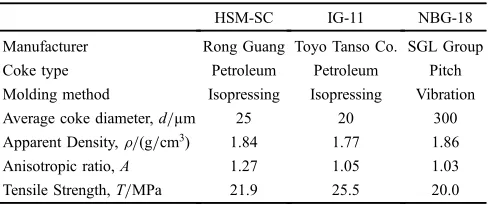
The basic information about the three brands of graphite is listed in Table 1. Graphite samples are cut into 10 mm© 10 mm©3 mm cubic pieces with one side polished for better surface morphology observation by Scanning Electron Microscopy (SEM).
[image:1.595.306.550.684.786.2]Samples are heated at 373 K in drying oven for 2 h before oxidized in tube furnace in open air. Internal diameter and length of the furnace is 44 mm and 1 m, respectively. Analytical balance with resolution of 0.1 mg is used to measure oxidation weight loss. Weight loss is weighed every 0.5 h by analytical balance.
Table 1 Characteristics of three nuclear graphite chosen for the present study.
HSM-SC IG-11 NBG-18
Manufacturer Rong Guang Toyo Tanso Co. SGL Group
Coke type Petroleum Petroleum Pitch
Molding method Isopressing Isopressing Vibration Average coke diameter,d/µm 25 20 300 Apparent Density,µ/(g/cm3) 1.84 1.77 1.86
Anisotropic ratio,A 1.27 1.05 1.03
Tensile Strength,T/MPa 21.9 25.5 20.0
Pore diameter distribution of graphite is measured by AutoPore IV 9500, which is a commercial mercury porosimetry produced by Micromeritics Instrument Corpo-ration with a measuring range between 30 nm15 µm. Porosimetry injects mercury into the open pores of graphite and thus calculates the total open pore volume by the volume of mercury injected. The pore diameter distribution of graphite can also be obtained, since the mercury injection pressure of porosimetry is slowly increased and bigger size pores arefilledfirst at lower injection pressure.
3. Results and Discussion
3.1 Oxidation behavior at 873 K
The three brands of graphite are oxidized in open air at 873 K, as shown in Fig. 1. From Fig. 1 we can see that NBG-18 shows the best oxidation resistance in air oxidation, while IG-11 is the worst of three. Note that the weight loss of the first 0.5 h seems erratically fast if the whole curve is taken into consideration. This may be due to the fact that graphite samples still retain sharp edges caused by machining at the beginning of oxidation, and these sharp edges are easier to react with air until they are later rounded by corrosion.
To better understand the oxidation behavior of these samples, the average oxidation rate R(t) between the oxidation time period of t and t+¦t is calculated through the following equation:
RðtÞ ¼mðtÞ mmð0ðtÞþtÞt
Where t is the oxidation time (in hours), and ¦t is 0.5 h here.m(t) is the graphite weight at timet(in grams), andm(0) represents the weight of unoxidized graphite.
The result of R(t) is plotted in Fig. 2, and as mentioned above, R(0) is meaningless since it is abnormally fast. Though the initial oxidation rates R(1.0) are quite similar between the three samples, IG-11 and HSM-SM perform obvious acceleration in oxidation rate during our experiment while NBG-18 almost maintains its initial rate all along the experiment time.
As a conclusion, HSM-SC has far better oxidation property in air at 873 K than IG-11, but is not as good as NBG-18. The oxidation rate of HSM-SC actually increases with oxidation time, although the increase is not as obvious as IG-11.
3.2 Effect of graphite porosity
Graphite is a typical porous material, and pore plays an important role in many aspects of graphite, such as mechanical, thermal and irradiation properties.911)Oxidation
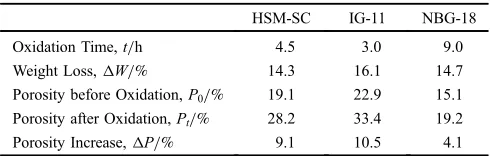
process also depends on graphite porosity. Using mercury porosimetry, the porosity before and after air oxidation is measured, and the change caused by oxidizing can be studied. By controlling oxidation time, the three brands of graphite are all oxidized to about 15%weight loss at 873 K. Thus, the differences in oxidation behavior between the three brands can also be compared under same level of weight loss. The porosity results are shown in Table 2. Their porosity is around 1523%.
Though the three samples are oxidized to similar weight loss around 15%, the porosity increase between original and oxidized samples are different among them. The porosity increase of both HSM-SC and IG-11 is much larger than that of NBG-18. This explains why the oxidizing rate of both HSM-SC and IG-11 accelerates remarkably while no such acceleration could be observed for NBG-18 in our experi-ment condition. Since bigger porosity means more gas penetrating through the bulk and bigger reaction surface for the graphite,12) the large change in porosity increases the
oxidation rate of HSM-SC and IG-11.
The detail of pore size distribution is also measured through mercury porosimetry, shown in Fig. 3. Pore size distribution before oxidation is found to be quite different among the three samples (Fig. 3(a)). HSM-SC and IG-11 mainly have small pores with diameter around 14 µm, while NBG-18 has no such sharp peak and only has a gradual rise around 25 µm. Compared to the other two brands, the pores in NBG-18 is large in size and small in quantity.
When oxidized to about 15% weight loss, HSM-SC
generates many small pores with diameter around 0.11 µm,
Fig. 1 Weight loss curve at 873 K for three graphite brands.
[image:2.595.64.267.64.216.2]Fig. 2 Average oxidation rate in every 0.5 h at 873 K.
Table 2 Graphite porosity before and after 873 K oxidation.
HSM-SC IG-11 NBG-18
Oxidation Time,t/h 4.5 3.0 9.0
Weight Loss,¦W/% 14.3 16.1 14.7
Porosity before Oxidation,P0/% 19.1 22.9 15.1 Porosity after Oxidation,Pt/% 28.2 33.4 19.2
[image:2.595.318.529.72.221.2] [image:2.595.305.550.276.354.2]whereas IG-11 has pores enlarged to up to 200 µm in diameter (Figs. 3(b) and 3(c)). For NBG-18, pores are also enlarged in size but the increase in pore diameter is not so big, thus the change in total porosity is also smaller.
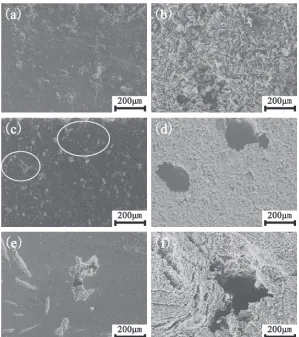
The SEM morphology pictures of the same region before and after oxidation confirm what we learn from mercury porosimetry, shown in Fig. 4. IG-11 generates huge pores with diameter of nearly 200 µm after oxidation, making porosity greatly increases (Figs. 4(c) and 4(d)). HSM-SC has no such big pores after oxidation, but the surface is extremely rough with small pores propagating almost everywhere (Figs. 4(a) and 4(b)). The diameter of these small pores in HSM-SC is about several microns or less, which matches the result of mercury porosimetry. But for NBG-18, the surface is not as rough as HSM-SC. The pore size is big after oxidation indeed, but the pore volume increase is much smaller than that of IG-11, because pores in NBG-18 before oxidation are already quite large.
Note that many coke particles have been revealed from the interior in HSM-SC after oxidation (Fig. 4(b)). This is due to preferential binder oxidation of nuclear graphite, which has been previously observed by Lim et al.13)Moormann et al.
discovered activation energy for coke and binder of HTGR fuel element matrix graphite to be 166 and 123 kJ/mol respectively,14) which also confirms their differences in
oxidation rate. In our experiment, the phenomenon of preferential binder oxidation is much severe in HSM-SC than in other two brands. This generates many small size pores in HSM-SC and becomes the main cause of its porosity
increase and oxidation acceleration. Thus the quality of binder should be improved to obtain better oxidation resistance for HSM-SC.
3.3 Effect of oxidizing temperature
The dependence of HSM-SC oxidation on temperature is also studied. HSM-SC is oxidized to about 15% weight loss in open air at 873 and 1073 K respectively, and their porosity change is shown in Table 3. Though oxidized to similar weight loss, the graphite oxidized at lower temperature has bigger porosity increase. Since outer surface corrosion introduces much less porosity increase than interior surface corrosion, it is clear that oxidation is more likely to happen in the interior of HSM-SC bulk at lower temperature. The result is in parallel with the theory that due to the faster chemical reaction rate at higher temperature, oxidizing gas has less chance to penetrate the bulk and would prefer corroding the bulk surface to the bulk interior.15,16)
[image:3.595.103.492.72.397.2]Fig. 3 Pore distribution before and after oxidation at 873 K (³15%weight loss).
Table 3 Porosity of HSM-SC oxidized to about 15%weight loss.
873 K 1073 K
Oxidation Time,t/h 4.5 0.25
Weight Loss,¦W/% 14.3 15.2
Porosity before Oxidation,P0/% 19.1 Porosity after Oxidation,Pt/% 28.2 24.9
[image:3.595.307.549.456.534.2]Detailed pore size change is given by pore size distribution in Fig. 5. Under both temperatures the tiny pores around 10 nm are enlarged to diameter of 0.11 µm, indicating that they are caused by similar oxidation mechanism, the preferential binder oxidation as discussed above. But much more pores are enlarged at 873 K in the HSM-SC bulk, which results in larger porosity increase.
4. Conclusion
Oxidation behavior of HSM-SC is studied at 873 and 1073 K in open air. Much less pores are enlarged from about
10 to 200 nm in diameter at higher temperature, which shows oxidizing gas tends to be exhausted at graphite surface at high temperature.
The oxidation resistance of HSM-SC at 873 K is better than that of IG-11, but worse than NBG-18. The acceleration of oxidizing rate is observed for both HSM-SC and IG-11, which is caused by large porosity increase during oxidation. The large porosity increase of HSM-SC comes from preferential binder oxidation, whereas that of IG-11 is introduced by the generation of huge pores with diameter exceeding 100 µm. Binder quality shall be improved to obtain better oxidation resistance for HSM-SC.
Fig. 4 Surface morphology of graphite oxidized at 873 K (³15%weight loss). (a) HSM-SC, (c) IG-11, (e) NBG-18 before oxidation; (b) HSM-SC, (d) IG-11, (f ) NBG-18 after oxidation.
[image:4.595.149.448.68.405.2] [image:4.595.87.511.452.605.2]
3) C. I. Contescu, S. Azad, D. Miller, M. J. Lance, F. S. Baker and T. D. Burchell:J. Nucl. Mater.381(2008) 1524.
4) S. H. Chi and G. C. Kim:J. Nucl. Mater.381(2008) 914. 5) L. Xiaowei, R. Jean-Charles and Y. Suyuan: Nucl. Eng. Des. 227
(2004) 273280.
14) R. Moormann, H. K. Hinssen, A. K. Krussenberg, B. Stauch and C. H. Wu:J. Nucl. Mater.212(1994) 11781182.