Dynamic Mechanical Behaviour of Polymer
Bonded Nd
Fe
B Composite Materials
Aleksandar Gruji
ć
1,+, Mirko Stijepovi
ć
2,3, Jasna Staji
ć
-Tro
š
i
ć
1, Slavi
š
a Puti
ć
2,
Dragutin Nedeljkovi
ć
1, Aleksandar Staj
č
i
ć
1and Radoslav Aleksi
ć
21Institute of Chemistry, Technology and Metallurgy, University of Belgrade, Njegoševa 12, 11000 Belgrade, Serbia 2Faculty of Technology and Metallurgy, University of Belgrade, Karnegijeva 4, 11000 Belgrade, Serbia
3Department of Chemical Engineering, Texas A&M University at Qatar, Education City P. O. Box 23874, Doha, Qatar
Magnetic composite materials with varied content of NdFeB particles in epoxy matrix are examined from a dynamic mechanical perspective. Structural, viscoelastic and magnetic properties of composites have been observed using Scanning Electron Microscope (SEM), Dynamic Mechanical Analysis (DMA) and Super Quantum Interference Device (SQUID) magnetometer, respectively. Experimental results show that magnetic properties and corresponding dynamic mechanical behaviour depend on packing density. Also, results observed by predictive mathematical models suggest that maximal packing factor has a direct impact on elastic behaviour of composites.
[doi:10.2320/matertrans.M2011218]
(Received July 19, 2011; Accepted October 31, 2011; Published January 25, 2012)
Keywords: neodymiumironboron, composite materials, dynamic mechanical analysis (DMA), super quantum interference device (SQUID), epoxy resin
1. Introduction
Polymer bonded NdFeB magnetic materials have a very important role as functional components within the wider spectra of contemporary devices in different industrial and consumer sectors.18) Advantages of the using bonded
composite materials include their simple technology, possi-bility of forming their final properties, low manufacturing costs because of no costlyfinishing and lowering of material losses resulting from the possibility of forming any shape.7)
The amount of NdFeB powder in the bonded magnet plays a crucial role in determining magnetic properties. A higher content of NdFeB powder usually results in a higher remanence magnetization (Br) and maximum energy
product (BH)max. Therefore, it is desirable from the magnetic
perspectives. However, a higher content of magnetic filler may change the rheology of polymer melt during the process, and subsequently, impact the mechanical strength of bonded magnets. Nevertheless, the balance between magnetic proper-ties and corresponding dynamic mechanical behaviour is an important issue for bonded magnet applications.8) The
advantage of DMA technique compared to the standard mechanical test methods is demonstrated. Predictive mathe-matical models are employed to evaluate dynamic mechan-ical behaviour of composites. Results obtained with the proposed mathematical models are in good agreement with experimental values.
2. Experimental
The rapid quenched magnetic powder with a particle size between 74 and 177 µm is used for composites preparation The magnetic properties of the Nd(Fe,Co)B were: Br=
0.82 T, Hcb=477.5 kA/m, Hcj=692.3 kA/m, (BH)max=
104.2 kJ/m3. The chemical composition of the starting
magnet alloy is Nd: 2125 mass%, Co: 35 mass%, B
<1.5 mass%, Zr: 35 mass%, Fe: balance. The thermosetting epoxy system that is a combination of liquid mixture of Bisphenol A and Bisphenol F resins and cross linking agent (hardener) which cures fully at room temperature is used as a polymer matrix. The cured pure epoxy resin has tensile strength³58 MPa, elongation³2.8%, com-pression strength³96 MPa,flexural strength³78 MPa and density³1.2 g/cm3.
Composites with varied NdFeB particle content in the epoxy matrix from 15 to 95 mass% are produced by compression moulding under a pressure of 4 MPa at room temperature, using a lab scale compression moulding press. The production process is carried out under conditions that avoid air bubbles in the mixture. No external magneticfield is used during the cure.
The structure and morphology of NdFeB powder and fracture surfaces of composites incurred during the tensile tests are observed by JEOL JSM-5800 Scanning Electron Microscope (SEM), with an accelerating voltage of 20 kV. After tensile tests at room temperature, fracture sample surfaces are sputtered with gold using a POLARON SC 502 sputter coater for enhanced conductivity. A TA Instruments DMA Q800 is used to obtain dynamic mechanical data for investigated magnetic composites and pure epoxy samples. These samples are tested using a three-point bend clamp with a 20 mm span width and rectangular-edge probe, at a frequency of 1 Hz. Testing is done over a temperature range from 25 to 100°C with a temperature ramp of 3°C/min. Tensile and flexural tests are performed under ambient temperature conditions using Schenck TREBEL RM100, a universal material testing machine. The macroscopic mag-netic properties were determined using Superconducting Quantum Interference Device (SQUID) magnetometer. During ambient temperature (300 K) measurements, the magneticfield strength®oHis varied from¹5 to 5 T. Sample
a magnetic moment from 10¹11 up to 103Am2 can be
measured with an accuracy of 0.1%.
3. Results and Discussion
3.1 Dynamic mechanical properties
Due to the viscoelastic nature of polymer composites, their dynamic and thermal behaviours significantly depend on strain, frequency and temperature. When comparing material properties, a material with a higher storage modulus (E¤) would be stiffer and harder to deform than one with a lower E¤. Besides the elastic component, a material also has a viscous component called the loss modulus (E¤¤). This viscous component relates to the materials ability to lose energy. The material’s tan¤designates the material’s ratio of viscous to elastic components (E¤¤/E¤) and it is sometimes called the materials damping ability.9,10) The dynamic
mechanical properties of the pure epoxy polymer and the NdFeB/epoxy magnetic composite materials are studied as a function of temperature, from the glassy to the rubbery state, as reported elsewhere.11,12) The results presented in Fig. 1(a) show a considerable improvement in the storage modulus (elastic component) caused by the presence of the NdFeB magneticfiller.
In the glassy region (around 25°C), the total dynamic modulus of composites is directly influenced by the modulus of the pure polymer, modulus of thefiller, the concentrations of both, as well as the adhesion factor between the filler and polymer.13,14)At the other end of temperature range, the
storage modulus decreases with the temperature to the lower values in the rubbery state.15)
DMA results presented in Fig. 1(b) show that a composite material with a higher tan¤ (µ0.7 for composite with 15 mass%of NdFeBfiller) has a higher viscous percentage than one with a lower tan¤ (µ 0.6 for composite with 95 mass% of NdFeB filler). Therefore the material would be more likely to absorb a vibration or impact, and disperse it throughout the material without failure. Glass transition temperatures (Tg) obtained from tan¤ curves (peak point
temperatures) were found within the same temperature region (around 54°C). This could be a consequence of the use of NdFeB powders with similar particle sizes distribution and without particle surface modification (uncoated).16)
3.2 Mechanical tests
The values of storage modulus under ambient conditions,
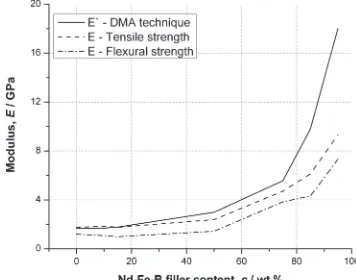
observed by DMA were compared to the elastic modulus obtained by the tensile andflexural tests (Fig. 2). In contrast to Deng, S. et al.15) mechanical properties at temperatures
higher than ambient are not compared with DMA results observed using two different clamps. It seems that observing the elastic modulus of composites by tensile, flexural and DMA tests at room temperature in the present study provides a better understanding to the increasing trend of elastic components of materials with increasing NdFeB filler content in the polymer matrix.
The modulus of elasticity is a very important parameter for analysis of the composite materials behaviour under discontinuous load conditions. The elastic modulus values, obtained by tensile and flexural tests, upswing with an increasing amount of NdFeB powder from 50 mass% achieve 9.2 and 7.1 GPa, respectively. Within the narrow region and up to 20 mass% content of NdFeB, where the modulus of elasticity is practically constant according to tensile andflexural tests, dynamic-mechanical analysis could be applied to acquire additional information’s related to the mechanical behaviour about transitions in polymer composites.17)
Modules of elasticity obtained by three presented tests are increased with higher quantities of magnetic filler (Fig. 2). This is crucial in analysis of possible uses of the investigated magnetic composite materials as functional material. This means that materials with higher amounts of NdFeBfiller, subject to equal stress levels (ballast), tolerate 2 to 3.5 times lower deformation.
(a) (b)
Fig. 1 DMA curves of (a) storage modulusE¤and (b) Tan¤, for the pure epoxy resin and the composites with different NdFeBfiller content versus temperature.
[image:2.595.136.461.68.192.2] [image:2.595.336.514.241.381.2]3.3 Mathematical prediction of NdFeB/epoxy compo-site behaviour
The strong influence of relatively small amounts offiller particles on the dynamic mechanical properties of polymers has significantly contributed to increased use of polymer materials in many commercial applications.18) The incorpo-ration offiller particles is known to increase the stiffness of the material and alter time dependent aspects of material behaviour such as hysteresis and stress relaxation. Even under strains sufficiently large for the structure to have been eliminated, the storage modulus is greater than that of the pure polymer, and greater than the amount which can be predicted due to hydrodynamic interaction of the filler particles.
Ideally, in an attempt to reduce laboratory costs, one would like to make a prediction of a new material’s behaviour using numerical simulation procedures, with the primary goal being to accelerate trial and error experimental testing.
Analytical models are easy to apply and require only properties of individual constituents of composite and their fraction. Proposed analytical models are tested versus experimental data as illustrated in following section. Some of the applied models are in good agreement with experimental data, whilst others deviate significantly.
There have been several attempts to derive formulas giving the apparent modulus according to a dispersion of particles in polymer. The earliest of these attempts was by Smallwood using the analogy to Einstain’s viscosity equation.19)
Smallwood’s estimate is only good at very low filler concentrations. A number of attempts have been made to incorporate interactions between neighbouring particles to allow prediction for higher volume fractions. Most of these models add one or more terms to a polynomial series expansion. One of the most cited model of this class is the GuthGold.20) Later Guth extended the GuthGold model
to include the impact of particle shape on properties. Guth introduced a shape factorf (ratio of diameter to width of particle) and proposed a new equation.21) Budiansky developed a model, for the special case of rigid particles in an incompressible matrix22) while the Ponte Castaneda has proposed a different self-consistent estimate for rigid particles in a neo-Hookean matrix.23) Later Govindjee and Simo proposed the novel model, for the case of rigid particles in a neo-Hookean matrix.24)In addition, it is worth to mention
the empirical formula suggested by Brinkmann.25)
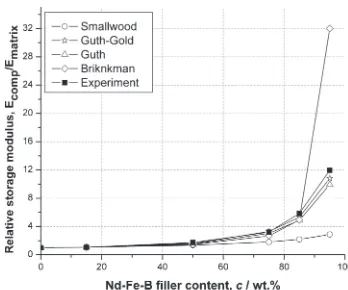
Major characteristics of all aforementioned theoretical models are: they neglect the impact of filler properties and assume that the medium wets thefiller particles, and they do not chemically react with the filler surface. The experimen-tally obtained values of storage modulus are compared with analytical models discussed above and presented in Fig. 3.
Predictions of models proposed by Budiansky, Ponte Castaneda and Govindjee-Simo give inadequate estimation so they are not included in Fig. 3. From Fig. 3 one may notice that all models included in analysis give very good predictions of storage modulus towards lower particles concentrations (till 50 mass%). This suggests that within low concentration ranges, the interactions between neigh-bouring particles have a very low intensity. At higher concentrations, the interactions become high intensity which is the main reason for the significant deviation of Smallwood’s model from experimental results. Brinkman’s model gives good predictions at high concentrations, but at very high concentrations of particles, it extensively over-predicts the storage modulus. The Guth and GuthGold models are in very good agreement with experimental results. The explanation for this behaviour lies in the fact that both models take into consideration interactions between neigh-bouring particles.
In contradiction to the aforementioned explicit models, Mori Tanaka model takes into consideration the impact of the filler properties and particle arrangement on composite properties.
E0
comp¼E0matrix
1þ 75¹m 810¹m
EP=E0matrix1 EP=E0matrixþ
75¹m
810¹m
VP
1 EP=E
0
matrix1
EP=E0matrixþ
75¹m
810¹m
1þ
1ºmax
º2 max
VP
ð1Þ
Equation (1) shows that storage modulus of composites depends on components storage modulus (E0matrix, E0P), Poisson’s ratio of polymer matrix (¹m), volume fraction of
filler (VP) and maximum packing factor (ºmax).
Storage moduli of components have a constant value for specific temperature as well as Poisson’s ratio. Therefore, the
only variable is maximum packing factor. In original MT model developed for one-dimensional spherical particles, maximal packing factor is assumed to be constant value and independent of particle size and distribution.26) Later,
Kwon et al. extended MT model to multidimensional spherical particles.27) This model considers that maximum
[image:3.595.338.512.68.213.2]packing factor is dependant on particle size and particle distribution.
In order to apply Kwonet al.model,27)irregular plate like
particles are approximated with multi-dimensional spherical particles using equivalent diameters (Deq) defined as follows:
Vp¼Apt¼1
6D
3
eq³ ð2Þ
Surface area (Ap) and thickness (t) of irregular plate-like
particles are determined from SEM micrographs by image analysis using Image Pro Plus software.28)The data obtained from image analysis are based on the shape and size of elements observed in the pictures. Application of the method is described by Veljovicet al.29)and Bajatet al.30)
Volume (Vp) and equivalent diameter (Deq) are calculated
applying eq. (2). The median equivalent diameters of particles are estimated from equivalent diameters distribution, as shown in Fig. 4(b).
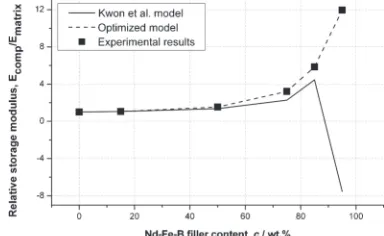
The results obtained by experiment and mathematical model developed by Kwon et al. are presented in Fig. 5 shows that values predicted by Kwon et al.model forfiller content less than 50 mass% are tracking the trend of experimental curve. Therefore, the constant value of packing factor does not have a huge impact on the estimated values of the modulus. As the content of filler rises, the deviation between the trends becomes more obvious. For the NdFeB content higher than 85 mass% model shows significant deviation, which is probably a consequence of a constant maximal packing factor value of 0.633.
According to aforementioned, it seems that maximum packing factor depends onfiller content. In order to prove this assumption maximum packing factor is evaluated for differ-ent contdiffer-ent of NdFeB filler by minimizing deviation between model and experimental values [eq. (3)].
min ¼XðE 0exp
compE0compmodelÞ2 E0exp
comp
ð3Þ
Evaluated modulus values (Fig. 5) for optimized maximal packing factors (Table 1) are in excellent match with experimental results. Obtained values of packing factor are within realistic range from 0 to 1.
Analyzing these results, one can conclude that there is a strong relationship between maximal packing factor and structural properties of composites. This relationship may be explained by introducing the packing density into the analysis. Optimal process parameters, particle distribution,
particle shape and size, packing density, and good adhesion between NdFeB and a polymer matrix, are all essential for microstructure, stiffness and magnetic properties of thefinal composite material.31)The packing density can be increased
by mixing powder fractions of different particle size and size distribution. The optimized powder mixture has small particlesfilling the inter-particle volume of packing of larger particles. Generally speaking, the plate-like particles would result in higher packing density under the optimal com-pression conditions.32,33) SEM micrographs of composites fracture surface in Fig. 6 clearly illustrate a packing density for different NdFeB content.
Although NdFeB particles are of variable size and shape, they seem to be attached rather well to the matrix. According to SEM micrographs [Figs. 6(a)6(c)], it is obvious that packing density increases with rising NdFe B filler content. For highly filler bonded magnets pressure has direct influence on structure and magnetic properties. According to Zhang et al.,32)pressure higher than 620 MPa
could cause structural damages of composite resulting in Fig. 4 (a) SEM micrograph and (b) equivalent diameters distribution of NdFeB particles.
[image:4.595.146.448.71.193.2]Fig. 5 Storage modulus obtained by: experiment, Kwonet al.model and optimized MT model.
Table 1 Maximal packing factor for different content of NdFeBfiller.
NdFeB, c/mass%
Maximal packing factor,¯max
Optimized MT model Kwonet al.model
15 0.2997
0.6332
50 0.3235
75 0.4539
85 0.5746
[image:4.595.329.521.240.358.2] [image:4.595.305.550.421.521.2]downswing of mechanical (magnetic) properties. Conversely, pressure has a slight or no impact on pure epoxy sample and composites with low filler content. In order to determine comparative experimental results, composites with a constant volume, but different particle to epoxy matrix ratio are prepared at constant pressure.
According to the results obtained, packing density and maximal packing factor rise with increasing content of particles. This infers that a strong relationship between these two packing factors exist for composites with irregular plate-like particles.
3.4 Magnetic properties
Magnetic properties of composite materials (bonded magnets) are affected by the magnetic properties of the magnetic powder and weight (volume) ratio of the powder. It is known that bonded magnets have inferior magnetic characteristics compared to magnetic material obtained by convectional methods (sintering for example), because in the bonded technology can not be achieved the maximal density of magnetic powder.32)One of the most important
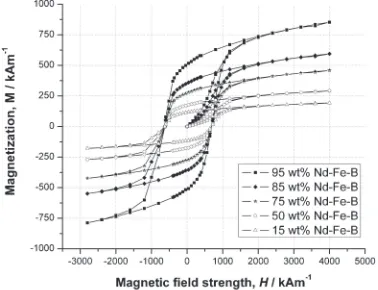
character-istics of the used type of NdFeB rare-earth magnetic material is the high remanence and coercivity values which have a direct influence on high values of maximal energy product.34) The results of magnetic measurements i.e. complete hysteresis loops for bonded NdFeB/epoxy type magnets with different contents of functional magnetic particles are presented in Fig. 7. It is obvious that the largest hysteresis loop correspond to the magnetic composite with the highest amount of magnetic component.
Based on these results, corresponding B-H diagrams are constructed, and the changes of remanence (Br), coercivity
(Hcb) and maximal energy product (BHmax) with an
increas-ing content of NdFeB in the epoxy matrix are taken and presented in Table 2.
The presented results show an increasing trend for three magnetic parameters with increasing amounts of NdFeB particles in the epoxy matrix. For example, the maximal energy product for composite with 95 mass% NdFeB is around 8 MGOe, which is two times higher than for the composite with the 85 mass%NdFeB case. For composites with NdFeB content higher than 75 mass%, (BH)max
rapidly increases i.e. for the highly filled composites even a small addition of magnetic medium can have a strong influence on the magnetic properties of bonded magnets. Also, the maximum energy product (BH)max of NdFeB
bonded magnets can be simulated using a mathematical model. Moreover, choosing appropriate parameters for the magnetic texture and the magnetic coupling between micro-grains can increase the value of (BH)max.35,36)
The comparison of magnetic and dynamic mechanical properties is illustrated in Fig. 8. Due to fact that magnetic and dynamic mechanical properties show the same trend with filler content enhancement, it can be concluded that there is a strong relationship between these properties.
(a) (b) (c)
Fig. 6 SEM micrographs of composites with (a) 95 mass%, (b) 50 mass%and (c) 20 mass%of NdFeBfiller (NdFeB particles are shown as light grey and the epoxy matrix is shown as dark grey colour).
[image:5.595.135.461.70.164.2]Fig. 7 Hysteresis loops of magnetic composites.
Table 2 Magnetic and dynamic mechanical properties of composites.
NdFeB,
c/mass% Br/T Hcb/kA·m
¹1 (BH)
max/kJ·m¹3
15 0.14 111.4 3.2
50 0.23 159.2 8.0
75 0.35 238.7 19.1
85 0.45 302.4 34.2
95 0.64 382.0 62.9
[image:5.595.75.264.213.358.2] [image:5.595.307.544.223.488.2]4. Conclusion
The results of this study show that addition of plate-like NdFeB particles to the polymer affects the rheological properties the polymer matrix via internal structural changes, and subsequently impacts the dynamic mechanical strength of bonded magnets.
DMA data show that the value of storage modulus amplifies in glassy, as well as in rubbery state, as the concentration of filler in composite rises. The tensile and flexural tests at ambient temperature show enhancement of modulus of elasticity with quantity of magnetic filler, which is a crucial parameter for analyzing of composite materials behaviour. Information extracted from tensile and flexural tests are consistent with results evaluated by DMA. Introduction of equivalent diameters distribution and con-sequently set of maximal packing factor values have a direct impact on the results in wide range of NdFeBfiller content. After optimization, the widely used Mori Tanaka mathemat-ical model show excellent agreement with experimental results and could be used as a potential model for further predictions of dynamic mechanical behaviour.
As expected, magnetic properties are drastically improved with a higher content of NdFeB magnetic particles, especially for highlyfilled composites. These results provide information about the NdFeB/epoxy composites which could be of importance in cases where the relatively brittle metallic permanent magnets are not useable.
Considering the increasing interest in polymer composites and advanced analytical tools, the present study provides a useful basis for future experiments and theory development for multifunctional components and commercially important polymer bonded magnets.
Acknowledgement
The authors are grateful to Ms Sabla Alnouri from Texas A&M University at Qatar for the assistance during the research activities. This work is supported by Ministry of Education and Science, Republic of Serbia, under projects TR 34011 and III 45019.
REFERENCES
1) K. Hono and D. H. Ping:Mater. Sci. Eng. A304306(2001) 8187.
2) Y. Matsuura:J. Magn. Magn. Mater.303(2006) 344347.
3) D. N. Brown, Z. Chen, P. Guschl and P. Campbell:J. Magn. Magn. Mater.303(2006) e371e374.
4) J. Li, Y. Liu, S. J. Gao, M. Li, Y. Q. Wang and M. J. Tu:J. Magn.
Magn. Mater.299(2006) 195204.
5) T. S. Chin:J. Magn. Magn. Mater.209(2000) 7579.
6) O. Gutfleisch, M. A. Willard, E. Brück, C. H. Chen, S. G. Sankar and J. P. Liu:Adv. Mater.23(2011) 821842.
7) L. A. Dobrzanski, M. Drak and B. Ziebowicz: J. Mater. Process. Technol.191(2007) 352355.
8) M. G. Garrell, B. M. Ma, A. J. Shih, E. Lara-Curzio and R. O. Scattergood:Mater. Sci. Eng. A359(2003) 375383.
9) K. P. Menard:Dynamic Mechanical Analysis: A Practical Introduction, (CRC Press LLC, Florida, 1999).
10) J. D. Ferry:Viscoelastic Properties of Polymers(3rd edition), (John Wiley & Sons, Inc., New York, 1980).
11) A. S. Grujić, N. L. Lazić, N. M. Talijan, V. Spasojević, J. T. Stajić -Trošić, V. R.Ćosovićand R. Aleksić: Acta Physiol. Pol. A117(2010) 859863.
12) A. Grujić, V.Ćosović, J. Stajić-Trošić, N. Talijan, V. Spasojević, N. Lazićand R. Aleksić: Proc. 21st Workshop on Rare-Earth Permanent Magnets and their Applications, ed. by Spomenka Kobe and Paul McGuiness, (Jožef Stefan Institute, Ljubljana, 2010) pp. 213216. 13) A. R. Payne:Dynamic Properties of Filler-Loaded Rubbers,
Reinforce-ment of Elastomers, Kraus G., (Interscience Publishers, a division of John Wiley & Sons, USA, 1965) pp. 69123.
14) M. J. Wang:Rubber Chem. Technol.72(1999) 430448.
15) S. Deng, M. Hou and L. Ye:Polym. Test.26(2007) 803813.
16) J. U. Otaigbe, H. S. Kim and J. Xiao:Polym. Compos.20(1999) 697 704.
17) T. Maity, B. C. Samanta, S. Dalai and A. K. Banthia:Mater. Sci. Eng. A
464(2007) 3846.
18) J. S. Bergstrom and M. C. Boyce:Rubber Chem. Technol.72(1999) 633656.
19) J. P. Donnet:Rubber Chem. Technol.71(1998) 323341.
20) E. Guth and O. Gold: Phys. Rev.53(1938) 322. 21) E. Guth:J. Appl. Phys.16(1945) 2025.
22) B. Budiansky:J. Mech. Phys. Solids13(1965) 223227.
23) P. Ponte Castaneda:Proc. R. Soc. London Ser. A422(1989) 147171.
24) S. Govindjee and J. C. Simo:J. Mech. Phys. Solids39(1991) 87112.
25) H. C. Brinkman:J. Chem. Phys.20(1952) 571.
26) T. Mori and K. Tanaka:Acta Metal.21(1973) 571574.
27) S. C. Kwon, T. Adachi, W. Araki and A. Yamaji:Acta Mater.54(2006) 33693374.
28) http://www.mediacy.com
29) Dj. Veljovic, R. Jancic-Hajneman, I. Balac, B. Jokic, S. Putic, R. Petrovic and Dj. Janackovic:Ceram. Int.37(2011) 471479.
30) J. B. Bajat, I. Milosev, Z. Jovanovic, R. M. Jancic-Heinemann, M. Dimitrijevic and V. B. Miskovic-Stankovic: Corros. Sci. 52 (2010) 10601069.
31) P. C. Guschl, H. S. Kim and J. U. Otaigbe:J. Appl. Polym. Sci.83
(2002) 10911102.
32) X. H. Zhang, W. H. Xiong, Y. F. Li and N. Song:Mater. Design30
(2009) 13861390.
33) D. Rodrigues, G. V. Concilio and F. G. Landgraf: Proc. 14th International Workshop Rare-Earth Magnets and Their Applications, (World Scientific, Sao Paulo, Brazil, 1996) Vol. 1, pp. 580589. 34) O. Gutfleisch:J. Phys. D Appl. Phys.33(2000) R157R172.
35) N. V. Vuong, N. V. Khanh and D. M. Thuy:Phys. B327(2003) 349 351.
36) J. Xiao, J. U. Otaigbe and D. C. Jiles: J. Magn. Magn. Mater.218