Compositional-ly Derived Representations of
Morphologically Complex Words in Distributional Semantics
Angeliki Lazaridou and Marco Marelli and Roberto Zamparelli and Marco Baroni
Center for Mind/Brain Sciences (University of Trento, Italy)
Abstract
Speakers of a language can construct an unlimited number of new words through morphological derivation. This is a major cause of data sparseness for corpus-based approaches to lexical semantics, such as distributional semantic models of word meaning. We adapt compositional meth-ods originally developed for phrases to the task of deriving the distributional meaning of morphologically complex words from their parts. Semantic representations con-structed in this way beat a strong baseline and can be of higher quality than represen-tations directly constructed from corpus data. Our results constitute a novel evalua-tion of the proposed composievalua-tion methods, in which thefull additive model achieves the best performance, and demonstrate the usefulness of a compositional morphology component in distributional semantics. 1 Introduction
Effective ways to represent word meaning are needed in many branches of natural language pro-cessing. In the last decades, corpus-based meth-ods have achieved some degree of success in mod-eling lexical semantics. Distributional semantic models (DSMs) in particular represent the mean-ing of a word by a vector, the dimensions of which encode corpus-extracted co-occurrence statistics, under the assumption that words that are semanti-cally similar will occur in similar contexts (Turney and Pantel, 2010). Reliable distributional vectors can only be extracted for words that occur in many contexts in the corpus. Not surprisingly, there is a strong correlation between word frequency and vector quality (Bullinaria and Levy, 2007), and since most words occur only once even in very large corpora (Baroni, 2009), DSMs suffer data sparseness.
While word rarity has many sources, one of the most common and systematic ones is the high pro-ductivity of morphological derivation processes, whereby an unlimited number of new words can be constructed by adding affixes to existing stems (Baayen, 2005; Bauer, 2001; Plag, 1999).1 For
example, in the multi-billion-word corpus we in-troduce below, perfectly reasonable derived forms such aslexicalizableoraffixlessnever occur. Even without considering the theoretically infinite num-ber of possible derived nonce words, and restrict-ing ourselves instead to words that are already listed in dictionaries, complex forms cover a high portion of the lexicon. For example, morphologi-cally complex forms account for 55% of the lem-mas in the CELEX English database (see Section 4.1 below). In most of these cases (80% according to our corpus) the stem is more frequent than the complex form (e.g., the stembuildoccurs 15 times more often than the derived formrebuild, and the latter is certainly not an unusual derived form).
DSMs ignore derivational morphology alto-gether. Consequently, they cannot provide mean-ing representations for new derived forms, nor can they harness the systematic relation existing be-tween stems and derivations (any English speaker can infer that torebuildis tobuild again, whether they are familiar with the prefixed form or not) in order to mitigate derived-form sparseness prob-lems. A simple way to handle derivational
mor-1Morphological derivation constructs new words (in the sense of lemmas) from existing lexical items ( re-source+ful→resourceful). In this work, we do not treat in-flectionalmorphology, pertaining to affixes that encode gram-matical features such as number or tense (dog+s). We use morphemefor any component of a word (resourceand -ful are both morphemes). We usestemfor the lexical item that constitutes the base of derivation (resource) andaffix( pre-fixorsuffix) for the element attached to the stem to derive the new form (-ful). In English, stems are typically indepen-dent words, affixesboundmorphemes, i.e., they cannot stand alone. Note that a stem can in turn be morphologically de-rived, e.g.,point+lessinpointless+ly. Finally, we use mor-phologically complexas synonymous withderived.
phology would be to identify the stem of rare de-rived words and use its distributional vector as a proxy to derived-form meaning.2 The meaning of
rebuild is not that far from that of build, so the latter might provide a reasonable surrogate. Still, something is clearly lost (if the author of a text felt the need to use the derived form, the stem was not fully appropriate), and sometimes the jump in meaning can be quite dramatic (resourcelessand
resourcemean very different things!).
In the past few years there has been much in-terest in how DSMs can scale up to represent the meaning of larger chunks of text such as phrases or even sentences. Trying to represent the mean-ing of arbitrarily long constructions by directly collecting co-occurrence statistics is obviously in-effective and thus methods have been developed to derive the meaning of larger constructions as a function of the meaning of their constituents (Ba-roni and Zamparelli, 2010; Coecke et al., 2010; Mitchell and Lapata, 2008; Mitchell and Lapata, 2010; Socher et al., 2012). Compositional distri-butional semantic models (cDSMs) of word units aim at handling, compositionally, the high produc-tivity of phrases and consequent data sparseness. It is natural to hypothesize that the same methods can be applied to morphology to derive the mean-ing of complex words from the meanmean-ing of their parts: For example, instead of harvesting arebuild
vector directly from the corpus, the latter could be constructed from the distributional representations ofre- andbuild. Besides alleviating data sparse-ness problems, a system of this sort, that automati-cally induces the semantic contents of morpholog-ical processes, would also be of tremendous theo-retical interest, given that the semantics of deriva-tion is a central and challenging topic in linguistic morphology (Dowty, 1979; Lieber, 2004).
In this paper, we explore, for the first time (ex-cept for the proof-of-con(ex-cept study in Guevara (2009)), the application of cDSMs to derivational morphology. We adapt a number of composition methods from the literature to the morphological setting, and we show that some of these methods can provide better distributional representations of derived forms than either those directly harvested from a large corpus, or those obtained by using the stem as a proxy to derived-form meaning. Our
2Of course, spotting and segmenting complex words is a big research topic unto itself (Beesley and Karttunen, 2000; Black et al., 1991; Sproat, 1992), and one we completely sidestep here.
results suggest that exploiting morphology could improve the quality of DSMs in general, extend the range of tasks that cDSMs can successfully model and support the development of new ways to test their performance.
2 Related work
Morphological induction systems use corpus-based methods to decide if two words are mor-phologically related and/or to segment words into morphemes (Dreyer and Eisner, 2011; Goldsmith, 2001; Goldwater and McClosky, 2005; Goldwater, 2006; Naradowsky and Goldwater, 2009; Wicen-towski, 2004). Morphological induction has re-cently received considerable attention since mor-phological analysis can mitigate data sparseness in domains such as parsing and machine translation (Goldberg and Tsarfaty, 2008; Lee, 2004). Among the cues that have been exploited there is distri-butional similarity among morphologically related words (Schone and Jurafsky, 2000; Yarowsky and Wicentowski, 2000). Our work, however, dif-fers substantially from this track of research. We do not aim at segmenting morphological complex words or identifying paradigms. Our goal is to automatically construct, given distributional rep-resentations of stems and affixes, semantic repre-sentations for the derived words containing those stems and affixes. A morphological induction sys-tem, given rebuild, will segment it into re- and
build (possibly using distributional similarity be-tween the words as a cue). Our system, given
re- and build, predicts the (distributional seman-tic) meaning ofrebuild.
Another emerging line of research uses distribu-tional semantics to model human intuitions about the semantic transparency of morphologically de-rived or compound expressions and how these im-pact various lexical processing tasks (Kuperman, 2009; Wang et al., 2012). Although these works exploit vectors representing complex forms, they do not attempt to generate them compositionally.
3 Composition methods
Distributional semantic models (DSMs), also known as vector-space models, semantic spaces, or by the names of famous incarnations such as Latent Semantic Analysis or Topic Models, ap-proximate the meaning of words with vectors that record their patterns of co-occurrence with cor-pus context features (often, other words). There is an extensive literature on how to develop such models and on their evaluation. Recent surveys include Clark (2012), Erk (2012) and Turney and Pantel (2010). We focus here on compositional DSMs (cDSMs). Since the very inception of dis-tributional semantics, there have been attempts to compose meanings for sentences and larger pas-sages (Landauer and Dumais, 1997), but inter-est in compositional DSMs has skyrocketed in the last few years, particularly since the influen-tial work of Mitchell and Lapata (2008; 2009; 2010). For the current study, we have reimple-mented and adapted to the morphological setting all cDSMs we are aware of, excluding the tensor-product-based models that Mitchell and Lapata (2010) have shown to be empirically disappointing and the models of Socher and colleagues (Socher et al., 2011; Socher et al., 2012), that require com-plex optimization procedures whose adaptation to morphology we leave to future work.
Mitchell and Lapata proposed a set of simple and effective models in which the composed vec-tors are obtained through component-wise opera-tions on the constituent vectors. Given input vec-torsuandv, the multiplicative model (mult) re-turns a composed vectorcwith: ci =uivi. In the weighted additive model (wadd), the composed vector is a weighted sum of the two input vectors: c =αu+βv, whereαandβare two scalars. In the dilationmodel, the output vector is obtained by first decomposing one of the input vectors, say v, into a vector parallel to u and an orthogonal vector. Following this, the parallel vector is dilated by a factorλbefore re-combining. This results in: c= (λ−1)hu,viu+hu,uiv.
Guevara (2010) and Zanzotto et al. (2010) pro-pose the full additive model (fulladd), where the two vectors to be added are pre-multiplied by weight matrices:c=Au+Bv
Since the Mitchell and Lapata andfulladd mod-els were developed for phrase composition, the two input vectors were taken to be, very straight-forwardly, the vectors of the two words to be
com-posed into the phrase of interest. In morphological derivation, at least one of the items to be composed (the affix) is a bound morpheme. In our adapta-tion of these composiadapta-tion models, we build bound morpheme vectors by accumulating the contexts in which a set of derived words containing the rel-evant morphemes occur, e.g., there-vector aggre-gates co-occurrences ofredo,remake,retry, etc.
Baroni and Zamparelli (2010) and Coecke et al. (2010) take inspiration from formal semantics to characterize composition in terms of function application, where the distributional representa-tion of one element in a composirepresenta-tion (the func-tor) is not a vector but a function. Given that linear functions can be expressed by matrices and their application by matrix-by-vector multiplica-tion, in thislexical function (lexfunc) model, the functor is represented by a matrixUto be multi-plied with the argument vector v: c = Uv. In the case of morphology, it is natural to treat bound affixes as functions over stems, since affixes en-code the systematic semantic patterns we intend to capture. Unlike the other composition meth-ods, lexfunc does not require the construction of distributional vectors for affixes. A matrix repre-sentation for every affix is instead induced directly from examples of stems and the corresponding de-rived forms, in line with the intuition that every af-fix corresponds to a different pattern of change of the stem meaning.
Finally, as already discussed in the Introduc-tion, performing no composition at all but using the stem vector as a surrogate of the derived form is a reasonable strategy. We saw that morphologi-cally derived words tend to appear less frequently than their stems, and in many cases the meanings are close. Consequently, we expect a stem-only “composition” method to be a strong baseline in the morphological setting.
4 Experimental setup 4.1 Morphological data
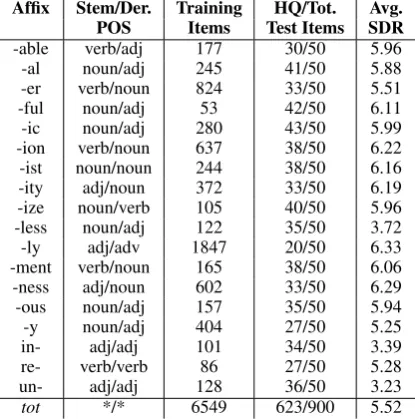
Affix Stem/Der. Training HQ/Tot. Avg.
POS Items Test Items SDR
-able verb/adj 177 30/50 5.96
-al noun/adj 245 41/50 5.88
-er verb/noun 824 33/50 5.51
-ful noun/adj 53 42/50 6.11
-ic noun/adj 280 43/50 5.99
-ion verb/noun 637 38/50 6.22 -ist noun/noun 244 38/50 6.16
-ity adj/noun 372 33/50 6.19
-ize noun/verb 105 40/50 5.96 -less noun/adj 122 35/50 3.72
-ly adj/adv 1847 20/50 6.33
-ment verb/noun 165 38/50 6.06
-ness adj/noun 602 33/50 6.29
-ous noun/adj 157 35/50 5.94
-y noun/adj 404 27/50 5.25
in- adj/adj 101 34/50 3.39
re- verb/verb 86 27/50 5.28
un- adj/adj 128 36/50 3.23
[image:4.595.73.281.63.273.2]tot */* 6549 623/900 5.52
Table 1: Derivational morphology dataset
having a verbal stem and nominal derived form). Since CELEX was populated by semi-automated morphological analysis, it includes forms that are probably not synchronically related to their stems, such ascrypt+icorre+form. However, we did not manually intervene on the pairs, since we are in-terested in training and testing our methods in re-alistic, noisy conditions. In particular, the need to pre-process corpora to determine which forms are “opaque”, and should thus be bypassed by our sys-tems, would greatly reduce their usefulness. Pairs in which either word occurred less than 20 times in our source corpus (described in Section 4.2 be-low) were filtered out and, in our final dataset, we only considered the 18 affixes (3 prefixes and 15 suffixes) with at least 100 pairs meeting this con-dition. We randomly chose 50 stem/derived pairs (900 in total) as test data. The remaining data were used as training items to estimate the parameters of the composition methods. Table 1 summarizes various characteristics of the dataset3(the last two
columns of the table are explained in the next para-graphs).
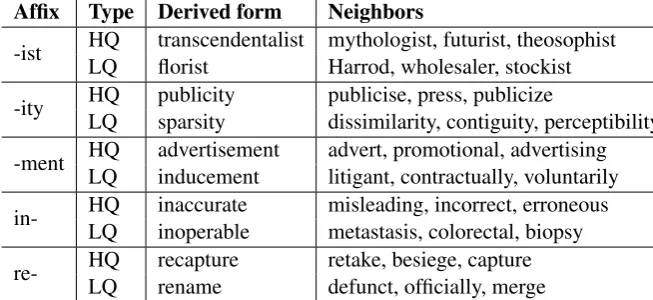
Annotation of quality of test vectors The qual-ity of the corpus-based vectors representing de-rived test items was determined by collecting hu-man sehu-mantic similarity judgments in a crowd-sourcing survey. In particular, we use the similar-ity of a vector to its nearest neighbors (NNs) as a proxy measure of quality. The underlying
assump-3Available fromhttp://clic.cimec.unitn.it/
composes
tion is that a vector, in order to be a good represen-tation of the meaning of the corresponding word, should lie in a region of semantic space populated by intuitively similar meanings, e.g., we are more likely to have captured the meaning ofcar if the NN of its vector is the automobile vector rather thanpotato. Therefore, to measure the quality of a given vector, we can look at the average simi-larity score provided by humans when comparing this very vector with its own NNs.
All 900 derived vectors from the test set were matched with their three closest NNs in our se-mantic space (see Section 4.2), thus producing a set of2,700word pairs. These pairs were admin-istered to CrowdFlower users,4 who were asked
to judge the relatedness of the two meanings on a 7-point scale (higher for more related). In order to ensure that participants were committed to the task and exclude non-proficient English speakers, we used 60 control pairs as gold standard, consist-ing of either perfect synonyms or completely un-related words. We obtained30judgments for each derived form (10judgments for each of 3 neighbor comparisons), with mean participant agreement of 58%. These ratings were averaged item-wise, re-sulting in a Gaussian distribution with a mean of 3.79 and a standard deviation of 1.31. Finally, each test item was marked as high-quality (HQ) if its derived form received an average score of at least3, as low-quality (LQ) otherwise. Table 1 re-ports the proportion of HQ test items for each af-fix, and Table 2 reports some examples of HQ and LQ items with the corresponding NNs. It is worth observing that the NNs of the LQ items, while not as relevant as the HQ ones, are hardly random. Annotation of similarity between stem and de-rived forms Derived forms differ in terms of how far their meaning is with respect to that of their stem. Certain morphological processes have systematically more impact than others on mean-ing: For example, the adjectival prefixin-negates the meaning of the stem, whereas-ly has the sole function to convert an adjective into an adverb. But the very same affix can affect different stems in different ways. For example,remelt means lit-tle more than tomelt again, butrethinkhas subtler implications of changing one’s way to look at a problem, and while one of the senses ofcyclingis present inrecycle, it takes some effort to see their relation.
Affix Type Derived form Neighbors
-ist HQ transcendentalist mythologist, futurist, theosophist LQ florist Harrod, wholesaler, stockist
-ity HQLQ publicitysparsity publicise, press, publicizedissimilarity, contiguity, perceptibility
-ment HQLQ advertisementinducement advert, promotional, advertisinglitigant, contractually, voluntarily
in- HQLQ inaccurateinoperable misleading, incorrect, erroneousmetastasis, colorectal, biopsy
[image:5.595.130.457.63.213.2]re- HQ recapture retake, besiege, capture LQ rename defunct, officially, merge
Table 2: Examples of HQ and LQ derived vectors with their NNs
We conducted a separate crowdsourcing study where participants were asked to rate the 900 test stem/derived pairs for the strength of their semantic relationship on a 7-point scale. We followed a procedure similar to the one de-scribed for quality measurement; 7 judgments were collected for each pair. Participants’ agree-ment was at 60%. The last column of Ta-ble 1 reports the average stem/derived related-ness (SDR) for the various affixes. Note that the affixes with systematically lower SDR are those carrying a negative meaning (in-, un-, -less), whereas those with highest SDR do little more than changing the POS of the stem (ion, ly, -ness). Among specific pairs with very low related-ness we encounterhand/handy,bear/bearableand
active/activist, whereascompulsory/compulsorily,
shameless/shamelessness and chaos/chaotic have high SDR. Since the distribution of the average ratings was negatively skewed (mean rating:5.52, standard deviation:1.26),5we took5as the rating
threshold to classify items as having high (HR) or low (LR) relatedness to their stems.
4.2 Distributional semantic space6
We use as our source corpus the concatenation of ukWaC, the English Wikipedia (2009 dump) and the BNC,7 for a total of about 2.8 billion tokens.
We collect co-occurrence statistics for the top 20K content words (adjectives, adverbs, nouns, verbs)
5The negative skew is not surprising, as derived forms must have some relation to their stems!
6Most steps of the semantic space construction and composition pipelines were implemented using the DISSECT toolkit: https://github.com/ composes-toolkit/dissect.
7http://wacky.sslmit.unibo.it, http:
//en.wikipedia.org, http://www.natcorp. ox.ac.uk
in lemma format, plus any item from the mor-phological dataset described above that was below this rank. The top 20K content words also con-stitute our context elements. We use a standard bag-of-words approach, counting collocates in a narrow 2-word before-and-after window. We ap-ply (non-negative) Pointwise Mutual Information as weighting scheme and dimensionality reduc-tion by Non-negative Matrix Factorizareduc-tion, setting the number of reduced-space dimensions to 350. These settings are chosen without tuning, and are based on previous experiments where they pro-duced high-quality semantic spaces (Boleda et al., 2013; Bullinaria and Levy, 2007).
4.3 Implementation of composition methods All composition methods except mult and stem
have weights to be estimated (e.g., theλ parame-ter ofdilationor the affix matrices oflexfunc). We adopt the estimation strategy proposed by Gue-vara (2010) and Baroni and Zamparelli (2010), namely we pick parameter values that optimize the mapping between stem and derived vectors di-rectly extracted from the corpus. To learn, say, a
prob-lem exist for all our composition methods. We use only the training items from Section 4.1 for esti-mation. Note that, unlike the test items, these have not been annotated for quality, so we are adopting an unsupervised (no manual labeling) but noisy es-timation method.8
For thelexfuncmodel, we use the training items separately to obtain weight matrices represent-ing each affix, whereas for the other models all training data are used together to globally de-rive single sets of affix and stem weights. For the wadd model, the learning process results in 0.16×affix+0.33×stem, i.e., the affix contributes only half of its mass to the composition of the derived form. For dilation, we stretch the stem (i.e.,vof the dilation equation is the stem vector), since it should provide richer contents than the af-fix to the derived meaning. We found that, on av-erage across the training pairs, dilationweighted the stem 20 times more heavily than the affix (0.05×affix+1×stem). We then expect that the
di-lationmodel will have similar performance to the baselinestemmodel, as confirmed below.9
For all methods, vectors were normalized be-fore composing both in training and in generation.
5 Experiment 1: approximating
high-quality corpus-extracted vectors The first experiment investigates to what extent composition models can approximate high-quality (HQ) corpus-extracted vectors representing de-rived forms. Note that since the test items were excluded from training, we are simulating a sce-nario in which composition models must generate representations for nonce derived forms.
Cosine similarity between model-generated and corpus-extracted vectors were computed for all models, including the stem baseline (i.e., co-sine between stem and derived form). The first row of Table 3 reports mean similarities. The
stem method sets the level of performance rel-atively high, confirming its soundness. Indeed, the parameter-freemultmodel performs below the baseline.10 As expected, dilation performs
simi-8More accurately, we relied on semi-manual CELEX in-formation to identify derived forms. A further step towards a fully knowledge-free system would be to pre-process the cor-pus with an unsupervised morphological induction system to extract stem/derived pairs.
9The other models have thousands of weights to be es-timated, so we cannot summarize the outcome of parameter estimation here.
10This result does not necessarily contradict those of
stem mult dil. wadd fulladd lexfunc
All 0.47 0.39 0.48 0.50 0.56 0.54
HR 0.52 0.43 0.53 0.55 0.61 0.58
[image:6.595.309.522.62.103.2]LR 0.32 0.28 0.33 0.38 0.41 0.42
Table 3: Mean similarity of composed vectors to high-quality corpus-extracted derived-form vec-tors, for all as well as high- (HR) and low-relatedness (LR) test items
larly to the baseline, while wadd outperforms it, although the effect does not reach significance (p=.06).11 Bothfulladdandlexfuncperform sig-nificantly better than stem (p < .001). Lexfunc provides a flexible way to account for affixation, since it models it directly as a function mapping from and onto word vectors, without requiring a vector representation of bound affixes. The rea-son at the base of its good performance is thus quite straightforward. On the other hand, it is surprising that a simple representation of bound affixes (i.e., as vectors aggregating the contexts of words containing them) can work so well, at least when used in conjunction with the granular dimension-by-dimension weights assigned by the
fulladdmethod. We hypothesize that these aggre-gated contexts, by providing information about the set of stems an affix combines with, capture the shared semantic features that the affix operates on. When the meaning of the derived form is far from that of its stem, thestembaseline should no longer constitute a suitable surrogate of derived-form meaning. The LR cases (see Section 4.1 above) are thus crucial to understand how well composition methods capture not only stem mean-ing, but also affix-triggered semantics. The HR and LR rows of Table 3 present the results for the respective test subsets. As expected, thestem
approach undergoes a strong drop when perfor-mance is measured on LR items. At the other ex-treme,fulladd andlexfunc, while also finding the LR cases more difficult, still clearly outperform the baseline (p<.001), confirming that they cap-ture the meaning of derived forms beyond what their stems contribute to it. The effect of wadd, again, approaches significance when compared to the baseline (p=.05). Very encouragingly, both
Mitchell and Lapata and others who foundmultto be highly competitive. Due to differences in co-occurrence weighting schemes (we use a logarithmically scaled measure, they do not), their multiplicative model is closer to our additive one.
stem mult wadd dil. fulladd lexfunc
-less 0.22 0.23 0.30 0.24 0.38 0.44
in- 0.39 0.34 0.45 0.40 0.47 0.45
[image:7.595.308.533.62.117.2]un- 0.33 0.33 0.41 0.34 0.44 0.46
Table 4: Mean similarity of composed vectors to high-quality corpus-extracted derived-form vec-tors with negative affixes
fulladd andlexfuncsignificantly outperformstem
also in the HR subset (p<.001). That is, the mod-els provide better approximations of derived forms even when the stem itself should already be a good surrogate. The difference between the two models is not significant.
We noted in Section 4.1 that forms containing the “negative” affixes -less, un- andin- received on average low SDR scores, since negation im-pacts meaning more drastically than other opera-tions. Table 4 reports the performance of the mod-els on these affixes. Indeed, thestembaseline per-forms quite poorly, whereas fulladd, lexfuncand, to a lesser extent,wadd are quite effective in this condition as well, all performing greatly above the baseline. These results are intriguing in light of the fact that modeling negation is a challenging task for DSMs (Mohammad et al., 2013) as well as cDSMs (Preller and Sadrzadeh, 2011). To the ex-tent that our best methods have captured the negat-ing function of a prefix such asin-, they might be applied to tasks such as recognizing lexical op-posites, or even simple forms of syntactic nega-tion (modelinginoperableis just a short step away from modelingnot operablecompositionally).
6 Experiment 2: Comparing the quality of corpus-extracted and
compositionally generated words The first experiment simulated the scenario in which derived forms are not in our corpus, so that directly extracting their representation from it is not an option. The second experiment tests if compositionally-derived representations can be better than those extracted directly from the corpus when the latter is a possible strategy (i.e., the de-rived forms are attested in the source corpus). To this purpose, we focused on those 277 test items that were judged as low-quality (LQ, see Section 4.1), which are presumably more challenging to generate, and where the compositional route could be most useful.
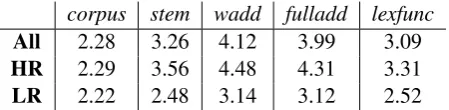
We evaluated the derived forms generated by
corpus stem wadd fulladd lexfunc
All 2.28 3.26 4.12 3.99 3.09
HR 2.29 3.56 4.48 4.31 3.31
LR 2.22 2.48 3.14 3.12 2.52
Table 5: Average quality ratings of derived vectors
Target Model Neighbors
florist waddfulladd flora, fauna, ecosystemflora, fauna, egologist
lexfunc ornithologist, naturalist, botanist sparsity waddfulladd sparse, sparsely, densesparse, sparseness, angularity
lexfunc fragility, angularity, smallness inducement waddfulladd induce, inhibit, inhibitioninduce, inhibition, mediate
lexfunc impairment, cerebral, ocular inoperable waddfulladd operable, palliation, biopsyoperable, inoperative, ventilator
lexfunc inoperative, unavoidably, flaw rename waddfulladd name, later, namesakename, namesake, later
[image:7.595.75.290.62.103.2]lexfunc temporarily, reinstate, thereafter Table 6: Examples of model-predicted neighbors for words with LQ corpus-extracted vectors
the models that performed best in the first exper-iment (fulladd, lexfuncandwadd), as well as the
stembaseline, by means of another crowdsourcing study. We followed the same procedure used to assess the quality of corpus-extracted vectors, that is, we asked judges to rate the relatedness of the target forms to their NNs (we obtained on average 29 responses per form).
The first line of Table 5 reports the average quality (on a7-point scale) of the representations of the derived forms as produced by the models and baseline, as well as of the corpus-harvested ones (corpuscolumn). All compositional models produce representations that are of significantly higher quality (p < .001) than the corpus-based ones. The effect is also evident in qualitative terms. Table 6 presents the NNs predicted by the three compositional methods for the same LQ test items whose corpus-based NNs are presented in Table 2. These results indicate that morpheme composition is an effective solution when the qual-ity of corpus-extracted derived forms is low (and the previous experiment showed that, when their quality is high, composition can at least approxi-mate corpus-based vectors).
[image:7.595.307.529.150.313.2]composition is dominated by the stem, and by looking at the examples in Table 6 we notice that both this model and fulladd tend to feature the stem as NN (100% of the cases for wadd, 73% forfulladdin the complete test set). The question thus arises as to whether the good performance of these composition techniques is simply due to the fact that they produce derived forms that are near their stems, with no added semantic value from the affix (a “stemploitation” strategy).
However, the stemploitation hypothesis is dis-pelled by the observation that both models signifi-cantly outperform thestembaseline (p<.001), de-spite the fact that the latter, again, has good per-formance, significantly outperforming the corpus-derived vectors (p < .001). Thus, we confirm that compositional models provide higher qual-ity vectors that are capturing the meaning of de-rived forms beyond the information provided by the stem.
Indeed, if we focus on the third row of Ta-ble 5, reporting performance on low stem-derived relatedness (LR) items (annotated as described in Section 4.1), fulladd and wadd still significantly outperform the corpus representations (p < .001), whereas the quality of thestemrepresentations of LR items is not significantly different form that of the corpus-derived ones. Interestingly,lexfunc dis-plays the smallest drop in performance when re-stricting evaluation to LR items; however, since it does not significantly outperform the LQ corpus representations, this is arguably due to a floor ef-fect.
7 Conclusion and future work
We investigated to what extent cDSMs can gener-ate effective meaning representations of complex words through morpheme composition. Several state-of-the-art composition models were adapted and evaluated on this novel task. Our results sug-gest that morpheme composition can indeed pro-vide high-quality vectors for complex forms, im-proving both on vectors directly extracted from the corpus and on a stem-backoff strategy. This re-sult is of practical importance for distributional se-mantics, as it paves the way to address one of the main causes of data sparseness, and it confirms the usefulness of the compositional approach in a new domain. Overall,fulladdemerged as the best per-forming model, with bothlexfunc and the simple
wadd approach constituting strong rivals. The
ef-fectiveness of the best models extended also to the challenging cases where the meaning of derived forms is far from that of the stem, including nega-tive affixes.
Thefulladd method requires a vector represen-tation for bound morphemes. A first direction for future work will thus be to investigate which as-pects of the meaning of bound morphemes are captured by our current simple-minded approach to populating their vectors, and to explore alterna-tive ways to construct them, seeing if they further improvefulladdperformance.
A natural extension of our research is to ad-dress morpheme composition and morphological induction jointly, trying to model the intuition that good candidate morphemes should have coherent semantic representations. Relatedly, in the cur-rent setting we generate complex forms from their parts. We want to investigate the inverse route, namely “composing” complex words to de-rive representations of their stems, especially for cases where the complex words are more frequent (e.g.comfort/comfortable).
We would also like to apply composition to in-flectional morphology (that currently lies outside the scope of distributional semantics), to capture the nuances of meaning that, for example, distin-guish singular and plural nouns (consider, e.g., the difference between the mass singularteaand the plural teas, which coerces the noun into a count interpretation (Katz and Zamparelli, 2012)).
Finally, in our current setup we focus on a single composition step, e.g., we derive the meaning of
inoperableby composing the morphemesin- and
operable. Butoperableis in turn composed of op-erateand-able. In the future, we will explore re-cursive morpheme composition, especially since we would like to apply these methods to more complex morphological systems (e.g., agglutina-tive languages) where multiple morphemes are the norm.
8 Acknowledgments
References
Herv´e Abdi and Lynne Williams. 2010. Newman-Keuls and Tukey test. In Neil Salkind, Bruce Frey,
and Dondald Dougherty, editors, Encyclopedia of
Research Design, pages 897–904. Sage, Thousand Oaks, CA.
Harald Baayen, Richard Piepenbrock, and Leon Gu-likers. 1995. The CELEX lexical database (re-lease 2). CD-ROM, Linguistic Data Consortium, Philadelphia, PA.
Harald Baayen. 2005. Morphological productivity. In Rajmund Piotrowski Reinhard K¨ohler, Gabriel
Alt-mann, editor, Quantitative Linguistics: An
Inter-national Handbook, pages 243–256. Mouton de Gruyter, Berlin, Germany.
Marco Baroni and Roberto Zamparelli. 2010. Nouns are vectors, adjectives are matrices: Representing adjective-noun constructions in semantic space. In Proceedings of EMNLP, pages 1183–1193, Boston, MA.
Marco Baroni. 2009. Distributions in text. In Anke L¨udeling and Merja Kyt¨o, editors,Corpus Linguis-tics: An International Handbook, volume 2, pages 803–821. Mouton de Gruyter, Berlin, Germany.
Laurie Bauer. 2001. Morphological Productivity.
Cambridge University Press, Cambridge, UK.
Kenneth Beesley and Lauri Karttunen. 2000.
Finite-State Morphology: Xerox Tools and Techniques. Cambridge University Press, Cambridge, UK.
Alan Black, Stephen Pulman, Graeme Ritchie, and
Graham Russell. 1991. Computational
Morphol-ogy. MIT Press, Cambrdige, MA.
Gemma Boleda, Marco Baroni, Louise McNally, and Nghia Pham. 2013. Intensionality was only alleged: On adjective-noun composition in distributional
se-mantics. In Proceedings of IWCS, pages 35–46,
Potsdam, Germany.
John Bullinaria and Joseph Levy. 2007. Extracting semantic representations from word co-occurrence
statistics: A computational study. Behavior
Re-search Methods, 39:510–526.
Stephen Clark. 2012. Vector space models of lexical meaning. In Shalom Lappin and Chris Fox, editors, Handbook of Contemporary Semantics, 2nd edition. Blackwell, Malden, MA. In press.
Bob Coecke, Mehrnoosh Sadrzadeh, and Stephen Clark. 2010. Mathematical foundations for a com-positional distributional model of meaning. Linguis-tic Analysis, 36:345–384.
David Dowty. 1979. Word Meaning and Montague
Grammar. Springer, New York.
Markus Dreyer and Jason Eisner. 2011. Discover-ing morphological paradigms from plain text usDiscover-ing
a Dirichlet process mixture model. InProceedings
of EMNLP, pages 616–627, Edinburgh, UK.
Katrin Erk. 2012. Vector space models of word
mean-ing and phrase meanmean-ing: A survey. Language and
Linguistics Compass, 6(10):635–653.
Yoav Goldberg and Reut Tsarfaty. 2008. A single gen-erative model for joint morphological segmentation and syntactic parsing. InProceedings of ACL, pages 371–379, Columbus, OH.
John Goldsmith. 2001. Unsupervised learning of the
morphology of a natural language. Computational
Linguistics, 2(27):153–198.
Sharon Goldwater and David McClosky. 2005. Im-proving statistical MT through morphological
anal-ysis. In Proceedings of EMNLP, pages 676–683,
Vancouver, Canada.
Sharon Goldwater. 2006. Nonparametric Bayesian
Models of Lexical Acquisition. Ph.D. thesis, Brown University.
Emiliano Guevara. 2009. Compositionality in distribu-tional semantics: Derivadistribu-tional affixes. In Proceed-ings of the Words in Action Workshop, Pisa, Italy.
Emiliano Guevara. 2010. A regression model of adjective-noun compositionality in distributional
se-mantics. In Proceedings of GEMS, pages 33–37,
Uppsala, Sweden.
Graham Katz and Roberto Zamparelli. 2012.
Quanti-fying count/mass elasticity. InProceedings of
WC-CFL, pages 371–379, Tucson, AR.
Victor Kuperman. 2009. Semantic transparency revis-ited. Presentation at the 6th International Morpho-logical Processing Conference.
Thomas Landauer and Susan Dumais. 1997. A solu-tion to Plato’s problem: The latent semantic analysis theory of acquisition, induction, and representation
of knowledge. Psychological Review, 104(2):211–
240.
Young-Suk Lee. 2004. Morphological analysis for sta-tistical machine translation. InProceedings of HLT-NAACL, pages 57–60, Boston, MA.
Rochelle Lieber. 2004. Morphology and Lexical
Se-mantics. Cambridge University Press, Cambridge, UK.
Jeff Mitchell and Mirella Lapata. 2008. Vector-based
models of semantic composition. InProceedings of
ACL, pages 236–244, Columbus, OH.
Jeff Mitchell and Mirella Lapata. 2009. Language
models based on semantic composition. In
Jeff Mitchell and Mirella Lapata. 2010. Composition in distributional models of semantics. Cognitive Sci-ence, 34(8):1388–1429.
Saif Mohammad, Bonnie Dorr, Graeme Hirst, and
Pe-ter Turney. 2013. Computing lexical contrast.
Com-putational Linguistics. In press.
Jason Naradowsky and Sharon Goldwater. 2009. Im-proving morphology induction by learning spelling
rules. In Proceedings of IJCAI, pages 11–17,
Pasadena, CA.
Ingo Plag. 1999. Morphological Productivity:
Struc-tural Constraints in English Derivation. Mouton de Gruyter, Berlin, Germany.
Anne Preller and Mehrnoosh Sadrzadeh. 2011. Bell states and negative sentences in the distributed
model of meaning. Electr. Notes Theor. Comput.
Sci., 270(2):141–153.
Patrick Schone and Daniel Jurafsky. 2000.
Knowledge-free induction of morphology us-ing latent semantic analysis. InProceedings of the ConLL workshop on learning language in logic, pages 67–72, Lisbon, Portugal.
Richard Socher, Eric Huang, Jeffrey Pennin, Andrew Ng, and Christopher Manning. 2011. Dynamic pooling and unfolding recursive autoencoders for paraphrase detection. InProceedings of NIPS, pages 801–809, Granada, Spain.
Richard Socher, Brody Huval, Christopher Manning, and Andrew Ng. 2012. Semantic compositionality through recursive matrix-vector spaces. In Proceed-ings of EMNLP, pages 1201–1211, Jeju Island, Ko-rea.
Richard Sproat. 1992. Morphology and Computation.
MIT Press, Cambrdige, MA.
Peter Turney and Patrick Pantel. 2010. From fre-quency to meaning: Vector space models of se-mantics. Journal of Artificial Intelligence Research, 37:141–188.
Hsueh-Cheng Wang, Yi-Min Tien, Li-Chuan Hsu, and Marc Pomplun. 2012. Estimating semantic trans-parency of constituents of English compounds and two-character Chinese words using Latent Semantic
Analysis. In Proceedings of CogSci, pages 2499–
2504, Sapporo, Japan.
Richard Wicentowski. 2004. Multilingual
noise-robust supervised morphological analysis using the
wordframe model. In Proceedings of SIGPHON,
pages 70–77, Barcelona, Spain.
David Yarowsky and Richard Wicentowski. 2000. Minimally supervised morphological analysis by
multimodal alignment. In Proceedings of ACL,
pages 207–216, Hong Kong.
Fabio Zanzotto, Ioannis Korkontzelos, Francesca Falucchi, and Suresh Manandhar. 2010. Estimat-ing linear models for compositional distributional
semantics. InProceedings of COLING, pages 1263–