Transition-based Dependency Parsing with Selectional Branching
Jinho D. Choi
Department of Computer Science University of Massachusetts Amherst
Amherst, MA, 01003, USA [email protected]
Andrew McCallum Department of Computer Science University of Massachusetts Amherst
Amherst, MA, 01003, USA [email protected]
Abstract
We present a novel approach, called selec-tional branching, which uses confidence es-timates to decide when to employ a beam, providing the accuracy of beam search at speeds close to a greedy transition-based dependency parsing approach. Selectional branching is guaranteed to perform a fewer number of transitions than beam search yet performs as accurately. We also present a new transition-based dependency parsing algorithm that gives a complexity ofO(n) for projective parsing and an expected lin-ear time speed for non-projective parsing. With the standard setup, our parser shows an unlabeled attachment score of 92.96% and a parsing speed of 9 milliseconds per sentence, which is faster and more accurate than the current state-of-the-art transition-based parser that uses beam search.
1 Introduction
Transition-based dependency parsing has gained considerable interest because it runs fast and per-forms accurately. Transition-based parsing gives complexities as low asO(n)andO(n2)for
projec-tive and non-projecprojec-tive parsing, respecprojec-tively (Nivre, 2008).1The complexity is lower for projective pars-ing because a parser can deterministically skip to-kens violating projectivity, while this property is not assumed for non-projective parsing. Nonethe-less, it is possible to perform non-projective parsing in expected linear time because the amount of non-projective dependencies is notably smaller (Nivre and Nilsson, 2005) so a parser can assume projec-tivity for most cases while recognizing ones for which projectivity should not be assumed (Nivre, 2009; Choi and Palmer, 2011).
1We refer parsing approaches that produce only projective
dependency trees as projective parsing and both projective and non-projective dependency trees as non-projective parsing.
Greedy transition-based dependency parsing has been widely deployed because of its speed (Cer et al., 2010); however, state-of-the-art accuracies have been achieved by globally optimized parsers using beam search (Zhang and Clark, 2008; Huang and Sagae, 2010; Zhang and Nivre, 2011; Bohnet and Nivre, 2012). These approaches generate multiple transition sequences given a sentence, and pick one with the highest confidence. Coupled with dynamic programming, transition-based dependency parsing with beam search can be done very efficiently and gives significant improvement to parsing accuracy.
One downside of beam search is that it always uses a fixed size of beam even when a smaller size of beam is sufficient for good results. In our exper-iments, a greedy parser performs as accurately as a parser that uses beam search for about 64% of time. Thus, it is preferred if the beam size is not fixed but proportional to the number of low confidence pre-dictions that a greedy parser makes, in which case, fewer transition sequences need to be explored to produce the same or similar parse output.
We first present a new transition-based parsing algorithm that gives a complexity ofO(n)for pro-jective parsing and an expected linear time speed for non-projective parsing. We then introduce se-lectional branching that uses confidence estimates to decide when to employ a beam. With our new ap-proach, we achieve a higher parsing accuracy than the current state-of-the-art transition-based parser that uses beam search and a much faster speed.
2 Transition-based dependency parsing
We introduce a transition-based dependency pars-ing algorithm that is a hybrid between Nivre’s arc-eager and list-based algorithms (Nivre, 2003; Nivre, 2008). Nivre’s arc-eager is a projective parsing al-gorithm showing a complexity ofO(n). Nivre’s list-based algorithm is a non-projective parsing al-gorithm showing a complexity ofO(n2). Table 1 shows transitions in our algorithm. The top 4 and
Transition Current state ⇒ Resulting state
LEFTl-REDUCE ( [σ|i],δ, [j|β],A) ⇒ (σ,δ, [j|β],A∪ {i←l j}) RIGHTl-SHIFT ( [σ|i],δ, [j|β],A) ⇒ ( [σ|i|δ|j], [ ],β,A∪ {i→l j}) NO-SHIFT ( [σ|i],δ, [j|β],A) ⇒ ( [σ|i|δ|j], [ ],β,A)
NO-REDUCE ( [σ|i],δ, [j|β],A) ⇒ (σ,δ, [j|β],A)
[image:2.595.148.454.61.176.2]LEFTl-PASS ( [σ|i],δ, [j|β],A) ⇒ (σ, [i|δ], [j|β],A∪ {i←l j}) RIGHTl-PASS ( [σ|i],δ, [j|β],A) ⇒ (σ, [i|δ], [j|β],A∪ {i→l j}) NO-PASS ( [σ|i],δ, [j|β],A) ⇒ (σ, [i|δ], [j|β],A)
Table 1: Transitions in our dependency parsing algorithm.
Transition Preconditions
LEFTl-∗ [i6= 0] ∧ ¬[∃k.(i←k)∈A] ∧ ¬[(i→∗j)∈A] RIGHTl-∗ ¬[∃k.(k→j)∈A] ∧ ¬[(i∗←j)∈A]
∗-SHIFT ¬[∃k∈σ.(k6=i)∧((k←j)∨(k→j))]
[image:2.595.146.452.208.265.2]∗-REDUCE [∃h.(h→i)∈A] ∧ ¬[∃k∈β.(i→k)]
Table 2: Preconditions of the transitions in Table 1 (∗is a wildcard representing any transition).
the bottom 3 transitions are inherited from Nivre’s arc-eager and list-based algorithms, respectively.2 Each parsing state is represented as a tuple (σ, δ,β,A), whereσis a stack containing processed tokens,δis a deque containing tokens popped out ofσbut will be pushed back intoσin later parsing states to handle non-projectivity, andβis a buffer containing unprocessed tokens.Ais a set of labeled arcs. (i,j) represent indices of their corresponding tokens (wi,wj),lis a dependency label, and the 0 identifier corresponds tow0, introduced as the root
of a tree. The initial state is ([0], [ ], [1, . . . , n],∅), and the final state is (σ,δ, [ ],A). At any parsing state, a decision is made by comparing the top of σ,wi, and the first element ofβ,wj. This decision is consulted by gold-standard trees during training and a classifier during decoding.
LEFTl-∗and RIGHTl-∗are performed whenwj is the head ofwiwith a dependency labell, and vice versa. After LEFTl-∗or RIGHTl-∗, an arc is added toA. NO-∗is performed when no dependency is found forwiandwj.∗-SHIFTis performed when no dependency is found forwj and any token in σ other thanwi. After ∗-SHIFT, all tokens in δ as well as wj are pushed intoσ. ∗-REDUCE is performed whenwialready has the head, andwiis not the head of any token inβ. After∗-REDUCE, wiis popped out ofσ.∗-PASSis performed when neither∗-SHIFTnor∗-REDUCEcan be performed. After∗-PASS,wi is moved to the front ofδso it
2The parsing complexity of a transition-based dependency
parsing algorithm is determined by the number of transitions performed with respect to the number of tokens in a sentence, sayn(Kübler et al., 2009).
can be compared to other tokens inβ later. Each transition needs to satisfy certain preconditions to ensure the properties of a well-formed dependency graph (Nivre, 2008); they are described in Table 2. (i←j)and(i∗← j)indicate thatwj is the head and an ancestor ofwiwith any label, respectively. When a parser is trained on only projective trees, our algorithm learns only the top 4 transitions and produces only projective trees during decoding. In this case, it performs at most2n−1 transitions per sentence so the complexity isO(n). When a parser is trained on a mixture of projective and non-projective trees, our algorithm learns all transitions and produces both kinds of trees during decoding. In this case, it performs at most n(n+1)
2 transitions
so the complexity isO(n2). However, because of the presence of∗-SHIFT and∗-REDUCE, our al-gorithm is capable of skipping or removing tokens during non-projective parsing, which allows it to show a linear time parsing speed in practice.
70 0 10 20 30 40 50 60 130
0 20 40 60 80 100
Sentence length
T
ra
ns
it
ions
[image:2.595.310.526.592.721.2]Transition σ δ β A
0 Initialization [0] [ ] [1|β] ∅
1 NO-SHIFT [σ|1] [ ] [2|β]
2 NO-SHIFT [σ|2] [ ] [3|β] 3 NO-SHIFT [σ|3] [ ] [4|β]
4 LEFT-REDUCE [σ|2] [ ] [4|β] A ∪ {3←NSUBJ−4}
5 NO-PASS [σ|1] [2] [4|β]
6 RIGHT-SHIFT [σ|4] [ ] [5|β] A ∪ {1−RCMOD→4}
7 NO-SHIFT [σ|5] [ ] [6|β]
8 LEFT-REDUCE [σ|4] [ ] [6|β] A ∪ {5←AUX−6}
9 RIGHT-PASS [σ|2] [4] [6|β] A ∪ {4−XCOMP→6}
10 LEFT-REDUCE [σ|1] [4] [6|β] A ∪ {2←DOBJ−6}
11 NO-SHIFT [σ|6] [ ] [7|β]
12 NO-REDUCE [σ|4] [ ] [7|β]
13 NO-REDUCE [σ|1] [ ] [7|β]
14 LEFT-REDUCE [0] [ ] [7|β] A ∪ {1←NSUBJ−7}
[image:3.595.110.490.60.352.2]15 RIGHT-SHIFT [σ|7] [ ] [8] A ∪ {0−ROOT→7} 16 RIGHT-SHIFT [σ|8] [ ] [ ] A ∪ {7−ADV→8}
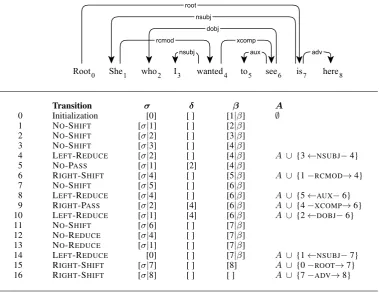
Table 3: A transition sequence generated by our parsing algorithm using gold-standard decisions.
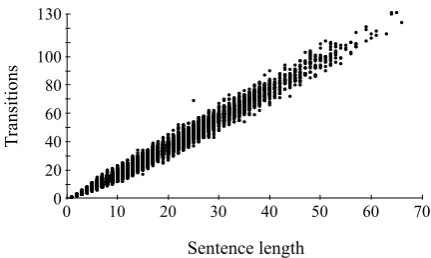
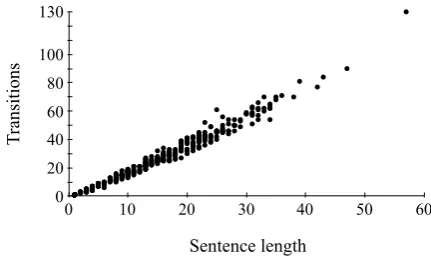
Figure 1 shows the total number of transitions per-formed during training with respect to sentence lengths for Dutch. Among all languages distributed by the CoNLL-X shared task (Buchholz and Marsi, 2006), Dutch consists of the highest number of non-projective dependencies (5.4% in arcs, 36.4% in trees). Even with such a high number of non-projective dependencies, our parsing algorithm still shows a linear growth in transitions.
Table 3 shows a transition sequence generated by our parsing algorithm using gold-standard deci-sions. Afterw3andw4are compared,w3is popped
out ofσ(state 4) so it is not compared to any other token inβ (states 9 and 13). Afterw2 andw4are
compared,w2 is moved toδ(state 5) so it can be
compared to other tokens inβ(state 10). Afterw4
andw6are compared, RIGHT-PASSis performed
(state 9) because there is a dependency between w6 and w2 inσ (state 10). Afterw6 and w7 are
compared,w6is popped out ofσ(state 12) because
it is not needed for later parsing states.
3 Selectional branching
3.1 Motivation
For transition-based parsing, state-of-the-art accu-racies have been achieved by parsers optimized on multiple transition sequences using beam search,
which can be done very efficiently when it is cou-pled with dynamic programming (Zhang and Clark, 2008; Huang and Sagae, 2010; Zhang and Nivre, 2011; Huang et al., 2012; Bohnet and Nivre, 2012). Despite all the benefits, there is one downside of this approach; it generates a fixed number of tran-sition sequences no matter how confident the one-best sequence is.3 If every prediction leading to the one-best sequence is confident, it may not be necessary to explore more sequences to get the best output. Thus, it is preferred if the beam size is not fixed but proportional to the number of low confi-dence predictions made for the one-best sequence. The selectional branching method presented here performs at mostd·t−etransitions, wheretis the maximum number of transitions performed to gen-erate a transition sequence,d= min(b,|λ|+1),bis the beam size,|λ|is the number of low confidence predictions made for the one-best sequence, and e= d(d2−1). Compared to beam search that always performsb·ttransitions, selectional branching is guaranteed to perform fewer transitions given the same beam size becaused≤bande >0except for d= 1, in which case, no branching happens. With selectional branching, our parser shows slightly
3The ‘one-best sequence’ is a transition sequence
higher parsing accuracy than the current state-of-the-art transition-based parser using beam search, and performs about 3 times faster.
[image:4.595.74.292.252.383.2]3.2 Branching strategy
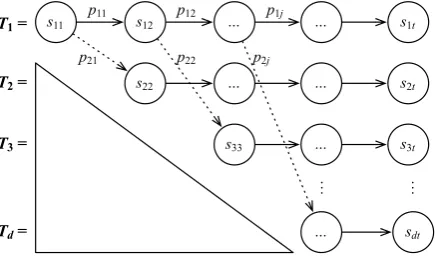
Figure 2 shows an overview of our branching strat-egy. sij represents a parsing state, whereiis the index of the current transition sequence andj is the index of the current parsing state (e.g.,s12
rep-resents the 2nd parsing state in the 1st transition sequence).pkj represents thek’th best prediction (in our case, it is a predicted transition) givens1j (e.g.,p21is the 2nd-best prediction givens11).
s11 p11 s12
s22
… … s1t
p12
… … s2t
p21
s33 p22
… s3t
sdt …
… …
p2j
T1 =
T2 =
T3 =
Td =
p1j
Figure 2: An overview of our branching strategy. Each sequenceTi>1branches fromT1.
Initially, the one-best sequenceT1 = [s11, ... , s1t] is generated by a greedy parser. While generating T1, the parser adds tuples(s1j, p2j), ... ,(s1j, pkj) to a listλfor each low confidence predictionp1j givens1j.4Then, new transition sequences are
gen-erated by using thebhighest scoring predictions in λ, wherebis the beam size. If|λ|< b, all predic-tions inλare used. The same greedy parser is used to generate these new sequences although it now starts with s1j instead of an initial parsing state, appliespkj tos1j, and performs further transitions. Once all transition sequences are generated, a parse tree is built from a sequence with the highest score.
For our experiments, we setk= 2, which gave noticeably more accurate results thank = 1. We also experimented withk >2, which did not show significant improvement overk= 2. Note that as-signing a greaterkmay increase|λ|but not the total number of transition sequences generated, which is restricted by the beam size, b. Since each se-quenceTi>1branches fromT1, selectional
branch-ing performs fewer transitions than beam search: at least d(d−1)
2 transitions are inherited from T1,
4λis initially empty, which is hidden in Figure 2.
whered= min(b,|λ|+ 1); thus, it performs that many transitions less than beam search (see the left lower triangle in Figure 2). Furthermore, se-lectional branching generates a d number of se-quences, wheredis proportional to the number of low confidence predictions made byT1. To sum up,
selectional branching generates the same or fewer transition sequences than beam search and each sequenceTi>1performs fewer transitions thanT1;
thus, it performs faster than beam search in general given the same beam size.
3.3 Finding low confidence predictions For each parsing statesij, a prediction is made by generating a feature vectorxij ∈ X, feeding it into a classifierC1that uses a feature mapΦ(x, y)and
a weight vectorwto measure a score for each label
y∈ Y, and choosing a label with the highest score. When there is a tie between labels with the highest score, the first one is chosen. This can be expressed as a logistic regression:
C1(x) = arg max
y∈Y{f(x, y)}
f(x, y) = P exp(w·Φ(x, y))
y0∈Yexp(w·Φ(x, y0))
To find low confidence predictions, we use the mar-gins (score differences) between the best prediction and the other predictions. If all margins are greater than a threshold, the best prediction is considered highly confident; otherwise, it is not. Given this analogy, the k-best predictions can be found as follows (m≥0is a margin threshold):
Ck(x, m) = Karg max
y∈Y{f(x, y)}
s.t. f(x, C1(x))−f(x, y)≤m
‘Karg max’ returns a set ofk0 labels whose mar-gins to C1(x)are smaller than any other label’s margin to C1(x) and also ≤ m, where k0 ≤ k. Whenm= 0, it returns a set of the highest scoring labels only, includingC1(x). Whenm= 1, it re-turns a set of all labels. Given this, a prediction is considered not confident if|Ck(x, m)|>1.
3.4 Finding the best transition sequence LetPi be a list of all predictions that lead to gen-erate a transition sequenceTi. The predictions in Pi are either inherited from T1 or made
specifi-cally forTi. In Figure 2,P3consists ofp11as its
further predictions made specifically forT3. The
score of each prediction is measured byf(x, y)in Section 3.3. Then, the score ofTiis measured by averaging scores of all predictions inPi.
score(Ti) =
P
p∈Piscore(p) |Pi|
Unlike Zhang and Clark (2008), we take the av-erage instead of the sum of all prediction scores. This is because our algorithm does not guarantee the same number of transitions for every sequence, so the sum of all scores would weigh more on se-quences with more transitions. We experimented with both the sum and the average, and taking the average led to slightly higher parsing accuracy.
3.5 Bootstrapping transition sequences During training, a training instance is generated for each parsing statesij by taking a feature vec-torxij and its true labelyij. To generate multiple transition sequences during training, the bootstrap-ping technique of Choi and Palmer (2011) is used, which is described in Algorithm 1.5
Algorithm 1Bootstrapping
Input: Dt: training set, Dd: development set.
Output: A modelM. 1: r ←0
2: I ←getTrainingInstances(Dt) 3: M0←buildModel(I)
4: S0 ←getScore(Dd, M0) 5: while (r= 0) or (Sr−1< Sr) do 6: r ←r+ 1
7: I ←getTrainingInstances(Dt, Mr−1) 8: Mr←buildModel(I)
9: Sr ←getScore(Dd, Mr) 10: return Mr−1
First, an initial modelM0is trained on all data by
taking the one-best sequences, and its score is mea-sured by testing on a development set (lines 2-4). Then, the next modelMris trained on all data but this time,Mr−1is used to generate multiple
tran-sition sequences (line 7-8). Among all trantran-sition sequences generated byMr−1, training instances
from onlyT1andTgare used to trainMr, whereT1
is the one-best sequence andTg is a sequence giv-ing the most accurate parse output compared to the gold-standard tree. The score ofMr is measured (line 9), and repeat the procedure if Sr−1 < Sr;
otherwise, return the previous modelMr−1.
5Alternatively, the dynamic oracle approach of Goldberg
and Nivre (2012) can be used to generate multiple transition sequences, which is expected to show similar results.
3.6 Adaptive subgradient algorithm
To build each model during bootstrapping, we use a stochastic adaptive subgradient algorithm called ADAGRADthat uses per-coordinate learning rates to exploit rarely seen features while remaining scal-able (Duchi et al., 2011).This is suitscal-able forNLP tasks where rarely seen features often play an im-portant role and training data consists of a large number of instances with high dimensional features. Algorithm 2 shows our adaptation of ADAGRAD with logistic regression for multi-class classifica-tion. Note that when used with logistic regression, ADAGRADtakes a regular gradient instead of a sub-gradient method for updating weights. For our ex-periments, ADAGRADslightly outperformed learn-ing algorithms such as average perceptron (Collins, 2002) or LiblinearSVM(Hsieh et al., 2008).
Algorithm 2ADAGRAD+ logistic regression
Input: D={(xi, yi)}ni=1s.t.xi∈ X, yi∈ Y
Φ(x, y)∈Rds.t.d=dimension(
X)× |Y|
T: iterations,α: learning rate,ρ: ridge
Output: A weight vectorw∈Rd. 1: w←0, wherew∈Rd 2: G←0, whereG∈Rd 3: for t←1. . . T do
4: for i←1. . . ndo
5: Q∀y∈Y←I(yi, y)−f(xi, y), s.t.Q∈R|Y| 6: ∂←Py∈Y(Φ(xi, y)·Qy)
7: G←G+∂◦∂
8: for j←1. . . ddo
9: wj←wj+α·ρ+√1Gj ·∂j
I(y, y0) =
(
1 y=y0 0 otherwise
The algorithm takes three hyper-parameters;T is the number of iterations,αis the learning rate, and ρis the ridge (T >0, α >0, ρ≥0).Gis our run-ning estimate of a diagonal covariance matrix for the gradients (per-coordinate learning rates). For each instance, scores for all labels are measured by the logistic regression functionf(x, y)in Sec-tion 3.3. These scores are subtracted from an output of the indicator functionI(y, y0), which forces our model to keep learning this instance until the pre-diction is 100% confident (in other words, until the score ofyi becomes 1). Then, a subgradient is measured by taking all feature vectors together weighted byQ(line 6). This subgradient is used to
4 Experiments
4.1 Corpora
For projective parsing experiments, the Penn En-glish Treebank (Marcus et al., 1993) is used with the standard split: sections 2-21 for training, 22 for development, and 23 for evaluation. All constituent trees are converted with the head-finding rules of Yamada and Matsumoto (2003) and the labeling rules of Nivre (2006). For non-projective pars-ing experiments, four languages from the CoNLL-X shared task are used: Danish, Dutch, Slovene, and Swedish (Buchholz and Marsi, 2006). These languages are selected because they contain non-projective trees and are publicly available from the CoNLL-X webpage.6Since the CoNLL-X data we have does not come with development sets, the last 10% of each training set is used for development.
4.2 Feature engineering
For English, we mostly adapt features from Zhang and Nivre (2011) who have shown state-of-the-art parsing accuracy for transition-based dependency parsing. Their distance features are not included in our approach because they do not seem to show meaningful improvement. Feature selection is done on the English development set.
For the other languages, the same features are used with the addition of morphological features provided by CoNLL-X; specifically, morphological features from the top ofσ and the front ofβ are added as unigram features. Moreover, allPOStag features from English are duplicated with coarse-grainedPOStags provided by CoNLL-X. No more feature engineering is done for these languages; it is possible to achieve higher performance by using different features, especially when these languages contain non-projective dependencies whereas En-glish does not, which we will explore in the future.
4.3 Development
Several parameters need to be optimized during de-velopment. For ADAGRAD,T,α, andρneed to be tuned (Section 3.6). For bootstrapping, the number of iterations, sayr, needs to be tuned (Section 3.5). For selectional branching, the margin thresholdm and the beam sizebneed to be tuned (Section 3.3). First, all parameters are tuned on the English devel-opment set by using grid search onT = [1, . . . ,10], α = [0,01,0,02], ρ = [0.1,0.2], r = [1,2,3],
6http://ilk.uvt.nl/conll/
m = [0.83, . . . ,0.92], and b = [16,32,64,80]. As a result, the following parameters are found: α= 0.02,ρ= 0.1,m= 0.88, andb= 64|80. For this development set, the beam size of 64 and 80 gave the exact same result, so we kept the one with a larger beam size (b= 80).
0.92 0.83 0.86 0.88 0.9
91.2
91 91.04 91.08 91.12 91.16
Margin
A
cc
ura
cy
64|80 32 16
[image:6.595.311.528.158.284.2]b =
[image:6.595.312.525.483.604.2]Figure 3: Parsing accuracies with respect to mar-gins and beam sizes on the English development set. b= 64|80: the black solid line with solid circles, b = 32: the blue dotted line with hollow circles, b= 16: the red dotted line with solid circles.
Figure 3 shows parsing accuracies with respect to different margins and beam sizes on the English de-velopment set. These parameters need to be tuned jointly because different margins prefer different beam sizes. For instance,m= 0.85gives the high-est accuracy withb= 32, butm= 0.88gives the highest accuracy withb= 64|80.
14
0 2 4 6 8 10 12
92
88.5 89 89.5 90 90.5 91 91.5
Iteration
A
cc
ura
cy
UAS
LAS
Figure 4: Parsing accuracies with respect to ADA -GRADand bootstrap iterations on the English de-velopment set whenα = 0.02,ρ= 0.1,m= 0.88, andb= 64|80. UAS: unlabeled attachment score, LAS: labeled attachment score.
first bootstrapping, and the range 10-14 shows re-sults of 5 iterations during the second bootstrap-ping. Thus, the number of bootstrap iteration is 2 where each bootstrapping takes a different num-ber of ADAGRADiterations. Using an Intel Xeon 2.57GHz machine, it takes less than 40 minutes to train the entire Penn Treebank, which includes times for IO, feature extraction and bootstrapping.
80 0 10 20 30 40 50 60 70
1,200,000
0 200,000 400,000 600,000 800,000 1,000,000
Beam size = 1, 2, 4, 8, 16, 32, 64, 80
T
ra
ns
it
[image:7.595.306.525.181.440.2]ions
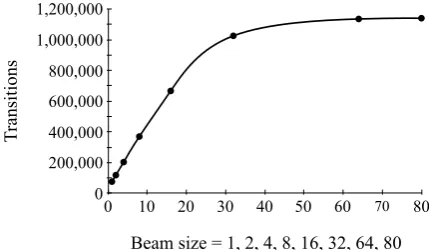
Figure 5: The total number of transitions performed during decoding with respect to beam sizes on the English development set.
Figure 5 shows the total number of transitions per-formed during decoding with respect to beam sizes on the English development set (1,700 sentences, 40,117 tokens). With selectional branching, the number of transitions grows logarithmically as the beam size increases whereas it would have grown linearly if beam search were used. We also checked how often the one best sequence is chosen as the final sequence during decoding. Out of 1,700 sen-tences, the one best sequences are chosen for 1,095 sentences. This implies that about 64% of time, our greedy parser performs as accurately as our non-greedy parser using selectional branching.
For the other languages, we use the same values as English forα,ρ,m, andb; only the ADAGRAD and bootstrap iterations are tuned on the develop-ment sets of the other languages.
4.4 Projective parsing experiments
Before parsing,POStags were assigned to the train-ing set by ustrain-ing 20-way jackkniftrain-ing. For the auto-matic generation ofPOStags, we used the domain-specific model of Choi and Palmer (2012a)’s tagger, which gave 97.5% accuracy on the English evalua-tion set (0.2% higher than Collins (2002)’s tagger). Table 4 shows comparison between past and cur-rent state-of-the-art parsers and our approach. The first block shows results from transition-based
de-pendency parsers using beam search. The second block shows results from other kinds of parsing approaches (e.g., graph-based parsing, ensemble parsing, linear programming, dual decomposition). The third block shows results from parsers using external data. The last block shows results from our approach. The Time column show how many seconds per sentence each parser takes.7
Approach UAS LAS Time
Zhang and Clark (2008) 92.1
Huang and Sagae (2010) 92.1 0.04 Zhang and Nivre (2011) 92.9 91.8 0.03 Bohnet and Nivre (2012) 93.38 92.44 0.4 McDonald et al. (2005) 90.9
Mcdonald and Pereira (2006) 91.5 Sagae and Lavie (2006) 92.7 Koo and Collins (2010) 93.04 Zhang and McDonald (2012) 93.06 91.86 Martins et al. (2010) 93.26 Rush et al. (2010) 93.8 Koo et al. (2008) 93.16 Carreras et al. (2008) 93.54 Bohnet and Nivre (2012) 93.67 92.68 Suzuki et al. (2009) 93.79
bt= 80,bd= 80,m= 0.88 92.96 91.93 0.009 bt= 80,bd= 64,m= 0.88 92.96 91.93 0.009 bt= 80,bd= 32,m= 0.88 92.96 91.94 0.009 bt= 80,bd= 16,m= 0.88 92.96 91.94 0.008 bt= 80,bd= 8,m= 0.88 92.89 91.87 0.006 bt= 80,bd= 4,m= 0.88 92.76 91.76 0.004 bt= 80,bd= 2,m= 0.88 92.56 91.54 0.003 bt= 80,bd= 1,m= 0.88 92.26 91.25 0.002 bt= 1,bd= 1,m= 0.88 92.06 91.05 0.002 Table 4: Parsing accuracies and speeds on the En-glish evaluation set, excluding tokens containing only punctuation.btandbdindicate the beam sizes used during training and decoding, respectively. UAS: unlabeled attachment score, LAS: labeled attachment score, Time: seconds per sentence.
For evaluation, we use the model trained withb= 80andm= 0.88, which is the best setting found during development. Our parser shows higher ac-curacy than Zhang and Nivre (2011), which is the current state-of-the-art transition-based parser that uses beam search. Bohnet and Nivre (2012)’s transition-based system jointly performsPOS tag-ging and dependency parsing, which shows higher accuracy than ours. Our parser gives a comparative accuracy to Koo and Collins (2010) that is a 3rd-order graph-based parsing approach. In terms of speed, our parser outperforms all other transition-based parsers; it takes about 9 milliseconds per
7Dhillon et al. (2012) and Rush and Petrov (2012) also
[image:7.595.75.290.187.312.2]Approach LASDanishUAS LASDutchUAS LASSloveneUAS LASSwedishUAS
Nivre et al. (2006) 84.77 89.80 78.59 81.35 70.30 78.72 84.58 89.50 McDonald et al. (2006) 84.79 90.58 79.19 83.57 73.44 83.17 82.55 88.93
Nivre (2009) 84.2 - - - 75.2 - -
-F.-González and G.-Rodríguez (2012) 85.17 90.10 - - - - 83.55 89.30
Nivre and McDonald (2008) 86.67 - 81.63 - 75.94 84.66
Martins et al. (2010) - 91.50 - 84.91 - 85.53 - 89.80
[image:8.595.90.508.61.170.2]bt= 80,bd= 1,m= 0.88 86.75 91.04 80.75 83.59 75.66 83.29 86.32 91.12 bt= 80,bd= 80,m= 0.88 87.27 91.36 82.45 85.33 77.46 84.65 86.80 91.36 Table 5: Parsing accuracies on four languages with non-projective dependencies, excluding punctuation.
sentence using the beam size of 80. Our parser is implemented in Java and tested on an Intel Xeon 2.57GHz. Note that we do not include input/output time for our speed comparison.
For a proof of concept, we run the same model, trained with bt = 80, but decode with different beam sizes using the same margin. Surprisingly, our parser gives the same accuracy (0.01% higher for labeled attachment score) on this data even with bd= 16. More importantly,bd= 16shows about the same parsing speed asbd= 80, which indicates that selectional branching automatically reduced down the beam size by estimating low confidence predictions, so even if we assigned a larger beam size for decoding, it would have performed as effi-ciently. This implies that we no longer need to be so conscious about the beam size during decoding.
Another interesting part is that(bt= 80, bd= 1) shows higher accuracy than(bt= 1, bd= 1); this implies that our training method of bootstrapping transition sequences can improve even a greedy parser. Notice that our greedy parser shows higher accuracy than many other greedy parsers (Hall et al., 2006; Goldberg and Elhadad, 2010) because it uses the non-local features of Zhang and Nivre (2011) and the bootstrapping technique of Choi and Palmer (2011) that had not been used for most other greedy parsing approaches.
4.5 Non-projective parsing experiments Table 5 shows comparison between state-of-the-art parsers and our approach for four languages with non-projective dependencies. Nivre et al. (2006) uses a pseudo-projective transition-based parsing approach. McDonald et al. (2006) uses a 2nd-order maximum spanning tree approach. Nivre (2009) and Fernández-González and Gómez-Rodríguez (2012) use different non-projective transition-based parsing approaches. Nivre and McDonald (2008) uses an ensemble model between transition-based and graph-based parsing approaches. Martins et
al. (2010) uses integer linear programming for the optimization of their parsing model.
Some of these approaches use greedy parsers, so we include our results from models using (bt= 80, bd= 1,m= 0.88), which finds only the one-best sequences during decoding although it is trained on multiple transition sequences (see Section 4.4). Our parser shows higher accuracies for most languages except for unlabeled attachment scores in Danish and Slovene. Our greedy approach outperforms both Nivre (2009) and Fernández-González and Gómez-Rodríguez (2012) who use different non-projective parsing algorithms.
60
0 10 20 30 40 50
130
0 20 40 60 80 100
Sentence length
T
ra
ns
it
[image:8.595.309.525.400.529.2]ions
Figure 6: The # of transitions performed during de-coding with respect to sentence lengths for Dutch.
Figure 6 shows the number of transitions performed during decoding with respect to sentence lengths for Dutch usingbd = 1. Our parser still shows a linear growth in transition during decoding.
5 Related work
for both cases; this is possible because of the new integration of the RIGHT-SHIFTand NO-REDUCE transitions. There are other transition-based de-pendency parsing algorithms that take a similar ap-proach; Nivre (2009) integrated a SWAPtransition into Nivre’s arc-standard algorithm (Nivre, 2004) and Fernández-González and Gómez-Rodríguez (2012) integrated a buffer transition into Nivre’s arc-eager algorithm to handle non-projectivity.
Our selectional branching method is most rele-vant to Zhang and Clark (2008) who introduced a transition-based dependency parsing model that uses beam search. Huang and Sagae (2010) later applied dynamic programming to this approach and showed improved efficiency. Zhang and Nivre (2011) added non-local features to this approach and showed improved parsing accuracy. Bohnet and Nivre (2012) introduced a transition-based sys-tem that jointly performed POS tagging and de-pendency parsing. Our work is distinguished from theirs because we use selectional branching instead.
6 Conclusion
We present selectional branching that uses confi-dence estimates to decide when to employ a beam. Coupled with our new hybrid parsing algorithm, ADAGRAD, rich non-local features, and bootstrap-ping, our parser gives higher parsing accuracy than most other transition-based dependency parsers in multiple languages and shows faster parsing speed. It is interesting to see that our greedy parser out-performed most other greedy dependency parsers. This is because our parser used both bootstrapping and Zhang and Nivre (2011)’s non-local features, which had not been used by other greedy parsers.
In the future, we will experiment with more ad-vanced dependency representations (de Marneffe and Manning, 2008; Choi and Palmer, 2012b) to show robustness of our approach. Furthermore, we will evaluate individual methods of our approach separately to show impact of each method on pars-ing performance. We also plan to implement the typical beam search approach to make a direct com-parison to our selectional branching.8
Acknowledgments
Special thanks are due to Luke Vilnis of the Uni-versity of Massachusetts Amherst for insights on
8Our parser is publicly available under an open source
project, ClearNLP (clearnlp.googlecode.com).
the ADAGRADderivation. We gratefully acknowl-edge a grant from the Defense Advanced Research Projects Agency (DARPA) under the DEFT project, solicitation #: DARPA-BAA-12-47.
References
Bernd Bohnet and Joakim Nivre. 2012. A Transition-Based System for Joint Part-of-Speech Tagging and Labeled Non-Projective Dependency Parsing. In
Proceedings of the 2012 Joint Conference on Em-pirical Methods in Natural Language Processing and Computational Natural Language Learning, EMNLP’12, pages 1455–1465.
Sabine Buchholz and Erwin Marsi. 2006. CoNLL-X shared task on multilingual dependency parsing. In Proceedings of the Tenth Conference on Com-putational Natural Language Learning, CoNLL’06, pages 149–164.
Xavier Carreras, Michael Collins, and Terry Koo. 2008. TAG, Dynamic Programming, and the Perceptron for Efficient, Feature-rich Parsing. InProceedings of the 12th Conference on Computational Natural Language Learning, CoNLL’08, pages 9–16.
Daniel Cer, Marie-Catherine de Marneffe, Daniel Ju-rafsky, and Christopher D. Manning. 2010. Pars-ing to Stanford Dependencies: Trade-offs between speed and accuracy. InProceedings of the 7th In-ternational Conference on Language Resources and Evaluation, LREC’10.
Jinho D. Choi and Martha Palmer. 2011. Getting the Most out of Transition-based Dependency Parsing. In Proceedings of the 49th Annual Meeting of the Association for Computational Linguistics: Human Language Technologies, ACL:HLT’11, pages 687– 692.
Jinho D. Choi and Martha Palmer. 2012a. Fast and Ro-bust Part-of-Speech Tagging Using Dynamic Model Selection. InProceedings of the 50th Annual Meet-ing of the Association for Computational LMeet-inguistics, ACL’12, pages 363–367.
Jinho D. Choi and Martha Palmer. 2012b. Guidelines for the Clear Style Constituent to Dependency Con-version. Technical Report 01-12, University of Col-orado Boulder.
Michael Collins. 2002. Discriminative Training Meth-ods for Hidden Markov Models: Theory and Exper-iments with Perceptron Algorithms. InProceedings of the conference on Empirical methods in natural language processing, EMNLP’02, pages 1–8.
Paramveer S. Dhillon, Jordan Rodu, Michael Collins, Dean P. Foster, and Lyle H. Ungar. 2012. Spectral Dependency Parsing with Latent Variables. In Pro-ceedings of the Conference on Empirical Methods in Natural Language Processing, EMNLP’12, pages 205–213.
John Duchi, Elad Hazan, and Yoram Singer. 2011. Adaptive Subgradient Methods for Online Learning and Stochastic Optimization. The Journal of Ma-chine Learning Research, 12(39):2121–2159.
Daniel Fernández-González and Carlos Gómez-Rodríguez. 2012. Improving Transition-Based Dependency Parsing with Buffer Transitions. In
Proceedings of the 2012 Joint Conference on Empirical Methods in Natural Language Processing and Computational Natural Language Learning, EMNLP’12, pages 308–319.
Yoav Goldberg and Michael Elhadad. 2010. An Effi-cient Algorithm for Easy-First Non-Directional De-pendency Parsing. In Human Language Technolo-gies: The 2010 Annual Conference of the North American Chapter of the Association for Computa-tional Linguistics, HLT:NAACL’10, pages 742–750.
Yoav Goldberg and Joakim Nivre. 2012. A Dynamic Oracle for Arc-Eager Dependency Parsing. In Pro-ceedings of the 24th International Conference on Computational Linguistics, COLING’12.
Johan Hall, Joakim Nivre, and Jens Nilsson. 2006. Discriminative Classifiers for Deterministic Depen-dency Parsing. InIn Proceedings of the 21st Interna-tional Conference on ComputaInterna-tional Linguistics and 44th Annual Meeting of the Association for Compu-tational Linguistics, COLING-ACL’06, pages 316– 323.
Cho-Jui Hsieh, Kai-Wei Chang, Chih-Jen Lin, S. Sathiya Keerthi, and S. Sundararajan. 2008. A Dual Coordinate Descent Method for Large-scale Linear SVM. In Proceedings of the 25th interna-tional conference on Machine learning, ICML’08, pages 408–415.
Liang Huang and Kenji Sagae. 2010. Dynamic Pro-gramming for Linear-Time Incremental Parsing. In
Proceedings of the 48th Annual Meeting of the Asso-ciation for Computational Linguistics, ACL’10.
Liang Huang, Suphan Fayong, and Yang Guo. 2012. Structured Perceptron with Inexact Search. In
Proceedings of the 2012 Conference of the North American Chapter of the Association for Computa-tional Linguistics: Human Language Technologies, NAACL-HLT’12, pages 142–151.
Terry Koo and Michael Collins. 2010. Efficient Third-order Dependency Parsers. In Proceedings of the 48th Annual Meeting of the Association for Compu-tational Linguistics, ACL’10.
Terry Koo, Xavier Carreras, and Michael Collins. 2008. Simple Semi-supervised Dependency Parsing. In
Proceedings of the Annual Meeting of the Associ-ation for ComputAssoci-ational Linguistics, ACL:HLT’08, pages 595–603.
Sandra Kübler, Ryan T. McDonald, and Joakim Nivre. 2009. Dependency Parsing. Synthesis Lectures on Human Language Technologies. Morgan & Clay-pool Publishers.
Mitchell P. Marcus, Mary Ann Marcinkiewicz, and Beatrice Santorini. 1993. Building a Large Anno-tated Corpus of English: The Penn Treebank. Com-putational Linguistics, 19(2):313–330.
André F. T. Martins, Noah A. Smith, Eric P. Xing, Pe-dro M. Q. Aguiar, and Mário A. T. Figueiredo. 2010. Turbo Parsers: Dependency Parsing by Approximate Variational Inference. In Proceedings of the 2010 Conference on Empirical Methods in Natural Lan-guage Processing, EMNLP’10, pages 34–44.
Ryan Mcdonald and Fernando Pereira. 2006. Online Learning of Approximate Dependency Parsing Algo-rithms. InProceedings of the Annual Meeting of the European American Chapter of the Association for Computational Linguistics, EACL’06, pages 81–88.
Ryan McDonald, Koby Crammer, and Fernando Pereira. 2005. Online Large-Margin Training of Dependency Parsers. InProceedings of the 43rd An-nual Meeting on Association for Computational Lin-guistics, pages 91–98.
Ryan McDonald, Kevin Lerman, and Fernando Pereira. 2006. Multilingual Dependency Analysis with a Two-Stage Discriminative Parser. In Proceedings of the Tenth Conference on Computational Natural Language Learning, CoNLL’06, pages 216–220.
Joakim Nivre and Ryan McDonald. 2008. Integrat-ing Graph-based and Transition-based Dependency Parsers. In Proceedings of the 46th Annual Meet-ing of the Association for Computational LMeet-inguis- Linguis-tics: Human Language Technologies, ACL:HLT’08, pages 950–958.
Joakim Nivre and Jens Nilsson. 2005. Pseudo-Projective Dependency Parsing. In Proceedings of the 43rd Annual Meeting of the Association for Com-putational Linguistics, ACL’05, pages 99–106.
Joakim Nivre, Johan Hall, Jens Nilsson, Gül¸sen Eryiˇgit, and Svetoslav Marinov. 2006. Labeled pseudo-projective dependency parsing with support vec-tor machines. In Proceedings of the 10th Confer-ence on Computational Natural Language Learning, CoNLL’06, pages 221–225.
Joakim Nivre. 2004. Incrementality in Deterministic Dependency Parsing. InProceedings of the ACL’04 Workshop on Incremental Parsing: Bringing Engi-neering and Cognition Together, pages 50–57.
Joakim Nivre. 2006. Inductive Dependency Parsing. Springer.
Joakim Nivre. 2008. Algorithms for deterministic in-cremental dependency parsing. Computational Lin-guistics, 34(4):513–553.
Joakim Nivre. 2009. Non-Projective Dependency Pars-ing in Expected Linear Time. InProceedings of the Joint Conference of the 47th Annual Meeting of the ACL and the 4th International Joint Conference on Natural Language Processing of the AFNLP, ACL-IJCNLP’09, pages 351–359.
Alexander M. Rush and Slav Petrov. 2012. Vine Prun-ing for Efficient Multi-Pass Dependency ParsPrun-ing. In
Proceedings of the 12th Annual Conference of the North American Chapter of the Association for Com-putational Linguistics: Human Language Technolo-gies, NAACL:HLT’12.
Alexander M. Rush, David Sontag, Michael Collins, and Tommi Jaakkola. 2010. On Dual Decomposi-tion and Linear Programming RelaxaDecomposi-tions for Nat-ural Language Processing. In Proceedings of the 2010 Conference on Empirical Methods in Natural Language Processing, EMNLP’10, pages 1–11.
Kenji Sagae and Alon Lavie. 2006. Parser Combina-tion by Reparsing. InIn Proceedings of the Human Language Technology Conference of the NAACL, NAACL’06, pages 129–132.
Jun Suzuki, Hideki Isozaki, Xavier Carreras, and Michael Collins. 2009. An Empirical Study of Semi-supervised Structured Conditional Models for Dependency Parsing. In Proceedings of the 2009 Conference on Empirical Methods in Natural Lan-guage Processing, EMNLP’09, pages 551–560.
Hiroyasu Yamada and Yuji Matsumoto. 2003. Statis-tical dependency analysis with support vector ma-chine. InProceedings of the 8th International Work-shop on Parsing Technologies, IWPT’03, pages 195– 206.
Yue Zhang and Stephen Clark. 2008. A Tale of Two Parsers: investigating and combining graph-based and transition-graph-based dependency parsing us-ing beam-search. InProceedings of the Conference on Empirical Methods in Natural Language Process-ing, EMNLP’08, pages 562–571.
Hao Zhang and Ryan McDonald. 2012. Generalized Higher-Order Dependency Parsing with Cube Prun-ing. In Proceedings of the 2012 Joint Conference on Empirical Methods in Natural Language Process-ing and Computational Natural Language LearnProcess-ing, EMNLP-CoNLL’12, pages 320–331.