Munich Personal RePEc Archive
Forecasting Nigerian Inflation using
Model Averaging methods: Modelling
Frameworks to Central Banks
Tumala, Mohammed M and Olubusoye, Olusanya E and
Yaaba, Baba N and Yaya, OlaOluwa S and Akanbi, Olawale
B
Department of Statistics, Central Bank of Nigeria, Department of
Statistics, University of Ibadan, Nigeria, Department of Statistics,
Central Bank of Nigeria, Department of Statistics, University of
Ibadan, Nigeria, Department of Statistics, University of Ibadan,
Nigeria
December 2017
Online at
https://mpra.ub.uni-muenchen.de/88754/
Forecasting Nigerian Inflation using Model Averaging methods:
Modelling Frameworks to Central Banks
1M.M. Tumala1 O.E. Olubusoye2 B.N. Yaaba1 O.S. Yaya2 O.B. Akanbi2
1Department of Statistics, Central Bank of Nigeria
2Department of Statistics, University of Ibadan, Nigeria
Abstract
As a result of the adverse macroeconomic effect of inflation on welfare, fiscal budgeting, trade performance, international competitiveness and the whole economy, inflation still remains a subject of utmost concern and interest to policy makers. The traditional Philips curve as well as other methodologies have been criticized for their inability to track correctly the pattern of inflation, particularly, these models do not allow for enough variables to be included as part of the regressors, and judgment is often made by a single model. In this work, model averaging techniques via Bayesian and frequentist approach were considered. Specifically, we considered the Bayesian model averaging (BMA) and Frequentist model averaging (FMA) techniques to model and forecast future path of CPI inflation in Nigeria using a wide range of variables. The results indicated that both in-sample and out-of-sample forecasts were highly reliable, judging from the various forecast performance criteria. Various policy scenarios conducted were highly fascinating both from the theoretical perspective and the prevailing economic situation in the country.
Key words: Bayesian model averaging; Forecasting; Frequentist approach; Inflation rate; Nigeria
1. Introduction
The need to ensure an effective conduct of monetary policy by the central bank has made
inflation forecasting very essential. Due to the traditional argument of lags in the monetary
policy transmission mechanism, inflation forecast therefore plays a crucial role in the conduct
of monetary policy. There are long lags between monetary policy actions and their impact on
the economy. Policies responding only to the current state of the economy may not prove to be
good stabilizers, therefore, it is generally recognized that central bank policies must be
far-sighted.
1 This is part 2 of the abridged version of the full report on Forecasting and Determining the Predictors of Inflation
There is no gainsaying the fact that a lot of progress and development has been made
in terms of both theoretical and econometric modelling in the recent times, and forecasting
inflation remains an arduous task requiring more attention and efforts. With the rapid changes
in the Nigerian economy often caused by different shocks, the task of forecasting inflation has
become even more difficult. The ambiguous and changing structure of the Nigerian economy
further complicates this task. However, producing a real-time macroeconomic forecasting
particularly, in a developing economy like Nigeria is such a complex and challenging problem.
In advanced economies, forecasting process often employs a variety of formal models, which
include structural and purely statistical. The forecasts of inflation are usually developed
through an eclectic process that combines model-based projections, anecdotal and other “extra
model” information as well as professional judgement.
The most common tool for inflation forecasting is probably the Phillips curve which
uses a single measure of economic slack such as unemployment to predict future inflation. The
Phillips curve equation uses the rate of unemployment or some other aggregate economic
measures in predicting inflation rate. Some recent specifications of Phillips curve equations
relate the current rate of unemployment to future changes in inflation rate. The main idea
behind this specification is that there is a baseline rate of unemployment at which inflation
tends to remain constant. There is, the popular feeling that inflation tends to rise over time
when unemployment is below this baseline rate, and inflation falls when unemployment is
above this baseline rate. The term non-accelerating inflation rate of unemployment (NAIRU)
is used to describe this baseline unemployment rate. Hence, modern specifications based on it
are referred to as NAIRU Phillips curves.
The NAIRU Phillips curves have become so popular in academic literature on inflation
forecasting, and among policy making institutions, because of the view that inflation forecasts
argues that “the empirical Phillips curve has worked amazingly well for a decade” and then
concludes based on this empirical success that a Phillips curve should have “a prominent place
in the core model” used for macroeconomic policy making purposes. The literature on studies
based on the extension of Phillips curve is rather too voluminous but a few representative and
prominent ones include Stock and Watson (1999), Ang et al. (2007), Stock and Watson (2008)
and Groen et al. (2009).
However, the usefulness of Phillips curve for predicting inflation has been challenged
and questioned by many authors. For instance, Atkeson and Ohanian (2001) obtained a
short-run variant of the curve by regressing the quarterly change in the rate of inflation on the
unemployment rate with a constant. The study shows that the short-run Phillips curve does not
represent a stable empirical relationship that can be exploited for constructing a reliable
inflation forecasts.
T
he regression coefficient on the unemployment rate (which measures theslope of the short-run Phillips curve) varies significantly across different sample periods.
Substantial progress has been made by researchers in the aspect of using many
predictors in forecasting inflation. Information in these large variables is combined in a sensible
manner to prevent the estimation of a large number of unrestricted parameters. Stock and
Watson (2001, 2002) submit that the best predictive performance is obtained by averaging
forecasts constructed from several models. This popular approach is referred to in the literature
as the Bayesian Model Averaging (BMA), initiated by Leamer (1978). BMA efficiently and
systematically evaluates a wide range of predictor variables for inflation and (almost) all
possible models that these predictors in combination can give rise to. Using the posterior
probabilities of the models, weights are assigned to the different models to obtain a weighted
model averaging.
In the present paper, the burning research questions is: How does a single model
overarching objective of this paper is to analyse a wide spectrum of CPI inflation predictors
and all possible models that can arise from combining the models using Bayesian Model
Averaging. Specifically, the study objectives to be pursued are to: (1) analyse and forecasts
from all the models combining predictors of price inflation based on BMA approach; and, (3)
make policy scenarios based on the BMA forecasts.
The structure of the paper is as follows: Section 1 introduces the work. Section 2
reviews available literature on inflation modelling by apex banks, African banks, international
monetary organizations, the Central Bank of Nigeria and individual researchers. Section 3
presents methodology on model averaging techniques, that is, the FMA and BMA. Section 4
presents the data, empirical results as well as some policy scenarios. Section 5 gives the
summary, conclusion and renders policy implications.
2. Review of Literature
Various inflation forecasting models have been applied in forecasting inflation rates in apex
banks of developed and developing countries. In Bank of Japan, Fujiwara and Koga (2002)
presented a statistical forecasting method (SFM) that related many economic and financial time
series data without making structural assumptions other than setting up the underlying
variables. The SFM was built on many VAR models from combinations of the underlying
variables. The data considered were the CPI, domestic wholesale price index, import price,
industrial production index, investment, unemployment rate, monetary aggregate, government
bond yield and effective exchange rate. The result showed that SFM could provide reliable
forecasts information that cannot be extracted when a single structural-type estimating is used.
Bruneau et al. (2003) assessed the usefulness of dynamic factor models of Bank of
France for generating headline and harmonized index of consumer prices (HICP) inflation
methodology and estimated within the sample period 1988:01 and 2002:03 for inflation, with
balanced and unbalanced panels. The total HICP, as well as its five main sub-components
(manufacturing, services, processed food, unprocessed food and energy were used across the
Euro countries. Their results showed evidence to support the improvement of factor/or
combined factors in modelling than using the simple AR model for forecasting HICP core
inflation and total inflation, and the overall results were found to be robust to potential
data-snooping.
Since 2011, the Bank of England inflation forecasting platform developed a Central
Organizing Model for Projection Analysis and Scenario (COMPASS). The model was
designed to organize framework for predicting inflation. The model is a New Keynesian,
Dynamic Stochastic General Equilibrium (DSGE) model estimated using Bayesian methods.
From the onset, before the inception of Monetary Policy (MPC), the bank focused on both GDP
and inflation (Bank of England, 2015), while MPC introduced other nine variables. Altogether,
the Bank of England considered, in modelling and forecasting inflation, variables such as the
real GDP, inflation, the unemployment rate, real private consumption, real total investment,
nominal wages, nominal house prices, nominal household lending, nominal corporate lending,
US real GDP and euro-area real GDP. The accuracy of Bank forecasts were then compared to
forecasts from simple model, and for a subset of those eleven variables. The forecasts accuracy
was also compared with UK private sector forecasters and other central banks, and the results
indicated that Bank forecasts based on COMPASS resulted in smallest forecasts error as
compared to other forecasts from other private sectors and other central banks (Bank of
England, 2015).
In South African Reserve Bank, Fedderke and Liu (2016) considered the relative
performance of models for forecasting inflation. These models included the classical Phillips
inflation included excess demand, unit labour cost, nominal wage rate, real labour productivity,
exchange rate, real wage, supply-side shock, money balances, government expenditure and
government surplus/deficit. By decomposing unit labour cost into changes in the nominal wage
and real labour productivity, the authors found a strong positive association between inflation
and nominal wages, while they observed weak negative association between real labour
productivity and inflation. On the long run, supply side shocks revealed significant association
with inflation, while as to demand side shocks, the output gap does not return a robust statistical
association with inflation but growth in the money supply and government expenditure
indicated consistent association with inflationary pressure.
Gaomab (1998) reviewed inflation dynamics for Namibian Bank for the past 24 years
using data spanning between 1972 and 1996. The model applied cointegration technique and
ECM, both with structural stability tests in making time series forecasts. The variables
considered were the CPI, real GDP, broad money supply, nominal interest rate, US dollar ex
change rate, South African CPI and US CPI. The results showed dominant influence of South
African macroeconomy on Namibian inflation. On the long run, US economy, representing the
influence of the rest of the world, also has considerable influence on Namibian prices.
Waiquamdee (2001) presented a Bank of Thailand Macroeconomic Model (BOTMM)
which is a system of equations representing transmission mechanisms in the economy and the
relationships among economic variables. This model gives information on the prospects for
growth and inflationary trend and assists in monetary policy decisions. The BOTMM system
incorporates a total of 17 equations with ECM properties. These are equations on consumption,
private investment, volume of export and import, energy price, domestic retail oil price, public
investment deflator, government consumption deflator, and export and import prices. The
results, except with the limitation that it allows for short-period of observations and the
coefficients in some equations are not stable.
Gonzalez et al. (2006) developed a short-run food inflation model to predict inflation
in Colombia. The model disaggregated food items based on economic theory and employed
least squares method with structural breaks in its specification. The results obtained indicated
significant improvement of the model when food items were disaggregated into processed
foods, unprocessed foods and food away from home. The findings further suggested the
importance of combining forecasts from alternative models.
Bjornland et al. (2009) developed a system for generating model-based forecasts for
Norwegian inflation rates by using a set of five models: the ARIMA, vector autoregressive
(VAR), Bayesian VAR (BVAR), error correction models (ECM), factor model and dynamic
stochastic general equilibrium (DSGE) models with each model having several model variants,
resulting in a total of 80 model combinations. The variables considered were the GDP, interest
rates, inflation, exchange rate, terms of trade, oil price, consumption growth, investment
growth, export growth, employment rate and real wage growth. The data were sampled
between 1987Q1 to 1998Q4, and forecasts were generated recursively from 1999 to 2008, and
the performance of these models over this period was then used to derive weights that were
used to combine the forecasts. The results showed that model combinations approach improved
upon the point forecasts from individual models and outperformed Norges Banks forecasts for
inflation. Norman and Richards (2010) estimated a range of single-equation models for
Australian inflation. Having considered standard Phillips curve, the New-Keynesian Phillips
Curve (NKPC) and other mark-up model on quarterly headline CPI, output gap, unit of labour
costs growth and import prices, the standard Phillips curve model emerged the best, followed
As reported in Figueiredo (2010), the Central Bank of Brazil applied a Bayesian VAR
model with principal components and other model combinations such as unrestricted VAR,
partial least square methodology (PLS), factor analysis and principal component model in
forecasting inflation in Brazil. The author considered the real interest rate, nominal interest
rate, money stock, industrial output, nominal exchange rate, regulated price and market price.
It was found that the best forecasting model emerged when the forecasts were generated at
6-step ahead. Furthermore, factor model with targeted predictors presented the best forecast
results, while PLS showed relatively poor result. The work further recommended the use of
other rich-data approach such as the Bayesian Model Averaging (BMA) in modelling inflation.
Younus and Roy (2016) applied Unrestricted VAR model in forecasting inflation rates in
Bangladesh. The authors considered data spanning between July 2006 and June 2016. In the
VAR system, real GDP growth rate, money supply (M2), private sector credit, exchange rate,
and world food price index were considered along with the inflation rate. The result of the VAR
model indicated strongest contribution of money supply (M2) and interest rates in predicting
inflation rate.
Giannone et al. (2014) applied Bayesian Vector Autoregressive (BVAR) model to
investigate the interrelationships between main components of the Harmonized CPI and its
determinants and obtained reliable forecasts. Altug and Cakmakli (2015) formulated a
statistical model that combined survey data on inflation expectations with actual inflation data
on Brazil and Turkey. The authors considered the state space model; an autoregressive model;
a backward-looking Phillips curve and a hybrid New Keynesian Phillips Curve. The results
obtained indicated clear alignment of inflation forecasts with survey expectations, that is, the
results showed superiority of predictive power of the proposed framework over the models
In the case of Nigeria, Doguwa and Alade (2013) used four short term inflation
forecasting models for Nigeria within the context of SARIMA and SARIMAX. They utilized
monthly data from July 2001 to September 2013 across fourteen (14) variables sub-divided
into endogenous and exogenous variables. The endogenous variables include consumer price
index, Food consumer price index and core consumer price index. The endogenous variables
comprises of price of petroleum motor spirit per litre, central government expenditure, nominal
Bureau-de-change exchange rate, broad money supply, official nominal exchange rate, reserve
money, net credit to central government, credit to private sector, average monthly rainfall in
cereals producing north central zone and average monthly rainfall in vegetables producing
southern zone. They found parsimonious SARMAX model to be relatively more effective in
predicting inflation. Okafor and Shaibu (2013) adopted a univariate autoregressive integrated
moving average (ARIMA) as suggested by Box and Jenkins (1976) to model and forecast
inflation for Nigeria using CPI data from 1981 to 2010. The result found ARIMA (2,2,3) as the
most adequate for the country as the in-sample forecast and the estimated ARIMA tracked
fairly well the actual inflation for the sampled period. They submitted that inflation expectation
largely drives actual inflation in Nigeria, hence advocated for monetary policy transparency.
Omekara, Ekpenyong and Ekerete (2013) were of the view that inflation in Nigeria is periodic
in nature. They used Periodogram and Fourier series analysis from 2003 to 2011 to model
Nigerian monthly inflation rates. They attributed the periodicity of inflation rate to variations
in government administration. The forecasts generated were found to be accurate for Nigeria.
Using monthly CPI data from 2003 through 2011, Amadi, Gideon and Nnoka (2013)
proposed SARIMA (1,1,0) x (1, 1, 1) to be the most reliable model for monthly inflation rate
of Nigeria. In their study on modelling and forecasting inflation for Nigeria, Otu et al. (2014)
explored ARIMA in line with Box and Jenkins using monthly data covering the period October
November, 2014. They reported ARIMA (1,1,1)(0,0,1) as adequate for Nigeria. The study
attributed the volatility of inflation in Nigeria to money supply, exchange rate depreciation,
petroleum prices and low level of agricultural production.
Kelikume and Salami (2014) adopted a univariate model of the form of Box-Jenkins
model and a multivariate model in the form of vector autoregression to forecast inflation for
Nigeria using monthly data on changes in CPI and broad money supply from January 2003 to
December 2012. The result, according to the authors reported the VAR model as the most
adequate for forecasting inflation in Nigeria because it returned smaller RMSE. Adams et al.
(2014) modelled the Nigerian CPI using ARIMA model in line with Box-Jenkins approach.
They used CPI data between the period 1980 and 2010, and forecast for five years ahead (i.e.
2011 to 2015). The result favoured ARIMA (1, 2, 1) as the most suitable for Nigeria. Yemitan
and Shittu (2015) employed Kalman filter technique to implement a state space model to
forecast inflation for Nigeria using monthly data from January 1995 to December 2014. The
authors introduced structural breaks to capture major political, monetary and macroeconomic
events in the country. They concluded that Kalman filter technique is relatively more efficient
than Box-Jenkins. They attributed the efficiency of Kalman filtration to availability of built-in
which allows information update.
To test the efficacy of artificial neural networks (ANN) in inflation forecasting,
Onimode et al. (2015) applied ANN and AR (1) on Nigeria monthly CPI data from November
2011 to October 2012 and submitted that neural network is more efficient than univariate
autoregressive models in forecasting inflation up to four quarters ahead. Duncan and
Martinez-Garcia (2015) using seasonally adjusted quarterly data on CPI from 1980Q1 to 2016Q4 of
fourteen (14) Emerging Market Economies (EMEs) including Nigeria, adopted both
Frequentist and Bayesian techniques to forecast inflation for Nigeria. The variable considered
production index. The findings support the adequacy of Random Walk based on Atkeson and
Ohanian (RW-AO) as it produces the lowest RMSPEs. The authors therefore suggested that
RW-AO should be used by the EMEs for inflation forecasting.
Employing a Univariate Autoregressive Integrated Moving Average (ARIMA)
modelling in line with Box-Jenkins technique, Kuhe and Egemba (2016) forecasted inflation
for Nigeria using annual CPI data from 1950 to 2014. They found ARIMA (3, 1, 0) to be the
best fit for Nigerian CPI data. The out-of-sample forecast (i.e. 2015 to 2020) reveals a
continuous rise in inflation throughout the period. In a comparative study to determine the more
efficient model between ARIMA-Fourier and Wavelet models, Iwok and Udoh (2016) who
obtained ARIMA-Fourier model by combining both the linear and sinusoidal components of
the CPI utilized MSE, MAE, and MAPE of the two models to determine their adequacy and
concluded that Wavelet model outperformed the ARIMA-Fourier model. They attributed the
performance of Wavelet model to its flexibility in handling non-stationary data as well as the
possibility of simultaneous utilization of information in both time-domain and the frequency
domain. John and Patrick (2016) forecasted monthly inflation rate for Nigeria using data from
January 2000 to June 2015 and found ARIMA (0,1,0) x (0,1,1) to be adequate because the
in-sample forecast obtained was tightly close to the original series. Similarly, Chinonso and
Justice (2016) applied Box-Jenkins ARIMA model on monthly urban and rural CPI from
January 2001 to December 2015 to provide 29 months ahead inflation forecast for Nigeria. The
study selected ARIMA (0,1,0), ARIMA (0,1,13) as the most suitable for forecasting inflation
for Nigeria. By applying the VAR model, Inam (2017) determined and forecasted future path
of inflation rate for Nigeria. The study utilized data on inflation rate, money supply, fiscal
deficit, real exchange rate, interest rate, changes in import prices and real output over the period
1970 to 2012. The result conclude that immediate lag value of inflation largely fuels current
3. Methodology
3.1 Frequentist Model Averaging Technique
A sizable number of frequentist methods for model averaging have been developed in the
literature, and a considerable number of them are on model selection methods. They are
generally considered to be hard-threshold averages. The procedure described below follows
the work of Moral-Benito (2015).
Consider the linear model in matrix form given as follows:
XA XB
y (1)
1
where y, XA and are T1 vectors of the dependent variable, the explanatory variable of
interest and the random shocks, respectively. XB is a
T
k
matrix of unsure or rather doubtfulcontrol variables which may or may not be included in the model, and
and (k1) containthe parameters to be estimated. There is altogether a total of 2 possible models that can be k
estimated from (4) if we set some of the components of ' 2
1, ,..., )
( k
to be zeros,
assuming that ˆM is the estimator of
for the candidate model M such that) ,..., ,
(M1 M2 M2k
M . Generally, in many applied research, the practice is to take the selected
model, and as given, and carry out statistical inference on this single estimate ˆM while the
selected is model th -2 the if , ˆ . . . selected is model second the if , ˆ selected is model first the if , ˆ ˆ 2 2 1 k M M M k (2)
Alternatively, (2) can be written as,
k j j j M M 2 1 ˆ ~ˆ
(3) where 0therwise , 0 model candidate the if , 1 ~ j M M j
. The estimator in (3) suffers some major
drawbacks particularly if model uncertainty is present, especially in the selection of the control
variables for instance. Consider the smoothed weights j M
, consequently therefore, the FMA
estimator becomes:
k j j j M M FMA 2 1 ˆˆ
(4)
where 0 1, j M
k j j M 2 1 1 . The FMA estimator of
given in equation (3) integratesmodel selection and parameter estimation. The asymptotic properties of the estimator has been
discussed in Hjort and Claeskens (2003) and the asymptotic distribution is detailed in
Claeskens and Hjort (2008). Notwithstanding, inference based on this limiting distribution still
ignores the uncertainty involved in the model selection procedure because its variance is
obtained by averaging the model specific variances. To overcome this challenge, Buckland et
al. (1997) has proposed an alternative method to deal with the problem of misleading inference
takes extra model uncertainty into consideration by incorporating an extra term in the variance
of the FMA estimator.
Another thorny issue with the FMA estimator is the choice of weights. The FMA
estimator depends heavily on the weights selected for estimation. The weights can be fixed as
noted earlier. However, the use of different weights will produce different asymptotic
properties of the corresponding FMA estimators. Three classes of weight choice techniques
have been proposed in the literature and they are well discussed in Moral‐ Benito (2015). The
first is the weight choice based on information criteria which is probably the most commonly
used approach in FMA. The different information criteria are of the form:
lj 2log(Lj)j (5)
where Lj is the maximized likelihood function for the j-th model, j is a penalty term function
of the number of parameters and/or the number of observations of model j. Consequently,
Buckland et al. (1997) proposed the following as model weights:
k
j
h h
j M
l l
2
1exp( /2)
) 2 / exp(
(6)
which are normalized to sum to unity.
Claeskens and Hjort (2003) proposed the use of the Focused Information Criterion
(FIC) to select one single best model rather than information criteria such as the AIC and BIC
in some circumstances. Such circumstances include when one model is best for estimating one
parameter and another model is best for another parameter. It follows naturally that FIC can be
employed as an alternative method of constructing FMA model weights. The second weight
choice technique is based on Mallows’ criterion. Mallows (1973) proposed a Ckstatistic for
model selection in linear regression. The Ck is defined as a criterion for selecting amongst k
Ck RSS k N 2k )
(
2
(7)
If model (k) is correct then Ckwill tend to be close to or smaller than k. Therefore, a simple
plot of Ck versus k can be used to decide amongst the model. Sequel to this, Hansen (2007)
proposed to select the model weights in least-squares model averaging by minimizing the
Mallows’ criterion in what has now become Mallows Model Averaging (MMA) estimator.
Although the MMA estimator is asymptotically optimal but the optimality fails under
heteroscedasticity. Hansen (2008) considers forecast combination based on MMA. The method
selects weights by minimizing a Mallows criterion. The third weight choice method is based
on cross-validation criterion. The most recent paper on this is Hansen and Racine (2012) which
proposes a Jackknife Model Averaging (JMA) for obtaining appropriate weights for averaging
M models for improved estimation of an unknown conditional mean in the face of non-nested
model uncertainty in heteroscedastic error settings. The JMA estimator selects weights by
minimizing a cross-validation criterion. Unlike the MMA, the JMA is appropriate for more
general linear models, that is, models with random errors with non-constant variances and
where the candidate models can be non-nested.
3.2Bayesian Model Averaging Technique
The use of BMA for forecast combination was first introduced by Min and Zellner (1993). The
usefulness was demonstrated by Wright (2008, 2009). Stock and Watson (1999, 2004, 2005,
2006) have provided detailed empirical evidence demonstrating the gains in forecast accuracy
through forecast combination, and have demonstrated the success of simple averaging (equal
weights) along with BMA. The BMA implementation begins the formulation of all feasible
models and specifying the prior beliefs about the probability that each model is the true one.
After that the posterior probability that each model is the true one is computed. Finally, the
This looks like a shrinkage methodology, but with the shrinkage over the possible models and
not just over the parameters.
In situations where many potential explanatory variables exist, alternative models can
be defined based on the set of explanatory variables they include. In general, if there are k
potential explanatory variables in a study, then 2k models are possible. It is obvious that as k
gets larger, the number of possible models grows larger. Two major problems are usually
confronted. First is how to handle this considerable number of models. The second relates to
prior information about the models. These problems have largely been surmounted by Bayesian
Model Averaging (BMA) as would be examined during this discussion.
Consider a linear regression model with a constant term, 𝛽0, and k potential
explanatory variables X X1, 2,...,Xk:
y 0 1X12X2.... kXk u (8)
From model (8), there are 2k different feasible models based on inclusion and exclusion of each
regressor. If we let 𝑀𝑗 for 𝑗 = 1, 2, 3, … , 𝑝 denotes the different models under consideration,
and having constructed the model space, the posterior distribution of any coefficient, say 𝛽𝑟,
given the data D is:
Pr(𝛽𝑟|𝐷) = ∑𝑗:𝛽𝑟∈𝑀𝑗Pr(𝛽𝑟|𝑀𝑗, 𝐷) Pr(𝑀𝑗|𝐷) (9)
The logic of Bayesian inference requires one to obtain result for every model under
consideration and average them. The weights in the averaging are the posterior model
probabilities, Pr(𝑀𝑗|𝐷). These weights are the key feature for estimation via the BMA. The
Posterior Model Probability (PMP) is the ratio of its marginal likelihood to the sum of marginal
Pr(𝑀𝑗|𝐷) =Pr(𝐷|𝑀𝑗) Pr(𝑀𝑗)
Pr(𝐷) =
Pr(𝐷|𝑀𝑗) Pr(𝑀𝑗)
∑2ki=1Pr(𝐷|𝑀𝑖) Pr(𝑀𝑖)
(10)
where the marginal likelihood of the jth model is
Pr(𝐷|𝑀𝑗) = ∫ Pr(𝐷|𝛽𝑗, 𝑀𝑗) Pr(𝛽𝑗|𝑀𝑗) 𝑑𝛽𝑗 (11)
and 𝛽𝑗is the vector of parameters from model 𝑀𝑗, Pr(𝛽𝑗|𝑀𝑗) is a prior probability distribution
assigned to the parameters of model 𝑀𝑗, Pr(𝑀𝑗) is the probability that 𝑀𝑗 is the true model
and Pr(𝐷|𝛽𝑗, 𝑀𝑗) is the likelihood. The posterior mean and standard deviation of 𝛽 =
𝛽𝑗(quantity of interest) are then constructed as
𝐸[ 𝛽|𝐷] = ∑ 𝛽̂ Pr(𝑀2j=1k 𝑗|𝐷) (12)
𝑉[ 𝛽|𝐷] = ∑ (𝑉𝑎𝑟[𝛽|𝐷, 𝑀2j=1k 𝑗] + 𝛽̂2) Pr(𝑀𝑗|𝐷) − 𝐸[ 𝛽|𝐷]2 (13)
where 𝛽̂ = 𝐸[ 𝛽|𝐷, 𝑀𝑗]. Each Model implies a forecast density 𝑓1… 𝑓𝑝, where 𝑝 is the last
model. Similarly, each model produces a point forecast. In reality, the true model is unknown,
thus leading to model uncertainty. In such situation, the point forecast density becomes
𝑓∗ = ∑ Pr(𝑀 𝑗|𝐷) 𝑓𝑗 2k
j=1 (14)
This implies that the point forecast in (9) weights each of the 2k forecasts by the posterior
density of the model. Thus, the weights in the averaging are the posterior model probabilities.
In summary, the BMA approach simply involves the following three steps: (a) specifying the
models, (b) specifying the model priors and (c) and specifying parameter priors. The only thing
remaining is just computation once the three steps are accomplished.
Monthly data were used in this study, these spanning January 2002 to June 2017, based on data
availability across the needed variables. Three key measures of inflation are of interest in the
empirical analysis. These are: all items consumer price index (CPI), core CPI (CCPI) and food
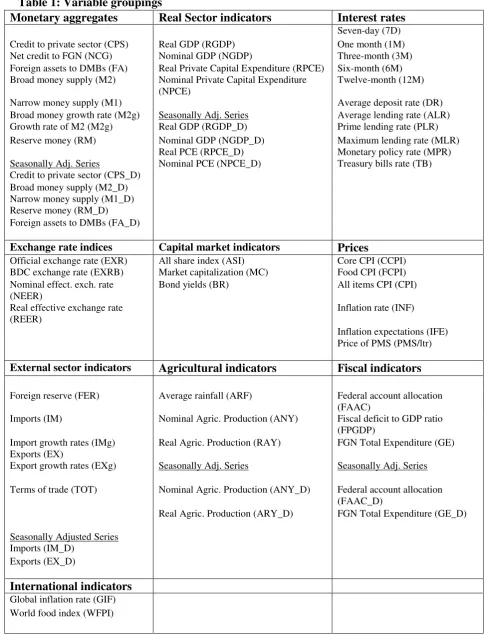
CPI (FCPI). The macroeconomic variables considered in the report are classified into 10 groups
as shown in Table 1.
INSERT TABLE 1 ABOUT HERE
The study adopts a factor-based approach to generate forecasts for each of the three measures
of inflation. This is because of the size of the predictors and the possibility of related variables
providing the same information in explaining the dependent variable. Therefore, principal
component analysis employed in the study is based on the underlying dataset2 consisting of 59
predictors which are classified into 10 groups as shown in Table 1. The principal components
are extracted for each group and used in the BMA model estimation and forecasting. The results
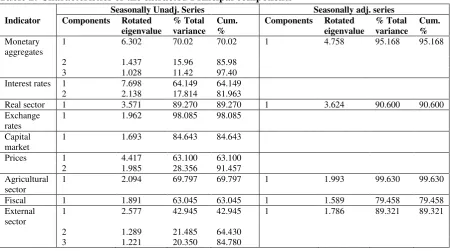
of the principal component analysis are presented in Tables 2 and 3. In Table 2, important
characteristics of the extracted principal components are presented. For the monetary
aggregates containing nine variables, three components were extracted and which accounts for
97.4 percent total variance.3 The first component accounts for 70.02 percent of the total
variance. For the seasonally adjusted monetary aggregates containing five variables, only one
component was extracted which accounts for 95.17 percent total variance. For the interest rate
indicators with 12 variables, two components are extracted. The first component accounts for
64.1 percent of total variance and cumulatively both components account for a total variance
of 81.96 percent. The real sector has four variables. The PCA analysis extracted one component
which accounts for 89.27 percent of the total variance. Exchange rates and capital market, each
2
This total number includes both seasonally adjusted and unadjusted series. Only series having observations from January 2002 to June 2017 are included in the analysis.
3
has one component extracted with total variance of 98.09 percent and 84.64 percent
respectively. The prices category has two extracted components, with the first accounting for
63.10 percent and both cumulatively accounts for 91.46 percent of the total variance. The
agricultural and fiscal categories have one component each with total variance of 69.80 percent
and 63.05 percent respectively. Lastly, for the external sector group, three components are
extracted from the PCA analysis. The first component accounts for up to 42.95 percent and the
three cumulatively accounts for 84.78 percent of the total variance.
INSERT TABLE 2 ABOUT HERE
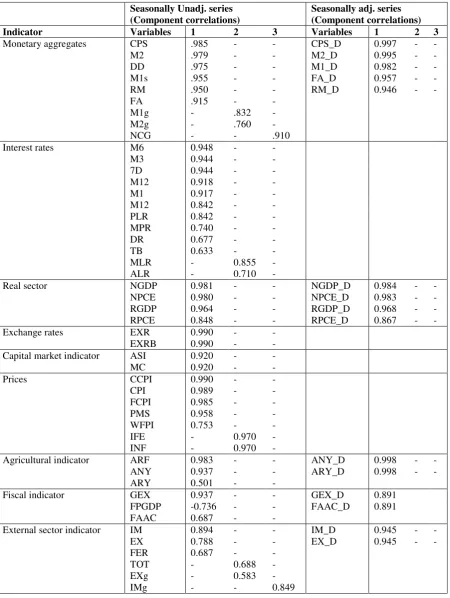
The identified variables in the principal components are presented in Table 3. We present the
results to include up to three components, as in the case of monetary aggregates and external
sector indicators. Generally, the PCA results that are presented in the report agree with the
peculiarity of the Nigerian economy. The first component of the monetary aggregates loads
only six variables. In the seasonally adjusted series, the CPS contributes most follow by the
broad money supply (M2) for both sets of data. For interest rate indicators, six-month interest
time/time deposit rate (M6) loads most with 0.948 correlation as compared to other variants of
interest rate in the principal component. For the real sector indicator, the highest loaded variable
is the nominal gross domestic product (NGDP) for both sets of data. In the case of prices, the
core consumer price index (CCPI) loads most with 0.99 correlation follow by all items CPI
with 0.98 correlation. The rest of the results are presented in Table 3. In all, 18 PCAs, each
representing an index for their respective category, are used as predictor variables in the BMA
model estimation and forecasting.
4.2 Model Forecast Performance
The forecast performance of the BMA model is evaluated using the forecast standard error (std
forecast) and the mean square error (MSE). The sample data is divided into two, namely,
training sample (January 2002 to February 2016) and testing sample (March 2016 to June
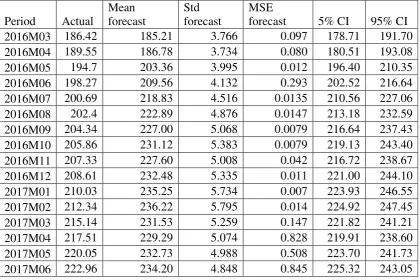
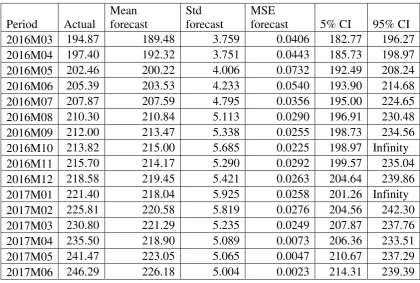
2017). The Tables 4 to 6 present the results for the testing sample for all items consumer price
index (CPI), core consumer price index (CCPI) and food consumer price index (FCPI),
respectively. The tables show the actual observation, the mean of the forecast density and the
forecast evaluation criteria. Altogether, the number of models visited by BMS (Bayesian Model
Selection) package used for the analysis is 24107 out of model space of 262144. Generally,
the results show low value (< 1.0) of MSE which ranges from 0.002 to 0.429. Looking at the
CPI, the mean forecast values are very close to the actual value. Also, the estimated credible
intervals give 95% confidence that inflation forecasts are within appreciable levels. Similarly,
the results follow for CCPI and FCPI. In all, the forecasts appeared to be reliable judging from
the various forecast performance criteria used.
INSERT TABLES 4-6 ABOUT HERE
4.3 Policy Scenarios and Simulations
In this section, analyses of three major policy scenarios are conducted. These are:
i. Baseline Scenario – assumes that all the predictor variables follow their historical pattern or movement up till June 2018.
ii. Expansionary Monetary Policy (EMP) Scenario– assumes a 5% monthly increase in money supply from July 2017 to June 2018.
iii. Contractionary Monetary Policy (CMP) Scenario – assumes a 5% monthly reduction in money supply from July 2017 to June 2018.
The baseline projections for the 59 predictor variables are made based on the assumption that
the variables will continue to follow their historical behaviour. To implement this, three
historical movement very closely particularly their turning points. The methods are
Holt-Winters’ multiplicative exponential smoothing method, Holt-Winters’ additive exponential smoothing method, and Holt-Winters’ (no seasonal) smoothing method. The software used for
the analysis is EViews 9 which can automatically search for the optimal smoothing
parameters.4
Effects of Monetary Policy Scenarios on All Items Consumer Price Index (CPI)
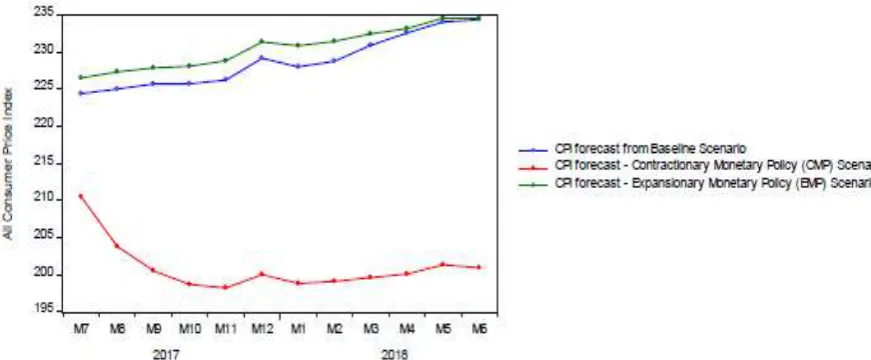
Figure 1 presents the forecast of all items CPI from July 2017 to June 2018 based on three
different scenarios (baseline, positive shock to M2 and negative shock to M2). With a positive
shock of 5% to monetary policy via broad money supply (M2), the CPI rises marginally above
the baseline scenario whereas a negative shock to M2 of the same magnitude leads to a huge
drop in all items CPI relative to the baseline scenario. Thus, upholding monetarist view on
inflation and supporting contractionary monetary policy as a veritable policy option for
achieving significant and consistent downward inflationary trend.
INSERT FIGURE 1 ABOUT HERE
Effects of Monetary Policy Scenarios on Core Consumer Price Index (CCPI)
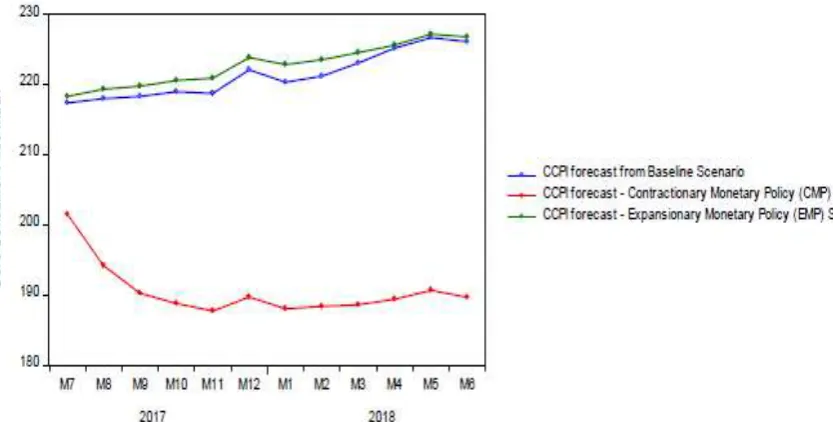
The response of the core CPI also follows the same pattern as the all item CPI. A positive shock
to M2 scenario leads to marginal increase in Core CPI above the baseline scenario but a similar
magnitude of negative shock yields a higher and consistent fall in the Core CPI (Figure 2).
INSERT FIGURE 2 ABOUT HERE
Effects of Monetary Policy Scenarios on Food Consumer Price Index (FCPI)
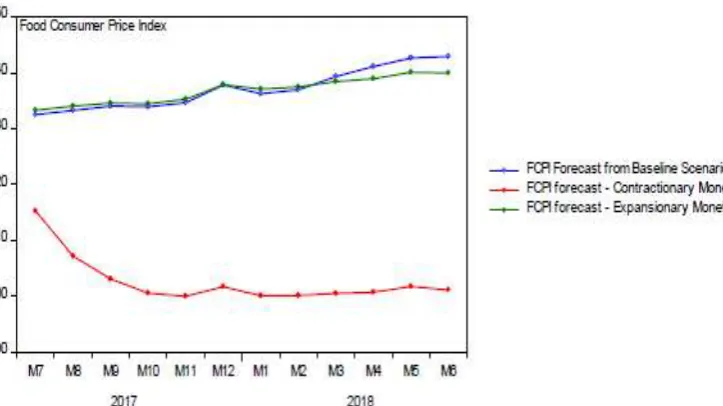
Figure 3 which presents the response of Food CPI to various types of shock to monetary
aggregates indicates that the response of Food CPI follows the same pattern as those of all item
CPI and Core CPI (Figure 3).
INSERT FIGURE 3 ABOUT HERE
4
5 Summary and Conclusion
Considering the adverse macroeconomic effect of inflation on welfare, fiscal budgeting, trade
performance, international competitiveness and the whole economy, it still remains a subject
of utmost concern and interest to policy makers. Thus, the historical path of inflation is not
only monitored by monetary authorities in both developed and developing countries, but
attempt is also often made to determine its future path. This is done by using various
methodologies which have been criticized to be defective in forecasting inflation. The large
number of macroeconomic variables included in forecasting inflation, according to the critics
of those methodologies, makes model selection cumbersome and difficult, hence the resort to
the use of BMA which obtained the best predictive performance averaging forecasts
constructed from several models. This study uses the Bayesian model averaging (BMA)
methodology to determine the predictors of inflation for Nigeria as well as forecast its future
path using a wide range of variables. The study derived eighteen (18) PCAs from sixty-three
(63) independent variables divided into ten groups and adopted the BMA and Frequentist
Model Averaging (FMA) as model averaging algorithms. Recognizing predictor variables as
either focused or auxiliary regressors, three different measures of inflation were estimated as
objective functions.
The results indicate that both in-sample and out-of-sample forecasts were highly
reliable judging from the various forecast performance criteria. The values of MSE were very
low (< 1.0) and ranges from 0.002 to 0.429; the mean forecast values of inflation rates were
very close to the actual values and the estimated credible intervals give 95% confidence that
inflation forecasts are within appreciable levels.
Various policy scenarios conducted were highly fascinating both from the theoretical
both positive and negative shocks to monetary aggregates moderate CPI inflation but with
higher magnitude for negative shocks. This study strongly recommends that, if the fiscal sector
is expected to maintain the current trend of expenditure up to June 2018, the Central Bank of
Nigeria, even with the objective of curtailing inflationary spiral, can embark on accommodative
monetary policy. This stems from the fact that it is capable, given the current economic
situation, of aiding recovery from recession without fueling inflation. It is however pertinent
to mention that restrictive monetary policy still proves more effective and efficient in curtailing
inflation.
References
Adams, S.O., Awujola, A. and Alumgudu, A.I. (2014). Modelling Nigeria’s Consumer Price Index using ARIMA Model. International Journal of Development and Economic
Sustainability, 2(2), 37 – 47.
Amadi, I. U., Gideon, W. O. & Nnoka, L. C. (2013). Time Series Models on Nigerian Monthly Inflation Rate Series. International Journal of Physical, Chemical and Mathematical Sciences, 2(2), 124-128.
Altug, S. and Cakmakli, C. (2015). Forecasting inflation using survey expectations and target inflation: Evidence for Brazil and Turkey. University of Amsterdam Working paper No IAAE2015-580.
Ang, A., Bekaert, G. and Wei, M. (2007). Do Macro Variables, Asset Markets, or Surveys Forecast Inflation Better? Journal of Monetary Economics, 54, 1163-1212.
Atkeson, A. and Ohanian, L.E. (2001). Are Phillips curves useful for forecasting inflation? Quarterly Federal Reserve Bank of Minneapolis, Winter 2001: pp. 1-12.
Bjornland, H.C., Gerdrup, K., Jore, A.S., Smith, C. and Thorsrud, L.A. (2009). Does forecast combination improve Norges Bank inflation forecasts? Working paper, Economics
Department, Norges Bank, Norway.
Blinder A.S. (1997). Is there a core of practical macroeconomics that we should all believe? American Economic Review, 87, 240-250.
Bruneau, C., DeBandt, O. and Flageollet, A. (2003). Forecasting inflation in the Euro area. Banque de France, Working paper series NER #102.
Buckland, S.T., Burnham, K.P. and Augustin, N.H. (1997). Model selection: an integral part of inference. Biometrics, 53, 603-618.
Chinonso, U.E. and Justice, O.I. (2016). Modelling Nigeria’s Urban and Rural Inflation
usingBox-Jenkins Model. Scientific Paper Series on Management, Economic Engineering in Agriculture and Rural Development, 16(4), pp 61 – 68.
Claeskens, G., and Hjort, N.L. (2003). The focused information criterion. Journal of the American Statistical Association, 98, 900-916.
Claeskens, G., and Hjort, N. L. (2008). Model selection and model averaging. Cambridge: Cambridge University Press.
Doguwa, I. S. and Alade, O. A. (2013). Short-term Inflation Forecasting Models in Nigeria. CBN Journal of Applied Statistics, 4(2), 1 – 29.
Duncan, R. and Martinez-Garcia, E. (2015). Forecasting Inflation with Global Inflation: When Economic Theory Meets the Facts. Paper presented at the 35th International Symposium on Forecasting, International Institute of Forecasters, Riverside, USA - June 21-24, 2015.
Fedderke, J. and Liu, Y. (2016). Inflation in South Africa: An assessment of alternative inflation models. South African Reserve Bank Working Paper series No. WP/16/03.
Figueiredo, F.M.D. (2010). Forecasting Brazilian inflation using a large dataset. The Banco Central do Brasil Working paper series No. 228.
Fujiwara, I. and Koga, M. (2002). A statistical forecasting method for inflation forecasting. Research and Statistics Department, Bank of Japan working paper 02-5.
Gaomab, M. (1998). Modelling inflation in Namibia. Bank of Namibia Occasional paper No. 1.
Giannone, D., Lenza, M., Momferatou, D. and Onorante, L. (2014). Short-term inflation projections: A Bayesian vector approach. International Journal of Forecasting, 30(3), 635- 644.
Groen J., Paap, R. and Ravazzolo, F. (2009). Real-time Inflation Forecasting in a Changing World. Econometric Institute Report, 2009-19, Erasmus University Rotterdam.
Hansen, B.E. (2007). Least Squares Model Averaging. Econometrica, 75, 1175-1189.
Hansen, B.E. (2008). Least-squares forecast averaging. Journal of Econometrics, 146(2), 342- 350.
Hansen, B.E. and Racine, J.S. (2012). Jackknife model averaging. Journal of Econometrics, 167(1), 38-46.
Hjort, N. L. and Claeskens, G. (2003). Frequentist model average estimators. Journal of the American Statistical Association, 98(464), 879-899.
Inam, U.S. (2017). Forecasting Inflation in Nigeria: A vector Autoregression Approach. International Journal of Economics, Commerce and Management, 5(1), 92 – 104.
Iwok, I.A. and Udoh, G.M. (2016). A Comparative study between the ARIMA-Fourier model and the Wavelet model. American Journal of Scientific and Industrial Research, 2016,
7(6):137-144.
John, E.E. and Patrick, U.U. (2016). Short-Term Forecasting of Nigeria Inflation Rates using Seasonal ARIMA Model. Science Journal of Applied Mathematics and Statistics, 4(3), 101- 107.
Kelikume, I. and Salami, A. (2014). Time Series Modeling and Forecasting Inflation: Evidence from Nigeria. The International Journal of Business and Finance Research, 8(2), 41 – 51.
Kuhe, D.A. and Egemba, R.C. (2016). Modelling and Forecasting CPI Inflation in Nigeria: Application of Autoregressive Integrated Moving average Homoskedastic Model. Journal of Scientific and engineering Research, 3(2), 57-66.
Lansing, K.J. (2002). Can the Phillips curve help forecast inflation?, FRBSF Economic Letter, Federal Reserve Bank of San Francisco, issue Oct 4.
Leamer, E.E. (1978). Specification Searches: Ad Hoc Inference with Nonexperimental Data, Wiley, New York.
Mallows, C.L. (1973). Some comments on C p. Technometrics, 15(4), 661-675.
Min, C.K. and Zellner, A. (1993). Bayesian and non-Bayesian methods for combining models and forecasts with applications to forecasting international growth rates. Journal of
Econometrics, 56(1-2), 89-118.
Moral‐ Benito, E. (2015). Model averaging in economics: An overview. Journal of Economic Surveys, 29(1), 46-75.
Okafor, C. and Shaibu, I. (2013). Application of ARIMA models to Nigerian Inflation dynamics. Research Journal of Finance and Accounting, 4(3): 138-150.
Omekara, C.O., Ekpenyong, E.J. and Ekerete, M.P. (2013). Modeling the Nigeria Inflation Rates using Periodogram and Fourier Series Analysis. CBN Journal of Applied Statistics, 4(2), 51-68.
Onimode, B.M., Alhassan, J.K. and Adepoju, S.A. (2015). Comparative Study of Inflation Rates Forecasting Using Feed-Forward Artificial Neural Networks and Auto-Regressive (AR) Models. International Journal of Computer Science Issues, 12(2), 260-266.
Otu, A.O., Osuji, G.A., Jude, O., Ifeyinwa, M.H. and Andrew, I.I. (2014). Application of
SARIMA Models in Modeling and Forecasting Nigeria’s Inflation Rates. American Journal of Applied mathematics and Statistics, 2(1), 16 – 28.
Stock, J.H. and Watson, M.W. (1999). Forecasting inflation. Journal of Monetary Economics, 44(2), 293-335.
Stock, J. H. and Watson, M.W. (2004). Combination forecasts of output growth in a seven‐ country data set. Journal of Forecasting, 23(6), 405-430.
Stock, J.H. and Watson, M.W. (2005). An empirical comparison of methods for forecasting using many predictors. Manuscript, Princeton University.
Stock, J.H. and Watson, M.W. (2006). Forecasting with many predictors. Handbook of economic forecasting, 1, 515-554.
Stock J. H. and Watson, M.W. (2008). Philips Curve Inflation Forecasts. NBER Working Paper No. 14322. vs. 0.3.0, URL: http://cran.r-project.org/web/packages/BMS/
Sims, C.A. (2002). The role of models and probabilities in the monetary policy process. Brookings Papers on Economic Activity, 1-40.
Waiquamdee, A. (2001). Modelling the inflation process in Thailand. BIS Papers No. 8: 252- 263.
Wright, J.H. (2008). Bayesian model averaging and exchange rate forecasts. Journal of Econometrics, 146(2), 329-341.
Wright, J. H. (2009). Forecasting US inflation by Bayesian model averaging. Journal of Forecasting, 28(2), 131-144.
Yemitan, R.A. and Shittu, O.I. (2015). Forecasting Inflation in Nigeria by State Space Modeling. International Journal of Scientific and Engineering Research, 6(8), 778-786.
Younus, S. and Roy, A. (2016). Forecasting inflation and output in Bangladesh: Evidence from a VAR model. Research department and Monetary Policy Department of Bangladesh Bank Working Paper series WP No. 1610.
Table 1: Variable groupings
Monetary aggregates Real Sector indicators Interest rates
Seven-day (7D) Credit to private sector (CPS) Real GDP (RGDP) One month (1M) Net credit to FGN (NCG) Nominal GDP (NGDP) Three-month (3M) Foreign assets to DMBs (FA) Real Private Capital Expenditure (RPCE) Six-month (6M) Broad money supply (M2) Nominal Private Capital Expenditure
(NPCE)
Twelve-month (12M) Narrow money supply (M1) Average deposit rate (DR) Broad money growth rate (M2g) Seasonally Adj. Series Average lending rate (ALR) Growth rate of M2 (M2g) Real GDP (RGDP_D) Prime lending rate (PLR) Reserve money (RM) Nominal GDP (NGDP_D) Maximum lending rate (MLR)
Real PCE (RPCE_D) Monetary policy rate (MPR) Seasonally Adj. Series Nominal PCE (NPCE_D) Treasury bills rate (TB) Credit to private sector (CPS_D)
Broad money supply (M2_D) Narrow money supply (M1_D) Reserve money (RM_D) Foreign assets to DMBs (FA_D)
Exchange rate indices Capital market indicators Prices
Official exchange rate (EXR) All share index (ASI) Core CPI (CCPI) BDC exchange rate (EXRB) Market capitalization (MC) Food CPI (FCPI) Nominal effect. exch. rate
(NEER)
Bond yields (BR) All items CPI (CPI) Real effective exchange rate
(REER)
Inflation rate (INF) Inflation expectations (IFE) Price of PMS (PMS/ltr)
External sector indicators Agricultural indicators Fiscal indicators
Foreign reserve (FER) Average rainfall (ARF) Federal account allocation (FAAC)
Imports (IM) Nominal Agric. Production (ANY) Fiscal deficit to GDP ratio (FPGDP)
Import growth rates (IMg) Real Agric. Production (RAY) FGN Total Expenditure (GE) Exports (EX)
Export growth rates (EXg) Seasonally Adj. Series Seasonally Adj. Series Terms of trade (TOT) Nominal Agric. Production (ANY_D) Federal account allocation
(FAAC_D)
Real Agric. Production (ARY_D) FGN Total Expenditure (GE_D) Seasonally Adjusted Series
Imports (IM_D) Exports (EX_D)
International indicators
Table 2: Characteristics of the extracted Principal components
Seasonally Unadj. Series Seasonally adj. series Indicator Components Rotated
eigenvalue
% Total variance
Cum. %
Components Rotated eigenvalue
% Total variance
Cum. %
Monetary aggregates
1 6.302 70.02 70.02 1 4.758 95.168 95.168
2 1.437 15.96 85.98
3 1.028 11.42 97.40
Interest rates 1 7.698 64.149 64.149
2 2.138 17.814 81.963
Real sector 1 3.571 89.270 89.270 1 3.624 90.600 90.600
Exchange rates
1 1.962 98.085 98.085
Capital market
1 1.693 84.643 84.643
Prices 1 4.417 63.100 63.100
2 1.985 28.356 91.457
Agricultural sector
1 2.094 69.797 69.797 1 1.993 99.630 99.630
Fiscal 1 1.891 63.045 63.045 1 1.589 79.458 79.458
External sector
1 2.577 42.945 42.945 1 1.786 89.321 89.321
2 1.289 21.485 64.430
Table 3: Identified principal components showing variables
Seasonally Unadj. series (Component correlations)
Seasonally adj. series (Component correlations)
Indicator Variables 1 2 3 Variables 1 2 3
Monetary aggregates CPS .985 - - CPS_D 0.997 - - M2 .979 - - M2_D 0.995 - - DD .975 - - M1_D 0.982 - - M1s .955 - - FA_D 0.957 - - RM .950 - - RM_D 0.946 - - FA .915 - -
M1g - .832 - M2g - .760 - NCG - - .910 Interest rates M6 0.948 - -
M3 0.944 - - 7D 0.944 - - M12 0.918 - - M1 0.917 - - M12 0.842 - - PLR 0.842 - - MPR 0.740 - - DR 0.677 - - TB 0.633 - - MLR - 0.855 - ALR - 0.710 -
Real sector NGDP 0.981 - - NGDP_D 0.984 - - NPCE 0.980 - - NPCE_D 0.983 - - RGDP 0.964 - - RGDP_D 0.968 - - RPCE 0.848 - - RPCE_D 0.867 - - Exchange rates EXR 0.990 - -
EXRB 0.990 - - Capital market indicator ASI 0.920 - - MC 0.920 - - Prices CCPI 0.990 - - CPI 0.989 - - FCPI 0.985 - - PMS 0.958 - - WFPI 0.753 - - IFE - 0.970 - INF - 0.970 -
Agricultural indicator ARF 0.983 - - ANY_D 0.998 - - ANY 0.937 - - ARY_D 0.998 - - ARY 0.501 - -
Fiscal indicator GEX 0.937 - - GEX_D 0.891 FPGDP -0.736 - - FAAC_D 0.891 FAAC 0.687 - -
External sector indicator IM 0.894 - - IM_D 0.945 - - EX 0.788 - - EX_D 0.945 - - FER 0.687 - -
Table 4: Forecasts for CPI
Period Actual
Mean forecast
Std forecast
MSE
forecast 5% CI 95% CI
2016M03 189.94 186.91 3.368 0.078 180.96 192.87
2016M04 192.99 189.23 3.361 0.064 183.38 195.09
2016M05 198.3 201.11 3.613 0.075 194.07 208.15
2016M06 201.7 206.58 3.861 0.043 196.63 215.81
2016M07 204.23 213.64 4.356 0.024 200.15 227.44
2016M08 206.29 217.78 4.668 0.019 203.25 236.05
2016M09 207.96 221.31 4.884 0.016 206.23 Infinity 2016M10 209.68 224.52 5.182 0.014 208.82 Infinity 2016M11 211.33 221.91 4.829 0.021 206.78 Infinity
2016M12 213.56 226.93 5.060 0.016 211.26 246.69
2017M01 215.72 228.97 5.433 0.016 212.18 Infinity
2017M02 218.95 230.43 5.384 0.018 213.84 250.17
2017M03 222.71 227.66 4.842 0.032 213.58 240.76
2017M04 226.27 224.48 4.690 0.055 211.96 236.01
2017M05 230.53 228.35 4.629 0.057 216.37 239.44
2017M06 234.17 230.48 4.507 0.058 219.75 240.52
Table 5: Forecasts for CCPI
Period Actual
Mean forecast
Std forecast
MSE
forecast 5% CI 95% CI
2016M03 186.42 185.21 3.766 0.097 178.71 191.70
2016M04 189.55 186.78 3.734 0.080 180.51 193.08
2016M05 194.7 203.36 3.995 0.012 196.40 210.35
2016M06 198.27 209.56 4.132 0.293 202.52 216.64
2016M07 200.69 218.83 4.516 0.0135 210.56 227.06
2016M08 202.4 222.89 4.876 0.0147 213.18 232.59
2016M09 204.34 227.00 5.068 0.0079 216.64 237.43
2016M10 205.86 231.12 5.383 0.0079 219.13 243.40
2016M11 207.33 227.60 5.008 0.042 216.72 238.67
2016M12 208.61 232.48 5.335 0.011 221.00 244.10
2017M01 210.03 235.25 5.734 0.007 223.93 246.55
2017M02 212.34 236.22 5.795 0.014 224.92 247.45
2017M03 215.14 231.53 5.259 0.147 221.82 241.21
2017M04 217.51 229.29 5.074 0.828 219.91 238.60
2017M05 220.05 232.73 4.988 0.508 223.70 241.73
[image:32.595.78.499.417.697.2]Table 6: Forecasts for FCPI
Period Actual
Mean forecast
Std forecast
MSE
forecast 5% CI 95% CI
2016M03 194.87 189.48 3.759 0.0406 182.77 196.27
2016M04 197.40 192.32 3.751 0.0443 185.73 198.97
2016M05 202.46 200.22 4.006 0.0732 192.49 208.24
2016M06 205.39 203.53 4.233 0.0540 193.90 214.68
2016M07 207.87 207.59 4.795 0.0356 195.00 224.65
2016M08 210.30 210.84 5.113 0.0290 196.91 230.48
2016M09 212.00 213.47 5.338 0.0255 198.73 234.56
2016M10 213.82 215.00 5.685 0.0225 198.97 Infinity
2016M11 215.70 214.17 5.290 0.0292 199.57 235.04
2016M12 218.58 219.45 5.421 0.0263 204.64 239.86
2017M01 221.40 218.04 5.925 0.0258 201.26 Infinity
2017M02 225.81 220.58 5.819 0.0276 204.56 242.30
2017M03 230.80 221.29 5.235 0.0249 207.87 237.76
2017M04 235.50 218.90 5.089 0.0073 206.36 233.51
2017M05 241.47 223.05 5.065 0.0047 210.67 237.29