Parsing Non-Recursive Context-Free Grammars
Mark-Jan Nederhof
Faculty of Arts University of Groningen
P.O. Box 716
NL-9700 AS Groningen, The Netherlands [email protected]
Giorgio Satta
Dip. di Elettronica e Informatica Universit`a di Padova
via Gradenigo, 6/A I-35131 Padova, Italy [email protected]
Abstract
We consider the problem of parsing non-recursive context-free grammars, i.e., context-free grammars that generate finite languages. In natural language process-ing, this problem arises in several areas of application, including natural language generation, speech recognition and ma-chine translation. We present two tabu-lar algorithms for parsing of non-recursive context-free grammars, and show that they perform well in practical settings, despite the fact that this problem is PSPACE-complete.
1 Introduction
Several applications in natural language processing require “parsing” of a large but finite set of candidate strings. Here parsing means some computation that selects those strings out of the finite set that are well-formed according to some grammar, or that are most likely according to some language model. In these applications, the finite set is typically encoded in a compact way as a context-free grammar (CFG) that is non-recursive. This is motivated by the fact that non-recursive CFGs allow very compact represen-tations for finite languages, since the strings deriv-able from single nonterminals may be substrings of many different strings in the language. Unfolding such a grammar and parsing the generated strings
Secondary affiliation is the German Research Center for Artificial Intelligence (DFKI).
one by one then leads to an unnecessary duplica-tion of subcomputaduplica-tions, since each occurrence of a repeated substring has to be independently parsed. As this approach may be prohibitively expensive, it is preferable to find a parsing algorithm that shares subcomputations among different strings by work-ing directly on the nonterminals and the rules of the non-recursive CFG. In this way, “parsing” a nonter-minal of the grammar amounts to shared parsing of all the substrings encoded by that nonterminal.
To give a few examples, in some natural lan-guage generation systems (Langkilde, 2000) non-recursive CFGs are used to encode very large sets of candidate sentences realizing some input con-ceptual representation (Langkilde calls such gram-mars forests). Each CFG is later “parsed” using a language model, in order to rank the sentences in the set according to their likelyhood. Similarly, in some approaches to automatic speech understand-ing (Corazza and Lavelli, 1994) the
-best sen-tences obtained from the speech recognition module are “compressed” into a non-recursive CFG gram-mar, which is later provided as input to a parser. Fi-nally, in some machine translation applications re-lated techniques are exploited to obtain sentences that simultaneously realize two different conceptual representations (Knight and Langkilde, 2000). This is done in order to produce translations that preserve syntactic or semantic ambiguity in cases where the ambiguity could not be resolved when processing the source sentence.
To be able to describe the above applications in an abstract way, let us first fix some terminology. The term “recognition” refers to the process of deciding
whether an input string is in the language described by a grammar, the parsing grammar . We will
generalize this notion in a natural way to input rep-resenting a set of strings, and here the goal of recog-nition is to decide whether at least one of the strings in the set is in the language described by . If the
input is itself given in the form of a grammar, the input grammar, then recognition amounts to
de-termining whether the intersection of the languages described by and is non-empty. In this paper
we use the term parsing as synonymous to recog-nition, since the recognition algorithms we present can be easily extended to yield parse trees (with as-sociated probabilities if either or or both are
probabilistic).
In what follows we consider the case where both and are CFGs. General CFGs have
un-favourable computational properties with respect to intersection. In particular, the problem of deciding whether the intersection of two CFGs is non-empty is undecidable (Harrison, 1978). Following the ter-minology adopted above, this means that parsing a context-free input grammar on the basis of a
context-free parsing grammar is not possible in
general.
One way to make the parsing problem decidable is to place some additional restrictions on or
. This direction is taken by Langkilde (2000), where is a non-recursive CFG and
repre-sents a regular language, more precisely an
-gram model. In this way the problem can be solved us-ing a stochastic variant of an algorithm presented by Bar-Hillel et al. (1964), where it is shown that the intersection of a general context-free language and a regular language is still context-free.
In the present paper we leave the theoretical framework of Bar-Hillel et al. (1964), and consider parsing grammars that are unrestricted CFGs,
and input grammars that are non-recursive
context-free grammars. In this case the parsing (in-tersection) problem becomes PSPACE-complete.1
Despite of this unfavourable theoretical result, algo-rithms for the problem at hand have been proposed in the literature and are currently used in practical applications. In (Knight and Langkilde, 2000) is
1
The PSPACE-hardness result has been shown by Harry B. Hunt III and Dan Rosenkrantz (Harry B. Hunt III, p.c.). Mem-bership in PSPACE is shown by Nederhof and Satta (2002).
unfolded into a lattice (acyclic finite automaton) and later parsed with using an algorithm close to the
one by Bar-Hillel et al. (1964). The algorithm pro-posed by Corazza and Lavelli (1994) involves copy-ing of charts, and this makes it very similar in be-haviour to the former approach. Thus in both al-gorithms parts of the input grammar are copied
where a nonterminal occurs more than once, which destroys the compactness of the representation. In this paper we propose two alternative tabular algo-rithms that exploit the compactness of as much
as possible. Although a limited amount of copying is also done by our algorithms, this never happens in cases where the resulting structure is ungrammatical with respect to the parsing grammar .
The structure of this paper is as follows. In Sec-tion 2 we introduce some preliminary definiSec-tions, followed in Section 3 by a first algorithm based on CKY parsing. A more sophisticated algorithm, sat-isfying the equivalent of the correct-prefix property and based on Earley’s algorithm, is presented in Sec-tion 4. SecSec-tion 5 presents our experimental results and Section 6 closes with some discussion.
2 Preliminaries
In this section we briefly recall some standard no-tions from formal language theory. For more details we refer the reader to textbooks such as (Harrison, 1978).
A context-free grammar is a 4-tuple
, where is a finite set of terminals, called the
alphabet, is a finite set of nonterminals, including
the start symbol , and
is a finite set of rules hav-ing the form with ! and"#$&%'
. Throughout the paper we assume the following con-ventions: ,()+*,*+* denote nonterminals,- ,./+*,*,*
de-note terminals,0 , 1 , are strings in $2%!
and
3
54 are strings in . We also assume that each
CFG is reduced, i.e., no CFG contains nonterminals that do not occur in any derivation of a string in the language. Furthermore, we assume that the input grammars do not contain epsilon rules and that there is only one rule67 defining the start symbol .
2
Finally, in Section 3 we will consider parsing gram-2
mars in Chomsky normal form (CNF), i.e., gram-mars with rules of the form8(:9 or7- .
Instead of working with non-recursive CFGs, it will be more convenient in the specification of our algorithms to encode as a push-down automaton
(PDA) with stack size bounded by some constant. Unlike many text-books, we assume PDAs do not have states; this is without loss of generality, since states can be encoded in the symbols that occur top-most on the stack. Thus, a PDA is a 5-tuple <;= >?A@+?CB
>ED @/F5G <H
, where is the alphabet as above, ; is a finite set of stack symbols including the initial
stack symbol> ?A@+?IB
and the final stack symbol>ED @/F5G
, andH is the set of transitions, having one of the
fol-lowing three forms: >KJ
>ML
(a push transition),
>MLNJ
O (a pop transition), or > JP
L
(a scan transition, scanning symbol- ). Throughout this
pa-per we use the following conventions: Q"
>
L
RO
denote stack symbols and S'UTVXW are strings in ;
representing stacks. We remark that in our notation stacks grow from left to right, i.e., the top-most stack symbol will be found at the right end.
Configurations of the PDA have the form YS'54
, whereSZM; is a stack and 4[\ is the
remain-ing input. We let the binary relation] be defined by: ^W_S' 3 4 ]`aWbT'X4
if and only if there is a transi-tion in H of the form S
J
cT , where 3edgf
, or of the form S
P
J
T , where 3hd
- . The relation ]
denotes the reflexive and transitive closure of] . An
input string4 is recognized by the PDA if and only
if >)?i@+?CB 54 ] >ED @/F5G f .
3 The CKY algorithm
In this section we present our first parsing algorithm, based on the so-called CKY algorithm (Harrison, 1978) and exploiting a decomposition of computa-tions of PDAs cast in a specific form. We start with a construction that translates the non-recursive input CFG into a PDA accepting the same language.
Let
d
$)R
. The PDA associated with is specified as
)X;=kjl&m/nkjo6pm/nqH
where; consists of symbols of the form jrs0#m 1tn forY0u1
, andH contains the following
transitions:
m For each pair of rulesvw0u(x1 and(yw , H contains: j70zm(x1tn J j70zm(x1tnujo(r7mkn and j70zm(x1tn{jo(r|m}n J
Kj70u(rm1tn. m For each rule 0~-1 , H contains:
j70zm-1tn
P
J
wj70~-m1tn.
Observe that for all PDAs constructed as above, no push transition can be immediately followed by a pop transition, i.e., there are no stack symbols>
,
L
and O such that >J
>ML
and>MLJ
O . As
a consequence of this, a computation >?A@+?IB X4 ] >|D @/F5G f
of the PDA can always and uniquely be decomposed into consecutive subcomputations, which we call segments, each starting with zero or more push transitions, followed by a single scan transition and by zero or more pop transitions. In what follows, we will formalize this basic idea and exploit it within our parsing algorithm.
We writeS
P
d{
T to indicate that there is a
com-putation
] aT'
f
of the PDA such that all of the following three conditions hold:
(i) either S d2
or T dr
;
(ii) the computation starts with zero or more push transitions, followed by one scan transition reading- and by zero or more pop transitions;
(iii) if S
then the top-most symbol ofS must
be in the right-hand side of a pop or scan tran-sition (i.e., top-most in the stack at the end of a previous segment) and if T t
, then the top-most symbol ofT must be the left-hand side of
a push or scan transition (i.e., top-most in the stack at the beginning of a following segment). Let$^ dr >?A@+?CBU % O > L j >MLyJ O n % L > 5-~j > JP
L
n
, and ' d8
>ED @/F5G
% > L j >NJ >ML n % > L X-{j > JP
L
n
. A formal definition of relation
above is provided in Figure 1 by means of a deduction system. We assign a procedural interpretation to such a system follow-ing Shieber et al. (1995), resultfollow-ing in an algorithm for the computation of the relation.
We now turn to an important property of seg-ments. Any computation
> ?i@+?CB 5-b{+,X- ] >|D @/F5G f ,
> P d{ L > P J L (1) > P d{ L Q P d~ O ¡ Q J ¢Q > Q LrJ £O (2) S > P d~ L QS > P d{ O ¡ Q L¤J ¢O > M$<a (3) > P d~ S L Q P d~ QS L ¡ Q J ¢Q > L ¥' (4)
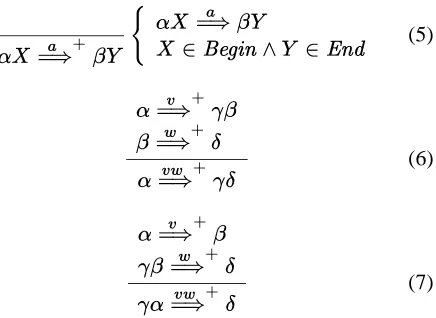
Figure 1: Inference rules for the computation of re-lation . S > P d{:¦ T L ¡ S > P d~ T L > ¥$^¨§ L &V© (5) S ª d{:¦ WT T¬« d{:¦¥ S¤ª®« d~ ¦ W (6) Scª d~ ¦ T WT¬« d~Z¦z W_S¤ªq« d{:¦M (7)
Figure 2: Inference rules for combining segments
S Pq¯ d~
T .
segments represented byS Pq¯ d{
T_ ,
°±|° ,
withS
d
>?A@+?CB
,T
d
>ED @/F5G
, and for )°r±² , T_ is a suffix ofS
¦
or S
¦
is a suffix of
T_. This
is done by the deduction system given in Figure 2, which defines the relation d{
¦ . The second
side-condition of inference rule (5) checks whether a seg-mentS
> P d{
T
L
may border on other segments, or may be the first or last segment in a computation.
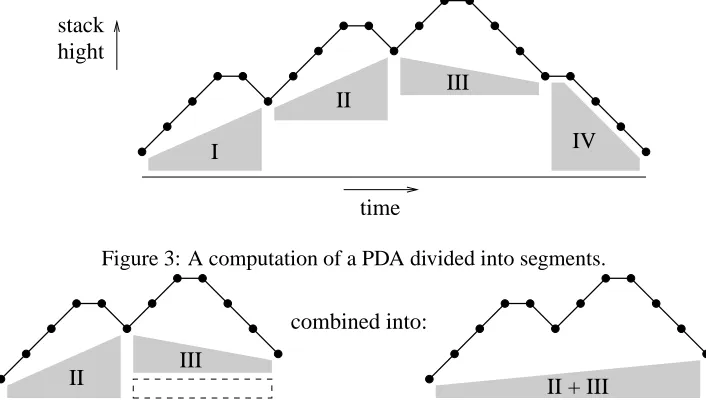
Figure 3 illustrates a computation of a PDA rec-ognizing a string- -³q-´R-tµ . A horizontal line
seg-ment in the curve represents a scan transition, an up-ward line segment represents a push transition, and a downward line segment a pop transition. The shaded areas represent segmentsS
Pq¯ d~
T . As an example,
the area labelled I represents>?A@+?IB P+¶ d~ >?A@+?IB·> > ³ ,
for certain stack symbols and
³ , where the left
edge of the shaded area represents >?A@+?IB
and the right edge represents > ?i@+?CB >
>
³ . Note that
seg-mentsS Pq¯ d{
Tb abstract away from the stack
sym-bols that are pushed and then popped again. Fur-thermore, in the context of the whole computation, segments abstract away from stack symbols that are not accessed during a subcomputation. As an exam-ple, the shaded area labelled III represents segment
L L ³ PR¸ d{
O , for certain stack symbols
L
,
L
³ and O , and this abstracts away from the stack symbols
that may occur belowL
andO .
Figure 4 illustrates how two adjacent segments are combined. The dashed box in the left-hand side of the picture represents stack symbols from the right edge of segment II that need not be explicitly repre-sented by segment III, as discussed above. We may assume that these symbols exist, so that II and III can be combined into the larger computation in the right-hand side of the picture. Note that if a com-putationS «
d{:¦
T is obtained as the combination
of two segments as in Figure 4, then some internal details of these segments are abstracted away, i.e., stack elements that were pushed and again popped in the combined computation are no longer recorded. This abstraction is a key feature of the parsing al-gorithm to be presented next, in that it considerably reduces the time complexity as compared with that of an algorithm that investigates all computations of the PDA in isolation.
We are now ready to present our parsing algo-rithm, which is the main result of this section. The algorithm combines the deduction system in Fig-ure 2, as applied to the PDA encoding the input grammar , with the CKY algorithm as applied to
the parsing grammar . (We assume that is
in CNF.) The parsing algorithm may rule out many combinations of segments from Figure 2 that are in-consistent with the language generated by . Also
ruled out are structural compositions of segments that are inconsistent with the structure that
as-signs to the corresponding substrings.
The parsing algorithm is again specified as a de-duction system, presented in Figure 5. The algo-rithm manipulates items of the formjEXS¹ºTn, where is a nonterminal of andS ,T are stacks of the
stack hight
time I
II III
[image:5.612.129.482.25.231.2]IV
Figure 3: A computation of a PDA divided into segments.
II III
combined into:
II + III
Figure 4: Combining two segments using rule (6) from Figure 2.
jEXS
>
ºT
L
n¼»½
¾
½¿
S
> P d{
T
L
>
¥$^¨§
L
¥V©
7-(8)
jo(!5S'XWTn jl9ºT'
n
j|5S'XW
n
h8(:9 (9)
j(!5S'UTn jo9XWT'
n
j|XW_S¹
n
[image:5.612.87.302.267.425.2]`¢(À9 (10)
Figure 5: Inference rules that simultaneously derive strings generated by and accepted by the PDA
encoding .
is some terminal string 4 that is derivable from
in , and such that YS'X4
] ÁT'
f
. If the item
jl >?A@+?IB
>|D @/F5G
n can be derived by the algorithm,
then the intersection of the language generated by and the language accepted by the PDA (gener-ated by) is non-empty.
4 Earley’s algorithm
The CKY algorithm from Figure 5 can be seen to filter out a selection of the computations that may be derived by the deduction system from Figure 2. One may however be even more selective in determining
which computations of the PDA to consider. The ba-sis for the algorithm in this section is Earley’s algo-rithm (Earley, 1970). This algoalgo-rithm differs from the CKY algorithm in that it satisfies the correct-prefix property (Harrison, 1978).
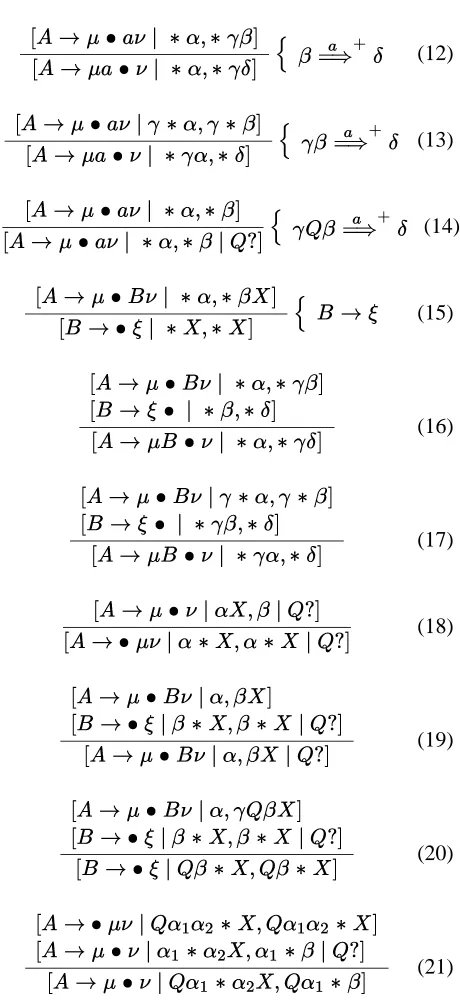
The new algorithm is presented by Figure 6. There are now two types of item involved. The first item has the form j 0Âm:1Z WÂÃ\S'UWÂÃ¥Tn,
where £ 0ÄmÅ1 has the same role as the
dot-ted rules in Earley’s original algorithm. The sec-ond and third components are stacks of the PDA as before, but these stacks now contain a distin-guished position, indicated by à . The existence of
an item jÆ 0 m¥1# WÃÇS'XWÃTn implies that ^W_S'
3
] ^WT'
f
, where 3
is now a string deriv-able from0 . This is quite similar to the meaning we
assigned to the items of the CKY algorithm, but here not all stack symbols inWS andWT are involved in
this computation: only the symbols inS andT are
now accessed, while all symbols inW remain
unaf-fected. The portion of the stack represented byW is
needed to ensure the correct-prefix property in sub-sequent computations following from this item, in case all of the symbols inT are popped.
The correct-prefix property is ensured in the fol-lowing sense. The existence of an item jÈc0m 1Ç +WMÃS¹UW¥ÃTn implies that (i) there is a string4
3
jl67m¨ Ã >)?i@+?CB
+Ã >)?i@+?CB
n
\7 (11)
j70zm-1 ÃS'+ÃWTn j70~-m1 ÃS'+Ã W
n
T
P
d~ ¦
(12)
j70zm-1 ÉWzÃS'XW¼ÃTun j70~-m1 à WS'ÉÃ
n
WT
P
d~
¦
(13)
j70zm-1 ÃS'+Ã Tn j`0zm-1 ÃS'+Ã Te /Q|Ê+n
W{Q=T
P
d{:¦
(14)
j`0zm(x1 ÃS'+ùT
>
n
j(rm¨ Ã
>
+Ã
>
n
(¤7 (15)
j70zm(x1 ÃS'+ÃWTn jo(r|mr à T'ÉÃ
n
j`0u(rm1 ÃS'+Ã W
n
(16)
j`0zm(x1 ÉWzÃS¹UWzà Tn jo(r7Emr ÃWT'+Ã
n
j`0u(rm1 ÃW_S¹ÉÃ
n
(17)
j70zm1 +S
>
UTe }QEÊÉn j`7m0u1 +SeÃ
>
5S#Ã
>
/Q|Ê+n
(18)
j70zm(x1Ç ÉS'UT
>
n
j(rm= qT#Ã
>
ºT#Ã
>
}QEÊÉn j70zm(x1 +S'ºT
>
/Q|Ê+n
(19)
j70zm(x1Ç ÉS'XW~QT
>
n
j(rm= qT#Ã
>
ºT#Ã
>
}QEÊÉn jo(rm=¨ /Q=T#Ã
>
qQT\Ã
>
n
(20)
jh7m=0u1Ç }QS
S˳=Ã
>
qQS
S̳=Ã
>
n
jh70zm1Ç ÉSV ÃS ³
>
5SV ùTÀ /Q|Ê+n j70zm1 /QS ÃS̳
>
RQS ÃTun
[image:6.612.72.302.54.555.2](21)
Figure 6: Inference rules based on Earley’s algo-rithm.
processing 4 , is expanded in a left-most
deriva-tion and some stack can be obtained of which WS
represent the top-most elements, and (ii)0 is
rewrit-ten to3
and while processing3
the PDA replaces the
stack elementsS byT .
3
The second type of item has the form jvw0Zm 1` _WÍÃÎS'XWyÃÅTÂ uQ|Ê+n. The first three
compo-nents are the same as before, andQ indicates that we
wish to know whether a stack with top-most symbols
QWS may arise after reading a prefix of a string that
may also lead to expansion of nonterminal in a
left-most derivation. Such an item results if it is de-tected that the existence ofQ belowW_S needs to be
ensured in order to continue the computation under the constraint of the correct-prefix property.
Our algorithm also makes use of segments, as computed by the algorithm from Figure 1. Con-sistently with rule (5) from Figure 2, we write
S
> P d~Z¦
T
L
to represent a segmentS > P
d{
T
L
such that>
:$<a)§
L
Z' . The use of
seg-ments that were computed bottom-up is a departure from pure left-to-right processing in the spirit of Ear-ley’s original algorithm. The motivation is that we have found empirically that the use of rule (2) was essential for avoiding a large part of the exponen-tial behaviour; note that that rule considers at most a number of stacks that is quadratic in the size of the PDA.
The first inference rule (11) can be easily justified: we want to investigate strings that are both generated by the grammar and recognized by the PDA, so we begin by combining the start symbol and a match-ing right-hand side from the grammar with the initial stack for the PDA.
Segments are incorporated into the left-to-right computation by rules (12) and (13). These two rules are the equivalents of (9) and (10) from Figure 5. Note that in the case of (13) we require the presence ofW below the marker in the antecedent. This
indi-cates that a stack with top-most symbolsW_S and a
dotted rule70zm-1 can be obtained by
simulta-neously processing a string from left to right by the grammar and the PDA. Thereby, we may continue the derivation with the item in the consequent with-out violating the correct-prefix property.
Rule (14) states that if a segment presupposes the existence of stack elements that are not yet available, we produce an item that starts a backward computa-tion. We do this one symbol at a time, starting with
3
We naturally assume that the PDA itself satisfies the correct-prefix property, which is guaranteed by the construction from Section 3 and the fact thatÏ
the symbolQ just beneath the part of the stack that is
already available. This will be discussed more care-fully below.
The predictor step of Earley’s algorithm is repre-sented by (15), and the completer step by rules (16) and (17). These latter two are very similar to (12) and (13) in that they incorporate a smaller derivation in a larger derivation.
Rules (18) and (19) repeat computations that have been done before, but in a backward manner, in or-der to propagate the information that deeper stack symbols are needed than those currently available, in particular that we want to know whether a certain stack symbolQ may occur below the currently
avail-able parts of the stack. In (18) this query is passed on to the beginning of the context-free rule, and in (19) this query is passed on backwards through a predic-tor step. In the antecedent of rule (18) the position of the marker is irrelevant, and is not indicated explic-itly. Similarly, for rule (19) we assume the position of the marker is copied unaltered from the first an-tecedent to the consequent.
If we find the required stack symbolQ , we
prop-agate the information forward that this symbol may indeed occur at the specified position in the stack. This is implemented by rules (20) and (21). Rule (20) corresponds to the predictor step (15), but (20) passes on a larger portion of the stack than (20). Rule (15) only transfers the top-most symbol>
to the consequent, in order to keep the stacks as shal-low as possible and to achieve a high degree of shar-ing of computation.
5 Empirical results
We have implemented the two algorithms and tested them on non-recursive input CFGs and a parsing CFG. We have had access to six input CFGs of the form described by Langkilde (2000). As parsing CFG we have taken a small hand-written grammar of about 100 rules. While this small size is not at all typical of practical grammars, it suffices to demon-strate the applicability of our algorithms.
The results of the experiments are reported in Fig-ure 1. We have ordered the input grammars by size, according to the number of nonterminals (or the number of nodes in the forest, following the ter-minology by Langkilde (2000)).
The second column presents the number of strings generated by the input CFG, or more accurately, the number of derivations, as the grammars contain some ambiguity. The high numbers show that with-out a doubt the naive solution of processing the input grammars by enumerating individual strings (deriva-tions) is not a viable option.
The third column shows the size, expressed as number of states, of a lattice (acyclic finite au-tomaton) that would result by unfolding the gram-mar (Knight and Langkilde, 2000). Although this approach could be of more practical interest than the naive approach of enumerating all strings, it still leads to large intermediate results. In fact, practical context-free parsing algorithms for finite automata have cubic time complexity in the number of states, and derive a number of items that is quadratic in the number of states.
The next column presents the number of segments
S
P
d{
T . These apply to both algorithm. We only
compute segmentsS
P
d{
T for terminals- that also
occur in the parsing grammar. (Further obvious op-timizations in the case of Earley’s algorithm were found to lead to no more than a slight reduction of produced segments.) The last two columns present the number of items specific to the two algorithms in Figures 5 and 6, respectively. Although our two algorithms are exponential in the number of stack symbols in the worst case, just as approaches that enumerate all strings or that unfold into a lattice,
we see that the numbers of items are relatively mod-erate if we compare them to the number of strings generated by the input grammars.
Earley’s algorithm generally produces more items than the CKY algorithm. An exception is the last in-put CFG; it seems that the number of items that Ear-ley’s algorithm needs to consider in order to main-tain the correct-prefix property is very sensitive to qualities of the particular input CFG.
The present implementations use a trie to store stacks; the arcs in the trie closest to the root rep-resent stack symbols closest to the top of the stacks. For example, for storingS
P
d~
T , the algorithm
rep-resentsS andT by their corresponding nodes in the
trie, and it indexes S
P
d~
T twice, once through
Table 1: Empirical results.
# nonts # strings # states # segments # items CKY # items Earley 168 Ð*AÑÃ
,ÒÓ
2643 1437 1252 6969
248 Ñ*AÑÃ ,Ò<Ô
21984 3542 4430 40568
259 Ð*
Ò
Ã
,Ò<Õ
6528 957 1314 29925
361 *iÖÃ
,Ò 5
77198 7824 14627 14907
586 Ð*AÑ=Ã ,Ò
³
45713 8832 5608 8611
869 Öt*iÖÃ ,Ò
³
63851 15679 5709 3781
from the corresponding nodes. This structure is also convenient for finding pairs of matching stacks, one of which may be deeper than the other, as required by the inference rules from e.g. Figure 5, since given the first stack in such a pair, the second can be found by traversing the trie either upwards or downwards.
6 Discussion
It is straightforward to give an algorithm for parsing a finite language: we may trivially parse each string in the language in isolation. However, this is not a practical solution when the number of strings in the language exceeds all reasonable bounds.
Some algorithms have been described in the exist-ing literature that parse sets of strexist-ings of exponential size in the length of the input description. These so-lutions have not considered context-free parsing of finite languages encoded by non-recursive CFGs, in a way that takes full advantage of the compactness of the representation. Our algorithms make this pos-sible, relying on the compactness of the input gram-mars for efficiency in practical cases, and on the ab-sence of recursion for guaranteeing termination. Our experiments also show that these algorithms are of practical interest.
Acknowledgements
We are indebted to Irene Langkilde for putting to our disposal the non-recursive CFGs on which we have based our empirical evaluation.
References
Y. Bar-Hillel, M. Perles, and E. Shamir. 1964. On formal properties of simple phrase structure grammars. In Y. Bar-Hillel, editor, Language and Information:
Se-lected Essays on their Theory and Application,
chap-ter 9, pages 116–150. Addison-Wesley.
A. Corazza and A. Lavelli. 1994. An× -best
represen-tation for bidirectional parsing strategies. In Working
Notes of the AAAI’94 Workshop on Integration of Nat-ural Language and Speech Processing, pages 7–14,
Seattle, WA.
J. Earley. 1970. An efficient context-free parsing algo-rithm. Communications of the ACM, 13(2):94–102, February.
M.A. Harrison. 1978. Introduction to Formal Language
Theory. Addison-Wesley.
K. Knight and I. Langkilde. 2000. Preserving ambigu-ities in generation via automata intersection. In
Pro-ceedings of the Seventeenth National Conference on Artificial Intelligence and Twelfth Conference on In-novative Applications of Artificial Intelligence, pages
697–702, Austin, Texas, USA, July–August.
I. Langkilde. 2000. Forest-based statistical sentence gen-eration. In 6th Applied Natural Language Processing
Conference and 1st Meeting of the North American Chapter of the Association for Computational Linguis-tics, pages Section 2, 170–177, Seattle, Washington,
USA, April–May.
M.-J. Nederhof and G. Satta. 2002. The emptiness prob-lem for intersection of a CFG and a nonrecursive CFG is PSPACE-complete. In preparation.
S.M. Shieber, Y. Schabes, and F.C.N. Pereira. 1995. Principles and implementation of deductive parsing.