Munich Personal RePEc Archive
A Perfect Specialization Model for
Gravity Equation in Bilateral Trade
based on Production Structure
Einian, Majid and Ravasan, Farshad
Graduate School of Management and Economics, Sharif University
of Technology„ Paris School of Economics
30 June 2016
A Perfect Specialization Model for Gravity Equation in Bilateral
Trade based on Production Structure
1Majid Einian
Graduate School of Management and Economics, Sharif University of Technology, Tehran, Iran.
Corresponding author, email: [email protected]
Farshad Ranjbar Ravasan
Paris School of Economics, Paris, France
1 This work of research has not been funded by any organization or institution. We hereby
1
A Perfect Specialization Model for Gravity Equation in Bilateral
Trade based on Production Structure
Abstract
Specialization models are important in providing a solid theoretical ground for
gravity equation in bilateral trade. Some research papers try to improve
specialization models by adding imperfect specialization to them, but we believe
it is unnecessary complication. We provide a perfect specialization model based
on the phenomenon that we call tradability, which overcomes the problems with
simpler models. We provide empirical evidence using estimations on panel data
of bilateral trade of 40 countries over 10 years that support the theoretical model.
Keywords: bilateral trade, gravity equation, perfect specialization, tradability.
JEL classification: F11, F14, C23, E23.
Introduction
Studying trade is one of the most important branches of economics. Although it is as old
as economics itself (since Ricardo [1819]), it is gaining much more importance as
international trade has been growing tremendously. Gravity equation is a form of
empirical relation explaining the flow of bilateral trade by the size of two engaging
countries and negatively by distance between them usually in a form resembling the law
of gravity in Physics. The traditional relationship did not have a theoretical basis, but
theories of trade have tried to explain this equation (Deardorff 1998).
There are a lot of theories, which try to explain the pattern of international trade.
A branch of these theories are based on relative factor abundance. One of the common
relative-factor-abundance models is the Heckscher-Ohlin model. This theory predicts
that trade patterns would be based on relative factor advantages. Those countries with a
2
comparatively large amount of that factor in their GDP. Although this model generally
is accepted as the theory of trade but does not satisfy empirical results (Bergstrand
1989).
A study by Wassily Leontief indicates that the exports of United States as the
most capital endowed country included more labour intensive commodities, which
suggests the opposite result. This contradiction is known as the Leontief paradox. The
Leontief paradox makes doubt about that Heckscher-Ohlin works in the real world.
An alternative theory, first proposed by Linder (1961), claims that the pattern of
trade is determined by similarity of two country’s preferences (Bohman and Nilson
2007). Countries with similar demand develop similar industries that result in producing
similar goods and services. These countries continue trade in differentiated but similar
goods. Linder (1961) writes, “The more similar the demand structure of the two
countries the more intensive potentially is the trade between these two countries.”
Importance of Linder's hypothesis considering demand part is what departs it from
neoclassical theories of trade, which pay attention only to production features' part.
Linder suggests that per capita income can be used as a proxy for preferences. The
hypothesis can then be tested by comparing per capita income between trading partners.
It means the more similar two country’s GDP’s are, the more they trade. That result is
consistent with the gravity equation.
Helpman and Krugman (1985) develop the Lender’s idea. They observed that
countries with similar levels of income trade more (Bohman and Nilson 2006). This is
not supported by Heckscher-Ohlin model of trade and comparative advantage theory.
They introduced Increasing Returns to Scale as the fundamental factor that account for
part of trade known as intra-industry trade. They relax the neoclassical assumption,
3
different approaches. First is the Marshallian approach, where the economies of scale is
assumed external to firms; second is the Chamberlinian approach, where imperfect
competition takes the relatively tractable form of monopolistic competition; and the
third one is the Cournot approach of non-cooperative quantity-setting firms.
The reciprocal dumping model – in which both countries export the same good
to each other to gain higher profits by supplying their product to the other country with
lower prices than their own market (Krugman and Obstfeld 2009) – also explains
gravity equation. Feenstra, Markusen, and Rose (1998) provided evidence for reciprocal
dumping by assessing the “home market effect” in separate gravity equations for
differentiated and homogeneous goods. The home market effect showed a relationship
in the gravity estimation for differentiated goods, but showed the inverse relationship
for homogeneous goods. The authors show that this result matches the theoretical
predictions of reciprocal dumping playing a role in homogeneous markets.
At all, the literature about the gravity model of trade includes two debates: first
what model is the theoretical base of gravity equation and second what factors account
for deviation of actual bilateral trade from gravity form. To answer the first question,
Deardorff (1998) claims that the basic gravity model can be derived from
Heckscher-Ohlin as well as the Linder and Helpman-Krugman hypotheses. Deardorff (1998)
concludes that, considering how many models can be tied to the gravity model equation;
it is not useful for evaluating the empirical validity of theories. Barriers, Demand
structure, and imperfect specialization are three factors, which were noticed as basic
factors for deviation from gravity equation.
To answer the second question Evenett and Keller (2002) suggest that relaxing
the perfect specialization assumption produces much better results. They support an
4
conditions, first the model should provide a regression coefficient less than one, i.e. can
match the real-world data; and second the model should be consistent with the
correlation of specialization index and the regression coefficient. As we mentioned the
first condition is a kind of gravity-equation-support-identification and the second one
checks if the model can provide an explanation for actual bilateral trade deviations from
traditional gravity equation. We provide a perfect specialization model based on the
phenomenon that we call tradability, which explains the less-than-one coefficient by
non-tradeable share of GDP rather than levels of specialization. We provide empirical
evidence using estimations on panel data of bilateral trade of 40 countries over 10 years
that support the theoretical model. We also provide some empirical evidence on how
imperfect specialization might not address the fundamental deviation factor since high
correlation of specialization index with other important deviation factors like trade cost
and barriers. The remainder of the paper is structured as follows. In the section 2, we
review Evenett and Keller's model identification approach. Then we introduce our
model of perfect specialization based on the tradability phenomenon in section 3.
Section 4 provides information about data used for the study and also the tradability
index we calculated for 40 countries. Section 5 gives the empirical test results. And
section 6 concludes.
Model Identification Approach
Evenett and Keller's identification approach consists of two steps based on a regression
of this type:
𝑋𝑎𝑏 = 𝛼(𝑋𝑎𝑏𝑀𝑜𝑑𝑒𝑙) + 𝜀𝑎𝑏 (1)
5
If we ignore the theoretic base of each specialization model, Evenett and Keller
suggest that all perfect specialization models will lead in a gravity equation as in
follows:
𝑋𝑎𝑏 = 𝑌𝑎𝑌×𝑌𝑤𝑏 (2)
in which 𝑋 is export volume, 𝑌 is the gross domestic product and 𝑎, 𝑏, and 𝑤 indices
are respectively indicators of exporting country, importing country, and the world. As
obvious in eq. 2, the coefficient of the fraction is equal to one, i.e. if this is the true
model, estimated 𝛼 in regression in eq. 1 will be not be significantly different from one.
Evenett and Keller (2002) give gravity equations in form of eq. 3 and eq. 4 based on
two different imperfect specialization models.
𝑋𝑎𝑏 = (1 − 𝛾𝑎)𝑌𝑎𝑌×𝑌𝑤𝑏 (3)
𝑋𝑎𝑏 = (𝛾𝑏− 𝛾𝑎)𝑌𝑎𝑌×𝑌𝑤𝑏 (4)
in which 𝛾 is the specialization index (a number between 0 and 1). As obvious, the
coefficient of the fraction in these models is less than one. Evenett and Keller has
shown that this coefficient is indeed less than one in bilateral trade data. They conclude
thus that perfect specialization models are incapable of explaining the data regarding
this coefficient.
The second criteria in Evenett and Keller (2002) is that the model should
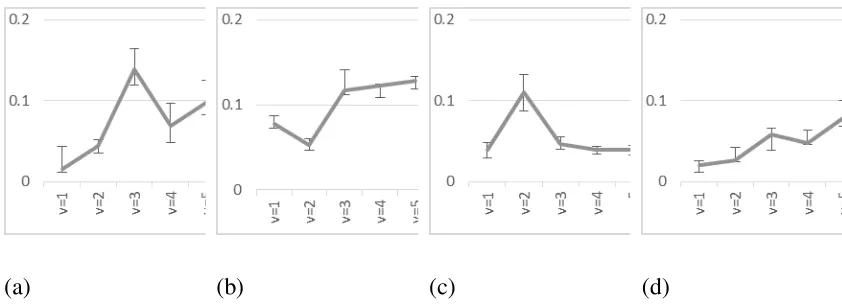
provide reasons why the coefficient departs from 1. They run different regressions to
estimate the coefficient of the fraction from data using five different levels of
6
estimates of coefficient of the fraction. Their results are summarized in panels (a) to (d)
of Figure 1, and shows a weak relationship.
A Model of Gravity with Perfect Specialization based on
Tradable/Non-tradable Product Distinction
Assume that there are three goods in world named as s, t and z. Assume that s is not
tradeable and so to be precise we should use different notation for product s of each
country. Assuming that there are two countries a and b, we call the s produced and
consumed in country a: 𝑠𝑎, and the s produced and consumed in country b: 𝑠𝑏. Either
reason of perfect specialization, namely IRS forces or H-O model forces, can be
assumed as the reason for perfect specialization in tradable goods in model. Perfect
specialization leads to each country to produce either of t or z. We assume that a is
producing t and b is producing z.
So these countries GDP’s are:
𝑌𝑎 = 𝑡 + 𝑠𝑎 (5)
𝑌𝑏 = 𝑧 + 𝑠𝑏 (6)
and so letting 𝜆's denote tradable share of GDP we have:
𝜆𝑎 =𝑌𝑡𝑎 =𝑡+𝑠𝑡𝑎 (7)
𝜆𝑏= 𝑌𝑧𝑏= 𝑧+𝑠𝑧𝑏 (8)
Supposing identical homothetic preferences, we have that each country's share in
consumption of each commodity is equal to its share of world GDP, i.e.
7
To simplify the perfect specialization model, Evenett and Keller (2002) assume that the
share of non-tradable goods in GDP is identical for all countries. We do not simplify
further as we believe that the idea of tradeable share of GDP plays a great role in
forming gravity equation and any simplification might lead to unreasonable results.
Thus our model leads in a gravity equation with a coefficient of the ratio less than 1. To
support the second criteria we shall show that the deviation of estimate of coefficient of
the ratio is related to the share of non-tradable production in GDP. To show this we take
logarithms of eq. 9 to get:
ln(𝑋𝑎𝑏) = 𝛽0+ 𝛽1ln 𝜆𝑎 + 𝛽2ln(𝑌𝑎𝑌×𝑌𝑤𝑏) + 𝜀 (10)
Which is in fact the logarithm of eq. 11:
𝑋𝑎𝑏 = 𝑒𝛽0 × 𝜆𝑎𝛽1× (𝑌𝑎𝑌×𝑌𝑤𝑏) 𝛽2
(11)
Thus 𝛽̂1 = 𝛽̂2 = 1 shows complete accordance of the model to the data. On the other
hand tradable production share in GDP is important only if 𝛽̂1 is statistically significant.
Data
World commodity trade data are gathered from UN ComTrade and UN Service Trade
data set provides the data on trade of services. National account data are from World
Development Indicators data set. 40 countries are selected that constitute a large part of
world GDP (about 90%) and world trade. Saudi Arabia and Israel are dropped because
of technical problems such as missing data. Table 2 lists the countries used for this
study. The data form a panel of 1600 (40x40) export relationship over 10 years
8
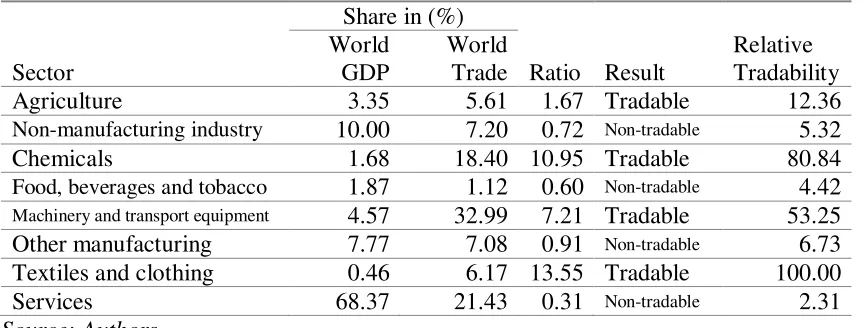
Calculating Tradable Productions Share
Model proposed in this paper is based on the tradeable production share in GDP,
so we shall provide some data on this phenomenon. However, in reality, no data are
gathered for tradability. We only observe traded goods and services, not what was
potentially tradable. We study sectors of production and compare the shares of each
sector in world production and world trade and decide if that section is tradable. For
example, agriculture constitutes about 5.61 percent of the world trade, but only 3.35
percent of world GDP, thus we can say that agriculture is tradeable. Adding up tradable
sectors, we can calculate the tradability index of each country. Even so, these
calculations are not precise because of absolute decision on tradability of sectors.
Textiles' share, as an example, is less than 0.5 percent of world GDP, yet more than 6
percent in world trade, so in fact textile is much more tradable than agriculture. So we
use relative tradability with comparing the shares with the most tradable sector
(textiles). So if 100 percent of textile is considered tradable, 81% of chemical and
12.36% of agricultural products are tradable. On the other hand, only 2.31 percent of
services (which is considered a non-tradable sector) are tradable.
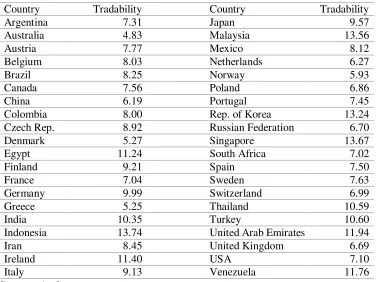
We use the data from Table 1 to calculate the tradability index for each country
in each year. Table 2 reports the average tradability index for countries of the study
from 2000 to 2009. As shown in this table, Indonesia, Singapore, Malaysia, and South
Korea had the highest indices. This means that these countries have production
structures that are able to export more. The calculated index is not based on trade data
of these countries and is only based on the production structure. Data in Table 2, is
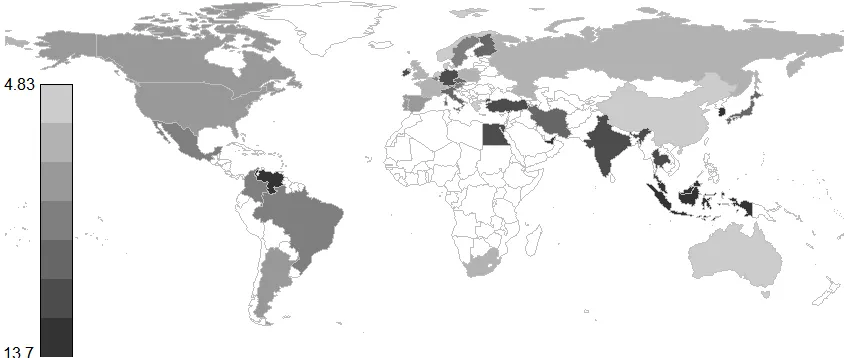
plotted on the map of the world in Figure 2.
The Results
9
panel is unbalanced by nature (not all countries have exported to all countries in every
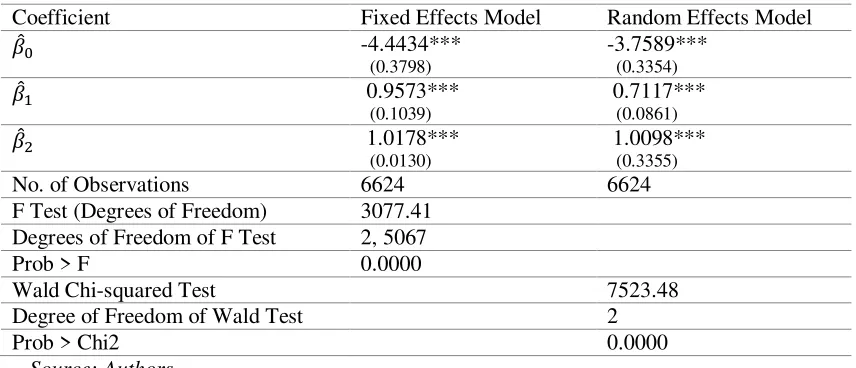
year). 6624 observations are available. We estimated the equation using both fixed
effect model and random effect model. Testing the null hypothesis that no panel effects
exits (thus recommending use of pooled estimates) is rejected. Hausman (1978) test
indicates that panel effects are fixed effects, and random effects estimations leads to
biased estimates of the equation (Baltagi 2008). Table 3 reports the results of the both
models and Hausman test results are reported in Table 4. As we can see in Table 3, both
coefficients of interest 𝛽̂1 and 𝛽̂2 are statistically not different than 1, thus the theoretic
model is supported with data. 𝛽̂2 = 1 means that the core part of the gravity equation,
i.e. that trade is positively related to the multiplication of GDP of both partners is
modelled in a way that is completely compatible with data. 𝛽̂1 = 1 means that the
tradability index is the sole reason for deviations of data from basic perfect
specialization models.
Conclusion
We provided a perfect specialization model based on the tradability phenomenon, which
does not have the problems indicated by Evenett and Keller (2002), namely that our
perfect specialization model totally explains the deviations of data from simpler perfect
specialization models without entrapment in the complexities of imperfect
specialization models (which we do not believe are doing any good in explaining the
data). Empirical evidence using estimations on panel data of bilateral trade of 40
countries over 10 years totally and fully supports the theoretical model. In the process of
providing empirical evidence, we built and reported an index of tradability, which is a
10
References
Bergstrand, J.H (1989). "The Generalized Gravity Equation, Monopolistic Competition
and the Factor-Proportions Theory in International Trade." The Review of Economics
and Statistics. 71(1): 143-153.
Bohman H, & Nilson, D. (2007) "Market Overlap and the Direction of Exports: A New
Approach of Assessing the Linder Hypothesis." Working Paper Series in Economics
and Institutions of Innovation. 86. Royal Institute of Technology.
Deardorff, A. (1998). "Determinants of Bilateral Trade: Does Gravity Work in a
Neoclassical World?", in The Regionalization of the World Economy, edited by J.A.
Frankel. Chicago: Univ. Chicago Press for National Bureau of Economic Research.
7-32.
Evenett, S. J., & Keller, W. (2002). "On Theories Explaining the Success of the Gravity
Equation." Journal of Political Economy, 110 (2): 281-361.
Feenstra, R. C., Markusen, J. A., & Rose, A. K. (1998). Understanding the home market
effect and the gravity equation: The role of differentiating goods (No. w6804). National
Bureau of Economic Research.
Hausman, J. A. (1978). "Specification tests in econometrics," Econometrica, 46(6):
1251-1271.
Helpman, E., & Krugman, P. R. (1985). Market structure and foreign trade: Increasing
returns, imperfect competition, and the international economy. MIT press.
Krugman, P. R., & Obstfeld, M. (2009). International Economics: Theory and Policy.
11
Linder S.B. (1961). An Essay on Trade and Transformations. Stockholm: Almqvist &
Wiksell.
12 Table 1: Tradability of Each Economic Sector
Sector
Share in (%)
Ratio Result
Relative Tradability World
GDP
World Trade
Agriculture 3.35 5.61 1.67 Tradable 12.36
Non-manufacturing industry 10.00 7.20 0.72 Non-tradable 5.32
Chemicals 1.68 18.40 10.95 Tradable 80.84
Food, beverages and tobacco 1.87 1.12 0.60 Non-tradable 4.42 Machinery and transport equipment 4.57 32.99 7.21 Tradable 53.25 Other manufacturing 7.77 7.08 0.91 Non-tradable 6.73 Textiles and clothing 0.46 6.17 13.55 Tradable 100.00
Services 68.37 21.43 0.31 Non-tradable 2.31
13
Table 2: Average of 2000-2009 Tradability Index for 40 Countries
Country Tradability Country Tradability
Argentina 7.31 Japan 9.57
Australia 4.83 Malaysia 13.56
Austria 7.77 Mexico 8.12
Belgium 8.03 Netherlands 6.27
Brazil 8.25 Norway 5.93
Canada 7.56 Poland 6.86
China 6.19 Portugal 7.45
Colombia 8.00 Rep. of Korea 13.24 Czech Rep. 8.92 Russian Federation 6.70
Denmark 5.27 Singapore 13.67
Egypt 11.24 South Africa 7.02
Finland 9.21 Spain 7.50
France 7.04 Sweden 7.63
Germany 9.99 Switzerland 6.99
Greece 5.25 Thailand 10.59
India 10.35 Turkey 10.60
Indonesia 13.74 United Arab Emirates 11.94 Iran 8.45 United Kingdom 6.69
Ireland 11.40 USA 7.10
Italy 9.13 Venezuela 11.76
14
Table 3: Estimating the Gravity Equation based on Imperfect Specialization Model of
Bilateral Trade; Fixed and Random Effect Models
Coefficient Fixed Effects Model Random Effects Model
𝛽̂0 -4.4434***
(0.3798)
-3.7589***
(0.3354)
𝛽̂1 0.9573***
(0.1039)
0.7117***
(0.0861)
𝛽̂2 1.0178***
(0.0130)
1.0098***
(0.3355)
No. of Observations 6624 6624 F Test (Degrees of Freedom) 3077.41
Degrees of Freedom of F Test 2, 5067 Prob > F 0.0000
Wald Chi-squared Test 7523.48
Degree of Freedom of Wald Test 2
Prob > Chi2 0.0000
15
[image:17.595.89.510.80.234.2](a) (b) (c) (d)
Figure 1. Estimates of Coefficients of Gravity Equation versus Specialization Level.
16
Figure (2) Average of 2000-2009 Tradability Index for 40 Countries
[image:18.595.84.508.71.250.2]