Proceedings of the 45th Annual Meeting of the Association of Computational Linguistics, pages 760–767,
Guided Learning for Bidirectional Sequence Classification
Libin Shen BBN Technologies Cambridge, MA 02138, USA
Giorgio Satta Dept. of Inf. Eng’g. University of Padua I-35131 Padova, Italy
Aravind K. Joshi Department of CIS University of Pennsylvania Philadelphia, PA 19104, USA
Abstract
In this paper, we propose guided learning, a new learning framework for bidirectional sequence classification. The tasks of learn-ing the order of inference and trainlearn-ing the local classifier are dynamically incorporated into a single Perceptron like learning rithm. We apply this novel learning algo-rithm to POS tagging. It obtains an error rate of 2.67% on the standard PTB test set, which represents 3.3% relative error reduction over the previous best result on the same data set, while using fewer features.
1 Introduction
Many NLP tasks can be modeled as a sequence clas-sification problem, such as POS tagging, chunking, and incremental parsing. A traditional method to solve this problem is to decompose the whole task into a set of individual tasks for each token in the in-put sequence, and solve these small tasks in a fixed order, usually from left to right. In this way, the out-put of the previous small tasks can be used as the input of the later tasks. HMM and MaxEnt Markov Model are examples of this method.
Lafferty et al. (2001) showed that this approach suffered from the so called label bias problem (Bot-tou, 1991). They proposed Conditional Random Fields (CRF) as a general solution for sequence clas-sification. CRF models a sequence as an undirected graph, which means that all the individual tasks are solved simultaneously. Taskar et al. (2003) improved the CRF method by employing the large margin method to separate the gold standard sequence
la-beling from incorrect labellings. However, the com-plexity of quadratic programming for the large mar-gin approach prevented it from being used in large scale NLP tasks.
Collins (2002) proposed a Perceptron like learn-ing algorithm to solve sequence classification in the traditional left-to-right order. This solution does not suffer from the label bias problem. Compared to the undirected methods, the Perceptron like algorithm is faster in training. In this paper, we will improve upon Collins’ algorithm by introducing a bidirec-tional searching strategy, so as to effectively utilize more context information at little extra cost.
When a bidirectional strategy is used, the main problem is how to select the order of inference. Tsu-ruoka and Tsujii (2005) proposed the easiest-first ap-proach which greatly reduced the computation com-plexity of inference while maintaining the accuracy on labeling. However, the easiest-first approach only serves as a heuristic rule. The order of inference is not incorporated into the training of the MaxEnt clas-sifier for individual labeling.
Here, we will propose a novel learning frame-work, namely guided learning, to integrate classifi-cation of individual tokens and inference order selec-tion into a single learning task. We proposed a Per-ceptron like learning algorithm (Collins and Roark, 2004; Daum´e III and Marcu, 2005) for guided learn-ing. We apply this algorithm to POS tagging, a clas-sic sequence learning problem. Our system reports an error rate of 2.67% on the standard PTB test set, a relative 3.3% error reduction of the previous best system (Toutanova et al., 2003) by using fewer fea-tures. By using deterministic search, it obtains an error rate of 2.73%, a 5.9% relative error reduction
over the previous best deterministic algorithm (Tsu-ruoka and Tsujii, 2005).
The new POS tagger is similar to (Toutanova et al., 2003; Tsuruoka and Tsujii, 2005) in the way that we employ context features. We use a bidi-rectional search strategy (Woods, 1976; Satta and Stock, 1994), and our algorithm is based on Percep-tron learning (Collins, 2002). A unique contribution of our work is on the integration of individual clas-sification and inference order selection, which are learned simultaneously.
2 Guided Learning for Bidirectional Labeling
We first present an example of POS tagging to show the idea of bidirectional labeling. Then we present the inference algorithm and the learning algorithm.
2.1 An Example of POS tagging
Suppose that we have an input sentence
Agatha found that book interesting
w1 w2 w3 w4 w5
(Step 0)
If we scan from left to right, we may find it difficult to resolve the ambiguity of the label for
that, which could be either DT (determiner), or IN (preposition or subordinating conjunction) in the Penn Treebank. However, if we resolve the labels for
bookandinteresting, it would be relatively easy to
figure out the correct label forthat.
Now, we show how bidirectional inference works on this sample. Suppose we use beam search with width of 2, and we use a window of (-2, 2) for con-text features.
For the first step, we enumerate hypotheses for each word. For example, foundcould have a label
VBN or VBD. Suppose that at this point the most favorable action, out of the candidate hypotheses, is the assignment of NN tobook, according to the
con-text features defined on words. Then, we resolve the label for book first. We maintain the top two hy-potheses as shown below. Here, the second most fa-vorable label forbookis VB.
NN VB
Agatha found that book interesting
w1 w2 w3 w4 w5
(Step 1)
At the second step, assume the most favorable ac-tion is the assignment of label JJ tointerestingin
the context of NN forbook. Then we maintain the top two hypotheses for spanbook interestingas shown below. The second most favorable label for
interestingis still JJ, but in the context of VB for book.
NN---JJ VB---JJ Agatha found that book interesting
w1 w2 w3 w4 w5
(Step 2)
Then, suppose we are most confident for assigning labels VBD and VBN tofound, in that order. We get
two separated tagged spans as shown below.
VBD NN---JJ
VBN VB---JJ
Agatha found that book interesting
w1 w2 w3 w4 w5
(Step 3)
In the next step, suppose we are most confident for assigning label DT tothatunder the context of VBD
on the left and NN-JJ on the right side, as shown below (second most favorable action, not discussed here, is also displayed). After taggingw3, two
sep-arated spans merge into one, starting fromfoundto interesting.
VBD---DT---NN---JJ VBD---IN---NN---JJ Agatha found that book interesting
w1 w2 w3 w4 w5
(Step 4)
For the last step, we assign label NNP toAgatha, which could be an out-of-vocabulary word, under the context of VBD-DT on the right.
NNP---VBD---DT---NN---JJ NNP---VBD---IN---NN---JJ Agatha found that book interesting
w1 w2 w3 w4 w5
(Step 5)
2.2 Inference Algorithm
Terminology: Let the input sequence be
w1w2· · ·wn. For each token wi, we are expected
to assign a labelti ∈T, withTthe label set. A subsequence wi· · ·wj is called a span, and is denoted [i, j]. Each span p considered by the al-gorithm is associated with one or more hypotheses, that is, sequences overThaving the same length as p. Part of the label sequence of each hypothesis is used as a context for labeling tokens outside the span p. For example, if a tri-gram model is adopted, we use the two labels on the left boundary and the two labels on the right boundary of the hypothesis for la-beling outside tokens. The left two labels are called the left interface, and the right two labels are called the right interface. Left and right interfaces have only one label in case of spans of length one.
A pair s = (Ileft, Iright) with a left and a right
interface is called a state. We partition the hypothe-ses associated with spanpinto sets compatible with the same state. In practice, for spanp, we use a ma-trixMpindexed by states, so thatMp(s),s= (Ileft,
Iright), is the set of all hypotheses associated withp
that are compatible withIleft andIright.
For a spanpand a states, we denote the associated top hypothesis as
s.T = argmax
h∈Mp(s) V(h),
whereV is the score of a hypothesis (defined in (1) below). Similarly, we denote the top state forpas
p.S= argmax
s:Mp(s)6=∅
V(s.T).
Therefore, for each spanp, we have a top hypothe-sisp.S.T, whose score is the highest among all the hypotheses for spanp.
Hypotheses are started and grown by means of labeling actions. For each hypothesis h associated with a spanp we maintain its most recent labeling actionh.A, involving some token withinp, as well as the statesh.SL andh.SRthat have been used as context by such an action, if any. Note thath.SLand h.SRrefer to spans that are subsequences ofp. We recursively compute the score ofhas
V(h) =V(h.SL.T) +V(h.SR.T) +U(h.A), (1)
Algorithm 1 Inference Algorithm Require: token sequencew1· · ·wn;
Require: beam widthB;
Require: weight vectorw;
1: InitializeP, the set of accepted spans;
2: InitializeQ, the queue of candidate spans;
3: repeat
4: spanp0 ←argmaxp∈QU(p.S.T.A);
5: UpdateP withp0;
6: UpdateQwithp0andP;
7: until (Q=∅)
whereU is the score of an action. In other words, the score of an hypothesis is the sum of the score of the most recent actionh.A and the scores of the top hypotheses of the context states. The score of an actionh.Ais computed through a linear function whose weight vector isw, as
U(h.A) =w·f(h.A), (2)
where f(h.A) is the feature vector of action h.A, which depends onh.SLandh.SR.
Algorithm: Algorithm 1 is the inference algorithm.
We are given the input sequence and two parame-ters, beam widthBto determine the number of states maintained for each span, and weight vectorwused to compute the score of an action.
We first initialize the setPof accepted spans with the empty set. Then we initialize the queue Q of candidate spans with span [i, i] for each token wi, and for eacht∈Tassigned towiwe set
M[i,i]((t, t)) ={i→t},
wherei→ trepresents the hypothesis consisting of a single action which assigns labelttowi. This pro-vides the set of starting hypotheses.
As for the example Agatha found that book interestingin the previous subsection, we have
• P =∅
• Q={[1,1],[2,2],[3,3],[4,4],[5,5]}
Suppose NN and VB are the two possible POS tags forw4book. We have
• M[4,4](NN, NN) ={h441= 4→NN}
• M[4,4](VB, VB) ={h442= 4→VB}
The most recent action of hypothesis h441 is to
of this actionU(h441.A)depends on the features
de-fined on the local context of action. For example,
f1001(h441.A) =
1 ift=NN∧w−1=that 0 otherwise,
where w−1 represents the left word. It should be noted that, for all the features depending on the neighboring tags, the value is always 0, since those tags are still unknown in the step of initialization. Since this operation does not depend on solved tags, we haveV(h441) =U(h411.A),according to
Equa-tion (1).
The core of the algorithm repeatedly selects a can-didate span fromQ, and uses it to updateP andQ, until a span covering the whole sequence is added to P andQbecomes empty. This is explained in detail below.
At each step, we remove fromQthe spanp0such that the action (not hypothesis) score of its top hy-pothesis,p0.S.T, is the highest. This represents the labeling action for the next move that we are most confident about. Now we need to update P andQ with the selected span p0. We add p0 toP, and re-move from P the spans included inp0, if any. Let
S be the set of removed spans. We remove fromQ each span which takes one of the spans inSas con-text, and replace it with a new candidate span taking p0(and another accepted span) as context. We always maintainB different states for each span.
Back to the previous example, after Step 3 is com-pleted, w2 found, w4 book and w5 interesting
have been tagged and we have
• P ={[2,2],[4,5]} • Q={[1,2],[2,5]}
There are two candidate spans inQ, each with its as-sociated hypotheses and most recent actions. More specifically, we can either solvew1based on the
con-text hypotheses for[2,2], resulting in span[1,2], or else solve w3 based on the context hypotheses in [2,2]and[4,5], resulting in span[2,5].
The top two states for span[2,2]are
• M[2,2](VBD, VBD) ={h221= 2→VBD}
• M[2,2](VBN, VBN) ={h222= 2→VBN}
and the top two states for span[4,5]are
• M[4,5](NN-JJ, NN-JJ)
={h451= (NN,NN)5→JJ}
• M[4,5](VB-JJ, VB-JJ)
={h452= (VB,VB)5→JJ}
Here (NN,NN)5 → JJ represents the hypothesis coming from the action of assigning JJ tow5 under
the left context state of (NN,NN).(VB,VB)5 → JJ has a similar meaning.1
We first compute the hypotheses resulting from all possible POS tag assignments tow3, under all
possi-ble state combinations of the neighboring spans[2,2]
and[4,5]. Suppose the highest score action consists in the assignment of DT under the left context state (VBD, VBD) and the right context state (JJ, NN-JJ). We obtain hypothesish251 = (VBD,VBD)3 →
DT(NN-JJ, NN-JJ)with
V(h251) = V((VBD,VBD).T) +
V((NN-JJ,NN-JJ).T) +U(h251.A)
= V(h221) +V(h451) +w·f(h251.A)
Here, features for action h251.A may depend on
the left tag VBD and right tags NN-JJ, which have been solved before. More details of the feature func-tions are given in Section 4.2. For example, we can have features like
f2002(h251.A) =
1 ift=DT∧t+2 =JJ
0 otherwise,
We maintain the top two states with the highest hypothesis scores, if the beam width is set to two. We have
• M[2,5](VBD-DT, NN-JJ) = {h251 = (VBD,VBD)3→DT(NN-JJ,NN-JJ)}
• M[2,5](VBD-IN, NN-JJ) = {h252 = (VBD,VBD)3→IN(NN-JJ,NN-JJ)}
Similarly, we compute the top hypotheses and states for span [1,2]. Suppose now the hypothesis with the highest action score ish251. Then we
up-datePby adding[2,5]and removing[2,2]and[4,5], which are covered by[2,5]. We also updateQby re-moving[2,5]and[1,2],2and add new candidate span
[1,5]resulting in
• P ={[2,5]} • Q={[1,5]}
1
It should be noted that, in these cases, each state con-tains only one hypothesis. However, if the span is longer than 4 words, there may exist multiple hypotheses for the same state. For example, hypotheses NN-VBD-JJ and DT-NN-VBN-DT-JJ have the same left interface DT-NN and right interface DT-JJ.
2Span[1,2]depends on[2,2]and[2,2]has been removed
The algorithm is especially designed in such a way that, at each step, some new span is added toP or else some spans already present in P are extended by some token(s). Furthermore, no pair of overlap-ping spans is ever found in P, and the number of pairs of overlapping spans that may be found inQis always bounded by a constant. This means that the algorithm performs at mostniterations, and its run-ning time is thereforeO(B2n), that is, linear in the length of the input sequence.
2.3 Learning Algorithm
In this section, we propose guided learning, a Per-ceptron like algorithm, to learn the weight vectorw, as shown in Algorithm 2. We usep0.G to represent the gold standard hypothesis on spanp0.
For each input sequenceXrand the gold standard sequence of labelingYr, we first initializeP andQ as in the inference algorithm. Then we select the span for the next move as in Algorithm 1. Ifp0.S.T, the top hypothesis of the selected span p0, is com-patible with the gold standard, we updateP andQ as in Algorithm 1. Otherwise, we update the weight vector in the Perceptron style, by promoting the fea-tures of the gold standard action, and demoting the features of the action of the top hypothesis. Then we re-generate the queueQwithP and the updated weight vectorw. Specifically, we first remove all the elements inQ, and then generate hypotheses for all the possible spans based on the context spans inP. Hypothesis scores and action scores are calculated with the updated weight vectorw.
A special aspect of Algorithm 2 is that we main-tain two scores: the score of the action represents the confidence for the next move, and the score of the hypothesis represents the overall quality of a partial result. The selection for the next action directly de-pends on the score of the action, but not on the score of the hypothesis. On the other hand, the score of the hypothesis is used to maintain top partial results for each span.
We briefly describe the soundness of the Guided Learning Algorithm in terms of two aspects. First, in Algorithm 2 weight update is activated whenever there exists an incorrect states, the action score of whose top hypothesiss.T is higher than that of any state in each span. We demote this action and pro-mote the gold standard action on the same span.
Algorithm 2 Guided Learning Algorithm
Require: training sequence pairs{(Xr, Yr)}1≤r≤R; Require: beam widthB and iterationsI;
1: w←0;
2: for (i←1;i≤I;i++) do
3: for (r←1;r≤R;r++) do
4: Load sequenceXrand gold labelingYr.
5: InitializeP, the set of accepted spans
6: InitializeQ, the queue of candidate spans;
7: repeat
8: p0 ←argmaxp∈QU(p.S.T.A);
9: if (p0.S.T =p0.G) then
10: UpdateP withp0;
11: UpdateQwithp0andP;
12: else
13: promote(w,f(p0.G.A));
14: demote(w,f(p0.S.T.A));
15: Re-generateQwithwandP;
16: end if
17: until (Q=∅)
18: end for
19: end for
However, we do not automatically adopt the gold standard action on this span. Instead, in the next step, the top hypothesis of another span might be se-lected based on the score of action, which means that it becomes the most favorable action according to the updated weights.
As a second aspect, if the action score of a gold standard hypothesis is higher than that of any oth-ers, this hypothesis and the corresponding span are guaranteed to be selected at line 8 of Algorithm 2. The reason for this is that the scores of the context hypotheses of a gold standard hypothesis must be no less than those of other hypotheses of the same span. This could be shown recursively with respect to Equation 1, because the context hypotheses of a gold standard hypothesis are also compatible with the gold standard.
Furthermore, if we take
(xi=f(p0.G.A)−f(p0.S.T.A), yi = +1)
as a positive sample, and
(xj =f(p0.S.T.A)−f(p0.G.A), yj =−1)
and 14 are a stochastic approximation of gradient de-scent that minimizes the squared errors of the mis-classified samples (Widrow and Hoff, 1960). What is special with our learning algorithm is the strategy used to select samples for training.
In general, this novel learning framework lies be-tween supervised learning and reinforcement learn-ing. Guided learning is more difficult than super-vised learning, because we do not know the order of inference. The order is learned automatically, and partial output is in turn used to train the local clas-sifier. Therefore, the order of inference and the lo-cal classification are dynamilo-cally incorporated in the learning phase.
Guided learning is not as hard as reinforcement learning. At each local step in learning, we always know the undesirable labeling actions according to the gold standard, although we do not know which is the most desirable. In this approach, we can eas-ily collect the automatically generated negative ples, and use them in learning. These negative sam-ples are exactly those we will face during inference with the current weight vector.
In our experiments, we have used Averaged Per-ceptron (Collins, 2002; Freund and Schapire, 1999) and Perceptron with margin (Krauth and M´ezard, 1987) to improve performance.
3 Related Works
Tsuruoka and Tsujii (2005) proposed a bidirectional POS tagger, in which the order of inference is han-dled with the easiest-first heuristic. Gim´enez and M`arquez (2004) combined the results of a left-to-right scan and a left-to-right-to-left scan. In our model, the order of inference is dynamically incorporated into the training of the local classifier.
Toutanova et al. (2003) reported a POS tagger based on cyclic dependency network. In their work, the order of inference is fixed as from left to right. In this approach, large beam width is required to main-tain the ambiguous hypotheses. In our approach, we can handle tokens that we are most confident about first, so that our system does not need a large beam. As shown in Section 4.2, even deterministic infer-ence shows rather good results.
Our guided learning can be modeled as a search algorithm with Perceptron like learning (Daum´e III and Marcu, 2005). However, as far as we know,
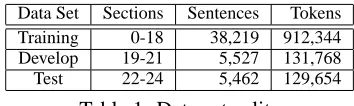
Data Set Sections Sentences Tokens
Training 0-18 38,219 912,344
Develop 19-21 5,527 131,768
[image:6.612.335.512.70.123.2]Test 22-24 5,462 129,654
Table 1: Data set splits
the mechanism of bidirectional search with an on-line learning algorithm has not been investigated be-fore. In (Daum´e III and Marcu, 2005), as well as other similar works (Collins, 2002; Collins and Roark, 2004; Shen and Joshi, 2005), only left-to-right search was employed. Our guided learning al-gorithm provides more flexibility in search with an automatically learned order. In addition, our treat-ment of the score of action and the score of hypoth-esis is unique (see discussion in Section 2.3).
Furthermore, compared to the above works, our guided learning algorithm is more aggressive on learning. In (Collins and Roark, 2004; Shen and Joshi, 2005), a search stops if there is no hypothe-sis compatible with the gold standard in the queue of candidates. In (Daum´e III and Marcu, 2005), the search is resumed after some gold standard compat-ible hypotheses are inserted into a queue for future expansion, and the weights are updated correspond-ingly. However, there is no guarantee that the up-dated weights assign a higher score to those inserted gold standard compatible hypotheses. In our algo-rithm, the gold standard compatible hypotheses are used for weight update only. As a result, after each sentence is processed, the weight vector can usually successfully predict the gold standard parse. There-fore our learning algorithm is aggressive on weight update.
As far as this aspect is concerned, our algorithm is similar to the MIRA algorithm in (Crammer and Singer, 2003). In MIRA, one always knows the cor-rect hypothesis. In our case, we do not know the correct order of operations. So we use our form of weight update to implement aggressive learning.
4 Experiments on POS Tagging
4.1 Settings
Feature Sets Templates Error%
A Ratnaparkhi’s 3.05
B A +[t0, t1],[t0, t−1, t1],[t0, t1, t2] 2.92
C B + [t0, t−2],[t0, t2],[t0, t−2, w0],[t0, t−1, w0],[t0, t1, w0],
[t0, t2, w0],[t0, t−2, t−1, w0],[t0, t−1, t1, w0],[t0, t1, t2, w0]
2.84
D C +[t0, w−1, w0],[t0, w1, w0] 2.78
E D +[t0, X=prefix or suffix ofw0],4<|X| ≤9 2.72
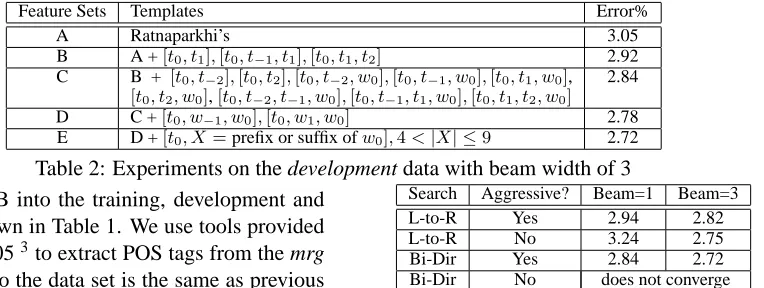
Table 2: Experiments on the development data with beam width of 3 we cut the PTB into the training, development and
test sets as shown in Table 1. We use tools provided by CoNLL-20053to extract POS tags from the mrg files of PTB. So the data set is the same as previous work. We use the development set to select features and estimate the number of iterations in training. In our experiments, we enumerate all the POS tags for each word instead of using a dictionary as in (Ratna-parkhi, 1996), since the size of the tag set is tractable and our learning algorithm is efficient enough.
4.2 Results
Effect of Features: We first run the experiments to
evaluate the effect of features. We use templates to define features. For this set of experiments, we set the beam widthB = 3 as a balance between speed and accuracy. The guided learning algorithm usually converges on the development data set in 4-8 itera-tions over the training data.
Table 2 shows the error rate on the development set with different features. We first use the same fea-ture set used in (Ratnaparkhi, 1996), which includes a set of prefix, suffix and lexical features, as well as some bi-gram and tri-gram context features. Fol-lowing (Collins, 2002), we do not distinguish rare words. On set A, Ratnaparkhi’s feature set, our sys-tem reports an error rate of 3.05% on the develop-ment data set.
With set B, we include a few feature templates which are symmetric to those in Ratnaparkhi’s set, but are only available with bidirectional search. With set C, we add more bi-gram and tri-gram features. With set D, we include bi-lexical features. With set E, we use prefixes and suffixes of length up to 9, as in (Toutanova et al., 2003; Tsuruoka and Tsujii, 2005). We obtain 2.72% of error rate. We will use this fea-ture set on our final experiments on the test data.
Effect of Search and Learning Strategies: For the
second set of experiments, we evaluate the effect of
3
http://www.lsi.upc.es/˜srlconll/soft.html, package srlconll-1.1.tgz.
Search Aggressive? Beam=1 Beam=3
L-to-R Yes 2.94 2.82
L-to-R No 3.24 2.75
Bi-Dir Yes 2.84 2.72
[image:7.612.138.520.71.215.2]Bi-Dir No does not converge
Table 3: Experiments on the development data
search methods, learning strategies, and beam width. We use feature set E for this set of experiments. Ta-ble 3 shows the error rates on the development data set with both left-to-right (L-to-R) and bidirectional (Bi-Dir) search methods. We also tested both aggres-sive learning and non-aggresaggres-sive learning strategies with beam width of 1 and 3.
First, with non-aggressive learning on bidirec-tional search, the error rate does not converge to a comparable number. This is due to the fact that the search space is too large in bidirectional search, if we do not use aggressive learning to constrain the samples for learning.
With aggressive learning, the bidirectional ap-proach always shows advantages over left-to-right search. However, the gap is not large. This is due to the fact that the accuracy of POS tagging is very high. As a result, we can always keep the gold-standard tags in the beam even with left-to-right search in training.
This can also explain why the performance of left-to-right search with non-aggressive learning is close to bidirectional search if the beam is large enough. However, with beam width = 1, non-aggressive learning over left-to-right search performs much worse, because in this case it is more likely that the gold-standard tag is not in the beam.
This set of experiments show that guided learn-ing is more preferable for tasks with higher ambi-guities. In our recent work (Shen and Joshi, 2007), we have applied a variant of this algorithm to depen-dency parsing, and showed significant improvement over left-to-right non-aggressive learning strategy.
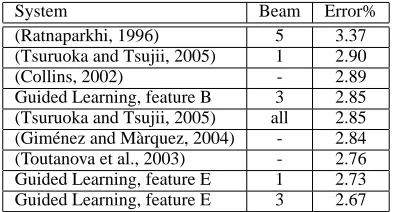
Comparison: Table 4 shows the comparison with
System Beam Error%
(Ratnaparkhi, 1996) 5 3.37
(Tsuruoka and Tsujii, 2005) 1 2.90
(Collins, 2002) - 2.89
Guided Learning, feature B 3 2.85
(Tsuruoka and Tsujii, 2005) all 2.85 (Gim´enez and M`arquez, 2004) - 2.84
(Toutanova et al., 2003) - 2.76
Guided Learning, feature E 1 2.73
[image:8.612.87.285.71.177.2]Guided Learning, feature E 3 2.67
Table 4: Comparison with the previous works
According to the experiments shown above, we build our best system by using feature set E with beam width B = 3. The number of iterations on the training data is estimated with respect to the de-velopment data. We obtain an error rate of 2.67% on the test data. With deterministic search, or beam withB = 1, we obtain an error rate of 2.73%.
Compared to previous best result on the same data set, 2.76% by (Toutanova et al., 2003), our best re-sult shows a relative error reduction of 3.3%. This result is very promising, since we have not used any specially designed features in our experiments. It is reported in (Toutanova et al., 2003) that a crude com-pany name detector was used to generate features, and it gave rise to significant improvement in per-formance. However, it is difficult for us to duplicate exactly the same feature for the purpose of compari-son, although it is convenient to use features like that in our framework.
5 Conclusions
In this paper, we propose guided learning, a new learning framework for bidirectional sequence clas-sification. The tasks of learning the order of infer-ence and training the local classifier are dynamically incorporated into a single Perceptron like algorithm. We apply this novel algorithm to POS tagging. It obtains an error rate of 2.67% on the standard PTB test set, which represents 3.3% relative error reduc-tion over the previous best result (Toutanova et al., 2003) on the same data set, while using fewer fea-tures. By using deterministic search, it obtains an error rate of 2.73%, a 5.9% relative error reduction over the previous best deterministic algorithm (Tsu-ruoka and Tsujii, 2005). It should be noted that the error rate is close to the inter-annotator discrepancy on PTB, the standard test set for POS tagging, there-fore it is very difficult to achieve improvement.
References
L. Bottou. 1991. Une approche th´eorique de l’apprentissage
connexionniste: Applications `a la reconnaissance de la pa-role. Ph.D. thesis, Universit´e de Paris XI.
M. Collins and B. Roark. 2004. Incremental parsing with the perceptron algorithm. In ACL-2004.
M. Collins. 2002. Discriminative training methods for hidden markov models: Theory and experiments with perceptron al-gorithms. In EMNLP-2002.
K. Crammer and Y. Singer. 2003. Ultraconservative online algorithms for multiclass problems. Journal of Machine Learning Research, 3:951–991.
H. Daum´e III and D. Marcu. 2005. Learning as search opti-mization: Approximate large margin methods for structured prediction. In ICML-2005.
Y. Freund and R. E. Schapire. 1999. Large margin classifi-cation using the perceptron algorithm. Machine Learning, 37(3):277–296.
J. Gim´enez and L. M`arquez. 2004. Svmtool: A general pos tag-ger generator based on support vector machines. In
LREC-2004.
W. Krauth and M. M´ezard. 1987. Learning algorithms with optimal stability in neural networks. Journal of Physics A, 20:745–752.
J. Lafferty, A. McCallum, and F. Pereira. 2001. Conditional random fields: Probabilistic models for segmentation and la-beling sequence data. In ICML-2001.
M. P. Marcus, B. Santorini, and M. A. Marcinkiewicz. 1994. Building a large annotated corpus of English: The Penn Tree-bank. Computational Linguistics, 19(2):313–330.
A. Ratnaparkhi. 1996. A maximum entropy part-of-speech tag-ger. In EMNLP-1996.
G. Satta and O. Stock. 1994. Bi-Directional Context-Free Grammar Parsing for Natural Language Processing.
Artifi-cial Intelligence, 69(1-2).
L. Shen and A. K. Joshi. 2005. Incremental LTAG Parsing. In
EMNLP-2005.
L. Shen and A. K. Joshi. 2007. Bidirectional LTAG Depen-dency Parsing. Technical Report 07-02, IRCS, UPenn.
B. Taskar, C. Guestrin, and D. Koller. 2003. Max-margin markov networks. In NIPS-2003.
K. Toutanova, D. Klein, C. Manning, and Y. Singer. 2003. Feature-rich part-of-speech tagging with a cyclic dependency network. In NAACL-2003.
Y. Tsuruoka and J. Tsujii. 2005. Bidirectional inference with the easiest-first strategy for tagging sequence data. In
EMNLP-2005.
B. Widrow and M. E. Hoff. 1960. Adaptive switching circuits.
IRE WESCON Convention Record, part 4.